
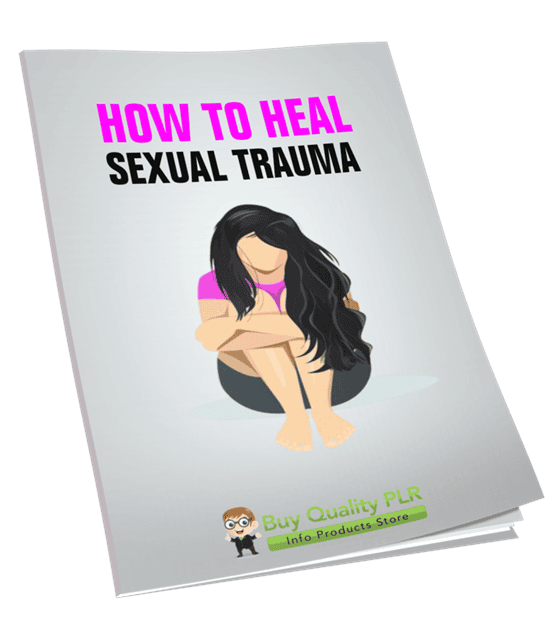
How To Heal Sexual Trauma PLR Course 23k Words
in Healing PLR , PLR eCourses , PLR List Building Reports , Premium PLR , Premium PLR Reports , Premium White Label Brandable PLR Coaching Courses , Self Esteem PLR , Self Help PLR , Wellness PLRChoose Your Desired Option(s)
has been added to your cart!
have been added to your cart!
#healsexualtrauma #plrcourse #traumahealing #mentalwellness #emotionalhealing #selfrecovery #plrcontent #wellnessmarketing #personalgrowthting #personalgrowth
How To Heal Sexual Trauma PLR Course – 23,000 Words
A Gentle, Supportive Path Toward Reclaiming Peace, Safety, and Self-Love
Sexual trauma leaves deep emotional, mental, and physical imprints, often affecting self-esteem, relationships, and overall wellbeing. Healing can feel overwhelming—but it doesn’t have to be.
The How To Heal Sexual Trauma PLR Course is a 23,000-word compassionate training program designed to guide learners through a safe, structured journey of recovery. This course provides practical tools, empowering strategies, and emotional support for anyone who wants to reclaim trust, confidence, and inner peace.
Whether your audience is survivors, therapists, coaches, or wellness educators, this ready-to-use PLR course offers actionable content they can use immediately—or package as a premium product.
Introducing the…
How To Heal Sexual Trauma
Why Healing Sexual Trauma Matters
Sexual trauma is more common than most realize, yet many survivors suffer in silence. Healing is not just about “getting over it”—it’s about reclaiming life on your terms.
This course empowers learners to:
- Recognize and understand trauma responses.
- Create emotional and physical safety.
- Reconnect with feelings and self-compassion.
- Rebuild trust in their body and boundaries.
- Move forward with resilience, hope, and strength.
By offering this course through your platform, you provide an essential resource that can change lives while also monetizing a high-demand, sensitive topic responsibly and ethically.
Course Overview: Your Guided Healing Journey
The course is carefully structured into five modules, each gently guiding learners through emotional, mental, and practical strategies for healing.
Module 1: Understanding Sexual Trauma
Objective: Establish a foundation of understanding and awareness of sexual trauma.
- Step 1: What Is Sexual Trauma?
Learn what sexual trauma entails, its common occurrences, and how it impacts emotional and physical wellbeing. - Step 2: How Trauma Affects the Brain and Body
Understand the science behind trauma responses—why triggers, flashbacks, or emotional numbness happen. - Step 3: Recognizing the Signs of Trauma in Your Life
Identify patterns like hypervigilance, guilt, avoidance, and people-pleasing that may indicate unresolved trauma. - Step 4: Why Acknowledging Trauma Matters
Learn why gently naming and facing trauma is the first courageous step toward healing.
Module 2: Creating Safety in Your Body and Mind
Objective: Build a safe internal and external environment to support recovery.
- Step 1: Building a Safety Plan for Yourself
Create boundaries, routines, and practices that foster control, comfort, and emotional security. - Step 2: Grounding Techniques for Overwhelm
Practice simple tools—deep breathing, 5-4-3-2-1 grounding, and safe-place visualizations—to calm the nervous system. - Step 3: Understanding Triggers and Flashbacks
Learn how to identify triggers, manage flashbacks, and gently return to the present. - Step 4: Creating a Safe Inner Dialogue
Begin speaking to yourself with compassion instead of judgment or shame.
Module 3: Reconnecting with Your Emotions
Objective: Guide learners to embrace, process, and release emotions safely.
- Step 1: Allowing Yourself to Feel Without Fear
Teach that all emotions are valid and that feeling them is part of healing, not a sign of weakness. - Step 2: Naming What You Feel
Use tools like the Feelings Wheel to articulate emotions and express them clearly. - Step 3: Processing Grief, Anger, and Shame
Explore journaling, movement, or therapeutic practices to release deeper emotions safely. - Step 4: Practicing Self-Compassion Daily
Implement daily rituals and habits that nurture self-love and kindness, even during difficult days.
Module 4: Reclaiming Your Body and Boundaries
Objective: Rebuild trust in your body, your autonomy, and your relationships.
- Step 1: Rebuilding Trust in Your Body
Learn to listen to physical cues, sensations, and intuition without fear or self-judgment. - Step 2: Exploring Touch and Consent at Your Own Pace
Discover safe ways to experience touch and practice consent, starting with yourself and gradually with others. - Step 3: Setting Boundaries Without Guilt
Develop confidence in saying no (or yes), expressing limits, and protecting emotional energy. - Step 4: Feeling Empowered in Your Physical Space
Create small daily practices that enhance control and comfort in your environment, schedule, and relationships.
Module 5: Moving Forward with Hope and Strength
Objective: Equip learners with tools to continue healing, maintain resilience, and envision a joyful future.
- Step 1: Creating a Personal Healing Toolkit
Assemble calming practices, self-care rituals, and supportive resources for ongoing healing. - Step 2: Seeking Support When You’re Ready
Learn how therapy, support groups, or trusted friends can provide guidance at the right time. - Step 3: Celebrating Your Progress
Recognize and honor achievements, no matter how small, reinforcing motivation and self-worth. - Step 4: Designing a Future That Feels Good to You
Envision and take actionable steps toward healthy relationships, self-expression, and personal joy.
Final Words of Support
Healing from sexual trauma is not linear. There will be difficult days, moments of hope, and periods of reflection. This course serves as a gentle, structured guide, but the learner is the hero of their own journey. They are never alone.
Bonus Materials Included
This PLR package includes ready-to-use resources that add tremendous value:
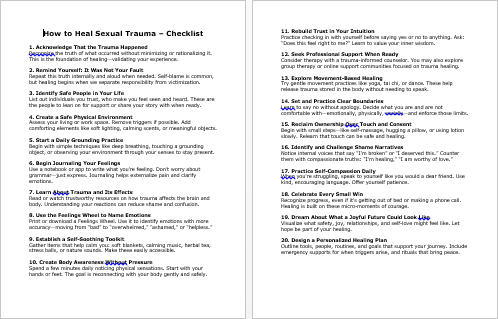
- How To Heal Sexual Trauma – Checklist (564 Words)
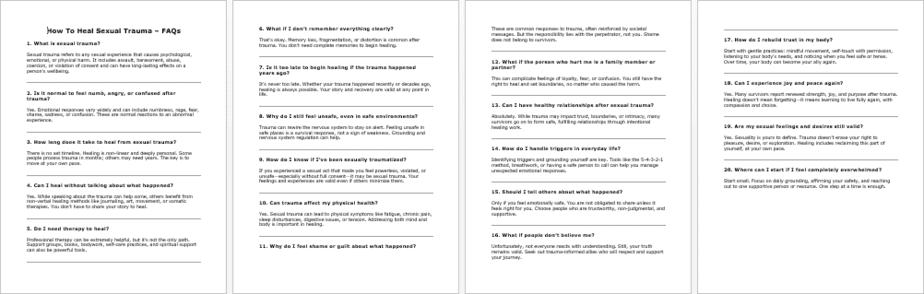
A practical step-by-step tool for implementing lessons immediately. - How To Heal Sexual Trauma – FAQs (732 Words)
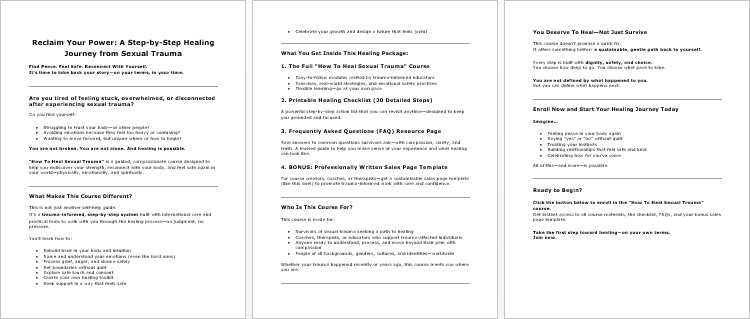
Answers to the most common questions about trauma recovery, emotional processing, and support systems. - How To Heal Sexual Trauma – Salespage (575 Words)
A professionally written template ready for marketing and conversion.
Who Can Benefit From This PLR Course?
This course is perfect for:
- Mental health professionals and trauma-informed coaches
- Wellness educators and therapists
- Bloggers, influencers, and content creators in self-care, trauma, and mental health niches
- Support groups, nonprofits, or programs focused on women’s and survivor support
- Anyone looking to offer a structured, safe, and compassionate resource
With PLR rights, this content can be rebranded, sold, or repurposed to provide both value and revenue.
Ways to Monetize and Profit from This Course
The How To Heal Sexual Trauma PLR Course is versatile and monetizable in multiple ways:
1. Sell the Course As-Is
Minor edits and branding make it ready to market as a complete digital course.
2. Create a Multi-Week eClass
Package as a 4–6 week guided course with modules released weekly for $297–$497.
3. Break Into Smaller Reports or Guides
Offer individual modules or steps for $10–$20 each, making content accessible to a wider audience.
4. Bundle With Other Wellness or Trauma Courses
Combine with related PLR products to create premium packages for $47–$97.
5. Membership Site Content
Deliver modules weekly or monthly to generate recurring revenue.
6. Convert to Audio or Video Content
Host webinars, guided audio sessions, or workshops based on the material.
7. Physical Products
Turn modules into journals, workbooks, or self-care planners for premium pricing.
8. Lead Magnets
Use excerpts to grow email lists, attract clients, or offer as free resources.
9. Build & Flip a Business Brand
Create a site focused on trauma support and wellness, then sell it as a ready-made online business.
Licensing Terms: What You Can and Cannot Do
You CAN:
- Sell the course with minor branding edits
- Rewrite 75%+ and claim copyright
- Break the course into smaller guides, modules, or reports
- Bundle with other PLR products
- Convert content to audio, video, or membership materials
- Use excerpts for blogs, lead magnets, or free resources
- Build a business around the content
You CANNOT:
- Pass PLR or resale rights to customers
- Offer 100% affiliate commissions (max 75%)
- Give away the full course for free
- Add the course to an existing paid package without an additional purchase
Why Buy Quality PLR?
When you purchase from Buy Quality PLR, you get:
- Professionally written, high-value content
- A ready-to-sell, turnkey PLR course
- Bonus materials for fast implementation
- Ethical, compassionate content in a growing niche
- Flexible formats for digital, audio, video, or physical products
The Bottom Line
Healing sexual trauma is a journey—but with the How To Heal Sexual Trauma PLR Course, your audience or clients gain:
- Compassionate guidance to process trauma safely
- Tools to reclaim safety, self-trust, and self-love
- Structured strategies to rebuild boundaries and resilience
- Support for creating a hopeful, empowered future
This complete, plug-and-play PLR package is a powerful, high-demand resource for anyone in the mental health, wellness, or trauma-support space.
Take the First Step Today!
Available now at Buy Quality PLR – provide your audience with a safe, structured path to healing while monetizing a high-value course.
Support healing. Empower survivors. Build a profitable course.
has been added to your cart!
have been added to your cart!
Here A Sample of the How To Heal Sexual Trauma PLR Course
This course is designed with compassion and care, offering you a safe and structured space to begin (or continue) your healing journey from sexual trauma. Whether you’re taking your very first step or you’re already on your path, this course will help you build emotional resilience, rediscover self-trust, and move toward lasting inner peace.
Module 1: Understanding Sexual Trauma
Let’s start by gently exploring what trauma is and how it affects your mind, body, and emotions.
Step 1: What Is Sexual Trauma?
Learn what sexual trauma is, how it may occur, and the common emotional, mental, and physical responses people experience after such trauma.
Course Instructions for Step 1: “What Is Sexual Trauma?”
This foundational step is designed to help participants clearly understand what sexual trauma means in a global context. As course creators, your objective is to guide learners with compassion, clarity, and sensitivity. The approach should be trauma-informed, culturally respectful, and supportive of diverse experiences across different countries, legal systems, and belief systems.
Learning Objectives for Step 1:
By the end of this step, participants should be able to:
- Define sexual trauma in accessible and inclusive terms.
- Understand the wide range of experiences that fall under sexual trauma.
- Recognize the short-term and long-term impacts on mental, emotional, and physical health.
- Begin to validate and normalize their own responses to trauma.
Step-by-Step Teaching Instructions:
1. Define Sexual Trauma in Simple, Inclusive Terms
Instruction: Begin with a clear and neutral definition of sexual trauma. Explain that sexual trauma refers to any sexual act or experience that was unwanted, forced, coerced, manipulated, or experienced without full, informed, and freely given consent. Highlight that trauma is not defined solely by the event itself, but by the impact it has on the individual.
Talking Points:
- Sexual trauma can include physical acts (e.g., sexual assault, rape), non-contact abuse (e.g., sexual harassment, exploitation), or psychological coercion.
- It may occur in childhood or adulthood, in personal relationships, or within systems of power (such as schools, workplaces, or religious institutions).
- Cultural differences in how consent and sexual boundaries are discussed must be acknowledged without minimizing harm.
- An individual does not need to have a clear memory or verbal account of the experience for it to be real or valid.
Example Phrase to Use:
“Sexual trauma refers to a violation of a person’s sexual autonomy and safety, often resulting in lasting psychological, emotional, or physical distress.”
2. Explain How Sexual Trauma Can Occur in Different Contexts
Instruction: Explore the many ways in which sexual trauma may happen. Make it clear that trauma can result from a single event or ongoing exposure. Emphasize that perpetrators can be strangers or trusted individuals and that power dynamics often play a significant role.
Situations to Cover:
- Sexual abuse by a family member or authority figure
- Rape or sexual assault by a stranger or acquaintance
- Sexual harassment in the workplace or public spaces
- Being pressured or manipulated into sexual activity
- Sexual violence during conflict or war
- Human trafficking or exploitation
Facilitation Tip: Use inclusive language (e.g., “individual” instead of “woman”) to recognize that people of all genders can experience sexual trauma.
Cultural Sensitivity Reminder: In international settings, it’s important to clarify that the definition of consent should be based on human rights standards, even if cultural or legal norms differ.
3. Identify the Common Emotional, Mental, and Physical Responses
Instruction: Teach learners that trauma affects the brain, nervous system, and body in complex ways. Help participants recognize their responses as normal reactions to abnormal events—not signs of weakness, failure, or “being broken.”
Break this down into three key areas:
A. Mental Responses:
- Intrusive memories or flashbacks
- Difficulty concentrating or making decisions
- Dissociation (feeling detached from body or surroundings)
- Nightmares or sleeping difficulties
- Memory gaps related to the traumatic event
B. Emotional Responses:
- Shock, fear, anger, sadness, guilt, or shame
- Feeling emotionally numb or disconnected
- Low self-esteem or loss of identity
- Difficulty trusting others or oneself
- Mood swings, panic attacks, or depression
C. Physical Responses:
- Chronic pain, headaches, or digestive issues
- Fatigue or sudden bursts of energy
- Increased startle response or hypervigilance
- Avoidance of physical touch or intimacy
- Stress-related conditions such as autoimmune symptoms
Important Note: Remind learners that not all trauma symptoms appear immediately. Some may show up weeks, months, or even years later, often in the form of emotional challenges or relational difficulties.
4. Normalize and Validate the Impact of Sexual Trauma
Instruction: Close the step by reminding learners that their feelings, responses, and survival mechanisms are valid. Explain that everyone’s healing journey looks different, and there is no “correct” timeline or method.
Affirmations to Introduce:
- “Your trauma is real—even if others dismissed it.”
- “Your body remembers what your mind might try to forget.”
- “You are not at fault for what happened to you.”
- “There is no shame in struggling. Healing takes time, and you deserve support.”
Encourage a Supportive Tone:
Course creators should reinforce a message of non-judgment, patience, and empowerment. If your course includes group interaction, offer clear guidelines to ensure respectful, confidential, and supportive communication.
Instructor Notes:
- Avoid graphic details that may re-trigger participants.
- Use closed captions, transcripts, and translations to ensure accessibility.
- Encourage participants to take breaks and go at their own pace.
- Provide helpline resources and trauma-informed therapy directories where possible.
- Use international trauma terms and frameworks (e.g., WHO definitions, UN Women reports) to ground your instruction in global best practices.
Conclusion of Step 1:
By the end of this step, participants should begin to understand that sexual trauma is not defined by the specifics of the event, but by the impact it has on the person. They will begin to see their reactions not as signs of weakness or damage—but as survival responses to violation, pain, and fear. This understanding lays the groundwork for safety, healing, and empowerment in the steps ahead.
Step 2: How Trauma Affects the Brain and Body
Understand the science of trauma: how your brain and nervous system react to threat, and why you may feel stuck, triggered, or emotionally numb.
Course Instructions for Step 2: “How Trauma Affects the Brain and Body”
This step introduces learners to the neuroscience of trauma, helping them understand that many of their emotional and physical responses are not personality flaws or failures—but biologically driven survival mechanisms. This awareness is essential to reduce shame, increase self-compassion, and lay the foundation for healing.
As international course creators, your job is to present this information in clear, trauma-informed, culturally sensitive, and non-clinical language that respects the diversity of learners worldwide. Use global science-backed frameworks such as Polyvagal Theory, Somatic Psychology, and the World Health Organization’s (WHO) understanding of trauma.
Learning Objectives for Step 2:
By the end of this step, participants should be able to:
- Describe how the brain processes threats and traumatic events.
- Understand the roles of the amygdala, hippocampus, and prefrontal cortex in trauma.
- Explain how the nervous system responds to trauma through fight, flight, freeze, or fawn responses.
- Recognize how trauma can cause emotional numbing, hypervigilance, physical symptoms, and a sense of being “stuck.”
Step-by-Step Teaching Instructions:
1. The Brain’s Response to Threat: Survival First
Instruction: Introduce the brain’s primary job: survival. When a person experiences trauma—especially sexual trauma—the brain reacts as if it’s in immediate danger, triggering protective responses.
Key Concepts:
- The brain is constantly scanning for threats through a system called neuroception.
- Trauma shifts the brain from a calm, thinking mode to a survival mode.
- This shift is automatic, not voluntary.
Explain the roles of three key brain regions:
- Amygdala (the alarm system): Detects threats and triggers a fear response. In trauma, it becomes overactive.
- Hippocampus (the memory processor): Helps make sense of time and context. Trauma can shrink its function, making memories feel like they’re happening now instead of the past.
- Prefrontal Cortex (the rational brain): Involved in logic, decision-making, and impulse control. Trauma temporarily shuts this down, which is why it can be hard to think clearly or speak during or after a traumatic event.
Instructor Tip: Use simple visual aids or metaphors like “the smoke alarm goes off,” “the brain’s filing cabinet shuts down,” or “your inner fire alarm gets stuck in the ON position.”
2. The Body’s Survival Responses: Fight, Flight, Freeze, and Fawn
Instruction: Teach learners that trauma responses are not choices. They are instinctive reactions from the autonomic nervous system, designed to protect the body from perceived harm.
Break down the 4 survival responses:
- Fight: The body prepares to defend itself (e.g., clenched fists, rage, yelling).
- Flight: The urge to run away or avoid (e.g., restlessness, anxiety, panic).
- Freeze: The body shuts down or becomes immobilized (e.g., feeling numb, dissociating, unable to move or speak).
- Fawn: A people-pleasing response to avoid further harm (e.g., complying, apologizing, minimizing one’s own pain to stay safe).
Make it clear:
- These are survival mechanisms, not signs of weakness or character flaws.
- Trauma responses may persist long after the threat is gone because the nervous system remains dysregulated.
Cultural Note: In some cultures, the “fawn” response is socially reinforced, especially among women or children raised to be obedient or deferential. Discuss this with cultural sensitivity.
3. The Long-Term Effects on the Nervous System and Body
Instruction: Help learners understand that trauma is stored not only in the mind but in the body. The nervous system may become stuck in a heightened or collapsed state, even when life is no longer threatening.
Two dominant states post-trauma:
- Hyperarousal (sympathetic dominance):
- Signs: anxiety, racing heart, hypervigilance, irritability, sleep issues.
- Feels like: “always on edge,” “unable to relax.”
- Hypoarousal (parasympathetic collapse):
- Signs: fatigue, disconnection, numbness, shutdown, memory problems.
- Feels like: “I feel nothing,” “I can’t move,” “I’m invisible.”
Physical Symptoms:
- Digestive issues, chronic pain, migraines, reproductive health concerns
- Hormonal imbalances (cortisol, adrenaline)
- Compromised immune function
Science Note: Refer to Polyvagal Theory (developed by Dr. Stephen Porges) to explain how the vagus nerve plays a central role in regulating trauma responses, especially freeze and shutdown.
4. Understanding Why You May Feel Stuck, Triggered, or Numb
Instruction: Teach learners that feeling emotionally “frozen,” “stuck in the past,” or “triggered by small things” is often a direct result of how trauma alters brain wiring and nervous system functioning.
Explain:
- Triggers: Sensory reminders (a smell, a tone of voice, a location) can unconsciously activate the trauma response—even if no current danger exists.
- Emotional Numbing: The body may block out emotions as a protective mechanism. This can lead to feeling disconnected from joy, love, and purpose—not just pain.
- Feeling Stuck: When trauma is unresolved, the nervous system doesn’t complete its natural cycle of safety and release. This creates a sense of “looping” or being frozen in time.
Clarification for Learners:
- These responses are common and explainable.
- They are not a sign that someone is weak, crazy, or permanently broken.
- Healing begins by understanding and compassionately working with your nervous system, not against it.
Instructor Notes:
- Use plain English and avoid medical jargon unless your audience is clinical.
- Provide somatic check-in exercises if appropriate (e.g., grounding techniques, body scans) to help learners notice their own nervous system states.
- Remind learners to pause, breathe, and take breaks as needed during this section—especially if the material feels intense or activating.
- Encourage journaling to reflect on where they notice fight/flight/freeze/fawn responses in their life.
- Always offer access to professional support resources for participants who may feel overwhelmed.
Conclusion of Step 2:
Understanding the science of trauma gives learners a powerful message: Your responses are not who you are—they are what your body did to protect you. By recognizing how trauma affects the brain and body, learners can begin to feel less ashamed and more empowered. This step creates a bridge from intellectual awareness to embodied healing, encouraging curiosity, self-compassion, and a deeper connection to the healing process.
Step 3: Recognizing the Signs of Trauma in Your Life
Identify emotional, behavioral, and physical patterns that could be trauma responses—such as people-pleasing, avoidance, hypervigilance, or chronic guilt.
Course Objective:
The goal of this step is to help learners begin noticing how trauma shows up in their everyday life—in their choices, habits, thoughts, emotions, and even in their physical health. This stage is not about judgment or labeling; it is about building self-awareness and recognizing patterns shaped by past experiences.
As an international course creator, your approach should remain compassionate, inclusive, and non-pathologizing, especially for learners from diverse cultures who may not have had access to trauma education or mental health language.
Learning Outcomes:
By the end of this step, participants will:
- Be able to name common trauma response patterns in thoughts, emotions, behaviors, and body sensations.
- Understand that many coping mechanisms are adaptations to past pain, not personal flaws.
- Begin observing their own triggers, patterns, and default responses with curiosity instead of shame.
- Recognize the importance of compassion and patience in their self-awareness journey.
Step-by-Step Teaching Instructions:
1. Start with Compassionate Awareness: “Nothing is Wrong with You”
Instruction: Begin by framing this session around curiosity, not criticism. Let learners know that trauma often hides in plain sight, and most people are unaware of how it has shaped their inner world.
Talking Points:
- You may have developed certain emotional or behavioral patterns as a way to feel safe or avoid pain.
- These responses are often unconscious and automatic.
- Becoming aware of them is the first empowering step toward healing—not a reason for self-blame.
Suggested Activity: Ask learners to reflect on this prompt:
“What habits or emotional reactions do I have that I don’t fully understand?”
Encourage journaling or silent reflection before moving into specific signs.
2. Recognizing Emotional Signs of Trauma
Instruction: Guide learners through the emotional markers that often indicate unresolved trauma.
Common Emotional Indicators:
- Chronic guilt or shame: Feeling responsible for things beyond your control, or believing you’re inherently “bad” or “too much.”
- Emotional numbness: Feeling detached from your own feelings, relationships, or environment.
- Low self-worth: Struggling to believe you’re lovable, deserving, or valuable.
- Difficulty trusting: Keeping others at a distance or assuming people will harm or betray you.
- Intense emotional reactions: Overreacting to small issues or being emotionally flooded by seemingly minor events.
Instructional Notes:
- Normalize these feelings—explain that they are protective mechanisms developed in unsafe environments.
- Avoid pathologizing language like “dysfunction”; instead, speak in terms of coping and survival.
Teaching Tip: Use metaphors like “emotional calluses” or “emotional armor” to explain how these feelings formed over time.
3. Spotting Behavioral Patterns that Signal Trauma Responses
Instruction: Help learners explore their actions and behaviors as messengers, not mistakes. Many trauma-formed behaviors are strategies that once helped the person survive, even if they are now limiting.
Key Behavioral Signs:
- People-pleasing or fawning: Prioritizing others’ needs to avoid conflict or abandonment, even at your own expense.
- Avoidance or numbing: Distracting yourself from emotions with work, substances, scrolling, sleep, or food.
- Control-seeking: Trying to plan, organize, or micromanage everything as a way to reduce uncertainty or anxiety.
- Self-isolation: Withdrawing from others due to fear of rejection, shame, or feeling like a burden.
- Overachievement or perfectionism: Trying to earn love or safety by being flawless or overly productive.
Practical Exercise:
Invite learners to do a “behavioral self-scan” over the past week:
- When did I say “yes” when I meant “no”?
- What did I avoid, and why?
- What behaviors helped me feel safe—even if they didn’t serve me?
Encourage compassionate reflection, not judgment.
4. Understanding Physical and Somatic Clues of Trauma
Instruction: Explain that trauma often lives in the body, and many physical symptoms or patterns are trauma’s way of asking for attention and care.
Common Physical and Somatic Symptoms:
- Tension and tightness: Especially in the jaw, shoulders, stomach, or chest.
- Digestive issues: IBS, nausea, loss of appetite, or emotional eating.
- Chronic fatigue: Constant exhaustion despite adequate sleep.
- Sleep disturbances: Difficulty falling asleep, nightmares, or waking frequently.
- Hypervigilance: Feeling “on edge,” startled easily, difficulty relaxing.
- Numbness or disconnection: Feeling like you’re “floating” or not fully present in your body.
Instructor Guidance:
- Emphasize that these are not “all in your head”—the body keeps a memory of what the mind may forget.
- Avoid giving medical advice. Always advise learners to consult a healthcare professional if physical symptoms are severe or worsening.
Somatic Awareness Exercise (Optional):
Guide learners to:
- Sit or lie comfortably.
- Close their eyes (if safe).
- Bring gentle attention to how their body feels, one area at a time.
- Ask: Where am I holding tension? What emotions live there?
Encourage them to notice without trying to fix or change anything.
Final Discussion and Integration:
Wrap up by revisiting the central theme:
These patterns are not personal failures—they are survival responses.
Encourage learners to:
- Approach every realization with self-compassion.
- Celebrate every moment of awareness as a small but powerful step forward.
- Take note of any signs that particularly stood out to them.
- Recognize that the goal is not to eliminate responses, but to understand them—and eventually choose healthier ways to cope.
Instructor Note:
Invite learners to create a simple list or journal entry titled:
“My Trauma Responses Are… My Safety Mechanisms Were…”
This reframe helps reduce shame and opens the door to healing.
Conclusion of Step 3:
Recognizing trauma signs in daily life helps learners reclaim their narrative. Instead of feeling confused or ashamed by their emotional, behavioral, or physical responses, they begin to understand:
“This makes sense. My body and mind did what they had to do to protect me.”
This clarity builds self-trust and lays the groundwork for gentle transformation in the next stages of healing.
We’re also giving these extra bonuses
How To Heal Sexual Trauma – Checklist
How To Heal Sexual Trauma – FAQs
How To Heal Sexual Trauma – Salespage Content
Package Details:
Word Count: 21 488 Words
Number of Pages: 109
How to Build Multiple Streams of Income – Bonus Content
Checklist
Word Count: 564 words
FAQs
Word Count: 732 words
Salespage Content
Word Count: 575 words
Total Word Count: 23 359 Words
Your PLR License Terms
PERMISSIONS: What Can You Do With These Materials?
Sell the content basically as it is (with some minor tweaks to make it “yours”).
If you are going to claim copyright to anything created with this content, then you must substantially change at 75% of the content to distinguish yourself from other licensees.
Break up the content into small portions to sell as individual reports for $10-$20 each.
Bundle the content with other existing content to create larger products for $47-$97 each.
Setup your own membership site with the content and generate monthly residual payments!
Take the content and convert it into a multiple-week “eclass” that you charge $297-$497 to access!
Use the content to create a “physical” product that you sell for premium prices!
Convert it to audios, videos, membership site content and more.
Excerpt and / or edit portions of the content to give away for free as blog posts, reports, etc. to use as lead magnets, incentives and more!
Create your own original product from it, set it up at a site and “flip” the site for megabucks!
RESTRICTIONS: What Can’t You Do With These Materials?
To protect the value of these products, you may not pass on the rights to your customers. This means that your customers may not have PLR rights or reprint / resell rights passed on to them.
You may not pass on any kind of licensing (PLR, reprint / resell, etc.) to ANY offer created from ANY PORTION OF this content that would allow additional people to sell or give away any portion of the content contained in this package.
You may not offer 100% commission to affiliates selling your version / copy of this product. The maximum affiliate commission you may pay out for offers created that include parts of this content is 75%.
You are not permitted to give the complete materials away in their current state for free – they must be sold. They must be excerpted and / or edited to be given away, unless otherwise noted. Example: You ARE permitted to excerpt portions of content for blog posts, lead magnets, etc.
You may not add this content to any part of an existing customer order that would not require them to make an additional purchase. (IE You cannot add it to a package, membership site, etc. that customers have ALREADY paid for.)
Share Now!
Latest Products





Free Sales Funnel Builder

Related Products

Popular & Trending



Featured Products