
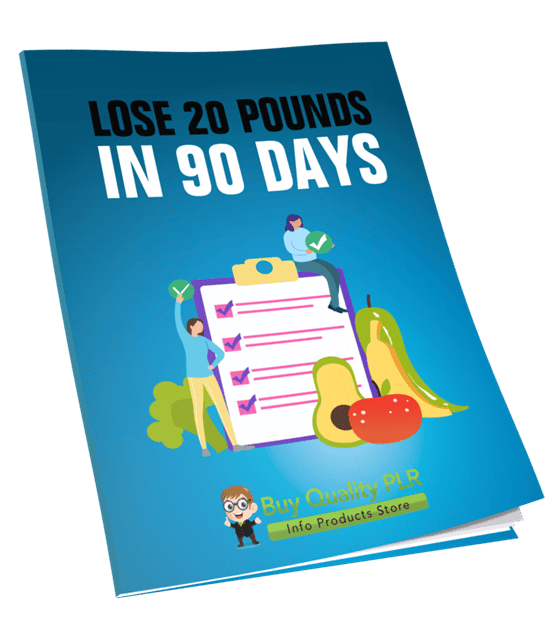
Lose 20 Pounds in 90 Days PLR Course 34k Words
in Health PLR , PLR eCourses , PLR List Building Reports , Premium PLR , Premium PLR Reports , Premium White Label Brandable PLR Coaching Courses , Private Label Rights Products , Weight Loss PLRChoose Your Desired Option(s)
has been added to your cart!
have been added to your cart!
#weightlossjourney #plrcourse #lose20pounds #healthylifestyle #fitnessgoals #wellnessmarketing #plrcontent #nutritiontips #bodytransformation
Lose 20 Pounds in 90 Days PLR Course – Your Step-by-Step Roadmap to a Healthier, Leaner You
Are you ready to transform your body, boost your energy, and feel confident in just 90 days?
The Lose 20 Pounds in 90 Days PLR Course is a science-backed, step-by-step program designed to help anyone shed weight safely, effectively, and sustainably. With 34,000 words of actionable guidance, this course provides everything needed to teach, sell, or repurpose a complete weight loss solution.
Whether you’re a health coach, fitness blogger, PLR reseller, or entrepreneur, this course gives you ready-to-use content to help your audience achieve real results—without gimmicks, crash diets, or unsustainable fads.
Introducing the…
Lose 20 Pounds in 90 Days
Why This Course Stands Out
Weight loss can be confusing. Most programs focus on extreme dieting, intense workouts, or quick fixes—and leave people frustrated and burned out.
Lose 20 Pounds in 90 Days is different because it’s:
- Science-Backed: Rooted in metabolism, hormones, nutrition, and exercise physiology.
- Step-by-Step: Easy to follow, with clear lessons and practical guidance.
- Sustainable: Designed for long-term success, turning weight loss into a healthy lifestyle.
- Comprehensive: Covers nutrition, exercise, habits, mindset, and accountability.
- Action-Oriented: Each module includes strategies you can implement immediately.
With this course, students will not only lose weight but develop habits that last a lifetime.
What You Get in the Lose 20 Pounds in 90 Days PLR Course
The course is organized into five comprehensive modules, each designed to guide your audience through a complete transformation.
Module 1: Understanding the Science of Weight Loss
Goal: Build a strong foundation so you know exactly how weight loss works.
- Lesson 1: The Energy Equation
Calories in vs. calories out—understand how food and activity impact fat loss. - Lesson 2: How Your Body Burns Energy
Learn how metabolism, resting energy, and activity levels influence results. - Lesson 3: The Role of Macronutrients
Protein, carbs, and fats—discover how each affects hunger, energy, and fat burning. - Lesson 4: The Hormone Connection
Understand how hormones like insulin, cortisol, and leptin regulate appetite and weight.
Outcome: Students will understand the mechanics of fat loss, setting them up for success.
Module 2: Building Your 90-Day Nutrition Blueprint
Goal: Create a practical, science-based eating plan for consistent fat loss.
- Lesson 1: Calculating Your Calorie Needs
Step-by-step guidance to determine your ideal calorie intake for safe weight loss. - Lesson 2: Meal Planning Made Easy
Learn how to balance protein, fiber, and healthy fats for every meal. - Lesson 3: Smart Food Choices
Swap high-calorie foods for nutrient-rich options without feeling deprived. - Lesson 4: Tackling Cravings & Emotional Eating
Strategies to manage cravings, control emotional eating, and stay consistent.
Outcome: Students will have a customized nutrition blueprint that supports steady, sustainable weight loss.
Module 3: Science-Backed Exercise for Fat Loss
Goal: Maximize calorie burn and preserve lean muscle through smart movement.
- Lesson 1: Why Exercise Matters (Beyond Calories)
Learn how physical activity boosts metabolism, hormones, and overall health. - Lesson 2: Strength Training Simplified
Build lean muscle that accelerates fat loss with simple, effective routines. - Lesson 3: Cardio That Works
Discover the best type of cardio for fat loss—steady-state, HIIT, or a mix. - Lesson 4: Building Your 90-Day Workout Plan
Combine strength, cardio, and recovery into a manageable, sustainable weekly schedule.
Outcome: Students will move confidently, burn fat efficiently, and maintain muscle while losing weight.
Module 4: Lifestyle Habits That Accelerate Weight Loss
Goal: Implement the daily habits that support long-term results.
- Lesson 1: The Power of Sleep
Learn why quality sleep is critical for fat loss, energy, and hormone balance. - Lesson 2: Stress and Weight Gain
Discover how chronic stress hinders results and strategies to manage it effectively. - Lesson 3: Hydration & Its Hidden Benefits
Drink your way to better metabolism, appetite control, and energy. - Lesson 4: Tracking & Accountability
Use journals, apps, and progress tracking to stay consistent and motivated.
Outcome: Students will optimize lifestyle factors that enhance fat loss and improve overall well-being.
Module 5: Staying Consistent & Making It a Lifestyle
Goal: Turn a 90-day plan into a lifelong transformation.
- Lesson 1: Breaking Plateaus
Learn how to adjust your plan when weight loss stalls. - Lesson 2: Social Situations & Eating Out
Practical strategies to stay on track without feeling left out. - Lesson 3: Building Long-Term Healthy Habits
Shift from “dieting” to a sustainable, enjoyable lifestyle. - Lesson 4: Celebrating Your Success & Next Steps
Learn how to measure success beyond the scale and continue improving.
Outcome: Students will develop lifelong habits, maintain their results, and build a healthier future.
Bonus Materials Included
- Lose 20 Pounds in 90 Days – Checklist (591 Words)
Quick reference to implement key strategies immediately. - Lose 20 Pounds in 90 Days – FAQs (892 Words)
Answers to the most common questions about nutrition, exercise, and mindset. - Lose 20 Pounds in 90 Days – Salespage (761 Words)
Ready-made sales copy to promote or sell the course instantly.
Who Can Benefit from This PLR Course
- Fitness Coaches & Personal Trainers: Offer structured programs for clients.
- Health Bloggers & Entrepreneurs: Use content to grow email lists or create premium courses.
- PLR Buyers & Resellers: Sell the course as-is or repurpose for multiple formats.
- Individuals Seeking Weight Loss: Gain a complete, science-backed roadmap to lose weight safely.
Ways to Use and Profit from This PLR Course
- Sell as a Full Course – Charge $297–$497 for online programs or coaching.
- Break into Reports or Guides – Sell smaller sections individually for $10–$20 each.
- Bundle with Other Fitness PLR Products – Create premium packages for $47–$97.
- Develop Multi-Week E-Classes – Teach a 4–12 week program using the content.
- Add to a Membership Site – Generate recurring income with exclusive access.
- Convert into Physical Products – Workbooks, meal planners, or fitness journals.
- Use for Lead Magnets – Give away excerpts to attract subscribers or clients.
- Flip a Niche Site – Build a health-focused website and sell it for profit.
Licensing Terms
Permissions:
- Sell as-is or with minor edits.
- Claim copyright if 75%+ is rewritten.
- Break into smaller guides or lessons for sale.
- Bundle with other PLR content for upsells.
Restrictions:
- Cannot pass PLR rights to customers.
- Maximum affiliate commission: 75%.
- Cannot give full course away for free.
- Cannot include in existing orders without additional purchase.
Why Buy from Buy Quality PLR
- 34,000 Words of Ready-to-Use Content – Save time and effort creating your course.
- Step-by-Step, Science-Based Program – Perfect for beginners and intermediates.
- Action-Oriented & Practical – Students can start seeing results immediately.
- Bonus Checklist, FAQs, and Salespage – Everything you need for marketing and delivery.
- PLR Licensing – Brand, sell, or teach with confidence.
- Multiple Profit Opportunities – E-courses, reports, bundles, memberships, and more.
Bottom Line
The Lose 20 Pounds in 90 Days PLR Course is a complete, ready-to-use weight loss solution for anyone looking to transform their body, health, and lifestyle.
Whether you’re selling, teaching, or repurposing content, this course gives you everything you need to deliver value, attract customers, and generate multiple income streams.
✅ Instant Access | Fully Editable | Science-Backed | Actionable | Profitable PLR
Take the first step to help others lose weight, gain confidence, and live healthier lives. Your 90-day transformation program starts now!
has been added to your cart!
have been added to your cart!
Here A Sample of the Lose 20 Pounds in 90 Days PLR Course
Module 1: Understanding the Science of Weight Loss
Before you start your journey, let’s make sure you understand how weight loss really works.
Lesson 1: The Energy Equation
Audience: international course creators (teachers, coaches, elearning authors)
Tone: friendly, clear, step-by-step, science-focused — ready to drop into a lesson plan or script.
Opening (Why this lesson matters)
Start by telling learners this simple, evidence-based truth: weight change is governed by an energy balance. If energy intake (food and drink) consistently exceeds energy expenditure (what the body uses), weight increases. If expenditure consistently exceeds intake, weight decreases. This lesson unpacks what “energy” means, how to measure it, and how to teach students to estimate realistic, safe calorie targets.
Learning objectives
By the end of this lesson learners will be able to:
- Define energy in the context of human metabolism using international units (kcal and kJ).
- Describe the components of total daily energy expenditure (TDEE): BMR/RMR, TEF, NEAT, and activity energy.
- Calculate rough calorie needs using standard formulas and convert units (kg ↔ lb, kcal ↔ kJ).
- Estimate the daily caloric deficit required to reach a specific weight-loss target and explain safety considerations.
Step 1 — Define the units: calories and kilojoules
Explain the two common energy units learners will meet on labels and studies.
- 1 kilocalorie = 1 kcal. This is often referred to simply as a “calorie” in everyday language.
- 1 kilocalorie (kcal) = 4.184 kilojoules (kJ).
- International signs to use in your materials: kcal, kJ, kg, lb, g, %.
Example statement you can read aloud to students:
“Food energy is reported as kcal or kJ. To convert, multiply kcal by 4.184 to get kJ; divide kJ by 4.184 to get kcal.”
Step 2 — Energy per macronutrient (quick reference)
Give learners a short chart to memorize or keep in their handouts:
- Protein: 4 kcal/g ≈ 16.7 kJ/g.
- Carbohydrate: 4 kcal/g ≈ 16.7 kJ/g.
- Fat: 9 kcal/g ≈ 37.7 kJ/g.
- Alcohol: 7 kcal/g ≈ 29.3 kJ/g.
Explain that these numbers are gross energy; the body’s usable energy varies slightly (thermic effect and digestion), but these figures are what diet planning commonly uses.
Step 3 — Break down energy out: components of TDEE
Teach TDEE as the sum of several measurable parts:
- Basal Metabolic Rate (BMR) / Resting Metabolic Rate (RMR) — energy used at complete rest to maintain life (organs, breathing, circulation). This is typically the largest component: roughly 60–75% of TDEE for many people.
- Thermic Effect of Food (TEF) — energy used to digest, absorb, and store food (≈ 5–15% of intake; protein has a higher TEF).
- Physical Activity Energy Expenditure (PAEE) — exercise sessions (structured training).
- Non-Exercise Activity Thermogenesis (NEAT) — energy from fidgeting, standing, walking, daily chores; highly variable and important for long-term weight change.
Use a simple pie chart on a slide to show approximate proportions — learners worldwide will grasp it quickly.
Step 4 — Estimating BMR: the Mifflin–St Jeor formula (for teaching)
Provide a practical formula teachers can show on slides and worksheets.
For adults:
- Men: BMR = 10 × weight(kg) + 6.25 × height(cm) − 5 × age + 5
- Women: BMR = 10 × weight(kg) + 6.25 × height(cm) − 5 × age − 161
Include conversion reminders:
- 1 lb = 0.45359237 kg
- 1 inch = 2.54 cm
Example (step-by-step arithmetic):
Estimate BMR for a 35-year-old woman, weight 80 kg, height 165 cm.
- 10 × 80 = 800
- 6.25 × 165 = 1,031.25
- 5 × 35 = 175
- Sum: 800 + 1,031.25 − 175 − 161 = 1,495.25 kcal/day
Display each arithmetic line-by-line so learners see the process. Emphasize this is an estimate; direct measurement (calorimetry) is possible but not necessary for routine course work.
Step 5 — Convert BMR into TDEE with an activity factor
Show activity multipliers commonly used in education:
- Sedentary: × 1.2
- Lightly active: × 1.375
- Moderately active: × 1.55
- Very active: × 1.725
- Extra active: × 1.9
Using the example above (BMR = 1,495 kcal), if this woman is moderately active:
- TDEE = 1,495 × 1.55 = 2,317.25 kcal/day.
Again, show the multiplication step so instructors can demonstrate the math.
Step 6 — The energy deficit: calculate how many kcal you must subtract to lose weight
Teach the commonly used conversions and do a worked example that matches the course goal context (an international explanation):
Two useful approximations:
- 1 pound ≈ 3,500 kcal.
- 1 kilogram ≈ 7,700 kcal.
Worked example — target: lose 20 pounds in 90 days
- Convert 20 lb to kcal using the pound rule:
- 20 × 3,500 = 70,000 kcal total deficit required.
- Divide by total days:
- 70,000 ÷ 90 = 777.78 kcal/day deficit (≈ 778 kcal/day).
Show the same idea in metric:
- Convert 20 lb to kg: 20 × 0.45359237 = 9.0718474 kg.
- Convert mass to kcal: 9.0718474 × 7,700 = 69,853.22498 kcal total.
- Daily deficit: 69,853.22498 ÷ 90 = 776.15 kcal/day (≈ 776 kcal/day).
Explain clearly: both approximations give similar answers — roughly a 770–780 kcal daily deficit sustained for 90 days. Emphasize that this is an approximation and that real-world weight loss is not perfectly linear because of water shifts, glycogen, and metabolic adaptation.
Step 7 — Safety and practical limits (teach this firmly)
Tell your learners these important safety points to teach any audience:
- A ~770–780 kcal/day deficit is quite large for many people. For safety, most guidelines recommend not dropping below ~1,200 kcal/day for adult women or ~1,500 kcal/day for adult men without medical supervision. Exact safe minimums vary by individual.
- A common safe rate of loss is ~0.5–1.0 kg (≈1.1–2.2 lb) per week for many people. Faster loss often includes water and lean tissue, and may be unsustainable.
- Always advise students to consult a healthcare professional if they have chronic medical conditions, are taking medications, pregnant, breastfeeding, or are older adults.
Make this a clear slide or handout item — risk communication is essential for international audiences with differing norms.
Step 8 — Teaching activities you can run in class or online
Provide step-by-step activities:
- Live calculator demo (10 minutes): Instructor projects the Mifflin–St Jeor calculation with one volunteer’s anonymized numbers. Show conversions and the activity multiplier.
- Pair activity (15 minutes): Learners work in pairs to estimate their own BMR and TDEE. Each pair records the calculations step-by-step and discusses which activity multiplier fits.
- Group discussion (10 minutes): Discuss limitations of the 3,500 kcal → 1 lb rule and examples of non-linear weight change (e.g., initial rapid loss due to glycogen/water).
- Homework assignment: Each learner computes a realistic daily calorie target for a 0.5–1.0 kg/week loss and writes a short paragraph explaining why their target is safe and how they will preserve lean mass (protein + strength training).
Provide worksheet templates that include spaces for each arithmetic step, unit conversions, and a short reflective section.
Step 9 — Common misconceptions to address (short scripts)
Give instructors short rebuttals to myths:
- Myth: “A calorie is just a calorie.” — Script: “Calories are a unit of energy, but how the body processes food differs: protein has a higher thermic effect, fiber affects satiety, and NEAT varies across people. Energy balance remains the core driver of weight change.”
- Myth: “If I burn 300 kcal in a workout, I can eat anything.” — Script: “Exercise is important but compensatory eating or reduced NEAT often offsets exercise energy. Use TDEE as the baseline, then plan exercise calories intentionally.”
Step 10 — Assessment ideas
Include short formative checks:
- Multiple-choice: Which component most affects daily energy expenditure? (Answer: BMR/RMR.)
- Short calculation: Given BMR = 1,680 kcal and activity factor 1.375, what is TDEE? (1,680 × 1.375 = 2,310 kcal) — show working.
- Practical task: Calculate the daily deficit needed to lose 5 kg in 12 weeks using the 7,700 kcal/kg rule; include step-by-step arithmetic.
Closing lines for the lesson (what learners should take away)
Conclude with a concise teaching line to read out:
“Energy balance—calories in versus calories out—is the foundational concept. Accurate estimates, transparent arithmetic, and safety limits are the tools we use to build effective, science-backed weight-loss programs. Teach the math, teach the limitations, and teach for sustainability.”
This lesson script and materials give international course creators everything needed to teach “The Energy Equation” so learners understand the math, the units, the physiology, and the practical safety considerations. If you want, I can convert the arithmetic steps into printable worksheets or slide-ready bullets formatted for different regions (metric-first or imperial-first).
Lesson 2: How Your Body Burns Energy
Audience: international course creators (teachers, coaches, e-learning authors)
Tone: friendly, step-by-step, science-focused — ready to drop into a lesson plan or script.
Units / international signs used: kcal, kJ, kg, lb, g, %.
Opening (set the scene)
Begin by telling learners: “If the previous lesson explained the ‘what’ (calories in vs. calories out), this lesson explains the ‘how’. We will explore the mechanisms that determine how the body converts food into usable energy and how different kinds of activity change that process. Understanding metabolism, resting energy, and activity-driven energy helps your students design safe, effective fat-loss programs.”
Use a simple metaphor for an international audience: the human body is an engine. Fuel (food) enters the tank; the engine’s idle setting (resting metabolism) and how much you rev it (movement, exercise, fidgeting) determine how fast fuel is burned.
Learning objectives
By the end of this lesson learners will be able to:
- Explain metabolism and the difference between basal/resting energy and activity energy.
- Describe the main routes of energy expenditure: resting metabolic rate, thermic effect of food, exercise, NEAT, and short-term post-exercise effects.
- Estimate activity energy using METs and show step-by-step arithmetic for real examples.
- Teach practical strategies that safely increase daily energy expenditure (without promoting extreme caloric restriction).
Step 1 — Define “metabolism” clearly
Offer a concise definition early:
“Metabolism is the set of chemical processes by which the body converts food into energy and uses that energy to maintain life and drive activity. When we talk about ‘metabolism’ in weight loss, we usually mean the rate at which the body burns energy.”
Give learners three quick subcategories to remember:
- Catabolic processes (breakdown of molecules to release energy).
- Anabolic processes (building tissues; consume energy).
- Regulatory processes (hormonal, neural control that modulates energy flow).
Step 2 — Resting energy: BMR and RMR
Explain the difference and importance.
- Basal Metabolic Rate (BMR): Energy the body uses at true biological rest in a thermoneutral environment (measured under strict laboratory conditions).
- Resting Metabolic Rate (RMR): Practical field approximation of BMR; measured under less strict conditions and the value most instructors use for everyday calculations.
Emphasize that RMR/BMR typically accounts for ≈ 60–75% of total daily energy expenditure (TDEE) for many adults: organs, breathing, circulation, cell maintenance.
Provide a worked example your trainees can show in class. Step-by-step arithmetic (show each line):
Example: 30-year-old man, weight 90 kg, height 180 cm, using Mifflin–St Jeor (men):
- 10 × weight(kg) = 10 × 90 = 900
- 6.25 × height(cm) = 6.25 × 180 = 1,125
- 5 × age = 5 × 30 = 150
- BMR = 900 + 1,125 − 150 + 5 = 1,880 kcal/day
Turn this into a slide: show each arithmetic line and the final BMR = 1,880 kcal/day.
Step 3 — Other components of daily energy burn
Teach these components with rough % ranges so international learners can contextualize numbers:
- Thermic Effect of Food (TEF) — energy to digest and store food. Usually ≈ 5–15% of daily intake; protein has the highest TEF.
- Physical Activity Energy Expenditure (PAEE) — structured exercise sessions (weight training, running). Highly variable.
- Non-Exercise Activity Thermogenesis (NEAT) — day-to-day movement: walking, standing, fidgeting, chores. NEAT is extremely variable across people and can account for several hundred to over 2,000 kcal/day difference between individuals.
- Post-exercise oxygen consumption (EPOC) — small additional burn after high-intensity work; useful but not a magic bullet.
Use a pie chart visual that places RMR largest, then PAEE + NEAT + TEF as smaller slices.
Step 4 — How activity converts into calories: METs and practical calculation
Introduce MET (Metabolic Equivalent of Task) as an international teaching tool. Define it: 1 MET ≈ resting oxygen consumption (≈ 1 kcal/kg/hour for many people). MET tables are widely used and cross-culturally recognized.
Give the formula and a worked example — include arithmetic line-by-line:
Formula: kcal burned = MET × weight(kg) × duration(hours)
Example: 45-minute run at 8 MET for the same 90 kg man:
- Duration in hours = 45 min ÷ 60 = 0.75 h
- MET × weight = 8 × 90 = 720
- kcal burned = 720 × 0.75 = 540 kcal
Show this as a ready slide and a downloadable worksheet for learners to plug in different METs and weights.
Step 5 — Factors that influence resting and activity energy
Give instructors a checklist they can teach and discuss:
- Body composition: more lean mass → higher RMR. Muscle is metabolically active.
- Age: RMR typically declines with age due to lower muscle mass and other factors.
- Sex: men usually have higher RMR than women at the same weight due to greater lean mass.
- Genetics: influence metabolic speed but do not nullify energy balance.
- Hormones: thyroid, sex hormones, cortisol, and insulin affect metabolic rate and substrate use.
- Temperature and environment: cold exposure increases energy burned for thermogenesis.
- Medications & illness: some drugs and conditions alter RMR.
For each factor, include a short classroom prompt: “Discuss an example where the factor changed energy needs (e.g., post-menopause muscle loss).”
Step 6 — Thermic effect of macronutrients and practical teaching points
Explain TEF with numbers so learners can teach accurate, evidence-based guidance:
- Protein: TEF ≈ 20–30% of protein kcal.
- Carbohydrate: TEF ≈ 5–10%.
- Fat: TEF ≈ 0–3%.
- Average TEF across mixed diets ≈ 10% of total energy intake.
Worked TEF example to put this in context (show arithmetic):
If a student eats 2,000 kcal/day and consumes 120 g protein:
- Protein kcal = 120 g × 4 kcal/g = 480 kcal
- Protein TEF ≈ 25% of 480 = 480 × 0.25 = 120 kcal
- Overall TEF ≈ 2,000 × 0.10 = 200 kcal
This shows that protein contributes a large portion of TEF and why protein increases satiety and modestly raises daily energy expenditure.
Step 7 — Practical strategies to increase daily energy expenditure (evidence-based)
Give course creators a list of safe, teachable strategies and short scripts to explain them:
- Preserve and build lean mass with progressive resistance training. Script: “Strength training increases muscle mass; more muscle raises RMR modestly and protects against metabolic slowdown during dieting.”
- Increase NEAT intentionally. Script: “Add steps, stand more, break long sitting bouts. Small changes add up.” Give a classroom challenge: add 2,000 steps/day for 7 days and log differences.
- Include higher-intensity work sensibly. Script: “Short high-intensity intervals can raise EPOC and cardiorespiratory fitness, but total energy burn still matters more than session intensity alone.”
- Raise dietary protein. Script: “Higher protein raises TEF and preserves muscle during weight loss; aim for an evidence-based range appropriate to the learner’s body mass and goals.”
- Avoid extreme restriction. Script: “Very low calorie intakes reduce RMR via adaptive thermogenesis and increase the risk of lean mass loss.”
Provide a safety caveat: recommend medical clearance for learners with underlying health issues before starting high-intensity programs or large caloric changes.
Step 8 — Classroom activities and demonstrations
Provide step-by-step activities instructors can run:
- Calculator clinic (25 minutes): learners compute their own RMR (Mifflin–St Jeor), estimate TDEE with an activity multiplier, then compute kcal burned for a chosen activity using METs. Provide printed worksheets with spaces for each arithmetic step.
- NEAT audit (homework, 7 days): learners log daily steps, standing minutes, and chores. Back in class, compare low vs high NEAT days and estimate kcal differences.
- Protein TEF demo (mini lecture + worksheet): compare two 2,000 kcal diets — one higher in protein (e.g., 120 g) and one lower (e.g., 60 g) — calculate TEF and discuss satiety and muscle preservation implications.
- Debate (30 minutes): “Which matters more for daily energy burn: adding 1 strength session per week or increasing daily NEAT by 20 minutes?” Encourage evidence-based arguments.
Step 9 — Assessment suggestions
Include practical and knowledge checks:
- Calculation problem: Given a 70 kg, 45-year-old woman (height 165 cm), compute BMR (Mifflin–St Jeor for women), estimate TDEE with a ×1.375 activity factor, and compute kcal burned for a 60-minute 6 MET cycling session. Expect step-by-step answers.
- Short answer: Explain NEAT and why it matters more than many people expect.
- Reflection: Write a short plan to increase daily energy expenditure for someone who sits at a desk job.
(For instructors: provide answer keys with arithmetic shown line-by-line.)
Step 10 — Common misconceptions and short rebuttals
Give ready lines instructors can use:
- “My metabolism is slow because I’m ‘special’” → reply: “Genetics play a role, but behavior (muscle, activity, diet) explains most differences and is changeable.”
- “Cardio is the only way to burn fat” → reply: “Cardio burns calories, yes, but resistance training preserves muscle and raises RMR; both have roles.”
- “Skipping meals speeds up metabolism” → reply: “Longer fasting can reduce RMR and increase compensatory overeating; sustainable meal patterns work better for most people.”
Closing summary (what to emphasize to learners)
Summarize in a clear teaching line to read aloud:
“Energy burn is a sum of resting needs, the cost of digesting food, planned exercise, and everyday movement. As instructors, teach your students the math, the modifiable behaviours (muscle, NEAT, activity choice), and the safety limits. The goal is durable change: increase daily energy expenditure in ways that fit the person’s life and preserve lean tissue while creating a modest, sustainable energy deficit.”
Finish the lesson with a short in-class quiz (3 questions) to reinforce the key fact: resting metabolism is the largest contributor to daily energy burn; NEAT is highly variable and highly influential; and protein and strength work preserve lean mass and improve energy balance.
This script and set of activities give international course creators everything needed to teach how the body burns energy: definitions, arithmetic examples with international units (kcal, kJ, kg, lb, g, %), practical demonstrations, and safe, evidence-based strategies to raise daily energy expenditure. If you want, I can format the arithmetic examples into printable worksheets for worksheets or slides.
Lesson 3: The Role of Macronutrients
Audience: international course creators (teachers, coaches, e-learning authors)
Tone: friendly, step-by-step, science-focused — ready to drop into a lesson plan or script.
Units used: kcal, kJ, kg, lb, g, %.
Opening — why this lesson matters
Tell learners: “If calories are the ‘how much’ in weight management, macronutrients are the ‘what’ — what you eat changes how hungry you feel, how much energy you have for exercise, and how much muscle you keep while losing fat. This lesson explains proteins, carbohydrates and fats in plain, teachable terms and gives concrete arithmetic examples you can use in class.”
Learning objectives
By the end of this lesson your students will be able to:
- List the three macronutrients and their energy values in kcal and kJ.
- Explain how each macronutrient affects hunger, satiety, energy for exercise and body composition.
- Calculate practical macronutrient targets using bodyweight and percentage methods (g/kg and % of calories).
- Design simple, safe macro allocations for different learner priorities (preserve muscle, train for performance, maximise satiety).
Step 1 — The basic numbers (energy per gram)
Start with the immutable basics — the energy each macronutrient supplies:
- Protein: 4 kcal/g → 4 × 4.184 = 16.736 kJ/g.
- Carbohydrate: 4 kcal/g → 16.736 kJ/g.
- Fat: 9 kcal/g → 9 × 4.184 = 37.656 kJ/g.
You can read this aloud to learners and put it on a slide or handout:
“Protein 4 kcal/g (≈16.7 kJ/g); Carbohydrate 4 kcal/g (≈16.7 kJ/g); Fat 9 kcal/g (≈37.7 kJ/g).”
These numbers are the foundation for any macro arithmetic that follows.
Step 2 — Protein: preservation, satiety and the thermic edge
Explain protein’s main roles succinctly and then give numbers.
Key teaching points:
- Protein builds and preserves lean tissue (muscle), which supports resting metabolic rate.
- Protein is the most satiating macronutrient, helping people eat fewer total calories naturally.
- Protein has the highest thermic effect of food (TEF): roughly 20–30% of the protein calories are used to digest and process protein.
Practical target guidance for weight-loss contexts (present as evidence-based ranges, not absolutes):
- General adult maintenance: ~0.8–1.0 g/kg bodyweight.
- For weight loss and muscle preservation: ~1.6–2.4 g/kg bodyweight (adjust based on age, training, and clinical needs).
Worked example (present step-by-step on a slide):
For an 80 kg learner aiming for 1.8 g/kg protein:
- Protein grams = 80 kg × 1.8 g/kg = 144 g protein.
- Protein kcal = 144 g × 4 kcal/g = 576 kcal.
- Protein kJ = 576 kcal × 4.184 = 2,409.98 kJ (≈2,410 kJ).
Show the arithmetic on screen line-by-line so learners can reproduce it.
Tip for instructors: teach per-meal targets too — for three meals, 144 g ÷ 3 = 48 g protein/meal; for four meals, ≈36 g/meal. That helps students hit the leucine threshold for muscle protein synthesis repeatedly across the day.
Step 3 — Carbohydrate: fuel for performance and glycogen
Explain carbohydrate roles:
- Primary rapid fuel for higher intensity exercise (sprinting, HIIT, heavy lifting).
- Replenishes muscle and liver glycogen.
- Affects appetite variably — whole-food, high-fiber carbs can be filling; refined carbs may be less satiating.
Guidance for practitioners:
- Carbohydrate needs are strongly activity-dependent. Recreational exercisers may be well served with ~3–5 g/kg; endurance or high-volume athletes often require 5–7+ g/kg. For weight loss, carbs are adjustable around protein priorities and activity needs.
Worked example (show operations):
For a 70 kg learner aiming at 4 g/kg carbohydrates:
- Carbohydrate grams = 70 kg × 4 g/kg = 280 g.
- Carbohydrate kcal = 280 g × 4 kcal/g = 1,120 kcal.
- Carbohydrate kJ = 1,120 kcal × 4.184 = 4,686.08 kJ.
Use this to illustrate how carbohydrate calories can occupy a large share of a daily calorie budget when performance is prioritised.
Step 4 — Fat: energy density, hormones and micronutrient absorption
Explain fats clearly:
- Dietary fat is energy-dense and provides essential fatty acids plus absorption of fat-soluble vitamins (A, D, E, K).
- Fat contributes to satiety but is less immediately filling per kcal than protein by weight, because it is calorie-dense.
- Extremely low fat intakes can impair hormone production and reduce diet adherence for many people.
Practical guidance:
- General recommendations often fall in the 20–35% of total energy range. Ensure a minimum (rule of thumb) to avoid inadequate essential fats; a common minimum is ≈0.5 g/kg bodyweight in many plans.
Worked example:
If a learner is on 2,000 kcal/day and we target 30% of calories from fat:
- Fat kcal = 2,000 × 0.30 = 600 kcal.
- Fat grams = 600 kcal ÷ 9 kcal/g ≈ 66.67 g.
- Fat kJ = 600 kcal × 4.184 = 2,510.4 kJ.
Show this as a slide and explain how a relatively small gram amount (≈67 g) contains many calories.
Step 5 — Thermic effect and satiety: why macros aren’t “just calories”
Teach two important mechanisms instructors should emphasise:
- Thermic Effect of Food (TEF): approximate TEF by macronutrient: protein 20–30% of its kcal, carbohydrate 5–10%, fat 0–3%. This means higher protein diets modestly increase daily energy expenditure through digestion.
- Example: on a 2,000 kcal diet with 120 g protein (120 g × 4 = 480 kcal protein), protein TEF at 25% ≈ 480 × 0.25 = 120 kcal used to process protein. Overall TEF of the mixed diet ≈ 200 kcal (≈10% of 2,000 kcal).
- Satiety: protein highest, then carbs (when fibre & volume are present), then fat by kcal density. Therefore, raising protein and choosing higher-fibre carbs often improves spontaneous adherence to a calorie target.
Explain both as mechanisms that help some diets “feel” easier although the energy-balance equation still governs actual weight change.
Step 6 — How to build a macro plan: a clear step-by-step process you can teach
Give course creators a repeatable four-step method to teach clients:
- Calculate target energy intake (TDEE minus chosen deficit). Example: TDEE 2,600 kcal − 500 kcal deficit = 2,100 kcal target.
- Set protein first using g/kg (to preserve muscle). Example (80 kg × 1.8 g/kg = 144 g → 576 kcal).
- Set fat next as a percentage or g/kg (e.g., 25% of calories). Example: 2,100 kcal × 0.25 = 525 kcal from fat → 525 ÷ 9 = 58.33 g fat.
- Allocate remaining calories to carbohydrates. Example remaining = 2,100 − 576 − 525 = 999 kcal → carbs = 999 ÷ 4 = 249.75 g.
Show the full arithmetic on a slide and explain each choice’s rationale (protein to preserve muscle, fat to support hormones/satiety, carbs for performance).
Step 7 — Practical meal design and per-meal distribution
Give simple blueprints instructors can hand out:
- Aim for 20–40 g protein per meal depending on total daily protein and meal frequency. Example: 144 g protein per day → 3 meals → 48 g/meal.
- Balance with whole grains, legumes, fruit, vegetables and a measured portion of fat (oil, nuts, avocado) to hit the fat target.
- Teach learners how to use plate visuals: protein ¼ plate, carbs ¼–½ plate depending on training, vegetables fill the rest, and add a measured fat serving.
Avoid prescriptive food lists; instead provide templates and examples that can be adapted to cultural and dietary preferences.
Step 8 — Special populations and practical caveats
Give short guidance to adapt macros:
- Vegetarians & vegans: prioritize varied plant proteins and consider slightly higher total protein targets because plant proteins have lower leucine per gram.
- Older adults: higher protein targets often recommended to counter sarcopenia.
- Diabetes/metabolic disease: tailor carbohydrate timing and amount; coordinate with medical team.
- Very low calorie diets or bariatric patients: require medical supervision and specialist input.
Always advise referral to a healthcare professional for complex clinical cases.
Step 9 — Classroom activities and assignments
Provide ready exercises:
- Macro calculation clinic (in-class): learners compute TDEE→target kcal→protein g (g/kg)→fat kcal (%, g)→carb grams for three sample clients. Show full arithmetic.
- Menu design homework (3 days): create culturally appropriate menus that hit the macro targets; include per-meal protein distribution.
- Role-play counselling: one student is the coach; another is a client who prefers vegan or low-carb. Coach adjusts macro plan and explains choices.
Provide answer keys and grading rubrics focusing on correct arithmetic and sound rationale.
Step 10 — Assessment ideas and misconceptions to correct
Assessment examples:
- Calculation task: Given TDEE 2,400 kcal and deficit 400 kcal, set macros if protein target = 1.6 g/kg for a 75 kg person and fat = 30% of calories. Show working.
- Short essay: Explain why protein helps preserve muscle during weight loss.
Common misconceptions and short rebuttals:
- “All calories are identical.” — Counter: “Calories are a unit of energy, yes, but macronutrient actions (TEF, satiety, muscle sparing) change how easy or hard it is to maintain a calorie target.”
- “Fat makes you fat.” — Counter: “Fat is energy-dense, but it’s only fattening if it contributes to a calorie surplus; it also has essential roles and supports satiety.”
Closing teaching line
Conclude to read aloud:
“Macronutrients are tools — not magic. Prioritise protein to preserve lean mass, match carbohydrates to training needs, and use fat to support satiety and hormone health. Teach the arithmetic, teach the reasons, and let cultural preferences guide the food choices that make a plan sustainable.”
This lesson gives international course creators concrete definitions, step-by-step arithmetic examples (kcal and kJ), practical targets (g/kg and % of calories), and classroom activities so learners can design real, culture-sensitive macro plans that support fat loss while preserving performance and lean tissue.
We’re also giving these extra bonuses
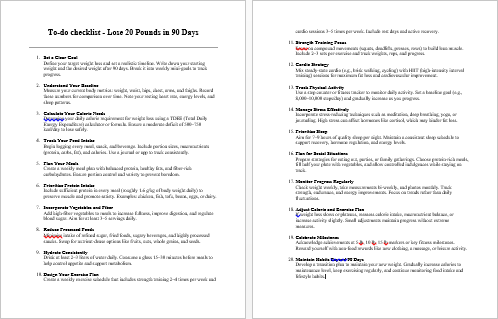
Lose 20 Pounds in 90 Days – Checklist
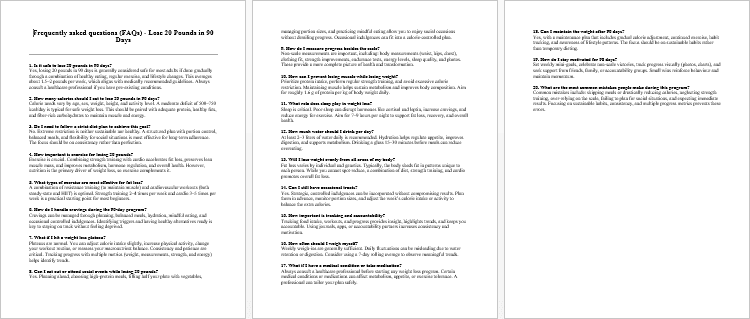
Lose 20 Pounds in 90 Days – FAQs
Lose 20 Pounds in 90 Days – Salespage Content

Package Details:
Word Count: 32 029 Words
Number of Pages: 133
Lose 20 Pounds in 90 Days – Bonus Content
Checklist
Word Count: 591 words
FAQs
Word Count: 892 words
Salespage Content
Word Count: 761 words
Total Word Count: 34 273 Words
Your PLR License Terms
PERMISSIONS: What Can You Do With These Materials?
Sell the content basically as it is (with some minor tweaks to make it “yours”).
If you are going to claim copyright to anything created with this content, then you must substantially change at 75% of the content to distinguish yourself from other licensees.
Break up the content into small portions to sell as individual reports for $10-$20 each.
Bundle the content with other existing content to create larger products for $47-$97 each.
Setup your own membership site with the content and generate monthly residual payments!
Take the content and convert it into a multiple-week “eclass” that you charge $297-$497 to access!
Use the content to create a “physical” product that you sell for premium prices!
Convert it to audios, videos, membership site content and more.
Excerpt and / or edit portions of the content to give away for free as blog posts, reports, etc. to use as lead magnets, incentives and more!
Create your own original product from it, set it up at a site and “flip” the site for megabucks!
RESTRICTIONS: What Can’t You Do With These Materials?
To protect the value of these products, you may not pass on the rights to your customers. This means that your customers may not have PLR rights or reprint / resell rights passed on to them.
You may not pass on any kind of licensing (PLR, reprint / resell, etc.) to ANY offer created from ANY PORTION OF this content that would allow additional people to sell or give away any portion of the content contained in this package.
You may not offer 100% commission to affiliates selling your version / copy of this product. The maximum affiliate commission you may pay out for offers created that include parts of this content is 75%.
You are not permitted to give the complete materials away in their current state for free – they must be sold. They must be excerpted and / or edited to be given away, unless otherwise noted. Example: You ARE permitted to excerpt portions of content for blog posts, lead magnets, etc.
You may not add this content to any part of an existing customer order that would not require them to make an additional purchase. (IE You cannot add it to a package, membership site, etc. that customers have ALREADY paid for.)
Share Now!
Latest Products




Free Sales Funnel Builder

Related Products
Popular & Trending

Featured Products