
Career Transition Coaching PLR Course 22k Words
in Business Coaching PLR , Business Coaching PLR Ebooks , Business PLR , Business PLR eBooks , PLR Checklists , PLR eBooks , PLR eCourses , PLR List Building Reports , Premium PLR , Premium PLR eBooks , Premium PLR Reports , Premium White Label Brandable PLR Coaching Courses , Private Label Rights ProductsChoose Your Desired Option(s)
has been added to your cart!
have been added to your cart!
#careertransition #careercoaching #professionalgrowth #jobchange #plrcontent #lifecoaching #digitalproducts #careersuccess #plrcourse
A Complete Done-For-You Career Coaching Program You Can Rebrand, Sell, or Monetize Immediately
Career change is no longer the exception—it is the norm. Professionals across all industries are re-evaluating their careers, searching for purpose, flexibility, growth, and fulfillment. Yet most feel overwhelmed, uncertain, and stuck because they lack a clear transition plan.
The Career Transition Coaching PLR Course was created to meet this growing demand.
This professionally written, 20,644-word PLR course delivers a structured, step-by-step coaching framework designed to guide individuals through a confident and successful career transition. Whether the goal is changing industries, moving into a new role, or starting something entirely new, this course provides clarity, direction, and momentum.
For PLR buyers, this represents a complete, ready-made coaching program that can be branded, sold, taught, or transformed into premium offers—without writing a single module from scratch.
Introducing the…
Career Transition Coaching PLR Course 22k Words
What This Career Transition Coaching Course Is Designed to Do
This course is built around one clear objective:
To guide professionals through a smooth and confident transition from one career path to another—without fear, overwhelm, or guesswork.
Rather than focusing on theory, the content emphasizes:
- Self-reflection and clarity
- Skill discovery and transferability
- Practical exploration of new career paths
- Strategic personal branding and networking
- Action planning, resilience, and execution
It is suitable for professionals at any stage—corporate employees, mid-career switchers, freelancers, and individuals re-entering the workforce.
A Complete Coaching Framework — Not Just Information
What sets this PLR course apart is its coaching-first structure.
Each module is designed to guide the learner through real decisions and actions, making it ideal for:
- Career coaches
- Life coaches
- HR consultants
- Personal development brands
- Course creators
- Membership site owners
This is not a motivational ebook. It is a practical transformation program.
Course Breakdown: What’s Included
Career Transition Coaching PLR Course
Total Course Length: 20,644 Words
Module 1: Understanding Your Why – Clarifying the Need for Change
This foundational module helps learners gain clarity before making any big decisions.
Step 1: Reflect on Your Current Role
Learners assess what is working and what is not, identifying patterns of dissatisfaction or fulfillment.
Step 2: Identify the Trigger
Explores common career change triggers such as burnout, lack of growth, values mismatch, or lifestyle shifts.
Step 3: Define Your Ideal Career Vision
Guides learners through visualizing their ideal future role, responsibilities, and lifestyle.
Step 4: Align with Your Core Values
Ensures the new career path aligns with personal values for long-term satisfaction.
This module prevents impulsive decisions and lays a strong emotional and strategic foundation.
Module 2: Discovering Your Strengths & Transferable Skills
This module focuses on confidence and capability.
Step 1: Take a Strengths Inventory
Introduces tools such as strengths assessments to uncover natural talents.
Step 2: Audit Skills from Past Roles
Helps learners identify transferable skills often overlooked in career transitions.
Step 3: Spot Skill Gaps and Learning Opportunities
Compares existing skills with target roles to highlight growth areas.
Step 4: Create a Skill-Building Plan
Encourages practical upskilling through courses, projects, or real-world experience.
This module reframes past experience as an asset—not a limitation.
Module 3: Exploring New Career Options
This module shifts learners from reflection to exploration.
Step 1: Brainstorm Career Possibilities
Encourages curiosity and open-minded thinking without judgment.
Step 2: Research Job Roles and Industries
Guides learners through evaluating roles, industries, salary expectations, and lifestyle impact.
Step 3: Conduct Informational Interviews
Teaches how to connect with professionals already working in desired fields.
Step 4: Test the Waters with Mini-Experiments
Promotes low-risk experimentation through freelancing, volunteering, or side projects.
This module reduces fear by replacing assumptions with real-world insights.
Module 4: Building Your Career Transition Toolkit
This module focuses on positioning and confidence.
Step 1: Update Your Resume and LinkedIn Profile
Shows how to reposition experience for a new career direction.
Step 2: Craft a Career Story That Connects the Dots
Helps learners explain their transition clearly and confidently.
Step 3: Strengthen Your Professional Network
Covers strategic networking and relationship-building techniques.
Step 4: Practice Interviewing with Purpose
Prepares learners to speak about their transition as a strength.
This module turns uncertainty into clarity and professionalism.
Module 5: Creating Your Career Launch Plan
This final module moves learners into execution.
Step 1: Set Clear Career Goals
Breaks down large goals into manageable milestones.
Step 2: Build a Weekly Action Plan
Introduces structure and accountability.
Step 3: Track Progress and Celebrate Wins
Encourages momentum through progress tracking and positive reinforcement.
Step 4: Stay Resilient and Embrace the Journey
Addresses mindset, patience, and emotional resilience during transition.
The course closes with empowerment—not pressure.
Additional High-Value Content Included
This PLR course package goes far beyond the core training.
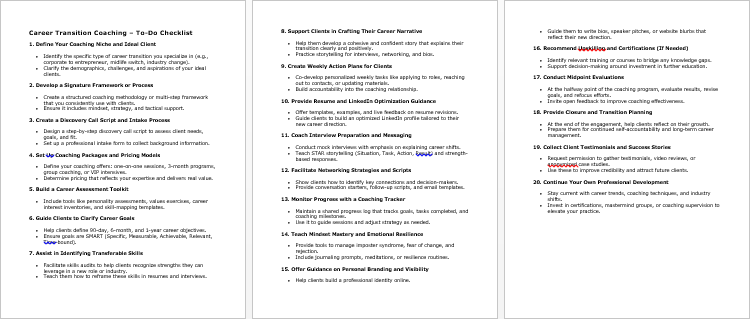
Career Transition Coaching Checklist – 603 Words
A practical implementation checklist that reinforces the course and supports action-taking.
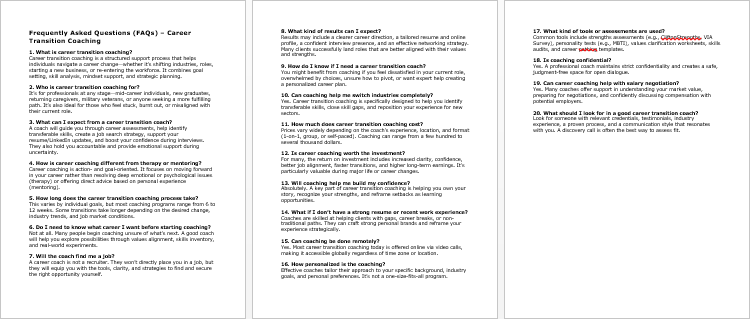
Career Transition Coaching FAQs – 736 Words
A ready-to-use FAQ resource that adds credibility and support value.
Career Transition Coaching Sales Page – 734 Words
A professionally written sales page buyers can rebrand, customize, or use as a foundation for their own offers.
Total Content Value
Total Word Count: 20,644 Words
This is a complete, premium-level career coaching program, not a basic PLR course.
Who This PLR Course Is Perfect For
This course is ideal for:
- Career coaches
- Life coaches
- HR consultants
- Personal development brands
- Course creators
- Membership site owners
- Coaches serving professionals or executives
- Online entrepreneurs in the self-improvement niche
It can be positioned as beginner, intermediate, or premium—depending on how it is branded and delivered.
How to Use and Profit from This Career Transition Coaching PLR Course
This PLR course offers exceptional monetization flexibility. Here are proven ways buyers can profit from it:
Sell It as a Standalone Online Course
Rebrand the content and sell it as a complete career transition program.
Turn It into a Premium Coaching Program
Use the course as the foundation for 1-on-1 or group coaching.
Create a Multi-Week eClass
Drip the content weekly and charge $297–$497 for guided access.
Add It to a Membership Site
Use it as cornerstone content to drive recurring monthly revenue.
Break It into Smaller Products
Sell individual modules or lessons as mini-courses or reports.
Convert It into Video or Audio Training
Record voice-overs or video lessons for higher perceived value.
Use It as Client Onboarding Material
Provide it as structured support for coaching clients.
Create Lead Magnets and Funnels
Use excerpts as free content to build email lists and upsell the full course.
Bundle It with Other Personal Development Products
Increase cart value with strategic bundles priced at $47–$97.
License Terms – What Buyers Are Allowed to Do
Permissions
Buyers may:
- Sell the content with minor edits
- Claim copyright if 75% of the content is substantially modified
- Break the content into smaller paid reports
- Bundle with other products for higher-priced offers
- Create membership sites with recurring income
- Convert into eClasses priced $297–$497
- Turn it into audio, video, or physical products
- Use excerpts as blog posts or lead magnets
- Build a branded site or product and flip it later
License Restrictions – What Buyers Cannot Do
To protect the value of this PLR product:
- PLR or resale rights may not be passed to customers
- No licensing rights may be transferred in any form
- Affiliate commissions may not exceed 75%
- The full content may not be given away for free in its current state
- The content may not be added to existing paid products without a new purchase
Why Buy This PLR Course from Buy Quality PLR
Buy Quality PLR is trusted for delivering high-quality, business-ready PLR products designed for real monetization—not filler content.
This course offers:
- Evergreen relevance
- Strong emotional appeal
- Clear coaching structure
- Premium resale potential
- Immediate usability
It saves months of content creation while opening the door to high-value offers.
Get Instant Access Today
The Career Transition Coaching PLR Course is available for instant download.
This is a complete, done-for-you career coaching system that can be rebranded, sold, taught, or transformed into premium coaching offers immediately.
Add this powerful PLR course to your Buy Quality PLR library today and start helping professionals transform their careers—while building profitable offers of your own.
has been added to your cart!
have been added to your cart!
Here A Sample of the Career Transition Coaching PLR Course
To guide professionals through a smooth and confident transition from one career path to another—whether it’s a shift in industry, a new role, or starting something entirely fresh.
Module 1: Understanding Your Why – Clarifying the Need for Change
Step 1: Reflect on Your Current Role
Objective:
To help learners gain deep clarity on their present work situation by identifying what energizes and drains them, so they can make informed decisions about their career transition.
Why This Step Matters:
Before making any career move, it’s critical to pause and reflect. Jumping into a new job or industry without understanding your current relationship with work can lead to repeating the same patterns. This step is all about bringing awareness to your current job experience—what’s working, what isn’t, and how you feel about it.
By reflecting intentionally, you begin to recognize themes, preferences, and frustrations that are key to shaping your next direction.
Instructional Content:
1. Create a Quiet Space for Reflection
Set aside at least 30–45 minutes where you can be alone, free from distractions. You’ll need a journal, notebook, or digital document where you can write freely. Turn off your phone notifications, close unnecessary tabs, and allow yourself to be fully present.
You’re not analyzing or problem-solving in this step—this is about being honest with yourself.
2. Answer Key Reflection Questions
Begin by answering the following prompts. Don’t rush—write as freely and as honestly as you can. There are no wrong answers.
- What parts of your current job do you enjoy?
- Think about the tasks or projects that make you feel accomplished, creative, or satisfied.
- Are there specific moments in your workweek when you feel energized or proud?
- What drains your energy?
- What tasks or situations make you feel frustrated, exhausted, or bored?
- Are there recurring patterns—certain meetings, responsibilities, or people—that deplete you?
- When do you feel most in “flow” during work?
- “Flow” refers to that state where you are completely immersed in a task and lose track of time.
- What are you doing when that happens?
- What causes stress or burnout?
- Identify the sources of pressure—deadlines, unrealistic expectations, poor communication, lack of recognition?
- What motivates you to show up each day?
- Is it the paycheck, your coworkers, a sense of responsibility, or genuine passion for the work?
- What are you tolerating that you shouldn’t be?
- Are there aspects of your role or environment that you’ve accepted but know are not sustainable long-term?
3. Organize Your Thoughts Into a Two-Column Table
Once you’ve written your raw reflections, it’s helpful to structure your thoughts. Create a simple table with two headings:
| What’s Working | What’s Not Working |
| (E.g., I enjoy leading team meetings and mentoring junior staff) | (E.g., I feel drained by repetitive admin tasks and poor team communication) |
This side-by-side format gives you a visual snapshot of your experience. You’ll likely start to see patterns. The goal is not to make decisions yet, but to understand your current landscape.
4. Dig Deeper With Emotional Checkpoints
Now, let’s go beyond tasks and look at how your job makes you feel. Use these prompts:
- On a scale of 1 to 10, how excited are you to start work each day?
- How often do you feel frustrated, stuck, or overlooked at work?
- Do you feel that your strengths are being used?
- Do you feel like you’re growing professionally?
- Are you proud to tell others what you do?
Write short paragraphs or bullet points in response. Pay attention to emotional words like drained, motivated, stuck, empowered, ignored, or valued. These emotional cues are strong indicators of alignment or misalignment in your current role.
5. Summarize Your Reflections in One Page
Once you’ve completed the questions, the table, and the emotional check-in, write a short summary—no more than one page.
Title it: “My Current Career Snapshot”
In your summary, describe:
- What you’ve learned about yourself
- What parts of your current role feel aligned
- What parts clearly don’t
- How your job affects your energy, emotions, and outlook
This written piece will serve as a foundation for your entire transition process. You’ll refer back to it often as you evaluate future opportunities.
6. Optional: Discuss With a Peer or Coach
If you’re comfortable, share your reflections with a trusted peer, career coach, or mentor. Speaking about your experience out loud can bring even more clarity. They might help you identify blind spots or patterns you hadn’t seen.
If you’re in a group coaching program, this could also be used as a breakout discussion or journaling assignment to bring into live sessions.
Instructional Notes for Course Creators:
- Encourage learners to save or print their reflection summary for future modules.
- Remind them that this step is not about judgment or action—it’s purely about awareness.
- You can include printable worksheets, downloadable templates, or interactive fillable forms to guide them.
- If your course has a learning portal, consider integrating a private journal feature where students can write their answers and keep track.
Conclusion of the Step:
Understanding where you stand right now is one of the most powerful career tools you have. It helps ground your transition in truth—not in frustration, fear, or guesswork. This honest self-inventory is your first real step toward making a meaningful change that lasts.
Step 2: Identify the Trigger
Objective:
To help learners uncover the root cause(s) behind their desire for career change, so they can make intentional, informed choices based on clarity—not impulse or temporary discomfort.
Why This Step Matters:
Career transitions don’t happen randomly. There is almost always a trigger—a push or pull—that nudges professionals toward change. It could be a subtle sense of dissatisfaction or a glaring issue like burnout or misalignment with company values.
Identifying the exact trigger is essential because it allows the learner to:
- Avoid making reactive decisions
- Understand whether a full transition is needed—or a minor course correction will do
- Build a roadmap tailored to the real issue, not the symptoms
Without knowing the “why” behind the urge to leave, a person risks stepping into a new job or industry with the same unresolved problems.
Instructional Content:
1. Understand What a ‘Trigger’ Is
Begin by clarifying that a trigger in the context of career transition refers to the emotional or situational spark that causes someone to question their current role.
There are two types of career triggers:
- Push Factors – things driving you away from your current role (e.g., toxic culture, burnout)
- Pull Factors – things drawing you toward something new (e.g., desire for creativity, entrepreneurship)
Both are important to understand and can exist simultaneously.
2. Explore Common Career Triggers
Below is a list of common triggers. Encourage learners to read through and highlight or mark any that resonate strongly.
- Burnout or Chronic Stress
Are you feeling emotionally, mentally, or physically depleted? Does the job leave you exhausted more often than energized? - Lack of Growth or Development
Have you stopped learning? Do you feel stuck or underutilized? - Values Mismatch
Do you feel disconnected from the company culture, leadership ethics, or the mission of your organization? - Desire for Purpose or Meaning
Are you craving work that aligns more with who you are or the impact you want to make? - Work-Life Imbalance
Is your job consuming so much of your time and energy that there’s little left for yourself, family, or life outside of work? - Toxic Work Environment
Are you experiencing poor leadership, unclear expectations, lack of recognition, or hostile relationships? - Industry Shifts or Instability
Are technological or economic changes making your current industry less viable or fulfilling? - Salary or Financial Dissatisfaction
Is compensation a growing issue? Do you feel undervalued for the work you provide? - Geographic or Lifestyle Needs
Have life changes made your job’s hours, location, or travel requirements unsustainable? - Entrepreneurial Pull
Do you feel a desire to start your own business, freelance, or become more independent?
Note for Learners:
You may relate to more than one. That’s okay. Highlight them all, but then circle the one or two that stand out most clearly—these are likely your dominant triggers.
3. Write Your Trigger Narrative
Now that you’ve identified the main reasons behind your desire to transition, it’s time to put it into your own words.
Use the following journaling prompt:
“The reason I’m seriously considering a career transition right now is because…”
In your writing, aim to:
- Describe the emotion behind the trigger (e.g., “I feel stuck,” “I feel disrespected,” “I feel like I’m wasting my potential”)
- Include specific experiences or patterns (e.g., “Over the last year, I’ve been passed over for three internal promotions.”)
- Avoid blaming others; this is about clarity, not complaints
Optional Format: If journaling isn’t comfortable, learners can write bullet points or even record an audio message to themselves.
4. Create a Trigger Map
To further clarify, draw a simple Trigger Map. This is a visual exercise that shows:
Center: Your current role
Left side: Push Factors (what’s pushing you away)
Right side: Pull Factors (what’s drawing you toward something new)
This exercise helps separate emotional drivers and provides a visual overview of what’s fueling your career pivot.
Learners should spend 10–15 minutes mapping out their push and pull influences.
5. Identify If the Trigger Is Temporary or Structural
Not all triggers require a complete career overhaul. Some may point to situational issues that could be resolved with a conversation, role change, or new strategy.
Ask yourself:
- Could these issues be improved within my current company or role?
- Have I communicated my concerns before?
- Is this frustration new or has it been building over years?
This isn’t about settling. It’s about distinguishing a temporary tension from a deep, systemic mismatch. This awareness will be useful as you begin to explore solutions later in the course.
6. Summarize Your Trigger Statement
End this step by writing a short paragraph summarizing your primary trigger.
Use this format:
“I am considering a career transition because [insert dominant trigger]. This has impacted me by [describe emotional, mental, or professional toll]. I’ve noticed this pattern for [insert time period]. I believe a new direction is necessary because [insert reason].”
Example:
“I am considering a career transition because I feel a deep lack of purpose in my current role. While the job pays well, I no longer feel connected to the company’s mission, and I spend most of my time in meetings that don’t align with my values. I’ve felt this way for over a year. I believe it’s time to explore a path where I can make a more meaningful contribution.”
Learners can store this in their journal or course portal—it becomes a guiding compass throughout the course.
Instructional Notes for Course Creators:
- Provide downloadable worksheets for trigger identification.
- Include example trigger narratives to inspire learners.
- Consider using audio prompts or video instructions to personalize this step.
- Allow learners to save or edit their Trigger Maps within the platform.
- If the course includes coaching, use this trigger statement as a discussion opener.
Conclusion of This Step:
Identifying the trigger behind your career transition is like locating the root of a tree. Once you know what’s truly fueling the shift, you can grow from a place of self-awareness—not guesswork. This clarity allows every future step in your transition to be more focused, authentic, and aligned with your long-term goals.
Step 3: Define Your Ideal Career Vision
Objective:
To help learners craft a vivid, personalized, and practical vision of their ideal career. This vision acts as a north star, guiding all future decisions in the transition process.
Why This Step Matters:
Without a clear picture of where you’re going, it’s easy to make decisions based on fear, urgency, or convenience. When you define your ideal career vision, you give your transition a sense of purpose, direction, and intentionality.
Think of it this way: If your trigger (from Step 2) reveals what’s not working, your career vision reveals what could work beautifully.
This step shifts the learner’s mindset from frustration to possibility. It gives shape to the future they want to build, instead of merely escaping their current situation.
Instructional Content:
1. Understand What a Career Vision Really Is
A career vision is not just a job title or salary goal. It’s a holistic picture of the kind of professional life you want to live—daily tasks, environment, impact, relationships, and lifestyle.
A strong vision includes:
- How you feel at work
- What type of work you’re doing
- Where and how you’re working
- Who you’re working with or for
- What outcomes you’re helping create
Learners should approach this exercise not as a fixed plan but as a creative exploration. The goal is clarity, not perfection.
2. Start with Visualization
Guide learners through a simple visualization exercise to imagine their ideal day in their dream career. Ask them to close their eyes, relax, and picture the following:
- What time do you wake up?
- What does your morning look like?
- Where are you working—home, office, on the road, hybrid?
- Who are you working with—teams, clients, independently?
- What kind of projects are you working on?
- How do you feel at the end of the day—energized, fulfilled, at peace?
Instructional Tip for Course Creators:
Record an audio or video guide to walk your learners through this visualization. Use soft, neutral music in the background and a calm voice to encourage immersion.
After the visualization, give learners 10–15 minutes to journal or type out what they imagined. Encourage full detail—sensory, emotional, and practical.
3. Break Down Your Vision into Career Elements
Now, take that imaginative experience and translate it into tangible categories. Provide learners with this table to fill in:
| Career Element | Your Vision |
| Industry / Field | What sector or area of work are you in? (e.g., education, technology, wellness, design, consulting) |
| Job Role / Title | What kind of work are you doing? What title or function best describes it? |
| Skills in Use | What are your top 3 skills being used in this role? (e.g., writing, coaching, data analysis, leadership) |
| Work Environment | Where are you working from? What’s the setting like? Is it collaborative, independent, flexible, structured? |
| Company Type / Culture | What kind of organization do you work for? Start-up, global company, nonprofit? What’s the workplace culture like? |
| Daily Routine | What does a typical day look like—from start to finish? |
| Work Style | Are you working full-time, part-time, contract-based, freelance, remote, hybrid? |
| Purpose / Impact | What positive change or result does your work create—for individuals, companies, society, or the planet? |
| Earning Goals | What kind of income or compensation are you aiming for to support your desired lifestyle and financial goals? |
| Lifestyle Compatibility | How does this career vision support your personal values, health, family time, hobbies, and travel aspirations? |
Learners can complete this exercise using bullet points, short paragraphs, or creative mind maps—whatever format suits their thinking style.
4. Create a Vision Statement
Now that learners have defined the building blocks of their career vision, guide them in creating a Career Vision Statement—a concise paragraph that brings their ideas together.
Career Vision Statement Template:
“In my ideal career, I work as a [role] in the [industry] field, using my strengths in [skills] to [describe your impact or purpose]. I work [location/style] in an environment that is [describe culture]. My work brings me [emotions—e.g., fulfillment, balance, excitement], and it supports a lifestyle where I can [personal aspiration—e.g., spend time with family, travel often, maintain health].”
Example:
“In my ideal career, I work as a UX designer in the healthcare tech industry, using my creativity and empathy to design digital tools that improve patient care. I work remotely with a small, collaborative team that values innovation and inclusion. My work brings me a sense of purpose and flexibility, allowing me to be present for my family, pursue hobbies, and maintain a healthy work-life balance.”
Encourage learners to print or save this statement somewhere visible. It becomes a compass they can refer back to whenever they face doubt, fear, or distraction during their career change process.
Instructional Notes for Course Creators:
- Include downloadable worksheets and templates for the Career Elements and Vision Statement.
- Provide real-life vision statement examples from diverse professions and life stages.
- Consider offering optional peer feedback within the course platform, where learners can share their vision statements and get encouragement.
- Offer reflection questions like:
- “How different is this from your current role?”
- “What feels most exciting about this vision?”
- “What fears or doubts does this vision bring up for you?”
Conclusion of This Step:
Defining your career vision isn’t just about dreaming—it’s about designing. By taking time to shape a vision that resonates with your strengths, values, and goals, you’re giving your career transition clarity, confidence, and intention. This north star won’t just keep you motivated—it will keep you aligned with the professional life you truly want to create.
Step 4: Align with Your Core Values
Objective:
To guide learners through the process of identifying their personal core values and aligning those values with their ideal career vision. This alignment ensures that their new path brings not only professional success but also personal fulfillment and lasting motivation.
Why This Step Matters:
Career transitions often fail when they focus solely on external improvements—like better pay, more flexibility, or new challenges—without considering internal alignment. A job may look perfect on paper, but if it doesn’t reflect your values, it can lead to dissatisfaction, misalignment, or even burnout.
Knowing your core values acts as a filter for decision-making. When your work aligns with what you believe in, your energy is more sustainable, your confidence grows, and your motivation deepens.
Values are not buzzwords—they are the deeply held beliefs that guide how you live, work, and relate to others. This step helps ensure your career path doesn’t just look good, but feels right.
Instructional Content:
1. Understand What Core Values Are
Start by introducing the concept of core values in a clear, accessible way.
Core values are:
- Deeply held beliefs and principles that guide your decisions and behavior
- The “why” behind your motivations, preferences, and reactions
- Non-negotiables that define what a meaningful life or career looks like to you
Examples of common core values:
- Integrity
- Freedom
- Creativity
- Service
- Security
- Adventure
- Recognition
- Growth
- Empathy
- Excellence
- Balance
- Justice
- Family
- Community
Instruction Tip for Course Creators:
Include a downloadable list of 100+ core values with definitions and space to highlight or annotate. You can also use a drag-and-drop interactive tool if teaching on a digital platform.
2. Identify Your Top 5 Core Values
Guide learners through a structured activity to uncover their personal values.
Activity Instructions:
- From the values list, ask learners to circle or highlight any words that resonate with them personally (they don’t need to justify their choices at this stage).
- Narrow the list to 10 values that feel most important.
- From those 10, ask them to select their Top 5 core values. Encourage them to consider:
- Which values would you fight for?
- Which values define your best decisions?
- Which values have consistently shown up in your life?
Optional Exercise:
Have learners write a brief explanation for why each of the 5 values is important to them. Use reflective questions such as:
- When have you felt most alive or proud in your career?
- What values were present in that moment?
- When have you felt most frustrated or disappointed?
- Which of your values may have been violated?
This deepens self-awareness and clarifies the role values play in work satisfaction.
3. Evaluate Alignment Between Career Vision and Values
Once learners have both their ideal career vision (from Step 3) and their core values, help them compare the two. The goal is to assess: Does your dream job reflect your values?
Provide learners with a simple table like this:
| Core Value | Is this value clearly present in your career vision? (Yes / No / Unsure) | How can you reinforce this value in your career path? |
| Integrity | Yes | Only consider companies with a strong ethical reputation |
| Balance | Unsure | Prioritize jobs with flexible work hours or remote options |
| Growth | Yes | Seek roles that include mentorship and training |
| Creativity | Yes | Ensure job duties include design, writing, or innovation |
| Service | No | Explore roles that contribute directly to helping others |
Encourage learners to write honestly—this isn’t about judgment, but awareness. If a value is missing, that’s a signal to adjust the vision or approach.
Guiding Reflection Questions:
- Are any of your values missing from your current vision?
- Are any values over-emphasized that don’t truly matter to you?
- What small or large changes could bring your vision into better alignment?
4. Create a Personal Values Alignment Statement
Help learners consolidate their insights by writing a short statement that links their top values with their career goals.
Sample Prompt:
“To feel fulfilled in my work, it’s important that my career supports these five core values: [list your values]. My ideal career path should reflect these by [brief explanation of how each value is represented]. I will use these values to guide my decisions moving forward.”
Example:
“To feel fulfilled in my work, it’s important that my career supports these five core values: Creativity, Freedom, Balance, Growth, and Service. My ideal career reflects this by allowing me to work remotely (Freedom), solve new design challenges (Creativity), set flexible hours (Balance), learn new technologies (Growth), and create meaningful experiences for others (Service). I will use these values to evaluate opportunities and organizations moving forward.”
Instruction Tip for Course Creators:
Encourage learners to save or print this statement as a values-based compass for making career decisions—from choosing job offers to selecting networking opportunities or even launching a business.
Instructional Notes for International Course Creators:
- Avoid culturally biased language or idioms when discussing values.
- Ensure the core values list is inclusive and globally relevant.
- Offer examples from diverse cultural, professional, and geographic backgrounds to show how values influence careers across contexts.
- Allow learners to revise or revisit their values later in the course—this isn’t a fixed identity but an evolving self-awareness tool.
Conclusion of This Step:
Aligning your career vision with your core values is not a luxury—it’s a foundation. Without this alignment, even the most prestigious or profitable career can feel hollow. When you’re clear on what matters most to you, your work becomes more than a job—it becomes an expression of who you are.
By doing this work now, you’re equipping yourself to say yes to the right opportunities and no to distractions, even when they seem tempting.
We’re also giving these extra bonuses
Career Transition Coaching – Checklist
Career Transition Coaching – FAQs
Career Transition Coaching – Salespage Content
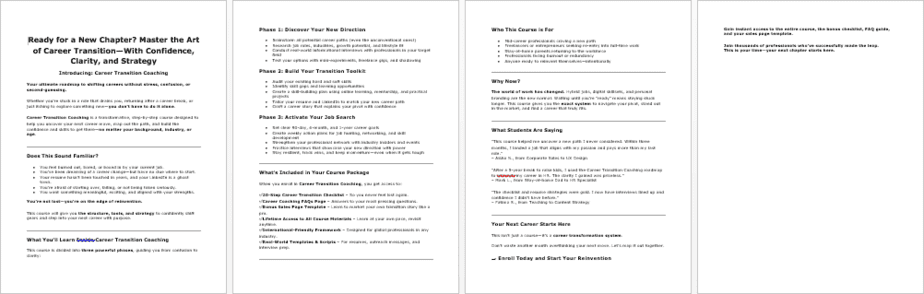
Package Details:
Word Count: 20 644 Words
Number of Pages: 103
Career Transition Coaching – Bonus Content
Checklist
Word Count: 603 words
FAQs
Word Count: 736 words
Salespage Content
Word Count: 734 words
Total Word Count: 22 717 Words
Your PLR License Terms
PERMISSIONS: What Can You Do With These Materials?
Sell the content basically as it is (with some minor tweaks to make it “yours”).
If you are going to claim copyright to anything created with this content, then you must substantially change at 75% of the content to distinguish yourself from other licensees.
Break up the content into small portions to sell as individual reports for $10-$20 each.
Bundle the content with other existing content to create larger products for $47-$97 each.
Setup your own membership site with the content and generate monthly residual payments!
Take the content and convert it into a multiple-week “eclass” that you charge $297-$497 to access!
Use the content to create a “physical” product that you sell for premium prices!
Convert it to audios, videos, membership site content and more.
Excerpt and / or edit portions of the content to give away for free as blog posts, reports, etc. to use as lead magnets, incentives and more!
Create your own original product from it, set it up at a site and “flip” the site for megabucks!
RESTRICTIONS: What Can’t You Do With These Materials?
To protect the value of these products, you may not pass on the rights to your customers. This means that your customers may not have PLR rights or reprint / resell rights passed on to them.
You may not pass on any kind of licensing (PLR, reprint / resell, etc.) to ANY offer created from ANY PORTION OF this content that would allow additional people to sell or give away any portion of the content contained in this package.
You may not offer 100% commission to affiliates selling your version / copy of this product. The maximum affiliate commission you may pay out for offers created that include parts of this content is 75%.
You are not permitted to give the complete materials away in their current state for free – they must be sold. They must be excerpted and / or edited to be given away, unless otherwise noted. Example: You ARE permitted to excerpt portions of content for blog posts, lead magnets, etc.
You may not add this content to any part of an existing customer order that would not require them to make an additional purchase. (IE You cannot add it to a package, membership site, etc. that customers have ALREADY paid for.)
Share Now!
Latest Products





Free Sales Funnel Builder

Related Products
Popular & Trending


Featured Products