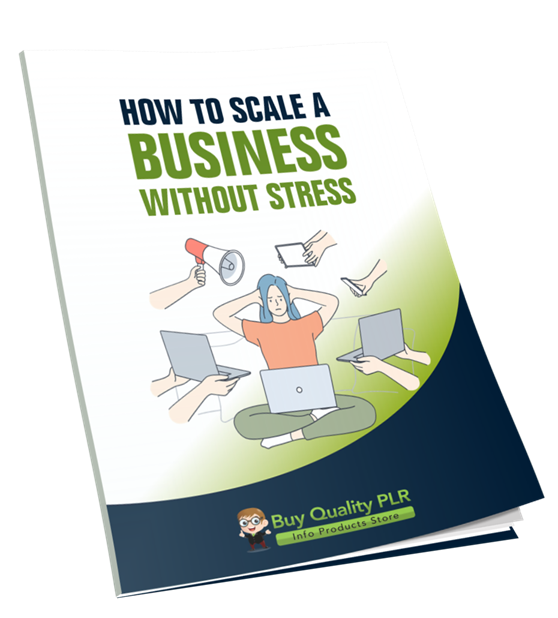
How to Scale a Business Without Stress PLR Course 36k Words
in Business Finance PLR , Business PLR , Online Business PLR , PLR eCourses , PLR List Building Reports , Premium PLR , Premium PLR Reports , Premium White Label Brandable PLR Coaching Courses , Private Label Rights Products , Stress PLRChoose Your Desired Option(s)
has been added to your cart!
have been added to your cart!
#scaleyourbusiness #plrcourse #businessgrowth #entrepreneurlife #stressfreebusiness #onlinebusiness #plrcontent #startupsuccess #businessstrategy
How to Scale a Business Without Stress PLR Course – 36,000 Words
Proven Tactics to Grow Smart, Not Burn Out
Scaling a business is exciting, but it can quickly become overwhelming. Many entrepreneurs hit a growth ceiling—not because the market isn’t there—but because their systems, team, and strategies aren’t built for sustainable expansion.
The How to Scale a Business Without Stress PLR Course provides 36,000 words of step-by-step guidance to help business owners grow their revenue, systems, and team without burnout or chaos.
This course equips learners with practical strategies for smart growth, combining business clarity, scalable offers, effective marketing, automation, and leadership practices that enable sustainable success.
As a ready-to-use PLR course, it’s perfect for entrepreneurs, business coaches, digital marketers, and content creators who want to sell, teach, or repurpose a high-value product in the business growth niche.
Introducing the…
How to Scale a Business Without Stress
Why Stress-Free Scaling Matters
Scaling a business without planning or proper systems leads to:
- Overwhelm and burnout
- Poor customer experiences
- Financial instability despite higher revenue
- Staff turnover and miscommunication
- Stagnant or unpredictable growth
This course teaches you to scale smartly, implementing strategies that grow revenue while reducing stress, freeing up your time, and maintaining lifestyle balance.
With proven techniques for business owners, your audience will learn how to:
- Build a solid foundation for growth
- Create scalable products and revenue streams
- Market effectively without burnout
- Automate and delegate tasks efficiently
- Maintain balance while growing profits
Course Overview: Step-by-Step Stress-Free Scaling
The course is organized into five comprehensive modules, each focusing on a critical component of business growth without stress.
Module 1: Laying the Foundation for Stress-Free Growth
Goal: Prepare your business for growth by creating systems, clarity, and financial awareness.
- Lesson 1: Clarity on Your Vision & Goals
Learn how to define scalable goals that inspire action, not overwhelm. - Lesson 2: Systems Before Growth
Understand why creating simple, repeatable systems is critical for stress-free scaling. - Lesson 3: Knowing Your Numbers
Track revenue, profit margins, and cash flow to make informed growth decisions. - Lesson 4: Delegating Early, Not Late
Let go of small tasks early to focus on high-impact strategies that drive growth.
Module 2: Building Scalable Offers & Revenue Streams
Goal: Ensure your products or services can grow efficiently with demand.
- Lesson 1: Packaging Your Core Offer
Refine your main offer so it can serve more clients without extra work. - Lesson 2: Adding Recurring Revenue Streams
Introduce subscriptions, retainers, or memberships that generate predictable, scalable income. - Lesson 3: Leveraging Digital Products or Services
Transform your expertise into scalable assets such as online courses, templates, or toolkits. - Lesson 4: Creating a Customer Experience That Scales
Maintain quality and delight your clients even as your customer base expands.
Module 3: Marketing That Grows With You
Goal: Set up marketing systems that attract leads and convert sales without constant effort.
- Lesson 1: The Power of Evergreen Marketing
Build automated funnels that run in the background while you focus on growth. - Lesson 2: Content That Works Long-Term
Create blogs, videos, and resources that attract leads for months or years. - Lesson 3: Paid Ads Without Stress
Use cost-effective, strategic ad campaigns to scale revenue efficiently. - Lesson 4: Scaling with Partnerships & Collaborations
Leverage joint ventures, influencer relationships, and referrals to reach new audiences.
Module 4: Team, Tools, and Automation for Stress-Free Scaling
Goal: Expand capacity without increasing stress.
- Lesson 1: Building Your Dream Team
Identify who to hire first and delegate effectively for maximum impact. - Lesson 2: Automation Made Simple
Learn tools and systems that save hours every week while maintaining consistency. - Lesson 3: Standard Operating Procedures (SOPs)
Document workflows so your team can handle tasks independently. - Lesson 4: Stress-Free Leadership
Lead with clarity, confidence, and communication that motivates your team to thrive.
Module 5: Sustainable Scaling & Lifestyle Freedom
Goal: Build a business that grows profitably while supporting your life and goals.
- Lesson 1: Stress-Free CEO Mindset
Step into a calm, strategic leadership role that inspires confidence and clarity. - Lesson 2: Sustainable Growth Habits
Daily and weekly routines that keep the business moving forward without chaos. - Lesson 3: Balancing Business & Life
Grow revenue while prioritizing family, health, and personal passions. - Lesson 4: Scaling Beyond You
Build a self-sustaining business that thrives even when you’re not working.
✅ End Result
By completing this course, learners will be able to:
- Establish a rock-solid foundation for stress-free growth
- Build scalable offers and revenue streams
- Implement marketing strategies that attract and convert efficiently
- Leverage tools, automation, and a capable team
- Maintain work-life balance while expanding profits
- Lead with confidence and create long-term business freedom
This course is designed for entrepreneurs who want to grow smart, not burn out, making it highly desirable for coaching programs, digital product sales, and business growth communities.
Bonus Materials Included
- Checklist – 540 Words: Step-by-step strategies for stress-free business scaling.
- FAQs – 815 Words: Answers common questions about growth, delegation, and automation.
- Salespage – 843 Words: Ready-to-use promotional content to sell the course immediately.
Who Can Benefit From This PLR Course?
- Entrepreneurs looking to grow revenue without stress
- Business coaches seeking turnkey content for clients
- Digital marketers offering business scaling programs
- Bloggers and content creators in the entrepreneurship niche
- Anyone who wants to sell or teach a high-value course in business growth
With PLR rights, you can rebrand, sell, or repurpose this content in multiple ways to generate income immediately.
How to Monetize and Profit From This PLR Course
1. Sell the Full Course As-Is
Offer a fully packaged course for $197–$497.
2. Multi-Week eClass
Convert modules into a 4–6 week coaching program for $297–$997.
3. Individual Guides or Lessons
Sell individual lessons as standalone reports for $10–$20 each.
4. Bundles with Other Business PLR Products
Package with other courses to sell higher-ticket bundles ($47–$97).
5. Membership Content
Deliver weekly lessons to members for recurring income.
6. Audio, Video, or Webinar Conversion
Repurpose the content for podcasts, YouTube series, webinars, or live workshops.
7. Physical Products
Turn lessons into workbooks, planners, or journals for premium sales.
8. Lead Magnets
Use excerpts for email opt-ins, blog posts, or social media campaigns.
9. Build & Flip a Business
Create a business website or membership site with this course and sell it as a complete business package.
Licensing Terms: What You Can and Cannot Do
You CAN:
- Sell the content with minor edits or rebranding
- Rewrite 75%+ and claim copyright
- Break into smaller guides, reports, or mini-courses
- Bundle with other PLR products
- Convert to audio, video, or membership content
- Use excerpts for blogs, lead magnets, or promotions
You CANNOT:
- Pass PLR rights to customers
- Offer 100% affiliate commissions (max 75%)
- Give away the full course for free
- Include the course in packages without requiring an extra purchase
Why Buy Quality PLR?
- Professionally written, high-value content for entrepreneurs
- Fully structured course ready to sell, teach, or repurpose
- Bonus materials for instant marketing and delivery
- Flexible content for digital, audio, video, or physical products
- High-demand niche content with actionable, practical strategies
The Bottom Line
Scaling a business doesn’t have to be stressful. The How to Scale a Business Without Stress PLR Course provides:
- Step-by-step strategies for growth without overwhelm
- Systems, team, and automation methods for smart expansion
- Scalable offers, recurring revenue, and stress-free marketing
- Practical routines to balance work, life, and leadership
This turnkey PLR course is ideal for entrepreneurs, coaches, and content creators who want to provide real business value while generating immediate revenue.
Take Action Today!
Offer your audience a proven roadmap to scale a business without stress while monetizing a ready-to-go, high-value PLR course.
Available now at Buy Quality PLR – help entrepreneurs grow smart, increase revenue, and reclaim freedom.
Grow Your Business. Reduce Stress. Scale Smart.
has been added to your cart!
have been added to your cart!
Here A Sample of the How to Scale a Business Without Stress PLR Course
Module 1: Laying the Foundation for Stress-Free Growth
Before scaling, you need a rock-solid base. This module ensures your business is prepared for growth without cracks in the system.
Lesson 1: Clarity on Your Vision & Goals – How to Define Scalable Goals That Excite You, Not Overwhelm You
Scaling a business is not just about making it bigger. True scaling is about growing in a way that feels sustainable, exciting, and manageable without leading to burnout or chaos. As a course creator working in today’s international landscape, you need to approach growth with clarity and structure, otherwise the journey becomes overwhelming.
This lesson is dedicated to helping you define scalable goals that inspire you to move forward while avoiding the stress trap. We will break this down step by step, so you walk away with a clear vision and measurable goals that support your business growth without consuming your life.
Step 1: Understand What “Scalable Goals” Really Mean
Many business owners confuse “scaling” with simply “growing.” Growth often means working harder—adding more students, creating more courses, running more ads, or putting in longer hours. Scaling, however, is different. Scaling is about creating a structure where your revenue and impact can increase without your workload increasing at the same rate.
Scalable goals, therefore, are:
- Achievable within systems that can handle higher demand.
- Designed to give you more freedom, not less.
- Focused on long-term sustainability rather than short-term wins.
Example:
- A non-scalable goal: “I want 50 private coaching clients this year.”
- A scalable goal: “I want to enroll 500 students into my self-paced online course this year.”
Both may produce revenue, but only the second allows you to scale without exhausting your time.
Step 2: Connect Goals to Your Bigger Vision
Before setting goals, you must clarify the larger vision of why you are scaling in the first place. Vision acts as your compass—it prevents you from chasing random opportunities and keeps you aligned with what truly matters.
Ask yourself:
- What do I want my business to look like in three years?
(Think about revenue, number of clients, the type of work you want to be doing, and the level of freedom you desire.) - Why do I want to scale?
(Is it for financial stability, more impact, freedom of time, or a mix of all?) - How do I want my life to feel while running this business?
(Busy and chaotic is not the goal; energized and balanced should be.)
Practical Exercise:
Write down a vision statement that captures your desired future. For example:
“In three years, I want my business to be serving thousands of international students through online learning programs while giving me the freedom to work 25 hours a week and spend more time with my family.”
This statement becomes your North Star. Every scalable goal you set should align with this vision.
Step 3: Break Down the Vision into Strategic Areas
Your business has several moving parts, and each requires clear goals to scale effectively. To avoid overwhelm, break your vision into four key areas:
- Financial Growth – Revenue, profit margins, and recurring income streams.
- Offer Development – Courses, programs, or services you provide.
- Marketing & Reach – How you attract and convert students.
- Operations & Lifestyle – Systems, delegation, and your personal work-life balance.
By dividing your vision this way, you create smaller, manageable sections. Instead of thinking, “I want to scale everything,” you can focus on one specific area at a time.
Step 4: Use the SMARTER Framework for Goal Setting
International course creators often struggle with vague goals like “I want more students” or “I want to make more money.” These goals do not provide direction or a way to measure success. To create clarity, use the SMARTER framework:
- S – Specific: Define exactly what you want.
- M – Measurable: Make it trackable with numbers or milestones.
- A – Achievable: Ensure it’s realistic with your current resources.
- R – Relevant: Align it with your long-term vision.
- T – Time-bound: Give it a clear deadline.
- E – Exciting: It should motivate you, not drain you.
- R – Reviewable: Build in checkpoints to assess progress.
Example of a SMARTER goal for scaling:
“Within the next 12 months, I will increase enrollments in my flagship online course from 100 to 500 students, generating at least $100,000 in revenue, by implementing automated marketing funnels and partnering with three international affiliates.”
This goal is specific, measurable, and scalable—it leverages automation and partnerships instead of more personal labor.
Step 5: Prioritize Goals That Have the Highest Impact
Not all goals are created equal. Some goals will move the needle significantly, while others only create small improvements. To avoid spreading yourself too thin, focus on goals with the highest leverage.
Ask:
- Will this goal increase revenue without equally increasing workload?
- Does this goal help me serve more people without sacrificing quality?
- Does this goal build a system that keeps working after the initial setup?
High-impact scalable goals might include:
- Creating a signature online course that runs on evergreen enrollment.
- Building a recurring revenue model (subscription, membership, retainer).
- Automating student onboarding and customer service.
- Expanding internationally through partnerships or licensing.
Step 6: Map Out Quarterly Milestones
A big vision can feel overwhelming if you look at it all at once. Instead, break it down into 90-day chunks. Each quarter, focus on one or two major milestones that move you toward your scalable goals.
For example, if your yearly goal is to increase course enrollment from 100 to 500 students:
- Quarter 1: Build an evergreen marketing funnel.
- Quarter 2: Launch the funnel and optimize based on results.
- Quarter 3: Partner with affiliates to increase international reach.
- Quarter 4: Refine systems and prepare for long-term scaling.
This breakdown keeps your focus clear and prevents burnout from trying to do everything at once.
Step 7: Balance Excitement with Practicality
One common trap course creators fall into is setting goals that sound exciting but are unrealistic for their current capacity. Excitement is important, but you need to match it with practicality.
To balance the two:
- Set a stretch goal that challenges you.
- Pair it with a baseline goal that you know is achievable.
Example:
- Baseline Goal: Enroll 300 students this year.
- Stretch Goal: Enroll 500 students this year.
This way, you push yourself to grow while avoiding the discouragement that comes from impossible expectations.
Step 8: Define Metrics That Matter
Numbers are essential, but not all numbers matter equally. Focus on the metrics that directly connect to your scalable goals. For course creators, these may include:
- Student enrollment numbers.
- Average revenue per student.
- Completion and satisfaction rates.
- Recurring income percentage.
- Hours worked per week.
By tracking only the metrics that matter, you avoid drowning in data and keep attention on what truly drives scalable growth.
Step 9: Align Personal Lifestyle Goals with Business Goals
Scaling a business should enhance your life, not consume it. As an international course creator, your personal lifestyle goals are just as important as your business goals.
Ask yourself:
- How many hours a week do I want to work?
- What kind of lifestyle freedom do I want scaling to provide?
- How do I want my daily routine to feel once my business is scaled?
Example alignment:
- Business Goal: Grow to $200,000 annual revenue.
- Lifestyle Goal: Work 25–30 hours a week, take one month off per year.
If a goal forces you into working 70 hours a week, it is not scalable, no matter how much money it generates.
Step 10: Put It All into a Clear Goal Map
Once you’ve clarified your vision, identified high-impact goals, and set quarterly milestones, put everything into a simple goal map.
A clear goal map should include:
- Your vision statement.
- Top 3–5 scalable goals for the year.
- Quarterly milestones for each goal.
- Key metrics to track.
- Lifestyle alignment notes (work hours, freedom, balance).
This document becomes your reference point. Whenever you feel overwhelmed or distracted, return to your goal map. It reminds you of what matters and keeps you on a stress-free path.
Conclusion: The Power of Clarity in Scaling
Without clarity, scaling feels chaotic. You chase new opportunities, overcommit to projects, and end up overwhelmed. With clarity, scaling becomes purposeful. Every step you take moves you closer to a business that is not only bigger but also smarter, more efficient, and more enjoyable to run.
By defining scalable goals that excite you, not overwhelm you, you lay the strongest possible foundation for stress-free growth. This clarity ensures that the next stages of scaling—building offers, expanding marketing, hiring, and automating—happen smoothly, with systems that support both your business and your lifestyle.
Lesson 2: Systems Before Growth
Why creating simple, repeatable systems is your first step to stress-free scaling
(Designed for international course creators)
Scaling becomes stressful when every result depends on your direct effort. Systems change that. A system is a clearly defined, repeatable way of achieving a result with consistent quality, minimal decision fatigue, and predictable timing. When your core activities run through systems—not improvisation—you unlock capacity, quality, and calm.
Below is a practical, step-by-step guide to designing, documenting, and improving business systems that let your course business grow across regions, time zones, and currencies without adding chaos.
1) Start with outcomes, not tools
Tools are helpful, but they are not systems. Begin by writing a one-sentence outcome for each area of your business. Keep it specific and testable.
- Enrollment: “A qualified lead becomes a paid student within ≤ 5 clicks and receives instant access to the correct course.”
- Onboarding: “Every new student completes orientation within 24 hours and starts the first lesson with zero confusion.”
- Support: “All tickets receive a first reply within 12 working hours and fully resolved within 48 working hours.”
- Content production: “Every new lesson is drafted, reviewed, captioned, translated (if applicable), and published on schedule each week.”
Clarity on outcomes prevents you from building complicated automations that do not serve the result.
2) Identify the 6 core workflows to systemize first
These generate most of the stress if they are ad hoc. Systemize them before scaling traffic or offers.
- Lead capture and qualification
- Sales and checkout
- Student onboarding and access
- Course delivery and engagement
- Customer support and success
- Content production and publishing
Optional but highly valuable as you grow: affiliate management, refunds/chargebacks, live event logistics, and compliance (VAT/GST, data protection).
3) Map each workflow with a simple SIPOC
Use the SIPOC view (Suppliers, Inputs, Process, Outputs, Customers). Keep it on one page.
Example: Student Onboarding (SIPOC)
- Suppliers: Payment processor, LMS, email platform
- Inputs: Payment success, course SKU, student name, email
- Process: Tag student → enroll in course → send orientation → confirm access
- Outputs: Student has course access + orientation completed
- Customers: Student, support team, instructor
This high-level map ensures everyone agrees on scope before you write a single step.
4) Assign ownership with a clear responsibility model
Decide who is Accountable (A), who is Responsible for execution (R), who must be Consulted (C), and who is Informed (I). Keep it lean.
Example (Onboarding):
- A: Operations Manager
- R: Automation Specialist (tech), Support Agent (human checks)
- C: Instructor for curriculum questions
- I: Finance for revenue recognition
When ownership is explicit, tasks do not stall during growth spikes.
5) Write a one-page SOP per workflow
Your Standard Operating Procedure should be concise and instantly usable.
SOP template (one page):
- Title and objective
- Scope and trigger (what starts this SOP)
- Prerequisites (tools, permissions, templates)
- Step-by-step procedure (numbered, each step ends in a check, output, or decision)
- Service-level targets (e.g., “send orientation email ≤ 5 minutes after payment”)
- Quality checks (what to verify and how)
- Exceptions and escalation path
- Change log (date, what changed, who approved)
Aim for language that a new team member can follow on day one.
6) Build the simplest working version first
Complexity increases risk. Design the Minimum Reliable System for each workflow, then improve.
Example: Minimum reliable enrollment system
- Trigger: Payment success in processor.
- Action: Add tag “Paid – Course A” in CRM.
- Action: LMS enrolls student in Course A.
- Action: Email platform sends “Orientation” message with login link, time-zone aware live calendar link, and support contact.
- Control: Slack/Teams alert to #sales-log with student name and course.
- Quality check: Daily report of enrollments, bounced emails, failed enrollments.
If this runs reliably for 14 days, consider adding segments, upsells, or multilingual variants.
7) Standardize inputs and outputs to reduce errors
Most failures are due to messy inputs. Define what “good” looks like.
- Lead form fields: first name, last name, email (lowercase), country, preferred language, time zone (UTC offset), consent checkbox.
- Product SKUs: standardized codes (e.g., CRSA-ENG-EVG for “Course Scale, English, Evergreen”).
- File naming: YYYY-MM-DD_CourseName_Lesson01_v1.ext
- Currency display: show currency code (USD, EUR, INR, GBP) rather than symbols to avoid confusion internationally.
When inputs and outputs are consistent, integrations behave.
8) Create reusable templates
Templates make systems fast and uniform.
- Email templates: lead magnet delivery, cart abandon, purchase receipts, onboarding, “how to get support,” review request, renewal reminders.
- Page templates: landing pages, webinar/event pages, checkout pages, thank-you pages, support knowledge base articles.
- Media templates: slide decks, lower-thirds for videos, thumbnail layouts, end-screen prompts, subtitle style guides.
- Spreadsheet templates: editorial calendar, launch checklist, UTM tracking, affiliate payouts, cohort rosters.
- Meeting templates: weekly ops review agenda, monthly KPI review, incident post-mortem.
Store all templates in a single repository with version control.
9) Add automation where it removes repetitive work (not judgment)
Automate repeatable, rules-based steps. Keep human review for judgment and exceptions.
Automation candidates:
- Tagging and segmenting leads based on behavior.
- Enrollment and access provisioning.
- Orientation and reminder emails.
- Certificate issuance on completion.
- NPS/CSAT survey requests.
- Slack/Teams alerts for failures (e.g., payment received but LMS enrollment failed).
Human-in-the-loop:
- Refund approvals outside policy
- Academic misconduct review
- Localization quality checks
- High-value enterprise partnerships
Use clear triggers, deterministic rules, and failure alerts. Always include a manual override.
10) Design the student onboarding system in detail
This is the highest-leverage system for course creators worldwide.
Objective: every new student reaches Lesson 1 within 24 hours with zero access issues.
Procedure:
- Payment success → CRM applies product tag.
- LMS enrolls student in correct language track.
- Email 1 (immediate): “Welcome + Access” with login, password reset link, and “Start Here” video.
- Email 2 (T+2 hours): “Orientation” with tour, how to get help, how to change time zone preferences, and community guidelines.
- Email 3 (T+22 hours): “Start Lesson 1” nudge; includes calendar link that displays times in the student’s local time zone.
- Control: daily automated report listing new students, login success, and first-lesson completion rate.
- Quality check: support spot-checks 5 random new students per day for access friction and language clarity.
Service-level targets:
- Access email delivered ≤ 5 minutes after payment.
- First login rate ≥ 85% within 24 hours.
- Orientation completion ≥ 70% within 48 hours.
11) Build a durable support system
Support is where stress accumulates if unmanaged.
Channels: email ticketing, in-platform chat during business hours, searchable knowledge base (FAQ), escalation to live session when needed.
Standards:
- First response ≤ 12 working hours (state your business hours with UTC offset).
- Resolution ≤ 48 working hours for standard issues.
- Priority issues (no access after payment) escalated immediately with a human callback where applicable.
Knowledge base structure:
- Access and login
- Payments, invoices, VAT/GST
- Course navigation
- Certificates
- Policies (refunds, transfers, deferrals)
- Data and privacy
Translate top 10 articles into your top languages as demand grows. Keep articles short, step-based, and illustrated.
12) Produce content with an editorial system
Great content drives enrollments, but ad hoc creation burns teams out. Use a weekly cadence.
Roles: Content Owner (A), Writer (R), Reviewer (C), Publisher (R), Analyst (I).
Flow:
Brief → Draft → Review → Compliance check (if relevant) → Edit → Caption/transcript → Translate (if applicable) → Publish → Distribute → Measure.
Cadence example:
- Monday: outline and data collection
- Tuesday: script and slides
- Wednesday: record and edit
- Thursday: captions, thumbnail, publish
- Friday: email, social distribution, update knowledge base if needed
Quality controls: accessibility (captions, readable fonts), international examples, neutral date and number formats (YYYY-MM-DD; 1 000.00 with space for thousands where appropriate), and clear currency codes.
13) Make sales and checkout robust and international-ready
Stress often starts at checkout. Build for clarity and compliance.
- Display price with currency code (e.g., 299 USD, 259 EUR, 24 999 INR).
- Support at least two global payment options (e.g., card + PayPal). Consider local options where volume justifies it.
- Address VAT/GST where applicable; show tax breakdown before payment.
- Offer one primary checkout per product; avoid multiple variants that fragment data.
- Provide receipts automatically with legal details.
- Test the flow monthly in sandbox and live with low-value transactions.
Failure handling: if payment succeeds but LMS fails, trigger an immediate alert and send a temporary access email with manual enrollment within 2 hours.
14) Measure what matters: a small KPI set per system
Track just a few indicators that reflect outcome quality and system health.
Enrollment:
- Conversion rate (%) from qualified lead to purchase
- Checkout completion rate (%)
- Payment failures (%)
Onboarding:
- First login within 24 hours (%)
- Orientation completion (%)
- Access-related tickets per 100 enrollments
Delivery and engagement:
- Lesson completion rates (%) by module
- Discussion participation rate (%)
- Assignment submission rate (%)
Support:
- First response time (hours)
- Time to resolution (hours)
- CSAT/NPS
Content ops:
- On-time publication rate (%)
- Editing cycle time (days)
System health:
- Automation success rate (%)
- Error alerts per week (count)
Review weekly. Investigate outliers with a simple root-cause analysis (What changed? Where did the signal degrade? Which step failed?).
15) Build for reliability: backups, redundancy, and test plans
Resilience prevents small hiccups from becoming crises.
- Access fallback: maintain a manual enrollment checklist and a “temporary access” email template you can send within minutes.
- Data backups: export student lists, progress data, and financial reports weekly to secure storage.
- Versioning: keep version numbers on SOPs and templates; update logs in one place.
- Load testing: before campaigns, simulate higher enrollment to confirm automation throughput.
- Incident response: one page that defines severity levels, who leads, who communicates to students, and timelines for updates.
16) Design for an international audience from day one
Small choices compound into ease or friction across borders.
- Time zones: show times with explicit UTC offsets; include “Add to Calendar” links that convert automatically.
- Language: keep copy plain, avoid idioms, provide captions and, when feasible, translated subtitles.
- Numbers and dates: use unambiguous formats (YYYY-MM-DD; 1 000.00).
- Currencies: display currency codes; collect and store currency at purchase for accurate reporting.
- Compliance: document consent for marketing; maintain a data-processing register; link to privacy policy on every form.
- Support windows: publish business hours with time zone and typical response times; consider a follow-the-sun model as you grow.
17) Train your team with micro-learning and job aids
Systems fail when only one person knows them.
- Record a 10–15 minute screencast per workflow walking through the SOP.
- Create a one-page checklist per role (what to do daily, weekly, monthly).
- Add short scenario quizzes (e.g., “payment succeeded but access failed; what do you do?”).
- Cross-train so at least two people can run each critical system.
- Keep all materials in a central knowledge hub with search and access control.
18) Create a lightweight improvement cycle
Systems improve through small, regular changes.
- Weekly ops stand-up (≤ 30 minutes): review KPIs, skim alerts, choose one improvement.
- Monthly SOP review: close the loop on changes; archive old versions.
- Feedback capture: add a one-click “Was this helpful?” to support articles and orientation pages.
- Change log: date, change summary, owner, reason, link to updated SOP or template.
Aim for simple → stable → scalable. Do not add complexity unless a stable need exists.
19) Example: end-to-end system design in practice
Goal: Enroll 500 students per quarter into an evergreen flagship course without increasing support volume per student.
Systems involved and key steps:
A) Lead capture and qualification
- Two lead magnets aligned with the flagship course; forms collect email, country, time zone, consent.
- CRM segments by intent based on downloads and page visits.
B) Sales and checkout
- One primary checkout page with currency code toggle.
- Abandoned checkout sequence (T+1 h, T+24 h).
- Payment success → tag → enrollment → receipt.
C) Onboarding
- Immediate “Welcome + Access” email; orientation at T+2 h; Lesson 1 nudge at T+22 h.
- Daily report checks first-login rate and flags access failures.
D) Delivery and engagement
- Weekly “What’s coming” message, in-platform checkpoints, live office hours at two time slots with UTC offsets.
- Automated nudge if a student stalls for 7 days.
E) Support and success
- Knowledge base covering top 20 questions; first reply ≤ 12 working hours; live escalation for access failures.
- CSAT survey after each resolved ticket; NPS at course midpoint.
F) Content production
- Weekly content cadence with captioning and optional translation.
- Publishing calendar visible to sales/support to align messaging.
KPI targets:
- Checkout completion ≥ 55%
- First-login within 24 h ≥ 85%
- Access-related tickets ≤ 3 per 100 enrollments
- NPS ≥ +40
If KPIs drift, you adjust the relevant SOP rather than improvising fixes.
20) Keep the tech stack small and dependable
A lightweight, interoperable stack is easier to stabilize.
- LMS with robust API/webhooks and reliable multi-language support
- CRM/email platform with automation and segmentation
- Payment processor with multi-currency and tax handling (VAT/GST)
- Help desk with SLA metrics and knowledge base
- Scheduling tool that auto-converts time zones
- Dashboard/reporting (even a shared spreadsheet is fine early on)
Fewer systems mean fewer integration points and fewer surprises.
Closing perspective
Systems are the bridge between your vision and stress-free reality. They translate intentions into consistent results across time zones, languages, currencies, and traffic spikes. Build them small and clear. Standardize inputs and outputs. Assign ownership. Measure a handful of outcomes. Add automation only where it removes repetitive work. Train people with job aids, and improve continuously in small steps.
When your business runs on simple, repeatable systems, scaling stops feeling like “more work” and starts feeling like “more flow.” That is the foundation that makes growth sustainable—and enjoyable—for international course creators.
We’re also giving these extra bonuses
How to Scale a Business Without Stress – Checklist
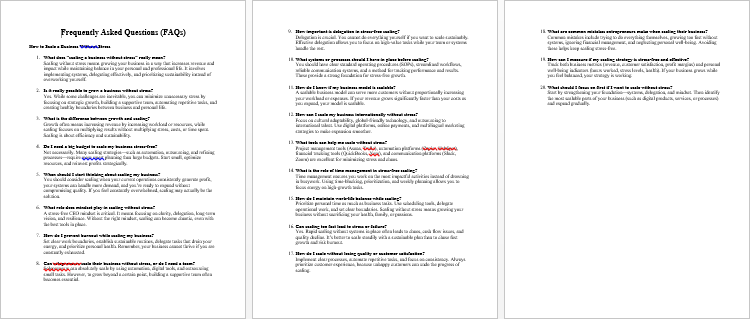
How to Scale a Business Without Stress – FAQs
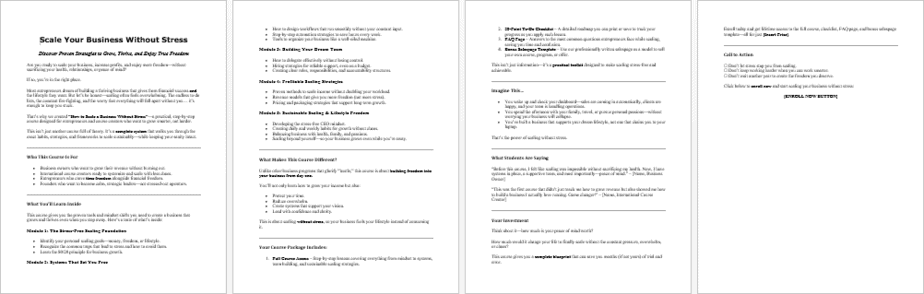
How to Scale a Business Without Stress – Salespage Content
Package Details:
Word Count: 34 496 Words
Number of Pages: 157
How to Build Multiple Streams of Income – Bonus Content
Checklist
Word Count: 540 words
FAQs
Word Count: 815 words
Salespage Content
Word Count: 843 words
Total Word Count: 36 694 Words
Your PLR License Terms
PERMISSIONS: What Can You Do With These Materials?
Sell the content basically as it is (with some minor tweaks to make it “yours”).
If you are going to claim copyright to anything created with this content, then you must substantially change at 75% of the content to distinguish yourself from other licensees.
Break up the content into small portions to sell as individual reports for $10-$20 each.
Bundle the content with other existing content to create larger products for $47-$97 each.
Setup your own membership site with the content and generate monthly residual payments!
Take the content and convert it into a multiple-week “eclass” that you charge $297-$497 to access!
Use the content to create a “physical” product that you sell for premium prices!
Convert it to audios, videos, membership site content and more.
Excerpt and / or edit portions of the content to give away for free as blog posts, reports, etc. to use as lead magnets, incentives and more!
Create your own original product from it, set it up at a site and “flip” the site for megabucks!
RESTRICTIONS: What Can’t You Do With These Materials?
To protect the value of these products, you may not pass on the rights to your customers. This means that your customers may not have PLR rights or reprint / resell rights passed on to them.
You may not pass on any kind of licensing (PLR, reprint / resell, etc.) to ANY offer created from ANY PORTION OF this content that would allow additional people to sell or give away any portion of the content contained in this package.
You may not offer 100% commission to affiliates selling your version / copy of this product. The maximum affiliate commission you may pay out for offers created that include parts of this content is 75%.
You are not permitted to give the complete materials away in their current state for free – they must be sold. They must be excerpted and / or edited to be given away, unless otherwise noted. Example: You ARE permitted to excerpt portions of content for blog posts, lead magnets, etc.
You may not add this content to any part of an existing customer order that would not require them to make an additional purchase. (IE You cannot add it to a package, membership site, etc. that customers have ALREADY paid for.)
Share Now!
Latest Products





Free Sales Funnel Builder

Related Products

Popular & Trending



Featured Products