
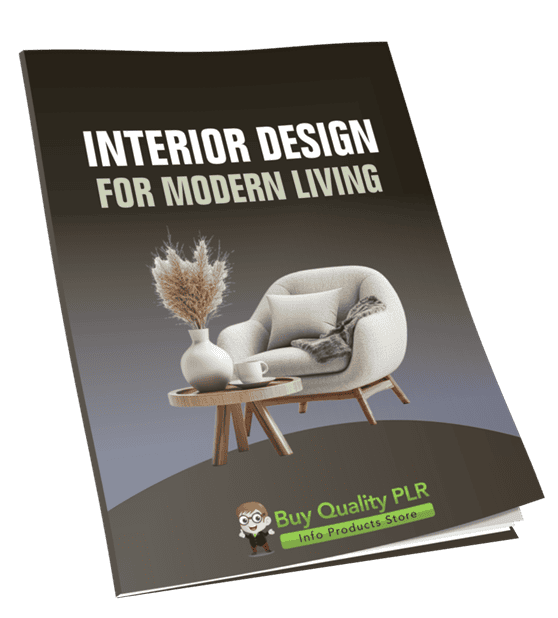
Interior Design for Modern Living PLR Course 34k Words
in Home Decor PLR , Home Improvement PLR , Home Remodeling PLR , Interior Design PLR , PLR eCourses , PLR List Building Reports , Premium PLR , Premium PLR Reports , Premium White Label Brandable PLR Coaching Courses , Private Label Rights ProductsChoose Your Desired Option(s)
has been added to your cart!
have been added to your cart!
#interiordesign #modernliving #plrcourse #homedecor #designinspiration #plrcontent #homestyling #creativedesign #lifestylebrand
Interior Design for Modern Living PLR Course – 34,000 Words
Transform Spaces, Inspire Creativity, and Teach Interior Design with a Complete PLR Course
Interior design isn’t just about making a room look good—it’s about creating spaces that feel right, function perfectly, and reflect personal style. Whether your audience is aspiring interior designers, homeowners, or creatives looking to refresh their spaces, the Interior Design for Modern Living PLR Course gives you everything needed to teach, sell, or repurpose premium content.
With 34,000 words of step-by-step instruction, this course is a comprehensive resource that covers interior design basics, spatial planning, color theory, lighting, styling, and personal touches to create beautiful, functional homes. Perfect for PLR resellers, online educators, coaches, or bloggers, this course comes ready to use, brand, and sell.
Introducing the…
Interior Design for Modern Living
Why Interior Design is a Hot Market
Interior design is a high-demand niche. People spend thousands improving their living and work spaces, but many don’t know where to start. This course taps into that demand by teaching:
- Foundational design principles for beginners and enthusiasts
- Practical, actionable techniques for real-life spaces
- Modern, stylish approaches that appeal to a broad audience
- Ways to balance aesthetics and functionality for livable homes
Whether used as a digital product, online course, or membership content, this PLR course provides ready-made value that can generate immediate revenue.
What’s Inside the Course
The course is organized into five modules, each with four lessons, providing learners with a structured, step-by-step path from interior design basics to full room makeovers.
Module 1: Getting Started with Interior Design
Goal: Lay the foundation and help learners understand the essentials before diving into actual design work.
- Lesson 1: What Interior Design Really Means
Explore what interior design is—and isn’t—and why it’s more than aesthetics. Learn how design transforms everyday spaces into inspiring, functional environments. - Lesson 2: Understanding the Elements of Design
Learn the building blocks of any room: color, texture, light, form, and space. Understand how each element affects mood and function. - Lesson 3: The Importance of Functionality in Design
Discover how to balance beauty with usability. Create spaces that are stylish and practical for everyday living. - Lesson 4: Identifying Your Design Style
Recognize your personal style—modern, minimal, eclectic, or classic—and see how it informs design decisions for consistent, cohesive spaces.
Module 2: Designing with Space in Mind
Goal: Teach learners to see and use space effectively.
- Lesson 1: Reading a Room
Learn to assess a space—its size, layout, and natural light—before making any design decisions. - Lesson 2: Furniture Placement 101
Easy rules for arranging furniture to create flow, balance, and comfort, regardless of room size. - Lesson 3: Making Small Spaces Feel Bigger
Practical tricks—like mirrors, vertical lines, and multifunction furniture—that visually expand any space. - Lesson 4: Creating Focal Points
Learn to draw the eye to one feature, like a fireplace, artwork, or accent wall, to anchor the room and create visual interest.
Module 3: Playing with Colors, Textures, and Patterns
Goal: Add life, personality, and depth to living spaces.
- Lesson 1: Color Psychology Basics
Understand how colors affect mood and energy. Learn to select palettes that enhance comfort, creativity, and style. - Lesson 2: Mixing and Matching Textures
Combine soft fabrics, shiny metals, rough woods, and smooth surfaces to create layered, tactile depth. - Lesson 3: Patterns Made Simple
Use stripes, florals, and geometrics strategically. Avoid clutter while giving spaces energy and personality. - Lesson 4: Creating a Cohesive Look
Blend colors, textures, and patterns systematically so that every element feels intentional and harmonious.
Module 4: Lighting and Accessories
Goal: Use lighting and décor to elevate rooms from good to exceptional.
- Lesson 1: Understanding Types of Lighting
Ambient, task, and accent lighting—learn how each type serves different purposes in your space. - Lesson 2: Choosing the Right Fixtures
Select lamps, chandeliers, and sconces that complement your design style and enhance the room’s functionality. - Lesson 3: Styling with Accessories
Transform rooms with pillows, rugs, art, and plants. Learn how small touches make a big visual impact. - Lesson 4: The Art of Layering Decor
Layer objects and accessories without clutter. Understand why less is often more and how to create a polished look.
Module 5: Bringing It All Together
Goal: Combine all elements into fully designed, functional spaces.
- Lesson 1: Room Makeover Step-by-Step
Practical guidance on redesigning a room from scratch using everything learned in previous modules. - Lesson 2: Budgeting Without Compromising Style
Tips for decorating on any budget. Learn to source affordable yet stylish items to make a space feel luxurious without overspending. - Lesson 3: Adding Your Personal Touch
Incorporate meaningful objects—family heirlooms, artwork, or photos—so the space reflects personality and story. - Lesson 4: Common Design Mistakes to Avoid
Avoid beginner pitfalls like overcrowding, mismatched palettes, and poor lighting. Simple fixes ensure professional results.
Bonus Materials
- Checklist – 577 Words: Step-by-step implementation guide for every module.
- FAQs – 768 Words: Answers to common questions about interior design and course application.
- Salespage – 844 Words: Ready-to-use marketing copy to resell the course.
Who Can Profit From This PLR Course
This course is perfect for:
- Aspiring interior designers wanting structured training content
- Homeowners and enthusiasts looking to sell guides, e-classes, or digital products
- PLR resellers seeking high-quality, ready-to-sell content
- Bloggers, YouTubers, and social media creators building tutorials or lead magnets
- Online educators wanting membership content, courses, or coaching programs
With PLR rights, this course can be rebranded, bundled, repurposed, and sold in multiple formats for maximum profit.
How to Use and Monetize This Course
Here are some practical ways to generate revenue:
- Sell as a Complete Digital Course – Offer as a ready-made course for $197–$497.
- Break into Mini-Guides or Reports – Sell individual lessons or modules for $10–$20 each.
- Bundle with Other PLR Products – Create larger packages priced $47–$97.
- Multi-Week E-Class – Convert into a step-by-step e-class and charge $297–$497.
- Membership Site Content – Generate recurring income with a subscription model.
- Physical Products – Turn lessons into books, journals, or workbooks for premium pricing.
- Repurpose for Marketing – Use content for blog posts, lead magnets, or email sequences.
- Flip a Site – Set up a site with this course and sell it for profit.
Licensing Terms
What You CAN Do:
- Sell the course as-is or with minor edits
- Claim copyright if you substantially modify 75%+ of the content
- Break it into smaller guides, reports, or membership content
- Bundle with other PLR products
- Use excerpts for marketing, blogs, or lead generation
What You CANNOT Do:
- Pass PLR rights to your customers
- Offer 100% affiliate commissions (max 75%)
- Give away the full course for free
- Include content in customer orders without purchase
Why Buy Quality PLR?
- Professionally written 34,000-word course ready for immediate use
- Comprehensive, step-by-step training suitable for beginners and enthusiasts
- High-demand niche with modern, practical, actionable content
- Save months of content creation while providing premium, sellable material
- Includes checklist, FAQs, and sales page copy for easy marketing
Bottom Line
The Interior Design for Modern Living PLR Course is a turnkey solution for anyone looking to:
- Teach interior design fundamentals to clients or students
- Launch a digital product in a high-demand niche
- Build recurring revenue with membership content or e-classes
- Monetize ready-made, professionally written PLR content
Sell it. Teach it. Repurpose it. Profit.
With this PLR course, you’re giving your audience the skills to create beautiful, functional, and stylish living spaces while providing yourself with a ready-to-sell, high-value product.
has been added to your cart!
have been added to your cart!
Here A Sample of the Interior Design for Modern Living PLR Course
Module 1: Getting Started with Interior Design
This module lays the foundation and helps learners understand the essentials before diving into actual design work.
Lesson 1: What Interior Design Really Means
Introduction
When most people hear the phrase “interior design,” they imagine picking out beautiful furniture, arranging decorative pillows, or choosing a paint color for the living room walls. While these activities can be part of the process, interior design is so much more than decorating. It is the art and science of understanding how people live, how spaces function, and how design choices influence both mood and lifestyle.
In this lesson, we will take a step-by-step look at what interior design really means, what it is not, why it matters in modern living, and how it has the power to transform ordinary rooms into inspiring, functional, and beautiful spaces. By the end, you will not only see design differently, but you will also appreciate the thought, planning, and creativity that go into creating environments people truly love.
Step 1: Defining Interior Design
Interior design is best described as the harmonious combination of aesthetics and functionality within a space. It involves balancing the look and feel of a room with its purpose and usability. Unlike simple decoration, interior design considers practical aspects such as lighting, circulation, ergonomics, storage, and spatial planning.
For example:
- A living room must be visually welcoming but also arranged to encourage conversation, relaxation, and entertainment.
- A kitchen needs to look appealing but should also be designed for efficient cooking and easy movement.
- A bedroom must feel calm and restful, but it also requires functional layouts for storage, comfort, and privacy.
This definition highlights an important principle: design is not just about how something looks—it is equally about how it works.
Step 2: What Interior Design Is NOT
To avoid confusion, it is helpful to understand what interior design is not:
- Interior design is not only decoration.
Decoration deals with the surface level: color schemes, fabrics, artwork, and furniture. While these are important, they are only the finishing touches. Interior design involves the structural, spatial, and functional elements that form the backbone of a room. - Interior design is not architecture.
Architects design the structure of a building—walls, floors, roofs, and load-bearing elements. Interior designers work within that structure to make the interior both functional and beautiful. In some cases, the lines blur, but generally, design focuses inward while architecture focuses outward. - Interior design is not random or impulsive.
Some people assume design is about following trends or simply arranging furniture until something looks good. In reality, interior design follows tested principles, from proportion and balance to rhythm and harmony, which ensure a space feels intentional and cohesive.
By clearing up these misunderstandings, we can see interior design as a profession that blends creativity with problem-solving.
Step 3: Why Interior Design Matters
Interior design impacts far more than aesthetics. It influences how people feel, think, and behave in a space. Here are a few reasons why it matters deeply:
- Well-being and Comfort: A thoughtfully designed space can reduce stress, promote relaxation, and enhance mood. For example, a calming bedroom with soft colors and strategic lighting supports better sleep.
- Efficiency and Productivity: In workspaces, good design improves focus and workflow. A poorly designed office, by contrast, may create frustration or distraction.
- Identity and Expression: Design allows people to express their personalities and cultural influences through their environments. It’s a form of storytelling that makes a home or space feel unique.
- Practical Living: Smart design ensures that storage, traffic flow, and furniture arrangements support daily routines, rather than hinder them.
- Economic Value: Well-designed interiors increase property value, attract renters or buyers, and stand the test of time compared to quickly outdated styles.
When you think of design this way, you realize it touches every aspect of life—from the home you live in to the cafés, offices, hotels, and even airports you pass through.
Step 4: The Principles That Guide Interior Design
Interior design is built on universal principles. These are not rigid rules, but they provide a framework for creating harmonious and functional spaces.
- Balance: Ensuring that furniture, colors, and visual weight feel evenly distributed. Balance can be symmetrical, asymmetrical, or radial.
- Proportion and Scale: Making sure objects fit comfortably in relation to each other and the room size. For instance, a tiny rug in a large living room will feel out of place.
- Rhythm: Creating a sense of flow by repeating colors, shapes, or lines throughout the space.
- Emphasis: Establishing focal points—like a fireplace, artwork, or accent wall—that give the eye somewhere to rest.
- Harmony and Unity: Ensuring all elements—furniture, colors, textures—work together to create a cohesive look.
These principles help designers achieve spaces that not only look good but also “feel right” to the people using them.
Step 5: The Role of Culture and Context
Interior design is not universal; it adapts to cultural, regional, and lifestyle needs. A modern Scandinavian design emphasizes simplicity, natural light, and minimalism. In contrast, Moroccan interiors highlight bold colors, intricate patterns, and handcrafted details.
As international course creators, it’s important to recognize that students and clients bring their own cultural expectations into the design process. Design is not about imposing one aesthetic; it is about respecting local traditions while applying universal principles. This sensitivity makes interior design inclusive and adaptable across the globe.
Step 6: The Emotional Power of Design
Spaces influence emotions in subtle but powerful ways. Think about walking into a dimly lit, cluttered room versus entering a bright, airy one with clean lines. The difference is immediate.
- Colors affect mood: Blues can feel calming, reds energizing, greens refreshing.
- Lighting sets atmosphere: Soft lighting creates intimacy, while bright lighting energizes a workspace.
- Textures evoke feelings: Plush fabrics suggest comfort, while sleek glass feels modern and sophisticated.
When designers understand these emotional cues, they can intentionally create environments that support human needs—whether that is relaxation, productivity, creativity, or social connection.
Step 7: Everyday Examples of Interior Design in Action
To better understand interior design, let’s look at some everyday examples:
- A coffee shop: The seating arrangement encourages customers to either work privately or chat socially. Lighting is warm to make the space inviting, while design details reflect the brand’s personality.
- A hotel lobby: The grand chandeliers, spacious layout, and comfortable seating set a tone of luxury and welcome.
- A child’s playroom: Bright colors, soft flooring, and safe furniture placement combine to encourage play and creativity while protecting safety.
Each of these spaces has been designed with intention. They may feel natural and effortless, but behind the scenes, careful planning has shaped every detail.
Step 8: Misconceptions That Hold People Back
Because design seems so accessible, many people assume they don’t need guidance. Some of the most common misconceptions include:
- “Design is too expensive.” In truth, even small adjustments—like rearranging furniture or repainting a room—can make dramatic changes without large budgets.
- “Design is just about following trends.” Trends come and go, but timeless design is rooted in principles that outlast fashion.
- “Anyone can do design.” While creativity is open to all, professional interior design combines technical knowledge, spatial awareness, and problem-solving skills that go far beyond decoration.
By addressing these misconceptions early, learners can approach design with realistic expectations and deeper appreciation.
Step 9: How Interior Design Transforms Spaces
The heart of this lesson lies in understanding transformation. Interior design takes ordinary environments and elevates them to meet both practical and emotional needs.
Consider these transformations:
- A cluttered studio apartment can be reimagined with multi-functional furniture, hidden storage, and light-reflective colors, making it feel larger and calmer.
- A dull corporate office can become an inspiring workplace with ergonomic furniture, natural light, and biophilic design elements (plants, natural materials).
- An outdated living room can be renewed with a fresh color scheme, strategic lighting, and carefully selected décor, turning it into a space for family gatherings and relaxation.
The true transformation is not just visual—it’s about how people live and feel in the space afterward.
Step 10: The Bigger Picture of Interior Design
Interior design plays a larger role in shaping society than many realize. Sustainable design practices help reduce environmental impact by using eco-friendly materials and energy-efficient solutions. Universal design ensures accessibility so people of all abilities can enjoy a space comfortably. Technology integration allows for smart homes that combine beauty with convenience.
In this way, interior design reflects the values of modern living: functionality, beauty, sustainability, inclusivity, and innovation.
Conclusion
Interior design is not simply decorating; it is the thoughtful art and science of shaping spaces to improve quality of life. It combines creativity with practical problem-solving and requires a balance of aesthetics, function, and emotion. It adapts across cultures, influences how people feel and behave, and has the power to transform ordinary rooms into extraordinary experiences.
By truly understanding what interior design means, we set the foundation for all the lessons to come. Every color choice, furniture placement, or lighting decision becomes part of a bigger story—the story of creating beautiful spaces that support modern living.
Lesson 2: Understanding the Elements of Design
Introduction
Every beautifully designed space, no matter how different in style, culture, or purpose, relies on the same set of building blocks. These are known as the elements of design. Think of them as the alphabet of interior design: once you understand the letters, you can form words, sentences, and entire stories. In interior design, these elements—color, texture, light, form, and space—combine to create harmonious, functional, and inspiring environments.
In this lesson, we will break down each element in detail, explore its role, and learn step-by-step how it can be applied in real interiors. By the end, you will have a clear framework for analyzing and shaping any room, regardless of style or scale.
Step 1: The Element of Color
Color is often the first thing people notice in a room. It has an immediate impact, setting mood, tone, and atmosphere. But color is much more than decoration—it is a powerful psychological tool.
- The Basics of Color Theory
- Primary colors: Red, blue, yellow.
- Secondary colors: Orange, green, purple (created by mixing primary colors).
- Tertiary colors: Created by mixing primary with secondary colors.
- Warm colors (reds, oranges, yellows) create energy and vibrancy.
- Cool colors (blues, greens, purples) bring calm and relaxation.
- Color Psychology in Interiors
- Red: Stimulating, energetic; ideal for dining spaces or accents.
- Blue: Calming, peaceful; commonly used in bedrooms and bathrooms.
- Green: Refreshing, natural; suitable for living rooms or offices.
- Yellow: Cheerful, uplifting; best for kitchens or social spaces.
- Neutral tones (white, beige, grey): Versatile, timeless, and create balance.
- Practical Application
When designing, start with a base color (walls or flooring), then add secondary colors (furniture, rugs), and finish with accent colors (art, pillows, accessories). This three-level approach ensures a balanced palette.
Color is not just visual—it affects how big or small a space feels. Dark shades make rooms feel intimate, while lighter shades open them up. Understanding this allows you to use color strategically, not just aesthetically.
Step 2: The Element of Texture
Texture is what makes a space feel alive. Without it, even the most colorful room can look flat and boring. Texture refers to how surfaces feel (or appear to feel), and it adds depth and dimension to design.
- Types of Texture
- Visual texture: How something looks (a wallpaper that mimics wood grain).
- Tactile texture: How something actually feels (a rough brick wall, soft velvet sofa).
- Balancing Textures
A well-designed room uses a mix of textures:- Smooth and rough (glass table with jute rug).
- Soft and hard (plush cushions with wooden furniture).
- Matte and shiny (ceramic vase beside a polished metal lamp).
- Why Texture Matters
Texture creates warmth, comfort, and richness. Imagine a modern minimalist room with only sleek, smooth surfaces—it risks feeling cold and lifeless. Add a knitted throw blanket, a wool rug, and wooden shelves, and suddenly the space feels inviting. - Practical Application
To apply texture:- Use textiles (rugs, curtains, cushions).
- Add natural elements (wood, stone, plants).
- Combine finishes (polished marble with matte ceramic).
Texture appeals to both sight and touch, making a room not only beautiful but also emotionally engaging.
Step 3: The Element of Light
Lighting is often called the unsung hero of interior design. Even the best colors, furniture, or artwork fall flat without proper lighting. Light influences mood, functionality, and the perception of space.
- Types of Lighting
- Ambient lighting: General illumination (ceiling lights, recessed lighting).
- Task lighting: Focused light for specific activities (desk lamp, kitchen counter light).
- Accent lighting: Decorative or mood-enhancing (spotlights on art, wall sconces).
- Natural vs. Artificial Light
- Natural light brings warmth and freshness. Designers often maximize it with large windows, mirrors, and light-reflective colors.
- Artificial light allows control and creativity—through dimmers, colored bulbs, or layered lighting systems.
- Light and Color
Light alters how colors appear. A blue wall under warm light may look greener, while the same wall under cool daylight looks crisp blue. Always test paint and fabrics under different lighting before finalizing choices. - Practical Application
- Layer lighting: combine ambient, task, and accent.
- Use dimmers for flexibility.
- Position lights to highlight focal points and avoid shadows in functional areas.
Light transforms a space not just visually but emotionally. A dining room lit by a soft pendant lamp feels intimate, while the same room under bright fluorescent light feels clinical.
Step 4: The Element of Form
Form refers to the shape and structure of objects in a room. It is what gives furniture, décor, and architecture their physical presence. Form can be geometric, organic, or a blend of both.
- Types of Form
- Geometric forms: Straight lines, sharp angles (rectangular tables, square shelves).
- Organic forms: Natural, flowing shapes (curved sofas, round tables, irregular vases).
- Form and Function
Form is not just about appearance—it affects usability. A round dining table may create intimacy by bringing people closer, while a rectangular one suits larger gatherings. - Balance of Forms
Too many geometric forms can feel rigid and cold. Too many organic forms may look chaotic. A good design balances both—for example, pairing a square coffee table with a curved sofa. - Practical Application
- Consider human movement when choosing forms (curved edges in small spaces prevent obstruction).
- Use repeated forms to create rhythm (several round mirrors on a wall).
- Allow a mix to add variety and interest.
Form shapes the personality of a room—whether structured and formal, or relaxed and organic.
Step 5: The Element of Space
Space is the canvas on which all other design elements are placed. Without understanding space, even the best colors, textures, or forms can feel misplaced.
- Positive and Negative Space
- Positive space: The area filled with furniture, objects, or décor.
- Negative space: The empty area that surrounds and separates those objects.
A common mistake is overcrowding a room with furniture, leaving no negative space. On the other hand, too much negative space can make a room feel empty and unfinished.
- Types of Space
- Two-dimensional space: Floor plan, considering length and width.
- Three-dimensional space: Adds height, which affects how volume is perceived.
- Practical Application
- Maintain walking paths and circulation zones.
- Use vertical space (shelves, tall plants, wall art) to expand small rooms.
- Balance filled and empty areas for harmony.
Space is perhaps the most fundamental element because it dictates how people move, interact, and experience a room.
Step 6: How the Elements Work Together
While each element—color, texture, light, form, and space—is powerful individually, the true magic happens when they are combined.
- A light-filled room painted in cool colors with textured fabrics feels refreshing and calm.
- A dimly lit room with warm colors, soft textures, and organic forms feels intimate and cozy.
- A modern office with geometric forms, neutral colors, ample negative space, and bright task lighting supports productivity.
The secret is balance. Overemphasizing one element while ignoring others can disrupt harmony. For example, a room full of bold colors but lacking texture or light variation may feel overwhelming.
Step 7: Cultural and Global Interpretations of Design Elements
As this course is for international learners, it’s important to note that the perception of these elements changes across cultures.
- Color: In Western cultures, white often symbolizes purity, while in some Asian cultures, it represents mourning. Designers must be culturally sensitive when using colors.
- Texture and Materials: Tropical countries may favor light, airy fabrics, while colder regions value heavier, insulating textures.
- Light: In Nordic design, maximizing natural light is essential due to long winters. In desert regions, light is filtered to reduce heat.
- Form: Minimalist Japanese interiors emphasize clean, geometric forms, while Indian interiors often celebrate organic and ornate details.
Recognizing these cultural nuances makes design globally relevant and respectful.
Step 8: Practical Design Exercise
To internalize these concepts, imagine redesigning a living room:
- Choose a color scheme (base, secondary, accent).
- Add textures: mix smooth (glass table), soft (wool rug), rough (wooden chair).
- Plan lighting layers: overhead for ambient, floor lamp for task, wall sconces for accent.
- Select forms: balance a rectangular sofa with a round coffee table.
- Consider space: leave pathways for circulation, use shelves for vertical storage, and avoid overcrowding.
This simple exercise demonstrates how each element works in harmony.
Conclusion
The elements of design—color, texture, light, form, and space—are the foundation of every successful interior. They are universal yet flexible, scientific yet artistic. Understanding them allows designers to move beyond guesswork and create intentional, beautiful spaces that respond to human needs and cultural contexts.
When applied thoughtfully, these elements can turn any room into an environment that feels not only stylish but also functional, welcoming, and deeply connected to the people who use it.
Lesson 3: The Importance of Functionality in Design
Theme: Beautiful design must also be practical—here’s how to balance style with everyday living needs.
Introduction
A room can be stunning in photos and still feel frustrating in daily life. True interior design solves real problems first, then elevates the solution with style. Functionality is about how comfortably, safely, and efficiently people use a space—day after day. When function leads, beauty lasts longer, because a space that works well is loved, maintained, and naturally admired. In this lesson, you’ll learn a practical, step-by-step approach to designing spaces that look great and perform even better.
Step 1: Define Function Before Form
Start every project by writing a concise purpose statement for the room.
- Identify primary activities (e.g., sleeping, cooking, studying, entertaining).
- Note secondary activities (e.g., reading, yoga, crafts).
- List required capacities (e.g., seating for 6, workstation for 2, storage for seasonal items).
- Rank priorities (must-have, nice-to-have, optional).
Keep this statement visible through the whole process. When stylistic choices create conflict, the purpose statement decides.
Step 2: Profile the Users and Routines
Design for real people, not for trends.
- Users: adults, children, elderly, guests, pets.
- Body dimensions and mobility: consider height ranges, reach, and any accessibility needs.
- Schedules and habits: morning vs. evening heavy use, meal routines, work-from-home patterns.
- Possessions: volume and types (books, instruments, sports gear, cookware).
- Tolerance for maintenance: low-maintenance finishes vs. high-care materials.
Documenting these details prevents attractive but impractical choices.
Step 3: Map Activities into Zones
Translate the purpose and user profile into activity zones on a plan (scale 1:50 or 1:100 recommended).
- Group related tasks: conversation zone, media zone, prep zone, dining zone, study zone.
- Set adjacency rules: noisy next to noisy, quiet next to quiet.
- Define support zones: storage, charging, waste/recycling, cleaning supplies.
- Plan circulation: aim for clear paths 900–1,100 mm (≈ 36–43 in) wide in main routes; 600–800 mm (≈ 24–31 in) for secondary.
- Use symbols: arrows for flow, dashed lines for clearances, rectangles for furniture footprints.
Zoning ensures the room’s layout serves life—not the other way around.
Step 4: Get Ergonomics Right
Comfort and health come from anthropometrics and ergonomics—the fit between body and environment.
- Key dimensions (guidelines, not codes):
- Dining table height: 730–760 mm (≈ 29–30 in).
- Dining chair seat height: 430–460 mm (≈ 17–18 in).
- Kitchen counter height: 900 ± 25 mm (≈ 36 ± 1 in).
- Desk height: 710–740 mm (≈ 28–29 in).
- Bed height to top of mattress: 500–600 mm (≈ 20–24 in).
- Wardrobe depth: 600 mm (≈ 24 in) for hanging clothes.
- Reach zones (comfortable): 650–1,600 mm (≈ 26–63 in) above floor.
- Clearances:
- Pull-out drawers/doors: leave 900 mm (≈ 36 in) in front.
- Dining chair pull-back: 900–1,000 mm (≈ 36–39 in).
- Wheelchair turning circle: Ø 1,500 mm (≈ Ø 60 in).
- Work surfaces: match tasks to heights (e.g., pastry work slightly lower than general prep).
Ergonomics prevents fatigue and injuries and makes tasks feel effortless.
Step 5: Plan Furniture for Use, Not Only Looks
Choose forms and sizes that support activities and flow.
- Scale & proportion: large sofas in small rooms compress circulation; use 1:20 paper cutouts to test fit.
- Conversation geometry: face-to-face distance 1,800–2,700 mm (≈ 6–9 ft) is comfortable; arrange seating in a “U” or “L”.
- Tables: round tables enhance social interaction in tight rooms; rectangular serve linear spaces.
- Edges & corners: rounded edges near walkways reduce bumps in tight apartments.
- Multi-function: extendable dining, nesting tables, sofa beds, ottomans with storage.
Always confirm that doors, drawers, and windows can open fully with people seated or walking by.
Step 6: Design Storage as Infrastructure
Beautiful rooms stay beautiful because clutter has a home.
- Inventory first: estimate volumes in litres or ft³ for books, toys, files, linens, equipment.
- Allocate by frequency:
- Daily-use: at arm level 900–1,600 mm (≈ 36–63 in).
- Occasional: higher than 1,600 mm or lower than 450 mm (≈ 18 in).
- Rare/seasonal: lofts, under-bed, overhead cabinets.
- Depth matters:
- Shelves for books: 250–300 mm (≈ 10–12 in).
- Kitchen base cabinets: 600 mm (≈ 24 in).
- Shallow “drop zones”: 150–200 mm (≈ 6–8 in) near entry for keys/mail.
- Vertical solutions: wall-hung units, pegboards, tall wardrobes, over-door racks.
- Smart inserts: drawer dividers, pull-out trays, lazy susans, file rails.
Treat storage like a utility line—planned early, routed logically, sized correctly.
Step 7: Lighting That Works as Hard as You Do
Layer light for tasks, safety, and atmosphere.
- Ambient (general): uniform base light—ceiling fixtures, recessed downlights.
- Task: focused light where you work—pendants over counters, under-cabinet strips (kitchen), reading lamps (bed/living), 300–500 lx for task areas.
- Accent: drama and focus—wall washers on art, sconces, LED strips in niches.
- Color temperature (K):
- 2,700–3,000 K warm for living/sleeping.
- 3,500–4,000 K neutral for kitchens/baths.
- 4,000–5,000 K cool for study/workshops (where alertness is key).
- Controls: dimmers, 2-way switching, motion sensors at entries, bedside master off.
- Glare & shadows: position task lights from the opposite side of your working hand; diffuse bare bulbs.
Great lighting reveals materials, supports rituals, and saves energy when specified wisely.
Step 8: Acoustics and Privacy
Sound is part of function. Plan for it.
- Absorb: soft materials—rugs, curtains, upholstered furniture, acoustic panels (NRC-rated where available).
- Block: solid doors, seals, heavier partitions, bookshelves as mass.
- Cover: gentle background sound (fountains, white noise) where blocking isn’t feasible.
- Zoning for noise: place bedrooms away from loud streets; separate study zones from TV walls.
- Gaps & flanking paths: seal around frames, use thresholds, consider ceiling/floor transmission in multi-storey homes.
Quiet rooms feel larger and more luxurious because the mind can rest.
Step 9: Safety and Accessibility as Baselines
Beauty never excuses risk. Design for universal access and everyday safety.
- Widths & reaches: 810 mm (≈ 32 in) clear doorways; 1,500 mm (≈ 60 in) turning circle where wheelchairs are expected.
- Stairs: consistent risers and treads, handrails both sides where possible, good lighting.
- Slips & trips: non-slip finishes (R-ratings where specified), level transitions, secure rugs with underlay.
- Edges & heights: tempered glass where required; guard rails; child-safe locks in high-risk zones.
- Fire & ventilation: keep egress paths clear; position detectors; respect safe distances around cooktops (≥ 450 mm / 18 in from side walls when possible).
- Bathrooms: grab-bar backing planned at framing stage; shower entries flush or low threshold; anti-scald mixers.
Always verify local codes and standards; use these figures as practical guidelines for planning.
Step 10: Materials for Durability and Maintenance
Long-term function depends on performance, not only appearance.
- Flooring: choose abrasion resistance for high-traffic (entry, kitchen), sound-friendly for bedrooms.
- Worktops: stain/heat/scratch resistance where food prep occurs.
- Upholstery: removable/washable covers in family zones; higher rub counts for commercial-like wear.
- Walls: scrubbable paints in corridors and kid zones; tile or washable panels in splash areas.
- Sunlight: specify UV-resistant finishes and window treatments to reduce fading.
- Repairability: prefer systems with replaceable parts (plinths, tiles, modular planks).
Low-maintenance materials keep spaces looking good without constant effort.
Step 11: Climate, Daylight, and Thermal Comfort
Design responds to environment.
- Daylight strategy: reflectance of surfaces (light ceilings/walls), mirrors opposite windows, light-shelves where applicable.
- Heat & cold: insulate envelopes, seal drafts, use rugs on cold floors, specify ceiling fans (summer) and layered window treatments (winter).
- Cross-ventilation: align openings for airflow; avoid blocking with tall furniture.
- Humidity control: exhaust in kitchens/baths; breathable materials where climate demands.
- Window orientation: shade west/south-west (in hot climates); harvest low winter sun (in cool climates) with appropriate glazing.
Comfort is a function; style supports it through textures and colors that suit the climate.
Step 12: Technology and Power Planning
Future-proof everyday living.
- Power & data: locate outlets where devices actually live: bedsides (both sides), sofa arms, desks, kitchen islands.
- Heights: general outlets 300–450 mm (≈ 12–18 in) above finished floor; countertop outlets 1,050–1,200 mm (≈ 41–47 in) or to local standards; USB-C where useful.
- Cable management: grommets, trunking, wall cavities, media cabinets with ventilation.
- Smart controls: central hubs near entries; separate circuits for scenes (work/relax/clean).
- Equipment ventilation: leave clearance and airflow behind AV receivers, routers, fridges, servers.
Technology should disappear visually while being effortlessly accessible.
Step 13: Budget for Function First
Allocate funds where they produce the most daily value.
- High-impact functional spends: mattresses, task chairs, kitchen hardware, lighting controls, durable flooring.
- Save smart: decorative items you can upgrade later—throws, cushions, art prints.
- Phasing: install infrastructure (power, storage shells, lighting circuits) first; add decorative layers as budget allows.
- 80/20 rule: 20% of items used 80% of the time deserve premium performance.
A functional budget yields a home that feels expensive because it performs effortlessly.
Step 14: Balance Style with Function—Decision Framework
When style and function clash, use this checklist:
- Does it hinder a major activity? If yes, modify or replace.
- Can the look be achieved differently? Explore alternative materials, finishes, or forms.
- Is the compromise reversible? Choose solutions you can adjust later (e.g., slipcovers, modular shelving).
- What’s the lifecycle cost? A cheap, high-maintenance choice is more expensive over time.
- Does it support the room’s mood? A functional solution that undermines the atmosphere may need refinement—adjust textures, colors, or lighting to harmonize.
Design maturity shows in quiet, unseen decisions that make daily life smoother.
Step 15: Mini Case Studies—Applying the Balance
A. Living Room (multi-use)
- Function first: seating for 5–6, clear TV sightlines, reading corner, storage for media/toys.
- Layout: “L” sofa + armchair; 450 mm (≈ 18 in) from seat to coffee table; 900 mm (≈ 36 in) circulation.
- Lighting: floor lamp for reading (task), dimmable ceiling ambient, wall washer for art (accent).
- Storage: low media unit + closed cabinets for visual calm; baskets for quick clean-up.
- Style balance: select a textured rug and cushions to soften, art to personalize—without blocking traffic.
B. Kitchen (workshop + social hub)
- Function first: prep, cook, clean triangle; breakfast seating; pantry access.
- Clearances: 1,000–1,200 mm (≈ 39–47 in) aisle width; 1,100 mm (≈ 43 in) around island for two cooks.
- Surfaces: durable countertops, easy-clean backsplashes.
- Lighting: under-cabinet task lights; pendants over island at 700–800 mm (≈ 27–31 in) above top.
- Style balance: warm timber fronts + matte hardware for grip; color in stools or small appliances to avoid visual heaviness.
C. Bedroom (rest + storage)
- Function first: restorative sleep, dressing, minimal nighttime obstacles.
- Layout: 600–700 mm (≈ 24–28 in) both sides of bed; bedside tables with drawers; soft path lighting.
- Materials: blackout curtains; quiet door hardware; low-VOC finishes.
- Style balance: layered textiles for comfort; art scaled to headboard; calm palette suited to local daylight.
D. Home Office (focus + ergonomics)
- Function first: 2 screens, video calls, filing within reach.
- Ergonomics: adjustable chair; monitor top at eye level; keyboard height to keep wrists neutral.
- Acoustics: soft surfaces near mic; door seals.
- Lighting: 4,000 K task light beside, not behind, the screen.
- Style balance: minimal visual noise in camera view; plant for liveliness without stealing desk space.
Step 16: Test, Simulate, and Iterate
Before committing, prototype the experience.
- Tape the plan on the floor at full scale to test circulation.
- Mock clearances by temporarily placing boxes where furniture will sit.
- Light tests: sample lamps at dusk/night; check glare on screens and reflections on art.
- Sound checks: clap test for echo; add soft layers until the echo calms.
- Usability drill: simulate a day—prepare a meal, host a “mock” guest, do laundry—note friction points.
Refinements discovered here are cheaper than post-installation regrets.
Step 17: Document Functional Specs Clearly
Good documentation keeps the build faithful to the design intent.
- Plans & elevations: dimensioned; show centerlines, clearances, and mounting heights.
- Schedules: doors, finishes, lighting, outlets—with codes and quantities.
- Details: sections of joinery, edge profiles, hardware specs, ventilation paths.
- Operating notes: cleaning instructions, load limits for shelves, maximum TV size, bulb types.
- Labels: use consistent symbols (Ø for diameter, m² for area, K for color temperature, lx for illuminance).
Clear specs protect function during procurement and installation.
Step 18: Measure Performance After Move-In
Functional design improves with feedback.
- Checklists: circulation unobstructed, storage not overflowing, lighting scenes used.
- Simple metrics:
- Storage capacity per room (L or ft³ per m²).
- Seating capacity vs. typical group size.
- Task lighting levels (approximate with a light meter app).
- Behavioral cues: are items piling on surfaces, are doors left open for lack of airflow, are specific lights never used?
- Adjust: swap bulbs, add hooks, reassign cabinets, move rugs for safety.
A lived-in space teaches you what to perfect.
Conclusion
Functionality is the backbone of design. It translates human needs into spatial solutions: clear zones, ergonomic dimensions, practical storage, supportive lighting, quiet acoustics, safe access, durable materials, and thoughtful technology. Style then expresses identity and culture over this solid framework. When you begin with function and refine with beauty, the result is a room that looks right, feels right, and works right—today and for years to come.
We’re also giving these extra bonuses
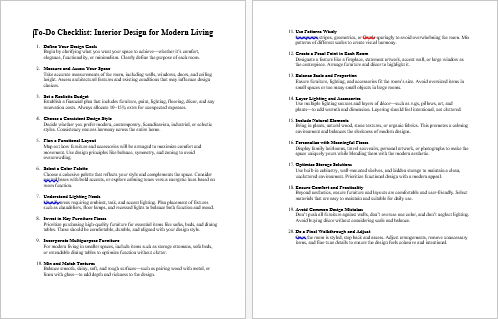
Interior Design for Modern Living – Checklist
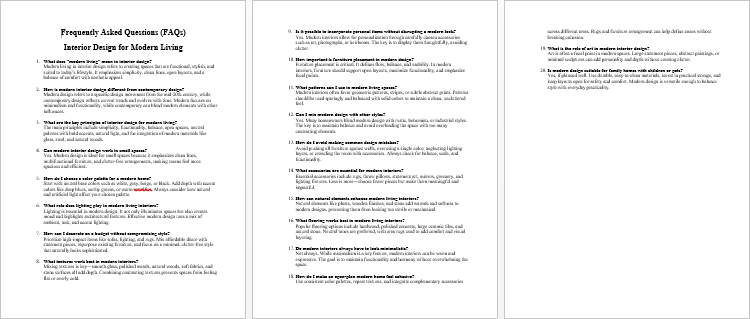
Interior Design for Modern Living – FAQs
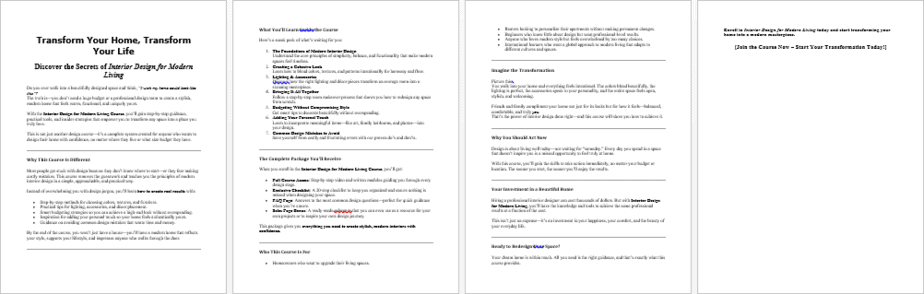
Interior Design for Modern Living – Salespage Content
Package Details:
Word Count: 32 735 Words
Number of Pages: 132
Interior Design for Modern Living – Bonus Content
Checklist
Word Count: 577 words
FAQs
Word Count: 768 words
Salespage Content
Word Count: 844 words
Total Word Count: 34 924 Words
Your PLR License Terms
PERMISSIONS: What Can You Do With These Materials?
Sell the content basically as it is (with some minor tweaks to make it “yours”).
If you are going to claim copyright to anything created with this content, then you must substantially change at 75% of the content to distinguish yourself from other licensees.
Break up the content into small portions to sell as individual reports for $10-$20 each.
Bundle the content with other existing content to create larger products for $47-$97 each.
Setup your own membership site with the content and generate monthly residual payments!
Take the content and convert it into a multiple-week “eclass” that you charge $297-$497 to access!
Use the content to create a “physical” product that you sell for premium prices!
Convert it to audios, videos, membership site content and more.
Excerpt and / or edit portions of the content to give away for free as blog posts, reports, etc. to use as lead magnets, incentives and more!
Create your own original product from it, set it up at a site and “flip” the site for megabucks!
RESTRICTIONS: What Can’t You Do With These Materials?
To protect the value of these products, you may not pass on the rights to your customers. This means that your customers may not have PLR rights or reprint / resell rights passed on to them.
You may not pass on any kind of licensing (PLR, reprint / resell, etc.) to ANY offer created from ANY PORTION OF this content that would allow additional people to sell or give away any portion of the content contained in this package.
You may not offer 100% commission to affiliates selling your version / copy of this product. The maximum affiliate commission you may pay out for offers created that include parts of this content is 75%.
You are not permitted to give the complete materials away in their current state for free – they must be sold. They must be excerpted and / or edited to be given away, unless otherwise noted. Example: You ARE permitted to excerpt portions of content for blog posts, lead magnets, etc.
You may not add this content to any part of an existing customer order that would not require them to make an additional purchase. (IE You cannot add it to a package, membership site, etc. that customers have ALREADY paid for.)
Share Now!
Latest Products




Free Sales Funnel Builder

Related Products
Popular & Trending



Featured Products