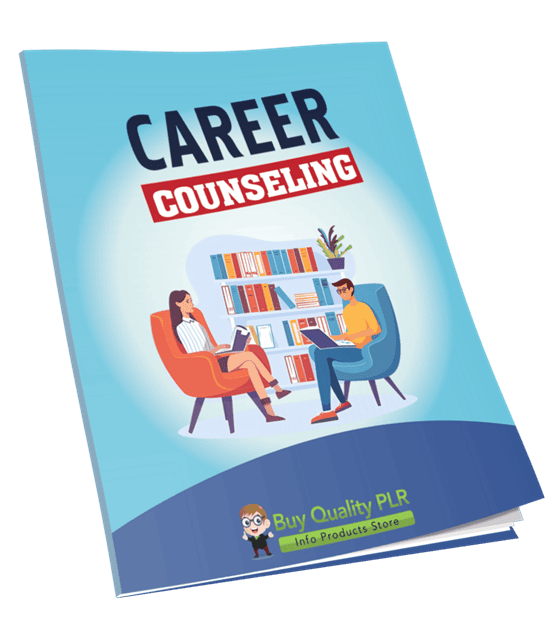
Career Counseling PLR Course 18k Words
in Business Coaching PLR , Business Coaching PLR Ebooks , Business PLR , Business PLR eBooks , PLR eCourses , PLR List Building Reports , Premium PLR , Premium PLR eBooks , Premium PLR Reports , Premium White Label Brandable PLR Coaching Courses , Private Label Rights ProductsChoose Your Desired Option(s)
has been added to your cart!
have been added to your cart!
#careercounseling #careercoaching #professionaldevelopment #jobsearchsupport #plrcontent #educationmarketing #plrcourse #careersuccess
A Step-by-Step Guide to Guiding Careers with Confidence
Create a High-Value Career & Coaching Product Without Starting From Scratch
Career advice is in constant demand. Students feel unsure about their future, professionals want career direction, and job seekers are overwhelmed by choices. Yet most people providing career support struggle to package their knowledge into a structured, sellable product.
That’s where the Career Counseling PLR Course comes in.
This professionally written, easy-to-follow course gives you everything you need to launch a career counseling product quickly and confidently—without spending months researching, organizing, and writing content yourself.
Whether your audience is:
- Students choosing career paths
- Professionals changing industries
- Job seekers returning to the workforce
- Coaches and mentors expanding services
This PLR course provides a ready-made foundation you can rebrand, customize, and sell as your own.
Introducing the…
Career Counseling PLR Course 18k Words
Why Career Counseling Is a Powerful PLR Niche
Career guidance sits at the intersection of education, self-development, coaching, and employment—making it one of the most versatile and evergreen niches available.
✅ Works for students and adults
✅ Ideal for online courses, coaching, and memberships
✅ Appeals to schools, training providers, and coaches
✅ Evergreen topic with consistent demand
✅ High perceived value
Career decisions impact income, lifestyle, confidence, and long-term fulfillment—making this topic easy to market and monetize.
Course Overview
Career Counseling: A Step-by-Step Guide to Guiding Careers with Confidence is designed to walk learners through the complete career counseling process, from foundational understanding to ethical practice and continued professional growth.
The course follows a clear, supportive, and conversational structure, making it suitable for beginners and intermediates alike.
The training is divided into 5 practical modules, each containing 4 structured steps that guide learners logically from understanding to application.
What’s Inside the Career Counseling Course
Module 1: Foundations of Career Counseling
This module lays the groundwork for understanding career guidance in today’s evolving job market.
Learners explore:
- What career counseling truly is and why it matters
- The modern role of a career counselor
- Essential skills like empathy, communication, and problem-solving
- Common career counseling theories and models used worldwide
This module builds confidence and ensures learners understand their responsibility and impact when guiding others.
Module 2: Understanding the Client
Career counseling starts with people—not job titles. This module focuses on meaningful, trust-based client relationships.
Key topics include:
- Building rapport and trust from the first session
- Conducting career and personality assessments
- Identifying true career goals, values, and motivations
- Recognizing readiness and common career barriers
This section teaches learners how to listen deeply, not just advise.
Module 3: Career Exploration and Planning
Here, learners move from discovery to action.
This module covers:
- Career exploration and research techniques
- Helping clients identify real-world opportunities
- Goal setting using SMART frameworks
- Creating actionable career development plans
- Decision-making tools to reduce confusion and overwhelm
By the end of this module, learners can confidently guide clients toward informed career decisions.
Module 4: Career Transitions and Job Search Skills
Career transitions can be emotionally and practically challenging—and this module addresses both.
Learners are taught how to:
- Support clients changing careers or re-entering the workforce
- Review and guide resumes and cover letters
- Conduct mock interviews and provide helpful feedback
- Teach networking and LinkedIn strategies
This module equips learners with hands-on career support tools clients actively seek.
Module 5: Ethical Practice and Continuous Growth
Career counseling is not just about advice—it’s about responsibility.
This module focuses on:
- Ethics, confidentiality, and professional boundaries
- Knowing when referrals are necessary
- Keeping up with evolving career and employment trends
- Reflecting on personal growth and professional development
Learners finish the course with clarity, confidence, and a professional mindset.
What Learners Will Be Able to Do After Completing This Course
✔ Guide individuals through career exploration with structure and clarity
✔ Use assessment tools to support career decisions
✔ Help clients plan, transition, and job hunt with confidence
✔ Communicate professionally and ethically
✔ Position themselves as career guides, coaches, or mentors
What’s Included in This PLR Package
You receive a complete, ready-to-sell product package, not just raw content.
✅ Main Course
- Career Counseling PLR Course – 17,015 Words
✅ Bonus Materials (Word Counts Included)
- Career Counseling Checklist – 644 Words
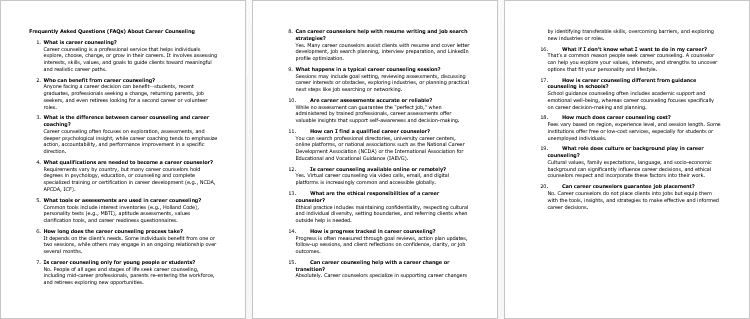
- Career Counseling FAQs – 677 Words
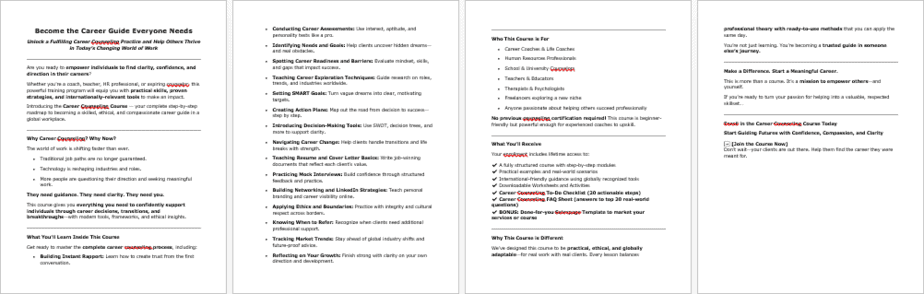
- Career Counseling Ready-Made Sales Page – 606 Words
All files are fully editable and professionally written.
How You Can Use & Profit From This Course
This PLR product gives you maximum flexibility. Here are proven monetization ideas that align with your license terms:
💼 Sell as a Standalone Digital Course
- Price range: $47–$97
🎓 Turn Into a Coaching or Certification Program
- Weekly guided sessions
- Charge $297–$497
📦 Break Into Mini Products
- Sell modules or sections as individual reports
- Price: $10–$20 per guide
🔁 Membership Site Content
- Add as a career development track
- Generate recurring monthly income
📧 Lead Magnet Strategy
- Excerpt portions for free guides to build your email list
- Upsell the full course
🎙 Convert to Audio or Video Training
- Expand reach and increase perceived value
🌐 Build & Flip a Career Website
- Create a niche site using this course as the flagship product
- Sell the site for profit
PLR License Summary (Plain English)
✅ You ARE Allowed To:
- Rebrand and sell the product
- Edit, rewrite, or expand content
- Bundle with other products
- Use inside paid memberships
- Convert into audio, video, or print
- Use excerpts as lead magnets
❌ You Are NOT Allowed To:
- Pass PLR or resale rights to buyers
- Give the full product away for free
- Offer 100% affiliate commissions
- Add it to an existing paid product without a new purchase
Why This Course Is a Smart Investment
✔ Time-saving done-for-you solution
✔ High-demand evergreen niche
✔ Flexible monetization options
✔ Ideal for coaches, educators, and marketers
✔ Beginner-friendly yet professional
✔ Fully aligned with Buy Quality PLR standards
Final Thoughts
The Career Counseling PLR Course (17,015 words) gives you the tools, structure, and authority to build a meaningful, profitable product in the career and personal development space—without the workload of creating everything yourself.
Simply brand it, customize it, and launch when you’re ready.
Buy Quality PLR provides the foundation. You keep the profits.
has been added to your cart!
have been added to your cart!
Here A Sample of the Career Counseling PLR Course
This course is designed to help you become a confident and effective career counselor—whether you’re guiding students, professionals in transition, or job seekers. Through five engaging modules, you’ll learn how to assess, guide, and support individuals toward fulfilling careers.
Module 1: Foundations of Career Counselling
Step 1: Understand What Career Counselling Really Is
Course Segment: Module 1 – Foundations of Career Counselling
Audience: International Course Creators and Career Development Professionals
Language: English (International)
Objective of This Step:
By the end of this step, you will have a clear, comprehensive understanding of the meaning and scope of career counseling, its target audience, and its growing importance in today’s global employment landscape. This knowledge will lay the groundwork for confidently developing, delivering, or facilitating career guidance content that resonates across cultures and economic contexts.
1.1 What Is Career Counseling? – A Clear Definition
Career counseling is a structured, client-centered process that helps individuals understand themselves and the world of work in order to make informed, meaningful career, educational, and life decisions. It is both a science and an art—grounded in psychology, education, and labor market trends—yet requires empathy, insight, and communication skills.
You may also encounter the term career guidance used interchangeably, especially in schools and career centers. However, career counseling often involves deeper, one-on-one conversations, assessments, and long-term planning, whereas career guidance may include broader information sessions, workshops, or tools without individualized intervention.
Key Elements of Career Counseling:
- Self-assessment and exploration
- Labor market research
- Career planning and goal-setting
- Decision-making strategies
- Emotional and psychological support related to work and identity
1.2 Who Needs Career Counseling?
Career counseling isn’t just for students or recent graduates. In today’s globalized, fast-evolving world of work, it serves people from diverse age groups, cultures, and professional stages. As an international course creator, it’s important to understand the wide audience your content might serve.
Examples of People Who Benefit from Career Counseling:
- High school and college students unsure about future career paths or educational choices
- Young professionals seeking to switch industries or roles
- Mid-career individuals facing burnout or career stagnation
- Mothers or caregivers returning to the workforce after a break
- Immigrants and international workers navigating unfamiliar job markets
- Retirees or older adults considering second careers or volunteer roles
- Individuals affected by layoffs, automation, or economic shifts
Each of these groups brings unique challenges, goals, and cultural backgrounds. A culturally sensitive career counseling approach considers economic conditions, societal expectations, and personal values.
1.3 Why Career Counseling Is More Important Than Ever
The 21st-century job market is complex. Career counseling plays a crucial role in helping people navigate it. Here’s why this field has become so vital on a global scale:
a. Rapid Technological Change
Automation, artificial intelligence, and digital transformation are reshaping industries. Many traditional roles are disappearing, while new ones emerge with updated skill requirements. Individuals often need support in understanding how to pivot, upskill, or reskill.
b. Economic Uncertainty and Global Shifts
From pandemics to geopolitical shifts, job markets are increasingly volatile. People are facing unexpected career disruptions and are looking for reliable guidance to reposition themselves professionally.
c. Expanding Career Options
In today’s world, people are no longer choosing from a narrow list of professions. There are hundreds of niche, interdisciplinary roles available globally. While this variety is exciting, it can also be overwhelming. Career counselors help individuals filter, prioritize, and strategize.
d. Mental Health and Work-Life Balance
Work and mental health are closely linked. More people are prioritizing well-being, purpose, and personal fulfillment. Career counseling helps individuals align careers with values, interests, and lifestyle needs—offering holistic guidance rather than only financial or status-based advice.
e. The Rise of Global Careers
Thanks to remote work and international hiring, professionals now explore careers across borders. Career counseling is no longer local or national—it requires global perspective, cultural sensitivity, and an understanding of international work trends and mobility.
1.4 The Role of Career Counseling in Lifelong Learning and Growth
Gone are the days when people chose one career for life. Today’s professionals may change roles or industries multiple times. Career counseling supports lifelong learning—not only in choosing what to study or where to work, but also in helping individuals adapt, grow, and evolve over time.
As a course creator, you’re not just helping people choose a job—you’re helping them build a flexible, meaningful career journey that aligns with who they are today and who they may become in the future.
1.5 Real-World Examples for Course Context
To make your content internationally relatable, use case studies or client profiles that reflect a variety of cultural and economic contexts. Here are a few examples you can embed in your course:
- A recent university graduate in Kenya exploring IT careers locally and abroad.
- A mid-career engineer in Germany transitioning into sustainability consulting.
- A homemaker in India returning to the workforce through digital freelancing.
- A migrant in Canada seeking work that aligns with their international credentials.
These examples can help learners understand how career counseling applies globally, across cultures, genders, age groups, and life situations.
1.6 Wrap-Up and Reflection
Before moving forward, give your learners a moment to reflect. You can include prompts like:
- How has your understanding of career counseling changed?
- Can you think of a time when you or someone you know could have benefited from career counseling?
- Which populations do you feel most inspired or qualified to support?
Encouraging reflection helps deepen learning and prepares students to engage meaningfully in the next phase of the training.
Step 2: Know the Role of a Career Counsellor
Course Segment: Module 1 – Foundations of Career Counselling
Audience: International Course Creators and Career Development Practitioners
Language: English (International)
Objective of This Step:
The purpose of this training step is to provide a deep, practical understanding of the roles and responsibilities of a career counselor. Whether you’re creating content for schools, universities, job centers, or private coaching practices, this lesson helps you define the professional identity of a career counselor and what is expected from them across various cultural and employment contexts.
2.1 Defining the Career Counselor’s Role
A career counselor is more than someone who hands out job descriptions or helps polish a resume. This role is a multi-dimensional one that combines knowledge, psychological insight, communication skill, and cultural sensitivity. At its core, career counseling is about helping people discover and navigate meaningful career pathways while also supporting their emotional, intellectual, and strategic growth.
As a course creator, you must train your learners to see career counseling as a professional relationship that requires trust, structure, and purpose.
2.2 Core Responsibilities of a Career Counselor
Let’s break down the key duties of a career counselor into four essential roles: Listening, Guiding, Supporting, and Staying Non-Judgmental.
Responsibility 1: Listening Actively and Empathetically
A skilled career counselor listens deeply—beyond just words.
- Active listening involves being fully present and engaged, showing understanding through body language, tone, and responses.
- The counselor pays attention to both verbal and non-verbal cues, helping clients feel heard and valued.
- Cultural sensitivity matters: be aware of silence, eye contact, and emotional expressions, which may vary significantly across cultures.
Instruction Tip for Course Creators:
Include audio simulations or case studies in which learners can hear examples of poor and excellent listening. Offer checklists for “what to listen for”—such as unspoken fears, unclear goals, or limiting beliefs.
Responsibility 2: Guiding Without Controlling
Career counselors guide clients through exploration but do not make decisions for them. This guidance involves:
- Asking reflective and open-ended questions to encourage self-discovery.
- Presenting career options, pathways, and industry insights in an unbiased manner.
- Helping clients understand consequences and possibilities, without imposing opinions.
This role is about facilitating decision-making, not directing it.
Instruction Tip for Course Creators:
Use role-playing or sample dialogue scripts to show how counselors can remain neutral while still being informative. For instance, compare responses that lead the client vs. ones that invite the client to lead their own journey.
Responsibility 3: Providing Emotional and Strategic Support
Career decisions are emotionally charged. Fear, self-doubt, pressure, and confusion are common. The counselor must be equipped to offer:
- Emotional support: Encouragement, validation, and confidence-building.
- Strategic support: Creating career action plans, researching options, and preparing for transitions.
Support is both relational (being there for the client) and technical (helping with tools, resources, and next steps).
Instruction Tip for Course Creators:
Introduce templates for career planning, checklists for job application readiness, and sample feedback forms. Help learners understand the balance between coaching and counseling.
Responsibility 4: Remaining Non-Judgmental and Culturally Aware
Career counselors work with clients from diverse backgrounds—economically, socially, ethnically, and professionally. Staying non-judgmental means:
- Avoiding bias about “better” careers or educational paths.
- Respecting cultural and personal values, even when they differ from the counselor’s own.
- Supporting non-linear career choices, such as freelancing, creative work, or informal sectors.
Clients may also be navigating language barriers, migration, generational pressure, or discrimination. Counselors must be prepared to suspend assumptions and operate from a place of openness and curiosity.
Instruction Tip for Course Creators:
Offer case scenarios involving cross-cultural situations. For example, a female student in a conservative culture interested in engineering, or a mature worker starting over in a new country. Include reflective questions about bias and cultural context.
2.3 Boundaries of the Career Counselor’s Role
It’s equally important to clarify what a career counselor is not.
Career counselors do not:
- Provide psychological therapy (unless also licensed as a therapist).
- Make decisions for the client.
- Guarantee job placement.
- Promote one path or school as superior.
- Cross professional or personal boundaries.
Understanding these boundaries protects the integrity of the profession and ensures clients receive the right type of support.
Instruction Tip for Course Creators:
Create a clear list of “Dos and Don’ts” for career counselors. Encourage your learners to reflect on their role and limitations—especially if they are transitioning from education, HR, or coaching.
2.4 The Counselor as a Facilitator of Growth
Ultimately, a career counselor is a facilitator of career development—helping individuals clarify who they are, what they want, and how to get there. This is not a one-size-fits-all job. It’s a responsive, evolving role that demands ongoing learning and flexibility.
A good career counselor:
- Encourages exploration without fear.
- Holds space for uncertainty.
- Provides structure and support without rigidity.
- Offers tools without attachment to specific outcomes.
As a course creator, your training content should inspire future counselors to become guides, not gurus—leading from a place of humility, knowledge, and care.
2.5 Reflection and Application
Before wrapping up this lesson, offer opportunities for learners to internalize the material:
- Reflection Prompt: Think of a time when someone gave you career advice. What made it helpful or unhelpful?
- Exercise: Identify which of the four roles—listening, guiding, supporting, or staying non-judgmental—you feel most confident in. Which one needs more development?
- Application Idea: Draft a professional values statement outlining your role and responsibility as a career counselor.
Step 3: Identify the Key Skills Needed
Course Segment: Module 1 – Foundations of Career Counseling
Audience: International Course Creators and Global Career Practitioners
Language: English (International)
Objective of This Step:
This step focuses on helping learners identify and develop the key soft and hard skills needed to succeed in the role of a career counselor. Whether you are creating a foundational program or advanced training, this section aims to help future counselors build the core competencies required to guide clients effectively across different cultural, economic, and social contexts.
3.1 Why Skills Matter in Career Counseling
Career counseling is a human-centered service that blends emotional intelligence with strategic thinking. It involves face-to-face (or virtual) interaction, guidance, and planning—often in emotionally complex situations.
As a course creator, it’s essential to teach your learners that being knowledgeable is not enough. It’s their skills, both soft and hard, that will build trust, promote clarity, and empower clients to take confident career steps.
3.2 Essential Soft Skills: The Heart of Career Counseling
Soft skills refer to interpersonal abilities that help you relate, connect, and support clients through their journey. These skills are transferable across industries and cultures, making them vital in any international setting.
Let’s explore the four core soft skills:
Skill 1: Communication Skills
Career counselors must communicate clearly, respectfully, and effectively.
- Verbal communication: Speaking in a calm, organized, and easy-to-understand manner.
- Non-verbal communication: Using appropriate facial expressions, posture, eye contact, and tone.
- Written communication: Writing clear, professional emails, reports, and summaries of career plans.
- Cross-cultural sensitivity: Adapting communication style when working with individuals from different regions or backgrounds.
Instruction Tip for Course Creators:
Use video demonstrations and sample dialogues to show good vs. poor communication. Provide templates for client summaries and email formats.
Skill 2: Empathy
Empathy means putting yourself in someone else’s shoes—not to feel pity, but to understand their world.
- Emotional empathy: Recognizing and validating emotions without over-identifying.
- Cognitive empathy: Understanding how someone thinks or sees the world.
- Cultural empathy: Acknowledging different values, customs, and career expectations.
This skill is especially important when working with clients facing discrimination, socio-economic barriers, or major transitions.
Instruction Tip for Course Creators:
Include case studies that require learners to identify and respond empathetically to different client scenarios—such as job loss, relocation stress, or identity-based barriers.
Skill 3: Active Listening
Active listening goes beyond hearing. It means absorbing, interpreting, and responding thoughtfully.
- Full attention: Avoiding distractions and multitasking.
- Reflecting and paraphrasing: Repeating key points to show understanding and ensure accuracy.
- Non-interruptive listening: Allowing clients to speak without jumping to conclusions or solutions.
- Emotional awareness: Picking up on unspoken emotions or hesitations.
Instruction Tip for Course Creators:
Offer mock counseling scripts or role-plays. Ask learners to practice identifying what was said and what was felt. Include listening checklists and observation guides.
Skill 4: Problem-Solving and Decision Support
Career paths are rarely linear. Clients may feel stuck, uncertain, or overwhelmed. Counselors must help them:
- Clarify the problem: What’s really holding them back—lack of confidence, unclear goals, or external pressure?
- Explore options: What are the possible routes they haven’t considered?
- Evaluate outcomes: What are the pros and cons of each option?
- Support decision-making: Helping clients choose based on values, strengths, and realistic opportunities.
Instruction Tip for Course Creators:
Provide real-life client dilemmas. Have learners use structured frameworks like SWOT (Strengths, Weaknesses, Opportunities, Threats) analysis or decision trees to guide clients.
3.3 Hard Skills: Technical Knowledge That Builds Trust
In addition to soft skills, career counselors need certain hard skills—knowledge-based competencies that can be taught and measured.
Key Hard Skills Include:
- Career Assessment Tools: Knowing how to administer and interpret interest inventories, personality assessments, or skills evaluations (e.g., Holland Codes, MBTI, StrengthsFinder).
- Labour Market Information (LMI): Understanding job trends, skills gaps, future-proof careers, and salary expectations across sectors and countries.
- Digital Literacy: Familiarity with virtual career platforms, LinkedIn profiles, resume-building tools, and online scheduling or client-management systems.
- Interview and Resume Coaching: Helping clients create tailored resumes and practice for interviews through feedback and mock sessions.
Instruction Tip for Course Creators:
Include how-to videos, software walkthroughs, downloadable assessment forms, and sector-specific labor market charts. Offer practice tasks where learners review mock resumes or simulate virtual interview coaching.
3.4 Teaching Skill Integration and Professional Application
These skills don’t function in isolation. Real career counseling requires blending them seamlessly in client sessions.
For example:
- A student client shares she’s feeling pressure from her family to become a doctor, but she’s passionate about digital design.
- You’ll need active listening to hear both the words and emotion.
- Use empathy to acknowledge cultural and emotional layers.
- Apply problem-solving to explore alternative career paths that combine both interests.
- Communicate clearly and without judgment to help her feel empowered to make informed choices.
Instruction Tip for Course Creators:
Design full-session walkthroughs, combining soft and hard skills. Include reflection prompts asking learners how they would respond, what skills they used, and what they might do differently.
3.5 Reflection and Application
Encourage learners to personalize their understanding and track growth.
- Skill Self-Assessment: Provide a downloadable checklist to rate themselves on each skill.
- Reflection Prompt: Which skill do you feel strongest in? Which one challenges you the most?
- Action Plan: What are three actions you’ll take to develop a skill that needs work?
Optional Resource: Create a “Career Counseling Skills Workbook” with exercises, real-world case examples, and a skill development tracker.
Step 4: Explore Career Counseling Models and Theories
Module Context: Part of Module 1 – Foundations of Career Counseling
Audience: International course creators and trainers designing professional-level curriculum in the field of career guidance
Purpose: To introduce learners to the foundational theories and models that shape how career counselors understand clients’ needs, decision-making processes, and career development paths.
4.1 Why Career Counseling Models and Theories Matter
Every professional field is built on a framework of proven theories. In career counseling, these models help explain:
- Why people choose certain careers.
- How interests and values evolve over time.
- What factors influence job satisfaction and career stability.
- How counselors can guide clients with evidence-based strategies.
For career counselors, theories serve as a compass. They help organize conversations, interpret assessments, and recommend realistic steps. As an international course creator, you must emphasize to your learners that knowing the theory doesn’t limit creativity—it supports clarity and confidence in decision-making.
In this step, we’ll explore the most widely used frameworks across cultures and contexts.
4.2 Holland’s Theory of Career Choice (RIASEC Model)
Overview:
Developed by John L. Holland, this is one of the most influential and accessible career theories. It proposes that people and work environments can be classified into six types, known as RIASEC:
- R – Realistic (Doers): Practical, hands-on, mechanical
- I – Investigative (Thinkers): Analytical, intellectual, scientific
- A – Artistic (Creators): Creative, expressive, original
- S – Social (Helpers): Caring, supportive, people-oriented
- E – Enterprising (Persuaders): Leadership-focused, entrepreneurial
- C – Conventional (Organizers): Detail-oriented, structured, administrative
Key Teaching Points:
- People are happiest and most productive when working in environments that match their personality type.
- The RIASEC model is widely used in career assessments and vocational interest inventories.
- The model supports career matching, helping counselors suggest fields that align with a client’s natural style.
Course Application:
Encourage your learners to:
- Take a sample RIASEC inventory.
- Practice interpreting the results with different personality combinations (e.g., “ISE” or “SEC”).
- Match the profiles to real-world job examples in multiple countries or cultures.
4.3 Super’s Life-Span, Life-Space Theory
Overview:
Developed by Donald Super, this model emphasizes that career development is a lifelong process, not a one-time choice. It focuses on how people grow, learn, and adapt across their lives.
Core Concepts:
- Life Stages: Super identified five major stages:
- Growth (birth to mid-teens)
- Exploration (teens to mid-20s)
- Establishment (mid-20s to mid-40s)
- Maintenance (mid-40s to 60s)
- Disengagement (60s and beyond)
- Life Roles: Career is only one role among many. Others include child, student, worker, citizen, homemaker, leisurite.
- Self-Concept: How a person views themselves shapes their career decisions. This self-concept evolves through experience and feedback.
Key Teaching Points:
- Counselors must consider where the client is in their life stage and what roles they are balancing.
- Career changes later in life are normal and often healthy.
- Life roles influence priorities and values at different stages.
Course Application:
Ask your learners to:
- Create a “Life Career Rainbow” (a visual representation of life roles across time).
- Analyze case studies where clients are at different career stages—e.g., a 19-year-old exploring majors vs. a 50-year-old considering a career shift.
- Discuss cultural variations in role importance—some cultures may prioritize family roles over career identity, for example.
4.4 Krumboltz’s Social Learning Theory
Overview:
John Krumboltz emphasized that learning from experience and chance events often has more impact on career decisions than planned goals.
Key Ideas:
- People learn from observational learning, direct experiences, and unexpected opportunities.
- Career counselors should teach decision-making skills, not just offer direction.
- Clients should remain open to change and see “unplanned events” as learning moments.
Key Teaching Points:
- Factors such as family influence, education, social context, and unexpected life events all shape career choices.
- The theory supports building career adaptability—the ability to respond to new challenges and opportunities.
Course Application:
Course creators can guide learners to:
- Identify how their own careers were influenced by unexpected events or role models.
- Use storytelling exercises where clients reflect on past learning experiences.
- Help clients shift from rigid goal-setting to flexible planning.
4.5 Cognitive Information Processing (CIP) Theory
Overview:
This theory by Peterson, Sampson, and Reardon focuses on how people make career decisions using problem-solving and cognitive skills.
Key Components:
- Self-Knowledge: Interests, values, abilities.
- Options Knowledge: Knowing available career choices.
- Decision-Making Skills: Using logic to weigh options.
- Executive Processing: Self-talk, beliefs, emotions that influence decision-making.
Key Teaching Points:
- The theory introduces the CASVE Cycle:
- C – Communication: Recognize a problem
- A – Analysis: Clarify self and options
- S – Synthesis: Develop a list of choices
- V – Valuing: Prioritize preferences
- E – Execution: Take action
- Counselors help clients improve their career decision-making process, not just give advice.
Course Application:
Offer exercises that help learners:
- Work through the CASVE cycle with a hypothetical client.
- Identify “executive processing” barriers like fear, doubt, or low confidence.
- Design decision-making activities like value ranking or career research assignments.
4.6 Additional Theories to Mention Briefly
While the above are essential, your course may also mention:
- Gottfredson’s Theory of Circumscription and Compromise: How social class, gender, and culture shape how people eliminate career choices early on.
- Planned Happenstance Theory: Cultivating curiosity, persistence, and risk-taking to turn unplanned events into career opportunities.
- Chaos Theory of Careers: Accepting uncertainty as a normal part of career paths and focusing on adaptability rather than control.
Use these theories as optional or advanced readings for learners who want to dive deeper.
4.7 Comparing Models: Teaching Students to Choose the Right One
Every theory has strengths and limitations. Encourage learners to ask:
- Is the client’s challenge developmental (long-term growth) or situational (specific issue now)?
- Are cultural or environmental factors playing a major role?
- Is the client ready for structured planning or do they need emotional clarity?
Provide comparison charts, summary tables, or theory selection flowcharts to guide their practical application.
4.8 Reflection and Practice
End this step by engaging learners in deep reflection and applied learning.
- Reflection Prompt: Which model resonates most with your personal experiences? Why?
- Journal Activity: Write a short paragraph applying one theory to your own career journey or a client you’ve worked with.
- Interactive Task: Match client profiles with the most appropriate theory and explain your reasoning.
We’re also giving these extra bonuses
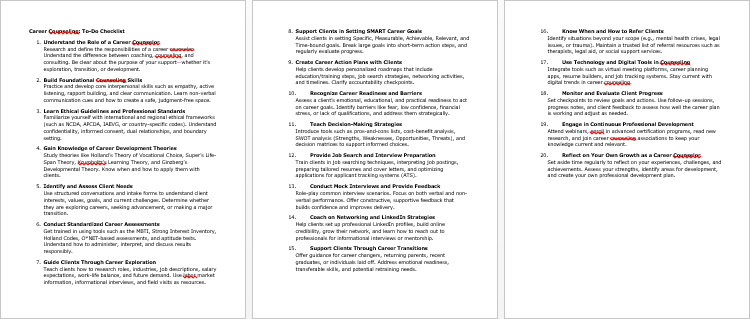
Career Counseling – Checklist
Career Counseling – FAQs
Career Counseling – Salespage Content
Package Details:
Word Count: 17 015 Words
Number of Pages: 100
Career Counseling – Bonus Content
Checklist
Word Count: 644 words
FAQs
Word Count: 677 words
Salespage Content
Word Count: 606 words
Total Word Count: 18 942 Words
Your PLR License Terms
PERMISSIONS: What Can You Do With These Materials?
Sell the content basically as it is (with some minor tweaks to make it “yours”).
If you are going to claim copyright to anything created with this content, then you must substantially change at 75% of the content to distinguish yourself from other licensees.
Break up the content into small portions to sell as individual reports for $10-$20 each.
Bundle the content with other existing content to create larger products for $47-$97 each.
Setup your own membership site with the content and generate monthly residual payments!
Take the content and convert it into a multiple-week “eclass” that you charge $297-$497 to access!
Use the content to create a “physical” product that you sell for premium prices!
Convert it to audios, videos, membership site content and more.
Excerpt and / or edit portions of the content to give away for free as blog posts, reports, etc. to use as lead magnets, incentives and more!
Create your own original product from it, set it up at a site and “flip” the site for megabucks!
RESTRICTIONS: What Can’t You Do With These Materials?
To protect the value of these products, you may not pass on the rights to your customers. This means that your customers may not have PLR rights or reprint / resell rights passed on to them.
You may not pass on any kind of licensing (PLR, reprint / resell, etc.) to ANY offer created from ANY PORTION OF this content that would allow additional people to sell or give away any portion of the content contained in this package.
You may not offer 100% commission to affiliates selling your version / copy of this product. The maximum affiliate commission you may pay out for offers created that include parts of this content is 75%.
You are not permitted to give the complete materials away in their current state for free – they must be sold. They must be excerpted and / or edited to be given away, unless otherwise noted. Example: You ARE permitted to excerpt portions of content for blog posts, lead magnets, etc.
You may not add this content to any part of an existing customer order that would not require them to make an additional purchase. (IE You cannot add it to a package, membership site, etc. that customers have ALREADY paid for.)
Share Now!
Latest Products

Free Sales Funnel Builder

Related Products
Popular & Trending


Featured Products