
Life Transitions Coaching PLR Course 22k Words
in Business Coaching PLR , Business PLR , Life Coaching PLR , PLR eCourses , PLR List Building Reports , Premium PLR , Premium PLR Reports , Premium White Label Brandable PLR Coaching Courses , Private Label Rights ProductsChoose Your Desired Option(s)
has been added to your cart!
have been added to your cart!
#lifetransitions #plrcourse #lifecoaching #personalgrowth #mindsetshift #wellnessmarketing #plrcontent #selfimprovement #coachingbusiness
Life Transitions Coaching PLR Course – 22,000 Words
A Step-by-Step Guide to Support Others Through Life’s Biggest Changes
Change is inevitable. But guiding someone through life’s transitions with confidence, compassion, and clarity is a skill that can transform lives.
The Life Transitions Coaching PLR Course is designed for aspiring coaches who want to help clients navigate major life changes — from career shifts and retirement to relationship transitions and personal reinvention.
With 22,000 words of expertly written, ready-to-use content, this course equips you to coach with heart and strategy, while also providing PLR flexibility to sell, teach, or repurpose for profit.
Introducing the…
Life Transitions Coaching
Why Life Transitions Coaching is In Demand
Life transitions are challenging, and millions of people seek guidance to:
- Navigate career changes, promotions, or retirement
- Heal and rebuild after divorce or relationship changes
- Manage parenthood, empty nest, or caregiving transitions
- Overcome loss, grief, or unexpected life events
- Reinvent themselves and find renewed purpose
Coaches who specialize in life transitions are in high demand, and this course gives you everything you need to step confidently into that role.
What’s Inside the Course
The course is organized into five action-packed modules, with step-by-step guidance to take learners from foundational knowledge to coaching practice.
Module 1: Understanding Life Transitions
Goal: Gain a deep understanding of transitions and the emotional journey clients experience.
- Step 1: Identify the Types of Life Transitions
Learn to recognize career, relationship, retirement, parenthood, loss, and personal growth transitions. - Step 2: Explore the Emotional Impact of Transitions
Understand stages like shock, resistance, acceptance, and renewal to support clients effectively. - Step 3: Discover the Role of a Life Transitions Coach
Learn your role — and what it isn’t — including boundaries, listening skills, and non-fixing support. - Step 4: Build a Foundation of Trust with Clients
Create safe, non-judgmental coaching spaces and earn client trust from day one.
Module 2: Core Coaching Tools & Techniques
Goal: Master essential coaching tools to empower clients.
- Step 1: Use Powerful Questions to Spark Clarity
Ask open-ended, thought-provoking questions that uncover beliefs, fears, and possibilities. - Step 2: Practice Active Listening & Reflective Feedback
Listen deeply and reflect insights that reveal patterns and empower clients. - Step 3: Apply the GROW Model for Structured Coaching
Use the Goal, Reality, Options, Will framework to guide sessions effectively. - Step 4: Identify and Shift Limiting Beliefs
Help clients uncover and rewrite internal stories that hold them back.
Module 3: Guiding Clients Through Change
Goal: Support clients through transitions with clarity, vision, and action.
- Step 1: Assess Readiness and Resistance to Change
Evaluate where clients are and work gently with resistance. - Step 2: Co-Create a Vision for What’s Next
Help clients visualize the life they want after the transition. - Step 3: Break Down Big Goals into Actionable Steps
Turn overwhelming dreams into achievable steps clients can commit to. - Step 4: Support Emotional Resilience Through Tools & Habits
Introduce journaling, grounding practices, and routines for emotional stability.
Module 4: Real-Life Scenarios & Coaching Practice
Goal: Practice coaching with real scenarios and develop personalized plans.
- Step 1: Explore Common Life Transition Scenarios
Learn from mid-life career changes, relocations, post-divorce reinvention, and more. - Step 2: Role-Play Coaching Conversations
Build confidence by practicing sessions with partners or groups. - Step 3: Develop Personalized Coaching Plans
Create flexible plans tailored to each client’s journey. - Step 4: Handle Setbacks & Celebrate Wins
Navigate setbacks compassionately and motivate clients by celebrating progress.
Module 5: Building Your Coaching Practice
Goal: Launch and grow a professional life transitions coaching business.
- Step 1: Define Your Niche and Ideal Client
Identify who you love working with and attract the right people with ease. - Step 2: Create Your Coaching Packages & Offers
Structure sessions, price services, and create clear, valuable offers. - Step 3: Set Up Simple Marketing Foundations
Use your website, social media, and referrals to promote your coaching. - Step 4: Confidently Launch Your Practice
Equip yourself with contracts, onboarding tools, scheduling systems, and mindset support.
By the End of This Course, You Will Be Able To:
✅ Confidently coach clients through major life changes
✅ Use proven coaching tools to inspire clarity and action
✅ Build strong relationships based on trust and compassion
✅ Launch and grow your own Life Transitions Coaching practice
Bonus Materials
- Checklist – 452 Words: Summarize key steps for client success.
- FAQs – 809 Words: Answer common questions about life transitions coaching.
- Salespage – 647 Words: Ready-made, high-converting copy for your website or promotions.
Who Can Benefit
- Aspiring Life Coaches: Gain skills to start a coaching practice.
- Current Coaches: Add life transitions expertise to your offerings.
- Corporate Trainers & Mentors: Provide structured guidance for employees and clients.
- PLR Resellers: Rebrand, sell, or bundle for instant revenue.
- Personal Development Enthusiasts: Help yourself and others navigate life transitions successfully.
How to Use and Profit from This PLR Course
- Sell as a Complete Course: $297–$497 for the full program online.
- Break Into Modules or Guides: Sell portions for $10–$20 each.
- Create Bundles: Combine with other coaching PLR content for $47–$97.
- Launch Multi-Week E-Classes: Offer a 3–6 week coaching program.
- Membership Sites: Deliver weekly coaching lessons to paying members.
- Convert to Physical Products: Turn into workbooks, journals, or printed guides.
- Lead Magnets & Email Campaigns: Use excerpts for free opt-ins or promotions.
- Flip a Coaching Website: Build a niche site around the course and sell it fully.
Licensing Terms
Permissions:
- Sell as-is or with minor edits.
- Claim copyright if 75%+ of content is rewritten.
- Use portions for guides, modules, or lead magnets.
- Bundle with other PLR products.
Restrictions:
- Do not pass PLR rights to customers.
- Max affiliate commission: 75%.
- Cannot give away the full course for free.
- Cannot include in existing orders without additional purchase.
Why Buy from Buy Quality PLR?
- 22,000-word professionally written course ready for resale or teaching
- Step-by-step modules to confidently coach clients through transitions
- Includes checklist, FAQs, and sales page for fast marketing
- Save months of research, writing, and content creation
- Monetize immediately with digital products, workshops, membership sites, or physical products
Bottom Line
The Life Transitions Coaching PLR Course gives you a complete, ready-to-use solution to:
- Coach clients through career, relationship, retirement, and personal transitions
- Build trust, clarity, and action plans with proven techniques
- Launch and grow a professional coaching practice
- Monetize high-value PLR content in an evergreen niche
Empower your clients. Build your business. Start selling today.
has been added to your cart!
have been added to your cart!
Here A Sample of the Life Transitions Coaching PLR Course
This course is designed to help aspiring coaches confidently support clients through major life changes — from career shifts and retirement to relationship transitions and personal reinvention. With real-life tools, coaching techniques, and heart-centered strategies, you’ll walk away ready to guide others into their next chapter with purpose and clarity.
Module 1: Understanding Life Transitions
Step 1: Identify the Types of Life Transitions
In this step, you’ll learn how to recognize and understand the various types of life transitions that individuals across different cultures and age groups experience. As a life transitions coach, this foundational understanding will allow you to tailor your coaching approach based on the type of transition your client is navigating.
Introduction:
Life is not static — it’s a continuous flow of events, stages, and experiences. Some transitions are planned, like starting a new job or having a child. Others may be unexpected, like a sudden loss or relocation. As a coach, your first responsibility is to help clients identify the transition they’re going through, acknowledge the impact it has on their emotional and mental well-being, and guide them through it with empathy and structure.
Before you can do this effectively, you must understand the wide spectrum of life transitions and how they manifest globally, across different demographics, cultures, and personal values.
Step-by-Step Breakdown:
1. Understand the Two Main Categories of Life Transitions
Begin by learning to distinguish between:
- Voluntary Transitions: These are initiated by choice or personal decision. Examples include:
- Changing careers or starting a business
- Moving to a new country for a better opportunity
- Getting married or becoming a parent
- Retiring after decades of work
- Involuntary Transitions: These are often unexpected and not chosen by the individual. Examples include:
- Loss of a job due to company downsizing
- Sudden illness or disability
- Divorce or separation
- Death of a loved one
Understanding this distinction helps you assess how much control the individual feels they have in the situation — a key insight into their mindset and emotional state.
2. Explore the Most Common Types of Life Transitions (Internationally Applicable)
Here is a breakdown of typical life transitions you’ll encounter in your coaching work:
a. Career Transitions
- Switching industries or job roles
- Returning to work after a long break (e.g., after raising children or recovery)
- Facing redundancy or unemployment
- Relocating internationally for a job
- Retirement and the loss of career identity
Coaching Focus: Redefining purpose, building confidence, re-establishing identity
b. Relationship Transitions
- Marriage, remarriage, or entering into a committed relationship
- Divorce or separation
- Widowhood
- Break-ups or co-parenting adjustments
Coaching Focus: Emotional healing, boundary setting, rebuilding trust, navigating shared responsibilities
c. Health & Wellness Transitions
- Sudden illness or chronic disease diagnosis
- Major lifestyle changes (e.g., diet, fitness, sobriety)
- Physical transformations (e.g., post-surgery, disability, aging)
Coaching Focus: Adapting to new realities, building resilience, reframing self-image
d. Family Transitions
- Becoming a parent or step-parent
- Adoption or fertility journeys
- Empty nest syndrome (children leaving home)
- Caring for aging parents
Coaching Focus: Identity shifts, role changes, emotional balance, prioritization
e. Geographical or Cultural Transitions
- Immigration or expatriation
- Refugee resettlement
- Moving to a new city or country
- Experiencing cultural shock or integration challenges
Coaching Focus: Building community, navigating loss of identity or belonging, cultivating adaptability
f. Personal Growth & Inner Transformations
- Spiritual awakenings or shifts in worldview
- Midlife awakening or existential questioning
- Self-discovery after years of conformity
- Gender identity or sexual orientation transitions
Coaching Focus: Clarity, confidence, aligning life with values, navigating vulnerability
g. Loss and Grief
- Death of a loved one
- Loss of a home or financial security
- Miscarriage or infertility struggles
- Losing a dream or life plan
Coaching Focus: Emotional processing, grief support, reimagining the future, honoring the loss
3. Understand the Emotional Patterns Associated With Each Type
Each type of transition brings with it emotional layers — not always linear, and often overlapping. Whether your client is going through a voluntary or involuntary transition, they may cycle through:
- Denial or disbelief
- Fear of the unknown
- Anger or frustration
- Sadness and grief
- Acceptance and adaptation
- Renewal and reinvention
For example:
- Someone starting a new job in a new country might feel excitement and fear at the same time.
- A person going through divorce may feel freedom and deep grief simultaneously.
Recognizing these emotional overlaps will help you normalize their experience and validate their feelings, which is key in building trust and coaching effectiveness.
4. Practice Identifying Life Transitions in Case Scenarios
To apply what you’ve learned, analyze brief case examples and practice identifying:
- What type of transition is happening?
- Is it voluntary or involuntary?
- What emotions might the client be experiencing?
- What kind of support might they need?
Example:
- A 52-year-old man has been laid off after 30 years in the same company and is uncertain about what’s next.
- Transition Type: Career and Identity loss
- Involuntary
- Likely Emotions: Shock, low self-esteem, anxiety, grief
- Coaching Focus: Rebuilding confidence, reimagining career paths, identity shift
Working with real-life scenarios will give you the insight and agility needed to adjust your coaching style to your client’s unique journey.
Wrap-Up Reflection for Learners:
As you complete this step, take a moment to reflect:
- Have you experienced any of these transitions yourself?
- Which ones do you feel most equipped to coach others through?
- Where might you need to build more empathy or understanding?
By developing awareness of the many transitions that define the human experience, you prepare yourself to become a well-rounded, deeply empathetic life transitions coach who can support clients from any walk of life — across borders, languages, and life stages.
Step 2: Explore the Emotional Impact of Transitions
In this step, you will learn how to identify and understand the emotional cycle that individuals typically experience during life transitions. This knowledge equips you, as a life transitions coach, to meet your clients where they are emotionally and provide them with meaningful, personalized support that aligns with their current state of mind.
Introduction:
Every life transition — whether welcomed or unexpected — triggers a cascade of emotional responses. These emotions are often intense, sometimes confusing, and almost always layered. A single event, like retirement or relocation, can bring joy, anxiety, loss, hope, and fear all at once.
Understanding the emotional patterns behind transitions is crucial for building empathy and offering targeted coaching support. This step introduces you to a universal emotional cycle that people move through during transitions, and how you can use this understanding to design your coaching sessions effectively.
Step-by-Step Breakdown:
1. Learn the 4 Core Emotional Stages of Life Transitions
Although every individual is different, there are four universal emotional stages that people tend to experience when navigating change. These stages do not always occur in a straight line — individuals may move back and forth between them — but understanding them as a framework will help you track and support emotional progress.
a. Shock and Disorientation
This is the initial reaction to change, especially when the transition is unexpected or disruptive. Even if the change was planned, the reality of it can trigger emotional turbulence.
Typical Emotions:
- Numbness
- Disbelief
- Panic or anxiety
- Physical symptoms like fatigue or restlessness
Client Behaviors:
- Avoidance
- Difficulty concentrating
- Questioning decisions
Coaching Tip:
At this stage, the goal is not to push clients to “fix” anything. Instead, create a space of psychological safety. Let them feel seen and heard. Avoid offering too many solutions — instead, normalize their reaction and help them ground themselves with simple routines or mindful reflection.
b. Resistance and Turmoil
As the initial shock fades, resistance sets in. This is when clients begin to feel the weight of the change — whether it’s grief over what was lost, fear of the unknown, or anger at circumstances outside their control.
Typical Emotions:
- Frustration
- Anger or blame
- Grief and sadness
- Fear and uncertainty
Client Behaviors:
- Emotional reactivity
- Withdrawal or denial
- Clinging to the past
Coaching Tip:
This stage often requires the most emotional labor. Encourage clients to express their feelings without judgment. Validate their experience. Help them start naming their emotions and reflecting on what they’re grieving or resisting. Use journaling, coaching conversations, or metaphor work (like “crossing a bridge”) to help them externalize their emotional experience.
c. Acceptance and Adjustment
Over time, clients begin to accept the reality of the change. It doesn’t mean they like it — but they start adjusting to the new situation. This is the turning point in their emotional journey.
Typical Emotions:
- Relief
- Openness
- Lingering doubt, but growing clarity
- Willingness to explore next steps
Client Behaviors:
- Letting go of old identities
- Re-engaging with new routines
- Experimenting with possibilities
Coaching Tip:
Celebrate small wins and shifts in mindset. Begin helping your client clarify their new values, set fresh intentions, and visualize a future beyond the transition. This is where goal-setting becomes productive — but keep it flexible and client-led.
d. Renewal and Empowerment
In this final stage, clients experience growth and transformation. They have not only adapted to the change — they’ve integrated it into their identity and are now using the experience to shape a new chapter of life.
Typical Emotions:
- Empowerment
- Confidence
- Peace
- Excitement for the future
Client Behaviors:
- Taking proactive steps
- Supporting others through similar transitions
- Feeling aligned with new purpose
Coaching Tip:
Support your clients in sustaining their momentum. Help them reflect on their growth, acknowledge the journey they’ve completed, and clarify what this new phase of life means for them. Encourage them to build long-term strategies to stay emotionally balanced and aligned with their values.
2. Recognize the Non-Linear Nature of the Emotional Journey
While the four stages provide a helpful structure, it’s critical to remember that emotions are not linear. Clients may move back and forth between stages. For instance, a person may reach the acceptance phase but then experience fresh grief when encountering a memory or a reminder of what was lost.
As a coach, your flexibility matters:
- Don’t rush the process.
- Avoid framing emotional setbacks as failures.
- Normalize emotional fluctuations as part of healing and growth.
Example:
A woman going through divorce may feel empowered and ready for a new beginning one week, only to feel overwhelmed and lonely the next. Your role is to meet her where she is — not where you think she “should” be.
3. Use Active Listening to Locate Clients Emotionally
When a new client comes to you, one of the first things you need to determine is: “Where are they emotionally?” You can’t help someone move forward unless you understand where they are standing now.
Techniques to Try:
- Ask open-ended questions like:
- “What’s been the most challenging part of this change for you?”
- “How are you feeling today, compared to a few weeks ago?”
- “What’s one thing you miss from before this transition began?”
- Pay attention to:
- Their language (Do they speak with hope? Frustration? Confusion?)
- Their energy (Are they withdrawn? Energized? Anxious?)
- Repeating emotional themes or resistance to planning
Once you have this emotional map, you can choose the right coaching tools and tone for your session.
4. Apply Emotion-Focused Coaching Techniques
Each stage calls for a different type of emotional support. Here’s how you can adapt:
- Shock/Disorientation: Use grounding techniques such as breathwork, mindfulness, and body awareness. Keep sessions simple and safe.
- Resistance/Turmoil: Use reflective listening, emotional naming, and journaling. Avoid rushing to action.
- Acceptance/Adjustment: Help clients begin designing their new routines and goals. Use visualization and value clarification exercises.
- Renewal/Empowerment: Encourage your clients to anchor their growth in a story. What strengths did they discover? What future do they want to create?
You can also introduce cultural or spiritual tools if appropriate and desired by the client — for example, storytelling, rituals of closure, or even symbolic activities that resonate across global communities.
Reflection for Learners:
Take time to reflect on these questions:
- Which of the four emotional stages do you feel most confident supporting?
- Which stage feels most challenging for you?
- Have you personally moved through these stages in your own transitions?
- How might cultural or generational factors influence how people express emotions in each stage?
Key Takeaway:
As a life transitions coach, your value is not only in helping clients move forward but also in honoring where they are emotionally right now. By understanding these emotional patterns, you’ll cultivate deeper empathy, greater patience, and a more authentic coaching presence — all of which are key to guiding clients through life’s most pivotal moments.
Step 3: Discover the Role of a Life Transitions Coach
In this step, we’ll explore the true scope and responsibility of being a Life Transitions Coach. This includes what you are expected to do — and what lies outside your role. You’ll gain clarity on boundaries, ethics, listening skills, and the powerful art of supporting without trying to fix someone’s life.
This step is essential for setting a professional foundation for your coaching practice and ensuring your clients are always respected, empowered, and emotionally safe.
Introduction:
When someone is going through a life transition, they are navigating uncertainty, loss, possibility, or change. They may feel disoriented, vulnerable, or deeply hopeful. It’s easy to feel like you want to “solve” their problems or “rescue” them from discomfort.
However, effective life transitions coaching is not about giving advice, fixing problems, or becoming a therapist. It’s about being a guide, not a guru — someone who walks beside the client with curiosity, compassion, and care.
To do this well, you need to understand your role clearly. This includes setting boundaries, using deep listening as your primary tool, and learning to hold space for others — without taking on the weight of their journey.
Step-by-Step Breakdown:
1. Understand What a Life Transitions Coach Is
A Life Transitions Coach is a professional who supports individuals navigating a personal or professional life change by helping them gain clarity, confidence, and direction. You’re a coach — not a therapist, counselor, advisor, or consultant.
Your primary job is to:
- Create a nonjudgmental, confidential space for your client to reflect
- Help them clarify their thoughts, emotions, and goals
- Provide tools for self-awareness, mindset shifts, and decision-making
- Encourage small, aligned steps forward
- Respect their timeline and process
Think of yourself as a mirror and a sounding board — not a solution machine.
Your power comes from helping clients:
- Feel seen and understood
- Reconnect with their own inner wisdom
- Move through transitions with greater ease and intention
2. Clarify What a Life Transitions Coach Is Not
Setting professional boundaries is just as important as offering support. Many new coaches accidentally slip into roles they are not trained or qualified to hold. To protect both yourself and your clients, you need to know where your responsibilities end.
A life transitions coach is not:
- A therapist: You do not diagnose or treat mental health issues such as trauma, depression, PTSD, or anxiety disorders.
- A crisis counselor: You are not trained to intervene in emergencies (e.g. suicide prevention, domestic abuse).
- A life guru or savior: You do not tell clients what to do or expect them to follow your personal beliefs.
- A fixer: You do not try to “solve” their problems for them.
Ethical Boundaries to Maintain:
- Refer out when a client needs therapy or mental health care.
- Don’t project your own opinions or choices onto the client.
- Avoid dependency — empower the client to make their own choices.
- Maintain confidentiality — never share client stories or sessions without consent.
By staying within your role, you build trust, professionalism, and credibility.
3. Master the Art of Deep, Nonjudgmental Listening
The core skill of coaching — especially during transitions — is listening. But this isn’t surface-level listening where you wait to speak. It’s deep, intuitive, and nonjudgmental listening that allows the client to feel truly heard.
What Deep Listening Looks Like:
- Being fully present — no distractions, no multi-tasking
- Letting the client finish their thoughts without interruption
- Reflecting back what they said, to show you understand
- Not jumping in to fix or reframe unless invited
- Noticing what’s not being said — tone, emotion, hesitation
Sample Prompts to Practice Listening:
- “Tell me more about that.”
- “How did that moment feel for you?”
- “What’s the hardest part of this transition for you?”
- “When you say ____, what does that mean to you?”
Benefits of Deep Listening:
- Builds emotional safety
- Encourages self-reflection
- Unlocks inner clarity
- Creates a space for new insights to emerge organically
Remember: Sometimes, your client will experience more growth just by speaking out loud to someone who truly listens than through any structured tool or exercise.
4. Support Without “Fixing”
It’s natural to want to help, to make the pain stop, or to offer advice when someone is struggling. But as a life transitions coach, your job is not to fix — it is to facilitate self-discovery.
Clients are the experts of their own lives. Your job is to ask questions, reflect their truth, and guide them to their own insights — not to give them your answers.
How to Support Without Fixing:
- Ask instead of tell: Instead of “You should try this,” say “What would feel supportive right now?”
- Invite choice: Offer tools, not directives. “Would you like to explore a visualization, or continue talking about this?”
- Validate emotions: Say “It’s okay to feel this way,” not “Don’t feel bad.”
- Trust their wisdom: Clients don’t need you to lead them — they need someone to walk beside them.
When You Feel the Urge to Fix:
- Pause.
- Ask yourself: “Am I feeling uncomfortable with their discomfort?”
- Remember: Your presence and belief in them is more powerful than any advice.
This step takes practice, especially if you are a natural helper. But over time, you’ll discover that your calm, non-fixing presence allows people to heal and grow more deeply than if you tried to solve it all for them.
Reflection for Learners:
Take a moment to reflect:
- Have you ever tried to “fix” someone’s problem? How did it go?
- How comfortable are you with just being with someone in discomfort?
- What do you think are the biggest boundaries to uphold as a coach?
- How might you create emotional safety without overstepping your role?
Key Takeaway:
Being a life transitions coach is not about having all the answers — it’s about creating space for your clients to find their own answers. With deep listening, strong boundaries, and a supportive, non-directive approach, you will empower others to walk through change with clarity and courage.
Your presence is the gift.
Your role is to reflect, not to rescue.
We’re also giving these extra bonuses
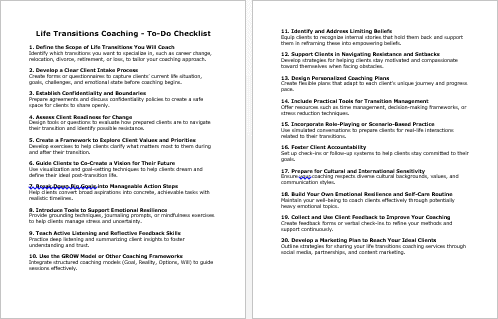
Life Transitions Coaching – Checklist
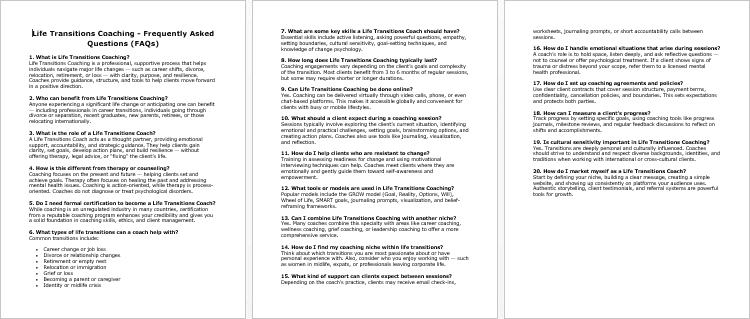
Life Transitions Coaching – FAQs
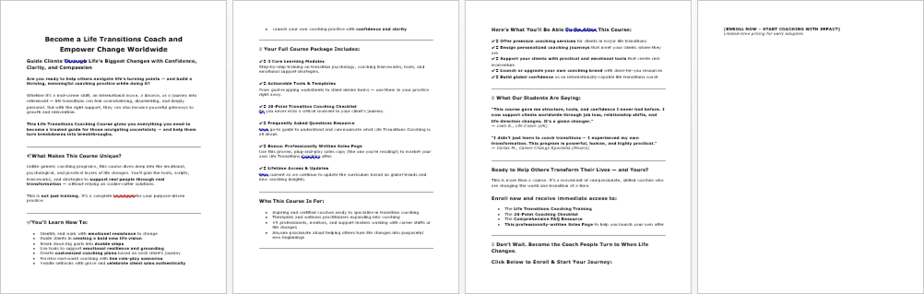
Life Transitions Coaching – Salespage Content
Package Details:
Word Count: 20 659 Words
Number of Pages: 97
Life Transitions Coaching – Bonus Content
Checklist
Word Count: 452 words
FAQs
Word Count: 809 words
Salespage Content
Word Count: 647 words
Total Word Count: 22 567 Words
Your PLR License Terms
PERMISSIONS: What Can You Do With These Materials?
Sell the content basically as it is (with some minor tweaks to make it “yours”).
If you are going to claim copyright to anything created with this content, then you must substantially change at 75% of the content to distinguish yourself from other licensees.
Break up the content into small portions to sell as individual reports for $10-$20 each.
Bundle the content with other existing content to create larger products for $47-$97 each.
Setup your own membership site with the content and generate monthly residual payments!
Take the content and convert it into a multiple-week “eclass” that you charge $297-$497 to access!
Use the content to create a “physical” product that you sell for premium prices!
Convert it to audios, videos, membership site content and more.
Excerpt and / or edit portions of the content to give away for free as blog posts, reports, etc. to use as lead magnets, incentives and more!
Create your own original product from it, set it up at a site and “flip” the site for megabucks!
RESTRICTIONS: What Can’t You Do With These Materials?
To protect the value of these products, you may not pass on the rights to your customers. This means that your customers may not have PLR rights or reprint / resell rights passed on to them.
You may not pass on any kind of licensing (PLR, reprint / resell, etc.) to ANY offer created from ANY PORTION OF this content that would allow additional people to sell or give away any portion of the content contained in this package.
You may not offer 100% commission to affiliates selling your version / copy of this product. The maximum affiliate commission you may pay out for offers created that include parts of this content is 75%.
You are not permitted to give the complete materials away in their current state for free – they must be sold. They must be excerpted and / or edited to be given away, unless otherwise noted. Example: You ARE permitted to excerpt portions of content for blog posts, lead magnets, etc.
You may not add this content to any part of an existing customer order that would not require them to make an additional purchase. (IE You cannot add it to a package, membership site, etc. that customers have ALREADY paid for.)
Share Now!
Latest Products



Free Sales Funnel Builder

Related Products
Popular & Trending



Featured Products