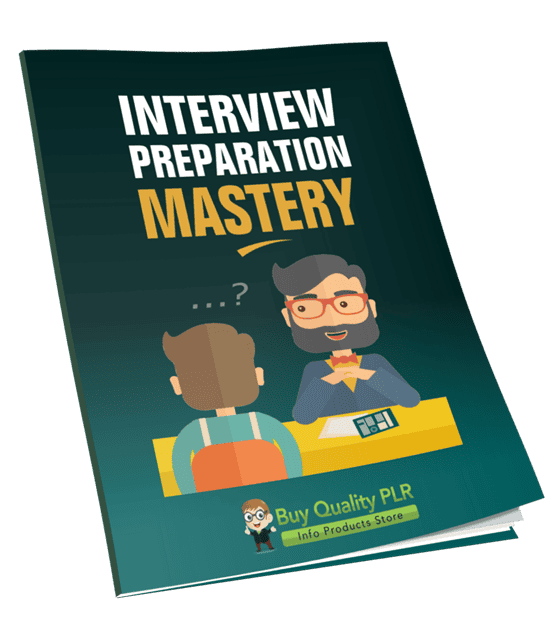
Interview Preparation Mastery PLR Course 32k Words
in Jobs PLR , PLR eCourses , PLR List Building Reports , Premium PLR , Premium PLR Reports , Premium White Label Brandable PLR Coaching Courses , Private Label Rights ProductsChoose Your Desired Option(s)
has been added to your cart!
have been added to your cart!
#interviewpreparation #plrcourse #careersuccess #jobinterviewtips #professionaldevelopment #careercoaching #plrcontent #workskills
Interview Preparation Mastery PLR Course – 32,000 Words
Techniques to Impress Employers, Stand Out from the Competition, and Land Your Dream Job
Landing a job isn’t just about sending resumes—it’s about showing up prepared, confident, and professional. With the Interview Preparation Mastery PLR Course, you can help your audience learn proven strategies to impress interviewers, answer tricky questions, and negotiate offers successfully.
This comprehensive 32,000-word course is perfect for career coaches, bloggers, educators, or PLR resellers who want to deliver high-value, ready-to-use content in the career development niche. From building confidence to mastering communication and negotiation, this course guides learners step by step to interview success.
Introducing the…
Interview Preparation Mastery
Why Interview Preparation Matters
Most job seekers fail to secure interviews or offers because they:
- Lack confidence or preparation
- Struggle to answer behavioral questions effectively
- Don’t understand employer expectations
- Panic when faced with tricky questions or negotiations
This course addresses all of these challenges. By learning practical, actionable techniques, learners gain an edge over the competition, improving their chances of landing interviews and securing offers.
What’s Inside the Course
The course is divided into five modules, each with four lessons, covering everything from foundational preparation to advanced interview strategies. Each lesson is designed to be easy to follow, practical, and immediately applicable.
Module 1: Building a Strong Foundation
Goal: Establish a clear understanding of what employers want and how to present yourself as the ideal candidate.
- Lesson 1: Understanding What Employers Really Want
Learn the key priorities of hiring managers, why first impressions are crucial, and how to align your approach with employer expectations. - Lesson 2: Researching the Company Like a Pro
Step-by-step methods for gathering insights on a company’s culture, values, and needs, so you sound informed and enthusiastic during the interview. - Lesson 3: Identifying Your Strengths and Achievements
Learn a simple method to compile your unique skills, accomplishments, and experiences that make you the perfect fit for the role. - Lesson 4: Tailoring Your Resume and Elevator Pitch
Build a personalized, 60-second pitch that highlights your strengths and aligns perfectly with the job you want.
Module 2: Mastering Communication Skills
Goal: Learn how to speak, listen, and present yourself with confidence and professionalism.
- Lesson 1: The Art of Confident Body Language
Master posture, gestures, facial expressions, and eye contact that instantly project confidence. - Lesson 2: Polished Verbal Communication
Speak clearly, avoid filler words, and maintain a tone that is friendly, professional, and memorable. - Lesson 3: Active Listening Techniques
Learn to truly understand interviewers’ questions, respond thoughtfully, and show engagement. - Lesson 4: Handling Nervousness and Anxiety
Step-by-step exercises and mindset strategies to stay calm, composed, and focused under pressure.
Module 3: Answering Questions with Impact
Goal: Equip learners with frameworks to answer common and challenging interview questions confidently.
- Lesson 1: Answering “Tell Me About Yourself”
Turn this often-dreaded opener into a structured, powerful introduction that leaves a lasting impression. - Lesson 2: The STAR Technique for Behavioral Questions
Use Situation, Task, Action, Result to provide structured, compelling responses that demonstrate results and skills. - Lesson 3: Tackling Tricky or Unexpected Questions
Practical techniques for handling curveballs, difficult scenarios, and unusual questions without panic. - Lesson 4: Asking Smart Questions Back
Craft thoughtful questions that show genuine interest in the role and company, positioning yourself as a proactive candidate.
Module 4: Impressing with Professionalism
Goal: Build credibility and demonstrate maturity, polish, and readiness for the role.
- Lesson 1: Dressing for Success
Step-by-step guide to choosing attire that fits the company culture and enhances confidence. - Lesson 2: Virtual Interview Etiquette
Techniques for acing online interviews, including lighting, camera angles, background, sound, and digital body language. - Lesson 3: Building Rapport with the Interviewer
Learn how to create natural, positive connections, establishing trust and likability from the start. - Lesson 4: Handling Salary and Negotiation Questions
Approach discussions about compensation confidently and professionally, ensuring you don’t undersell yourself.
Module 5: Sealing the Deal
Goal: Turn preparation into results with effective follow-up, offer evaluation, and long-term career strategies.
- Lesson 1: Following Up After the Interview
Write a standout thank-you note that reinforces your fit and keeps you top of mind. - Lesson 2: Evaluating Job Offers
Assess salary, benefits, growth potential, and culture before accepting an offer to make informed decisions. - Lesson 3: What to Do if You Don’t Get the Job
Learn strategies to turn rejections into feedback, skill-building opportunities, and future success. - Lesson 4: Preparing for Long-Term Career Success
Build habits and strategies that keep you interview-ready and positioned for future advancement.
Bonus Materials
This course also includes high-value extras to support learners and resellers:
- Checklist – 429 Words: Step-by-step implementation guide to ensure learners cover every crucial aspect of preparation.
- FAQs – 1,020 Words: Common questions and answers covering interview scenarios, strategies, and techniques.
- Salespage – 676 Words: Ready-to-use copy to promote the course immediately.
Who Can Profit from This PLR Course
The Interview Preparation Mastery PLR Course is ideal for:
- Career coaches and consultants looking for turnkey training content
- Bloggers and influencers creating lead magnets, guides, or email courses
- Educators offering online workshops or virtual classes
- PLR resellers seeking a high-demand career product ready to sell
- Job-seekers looking to teach peers or friends with professional-grade content
This course can be rebranded, packaged, and sold in multiple formats, making it a versatile asset for generating revenue.
How to Use and Monetize This Course
Here are practical ways to profit:
- Sell as a Complete Course: Offer as a full digital course for $197–$497.
- Break into Mini-Reports: Sell individual modules or lessons for $10–$20 each.
- Bundle with Other Career Products: Create premium packages priced $47–$97.
- Multi-Week Coaching Program: Use the lessons as a structured e-class with a $297–$497 price point.
- Membership Site Content: Provide recurring value and generate monthly income.
- Physical Products: Convert lessons into workbooks, guides, or journals for offline sales.
- Lead Generation and Marketing: Use excerpts as blog posts, social media content, or opt-in incentives.
- Flip a Website: Build a career coaching site with this course and sell the complete setup for profit.
Licensing Terms
Permissions: What You Can Do:
- Sell the course as-is or with minor edits
- Claim copyright if 75%+ of the content is rewritten
- Break it into smaller guides or membership content
- Bundle with other PLR products or digital courses
- Use excerpts for marketing, blogs, or lead magnets
Restrictions: What You Cannot Do:
- Pass PLR or resale rights to your customers
- Offer 100% affiliate commissions (maximum 75%)
- Give away the complete materials for free
- Include content in existing orders without requiring a purchase
Why Buy This PLR Course from Buy Quality PLR?
- Professionally written 32,000-word course ready for immediate use
- Comprehensive, step-by-step training suitable for all experience levels
- High-demand career development niche with evergreen appeal
- Includes checklist, FAQs, and sales page copy for easy marketing
- Save months of content creation and start selling immediately
Bottom Line
The Interview Preparation Mastery PLR Course is a turnkey solution for anyone in the career, coaching, or personal development space. You can:
- Teach clients, students, or readers to ace interviews with confidence
- Launch a digital product in a profitable niche
- Create recurring income via membership content, e-classes, or bundles
- Profit from ready-to-use, professional content without spending months creating it
Empower your audience to shine in interviews, land their dream jobs, and grow your business with this comprehensive PLR course.
has been added to your cart!
have been added to your cart!
Here A Sample of the Interview Preparation Mastery PLR Course
This course is designed to give learners practical, easy-to-apply strategies to shine in job interviews, stand out from the competition, and confidently land the job they want. The modules are structured in a logical sequence, so learners build skills layer by layer.
Module 1: Building a Strong Foundation
Lesson 1 – Understanding What Employers Really Want
Detailed step-by-step instructions and teaching notes for international course creators
Lesson goal (clear, instructor-facing):
By the end of this lesson learners will be able to explain how hiring managers evaluate candidates, identify the top priorities employers look for across industries, and create concrete evidence statements that map their strengths to employer needs. This lesson focuses on mind-set, signals, and first-impression mechanics so learners can prepare targeted, persuasive interview responses.
Duration: 90–110 minutes (flexible for shorter or longer workshop formats).
Materials needed:
• Flipchart or slides with learning objectives and frameworks.
• Participant worksheets (Skills → Evidence matrix; 60-second pitch template).
• Timer, breakout room tool for virtual classes, role-play cards with common interviewer scenarios.
• Camera or smartphone for recording practice (optional).
Lesson outline — step by step
1) Set the stage (10 minutes)
- Welcome learners, state the lesson goal and relevance. Use a single concise sentence: “Today we learn how hiring managers think — so you can speak their language and make hiring decisions easy.”
- Quick icebreaker: ask each participant (30 seconds max) to name one job they’d love and one quality they think employers want. Capture variety to show cultural/industry differences.
- Show a slide titled “What hiring managers silently ask” containing three probing questions:
→ Will this person solve a business problem?
→ Will they fit into the team and culture?
→ Can I trust them to deliver?
Explain that every interviewer implicitly weighs these questions.
2) Teach the hiring-manager mindset (20 minutes)
Use a clear, repeatable list of employer priorities. Present each priority, explain why it matters to the business, and give 1–2 concrete signals that demonstrate it.
Employer priorities and concrete interviewer signals
- Business impact (priority: results and ROI)
• Why it matters: hiring is an investment; managers hire for measurable improvements.
• Signals: quantified achievements, clear metrics, scope of responsibility. - Reliability and work ethic (priority: consistent delivery)
• Why: projects slip if people are unreliable.
• Signals: tenure on projects, references describing dependability, examples of meeting tight deadlines. - Problem-solving and learning agility (priority: adaptability)
• Why: environments change quickly.
• Signals: examples of learning new tools, pivoting strategies, structured problem statements. - Communication and teamwork (priority: collaboration)
• Why: individual talent fails without clear coordination.
• Signals: cross-functional projects, conflict resolution examples, clarity in explaining complex ideas. - Cultural fit and attitude (priority: working style alignment)
• Why: cultural friction increases turnover.
• Signals: language used in interview (team-oriented vs individualistic), examples of values alignment. - Technical or role expertise (priority: baseline competence)
• Why: minimises ramp time.
• Signals: certifications, portfolio, technical results, code samples, case studies. - Potential and coachability (priority: future growth)
• Why: long-term value.
• Signals: curiosity, mentorship examples, initiatives taken to grow.
Instructional tip: Invite brief audience examples for each priority. Highlight that signals can be cultural: how a “reliable” signal looks in a startup (weekend fixes, fast pivots) vs a regulated bank (compliance, documentation).
3) Explain why first impressions matter — the mechanics (15 minutes)
Break the concept into discrete, teachable parts. Use short demonstrations.
Key mechanisms
• Cognitive shortcuts: Interviewers use heuristics — a strong opening can create a “halo” that colors later answers.
• Small cues, big effects: punctuality, tone, attire, eye contact, and the first 30–60 seconds of the introduction shape perceived competence.
• Consistency checking: Hiring managers look for alignment between resume claims and first impression; mismatch raises doubt.
• Risk assessment: Many employers are risk-averse; they prefer candidates who reduce perceived hiring risk.
Practical demo: Instructor models two 30-second openings—one polished, one vague—and ask learners which inspired confidence and why. Decompose observable elements: clarity, specificity, confident posture, concise evidence.
4) Active exercise — map your strengths to employer priorities (20 minutes)
This is the central, practical activity. Hand out the Skills → Evidence worksheet.
Worksheet structure (one page):
Column A: Strength / skill (e.g., “Project leadership”)
Column B: Concrete evidence (numbers, timeframe, role)
Column C: Employer priority it supports (choose from list)
Column D: 1-sentence proof statement for interviews (ready-to-say)
Step-by-step instructions for learners:
- List your top 5 strengths (5 minutes). Think of job tasks, cross-functional work, or soft skills.
- For each strength, write one piece of concrete evidence — a metric, timeframe, or observable outcome (7 minutes). If you don’t have numbers, use comparative language: “reduced cycle time by half in under three months.”
- Link each to an employer priority (2 minutes). This teaches framing: a technical skill can be framed as “reducing risk” or “increasing revenue.”
- Draft a 1-sentence proof statement for interviews (6 minutes). Example: “As the lead for the payment integration, I led a three-person team that cut transaction errors by 40% within four weeks, improving checkout conversion.”
Instructor notes: Walk the room or visit breakout rooms to give micro-feedback. Encourage specificity—avoid vague adjectives like “hardworking” without evidence.
5) Craft the 60-second pitch (10–15 minutes)
Show a simple template: Situation → Role → Action → Result → Relevance to employer.
Template example:
“I’m [name], a [role/years] who [what you do]. At [company/project], I [action] which resulted in [measurable result]. I’m looking to bring that experience to [how you will help the new employer].”
Activity: Each learner writes a pitch and delivers it to a partner. Partners give feedback using a 3-point rubric: clarity, evidence, relevance (✓/✗/✓).
International adaptation tip: Encourage local language norms—some cultures prefer modest phrasing; teach learners to maintain humility while still using measurable language.
6) Role-play: interview openings and signal alignment (15–20 minutes)
Set up short role-play rounds (5–7 minutes each).
Structure:
• Round 1: Candidate delivers 60-second pitch; interviewer asks a quick follow-up.
• Round 2: Candidate answers a behavioral opener (e.g., “Tell me about a time you handled a tight deadline”). Use STAR structure.
• Peer feedback: Use the checklist below.
Feedback checklist (use international signs):
✓ Clear opening and role definition
✓ One concrete metric or outcome included
✓ Tone consistent with company type (formal vs conversational)
✓ Evidence mapped to employer priority
✓ No unsupported claims
Instructor tip: Rotate roles so everyone experiences both candidate and interviewer perspectives. Record one example if learners agree; playback can accelerate learning.
7) Cultural and industry adaptations (10 minutes)
Provide short guidance for adapting signals depending on region and sector.
High-level pointers:
• Formal hierarchies (some East Asian, Middle Eastern, European corporate settings): lead with respectful humility, reference titles where appropriate, emphasize longevity and credentials.
• Startup and creative sectors (global hubs): emphasize initiative, speed, flexibility, and visible contribution; storytelling and passion matter.
• Public sector and regulated industries: foreground process adherence, risk mitigation, certifications.
• Cross-border teams: emphasize intercultural communication, remote collaboration examples, and language skills.
Practical teacher script: “Tell learners: always research the company and industry culture, then adapt your opening and examples to highlight the signals those employers value most.”
8) Assessment, reflection, and practice assignment (10 minutes)
Conclude the lesson with short formative assessment and a practice task.
In-class quick assessment: Ask learners to write a 2-line response to: “What is the single most important question a hiring manager asks, and how will you answer it?” Collect a few answers aloud and give targeted praise.
Practice assignment (home practice):
• Finalize your Skills → Evidence worksheet with five fully quantified proof statements.
• Record your 60-second pitch and review it for clarity and evidence (self-check: did you mention a measurable result?).
(Do not label this as “next steps” in your delivery—present it as “practice” integrated into the lesson.)
Instructor tips & cautions
• Encourage evidence over adjectives. “Hardworking” is weak; “reduced errors by 25% over six months” is strong.
• Avoid cultural stereotyping—frame differences as tendencies and teach learners to research each employer specifically.
• Keep feedback constructive and specific: cite the phrase to change and suggest a replacement.
• Timebox exercises tightly to preserve energy and momentum.
• Use the role of “observer” to teach active listening: observers note one strength and one improvement suggestion per candidate.
Key takeaways for learners (one-line each; present at close)
• Employers hire for impact, reliability, and fit.
• Signals beat adjectives: prove claims with concrete evidence.
• First impressions shape interviewer bias—open clearly and confidently.
• Tailoring your language to the employer’s priorities changes the hiring equation.
This lesson gives international course creators a ready sequence of teaching moves: concept explanation, demonstration, active mapping, pitch crafting, role-play, cultural adaptation, and short assessment. Each activity is designed to be practical and repeatable so learners leave with both insight and ready-to-use materials they can deploy in real interviews.
Lesson 2 — Researching the Company Like a Pro
Detailed step-by-step instructions and teaching notes for international course creators
Lesson goal (instructor-facing):
Learners will be able to gather, organise and interpret the key facts about any employer so they can speak with authority, ask insightful questions and align their examples to what the company truly values.
Duration: 90–100 minutes (flexible for workshop or masterclass delivery).
Materials:
• Company Research Checklist (worksheet).
• Laptop or tablet for each learner, or printed research sheets.
• Projector/slides with prompts and templates.
• Timer, breakout room capability for virtual classes.
• Role-play cards: interviewer profiles with company context.
Lesson structure — step by step
1) Open and orient (8–10 minutes)
→ Welcome learners, read the lesson goal aloud and make the purpose practical: “Good research makes you sound informed, interested and low-risk — exactly what hiring managers want.”
→ Quick warm-up: ask participants to name one surprising fact they once discovered about a company before an interview (30–60 seconds each, volunteer). This primes curiosity and demonstrates the payoff of good research.
→ Present the lesson roadmap on a slide: 1) What to look for, 2) Where to look, 3) How to synthesize findings, 4) Practice and role-play.
2) Explain the WHY — what research achieves (10 minutes)
Use a short mini-lecture with clear signals employers look for when candidates research well:
• ✓ Respect and interest — shows you value the role.
• ✓ Reduced hiring risk — you understand the business context.
• ✓ Better interview answers — your examples become relevant, not generic.
• ✓ Stronger questions — you can interrogate role fit and growth opportunities.
Give a brief demo: read two short candidate responses to “Why do you want this role?” — one generic, one research-informed — and ask learners which is more convincing and why. Decompose the convincing answer into specific facts and relevance.
3) Teach the Company Research Checklist (20 minutes)
Present a single-page checklist learners will use every time. Walk through each item and give practical instructions on how to extract meaningful, interview-ready notes.
Company Research Checklist — headline sections
- Company snapshot — sector, size, location(s), founding year, headline product/service.
- Mission, vision and values — key phrases and tone.
- Business model & customers — who pays, who benefits, market served.
- Recent performance & milestones — launches, funding, earnings, growth signals.
- Products / services & roadmap — flagship offerings and obvious priorities.
- Competitors & market position — direct rivals and differentiators.
- Culture & people — leadership style, employee reviews, public commentary.
- Interview specifics — expected interview format, key stakeholders, likely KPIs.
- Language & tone — formal vs conversational, technical depth, jargon.
- Open questions for interviewers — 6–8 tailored queries that show insight.
For each item, give one practical extraction tip and one example of how to turn it into interview language:
• → Mission, vision and values
- Tip: copy 2–3 short phrases from the company’s “About” page; note any recurring words (“innovation”, “customer-first”, “sustainability”).
- Interview language: “I’m particularly drawn to your emphasis on sustainability — in my last role I led a packaging change that reduced material use by 18%.”
• → Business model & customers
- Tip: identify who pays and what problem is solved for them (enterprise? consumers? B2B SaaS?).
- Interview language: “Given you serve mid-market retailers, my experience scaling onboarding for similar customers should shorten time-to-value.”
• → Recent milestones
- Tip: note one recent event (product launch, funding round, regulatory approval) and its likely consequence (hiring, scaling, new priorities).
- Interview language: “I saw you launched X last quarter; I’d love to support the scaling phase and reduce time-to-market for new features.”
4) Where to look — sources and search strategy (15 minutes)
Teach a prioritized list of sources and a simple search sequence learners can follow in 20–30 minutes.
Recommended search sequence (fast and focused):
- Company website — About, Products, Careers, News / Press.
- Job description — read carefully and highlight required skills and repeated words.
- Leadership bios — note CEO/CTO statements and board composition.
- Professional networks (company page and employee profiles) — see team size, recent hires, and alumni.
- Public filings or reports (for public companies) — revenue, strategy notes.
- News articles & trade press — major events or controversies.
- Employee reviews & glassdoor-type sources — culture signals and recurring themes.
- Product reviews and customer forums — common pain points.
- Social media channels — product announcements and tone of voice.
- Technical repositories or portfolios (GitHub, Dribbble) for technical/creative roles.
For each source, give a time-saving tip. Example: “When reading the job description, underline every verb — these are the skills you must echo in your examples.”
5) Active work — structured research sprint (20 minutes)
Split learners into pairs or small groups. Assign each group a different sample role and company brief (create realistic but anonymised profiles).
Sprint instructions:
→ 15 minutes: use the checklist to collect 8–10 key findings. Each learner fills one research sheet. Timebox strictly.
→ 5 minutes: pair up to explain the top three insights to a partner.
Provide a facilitator script for feedback: “Ask them: which fact surprised you and why? Which priority should the candidate emphasise in their opening?”
6) Synthesis — turning facts into interview language (15 minutes)
Teach a simple three-line template to convert research into interview-ready statements:
Template: Context → Insight → Relevance
Example: “Context: You’re scaling into Europe. Insight: Product teams focus on compliance. Relevance: My experience launching compliant features across three EU markets will reduce your regulatory ramp-up time.”
Use 3–4 live examples from the sprint and rewrite them into this formula. Invite volunteers to produce one such line; coach for specificity and brevity.
7) Role-play: research-informed intro and questions (15–20 minutes)
Set up paired role-plays where one learner is the candidate and the other the interviewer with a short interviewer profile. Candidate must: a) open with a 45–60 second research-informed intro; b) ask two insightful questions at the end.
Interviewer prompt examples (cards):
• “We’ve recently expanded into Asia; how would you approach localisation?”
• “We’re a product-led start-up with a flat structure; how do you handle unclear priorities?”
Use an observation checklist for peers:
✓ Was the opening concise and research-led?
✓ Did the candidate use at least one company-specific fact?
✓ Were the final questions specific and strategic?
✓ Tone matched the company’s style?
Rotate roles so everyone practices both sides.
8) Cultural adaptations and sensitivity (8–10 minutes)
Teach quick guidance for international contexts:
• In hierarchical settings, reference formal titles and respect processes when naming leaders.
• In collaborative/startup cultures, lead with initiative examples and speed.
• In regulated industries, foreground compliance, longevity and process improvements.
• For cross-border teams, emphasise remote collaboration, language skills and cultural sensitivity.
Remind instructors to avoid stereotyping; present these as tendencies that learners must confirm through research.
9) Assessment, reflection and practice assignment (7–8 minutes)
Conclude with a short formative check: ask each learner to write one sentence answering: “What one fact about this company will most change how you present yourself in the interview?” Collect a few aloud and give quick praise and one refinement suggestion each.
Practice assignment (home practice):
• Complete the Company Research Checklist for two target roles: one in your home market and one abroad.
• Prepare a research-informed 60-second opening and three tailored questions.
(Do not label this section as “next steps” in your delivery — present it as integrated practice.)
Instructor tips & cautions
• Encourage evidence over flattery. A specific observation (“I noticed your product X targets midsize retailers…”) beats vague praise.
• Teach learners to correct misinformation politely. If they find contradictory reports, note it and ask clarifying questions in the interview.
• Be mindful of privacy and ethics when researching people — avoid intrusive searches.
• Timebox research sprints to keep energy high and focus practical learning.
• For virtual classes, provide research templates in editable format to speed up the activity.
Key takeaways for learners (short list to close)
• Good research = less risk for employers and more precise answers from you.
• Use a simple checklist and a fast search sequence — 20–30 minutes yields powerful results.
• Turn facts into relevance: always answer “So what does this mean for the employer?”
• Tailor tone and examples to the company culture and the industry.
This lesson equips international course creators with clear, repeatable teaching moves: demonstration, rapid research practice, synthesis of facts into interview language, role-play, and culturally-aware guidance. Each activity is designed to leave learners with both a portable research checklist and the ability to translate facts into interview advantage.
Lesson 3 — Identifying Your Strengths and Achievements
Detailed step-by-step instructions and teaching notes for international course creators
Lesson goal (instructor-facing):
By the end of this lesson learners will be able to extract, articulate and package their core strengths and concrete achievements into short, interview-ready proof statements that clearly demonstrate value to employers.
Duration: 90–110 minutes (flexible depending on cohort size and interaction level).
Materials needed:
• Strengths Inventory worksheet (one per learner).
• Achievement Bank template (spreadsheet or paper).
• STAR proof-statement template (handout).
• Sample job descriptions for pairing exercises.
• Timer and breakout room tool (for virtual delivery).
• Whiteboard or slides for live examples.
Lesson flow — step by step
1) Warm-up and framing (8–10 minutes)
- Open with a short, practical statement: “We are turning work history into persuasive proof — not a list of duties.”
- Quick prompt for learners (30–60 seconds each, volunteers): name one success they’re quietly proud of. Capture one or two aloud to model how ordinary work can read as achievement.
- Present the three essential rules for this lesson:
✓ Evidence beats adjectives.
✓ Numbers and specifics travel across cultures.
✓ Relevance matters — match achievements to what employers value.
2) Clarify terms: skills vs achievements vs strengths (10–12 minutes)
Explain definitions with examples and why the distinction matters in interviews.
• Skill = an ability or competence (e.g., “data analysis”, “negotiation”).
• Achievement = a result that shows the skill in action with impact (e.g., “reduced churn 12% in six months by redesigning onboarding”).
• Strength = a characteristic you reliably bring to work that combines skills, mindset and preferred contribution (e.g., “systems thinker who simplifies complex processes”).
Activity: give three short role examples (corporate, startup, non-profit). Ask learners to identify whether a given phrase is a skill, an achievement or a strength. Discuss quickly.
3) Guided self-reflection — Strengths Inventory (20 minutes)
Distribute the Strengths Inventory worksheet. The worksheet has four columns:
A. Role / context (company, project, volunteer role)
B. What I did (tasks + tools used)
C. Result or outcome (what changed because of your work)
D. Evidence / metric (numbers, timelines, testimonials, awards)
Step-by-step instructions for learners:
- Spend 6–8 minutes listing 6–8 roles/contexts from the last 8–10 years (include short-term projects and volunteer roles).
- For each role, write one clear action you took (Column B). Be concrete: replace “managed team” with “managed a cross-functional team of 4 to deliver X.” (6 minutes)
- In Column C, convert the action into a result. If there’s no formal metric, use relative language (“reduced processing time by roughly half” or “improved customer satisfaction from low to above average”). (6 minutes)
- In Column D, record any evidence you can produce: reports, screenshots, testimonials, dates, awards, percentage changes, cost savings. (2–4 minutes)
Instructor notes: circulate and prompt specifics. Example prompts: “Who benefited from this? By how much? Over what period?” Push for at least a comparative or timeframe metric if exact numbers aren’t available.
4) Converting duties into achievements — a 3-step technique (15 minutes)
Teach a repeatable transformation method: Duty → Action → Outcome.
- Identify the duty (e.g., “answered customer emails”).
- Name the specific action you did differently (e.g., “created response templates and triaged emails by priority”).
- Define the measurable outcome (e.g., “reduced average response time from 48 to 8 hours; customer satisfaction rose 10 points”).
Give 3 short industry-agnostic examples (IT, retail, education). Ask learners to convert one duty from their worksheet using this method and share aloud.
5) Building the Achievement Bank (15 minutes)
Explain the Achievement Bank as a living document — a searchable list of 20–30 accomplishment bullets tailored over time.
Bank structure (columns):
• Short title (10 words max) → e.g., “Reduced onboarding time”
• One-line achievement (action + result + metric)
• Context / role
• Evidence type (report, testimonial, KPI dashboard)
• STAR-ready notes (one sentence each for Situation, Task, Action, Result)
Activity: learners add 3–5 achievements from their Strengths Inventory into the Achievement Bank. Encourage concise, quantified lines. Offer examples:
→ “Led migration of CRM that increased lead conversion by 18% within three months (Project Manager, SMB retail).”
Instructor tip: suggest learners store the bank in a simple spreadsheet or note app and update it after every project.
6) Crafting STAR proof-statements (20 minutes)
Introduce the STAR format as the standard for turning achievements into compelling interview answers.
STAR template:
Situation → Task → Action → Result
Step-by-step teaching method:
- Model with a real example on the whiteboard. Break down each element.
- Show how to compress a STAR answer into a 30–45 second proof-statement for quick interview moments. Use the formula: “Brief context + singular action + measurable outcome.”
- Ask learners to pick one Achievement Bank item and write a STAR proof-statement. Timebox: 8 minutes.
- Volunteers deliver their 30–45 second proof; provide micro-feedback focused on clarity and evidence.
Sample STAR compressed into a proof-statement:
“I led a cross-functional team to redesign the checkout flow (Situation/Task). I implemented A/B testing and prioritized three friction points (Action), which reduced cart abandonment by 14% in two months and increased monthly revenue by 7% (Result).”
7) Peer interview and micro-presentations (20 minutes)
Divide learners into pairs or triads. Structure rounds:
• Round A — Candidate presents two STAR proof-statements (45–60 seconds each).
• Round B — Interviewer asks one probing question: “What obstacles did you face?” or “How did you measure success?” (1–2 minutes).
• Observers give one strength and one improvement suggestion, using the rubric below.
Peer feedback rubric (use during observations):
✓ Clarity: Is the Situation clear?
✓ Evidence: Is there a metric or concrete outcome?
✓ Brevity: Was it delivered within 60 seconds?
✓ Relevance: Did the candidate tie it to likely employer priorities?
Instructor role: float, offer corrections on phrasing, suggest tighter metrics, and model rewording for modest cultures.
8) Special cases: gaps, junior applicants, and non-traditional experience (12 minutes)
Give explicit coaching for learners with non-standard CVs.
• Career gaps: frame actions during gaps as projects, volunteer work, learning outcomes. Example: “During my break I freelance-managed a local supply chain project that reduced waste by X%.”
• Junior candidates / students: focus on course projects, internships, team roles, class leadership, and quantifiable class outcomes (grades, competition placement).
• Freelancers and consultants: present client outcomes, repeat business rate, and scope (number of clients, average project size).
• Caregivers / career switchers: emphasise transferable skills — project management, stakeholder communication, budgeting.
Provide sentence starters that transform non-traditional experience into results: “While [context], I [action], which resulted in [impact].”
9) Cultural and international sensitivity (8–10 minutes)
Discuss how self-presentation norms vary and how to adapt without losing evidence.
• Modesty vs directness: in cultures that value modesty, teach using third-party evidence (client quote, performance review) to avoid appearing boastful.
• Numeric norms: some markets use absolute numbers (USD, units); others prefer percentages or relative improvements — teach learners to translate metrics into formats the interviewer will understand.
• Language differences: for non-native speakers, recommend rehearsed proof-statements focusing on clarity and simple numbers.
• Collective achievements: attribute team results properly — “Led a team of five; our efforts reduced X by Y%,” which honours teamwork while showing leadership.
Encourage instructors to give culturally-local examples and to role-model phrasing appropriate for different audiences.
10) Assessment, reflection and consolidation (6–8 minutes)
Close with a short formative assessment: ask learners to write one 45-second proof-statement that they could use in an interview tomorrow. Collect 4–5 aloud and give targeted praise and one refinement suggestion each.
Consolidation message to learners: “Keep the Achievement Bank updated. When in doubt, quantify, clarify the action you took, and tie every story to employer value.”
Instructor tips & cautions
• Push for specifics — ask “how much?”, “how long?”, “who benefited?” — but respect privacy and confidentiality.
• Discourage invented numbers. If exact figures are unavailable, use honest comparative language with approximate timeframes.
• Use examples across sectors to avoid bias toward corporate or tech roles.
• For larger classes, use breakout rooms and assign a timekeeper to keep practice brisk.
• Help learners with language barriers by co-developing short script versions they can rehearse.
Key takeaways (to present at close)
• ✓ Strengths are useful only when shown through achievements.
• ✓ Convert duties into achievements by focusing on action + outcome.
• ✓ Quantify wherever possible; when you cannot, use clear comparative language.
• ✓ Keep an Achievement Bank — it saves time and sharpens confidence.
• ✓ Tailor your proof-statements to culture and the specific employer’s priorities.
This lesson gives international course creators a complete, repeatable classroom/workshop sequence: teach distinctions, guide reflection, convert duties into measurable achievements, build an Achievement Bank, practice STAR proof-statements, and handle special cases and cultural nuances. The result is learners who can present real, verifiable value to hiring managers in any market.
We’re also giving these extra bonuses
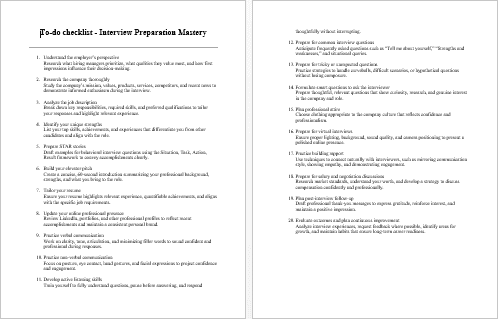
Interview Preparation Mastery – Checklist
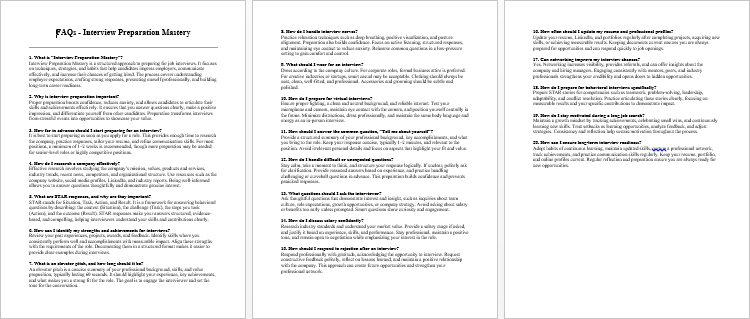
Interview Preparation Mastery – FAQs
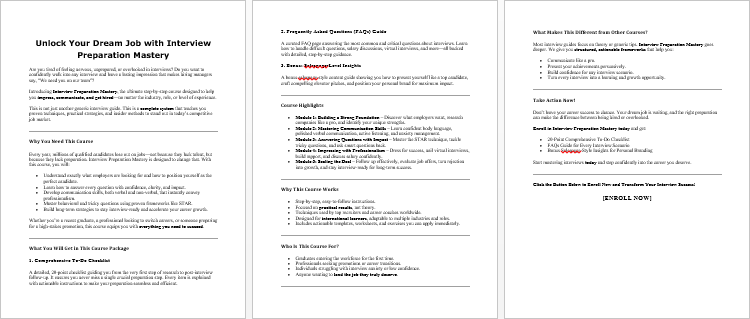
Interview Preparation Mastery – Salespage Content
Package Details:
Word Count: 30 727 Words
Number of Pages: 128
Interview Preparation Mastery – Bonus Content
Checklist
Word Count: 429 words
FAQs
Word Count: 1020 words
Salespage Content
Word Count: 676 words
Total Word Count: 32 852 Words
Your PLR License Terms
PERMISSIONS: What Can You Do With These Materials?
Sell the content basically as it is (with some minor tweaks to make it “yours”).
If you are going to claim copyright to anything created with this content, then you must substantially change at 75% of the content to distinguish yourself from other licensees.
Break up the content into small portions to sell as individual reports for $10-$20 each.
Bundle the content with other existing content to create larger products for $47-$97 each.
Setup your own membership site with the content and generate monthly residual payments!
Take the content and convert it into a multiple-week “eclass” that you charge $297-$497 to access!
Use the content to create a “physical” product that you sell for premium prices!
Convert it to audios, videos, membership site content and more.
Excerpt and / or edit portions of the content to give away for free as blog posts, reports, etc. to use as lead magnets, incentives and more!
Create your own original product from it, set it up at a site and “flip” the site for megabucks!
RESTRICTIONS: What Can’t You Do With These Materials?
To protect the value of these products, you may not pass on the rights to your customers. This means that your customers may not have PLR rights or reprint / resell rights passed on to them.
You may not pass on any kind of licensing (PLR, reprint / resell, etc.) to ANY offer created from ANY PORTION OF this content that would allow additional people to sell or give away any portion of the content contained in this package.
You may not offer 100% commission to affiliates selling your version / copy of this product. The maximum affiliate commission you may pay out for offers created that include parts of this content is 75%.
You are not permitted to give the complete materials away in their current state for free – they must be sold. They must be excerpted and / or edited to be given away, unless otherwise noted. Example: You ARE permitted to excerpt portions of content for blog posts, lead magnets, etc.
You may not add this content to any part of an existing customer order that would not require them to make an additional purchase. (IE You cannot add it to a package, membership site, etc. that customers have ALREADY paid for.)
Share Now!
Latest Products


Free Sales Funnel Builder

Related Products

Popular & Trending


Featured Products