Improve Focus and Concentration PLR Course 24k Words
in Focus PLR , PLR eCourses , PLR List Building Reports , Premium PLR , Premium PLR Reports , Premium White Label Brandable PLR Coaching Courses , Private Label Rights Products , Self Help PLR , Self Improvement PLRChoose Your Desired Option(s)
has been added to your cart!
have been added to your cart!
#improvefocus #concentration #plrcourse #productivitytips #mindsetgrowth #focusbetter #plrcontent #selfimprovement #successhabits
Improve Focus and Concentration PLR Course – 24,000 Words
Regain Control of Your Attention, Sharpen Your Mind, and Unlock Your Full Productivity Potential
Do you feel distracted, overwhelmed, or constantly battling a wandering mind? Do you struggle to complete tasks, stay organized, or focus on what truly matters? You are not alone. In today’s fast-paced digital world, focus and concentration are harder than ever to maintain.
The Improve Focus and Concentration PLR Course is a comprehensive, ready-to-use course designed to help you—and your audience—regain control of attention, eliminate distractions, and improve productivity naturally. With step-by-step guidance, practical exercises, and actionable tips, this course gives anyone the tools to train their brain like a muscle for peak focus.
This 24,000-word PLR course is perfect for coaches, trainers, educators, bloggers, and digital entrepreneurs who want high-quality, ready-to-sell content in the personal development and productivity niche.
Introducing the…
Improve Focus and Concentration
Why Focus Matters
Focus isn’t just about getting tasks done—it’s about taking control of your life, reducing stress, and achieving meaningful results. Without focus, even the best ideas, skills, or goals remain unfulfilled.
Here’s what your audience will gain from this course:
- Learn the science behind focus and how attention works in the brain.
- Discover simple, daily routines and exercises that strengthen concentration.
- Set up a physical and digital environment that promotes productivity.
- Master time management techniques that protect energy and focus.
- Build long-term habits for sustained mental clarity and efficiency.
By the end of the course, learners will have a repeatable system to stay focused, get more done, and feel in control of their lives.
What’s Inside the Course
The course is divided into five in-depth modules, each with step-by-step lessons, actionable tips, and easy-to-follow strategies.
Module 1: Understanding Focus & Why It Matters
Goal: Learn what focus truly is and why it is essential for success and peace of mind.
- Step 1: What is Focus, Really?
Discover the difference between focus and attention and why your brain is not naturally built to multitask. Understand the science of attention and why single-tasking produces better results. - Step 2: The Real Cost of Distraction
Learn how distractions silently drain mental energy and productivity, and understand the hidden costs of constantly shifting attention. - Step 3: Your Brain on Focus
A beginner-friendly overview of how the brain processes concentration. Learn why focus is like a muscle that can be trained, strengthened, and sustained. - Step 4: The Lifestyle Connection
Sleep, nutrition, exercise, and daily habits all impact focus. This lesson shows how small lifestyle changes dramatically improve mental clarity.
Module 2: Building a Focus-Friendly Environment
Goal: Create a physical and digital space that naturally encourages concentration.
- Step 1: Declutter Your Physical Space
A tidy space equals a tidy mind. Learn how to design a workspace that minimizes stress and cognitive overload. - Step 2: Minimize Digital Distractions
Discover tools, apps, and strategies to block notifications, time-wasting websites, and unnecessary alerts. - Step 3: Create a Focus Zone
Designate a calm, distraction-free area for deep work. Tips on lighting, colors, seating, and ergonomics make concentration effortless. - Step 4: The Power of Routine
Learn to build daily routines that signal your brain it’s time to focus. Consistency trains your mind to enter deep work mode faster.
Module 3: Time Management for Better Focus
Goal: Master your time so that focus comes naturally and productivity skyrockets.
- Step 1: Use the Pomodoro Technique
Short, focused bursts with regular breaks improve attention span, prevent burnout, and keep your energy consistent throughout the day. - Step 2: Prioritize with the 1-3-5 Rule
Start each day with 1 big task, 3 medium tasks, and 5 smaller tasks. This method reduces overwhelm and increases motivation. - Step 3: Schedule Focus Time
Learn how to block “focus hours” in your calendar and guard them like gold, ensuring deep work is protected from interruptions. - Step 4: Say No (Without Guilt)
Protect your time and attention by politely declining distractions or unnecessary commitments. Learn scripts and strategies for assertive, guilt-free refusal.
Module 4: Training Your Mind for Deep Focus
Goal: Strengthen mental discipline and concentration power through practical exercises.
- Step 1: Practice Mindfulness
Daily mindfulness exercises anchor your mind, calm racing thoughts, and improve the ability to stay present. - Step 2: Do One Thing at a Time
Embrace single-tasking and learn how focusing fully on one task increases quality and efficiency. - Step 3: Visualization Techniques
Use mental imagery to rehearse focus success before starting important tasks, improving performance and confidence. - Step 4: Track Your Focus
Keep a simple focus journal to identify patterns, measure improvements, and train your brain back to concentration when it wanders.
Module 5: Staying Consistent & Focused Long-Term
Goal: Turn focus into a permanent habit that supports your goals and lifestyle.
- Step 1: Set Small, Measurable Goals
Break big goals into small, achievable wins to maintain motivation and track progress effectively. - Step 2: Review & Reflect Weekly
Dedicate 10 minutes each week to reflect on wins, challenges, and adjustments. Fine-tune focus strategies to improve continuously. - Step 3: Celebrate Your Wins
Reward yourself for maintaining focus, completing tasks, and sticking to routines. Positive reinforcement strengthens habits. - Step 4: Make Focus a Lifestyle
Apply techniques to work, learning, and personal life. Become present in conversations, reading, and daily experiences, ensuring mental clarity everywhere.
✅ End Result
By the end of this course, learners will:
- Have a complete, step-by-step system to improve focus and concentration
- Reduce distractions and procrastination naturally
- Boost productivity and achieve goals faster
- Develop habits that support long-term mental clarity
- Feel confident, in control, and less stressed
This is more than just a course—it’s a life-changing blueprint for attention mastery.
Bonus Materials
- Checklist – 545 Words: A concise, actionable reference guide to implement focus strategies daily
- FAQs – 662 Words: Answers to common focus and concentration challenges
- Salespage – 643 Words: Ready-to-use sales copy you can resell immediately
Who Can Profit From This PLR Course?
This course is ideal for:
- Life coaches and productivity trainers looking for ready-to-sell content
- PLR entrepreneurs in the personal development niche
- Educators and workshop facilitators building training programs or webinars
- Bloggers and marketers who want to use excerpts as lead magnets, guides, or premium reports
- Wellness professionals looking to provide clients with practical mental clarity tools
With PLR rights, you can resell, rebrand, bundle, or convert this course into multiple profitable formats.
How to Use and Profit From This PLR Course
Here are practical ways to monetize this PLR course:
- Sell the complete course as-is for $197–$497
- Create a multi-week eClass and charge $297–$497
- Break into mini-guides or reports for $10–$20 each
- Bundle with other PLR products for $47–$97
- Set up a membership site to generate recurring monthly income
- Convert the content into audio, video, or workbook formats for premium pricing
- Use excerpts as lead magnets or free incentives to grow your audience
- Create a dedicated website with the course and flip it for a profit
Licensing Terms
What You CAN Do:
- Sell with minor edits or rebranding
- Rewrite 75%+ to claim copyright
- Break into smaller guides, e-classes, or membership content
- Bundle with other PLR products
- Use excerpts for blog posts, lead magnets, or email campaigns
What You CANNOT Do:
- Pass PLR rights to customers
- Offer 100% affiliate commissions (maximum 75%)
- Give away the full course for free
- Include the full course in existing orders without requiring purchase
Why Buy Quality PLR?
- Professionally written, 24,000-word course ready for immediate resale
- Bonus materials included for instant marketing and delivery
- High-demand niche: productivity, focus, and personal development
- Save months of research and writing while providing high-quality content your audience will love
The Bottom Line
The Improve Focus and Concentration PLR Course is a turnkey solution for anyone wanting to:
- Help themselves or their clients regain focus
- Increase productivity and mental clarity
- Deliver high-quality, actionable training with no content creation required
Teach. Sell. Transform. Profit.
Take control of your focus today—and give your audience the tools to do the same.
has been added to your cart!
have been added to your cart!
Here A Sample of the Improve Focus and Concentration PLR Course
A simple, life-changing training to help you regain control of your attention and sharpen your mind.
Module 1: Understanding Focus & Why It Matters
Let’s start by understanding what focus really is and why it plays such a huge role in your success and daily peace of mind.
Step 1: What is Focus, Really?
Learn the difference between focus and attention, and why your brain is not built to multitask.
Course Instruction & Description:
Welcome to Step 1: Understanding the Core Concept of Focus
Before you can improve your ability to focus, you need to understand what focus actually is. Many people confuse “focus” with “attention,” but they are not the same. In this foundational step, we’ll break down the differences, explore how your brain processes information, and explain the myth of multitasking—one of the most common productivity traps worldwide.
Let’s get started.
Section 1: What Is Focus? A Clear Definition
Focus is your brain’s ability to direct mental effort toward one task or object for a sustained period of time, while blocking out irrelevant distractions.
Think of focus as a spotlight on a dark stage. The brighter and narrower the beam, the more clearly you can see what’s in front of you—while everything else fades into the background. That’s how focus works in your brain. It highlights what matters right now.
In real life, this might look like:
- Writing a report without checking your phone
- Listening to someone without planning your response
- Reading a book and remembering what you’ve read
In each case, your mind is locked onto one task—and stays there.
Section 2: Focus vs. Attention – What’s the Difference?
Now, let’s clarify a common confusion: attention and focus are not interchangeable terms.
- Attention is your brain’s ability to notice things. It’s your awareness of stimuli in your environment—like noticing a sound, a flashing light, or a thought that pops into your mind.
- Focus is the act of choosing what to pay attention to—and ignoring the rest.
In other words, attention is passive. Focus is intentional.
Imagine walking into a crowded café. Your attention is pulled in many directions—people chatting, music playing, dishes clinking. But then you open your laptop and start writing. You put your headphones on, lower your gaze, and your mental spotlight lands squarely on your task. That’s focus.
Without focus, attention jumps from one stimulus to another. Without attention, there’s nothing to focus on.
Key takeaway: Attention is what gets your brain’s notice. Focus is what gets your brain’s priority.
Section 3: Why Your Brain Is Not Built to Multitask
You might think you’re good at multitasking—answering emails while in a meeting, scrolling through messages while writing, cooking while on a call—but research shows otherwise.
Here’s the truth: The human brain is not designed for multitasking.
Cognitive neuroscientists explain that what we often call “multitasking” is actually task-switching. Your brain isn’t doing two things at once; it’s flipping back and forth between them very quickly. This rapid switching comes with a cost:
- Slower performance: Every switch drains mental energy and slows you down.
- Increased mistakes: You’re more likely to make errors when your brain divides attention.
- Mental fatigue: Switching tasks requires effort. Your brain tires out faster.
A study from Stanford University found that people who believed they were good at multitasking were actually worse at filtering out irrelevant information and organizing their thoughts.
Why does this happen?
Because your prefrontal cortex, the part of your brain responsible for focus, decision-making, and planning, can only handle one high-level cognitive task at a time. When you force it to handle more than one, it gets overwhelmed and underperforms.
So the next time you’re tempted to “just check your messages” while working—remember, you’re not multitasking. You’re splitting your brain’s power and lowering your performance.
Section 4: Practical Example – The Spotlight Effect
Let’s bring it home with a relatable example.
You’re at an international airport. Announcements are being made in several languages. There are people speaking around you, luggage rolling, lights flickering. That’s attention overload.
Now imagine someone calls your name from across the terminal. Even with all the background noise, you immediately hear it. Your brain has been trained to recognize it—and it narrows your focus instantly, like a laser.
That’s how selective your focus can be. But only if you choose it.
Section 5: Self-Reflection – How’s Your Focus Today?
Let’s pause for a short activity.
Ask yourself the following questions:
- How often do I try to do more than one thing at a time?
- When was the last time I was fully focused on one task?
- What typically pulls my attention away during the day?
Write your answers in your notebook or digital journal. This self-awareness is key to improving your focus in the upcoming modules.
Conclusion of Step 1
Understanding the nature of focus is the foundation of this course. You now know:
- The difference between attention and focus
- That focus is intentional and selective
- That multitasking is a myth that leads to lower performance
In the next steps, you’ll build on this knowledge by designing environments and habits that help you focus better, longer, and more naturally.
But for now, reflect on what you’ve learned, notice your habits, and start observing your own attention patterns in everyday life.
Let’s train your mind to work smarter—not harder.
Step 2: The Real Cost of Distraction
Discover how distractions drain your mental energy and productivity without you even realizing it.
Introduction: Understanding the Hidden Impact of Distractions
Welcome to Step 2 of the course. In this section, we’re going to look closely at something that affects everyone, everywhere — distractions.
Whether you’re working from home in Tokyo, managing a team in London, studying in Cape Town, or launching a business in São Paulo, distractions are a global productivity killer. And the most dangerous part? You often don’t even realize they’re happening.
This lesson will help you identify, understand, and calculate the real cost of distractions on your time, mental energy, and output — so you can begin eliminating them with purpose.
Section 1: What Counts as a Distraction?
Let’s begin by defining what we mean by “distraction.”
A distraction is anything that pulls your attention away from the task or goal you’ve chosen to focus on.
Distractions can be:
- External: Notifications, phone calls, messages, emails, noise, people interrupting, advertisements, social media, meetings.
- Internal: Worry, hunger, boredom, daydreaming, stress, fatigue, overthinking.
Some distractions are obvious — like someone calling your name or a pop-up ad appearing on your screen. Others are subtle — like repeatedly switching browser tabs, rereading the same paragraph without processing it, or checking your phone “just for a second.”
The danger of subtle distractions is that they feel harmless, but they accumulate over time, eating away at your productivity.
Section 2: The Mental Energy Drain
Every time you switch tasks — whether it’s checking a message during a meeting or glancing at a notification while writing — your brain has to refocus. This is called context switching.
Here’s how context switching drains you:
- Your brain detaches from the current task.
- It engages in a new activity or thought.
- It takes time and effort to return to the original task with full attention.
Each switch may only take a few seconds, but over time, these mental jumps create:
- Cognitive fatigue: Your brain works harder and tires faster.
- Reduced willpower: You become more likely to give in to further distractions.
- Lower memory recall: Your brain doesn’t store fragmented information effectively.
- Shallow thinking: You process information less deeply, resulting in surface-level work.
Researchers call this the “attention residue” effect — your mind leaves a part of itself behind in every unfinished task, making full concentration nearly impossible.
Think of it like opening too many browser tabs. The more tabs you open, the slower your computer runs. Your brain works the same way.
Section 3: The Time Cost of Distractions
Distractions are not just draining — they’re expensive in terms of time.
According to a study from the University of California, Irvine, after a typical interruption, it takes an average of 23 minutes and 15 seconds to get back on track with the original task.
Let’s break that down with a simple scenario:
- You’re writing a report.
- A message pops up. You check it. It takes 30 seconds.
- But before you return to the report, you check the news, then email, then get a snack.
- By the time you’re back, your mind is scattered. You reread the last few paragraphs.
- You spend another 5–10 minutes “getting into the zone.”
Now imagine this happening 10 times a day — that’s over 3 hours lost to recovering from distractions.
Multiply this over weeks, months, or years, and you start to see how distraction steals not just your time — but your potential.
Section 4: Productivity vs. Busyness
Distraction gives the illusion of productivity. You may feel busy all day — answering messages, attending calls, switching between tasks — but at the end of the day, very little of your deep, meaningful work is done.
There’s a difference between being active and being effective.
- Busyness: Doing many things, often reactively, with frequent interruptions.
- Productivity: Doing fewer things, but with full attention and clear outcomes.
Distraction leads you into the trap of busyness. You’re constantly responding, reacting, and switching — but not advancing on your most important goals.
Section 5: Global Case Studies & Research Insights
Let’s look at a few international insights to reinforce the point:
- United States (Microsoft study): Workers switch screens up to 560 times a day. Most of these switches are unintentional and led by distractions.
- United Kingdom (YouGov Poll): 2 out of 3 employees admit to being distracted for at least 2 hours daily due to smartphones and non-work websites.
- India (LinkedIn survey): Professionals report losing significant work time to internal distractions like mental stress, family interruptions during remote work, and social media.
- Germany (Fraunhofer Institute): Workers who practiced deep work for just 90 minutes per day saw a 40% increase in productivity over 3 weeks.
These numbers highlight that distraction is not a personal flaw — it’s a global phenomenon. But it’s also a personal responsibility to manage.
Section 6: Quick Reflection Exercise
Let’s pause here and reflect:
Take 5 minutes and answer these questions in your notebook or course journal:
- What are the most frequent distractions in your day?
- How many times do you estimate you switch tasks in an hour?
- How do you feel after a full day of work — mentally fresh or drained?
- Can you think of a time when a single distraction derailed a whole project or idea?
This self-inquiry is vital. You must become aware of distractions before you can reduce or remove them.
Conclusion of Step 2: Awareness is Step One
By now, you should clearly understand that:
- Distractions are more than annoying — they are energy leaks.
- Task switching wears down your mental sharpness.
- Every little interruption adds up to a big loss in focus, productivity, and progress.
In the modern world, focus is a competitive advantage. Those who can manage their attention will rise above those who can’t.
Awareness of distraction is the first step to reclaiming your mental energy. From here, you’ll be ready to start designing your day and environment to support true, deep focus.
Stay focused. Your time and energy are valuable assets. Use them wisely.
Step 3: Your Brain on Focus
A beginner-friendly look into how your brain handles concentration and how you can “train” it like a muscle.
Introduction: Understanding the Engine of Focus
In this lesson, we’ll explore how your brain handles focus — not through complex neuroscience, but through clear, relatable explanations. By the end of this module, you’ll not only understand how concentration works, but also learn how to train your brain to become sharper, more focused, and more resilient.
Think of your brain like a muscle. Just as you wouldn’t expect to run a marathon without training your legs, you can’t expect peak focus if you don’t intentionally strengthen the part of your brain responsible for it.
This step will help you:
- Discover which brain regions are involved in attention and focus
- Understand how mental habits form
- Learn how to gradually train your brain for longer, deeper focus sessions
- Build simple routines that strengthen your cognitive stamina
Section 1: The Brain’s Focus System — A Simple Breakdown
To begin, let’s look at the key parts of the brain involved in focus:
🧠 Prefrontal Cortex — The Control Center
- Located behind your forehead, the prefrontal cortex (PFC) is responsible for executive functions like decision-making, problem-solving, and — you guessed it — focus.
- When you’re engaged in deep work, your PFC is actively coordinating your attention and keeping distractions at bay.
🧠 Reticular Activating System (RAS) — The Gatekeeper of Attention
- The RAS filters incoming information and determines what is worthy of your conscious attention.
- Think of it as a gate that either lets information in or keeps it out. If you’ve ever suddenly noticed your name in a noisy room, that’s your RAS at work.
🧠 Basal Ganglia — The Habit Hub
- This part of your brain is where routines are formed and automated. Focus improves when good mental habits are reinforced, just like physical training.
🧠 Amygdala — The Emotion Regulator
- Strong emotions like anxiety, fear, or even excitement can either sharpen or shatter your focus. A calm mind supports a focused brain.
Don’t worry if this seems like a lot. All you need to remember is this: Your brain has systems built for attention, but they work best when you create the right mental environment.
Section 2: Focus is Like a Mental Workout
Let’s use a metaphor that works across all cultures: the gym.
Your brain is like a mental gym. And focus? That’s your attention muscle.
Here’s how this works in practice:
- Baseline Fitness (Your Current Ability)
Most people can only focus for short periods without becoming distracted. This is not a flaw — it’s just a reflection of your current mental “fitness level.” - Progressive Training (Stretching Your Attention Span)
Just like lifting weights, you can gradually increase your focus duration over time. You might start with 10-minute focus blocks and work your way up to 30, 45, or even 90 minutes of deep concentration. - Mental Reps (Regular Practice)
Repetition builds strength. The more often you practice intentional focus — reading without checking your phone, writing without switching tabs — the stronger your brain becomes at holding attention. - Rest and Recovery (Cognitive Breaks)
Just as muscles need rest, your brain needs recovery time between deep work sessions. Short walks, deep breathing, or even looking out a window can reset your attention and prevent burnout.
The key takeaway: Focus can be trained — just like physical strength.
Section 3: The Science of Neuroplasticity
One of the most powerful features of the human brain is neuroplasticity — the ability to rewire itself based on repeated behavior.
When you train focus deliberately, your brain:
- Builds new neural pathways that support attention
- Weakens distraction circuits through disuse
- Strengthens willpower and mental discipline
Here’s how to take advantage of this:
- Use it or lose it: The more you practice staying focused, the easier it becomes.
- Routine is reinforcement: Training your focus at the same time each day (e.g., first thing in the morning) teaches your brain when to be alert and engaged.
- Positive feedback loop: The more you succeed at staying focused, the more your brain rewards you with satisfaction and motivation — reinforcing the behavior.
In other words, every time you resist the urge to check your phone, or finish a task without interruption, you’re literally rewiring your brain for better focus.
Section 4: Practical Daily Brain Training Techniques
Now that you understand the brain systems behind focus, let’s get practical. You don’t need complicated tools or fancy technology — just a few intentional habits.
Here are some effective ways to train your brain for better focus:
1. Pomodoro Technique
- Set a timer for 25 minutes of focused work followed by a 5-minute break.
- After four rounds, take a longer 15–30 minute break.
- This method increases mental stamina and reduces fatigue.
2. Focus Anchoring
- Choose a physical object (e.g., a notebook, a candle, a stone) and place it on your desk when doing deep work.
- Use this object as a signal to your brain that it’s time to focus.
- Over time, this becomes a mental cue for concentration.
3. Deep Work Sessions
- Schedule specific blocks of time where you eliminate all distractions and commit to a single task.
- Start with 20–30 minutes, then increase gradually.
- During this time: no emails, no texts, no multitasking.
4. Mindfulness Practice
- Even 5–10 minutes of mindful breathing daily can dramatically improve your focus.
- Close your eyes, breathe deeply, and when your mind wanders, gently bring it back. This is “repping” your attention muscle.
Remember: Focus training is not about perfection — it’s about consistency.
Section 5: Global Relevance of Brain-Based Focus Training
This model of training attention applies everywhere.
Whether you’re:
- A teacher in Finland trying to plan engaging lessons
- A software developer in Nigeria aiming for fewer coding errors
- A writer in Canada working on your next chapter
- A course creator in Singapore building your curriculum
… these same principles apply.
Why? Because the human brain, across all regions, cultures, and industries, is wired similarly when it comes to attention. Focus is not just an individual advantage — it’s a universal skill.
Conclusion of Step 3: Train It, and It Will Grow
By now, you should understand:
- Your brain has systems specifically designed to handle focus.
- Focus is a skill, not just a trait — and you can build it.
- Like any muscle, attention strengthens with regular, deliberate training.
- Even small changes in your daily habits can have a profound impact over time.
The path to focus is not about willpower alone. It’s about understanding your brain, building the right habits, and practicing consistently — no matter where in the world you are.
Your brain is capable of more than you think. The more you challenge it, the more it grows. And the sharper your focus becomes, the more control you gain over your work, your time, and your life.
Stay consistent. Stay curious. Your brain is listening.
We’re also giving these extra bonuses
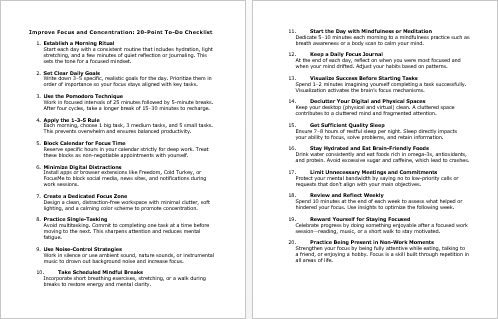
Improve Focus and Concentration – Checklist
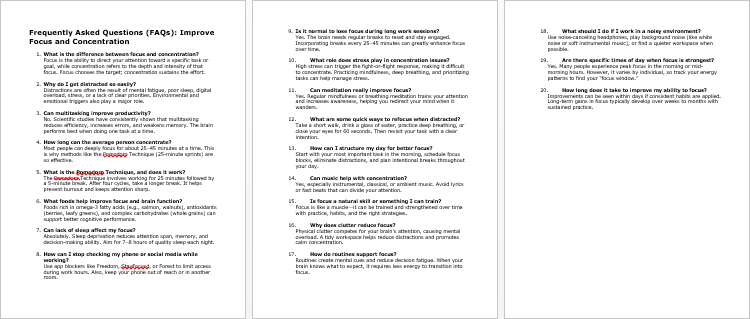
Improve Focus and Concentration – FAQs
Improve Focus and Concentration – Salespage Content
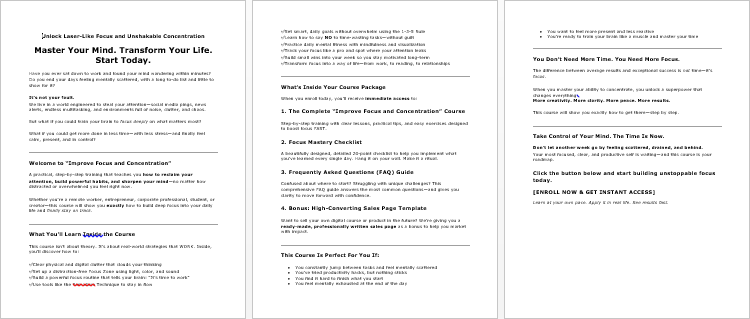
Package Details:
Word Count: 22 594 Words
Number of Pages: 115
Improve Focus and Concentration – Bonus Content
Checklist
Word Count: 480 words
FAQs
Word Count: 679 words
Salespage Content
Word Count: 918 words
Total Word Count: 24 444 Words
Your PLR License Terms
PERMISSIONS: What Can You Do With These Materials?
Sell the content basically as it is (with some minor tweaks to make it “yours”).
If you are going to claim copyright to anything created with this content, then you must substantially change at 75% of the content to distinguish yourself from other licensees.
Break up the content into small portions to sell as individual reports for $10-$20 each.
Bundle the content with other existing content to create larger products for $47-$97 each.
Setup your own membership site with the content and generate monthly residual payments!
Take the content and convert it into a multiple-week “eclass” that you charge $297-$497 to access!
Use the content to create a “physical” product that you sell for premium prices!
Convert it to audios, videos, membership site content and more.
Excerpt and / or edit portions of the content to give away for free as blog posts, reports, etc. to use as lead magnets, incentives and more!
Create your own original product from it, set it up at a site and “flip” the site for megabucks!
RESTRICTIONS: What Can’t You Do With These Materials?
To protect the value of these products, you may not pass on the rights to your customers. This means that your customers may not have PLR rights or reprint / resell rights passed on to them.
You may not pass on any kind of licensing (PLR, reprint / resell, etc.) to ANY offer created from ANY PORTION OF this content that would allow additional people to sell or give away any portion of the content contained in this package.
You may not offer 100% commission to affiliates selling your version / copy of this product. The maximum affiliate commission you may pay out for offers created that include parts of this content is 75%.
You are not permitted to give the complete materials away in their current state for free – they must be sold. They must be excerpted and / or edited to be given away, unless otherwise noted. Example: You ARE permitted to excerpt portions of content for blog posts, lead magnets, etc.
You may not add this content to any part of an existing customer order that would not require them to make an additional purchase. (IE You cannot add it to a package, membership site, etc. that customers have ALREADY paid for.)
Share Now!
Latest Products





Free Sales Funnel Builder

Related Products

Popular & Trending



Featured Products