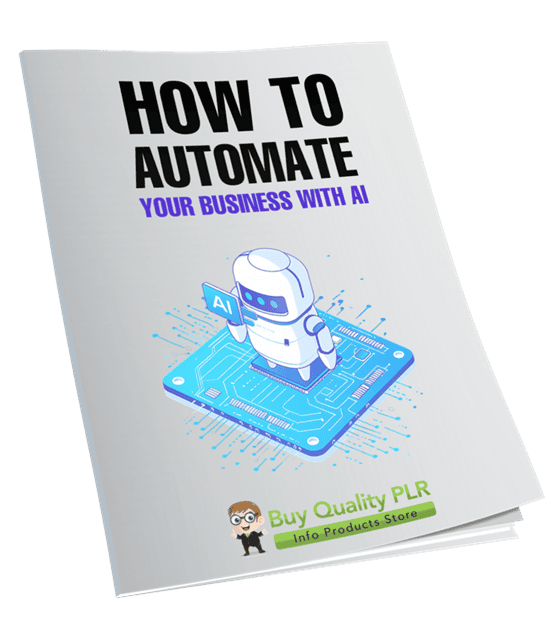
How to Automate Your Business with AI PLR Course 35k Words
in Artificial intelligence PLR , Business PLR , PLR eCourses , PLR List Building Reports , Premium PLR , Premium PLR Reports , Premium White Label Brandable PLR Coaching Courses , Private Label Rights ProductsChoose Your Desired Option(s)
has been added to your cart!
have been added to your cart!
#businessautomation #aiforbusiness #plrcourse #entrepreneurtools #onlinebusiness #plrcontent #automationstrategies #techforentrepreneurs #passiveincome
How to Automate Your Business with AI PLR Course – 35,000 Words
Save Time, Reduce Errors, and Scale Your Business Smarter with AI
In today’s fast-paced digital landscape, efficiency isn’t just a luxury—it’s essential. Every business owner, entrepreneur, or manager knows the challenge: endless repetitive tasks, data management headaches, marketing bottlenecks, and operational inefficiencies that consume hours of your day.
What if you could free yourself from the mundane, reduce errors, and focus only on the strategies that grow your business? That’s exactly what AI can do.
The How to Automate Your Business with AI PLR Course is a comprehensive 35,000-word training program that teaches you or your clients how to implement AI to streamline operations, automate marketing, optimize workflows, and scale businesses efficiently.
Whether your audience is small business owners, solopreneurs, or corporate managers, this course provides a ready-to-use, high-value solution that is fully editable, brandable, and monetizable.
Introducing the…
How to Automate Your Business with AI
Why AI Automation Is Critical for Modern Businesses
Artificial Intelligence (AI) is no longer a futuristic concept—it’s here, and businesses leveraging it gain a competitive edge immediately. Here’s why AI automation matters:
- Time Savings: Automate repetitive tasks and spend your time on high-value strategic work.
- Cost Reduction: Reduce human error and optimize resource allocation.
- Enhanced Productivity: AI helps your team focus on what matters most.
- Improved Customer Engagement: Use chatbots, personalized emails, and analytics to satisfy and retain clients.
- Scalability: Expand operations without proportionally increasing costs or staff.
- Data-Driven Decisions: AI provides insights, predicts trends, and guides your business strategies.
With AI adoption growing across industries, offering a course on AI automation positions you—or your clients—at the forefront of modern business innovation.
Course Overview: What Your Audience Will Learn
This course is divided into five comprehensive modules, each designed to provide step-by-step guidance on implementing AI automation in every area of a business.
Module 1: Understanding AI and Its Potential for Business
Goal: Build a solid foundation by understanding AI and its transformative potential.
- Lesson 1: What is AI and How It Works
Learn the fundamentals of Artificial Intelligence, machine learning, and how AI differs from traditional automation. - Lesson 2: The Role of AI in Modern Business
Discover real-world examples of AI reducing costs, boosting efficiency, and increasing revenue across industries. - Lesson 3: Identifying Tasks Suitable for Automation
Pinpoint repetitive and time-consuming tasks that can be automated with AI for maximum impact. - Lesson 4: Setting Your AI Automation Goals
Establish clear objectives and measurable outcomes for AI implementation in your business.
Module 2: Tools and Technologies for AI Automation
Goal: Identify the best tools to implement AI automation in your business.
- Lesson 1: Overview of Popular AI Tools
Learn about tools for marketing, operations, customer service, and analytics. - Lesson 2: Choosing the Right AI Tool for Your Business
Match AI solutions to your business needs to maximize ROI. - Lesson 3: Introduction to AI-Powered Workflow Automation
Integrate AI into workflows to save time and reduce errors. - Lesson 4: Basics of AI Integration
Step-by-step instructions for connecting AI tools to existing platforms such as CRM, email marketing, and project management apps.
Module 3: Automating Marketing and Customer Engagement
Goal: Leverage AI to grow your audience, improve engagement, and generate sales.
- Lesson 1: AI for Social Media Marketing
Schedule posts, analyze engagement, and generate high-performing content ideas automatically. - Lesson 2: AI Email Automation
Personalize email campaigns, optimize send times, and increase open rates effortlessly. - Lesson 3: Chatbots and Customer Service Automation
Deploy AI-powered chatbots to respond to customer queries 24/7 and improve satisfaction. - Lesson 4: AI for Analytics and Insights
Track marketing performance, predict trends, and refine strategies based on data.
Module 4: Automating Operations and Productivity
Goal: Streamline internal processes to maximize efficiency and reduce manual effort.
- Lesson 1: AI for Task Management and Scheduling
Automate reminders, task assignments, and daily schedules. - Lesson 2: AI for Data Management
Organize, clean, and analyze data automatically without human error. - Lesson 3: AI for Inventory and Supply Chain
Forecast demand, monitor stock levels, and manage suppliers efficiently. - Lesson 4: AI for Document Automation
Automate invoices, contracts, and reporting, saving hours each week.
Module 5: Scaling and Optimizing AI Automation
Goal: Learn to scale AI throughout the business while maintaining quality and efficiency.
- Lesson 1: Monitoring and Measuring AI Performance
Evaluate AI effectiveness and track ROI. - Lesson 2: Optimizing AI Workflows
Continuously improve efficiency and accuracy of automated systems. - Lesson 3: Scaling AI Across Your Business
Expand automation into multiple departments while keeping control and quality high. - Lesson 4: Staying Ahead: Future AI Trends
Stay updated with emerging AI technologies and maintain a competitive edge.
Course Outcomes
By the end of this course, your audience will be able to:
- Identify automation opportunities in any business.
- Select and implement AI tools effectively.
- Automate marketing, operations, and customer engagement.
- Measure, optimize, and scale AI automation for growth.
- Free up time for strategy, creativity, and high-value work.
This course equips learners with the knowledge to run smarter, faster, and more efficiently, giving them a significant competitive advantage.
Bonus Materials Included
To maximize value, the course package also includes ready-to-use bonus resources:
- How to Automate Your Business with AI – Checklist (585 Words)
Step-by-step reference to implement AI in your business. - How to Automate Your Business with AI – FAQs (832 Words)
Answers to the most common questions about AI and business automation. - How to Automate Your Business with AI – Salespage (726 Words)
A professionally written sales page template ready to publish or use for marketing campaigns.
Who Can Benefit From This PLR Course?
This course is perfect for:
- Business coaches and consultants
- Online course creators
- Productivity and automation influencers
- Entrepreneurs and solopreneurs
- Membership site owners
- Small business managers looking to optimize operations
It provides a turnkey product that can be sold as-is, customized, or used to create premium content, making it ideal for anyone in the digital business education space.
Multiple Ways to Monetize This PLR Course
The How to Automate Your Business with AI PLR Course is highly versatile and can generate revenue in multiple ways:
1. Sell the Course As-Is
Minor tweaks, branding, and launch immediately.
2. Premium AI Training Program
Convert it into a 4–6 week online course priced at $297–$497.
3. Break Into Mini-Guides or Reports
Sell individual modules or lessons for $10–$20 each.
4. Bundle with Other Business Resources
Package with marketing, productivity, or operational guides for $47–$97.
5. Membership Site Content
Deliver modules weekly or monthly to generate recurring income.
6. Convert to Video or Audio Content
Host webinars, workshops, or coaching sessions based on this content.
7. Physical Products
Create planners, workbooks, or guides and sell at premium prices.
8. Lead Magnets
Use excerpts to build email lists, drive traffic, or incentivize downloads.
9. Build and Flip a Business Automation Brand
Launch a site around AI automation, populate it with this content, and sell it for profit.
Licensing Terms: What You Can and Cannot Do
You CAN:
- Sell the content as-is with minor branding changes
- Rewrite 75%+ of content and claim copyright
- Break the course into smaller reports or modules
- Bundle with other PLR content or resources
- Convert to audio, video, or membership content
- Create physical products based on the content
- Use excerpts for lead magnets, blogs, or promotions
You CANNOT:
- Pass PLR or resale rights to your customers
- Transfer licensing rights
- Offer 100% affiliate commissions (max 75%)
- Give away the complete course in current form
- Add the course to existing paid packages without a new purchase
Why Choose Buy Quality PLR?
When you buy PLR content from Buy Quality PLR, you get:
- Professionally written, high-value, ready-to-use content
- Step-by-step lessons for marketing, operations, and productivity automation
- A turnkey product to brand, sell, or repurpose immediately
- Bonus resources to accelerate launch and sales
- A product in a high-demand, growing AI niche
The Bottom Line
AI is revolutionizing the way businesses operate. Those who adopt it early enjoy:
- Faster processes
- Lower costs
- Smarter decisions
- More free time to focus on growth
With the How to Automate Your Business with AI PLR Course, you can enter this booming niche immediately without creating content from scratch.
Whether you want to sell the course, create an online program, launch a membership site, or bundle it into premium offerings, this PLR package gives you all the tools, lessons, and resources to generate revenue quickly and effectively.
Get the How to Automate Your Business with AI PLR Course Today!
Available now at Buy Quality PLR – your shortcut to offering high-demand AI automation training with zero content creation required.
Empower businesses. Save time. Boost efficiency. Generate revenue.
has been added to your cart!
have been added to your cart!
Here A Sample of the How to Automate Your Business with AI PLR Course
Welcome to this exciting journey where you’ll discover how AI can transform your business by saving time, reducing errors, and boosting efficiency. This course is perfect for business owners, entrepreneurs, and managers who want to leverage AI to automate repetitive tasks, improve decision-making, and grow their business smarter, not harder.
Module 1: Understanding AI and Its Potential for Business
Goal: Learn the basics of AI, how it works, and why it’s a game-changer for your business.
Lesson 1: What is AI and How It Works
Goal: Understand the fundamentals of Artificial Intelligence and the difference between AI, Machine Learning, and Automation.
Welcome to the first lesson of your journey into AI-powered business automation. This lesson sets the foundation for everything you will learn in this course. Artificial Intelligence, or AI, has become one of the most transformative technologies in the world today. It has the potential to revolutionize how businesses operate, interact with customers, and make decisions. But before you can leverage AI in your business, you need to understand what it is, how it works, and how it differs from related technologies like Machine Learning and Automation.
Artificial Intelligence, at its core, is the simulation of human intelligence in machines. These machines are designed to think, learn, and make decisions, similar to how a human brain operates. AI systems can analyze large amounts of data, identify patterns, predict outcomes, and even perform tasks autonomously. Unlike traditional software that requires explicit instructions for every step, AI can adapt and improve over time based on the data it processes.
Step 1: Understanding the Concept of AI
Artificial Intelligence is not a single technology but a field of computer science that combines multiple disciplines, including mathematics, computer science, cognitive science, and data analytics. The objective of AI is to create systems that can perform tasks that usually require human intelligence. These tasks include decision-making, problem-solving, recognizing patterns, understanding natural language, and interpreting visual information.
To fully understand AI, it is useful to think of it in terms of capabilities:
- Narrow AI: Also called weak AI, narrow AI is designed to perform a specific task or a set of tasks. For example, AI tools that recommend products to customers, or chatbots that answer customer questions. Narrow AI does not possess general intelligence or consciousness; it excels only in its specific domain.
- General AI: This is theoretical at this stage but represents AI systems that possess intelligence comparable to human beings. General AI can perform a wide variety of tasks across different domains, understand complex concepts, and adapt to new situations autonomously.
- Superintelligent AI: Another theoretical concept, superintelligent AI would surpass human intelligence in all areas, including creativity, problem-solving, and emotional intelligence. While it is an exciting concept, it remains largely speculative and is the subject of ethical and philosophical debates.
For business purposes, most applications you will encounter today are examples of narrow AI, designed to solve specific business problems efficiently.
Step 2: Differentiating AI from Machine Learning and Automation
One of the most common misunderstandings about AI is confusing it with Machine Learning (ML) or simple automation. While these terms are related, they have distinct meanings and applications.
- Artificial Intelligence (AI): As mentioned, AI is the overarching concept that encompasses machines capable of performing tasks that typically require human intelligence. AI includes reasoning, learning, understanding language, and perceiving the environment.
- Machine Learning (ML): Machine Learning is a subset of AI. It refers to the ability of machines to learn from data and improve their performance without being explicitly programmed. ML algorithms analyze historical data, identify patterns, and make predictions or decisions. For example, an AI-powered recommendation engine on an e-commerce website uses Machine Learning to suggest products based on a customer’s browsing history and preferences.
- Automation: Automation refers to using technology to perform repetitive tasks without human intervention. It can be rule-based, meaning it follows a set of predefined instructions, or AI-driven, where the system can adapt and make decisions based on data. For instance, a traditional automated system may send out invoices at scheduled times, while an AI-driven automation system could prioritize invoices based on payment history, detect anomalies, or even generate reports that predict cash flow.
Understanding these distinctions is critical because as a business owner or course creator, you need to know which technology suits which task. AI and Machine Learning bring intelligence and adaptability, while automation focuses on efficiency and consistency. When combined, these technologies can transform your business operations.
Step 3: How AI Works in Simple Terms
At a high level, AI works through a combination of data, algorithms, and computing power. Let’s break this down step by step:
- Data Collection: Data is the fuel for AI. AI systems learn and make decisions by analyzing large volumes of data. This data can come from various sources, including customer interactions, sales transactions, social media, emails, sensors, or even public databases. The quality and relevance of the data significantly impact AI performance.
- Data Processing and Cleaning: Raw data is often messy, incomplete, or inconsistent. Before feeding it to an AI system, it needs to be processed and cleaned. This involves removing errors, filling gaps, and organizing it into a structured format suitable for analysis.
- Algorithms: AI systems rely on algorithms, which are step-by-step instructions or mathematical models that enable machines to make decisions or predictions. These algorithms analyze data, detect patterns, and identify relationships between variables. In Machine Learning, algorithms learn from the data to improve performance over time.
- Training the Model: For AI systems using Machine Learning, training involves feeding the algorithm with data and allowing it to learn patterns. For example, an AI model designed to predict customer churn would analyze historical customer data, identify behaviors that indicate churn, and learn to predict which customers are at risk.
- Testing and Validation: Once trained, the AI model is tested on new data to see how accurately it performs. This step ensures that the system can generalize and make reliable predictions on data it has not seen before.
- Deployment and Continuous Learning: After testing, the AI system is deployed in a real-world environment. Many AI systems continue to learn and adapt as they process new data, improving their accuracy and efficiency over time.
By understanding these basic steps, you can appreciate how AI transforms raw data into actionable insights and intelligent automation.
Step 4: Why AI is a Game-Changer for Business
The potential of AI in business is enormous. Here are some key ways AI can transform your operations:
- Increased Efficiency: AI automates repetitive and time-consuming tasks, freeing up human resources for more strategic and creative work. For instance, AI can automate customer support inquiries, manage inventory, or schedule appointments, saving hundreds of hours of manual work.
- Data-Driven Decisions: AI analyzes vast amounts of data quickly and accurately, providing insights that humans may overlook. This enables business owners to make informed decisions, predict trends, and optimize strategies.
- Enhanced Customer Experience: AI-powered chatbots, recommendation engines, and personalized marketing campaigns improve customer engagement and satisfaction. Customers receive faster responses and tailored suggestions, which can boost loyalty and retention.
- Cost Reduction: By automating tasks and optimizing processes, AI reduces operational costs. Businesses can achieve more with fewer resources, improving profitability and scalability.
- Competitive Advantage: Early adopters of AI gain a significant edge over competitors. Businesses that leverage AI can respond faster to market changes, offer innovative products and services, and streamline operations.
- Scalability: AI allows businesses to handle growth without proportionally increasing costs or workforce. Processes that once required dozens of employees can now be managed by AI systems, enabling scalable expansion.
By recognizing these benefits, it becomes clear why AI is no longer just a technological trend but a strategic necessity for modern businesses.
Step 5: Common Misconceptions About AI
Before diving deeper into AI automation, it is essential to address some common misconceptions:
- AI Will Replace Humans Completely: While AI can automate many tasks, human oversight, creativity, and decision-making are still crucial. AI is designed to assist, not replace, humans in most business scenarios.
- AI Is Too Complex to Use: Modern AI tools are increasingly user-friendly, designed for non-technical users. Many platforms allow you to implement AI without coding knowledge.
- AI Always Makes Perfect Decisions: AI systems are only as good as the data and algorithms behind them. Poor-quality data or flawed models can lead to inaccurate predictions, making human supervision necessary.
- AI Is Only for Large Companies: Small and medium-sized businesses can benefit from AI as much as large corporations. Cloud-based AI tools and affordable platforms make AI accessible to businesses of all sizes.
By dispelling these myths, you can approach AI with realistic expectations and focus on leveraging it effectively in your business.
Step 6: Key Takeaways for This Lesson
To summarize, this lesson has covered the following critical points:
- AI is the simulation of human intelligence in machines that can learn, reason, and perform tasks autonomously.
- Narrow AI focuses on specific tasks, while General and Superintelligent AI remain largely theoretical.
- AI differs from Machine Learning and Automation, though these technologies often work together to enhance business processes.
- AI operates through data collection, processing, algorithms, training, testing, and continuous learning.
- The benefits of AI for business include efficiency, data-driven insights, enhanced customer experience, cost reduction, competitive advantage, and scalability.
- Understanding AI’s capabilities and limitations allows business owners to implement it strategically and effectively.
By mastering the concepts in this lesson, you now have a solid foundation for exploring AI applications in marketing, operations, and business automation in the upcoming modules. You are prepared to think critically about which areas of your business can benefit most from AI and how to approach implementation.
This concludes Lesson 1: What is AI and How It Works. You have taken your first step towards understanding AI and its immense potential to transform your business. As you move forward, you will explore how to identify opportunities for AI automation, select the right tools, and implement solutions that make your business smarter, faster, and more efficient.
Lesson 2: The Role of AI in Modern Business
Goal: Explore real-world examples of how businesses are using AI to save time, cut costs, and increase revenue.
Artificial Intelligence is no longer a futuristic concept reserved for tech companies or science fiction. It is a practical, accessible, and transformative tool that is reshaping businesses across all industries. In this lesson, we will explore how AI is being applied in the real world, understand the tangible benefits, and analyze how businesses leverage AI to gain a competitive advantage.
Understanding the role of AI in modern business is crucial because it allows you, as a course creator or business owner, to identify areas where AI can have the most impact. AI is not just about automating repetitive tasks—it is about improving decision-making, personalizing customer experiences, optimizing operations, and ultimately driving revenue growth.
Step 1: AI in Customer Service and Support
Customer service is one of the most common areas where businesses have integrated AI successfully. Traditionally, customer service relied on human agents handling inquiries, complaints, and support tickets. While this approach is effective, it is also time-consuming, expensive, and prone to human error. AI can revolutionize this space in several ways:
- Chatbots: AI-powered chatbots are capable of handling customer queries 24/7. They can provide instant responses to frequently asked questions, guide users through processes, and escalate complex issues to human agents. This reduces response time, improves customer satisfaction, and allows human employees to focus on higher-value tasks.
- Virtual Assistants: Companies use AI virtual assistants to assist with scheduling, order tracking, and troubleshooting. For instance, a virtual assistant can help a customer check the status of an order or schedule a service appointment without any human intervention.
- Sentiment Analysis: AI tools can analyze customer feedback, reviews, and social media interactions to detect sentiment. This allows businesses to identify potential problems early, understand customer preferences, and tailor their services accordingly.
Example: A global e-commerce company implemented AI chatbots for its customer support system, which reduced response times by 70% and decreased operational costs by over 30%. Customers received instant support, and human agents were freed to handle complex inquiries that required emotional intelligence and problem-solving skills.
Step 2: AI in Marketing and Sales
Marketing and sales are highly data-driven fields, making them ideal for AI integration. AI helps businesses understand their customers better, predict trends, personalize communications, and optimize campaigns.
- Personalization: AI can analyze customer behavior and purchase history to deliver personalized recommendations, offers, and content. This increases engagement and conversion rates. Personalized marketing campaigns are proven to be more effective than generic campaigns because they address the specific needs and preferences of each customer.
- Predictive Analytics: AI algorithms can forecast customer behavior, identify high-value prospects, and predict future sales trends. Businesses can use this information to allocate resources efficiently and target marketing efforts effectively.
- Content Generation and Optimization: AI tools can generate content such as product descriptions, social media posts, and email campaigns. They can also analyze which types of content perform best and suggest improvements. This allows marketers to scale their efforts without sacrificing quality.
- Dynamic Pricing: AI can analyze market trends, competitor pricing, and customer behavior to adjust prices in real-time. This ensures optimal pricing strategies, maximizes revenue, and maintains competitiveness.
Example: A fashion retailer used AI to personalize email campaigns and product recommendations. As a result, email open rates increased by 50%, and conversion rates improved by 40%. AI-driven insights allowed the company to target customers with the right product at the right time, increasing overall sales.
Step 3: AI in Operations and Supply Chain Management
Operational efficiency is critical to profitability, and AI plays a significant role in streamlining business processes, reducing errors, and managing complex supply chains.
- Inventory Management: AI systems can predict demand, optimize stock levels, and prevent overstocking or stockouts. Machine Learning models analyze historical sales data, seasonal trends, and external factors to make accurate inventory forecasts.
- Predictive Maintenance: For manufacturing or equipment-intensive industries, AI can monitor machinery and predict maintenance needs before failures occur. This minimizes downtime, reduces repair costs, and extends the life of assets.
- Process Automation: AI automates routine operational tasks, such as order processing, invoice generation, and workflow approvals. This reduces human error, saves time, and ensures consistency across processes.
- Supply Chain Optimization: AI analyzes supplier performance, shipping routes, and logistics data to optimize delivery schedules and reduce costs. It can also detect potential disruptions and recommend alternative strategies.
Example: A logistics company implemented AI for route optimization and predictive maintenance of its delivery fleet. The system reduced fuel consumption by 20%, minimized late deliveries, and improved customer satisfaction scores. AI-driven insights enabled better planning and resource allocation across the supply chain.
Step 4: AI in Financial Management
Financial operations are complex and often involve large volumes of data that require accuracy and compliance. AI has become essential in streamlining financial processes and enabling smarter decision-making.
- Fraud Detection: AI systems analyze transaction patterns and detect unusual activity, preventing fraudulent activities in real time. This is particularly useful for banks, e-commerce platforms, and payment processors.
- Expense Management: AI can automatically categorize expenses, detect anomalies, and provide insights into cost-saving opportunities. This reduces manual effort and improves accuracy in financial reporting.
- Financial Forecasting: Machine Learning models can predict revenue trends, cash flow needs, and investment outcomes based on historical data. Businesses can make informed decisions about budgeting, investment, and growth strategies.
- Automated Accounting: AI-powered software can handle bookkeeping, invoicing, and compliance reporting with minimal human intervention. This improves efficiency and reduces the risk of errors.
Example: A mid-sized enterprise implemented AI for fraud detection and expense management. The system flagged unusual transactions instantly, preventing significant financial loss, while automated reporting saved the finance team hundreds of hours each month.
Step 5: AI in Human Resources
Human Resources (HR) is another area where AI is making a significant impact. Recruitment, employee engagement, and performance management benefit from AI’s ability to process large volumes of data and provide actionable insights.
- Recruitment Automation: AI tools can screen resumes, analyze candidate profiles, and identify the most suitable applicants based on predefined criteria. This reduces the time spent on manual screening and ensures better matches for job roles.
- Employee Engagement and Retention: AI-driven surveys and analytics can track employee satisfaction, engagement, and performance trends. HR teams can use this information to address concerns proactively and implement retention strategies.
- Learning and Development: AI can personalize training programs based on employee skills, performance, and learning preferences. Employees receive targeted learning resources that enhance productivity and skill development.
- Workforce Planning: AI predicts workforce needs based on business growth, seasonal demands, and turnover rates, allowing HR teams to plan staffing and resource allocation more effectively.
Example: A multinational company integrated AI in recruitment and employee engagement processes. AI-powered screening reduced the hiring cycle by 60%, while predictive analytics helped HR teams identify employees at risk of leaving, enabling proactive retention measures.
Step 6: AI in Product Development and Innovation
AI is not limited to operational efficiency; it also drives product development, innovation, and creativity. By analyzing customer feedback, market trends, and usage data, AI can inform the creation of better products and services.
- Product Design: AI can analyze customer preferences and predict features that will appeal to the target market. This accelerates product development cycles and reduces the risk of failure.
- Quality Control: AI-powered visual inspection systems detect defects and anomalies in manufacturing processes, ensuring higher product quality and consistency.
- Innovation Insights: AI can scan patents, research publications, and competitor offerings to identify opportunities for innovation. Businesses can leverage these insights to create unique products and differentiate themselves in the market.
Example: An electronics company used AI to analyze customer feedback and usage data for its smartphones. The insights guided the design of new features, resulting in a product that better met customer expectations and achieved higher sales performance.
Step 7: Key Benefits of AI Across Business Functions
From the examples above, it is evident that AI delivers substantial benefits across various business functions. These benefits include:
- Time Savings: Automating repetitive tasks frees employees to focus on strategic activities.
- Cost Reduction: AI optimizes processes, reduces errors, and minimizes operational costs.
- Revenue Growth: Personalized marketing, predictive analytics, and intelligent recommendations increase sales and customer retention.
- Improved Decision-Making: AI provides data-driven insights, enabling smarter and faster decisions.
- Scalability: AI systems allow businesses to scale operations without proportionally increasing resources.
- Enhanced Customer Experience: Personalized interactions, faster responses, and better product recommendations improve satisfaction and loyalty.
Step 8: Real-World AI Implementation Tips for Course Creators
As a course creator, understanding AI in modern business not only helps you optimize your operations but also allows you to teach and inspire your students effectively. Here are some practical considerations:
- Start Small: Begin by automating simple, repetitive tasks such as email follow-ups, customer inquiries, or social media scheduling. This provides quick wins and builds confidence.
- Focus on Data: The success of AI depends on quality data. Ensure your data is accurate, well-organized, and relevant.
- Measure Impact: Track performance metrics such as time saved, cost reduction, engagement rates, or revenue growth to evaluate AI effectiveness.
- Blend AI and Human Expertise: AI should enhance human capabilities, not replace them. Use AI for efficiency and insights, while humans handle creativity, strategy, and relationship-building.
- Stay Informed: AI technologies are evolving rapidly. Stay updated with trends, tools, and best practices to maintain a competitive edge.
Step 9: Key Takeaways for Lesson 2
To summarize, this lesson highlighted the role of AI in modern business by examining real-world applications and benefits:
- AI is transforming customer service, marketing, operations, finance, HR, and product development.
- Businesses use AI to automate tasks, analyze data, improve decision-making, and enhance customer experiences.
- AI leads to measurable benefits such as cost savings, revenue growth, scalability, and efficiency.
- Real-world examples demonstrate how organizations of all sizes can implement AI effectively.
- Course creators and business owners can start small, focus on data, and combine AI with human expertise for maximum impact.
By understanding the role of AI in modern business, you are better equipped to identify opportunities in your own operations, make informed decisions about AI adoption, and teach your students how to leverage AI strategically.
This concludes Lesson 2: The Role of AI in Modern Business. You now have a comprehensive understanding of how AI is applied in real-world business scenarios and why it has become an indispensable tool for modern organizations.
Lesson 3: Identifying Tasks Suitable for Automation
Goal: Learn how to spot repetitive and time-consuming tasks in your business that can be automated with AI.
Automation is one of the most powerful applications of Artificial Intelligence in business. However, implementing AI effectively begins with identifying the right tasks to automate. Not every process benefits from automation, and attempting to automate unsuitable tasks can lead to wasted resources, inefficiencies, or poor outcomes. In this lesson, you will learn how to systematically identify repetitive, high-volume, and rule-based tasks in your business that are ideal candidates for AI automation.
Understanding which tasks to automate is critical for maximizing the value of AI. Automation is not simply about replacing human effort; it is about enhancing efficiency, accuracy, and scalability while allowing your team to focus on strategic and creative work. By the end of this lesson, you will have a clear framework for evaluating your business processes and identifying automation opportunities.
Step 1: Understanding the Characteristics of Automatable Tasks
Before you start evaluating your business processes, it is essential to understand the characteristics that make a task suitable for automation. Not all tasks benefit from AI, and some require human judgment, creativity, or emotional intelligence that AI cannot replicate. Key characteristics of automatable tasks include:
- Repetitive Nature: Tasks that are performed frequently and follow a consistent pattern are prime candidates for automation. For example, sending follow-up emails, generating invoices, or data entry are repetitive tasks that AI can handle efficiently.
- Rule-Based Processes: Tasks that follow clear, predefined rules or standard operating procedures are ideal for automation. AI excels at tasks where the input, process, and output are predictable.
- High Volume: Tasks that are performed in large volumes and consume significant time are excellent targets for automation. Automating high-volume processes results in substantial time savings and cost reduction.
- Data-Driven Tasks: Tasks that rely heavily on data, calculations, or analysis can be automated with AI. For instance, generating reports, analyzing sales trends, or segmenting customers can be automated efficiently.
- Error-Prone Tasks: Tasks that are prone to human error can benefit from automation. AI can perform these tasks with consistency and accuracy, reducing mistakes and improving reliability.
By understanding these characteristics, you can quickly evaluate which tasks in your business are suitable for AI automation.
Step 2: Conducting a Business Process Audit
The next step in identifying automatable tasks is to conduct a comprehensive business process audit. This involves examining your current workflows, documenting each step, and analyzing where time and resources are spent. The process can be broken down as follows:
- List All Business Processes: Create a complete inventory of your business processes across all functions, including marketing, sales, operations, finance, human resources, and customer support. Include both daily and periodic tasks.
- Map Each Process: For each process, map out the step-by-step workflow. Document who performs each task, how long it takes, and what tools or systems are used. This visualization helps identify repetitive, rule-based, and data-heavy activities.
- Identify Pain Points: Look for tasks that consume excessive time, require significant manual effort, or are prone to errors. These pain points are potential opportunities for automation.
- Categorize Tasks: Group tasks into categories such as manual, semi-automated, and fully automated. This categorization helps prioritize which tasks should be addressed first.
- Gather Feedback from Team Members: Your employees often have valuable insights into inefficiencies and repetitive tasks that may not be immediately apparent. Conduct interviews or surveys to understand their pain points and identify processes that could benefit from AI automation.
By systematically auditing your business processes, you can identify tasks that consume resources, slow down operations, and are suitable candidates for automation.
Step 3: Evaluating Automation Potential Using Key Criteria
Once you have identified potential tasks for automation, the next step is to evaluate their suitability based on specific criteria. Not every task should be automated immediately; it is important to prioritize tasks based on impact, feasibility, and alignment with business goals. Consider the following criteria:
- Impact on Efficiency: Will automating this task significantly reduce time and effort? High-impact tasks that save hours of work each week should be prioritized.
- Frequency of the Task: Tasks performed daily, weekly, or monthly that consume considerable time are better candidates for automation than tasks performed sporadically.
- Complexity of the Task: Tasks that are straightforward, rule-based, and data-driven are easier to automate. Highly complex or creative tasks may require partial automation or human oversight.
- Cost-Benefit Analysis: Evaluate the cost of implementing AI automation against the potential time and cost savings. High-cost, low-impact tasks may not be worth automating initially.
- Risk and Compliance Considerations: Tasks that involve sensitive data, regulatory compliance, or critical business decisions may require careful consideration before automation. AI can assist in these tasks, but human supervision may still be necessary.
By applying these criteria, you can create a prioritized list of tasks that are most suitable for AI automation.
Step 4: Identifying Automatable Tasks Across Key Business Functions
AI can be applied to a wide range of business functions. Below are examples of tasks suitable for automation in various areas of a business:
- Marketing:
- Social media post scheduling and optimization
- Email marketing campaigns and follow-ups
- Customer segmentation and targeting
- Analytics and performance reporting
- Sales:
- Lead scoring and prioritization
- Sales pipeline tracking
- Automated proposal generation
- Customer follow-up and reminders
- Operations:
- Inventory management and restocking alerts
- Workflow approvals and task assignments
- Document management and reporting
- Scheduling and resource allocation
- Customer Support:
- AI chatbots for FAQs and troubleshooting
- Ticket routing and prioritization
- Sentiment analysis of customer feedback
- Automated surveys and feedback collection
- Finance:
- Invoice generation and payment reminders
- Expense tracking and categorization
- Financial forecasting and reporting
- Fraud detection and compliance monitoring
- Human Resources:
- Resume screening and candidate shortlisting
- Employee onboarding workflows
- Performance tracking and reporting
- Personalized training and learning recommendations
By analyzing each business function in detail, you can identify multiple opportunities to implement AI-driven automation.
Step 5: Using AI Tools to Identify Automation Opportunities
Modern AI tools not only automate tasks but also help identify opportunities for automation. Many platforms use process mining, workflow analysis, and predictive analytics to determine which tasks are repetitive, time-consuming, or error-prone. Some steps include:
- Process Mining: AI tools can analyze existing workflows, identify bottlenecks, and highlight tasks that can be automated.
- Time Tracking Analysis: AI can evaluate how employees spend their time, identify repetitive activities, and recommend automation solutions.
- Predictive Analytics: AI can forecast the impact of automating a task by simulating outcomes, such as time saved, cost reduction, or productivity improvement.
- Automation Suitability Scores: Some AI platforms assign a score to tasks based on complexity, frequency, and potential impact, making it easier to prioritize automation efforts.
Leveraging AI tools to identify opportunities ensures that you focus on high-value processes that provide maximum return on investment.
Step 6: Practical Framework for Selecting Tasks for Automation
To simplify the decision-making process, you can use a practical framework for selecting tasks suitable for automation:
- Step 1: List All Tasks – Document every task performed in your business, including manual, repetitive, and administrative tasks.
- Step 2: Evaluate Task Characteristics – Assess each task based on repetitiveness, rule-based nature, volume, data dependency, and error-proneness.
- Step 3: Apply Prioritization Criteria – Use impact, frequency, complexity, cost-benefit, and risk as criteria to rank tasks.
- Step 4: Identify Quick Wins – Start with tasks that are easy to automate, high-volume, and high-impact. These “quick wins” demonstrate value and build confidence in AI adoption.
- Step 5: Plan for Complex Tasks – For tasks that are complex or sensitive, consider partial automation or AI-assisted workflows. Human oversight may be required initially, with gradual AI integration over time.
- Step 6: Document Automation Roadmap – Create a roadmap for implementing automation, starting with high-priority tasks and expanding gradually across business functions.
Using this structured approach ensures that you maximize efficiency, minimize disruption, and achieve measurable results from AI automation.
Step 7: Common Pitfalls to Avoid When Identifying Tasks
While identifying tasks for automation, it is important to avoid common mistakes that can undermine your AI implementation:
- Automating the Wrong Tasks – Focus on tasks that add real value when automated. Avoid automating tasks that are rarely performed or require creative problem-solving.
- Ignoring Human Input – Engage your team in the process. Employees often provide valuable insights into inefficiencies and repetitive tasks that may not be immediately apparent.
- Overlooking Data Quality – AI automation relies on clean, accurate data. Ensure your data is organized, consistent, and relevant before implementing automation.
- Expecting Immediate Perfection – AI systems require training, testing, and optimization. Be prepared to refine processes gradually.
- Neglecting Compliance and Security – Ensure that automated tasks comply with legal, regulatory, and security requirements, especially when dealing with sensitive data.
Avoiding these pitfalls ensures a smoother and more effective automation journey.
Step 8: Key Takeaways for Lesson 3
To summarize, this lesson has provided a comprehensive framework for identifying tasks suitable for AI automation:
- Automatable tasks are repetitive, rule-based, high-volume, data-driven, and error-prone.
- Conducting a business process audit helps map workflows, identify pain points, and gather team insights.
- Evaluating tasks based on impact, frequency, complexity, cost-benefit, and risk allows for prioritization.
- AI can be applied across marketing, sales, operations, customer support, finance, and HR.
- Leveraging AI tools and analytics helps identify opportunities and predict outcomes.
- A practical framework ensures structured selection of tasks for automation, focusing on quick wins and high-value processes.
- Avoid common pitfalls such as automating inappropriate tasks, neglecting human input, or ignoring data quality and compliance.
By mastering this lesson, you are now equipped to systematically identify which tasks in your business can be automated with AI. This understanding is essential for creating efficient workflows, reducing costs, and enabling your team to focus on strategic, high-value activities.
This concludes Lesson 3: Identifying Tasks Suitable for Automation. You now have a structured approach to analyze your business processes, identify automation opportunities, and prepare for AI implementation across various business functions.
We’re also giving these extra bonuses
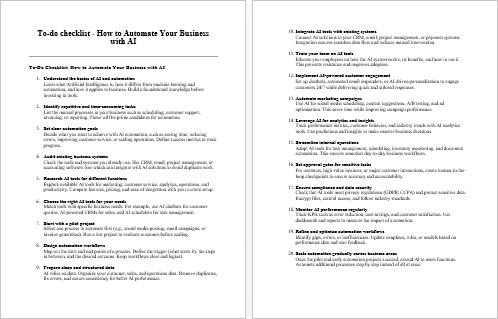
How to Automate Your Business with AI – Checklist
How to Automate Your Business with AI – FAQs
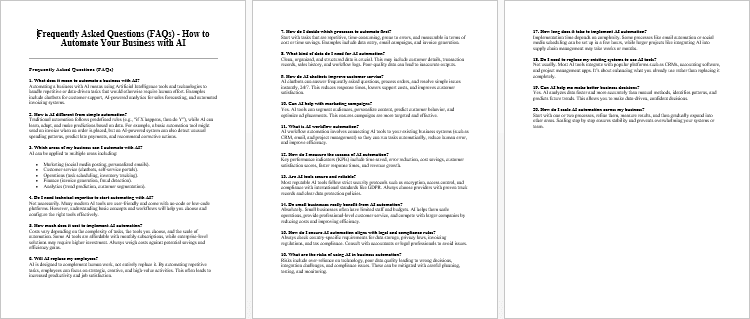
How to Automate Your Business with AI – Salespage Content
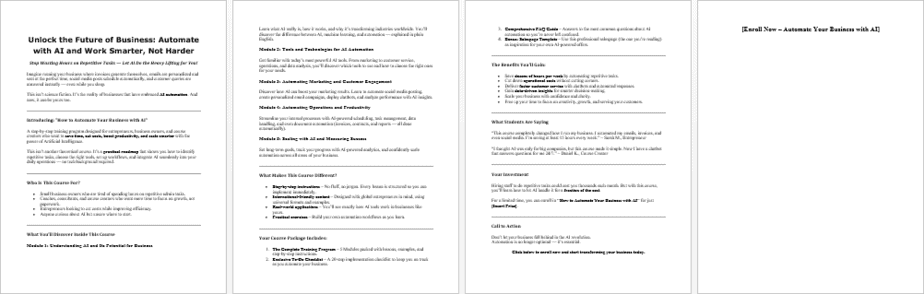
Package Details:
Word Count: 33 520 Words
Number of Pages: 142
How to Automate Your Business with AI – Bonus Content
Checklist
Word Count: 585 words
FAQs
Word Count: 832 words
Salespage Content
Word Count: 726 words
Total Word Count: 35 663 Words
Your PLR License Terms
PERMISSIONS: What Can You Do With These Materials?
Sell the content basically as it is (with some minor tweaks to make it “yours”).
If you are going to claim copyright to anything created with this content, then you must substantially change at 75% of the content to distinguish yourself from other licensees.
Break up the content into small portions to sell as individual reports for $10-$20 each.
Bundle the content with other existing content to create larger products for $47-$97 each.
Setup your own membership site with the content and generate monthly residual payments!
Take the content and convert it into a multiple-week “eclass” that you charge $297-$497 to access!
Use the content to create a “physical” product that you sell for premium prices!
Convert it to audios, videos, membership site content and more.
Excerpt and / or edit portions of the content to give away for free as blog posts, reports, etc. to use as lead magnets, incentives and more!
Create your own original product from it, set it up at a site and “flip” the site for megabucks!
RESTRICTIONS: What Can’t You Do With These Materials?
To protect the value of these products, you may not pass on the rights to your customers. This means that your customers may not have PLR rights or reprint / resell rights passed on to them.
You may not pass on any kind of licensing (PLR, reprint / resell, etc.) to ANY offer created from ANY PORTION OF this content that would allow additional people to sell or give away any portion of the content contained in this package.
You may not offer 100% commission to affiliates selling your version / copy of this product. The maximum affiliate commission you may pay out for offers created that include parts of this content is 75%.
You are not permitted to give the complete materials away in their current state for free – they must be sold. They must be excerpted and / or edited to be given away, unless otherwise noted. Example: You ARE permitted to excerpt portions of content for blog posts, lead magnets, etc.
You may not add this content to any part of an existing customer order that would not require them to make an additional purchase. (IE You cannot add it to a package, membership site, etc. that customers have ALREADY paid for.)
Share Now!
Latest Products





Free Sales Funnel Builder

Related Products
Popular & Trending



Featured Products