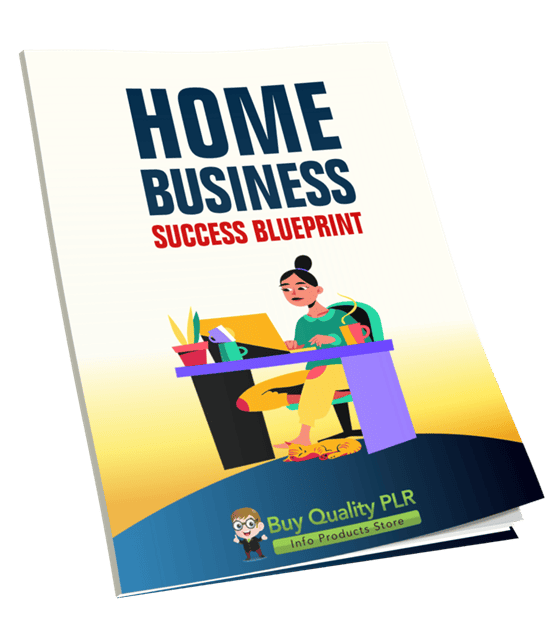
Home Business Success Blueprint PLR Course 18k Words
in Business PLR , Entrepreneur PLR , Home Business PLR , PLR eCourses , PLR List Building Reports , Premium PLR , Premium PLR Reports , Premium White Label Brandable PLR Coaching Courses , Private Label Rights Products , Work At Home PLRChoose Your Desired Option(s)
has been added to your cart!
have been added to your cart!
#homebusinesssuccess #plrcourse #entrepreneurlife #workfromhome #onlinebusiness #plrcontent #businessgrowth #passiveincome
Home Business Success Blueprint PLR Course (18,000 Words)
The Ultimate Guide to Starting a Home Business
Build a thriving business from your living room — with clarity, confidence, and consistency.
If you’re looking for a high-demand PLR product that taps into the booming work-from-home and entrepreneurship market, the Home Business Success Blueprint PLR Course is exactly what you need.
This professionally written, 18,000-word course gives you a complete, step-by-step roadmap to help aspiring entrepreneurs go from idea to income — all from the comfort of home. Whether your audience wants to freelance, sell products online, offer coaching services, or build a digital brand, this course walks them through every critical stage of building a profitable home-based business.
Instead of spending weeks or months creating content from scratch, you can launch a comprehensive, high-value training program almost immediately.
Let’s explore what makes this PLR course such a powerful asset for your business.
Introducing the…
Home Business Success Blueprint PLR Course 18k Words
Why the Home Business Market Is Exploding
Remote work is no longer a trend — it’s a lifestyle shift.
Millions of people are searching for ways to:
- Escape traditional 9–5 jobs
- Build flexible income streams
- Start online side hustles
- Create financial independence
- Work around family schedules
- Turn passions into profit
The demand for practical, beginner-friendly guidance has never been higher.
Most aspiring entrepreneurs feel overwhelmed. They don’t know where to start, what business model to choose, how to set up legally, or how to make their first sale.
The Home Business Success Blueprint eliminates confusion and provides clarity.
And now, you can offer that solution under your own brand.
What’s Included in the Home Business Success Blueprint PLR Course?
This isn’t a short report or surface-level overview.
You receive a fully developed 18,000-word course organized into five structured modules, each broken down into actionable, easy-to-follow steps.
The content is written in a supportive, encouraging tone — perfect for beginners who need direction without technical overwhelm.
Here’s what your customers will learn.
📦 Module 1: Laying the Foundation for Your Home Business
Before launching a business, a strong foundation is essential. This module helps students clarify their direction and build confidence from day one.
✅ Step 1: Discover What Business Is Right for You
Not every business model fits every personality.
This lesson helps learners assess:
- Skills and strengths
- Interests and passions
- Lifestyle preferences
- Income goals
- Time availability
Students explore options like freelancing, eCommerce, digital products, consulting, coaching, service-based businesses, and more — ensuring they choose a model aligned with who they are.
✅ Step 2: Validate Your Business Idea
Many beginners skip this step — and regret it later.
This lesson teaches how to:
- Conduct simple market research
- Identify demand
- Analyze competitors
- Gather real-world feedback
- Test offers before investing heavily
Validation reduces risk and builds confidence.
✅ Step 3: Identify Your Ideal Customer
Clarity equals profitability.
Students learn how to define:
- Who they serve
- Their audience’s biggest struggles
- Their goals and desires
- Buying behavior patterns
When entrepreneurs understand their audience deeply, marketing becomes easier and more effective.
✅ Step 4: Set Smart Goals & Map Your Journey
Dreams become reality through planning.
This lesson walks learners through:
- Setting measurable goals
- Breaking big goals into small milestones
- Creating simple action plans
- Tracking progress
This module sets the tone for focused execution.
💻 Module 2: Setting Up Your Business from Home
Now it’s time to turn ideas into action.
This module walks students through the practical setup process — without confusing legal jargon or technical overwhelm.
✅ Step 1: Legal Basics & Business Structure
Students gain clarity on:
- Sole proprietorship vs. LLC basics
- Business registration considerations
- Tax fundamentals
- Local compliance essentials
The information is presented in simple, beginner-friendly language.
✅ Step 2: Organize Your Home Workspace
Productivity starts with environment.
This lesson shows how to:
- Create a productive workspace in small areas
- Reduce distractions
- Organize efficiently
- Separate work and home life
Even learners with limited space can build a professional setup.
✅ Step 3: Tools, Tech & Systems You Need
Entrepreneurs don’t need expensive tools to start.
Students discover:
- Free and affordable software
- Scheduling tools
- Email platforms
- Payment processors
- Organization apps
This lesson prevents unnecessary spending while ensuring functionality.
✅ Step 4: Create a Daily Routine for Productivity
Working from home requires discipline.
This lesson helps students:
- Build structured daily schedules
- Avoid procrastination
- Stay motivated
- Prevent burnout
The emphasis is on sustainable productivity.
📢 Module 3: Building Your Brand & Online Presence
Visibility creates opportunity.
This module helps students build a clear, attractive brand presence online.
✅ Step 1: Craft a Clear Business Message
If people don’t understand what you do, they won’t buy.
Students learn how to:
- Clarify their value proposition
- Communicate benefits clearly
- Create simple, compelling messaging
✅ Step 2: Design a Simple Brand Look & Feel
Branding doesn’t have to be complicated.
This lesson covers:
- Choosing colors and fonts
- Creating visual consistency
- Using simple design tools
- Establishing brand personality
✅ Step 3: Set Up a Basic Website or Online Store
Step-by-step guidance helps students:
- Choose beginner-friendly platforms
- Build essential website pages
- Set up product listings
- Create clear calls-to-action
Everything is explained in accessible language.
✅ Step 4: Create Social Media Profiles That Attract
Students learn how to:
- Choose the right platforms
- Optimize profiles
- Create engaging bios
- Build audience trust
This module empowers entrepreneurs to confidently show up online.
💸 Module 4: Marketing & Making Sales from Home
Marketing is where income begins.
This module removes fear around selling and replaces it with strategy.
✅ Step 1: Choose Your Main Marketing Channels
Students evaluate:
- Social media marketing
- Email marketing
- Content marketing
- Word-of-mouth strategies
- Paid advertising basics
They’re guided to focus on one or two channels first to avoid overwhelm.
✅ Step 2: Build Trust with Content
Trust drives sales.
Students learn how to:
- Create valuable posts
- Write helpful emails
- Produce engaging videos
- Educate and inspire their audience
✅ Step 3: Make Your First Sale (and Then More!)
This lesson addresses:
- Creating irresistible offers
- Pricing strategies
- Confident sales conversations
- Closing techniques
- Handling objections
It empowers beginners to take action without fear.
✅ Step 4: Track What’s Working & Improve
Entrepreneurs learn to:
- Track metrics
- Analyze simple data
- Identify winning strategies
- Improve performance over time
This module builds momentum and clarity.
🚀 Module 5: Growing & Scaling Your Home Business
Starting is one thing. Scaling is another.
This final module prepares students for long-term success.
✅ Step 1: Create Repeatable Systems
Students learn how to:
- Document processes
- Automate repetitive tasks
- Improve efficiency
✅ Step 2: Build a Customer Experience That Wows
Retention fuels growth.
This lesson focuses on:
- Communication excellence
- Fast response systems
- Personalized service
- Building loyalty
✅ Step 3: Explore Passive Income Options
Scaling opportunities include:
- Digital products
- Affiliate marketing
- Online courses
- Subscription models
✅ Step 4: Stay Consistent & Avoid Burnout
Long-term success requires balance.
Students learn mindset strategies to:
- Avoid overwhelm
- Maintain focus
- Protect energy
- Stay consistent
Bonus Materials Included
In addition to the 18,000-word course, you also receive:
- Home Business Success Blueprint Checklist (542 Words)
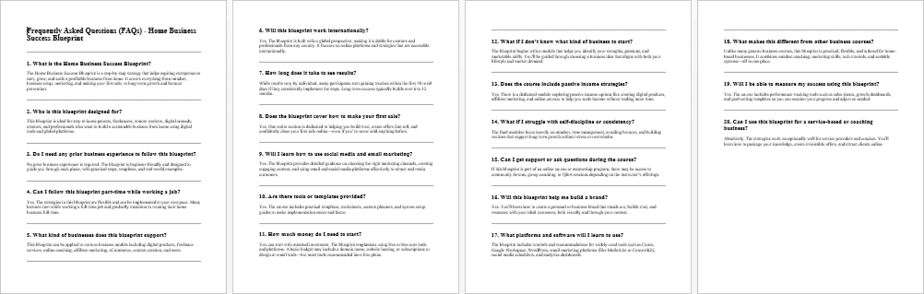
- Home Business Success Blueprint FAQs (780 Words)
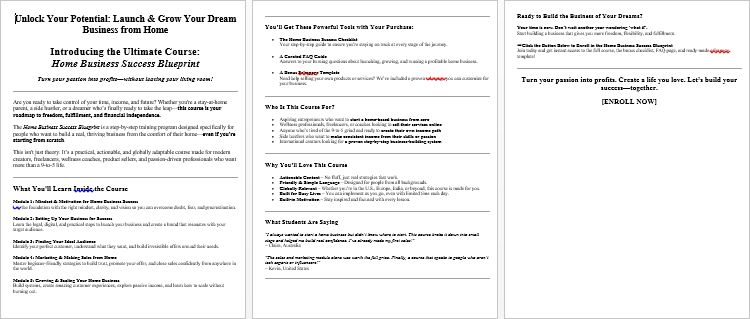
- Home Business Success Blueprint Salespage (628 Words)
These materials help you market and package the product faster.
Who Is This PLR Course Perfect For?
This content is ideal for:
- Online marketers
- Business coaches
- Career bloggers
- Side hustle influencers
- Entrepreneurship educators
- Personal development brands
- Membership site owners
- Course creators
If your audience wants freedom, flexibility, and financial growth — this course fits perfectly.
Profitable Ways to Use This PLR Course
The monetization potential is substantial.
1. Sell It With Minor Customization
Add branding, tweak the introduction, and launch quickly.
2. Create a Premium Multi-Week eClass
Turn each module into weekly lessons and sell access for $297–$497.
3. Break Into Smaller Products
Sell individual modules for $10–$20 each.
4. Bundle With Other Business Content
Combine with social media marketing or productivity courses and sell for $47–$97.
5. Launch a Membership Site
Release one module per month for recurring revenue.
6. Convert Into Video or Audio
Create webinars, workshops, or video training programs.
7. Produce a Physical Workbook
Turn the content into a printed planner or startup workbook.
8. Use as Lead Magnets
Offer excerpts as free downloads to grow your email list.
9. Build and Flip a Niche Brand
Create a home business authority site and sell it for profit later.
Licensing Overview
You CAN:
- Sell the content with minor tweaks
- Rewrite 75%+ and claim copyright
- Break into smaller reports
- Bundle with other products
- Convert to video, audio, or memberships
- Sell physical versions
- Use excerpts as lead magnets
- Build and flip a branded business
You CANNOT:
- Pass PLR or resale rights to customers
- Transfer licensing rights
- Offer 100% affiliate commissions (maximum 75%)
- Give away the full course in its current form
- Add it to existing paid packages without requiring a new purchase
These protections maintain the value of the product and protect your investment.
Why Buy From Buy Quality PLR?
When you purchase from Buy Quality PLR, you receive:
- Structured, professionally written content
- Beginner-friendly explanations
- Clear lesson progression
- High-demand niche focus
- Flexible monetization potential
- Immediate launch readiness
This isn’t filler content. It’s a strategic, practical roadmap designed to deliver real value.
The Bottom Line
The desire for home-based income is stronger than ever. People want control, flexibility, and financial independence — but they need guidance.
With the Home Business Success Blueprint PLR Course, you can provide that roadmap.
Instead of creating an 18,000-word course from scratch, you can focus on branding, marketing, and revenue generation.
If you’re ready to expand your digital product library, serve aspiring entrepreneurs, and unlock new income streams, this course is your next smart move.
Get the Home Business Success Blueprint PLR Course Today
Available Now at Buy Quality PLR
Launch faster. Serve better. Profit smarter.
has been added to your cart!
have been added to your cart!
Here A Sample of the Home Business Success Blueprint PLR Course
This course is your complete roadmap to starting a successful home-based business from scratch. Whether you’re dreaming of freelancing, selling products online, or offering services from home—this guide will help you go from idea to income, step by step.
Module 1: Laying the Foundation for Your Home Business
Before you start selling, you need a solid base. Let’s build it together.
Step 1: Discover What Business Is Right for You
Objective: Help learners explore their personal strengths, passions, skills, and lifestyle preferences to choose a home business model that aligns with their identity and goals.
This is the very first and most essential step in launching a successful home-based business. Rather than randomly picking a trending idea or copying what someone else is doing, this step is about tuning into you—your strengths, your rhythm of life, and the value you want to bring into the world.
Step-by-Step Training Instructions
1. Understand the Three Pillars of a Sustainable Home Business
Before diving into exercises or brainstorming ideas, it’s important to understand what makes a home business sustainable and fulfilling in the long run. We break it down into three pillars:
a. Personal Alignment – Your business should reflect your interests, natural skills, and personal goals. If you enjoy what you do, you’re more likely to stay consistent.
b. Market Demand – There must be a clear need in the market for your product or service. Passion without market demand often leads to frustration.
c. Practical Fit – Your business must match your available time, space, tools, and energy level. If you’re juggling other commitments (e.g., parenting or a day job), this is critical.
Keep these three pillars in mind as you move through this step.
2. Self-Discovery Exercise: Identify Your Strengths and Skills
Let’s start with an internal inventory. Use a notebook, worksheet, or digital document to answer the following prompts. This is not about perfection—it’s about clarity.
a. What are your professional and personal strengths?
List hard skills (e.g., writing, video editing, teaching, designing, selling) and soft skills (e.g., empathy, leadership, time management, communication).
b. What do people often ask you for help with?
Sometimes your marketable skills show up through repeated requests from friends, colleagues, or family.
c. What have you achieved or been recognized for in the past?
Include things from your education, job experience, volunteer work, or hobbies.
Tip: Use free tools like StrengthsFinder or 16Personalities if you’re unsure of your core strengths. These can offer a helpful starting point.
3. Passion Mapping: Define What Interests You
You’re more likely to thrive in a business you actually enjoy. In this step, we’ll use the Passion Mapping technique:
a. Write down all topics, industries, or causes you’re naturally drawn to.
Think beyond business: it could be wellness, education, fashion, gaming, sustainability, crafts, parenting, or finance.
b. Reflect on your ideal day.
What kind of work would you be doing? Who would you be helping? Would you prefer being behind a screen or engaging with people?
c. List 3–5 people or brands you admire.
This gives clues to the type of work or business culture you resonate with.
You’re looking for themes here. You don’t have to be obsessed with a niche—but it should be something you’re curious about or willing to learn more deeply.
4. Lifestyle Audit: Assess Your Environment, Time & Priorities
Now, ground your dreams in reality. Your business should fit into your life—not the other way around.
Answer the following:
a. How many hours per week can you realistically dedicate to a home business?
Be honest. Factor in your job, family, health, and other obligations.
b. What is your budget to invest in your business upfront?
This helps you decide whether you need a low-cost business model (e.g., freelancing) or can afford inventory or digital tools.
c. What kind of work energizes you vs. drains you?
Do you love working alone? Thrive in community? Enjoy solving problems? Prefer structure or flexibility?
d. What’s your income goal for the next 12 months?
Setting a financial target helps narrow down the business models that can realistically meet that goal.
5. Explore Home Business Models (With Examples)
Now that you’ve gathered personal insights, it’s time to look at types of home businesses that align with your findings. Below are four popular home business categories and examples:
a. Freelance or Service-Based
Offer a skill or expertise to others on a project or hourly basis.
Examples: copywriting, virtual assistance, web design, consulting, bookkeeping, coaching.
b. Product-Based (Ecommerce or Handmade)
Sell physical or digital products through platforms like Etsy, Amazon, or your own website.
Examples: handmade crafts, printable planners, drop-shipping, digital courses, merchandise.
c. Content or Audience-Based
Grow an audience and monetize through sponsorships, ads, or affiliate marketing.
Examples: blogging, YouTube, podcasting, influencer marketing, niche newsletters.
d. Education-Based
Teach others a skill, process, or subject you know well.
Examples: online courses, coaching programs, live workshops, memberships.
Tip: It’s okay if more than one model excites you. Write them all down for now—we’ll narrow it down later.
6. Match Your Profile to the Right Business Type
Now let’s bring everything together. Compare your responses from Steps 2–4 with the models from Step 5.
Use this checklist:
- Does this business model use my existing strengths or skills?
- Am I interested enough to stay consistent for at least 6–12 months?
- Does it align with my lifestyle, time, and energy?
- Can this model meet my income goals?
Narrow down to 2–3 home business ideas that best match your profile.
7. Final Reflection: Your Business Alignment Statement
To complete this step, write your own “Business Alignment Statement.” It’s a one-paragraph summary that includes:
- What kind of business you want to start
- Why it’s a good fit for your strengths
- Who it will help or serve
- Why it feels right for your current lifestyle
Example:
“I want to start a freelance writing business from home, helping small business owners create better website content. I’ve always enjoyed writing and get positive feedback about it. I can work during my child’s school hours and aim to replace my part-time job income within 6 months.”
This alignment statement will serve as your north star throughout the course and beyond.
End of Step 1: You’re Ready
At this point, you’ve done the important work of self-assessment and aligned your business direction with who you are and how you want to live. You’re not just chasing trends—you’re creating a business that fits you.
Stay grounded in this clarity as you move forward to build and launch your home business.
Step 2: Validate Your Business Idea
Objective: Ensure your business idea has real market potential before you invest significant time, money, or resources into it.
One of the biggest reasons new businesses fail isn’t lack of effort—it’s building something no one truly needs or wants. That’s why validating your business idea is critical. This step is all about confirming that your product or service solves a real problem for a real audience and that people are willing to pay for it.
By the end of this step, you’ll have clarity on whether to proceed, pivot, or fine-tune your business idea—before you spend money on branding, websites, or inventory.
Step-by-Step Course Instructions
1. Clarify the Core of Your Business Idea
Before you can test your idea, you need to define it clearly.
Ask yourself:
- What exactly am I offering?
Be specific. Is it a product, service, digital item, course, or subscription? - Who is it for?
Define the target audience in terms of demographics (age, location, income) and psychographics (lifestyle, values, interests). - What problem does it solve or what desire does it fulfill?
This is the most important question. People pay for results—pain relief or pleasure gain.
Action: Write a short, one-sentence summary of your business idea using this format:
I help [audience] achieve [outcome] by providing [solution].
Example:
I help freelance designers streamline their workflow by offering easy-to-use project management templates.
2. Conduct Simple Market Research
Now that you’ve clarified your idea, it’s time to explore whether there’s a market for it.
a. Analyze Search Trends
Use tools like:
- Google Trends – See if your product or topic is growing in popularity.
- Ubersuggest or AnswerThePublic – Identify what people are searching for related to your idea.
- Amazon / Etsy Search Bar – Type in related keywords and observe autocomplete suggestions.
Look for:
- Keywords with consistent or rising interest.
- Real searches that match your solution.
- Frequently asked questions around your niche.
b. Check Out the Competition
Contrary to popular belief, competition is a good sign—it means there’s demand.
Go to:
- Google – Search for businesses offering similar services.
- Marketplaces – Review top sellers in your niche on Etsy, Amazon, Fiverr, or Udemy.
- Social Media – Search hashtags, pages, or groups related to your topic.
Look for:
- What’s working well for others?
- What’s missing in their offering that you could improve on?
- Are people engaging with these businesses (likes, comments, reviews)?
Action: Create a simple spreadsheet and track:
- 3 competitors or similar businesses
- What they offer
- Their pricing
- Their unique angle
- What customers say in reviews or comments (both good and bad)
3. Engage with Your Target Audience Directly
Online research is useful—but real feedback from real people is far more powerful.
Here’s how to get it:
a. Join Relevant Communities
Find Facebook groups, Reddit threads, LinkedIn communities, or niche forums where your ideal customers hang out.
- Observe what questions people ask
- Look for common complaints or problems
- Ask questions like:
“Would you find [your solution] helpful if you struggle with [problem]?”
Avoid being salesy—be genuine and listen.
b. Conduct Informal Interviews
Talk to 5–10 people who represent your ideal customer.
Ask:
- What are your biggest frustrations with [problem area]?
- Have you tried solving it? What worked or didn’t work?
- Would you consider a solution like [your idea]?
- How much would it be worth to you to solve this?
You can do this over email, voice notes, phone calls, or video chats. Keep it casual but focused.
c. Use Online Surveys
Tools like Google Forms, Typeform, or SurveyMonkey make it easy to gather structured feedback.
Best practices:
- Keep it under 10 questions
- Ask a mix of multiple choice and open-ended questions
- Include an option for people to leave their email if they want to hear when your offer launches
4. Create a Low-Risk “Prototype” or Concept Test
Instead of building the full business, start by testing interest with a lightweight version.
Choose one of the following based on your business model:
a. Offer a Free Beta Version
- If you’re selling a course or service, offer it free or at a discount to 5–10 people.
- Let them experience it and give honest feedback.
- Observe how they use it, what questions they ask, and what excites them.
b. Build a Simple Landing Page
Use tools like Carrd, ConvertKit, or Mailchimp to create a basic page with:
- A short description of your offer
- Key benefits
- A sign-up form or “Join Waitlist” button
Drive traffic through:
- Social media
- Email invites
- Community groups
If people sign up or express interest without you pushing hard, it’s a positive signal.
c. Pre-Sell Your Offer
If you’re confident in the idea, try offering it for sale before it’s fully built.
- Create a pre-order page
- Offer an incentive (like early access or a discount)
- See if people are willing to pay to reserve it
If no one buys, that doesn’t mean failure—it simply means you may need to refine the offer or the messaging.
5. Analyze the Results Objectively
After testing and feedback collection, it’s time to reflect:
- Did people respond positively?
- Were they willing to spend time, give feedback, or even pay?
- What were the common objections or hesitations?
- Were there patterns in the problems people expressed?
Action: Create a “Validation Summary” with these headings:
- What worked
- What didn’t
- Key feedback themes
- Next decisions (e.g., proceed, pivot, pause)
Be honest with yourself here. This is not about forcing an idea—it’s about aligning with reality.
6. Refine Your Business Idea Based on What You Learned
Validation is rarely “yes or no.” It’s more often: “What can I improve or adjust?”
You may need to:
- Adjust the target audience
- Reposition the value of your offer
- Simplify or add to your product/service
- Improve the way you explain it
Use feedback as fuel to build something people actually want.
End of Step 2: Your Idea is Now Grounded in Reality
You’ve taken your idea and tested it in the real world—before building an entire business around it. Whether your results were strong or mixed, you’re now moving forward with greater clarity and confidence.
Step 3: Identify Your Ideal Customer
Objective: Develop a crystal-clear profile of the person your business will serve—so your message, marketing, products, and services resonate deeply with the people who need them most.
In business, trying to speak to “everyone” is one of the fastest ways to be ignored. The more precisely you define who you’re helping, the more effectively you’ll attract them. This step is about understanding your ideal customer at a detailed level—so that every decision you make going forward (from product design to marketing copy) is based on a real person’s needs, desires, and language.
Whether you’re selling a service, product, digital course, or coaching program, this step is essential to long-term success.
Step-by-Step Training Instructions
1. Understand the Power of a Well-Defined Ideal Customer
Before creating your customer profile, it’s important to understand why this matters:
- You’ll know what to say in your content and how to say it
- You can design offers that solve specific problems people will pay to fix
- Your sales process becomes easier because people feel “you get them”
- You save money and time on ineffective marketing efforts
Key Principle: Specificity attracts. Vagueness repels.
2. Differentiate Between “Anyone” and “Ideal One”
Many new entrepreneurs believe their product is “for everyone.” But successful businesses thrive by focusing on a niche.
Let’s say you’re offering website design services:
- “Everyone needs a website” is too broad.
- “Coaches who are launching their first course and need a simple, mobile-friendly landing page” is specific.
Think of one person your business is designed to serve—your “ideal client avatar.”
Action: Write down the name of your ideal customer (real or imagined). Give them a name. This makes the process feel real.
3. Build a 360-Degree Customer Avatar
Let’s dig deep. The more you understand your ideal customer’s life, the better you can craft offers that truly serve them.
Use the following framework:
A. Demographics (Basic Information)
- Age range
- Gender identity
- Location (urban, rural, global region)
- Education level
- Occupation and income level
- Marital or family status
Example:
- Name: Aisha
- Age: 34
- Lives in: Nairobi, Kenya
- Works as: A part-time content strategist
- Family: Married with one child
B. Psychographics (Beliefs, Desires, and Emotions)
- What are their goals or dreams?
- What do they value? (freedom, stability, success, recognition)
- What are their biggest frustrations or fears?
- What keeps them awake at night?
Example:
Aisha dreams of starting her own online course but feels overwhelmed by tech and lacks a clear roadmap. She values flexibility, creativity, and time with her family.
C. Behaviors & Habits
- What do they do during the day?
- What websites, platforms, or apps do they use?
- What kind of content do they consume? (videos, blogs, podcasts)
- Who do they follow online?
Example:
Aisha reads Medium articles, watches YouTube videos about digital marketing, and follows female solopreneurs on Instagram.
Action: Create a simple one-page Customer Avatar document using a word processor or Google Docs. Include visuals if helpful.
4. Identify Their Core Problem (and Your Solution)
All successful businesses solve a problem—big or small. Your job is to understand your ideal customer’s main pain point and how your product or service provides relief.
Ask:
- What is the external problem they’re facing?
(e.g., “I don’t know how to build a website.”) - What is the internal problem they’re feeling?
(e.g., “I feel frustrated and behind compared to others.”) - What is the emotional consequence of this problem?
(e.g., “I’m doubting whether I should even start my business.”)
Your solution needs to address all three.
Then answer:
- What result or transformation do they want?
- How does your offer help them get there?
Action: Fill in this sentence:
My ideal customer struggles with [core problem], feels [emotional frustration], and wants to [desired outcome]. I help them by [your unique solution].
Example:
Aisha struggles with launching her course because she’s confused by tech tools, feels stuck and unqualified, and wants to create an income stream from home. I help her by guiding her through a step-by-step website launch program tailored for non-tech creators.
5. Speak Their Language
To truly connect with your ideal customer, you need to communicate in a way that reflects their world—using the words they actually say.
Here’s how to do it:
A. Read What They’re Already Saying
Go to:
- Facebook groups
- Reddit threads
- Amazon reviews
- YouTube video comments
- Quora or niche forums
Look for the exact phrases and questions they use to describe their problem.
B. Save Key Phrases and Emotional Triggers
Create a “Voice of Customer” document where you copy and paste their real words. Use these exact phrases in your sales copy, headlines, emails, and website.
Example:
Instead of saying “We help you leverage integrated tech for digital enablement,” say “We show you how to launch your first course—without tech overwhelm.”
Action: Start a “Voice of Customer” research doc and collect 15–20 real-world quotes that express your ideal customer’s concerns, desires, or struggles.
6. Refine Your Customer Avatar into a Clear Statement
Now that you’ve gathered data, build a concise profile you can refer back to whenever you’re creating content, writing marketing materials, or designing offers.
Template:
My ideal customer is [name], a [demographic info] who struggles with [main problem] and wants [desired transformation]. They value [values] and are most active on [platforms/channels]. I help them through [your solution].
Example Statement:
My ideal customer is Aisha, a 34-year-old content strategist and mother from Nairobi who dreams of launching her first course but feels stuck by the tech side of things. She values time freedom and creative independence. She’s active on YouTube and Instagram. I help her by providing simple, step-by-step training that helps her go from idea to launch.
7. Use Your Customer Avatar as a Decision Filter
Once your avatar is created, use it to guide business decisions:
- Is this product or service right for them?
- Would they understand this message?
- Would they find this content helpful?
- Where would they likely hang out online?
If the answer is unclear, revisit the avatar and tweak based on what you learn from actual interactions or feedback.
End of Step 3: You Know Exactly Who You’re Helping
By the end of this step, you’ve developed a clear, detailed picture of the person you’re here to serve. You’re no longer talking to “everyone”—you’re building a business for someone. This clarity will drive your marketing, content, offers, and even your brand voice moving forward.
Step 4: Set Smart Goals & Map Your Journey
Break down your big dreams into small, doable milestones—so you always know what step comes next.
Starting a home business is exciting, but without a clear direction, it’s easy to get overwhelmed, distracted, or even give up. This step is all about transforming your vision into a roadmap—one that keeps you motivated, organized, and focused on results.
In this lesson, you’ll learn how to set SMART goals, create milestones, and build a step-by-step journey that aligns with your lifestyle and business type.
Step-by-Step Breakdown
Step 1: Get Clear on the Big Picture
Start with the end in mind.
Ask yourself: “What does success look like for me?” This is about defining your ultimate vision—not just in your business, but in your life.
Here’s how to define your big picture:
- Visualize your home business running successfully 1–3 years from now.
- What does your day look like?
- How much money are you making per month?
- How many hours are you working?
- Who are your clients/customers?
- What impact are you having?
This is your vision anchor—everything you plan from here on out must point toward this.
Your action task: Write down a clear, one-paragraph vision statement of where you want your business to be in 12–36 months.
Step 2: Set SMART Goals (Specific, Measurable, Achievable, Relevant, Time-Bound)
Now that you know where you’re headed, let’s zoom in and set the right goals to get there. We don’t want vague dreams—we want concrete, actionable goals.
Use the SMART framework:
- Specific – What exactly do you want to achieve?
- Measurable – How will you know when it’s done?
- Achievable – Is this realistic given your time, tools, and skills?
- Relevant – Does this align with your bigger business vision?
- Time-bound – When will you complete it?
Examples:
- Vague: “I want to grow my business.”
- SMART: “I will launch my first product (a mini course) in 45 days and aim for 20 sales.”
Your action task: Write down your top 3 SMART goals for the next 90 days that align with your vision.
Step 3: Break Goals into Actionable Milestones
Big goals are great, but they can feel heavy. So the key here is to chunk them into milestones—bite-sized outcomes you can celebrate along the way.
Here’s how to break down a SMART goal into smaller tasks:
Example SMART Goal:
“Launch my first online course in 45 days.”
Milestones:
- Finalize course topic and outline by Week 1.
- Record all videos by Week 3.
- Set up course platform and upload materials by Week 5.
- Launch to my email list and social media by Week 6.
These milestones keep your progress visible and motivating.
Your action task: For each of your 3 SMART goals, list 3–5 key milestones that move you toward completion.
Step 4: Create a Visual Roadmap or Timeline
Now let’s bring it all together into a clear and visual journey. A roadmap makes your path concrete—you’re not just reacting to the day; you’re following a plan.
Choose your format:
- Google Calendar
- Trello board
- ClickUp / Asana
- Printable timeline
- Excel sheet or table
Your visual roadmap should show:
- Each SMART goal
- Each milestone with a deadline
- Weekly or daily focus tasks
It should feel achievable, not overwhelming. You don’t need to plan every single hour—just the key actions that move you forward each week.
Your action task: Build your personal 6-week roadmap using the milestones and goals you set earlier. Use any digital or paper method that suits your work style.
Recap of What You’ve Learned
By completing this step, you’ve:
- Defined your big-picture vision
- Set SMART goals that align with that vision
- Broken those goals into achievable milestones
- Created a roadmap to guide your daily and weekly actions
This structure is your business GPS. When you hit obstacles (and you will), it will keep you grounded, clear, and confident that you’re on the right track.
Keep this roadmap visible—on your wall, on your desktop, or in your planner—and update it weekly as you make progress.
We’re also giving these extra bonuses
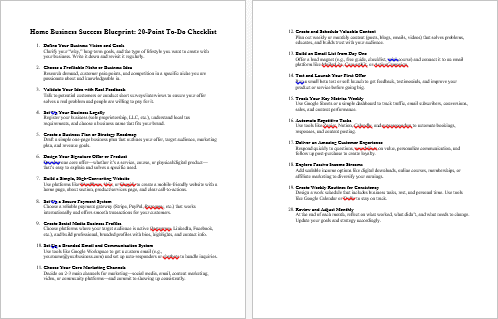
Home Business Success Blueprint – Checklist
Home Business Success Blueprint – FAQs
Home Business Success Blueprint – Salespage Content
Package Details:
Word Count: 16 476 Words
Number of Pages: 79
Home Business Success Blueprint – Bonus Content
Checklist
Word Count: 542 words
FAQs
Word Count: 780 words
Salespage Content
Word Count: 628 words
Total Word Count: 18 426 Words
Your PLR License Terms
PERMISSIONS: What Can You Do With These Materials?
Sell the content basically as it is (with some minor tweaks to make it “yours”).
If you are going to claim copyright to anything created with this content, then you must substantially change at 75% of the content to distinguish yourself from other licensees.
Break up the content into small portions to sell as individual reports for $10-$20 each.
Bundle the content with other existing content to create larger products for $47-$97 each.
Setup your own membership site with the content and generate monthly residual payments!
Take the content and convert it into a multiple-week “eclass” that you charge $297-$497 to access!
Use the content to create a “physical” product that you sell for premium prices!
Convert it to audios, videos, membership site content and more.
Excerpt and / or edit portions of the content to give away for free as blog posts, reports, etc. to use as lead magnets, incentives and more!
Create your own original product from it, set it up at a site and “flip” the site for megabucks!
RESTRICTIONS: What Can’t You Do With These Materials?
To protect the value of these products, you may not pass on the rights to your customers. This means that your customers may not have PLR rights or reprint / resell rights passed on to them.
You may not pass on any kind of licensing (PLR, reprint / resell, etc.) to ANY offer created from ANY PORTION OF this content that would allow additional people to sell or give away any portion of the content contained in this package.
You may not offer 100% commission to affiliates selling your version / copy of this product. The maximum affiliate commission you may pay out for offers created that include parts of this content is 75%.
You are not permitted to give the complete materials away in their current state for free – they must be sold. They must be excerpted and / or edited to be given away, unless otherwise noted. Example: You ARE permitted to excerpt portions of content for blog posts, lead magnets, etc.
You may not add this content to any part of an existing customer order that would not require them to make an additional purchase. (IE You cannot add it to a package, membership site, etc. that customers have ALREADY paid for.)
Share Now!
Latest Products

Free Sales Funnel Builder

Related Products

Popular & Trending


Featured Products