
Mastering Online Reputation PLR Course 33k Words
in Offline Marketing PLR , Online Marketing PLR Ebooks , PLR Checklists , PLR eBooks , PLR eCourses , PLR List Building Reports , Premium PLR , Premium PLR eBooks , Premium PLR Packages , Premium PLR Reports , Premium White Label Brandable PLR Coaching Courses , Private Label Rights ProductsChoose Your Desired Option(s)
has been added to your cart!
have been added to your cart!
#onlinereputation #reputationmanagement #plrcourse #plrcontent #plrproducts #digitalreputation #brandreputation #brandmanagement #digitalmarketing #businessgrowth #personalbranding #onlinebusines
Mastering Online Reputation PLR Course
Build, Protect, and Grow Your Digital Presence with Confidence
In today’s digital world, your online reputation is your most valuable asset. One negative review, outdated profile, or mismanaged social post can impact your business, personal brand, or career opportunities.
The Mastering Online Reputation PLR Course is a 33,000-word, step-by-step program designed to teach anyone how to build, protect, and grow a strong digital presence.
Whether you’re a coach, entrepreneur, freelancer, or PLR reseller, this course provides ready-to-use content, practical exercises, and marketing assets to help learners safeguard their online image and capitalize on opportunities.
Presenting…
Mastering Online Reputation PLR Course 33k Words
Why Online Reputation Matters
A strong online reputation:
- Builds trust and credibility with clients, partners, and audiences
- Opens doors to collaborations, job offers, and sales
- Protects you from setbacks caused by negative feedback or misinformation
- Positions you as a leader in your industry
Without a plan, your digital footprint can drift into chaos, leaving you vulnerable to misperceptions, missed opportunities, and reputation damage.
This course gives learners the strategies, tools, and actionable steps to take control of their digital presence, step by step.
What’s Inside the Mastering Online Reputation Course
The course is divided into five comprehensive modules, each with actionable lessons, exercises, and guidance.
Module 1: Laying the Foundation of Online Reputation
Goal: Understand what reputation means and how to start shaping it intentionally.
- Lesson 1: Understanding Online Reputation
Learn how people form opinions online and why first impressions in the digital space matter. - Lesson 2: The Impact of Digital Presence
Discover how a strong presence increases trust, credibility, and opportunities. - Lesson 3: Identifying Your Current Reputation
Audit your digital footprint—search your name/brand, read reviews, and analyze social mentions. - Lesson 4: Setting Reputation Goals
Define how you want to be perceived online and establish benchmarks to measure progress.
Outcome: Students will know where they stand online and set clear goals for their digital image.
Module 2: Building a Strong Digital Presence
Goal: Establish a trustworthy, authoritative online identity.
- Lesson 1: Crafting Your Personal/Brand Story
Create a compelling narrative that communicates your values, mission, and expertise. - Lesson 2: Optimizing Social Media Profiles
Build consistent, professional, and engaging profiles that reflect your reputation goals. - Lesson 3: Creating Value-Driven Content
Use blogs, videos, and posts to position yourself as an authority. - Lesson 4: Leveraging Positive Engagement
Connect with followers, reply to comments, and foster genuine online relationships.
Outcome: Students will stand out online with profiles, stories, and content that attract trust and attention.
Module 3: Protecting Your Reputation
Goal: Safeguard your brand and handle challenges gracefully.
- Lesson 1: Monitoring Your Digital Footprint
Track mentions, reviews, and discussions using reputation management tools. - Lesson 2: Managing Negative Feedback & Reviews
Respond professionally, turn negatives into positives, and maintain credibility. - Lesson 3: Dealing with Online Crisis
Strategies for handling bad press, viral backlash, or reputation attacks. - Lesson 4: Securing Personal & Brand Information
Practice online privacy, security, and protect against identity misuse.
Outcome: Students will manage risks effectively and protect their online image from harm.
Module 4: Growing Your Reputation Consistently
Goal: Transform a strong foundation into long-term influence.
- Lesson 1: Building Thought Leadership
Share expertise through articles, podcasts, webinars, and interviews. - Lesson 2: Expanding Your Online Presence
Branch out to new platforms, forums, and networks to grow visibility. - Lesson 3: Gathering Testimonials & Case Studies
Collect success stories and reviews to amplify credibility. - Lesson 4: Collaborating with Influencers & Communities
Partner with industry leaders and communities to boost reputation.
Outcome: Students will increase authority, reach, and professional opportunities.
Module 5: Sustaining & Future-Proofing Your Online Reputation
Goal: Maintain and evolve your digital presence for long-term impact.
- Lesson 1: Maintaining Consistency
Keep brand voice, visuals, and values aligned across platforms. - Lesson 2: Updating Your Online Identity
Refresh content, bios, and profiles to stay relevant. - Lesson 3: Tracking Success & Measuring Growth
Measure progress with engagement, reviews, and visibility metrics. - Lesson 4: Adapting to Future Trends
Stay ahead of AI, new platforms, and evolving audience behavior.
Outcome: Students will keep their reputation strong, adaptable, and future-ready.
Bonus Materials
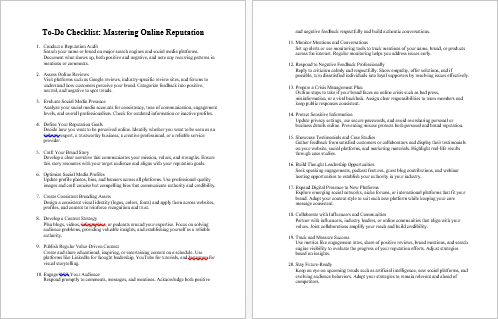
- Checklist (604 Words) – Quick reference to implement lessons efficiently.
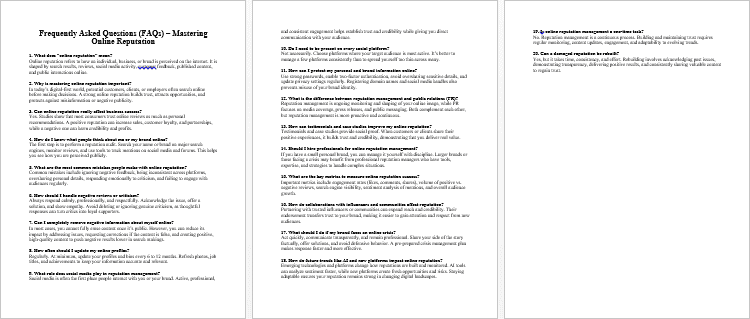
- FAQs (817 Words) – Answers common questions about online reputation management.
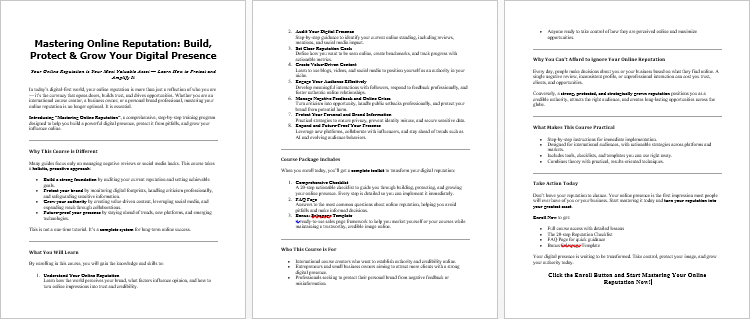
- Salespage (742 Words) – Pre-written sales copy to market the course immediately.
Who Can Benefit from This PLR Course
- Entrepreneurs & Small Business Owners – Protect and grow brand credibility.
- Coaches & Consultants – Build trust and attract clients online.
- Freelancers & Professionals – Establish authority and stand out in a crowded market.
- PLR Resellers & Content Creators – Sell, bundle, or repurpose a high-value course.
- Individuals Focused on Personal Branding – Create a polished, professional digital presence.
Ways to Use & Profit from the Course
- Sell as a Full Online Course – Charge $297–$497 for complete access.
- Break into Reports or Guides – Sell modules individually for $10–$20.
- Bundle With Other PLR Content – Create premium packages for $47–$97.
- Multi-Week E-Class – Deliver as a 4–12 week structured program.
- Membership Site Content – Generate recurring revenue with exclusive access.
- Create Physical Products – Workbooks, journals, or planners aligned with the course.
- Lead Magnets & Blog Content – Grow email lists and social media audiences.
- Flip a Niche Site – Build and sell a site around online reputation using course content.
Licensing Terms
Permissions:
- Sell as-is or with minor edits.
- Claim copyright if 75%+ is rewritten.
- Break into smaller products for sale.
- Bundle with other PLR content for upsells.
Restrictions:
- Cannot pass PLR rights to customers.
- Max affiliate commission: 75%.
- Cannot give the full course away for free.
- Cannot include in existing orders without additional purchase.
Why Buy from Buy Quality PLR
- 33,000 Words of Ready-to-Use Content – Complete course with lessons, exercises, and marketing materials.
- Actionable & Practical – Students can implement immediately.
- Comprehensive Curriculum – Covers building, protecting, and growing reputation.
- Marketing Assets Included – Checklist, FAQs, and sales page to start selling right away.
- Multiple Profit Opportunities – Sell online, create memberships, or bundle for higher value.
Bottom Line
The Mastering Online Reputation PLR Course gives learners the tools, strategies, and confidence to manage their online image, increase credibility, and attract opportunities, while providing you with ready-to-sell, high-value content.
Empower your audience to build, protect, and grow their reputation online and profit from a professional, ready-made PLR course today.
✅ Instant Access | Fully Editable | Step-by-Step Curriculum | High-Value PLR
has been added to your cart!
have been added to your cart!
Here A Sample of Mastering Online Reputation PLR Course
Module 1: Laying the Foundation of Online Reputation
Get started by understanding what online reputation is and why it’s crucial for personal brands and businesses.
Lesson 1: Understanding Online Reputation
For international course creators | Friendly, step-by-step training instructions and descriptions
Lesson objective (what learners will achieve)
By the end of this lesson learners will be able to:
- Describe what “online reputation” actually is and why it matters for creators, instructors, and brands across borders.
- Identify the primary online signals people use to form an opinion.
- Run a simple, practical audit to see their current reputation baseline.
- Take immediate, high-impact actions to strengthen first impressions.
Quick orientation (5 minutes)
Before you begin, set up three simple things:
- A notebook or a single Google/Word document titled “Reputation Audit — [Your Name/Brand]”.
- One browser window in normal mode and one in private/incognito mode.
- A timer set for short tasks (15–30 minutes).
These keep your work organized, let you view personalized vs. neutral search results, and help you stay focused.
Part A — What is “online reputation”? (Step 1 — 10 minutes)
Definition (simple):
Online reputation is the sum of publicly available digital signals that shape how people perceive you or your brand. It includes what appears on search engines, social networks, review platforms, media coverage, multimedia (photos/videos), and any third-party mentions.
Think of reputation as a mosaic: each tile is one signal — a review, a tweet, a video, a mention in a news article — and together they form someone’s impression of you.
Why this matters for course creators (short, direct):
- Trust converts: Students choose teachers they trust. A consistent, professional digital presence increases enrollments, partnerships, and speaking invitations.
- Global reach: International audiences compare you across markets; a poor local signal can reduce conversions abroad.
- Reputation = Risk + Opportunity: Positive signals open doors; negative ones reduce pricing power and damage partnerships. Even small changes can move conversion rates by a few percentage points (%) — which matters when you scale.
Part B — How people form opinions online (Step 2 — 20 minutes)
People use mental shortcuts when they evaluate someone online. Teach learners these core heuristics so they can design for them.
- First cue wins. The first visible clue (profile photo, headline, first search result) anchors perception. Make that cue positive.
- Social proof. Likes, reviews, testimonials, follower counts and endorsements (e.g., LinkedIn) act as evidence. More positive proof typically equals more trust.
- Recency and frequency. Recent activity and repeated mentions carry weight. A single old article matters less than a steady stream of current, positive content.
- Relevance and context. Country, language, and platform change meaning — a post that’s normal on X may be perceived differently on Weibo, VK, or LinkedIn.
- Emotional valence. Positive or negative tone influences decisions faster than factual corrections. Negative items often stick longer than neutral or positive ones.
Practical teaching point: run a quick demo in class showing a search result and highlight the first visible elements: title, snippet, date, and the site domain. Ask learners how those elements would influence their decision to enrol.
Part C — The reputation signal map (Step 3 — 15 minutes)
Present a simple checklist of signals. Ask learners to tick which apply to them.
Primary signals:
- Search engine results (name or brand in quotes).
- Social profiles (@handles, profile photo, bio).
- Reviews and ratings (platforms vary by country).
- Website (homepage + “About” page + blog).
- Media mentions (podcasts, news, guest posts).
- Visual content (images, video — YouTube, Vimeo, TikTok).
- Community presence (forums, Q&A, course marketplaces).
- Legal or public records (if applicable in their market).
International sign usage: show how signals vary: for a learner in Korea, local platforms matter; for someone aiming at EU learners, Google + LinkedIn + Trustpilot may be most visible; for a China-facing creator, Baidu + Weibo matter. Use symbols like @ (handles), # (hashtags), and % (engagement) as shorthand on your slides.
Part D — Guided baseline audit (Step 4 — 30–45 minutes)
This is a hands-on activity. Have learners perform each task and record results in their “Reputation Audit” document.
- Search for exact name / brand in quotes:
- Use normal mode and incognito. Record first 10 results. Note: different country IPs and languages yield different first pages.
- Try variants: “Firstname Lastname”, “Brand name”, “Brand + Course”, “Firstname + City/Country”.
- Check images & video tabs:
- Note whether professional photos, logos, or unrelated images appear.
- Scan social networks for @handles:
- Look at main profiles (LinkedIn, Instagram, X, Facebook, TikTok, YouTube). Observe bio clarity, profile photo, and pinned posts. Record any inconsistent messaging.
- Find reviews and testimonials:
- Search for “[Name] review”, “reviews [Brand]”, and check marketplaces (Udemy, Teachable, Thinkific, marketplaces in target countries). Note average rating and any recurring complaints.
- Check news & public mentions:
- Use search filters for the past 12 months. Record any major positive or negative mentions.
- Personal site audit (if you own the site):
- Open your homepage in desktop and mobile view. Does the purpose appear within 5 seconds? Is contact info visible? Is the brand voice consistent?
- Record first impressions (qualitative):
- On a 1–5 scale (1 = poor, 5 = excellent), rate your overall initial impression, clarity of message, trustworthiness, and discoverability.
Trainer tip: if learners target multiple markets, repeat the search from one or two key market locales (e.g., Google.co.uk, Google.co.in, Baidu, Yandex). If they can’t switch locales, ask them to imagine how a local user would see the results.
Part E — Interpreting the audit: what to watch for (Step 5 — 20 minutes)
Guide learners how to read patterns:
- Dominant negative items: If the top 3 results are negative, prioritize remediation. Negative visibility is more damaging than a lack of visibility.
- Mixed signals: If you have high engagement but low-quality media or poor bios, you’re attracting attention but losing conversions — fix profile clarity first.
- No presence: If you don’t appear at all, your strategy should be growth and claim-ownership (claim domain, secure @handles, publish authoritative content).
- Misinformation or confusion: When people confuse you with someone else, add clarifying phrases to your profiles (“Course creator in [niche] — based in [City, Country]”).
Mini-case: a course creator discovers that their brand name is shared with a local business in another country. Solution: add a differentiator to SEO and social bios (e.g., “Firstname Lastname — Online Learning for Designers | ℠”).
Part F — Immediate fixes you can implement today (Step 6 — 15–25 minutes)
Provide a short, actionable checklist learners can complete now:
- Profile refresh (15–30 min):
- Update profile photo to a clear, high-resolution headshot.
- Rewrite your bio to one strong opening sentence + one line about what you teach and who benefits (example: “I teach busy professionals how to design micro-learning courses that sell internationally”). Include a location or timezone if relevant (e.g., GMT+5:30). Use consistent punctuation and capitalization.
- Claim and standardize handles (10–20 min):
- Create or claim consistent @handles across major platforms, even if you don’t use them yet. Consistency reduces impersonation risk.
- Homepage headline (10–20 min):
- Ensure your site’s hero headline answers: “Who you are” + “What you do” + “Who it’s for.” This fixes first impressions fast.
- Prepare a review-response template (15 min):
- Short template: Acknowledge → Apologize (if appropriate) → Offer remedy → Invite offline contact → Thank.
- Example (neutral): “Thank you for your feedback. I’m sorry this experience didn’t meet expectations. Please email [email] so we can resolve it. Thank you for letting me know.”
- Privacy & security check (15 min):
- Ensure public contact info is correct and review account recovery options. Weak accounts increase impersonation and fraud risk.
Part G — Short exercises and reflection prompts (Step 7 — 10–15 minutes)
Give learners quick tasks to solidify the lesson:
- Write a one-sentence “elevator bio” for your course that makes sense to someone in a different country. Keep it under 140 characters.
- In your audit document, list the three most visible items someone sees when they Google you. What emotion do those items create (trust, confusion, neutral, distrust)?
- Choose one low-effort improvement (photo, bio, or homepage headline) and commit to finishing it within 24 hours.
Part H — How you’ll measure progress (assessment criteria)
For this lesson, learners should capture baseline numbers and qualitative notes:
- Search visibility: list of top 10 results.
- Number of platforms with a completed/consistent profile.
- Average rating (if reviews exist) or number of testimonials.
- One qualitative score (1–5) for first impression.
Re-run the audit after 7–14 days to measure change.
Final coach note (encouragement)
Understanding reputation is the foundation of everything you build online. It’s not about perfection; it’s about visibility, clarity, and predictable signals that build trust across cultures and time zones. Treat this lesson as a discovery phase: the audit reveals where to focus effort next, and the small fixes listed above create immediate uplift you — and potential students — will notice.
Lesson 2 — The Impact of Digital Presence
For international course creators | Friendly, step-by-step training instructions and descriptions
Lesson objective (what learners will achieve)
By the end of this lesson you will be able to:
- Explain clearly how a strong digital presence shapes trust, credibility, and opportunity for course creators across markets.
- Identify the specific ways online signals convert into tangible outcomes (enrolments, partnerships, speaking invites, pricing power).
- Apply three practical strategies to amplify the positive impact of your digital presence.
- Choose meaningful metrics to track progress across different platforms and territories.
Quick orientation (5 minutes)
Get ready with:
- Your “Reputation Audit — [Your Name/Brand]” document from Lesson 1.
- A list of your top three target markets (for example: UK, India, Brazil). Use shorthand like UK, IN, BR.
- A blank column in your audit for “Impact Notes” where you’ll record outcomes tied to digital signals (e.g., “X post led to 5 signups”, “Guest post → 1 collaboration”).
Part A — What “impact” really means (Step 1 — 10 minutes)
Start by clarifying terms. “Impact” here = measurable shifts in how others act toward you after seeing your digital signals. Those actions include, but are not limited to:
- Trust: willingness to share money, time, or data with you.
- Credibility: perceived expertise that justifies price and authority.
- Opportunity: requests for partnerships, invitations, and sales.
Think of digital presence as a marketplace signal: the clearer and more consistent the signal, the higher the chances of positive downstream actions. Use simple international signs as shorthand when mapping causes to effects:
- @ = social identity (profiles)
= topical relevance (hashtags, SEO keywords)
- % = engagement (likes, comments, completion rates)
- € / $ / ₹ / ¥ = monetization outcomes (currency symbol shows where revenue originates)
- GMT± = timezone/localization signal
Part B — How presence builds trust and credibility (Step 2 — 25 minutes)
Break this down into three causal pathways. Present each pathway, illustrate with a short scenario, then give learners a short task.
- Visibility → Familiarity → Trust
- Explanation: When people repeatedly see consistent messages from you across platforms, familiarity reduces uncertainty and increases trust.
- Scenario: A potential student in Germany sees your article on LinkedIn, your YouTube explainer, then a guest post on a local education blog; the repeated exposure makes them more likely to click “Enroll”.
- Task (5 minutes): List the three channels where you are most visible and note how often you post on each. Add an “exposure frequency” column (daily / weekly / monthly).
- Social Proof → Credibility → Higher Conversions
- Explanation: Testimonials, ratings, and endorsements act as external validation. In many markets a 4.5★ rating or a case study matters more than a long bio.
- Scenario: A corporate L&D buyer in Japan scans your site, sees client logos and a case study showing % completion and improvement in scores — credibility converts to an RFP.
- Task (5 minutes): Record your top three social proof assets (review average, key testimonial, or a well-known client logo).
- Content Quality → Authority → Opportunity
- Explanation: Depth and clarity of content demonstrate expertise. Quality content attracts media, podcasts, and high-level collaborations.
- Scenario: A podcast producer in Brazil finds your thought piece and invites you to speak — that interview then drives traffic and signups in BR.
- Task (5 minutes): Identify one long-form asset (a flagship lesson, whitepaper, or video) that best showcases your expertise.
Part C — The business and personal growth levers (Step 3 — 20 minutes)
Explain concrete levers and what to measure for each. Use clear action items.
- Enrolment and sales funnel
- Lever: Landing page clarity + targeted ads + social proof.
- Measure: Conversion rate (% of visitors who enroll), average revenue per user (€/$/₹), and cost per acquisition (CPA).
- Action: Create a one-line value proposition that appears above the fold on your landing page.
- Partnerships and collaborations
- Lever: Thought leadership content + outreach + presence on professional platforms.
- Measure: Number of partnership inquiries per month; % that convert to paid collaborations.
- Action: Publish a concise “collaborate” paragraph on your site and pin it to your LinkedIn profile.
- Pricing power and negotiation
- Lever: Reputation, reviews, and media profile.
- Measure: Average deal size or course price over time by market (e.g., £199 in UK vs ₹6,999 in IN).
- Action: Package a premium offering (certified course + one coaching call) and test at a higher price in one market.
- Brand resilience
- Lever: Diversified presence (owned site + marketplace presence + social channels).
- Measure: Percentage of traffic owned (email list) versus channel-dependent (marketplaces).
- Action: Build an automated email welcome sequence to convert channel traffic into owned customers.
Part D — Step-by-step strategies to increase impact (Step 4 — 30–40 minutes)
Give learners practical routines they can implement. Each strategy includes the “why”, “how”, and a 30/60/90-day plan.
- Strategy 1 — Clarify and translate your core message
- Why: International audiences respond quickly when they understand who you are and what problem you solve.
- How: Write a one-sentence mission statement and adapt it for each key market (language, currency, local examples). Use symbols like GMT+ to show availability.
- 30/60/90: 30 days — finalize the one-liner; 60 days — localize for two markets; 90 days — test in landing pages and measure CTR.
- Strategy 2 — Publish pillar content and repurpose
- Why: Long-form content builds authority and can be sliced into many assets.
- How: Create a pillar article/video (2,000–3,000 words or 20–30 minute video) and repurpose it into 6 shorter posts, 3 tweets, and 1 webinar. Mark each repurposed piece with #topic and @handle.
- 30/60/90: 30 days — produce pillar content; 60 days — repurpose and distribute; 90 days — measure engagement and enrolments tied to the pillar.
- Strategy 3 — Collect and showcase measurable outcomes
- Why: Numbers persuade. Showing % improvement, completion rates, or ROI is powerful across cultures.
- How: Run a short pilot course, collect pre/post metrics, and create a simple case study with % improvements and quotes. Use currency symbols where relevant in the case study.
- 30/60/90: 30 days — recruit 10 pilot learners; 60 days — gather data; 90 days — publish a case study.
- Strategy 4 — Localize outreach and testimonials
- Why: Local trust markers (a testimonial in the local language, local currency pricing) perform better.
- How: Translate 2–3 testimonials into the language of your key market and display localized pricing using local currency symbols. Add timezone info like GMT+1, GMT+5:30 to clarify availability.
- 30/60/90: 30 days — identify translators or bilingual students; 60 days — implement localized pages; 90 days — run A/B tests for conversion lift.
Part E — Cross-cultural considerations (Step 5 — 20 minutes)
Address differences across markets and how to adapt signals for maximum impact.
- Formality and tone: Some markets prefer formal professional language (e.g., Germany, Japan) while others favor casual, story-driven copy (e.g., US, Brazil). Adapt voice but keep @handle and brand name consistent.
- Platform preferences: Google + LinkedIn are strong in many markets; WeChat/Weibo matter in China; VK in parts of Eastern Europe. Prioritize one platform per market.
- Payment and pricing expectations: Price using local currency symbols and consider local purchasing power (€, £, $, ₹, ¥). Offer multiple payment methods where possible.
- Privacy and legal norms: GDPR in EU affects data collection; other markets have different expectations. Be explicit about data use in your course sign-up forms.
Activity: For each of your top three markets, write three localization changes you will implement (tone, platform, pricing).
Part F — Measuring impact: KPIs and dashboards (Step 6 — 20 minutes)
List a compact set of KPIs and how to track them. Keep it actionable.
Core KPIs:
- Organic search visibility (top 10 results for your name/brand).
- Conversion rate (visitors → signups) as a percentage (%).
- Average revenue per customer (€/$/₹).
- Engagement metrics: watch time, completion rate, comments per lesson (%).
- Partnership inquiries per month.
Mini dashboard: Create a simple table in your audit doc with rows = KPI and columns = current value, target (30 days), target (90 days), source (where you track it). Use + or − to mark change.
Part G — Short exercises and reflection prompts (Step 7 — 15 minutes)
- Identify one piece of content that produced the best result for you in the past six months. What signal (social proof, visibility, or content depth) do you think caused the most impact? Write a 150-word analysis.
- Pick one KPI from the dashboard and create a 30-day plan to improve it by 10%. List three tactical moves.
- Role-play: imagine a potential partner in Spain asks “Why partner with you?” Draft a 3-line response that uses a concrete metric and a local signal (example: “Our last cohort increased learner completion by 42% and included students from ES, UK, and MX.”).
Part H — Common pitfalls and how to avoid them (Step 8 — 15 minutes)
List frequent mistakes and corrective actions.
- Being everywhere, but shallow. Focus on 2–3 platforms per market and do them well.
- Over-reliance on vanity metrics. Don’t chase followers; track conversions and revenue.
- Ignoring localization. A single English-only page may reduce conversions in non-English markets. Localize essentials.
- Neglecting measurement. If you don’t track outcomes, you can’t optimize. Set even a simple spreadsheet KPI tracker.
Final coach note (encouragement)
A strong digital presence is not vanity — it’s a strategic engine that turns visibility into trust, and trust into real opportunities across borders. Small, consistent actions (clarifying your message, publishing quality content, showcasing measurable outcomes) compound quickly. Treat metrics like a map, not a mandate: they guide experiments and help you invest effort in what actually drives enrolments and partnerships. Keep your international signs handy (@, #, %, €/$/₹, GMT±) as shorthand when mapping signals to outcomes — they’ll speed your decisions and align your team across time zones.
Lesson 3 — Identifying Your Current Reputation
For international course creators | Friendly, step-by-step training instructions and descriptions
Lesson objective (what learners will achieve)
By the end of this lesson you will be able to:
- Run a thorough, repeatable reputation audit for your name and brand across search engines, review sites, and social platforms.
- Capture and score every visible signal so you can prioritize what to fix and what to amplify.
- Spot cross-border differences (platforms, languages, local signals) and adapt your audit to three key markets.
- Create a living Reputation Audit document that you can update weekly or monthly.
Quick orientation (5 minutes)
Prepare these three things before you begin:
- A single spreadsheet or document titled “Reputation Audit — [Your Name/Brand]”. Include columns: Date, Source, URL, Snippet, Tone, Reach, Impact Score, Priority, Notes.
- One browser window in normal mode and one in private/incognito mode.
- A short list of your top three markets (use abbreviations like UK, IN, BR) and the timezone shorthand for your availability (GMT±).
Use the international signs as shorthand in your notes: @ for handles, # for hashtags/topics, % for engagement, and currency symbols like €, $, ₹, ¥ when you record pricing or monetization evidence.
Part A — The audit framework (Step 1 — 10 minutes)
Work through four stages: Discover → Capture → Analyse → Prioritise. Treat the audit as a loop you will repeat.
Stage 1 — Discover: find all public mentions.
Stage 2 — Capture: record each mention in your spreadsheet with required fields.
Stage 3 — Analyse: assign tone, reach, and compute an impact score.
Stage 4 — Prioritise: decide which items to fix, reply to, or amplify.
Keep the audit methodical: discovery first, judgement later.
Part B — Discovery: searching your name and brand (Step 2 — 30–45 minutes)
This section is a step-by-step checklist for finding where you appear online.
- Exact-phrase search (global view).
- Open a search engine and search your full name or brand name inside quotes, for example: “Firstname Lastname” or “Brand Name”. Record the first 10 results in your spreadsheet.
- Variant searches (common permutations).
- Search variations: “Firstname”, “Firstname Lastname course”, “Brand + course”, “Firstname + niche”, “Firstname + city/country”. Include a search for negative phrases such as: “Firstname Lastname review”, “Brand + complaint”, or “Brand + scam” — these surface friction points.
- Site-specific searches using search syntax.
- Use syntax like site:linkedin.com “Firstname Lastname” to check specific domains. Also try site:youtube.com and site:medium.com. Record any high-visibility pages.
- Images and video tabs.
- Click the Images and Video results. Note whether professional photos, logos, or irrelevant images appear. If a low-quality or incorrect image appears prominently, mark it as a high-priority fix.
- Locale-specific checks.
- Repeat the exact-phrase search for each target market using local versions of search engines or by changing the search engine settings to the relevant country (for example Google.co.uk, Google.co.in). If you cannot change locale, add the country name to queries, e.g., “Firstname Lastname UK”. Note the differences.
- Incognito vs signed-in view.
- Compare normal and incognito results. Signed-in results may be personalized and hide items you should still know about. Record both perspectives.
- Advanced boolean queries (optional but powerful).
- Use +, -, and filetype: operators to refine searches. Example: “Firstname Lastname” -site:facebook.com to find non-social mentions. Try filetype:pdf to discover course materials or slides.
Write down each result’s URL, the visible title, the date (if shown), and a one-line summary in your spreadsheet.
Part C — Reading reviews and marketplace signals (Step 3 — 20–30 minutes)
Reviews and ratings are high-impact signals. Know where to look and what to capture.
- Platform checklist.
- Search course marketplaces and platforms where you sell (Udemy, Teachable, Thinkific, local marketplaces) for your course name and instructor name. Also check general review platforms common in your markets (for example, Trustpilot in some countries). Record average rating, number of reviews, and any repeated praise or complaints.
- Extract the signal (what to record).
- For each review record: reviewer name (if public), review snippet, rating (stars or numeric), date, and whether you responded. Note language and whether a translation is needed.
- Assess review patterns.
- Look for recurring topics: pricing, content quality, support response time, localization issues, platform UX. These are themes you will later address.
- Respondable negatives.
- Identify reviews where a public reply could reduce damage (complaints about support, unclear instructions). Flag them for response and draft a reply template in your notes.
Part D — Social media mentions and listening (Step 4 — 30–45 minutes)
Social signals happen fast and across many platforms. This step gives you a systematic search routine.
- Platform-by-platform sweep.
- Search for your @handles and name on major platforms: LinkedIn, X (Twitter), Instagram, YouTube, Facebook, Reddit, Quora, and the platforms specific to your target markets (Weibo, VK, etc.). Use platform search bars and record prominent mentions.
- Hashtag and topic searches.
- Search relevant hashtags #topic and your course name as a hashtag #CourseName. Capture posts with significant engagement (high % likes, comments, shares).
- Advanced social search tips.
- On X/Twitter use filters for language and date range. On YouTube search comments on your videos and videos mentioning you. On Reddit and Quora, search threads where your name or topic is discussed and save the thread URL.
- Listen for sentiment and volume.
- Note whether mentions are isolated or trending. A single negative comment on a low-traffic account is low reach; a critical thread with many comments is high reach. Mark reach as High / Medium / Low.
Part E — Capture and scoring (Step 5 — 15–20 minutes)
Now convert findings into structured data.
- Spreadsheet fields (minimum):
- Date | Source | URL | Snippet | Tone (Positive / Neutral / Negative) | Reach (High/Medium/Low) | Impact Score | Priority | Notes.
- Tone coding: assign numeric tone values: Positive = +1, Neutral = 0, Negative = -2.
- Reach weights: assign weights: High = 3, Medium = 2, Low = 1.
- Compute an Impact Score with a simple formula:
- Impact Score = Tone Value × Reach Weight + Recency Bonus (Recency Bonus = 2 if within last 30 days, otherwise 0).
- Example calculation (showing each arithmetic step): suppose a negative review (Tone Value = −2) on a high-reach site (Reach Weight = 3) posted 10 days ago (Recency Bonus = 2).
Step 1: Multiply tone and reach: −2 × 3 = −6.
Step 2: Add Recency Bonus: −6 + 2 = −4.
Impact Score = −4.
- Use the impact score to rank items: lower scores (more negative) should get higher remediation priority.
Record every computed score in the Impact Score column so you can sort and filter.
Part F — Analyse: pattern recognition and insight gathering (Step 6 — 25–30 minutes)
Turn raw captures into insights.
- Theme clustering.
- Group mentions by recurring themes (content quality, support, pricing, localization). Use #theme tags in your Notes column to make this visible.
- Geography mapping.
- For each theme, note which markets it appears in (UK, IN, BR). If a complaint appears repeatedly in one market, that suggests a localization or payment issue.
- Platform-specific problems.
- Identify problems tied to specific platforms: “All YouTube comments mention audio quality,” or “LinkedIn posts have high engagement but no conversions.” These lead to targeted fixes.
- Identify false or misleading mentions.
- Spot incorrect claims (misattributed content or impersonation). Flag those separately and determine whether they require legal, platform, or public response.
Part G — Prioritisation and immediate actions (Step 7 — 15–20 minutes)
Use the impact scores and themes to create a 24–72 hour action list.
- Top priority (within 24 hours): any negative item with high reach and recent date (Impact Score very negative). Actions: public reply, contact platform support, or correct factual errors.
- Quick wins (24–72 hours): update profile photos and bios, claim handles, fix obvious website headlines, correct contact info. These are low-effort, high-return.
- Medium-term (1–4 weeks): create case studies to counterbalance negatives, launch a follow-up email campaign to past learners asking for updated testimonials in local languages, and produce a high-quality pillar piece.
- Long-term (1–3 months): fix structural issues (course content localization, on-platform UX problems), build ongoing monitoring.
Do not try to fix everything at once. Use the Impact Score ranking to focus where you get the biggest return for effort.
Part H — Exercises and reflection prompts (Step 8 — 20 minutes)
- Complete the full discovery step for one market and capture 20 items in your spreadsheet.
- Compute Impact Scores for those items and sort them. Identify the top three items requiring attention and write one-sentence actions for each.
- Translate one positive testimonial into a target market language and prepare a localized display snippet with a local currency symbol (€, $, ₹) and a timezone (GMT±).
Final coach note (encouragement)
A reputation audit is detective work: methodical, repeatable, and revealing. You will discover patterns that surprise you and quick fixes that move the needle. Keep your spreadsheet living and update it regularly — small weekly checks prevent surprises and help you grow trust and credibility across borders. Treat @, #, %, currency symbols, and GMT± as your universal shorthand when you log items — they speed communication and keep your cross-market notes tidy.
We’re also giving these extra bonuses
Mastering Online Reputation – Checklist
Mastering Online Reputation – FAQs
Mastering Online Reputation – Salespage Content
Package Details:
Word Count: 31 736 Words
Number of Pages: 129
Mastering Online Reputation – Bonus Content
Checklist
Word Count: 604 words
FAQs
Word Count: 817 words
Salespage Content
Word Count: 742 words
Total Word Count: 33 899 Words
Your PLR License Terms
PERMISSIONS: What Can You Do With These Materials?
Sell the content basically as it is (with some minor tweaks to make it “yours”).
If you are going to claim copyright to anything created with this content, then you must substantially change at 75% of the content to distinguish yourself from other licensees.
Break up the content into small portions to sell as individual reports for $10-$20 each.
Bundle the content with other existing content to create larger products for $47-$97 each.
Setup your own membership site with the content and generate monthly residual payments!
Take the content and convert it into a multiple-week “eclass” that you charge $297-$497 to access!
Use the content to create a “physical” product that you sell for premium prices!
Convert it to audios, videos, membership site content and more.
Excerpt and / or edit portions of the content to give away for free as blog posts, reports, etc. to use as lead magnets, incentives and more!
Create your own original product from it, set it up at a site and “flip” the site for megabucks!
RESTRICTIONS: What Can’t You Do With These Materials?
To protect the value of these products, you may not pass on the rights to your customers. This means that your customers may not have PLR rights or reprint / resell rights passed on to them.
You may not pass on any kind of licensing (PLR, reprint / resell, etc.) to ANY offer created from ANY PORTION OF this content that would allow additional people to sell or give away any portion of the content contained in this package.
You may not offer 100% commission to affiliates selling your version / copy of this product. The maximum affiliate commission you may pay out for offers created that include parts of this content is 75%.
You are not permitted to give the complete materials away in their current state for free – they must be sold. They must be excerpted and / or edited to be given away, unless otherwise noted. Example: You ARE permitted to excerpt portions of content for blog posts, lead magnets, etc.
You may not add this content to any part of an existing customer order that would not require them to make an additional purchase. (IE You cannot add it to a package, membership site, etc. that customers have ALREADY paid for.)
Share Now!
Latest Products





Free Sales Funnel Builder

Related Products

Popular & Trending



Featured Products