Manifestation Mindset Think It, Attract It PLR Course 34k Words
in Mindset PLR , Mindset PLR eBooks , PLR Checklists , PLR eBooks , PLR eCourses , PLR List Building Reports , Premium PLR , Premium PLR eBooks , Premium White Label Brandable PLR Coaching Courses , Private Label Rights Products , Self Help PLR , Self Help PLR eBooks , Self Improvement PLR , Self Improvement PLR EbooksChoose Your Desired Option(s)
has been added to your cart!
have been added to your cart!
Manifestation Mindset: Think It, Attract It PLR Course
Unlock the Power of Your Mind to Attract the Life You Desire
Do you ever feel like life is happening to you instead of for you? What if the life you want—abundance, success, love, and health—was already within your reach?
The Manifestation Mindset: Think It, Attract It PLR Course is a 34,000-word, step-by-step training program designed to teach anyone how to build a powerful, repeatable daily manifestation ritual. It’s practical, actionable, and perfect for anyone ready to turn thoughts into reality.
Whether you’re a coach, content creator, entrepreneur, or PLR reseller, this course gives you the tools to teach, sell, or repurpose a complete manifestation program.
Presenting…
Manifestation Mindset Think It, Attract It PLR Course 34k Words
Why a Manifestation Mindset Changes Everything
Manifestation isn’t magic—it’s a science-backed process that combines thoughts, emotions, and energy to create results.
Many people struggle because they lack clarity, consistency, or a daily practice. This course eliminates confusion and shows learners how to integrate manifestation into everyday life.
With a simple 10–15 minute daily ritual, anyone can start:
- Shifting limiting beliefs that hold them back
- Aligning desires with emotions to attract opportunities
- Using visualization and gratitude to raise vibrational energy
- Recognizing synchronicities and signs from the universe
- Living a more intentional and empowered life
By the end of the course, students will have a repeatable, practical framework for manifesting what they want—without overwhelm or complicated routines.
What’s Inside the Manifestation Mindset Course
The course is divided into five comprehensive modules, each packed with lessons, exercises, and actionable steps.
Module 1: The Foundations of Manifestation
Goal: Build a solid understanding of manifestation and create the perfect environment for daily practice.
- Lesson 1: What is Manifestation, Really?
Discover the true meaning of manifestation, why it works beyond wishful thinking, and how your thoughts, emotions, and energy shape reality. - Lesson 2: The Power of Belief and Mindset
Learn to identify and shift subconscious beliefs to align with your desires. - Lesson 3: Why Daily Rituals Work
Understand the neuroscience behind small, consistent practices that yield big results. - Lesson 4: Designing Your Manifestation Space
Set up a calm, inspiring environment for your daily ritual—journal, candle, or quiet corner.
Outcome: Students will understand manifestation deeply and be ready to implement daily rituals confidently.
Module 2: Setting Clear Intentions
Goal: Gain clarity and focus on what you truly want.
- Lesson 1: The Power of Intention vs. Goals
Understand the difference between energetic intentions and tangible goals—and how they work together. - Lesson 2: Creating Your Personal Vision Statement
Write a simple, powerful statement capturing the life you want to attract. - Lesson 3: Aligning Desires with Emotions
Learn to attach strong emotions to your intentions, because feelings fuel manifestation. - Lesson 4: Daily Affirmations that Stick
Craft short, memorable affirmations for your ritual to reprogram your mind.
Outcome: Students will have a clear vision, aligned emotions, and daily affirmations to guide their manifestation practice.
Module 3: Visualization and Energy Alignment
Goal: Teach learners to feel, see, and embody the life they desire.
- Lesson 1: The Art of Visualization Made Simple
Step-by-step methods to visualize your desires as if they are already real. - Lesson 2: Emotional Frequency Tuning
Raise vibration using gratitude, joy, or excitement to align with your desires. - Lesson 3: Embodying Your Future Self
Think, feel, and act like the version of you who already has what you’re manifesting. - Lesson 4: Morning & Evening Ritual Practices
Quick, practical visualization practices to start and end your day with focus.
Outcome: Students will learn how to use energy, visualization, and mindset to attract what they want consistently.
Module 4: Overcoming Doubts and Blocks
Goal: Clear mental resistance and limiting beliefs that block manifestation.
- Lesson 1: Spotting Limiting Beliefs
Identify hidden stories in your mind that sabotage your success. - Lesson 2: Reframing and Releasing Doubts
Learn a process to replace negative thoughts with empowering ones. - Lesson 3: Dealing with Impatience
Avoid the “waiting trap” and learn to trust the process. - Lesson 4: Protecting Your Energy Daily
Practical steps to avoid energy drains and negative influences.
Outcome: Students will overcome mental blocks and doubts, staying aligned with their manifestations.
Module 5: Living the Daily Manifestation Ritual
Goal: Turn learning into consistent action with a repeatable daily practice.
- Lesson 1: The Step-by-Step Daily Ritual
Combine intention, affirmation, visualization, and gratitude into a 10–15 minute ritual. - Lesson 2: Journaling for Manifestation
Track progress, shifts, and universal signs with a manifestation journal. - Lesson 3: Recognizing Signs and Synchronicities
Notice opportunities and coincidences that confirm you’re on the right path. - Lesson 4: Making Manifestation a Lifestyle
Integrate manifestation mindset into everyday life so it becomes natural, effortless, and powerful.
Outcome: Students will have a practical daily ritual and mindset tools to attract the life they desire.
Bonus Materials
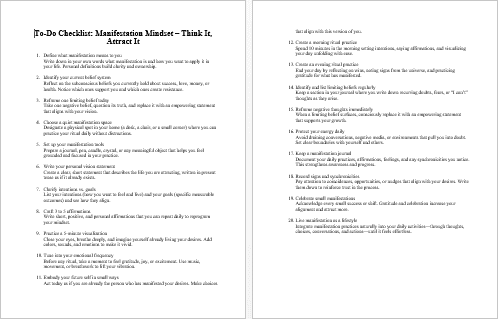
- Checklist (519 Words) – Quick reference to implement all rituals and steps efficiently.
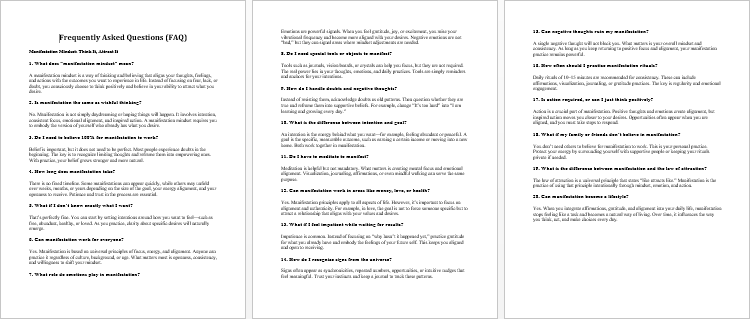
- FAQs (890 Words) – Answering common questions about manifestation, mindset, and daily practice.
- Salespage (804 Words) – Pre-written, ready-to-use sales copy for marketing the course.
Who Can Benefit from This PLR Course
- Coaches & Mentors: Teach manifestation as a structured program.
- Content Creators: Repurpose into e-courses, guides, or membership content.
- Entrepreneurs & PLR Resellers: Sell or bundle to generate new income streams.
- Beginners & Life Enthusiasts: Learn actionable steps to manifest health, wealth, and relationships.
- Bloggers & Influencers: Use content to educate and grow your audience.
Ways to Use & Profit from the Course
- Sell as a Complete Online Course – Charge $297–$497 for full access.
- Break Into Smaller Reports – Sell modules individually for $10–$20.
- Bundle With Other Content – Offer premium packages for $47–$97.
- Multi-Week E-Class – Turn it into a structured 4–12 week course.
- Membership Site Content – Generate recurring income with exclusive access.
- Physical Products – Journals, planners, or workbooks aligned with the course.
- Lead Magnets & Free Excerpts – Grow email lists and social audience.
- Flip a Niche Site – Build and sell a manifestation-focused website using course content.
Licensing Terms
Permissions:
- Sell as-is or with minor edits.
- Claim copyright if 75%+ is rewritten.
- Break into smaller products for sale.
- Bundle with other PLR content for upsells.
Restrictions:
- Cannot pass PLR rights to customers.
- Max affiliate commission: 75%.
- Cannot give the full course away for free.
- Cannot include in existing orders without additional purchase.
Why Buy from Buy Quality PLR
- 34,000 Words of Ready-to-Use Content – Complete course with lessons, exercises, and bonuses.
- Actionable, Practical, and Repeatable – Teach, sell, or repurpose with confidence.
- Step-by-Step Daily Ritual – Students can practice manifestation in under 15 minutes a day.
- Marketing Tools Included – Checklist, FAQs, and sales page to start selling immediately.
- Multiple Profit Opportunities – Online course, membership content, e-classes, or digital products.
Bottom Line
The Manifestation Mindset Think It, Attract It PLR Course is the ultimate toolkit for anyone wanting to teach, sell, or practice manifestation effectively.
Empower your audience to think it, feel it, and attract it, while you profit from high-value, ready-made content.
✅ Instant Access | Fully Editable | Actionable & Practical | Step-by-Step PLR
Start helping your audience manifest their dreams today with Manifestation Mindset: Think It, Attract It.
has been added to your cart!
have been added to your cart!
Here A Sample of Manifestation Mindset Think It, Attract It PLR Course
Building & practicing a simple, repeatable Daily Manifestation Mindset Ritual to attract your desired life.
Module 1: The Foundations of Manifestation
This module helps learners understand what manifestation really is and sets the stage for their daily ritual.
Lesson 1: What is Manifestation, Really?
[Objective] Understand what manifestation is (and isn’t), how thoughts, emotions, and energy interact, and how to explain it clearly to a global audience.
[Outcome] By the end of this lesson, learners can define manifestation, map the thought-emotion-energy-action loop, and practice a short evidence-informed alignment exercise.
1) Plain-Language Definition (for international audiences)
Manifestation = the intentional process of shaping your inner state (thoughts, emotions, and energy) so that your attention, decisions, and actions consistently align with a chosen outcome → which increases the likelihood of that outcome becoming real.
Key points to communicate simply:
- Intention sets direction.
- Attention selects and amplifies what you notice.
- Emotion powers motivation and persistence.
- Energy = your moment-to-moment state (calm, tense, open, closed) that influences how you think, speak, act, and collaborate.
- Action translates inner alignment into results.
- Feedback from reality refines beliefs and next choices.
Use this visual flow in your slides or board:
Intention → Attention → Emotion → Energy → Action → Outcome → Feedback → Belief (loop)
Explain that this loop is both practical (psychology and behavior) and, for many, spiritual (meaning, purpose, coherence). Both lenses can coexist.
2) What Manifestation Is Not (set healthy expectations)
- Not magic on demand. Results arrive through choices, skills, timing, and collaboration.
- Not denial of challenges. We acknowledge constraints, then decide the best response.
- Not “positive thinking only.” Balanced thinking (clear intention + grounded assessment) prevents false optimism.
- Not blaming victims. Circumstances vary globally; manifestation is a practice of influence, not a guarantee.
Use a neutral icon like CAUTION: on your slide to highlight these clarifications. This builds trust with diverse learners.
3) Two Complementary Lenses (teach inclusively)
Lens A: Psychological / Behavioral (observable)
- Thoughts prime perception (what you notice and recall).
- Emotions influence risk tolerance, creativity, and persistence.
- Body state (breathing, posture) affects cognition and communication.
- Habits and micro-actions compound over time.
Lens B: Meaning / Energetic (subjective but widely reported)
- Intention + elevated emotion often correlates with a sense of “flow” or “alignment.”
- Many cultures describe this as “vibration,” “qi,” “prana,” or “coherence.”
- Whether learners treat this as metaphor or metaphysics, the practices (clarity, gratitude, visualization, aligned action) remain useful.
Invite learners to hold both lenses with a both/and mindset. Use phrases like “From a practical perspective…” and “From a meaning perspective…” to welcome different worldviews.
4) Trainer Preparation (before class)
[Time] 10–15 minutes
[Materials] Flipchart or slides, markers, a plain notebook, timer, water.
- Write the loop on the board: Intention → Attention → Emotion → Energy → Action → Outcome → Feedback → Belief.
- Prepare 3 culturally neutral examples (below).
- Choose short words, minimal idioms, and clear visuals (arrows, circles, +/-).
- Plan to pause for translation or interpretation if your group is multilingual.
5) Opening Frame (5 minutes)
Say: “Today we will explore a practical definition of manifestation and run a short alignment exercise. The goal is simple: understand how your inner state guides your choices, and how repeated aligned choices influence results.”
Ask (hands or brief poll):
- “Who has heard different definitions of manifestation?”
- “Who prefers a practical lens? Who resonates with an energetic lens? Both are welcome.”
Set a respectful tone: “We won’t debate beliefs; we will practice skills that work across beliefs.”
6) Explain the Mechanism Step-by-Step (15 minutes)
Step 1 — Intention (Direction)
- Definition: A clear statement of what you choose to create or experience.
- Why it matters: It filters attention and suggests next actions.
- Micro-practice: One sentence, present tense, specific yet flexible:
“I serve 3 ideal clients this month,” or “I deliver my lesson with clarity and calm.”
Step 2 — Attention (Selection)
- Attention is selective. What you focus on grows in your awareness.
- Trainer cue: Draw a spotlight. Label it “Attention.” Ask, “What does this spotlight land on in your day?”
Step 3 — Emotion (Fuel)
- Emotions signal meaning and mobilize energy.
- Balanced approach: Acknowledge all emotions, then choose one that supports your intention (e.g., steady, curious, confident).
- Language note: Offer universal terms (calm, focused, grateful) rather than culture-specific idioms.
Step 4 — Energy (State)
- Working definition: How your body and mind feel right now (tension/relaxation, openness, breath depth).
- This state affects voice, timing, and decisions.
- Trainer cue: Demonstrate upright posture and slow breathing; ask learners to notice the shift.
Step 5 — Action (Translation)
- From inner alignment to visible steps: message sent, call made, page written, practice done.
- Emphasize consistency over intensity: small repeated actions > rare heroic efforts.
Step 6 — Outcome & Feedback (Learning)
- Every action returns data: progress, obstacles, surprises.
- We harvest data without self-attack; we refine intention and next actions.
Draw the loop as a circle and add arrows to show it repeats daily.
7) Short Guided Practice (10–12 minutes)
[Purpose] Help learners feel the inside of the model, not just understand it.
Guide (speak slowly; use simple sentences):
- Posture: Sit with feet on the floor, spine long, shoulders relaxed.
- Breath: Inhale through the nose to a count of 4; exhale to a count of 4. Repeat 6 cycles.
- Intention: Silently state one intention for the next 24 hours. Keep it short and concrete.
- Emotion: Recall a memory that evokes the emotion that best supports your intention (e.g., calm confidence). Let it rise naturally.
- Visualization: See a single scene where your intention is already real. Notice sensory details (what you see, hear, say).
- Micro-action: Identify one action you can complete in under 10 minutes that aligns with your intention. Name it quietly.
- Seal: One long exhale. Open your eyes.
Debrief (2–3 quick prompts):
- “What changed in your body?”
- “What micro-action did you choose?”
- “What obstacle might appear, and how will you respond?”
Keep discussion concise; this lesson centers on understanding, not planning beyond the next small step.
8) Culturally Neutral Examples (8–10 minutes)
Example A: Job Search (global context)
- Intention: “I secure a suitable role that matches my skills within 60 days.”
- Attention: Relevant postings, networking opportunities, skill gaps to close.
- Emotion/Energy: Steady hope + professional readiness (updated CV, rehearsed intro).
- Action: Daily applications, targeted outreach, brief practice interviews.
- Outcome/Feedback: Interview offers or silence → refine resume, keywords, approach.
Example B: Small Business (service or product)
- Intention: “I consistently serve happy clients and meet monthly revenue targets.”
- Attention: Ideal client needs, service quality, retention signals.
- Emotion/Energy: Warm, reliable, solutions-oriented.
- Action: Follow-ups, content that addresses real problems, on-time delivery.
- Outcome/Feedback: Reviews, referrals, repeat business → adjust offer or messaging.
Example C: Learning a Skill (language, software, teaching)
- Intention: “I complete 30 focused practice sessions this month.”
- Attention: Short daily windows, clear exercises, feedback sources.
- Emotion/Energy: Curious, playful, non-judgmental.
- Action: 25-minute sessions, track streaks, request feedback.
- Outcome/Feedback: Accuracy, speed, confidence → update practice plan.
Highlight the same loop operating in each case. This helps learners see universality across cultures.
9) Address Common Misconceptions (7–8 minutes)
Misconception 1: “If I think positively, results arrive automatically.”
Clarify: Thoughts influence perception and behavior; actions and timing still matter.
Misconception 2: “If I feel doubt, I ruin my manifestation.”
Clarify: Doubt is data. Acknowledge it, regulate your state, and choose the next aligned action.
Misconception 3: “Manifestation ignores social and economic realities.”
Clarify: Context matters. The practice helps you optimize what you can influence (skills, networks, resilience) within real constraints.
Misconception 4: “Only big emotions work.”
Clarify: Steady beats intense. Calm confidence sustains effort; spikes of excitement are optional.
10) Evidence-Informed Anchors (communicate responsibly)
Use accessible language without technical overload:
- Attention is selective. What we expect and rehearse becomes easier to notice and act on.
- Emotion shapes decision-making. Regulated, supportive emotions improve persistence and communication.
- Embodiment matters. Breath and posture affect clarity, voice, and presence.
- Habits compound. Small consistent behaviors create outsized results over time.
Position these as practical anchors rather than proofs of metaphysics. This keeps the lesson inclusive.
11) Language and Accessibility Tips (international delivery)
- Short sentences. Avoid slang, idioms, or regional references.
- Define terms once. Intention, attention, emotion, energy, action, feedback, belief.
- Visuals with arrows and shapes. →, △, ○ are recognizable.
- Invite translation. Encourage note-taking in native languages; allow bilingual summaries.
- Inclusive examples. Use work, study, family, and community contexts.
- Respect beliefs. Offer both practical and meaning-based interpretations.
12) Instructor Script (10 minutes)
1) Hook (2 minutes)
“Have you noticed that when you decide on a goal, you start seeing chances related to it everywhere? Today we’ll learn how to guide that effect on purpose.”
2) Define (3 minutes)
“Manifestation is the intentional alignment of your thoughts, emotions, and energy with a chosen outcome so your attention and actions reliably move in that direction.”
3) Diagram (2 minutes)
Draw: Intention → Attention → Emotion → Energy → Action → Outcome → Feedback → Belief
Say: “This is the loop we will work with in simple, repeatable ways.”
4) Normalize (3 minutes)
“Manifestation is not instant or guaranteed. It’s a daily alignment practice. Everyone can do this at their own pace.”
13) Mini Practice: The 5-Minute Alignment (for live demonstration)
[Timer] 5 minutes
- Breath (1 min): Inhale 4, exhale 4, six cycles.
- Intention (1 min): One clear sentence in present tense.
- Emotion (1 min): Recall a matching feeling; notice the body shift.
- Picture (1 min): See one successful moment in detail.
- Micro-action (1 min): Name a 10-minute step that fits the intention.
Invite one or two volunteers to share their intention and micro-action in simple terms.
14) Reflection & Self-Assessment (8 minutes)
Provide a simple, text-based self-check (no checkboxes):
- I can explain the manifestation loop in my own words.
- I can set a one-sentence intention without overcomplicating it.
- I can regulate my state with breath and posture within one minute.
- I can identify at least one micro-action that aligns with my intention.
- I can harvest feedback without self-criticism and refine my approach.
Ask learners to rate each item Low / Medium / High confidence. Encourage honest, private responses.
15) Handling Questions (trainer guidance)
When questions lean metaphysical, acknowledge respectfully and return to practice:
- “That’s a meaningful view. In this course, we focus on repeatable skills anyone can use: clarity, state regulation, and aligned action.”
- “We welcome both spiritual and practical interpretations; let’s apply the steps and observe results.”
When questions express skepticism, align on shared ground:
- “Let’s treat this as a performance framework: intention clarifies, attention selects, emotion fuels, energy stabilizes, action delivers, feedback refines.”
16) Troubleshooting (quick guide)
- “My mind wanders.” Shorten the practice; use a single word anchor for your intention.
- “I feel flat.” Choose emotions like “steady” or “curious” instead of “ecstatic.”
- “I don’t see images.” Visualize in words, sounds, or lists. Sensory style can be auditory or kinesthetic.
- “I feel pressure.” Replace outcome-obsession with process focus: one clear intention + one small action.
17) Ethical Frame (important in international groups)
- Support agency without blame. Results vary across contexts; the practice aims to enhance possibilities, not to judge people.
- Encourage informed optimism: hopeful, effort-based, and reality-aware.
- Protect privacy: intentions shared in class are voluntary.
18) Recap (key lines to close the lesson)
- Manifestation is intentional alignment that influences what you notice, how you feel, and what you do—reliably and repeatedly.
- The core practical loop you can use anywhere:
Intention → Attention → Emotion → Energy → Action → Outcome → Feedback → Belief. - A short daily alignment (breath, intention, supportive emotion, single scene, micro-action) is simple, portable, and culturally adaptable.
19) Optional Materials (text-only, no links)
- Slide with the loop diagram and minimal text.
- One page with the 5-minute alignment steps.
- A plain notes page with headings: Intention | Emotion | Scene | Micro-Action | Feedback.
20) Instructor Quality Checklist (for your own review)
- Definition delivered clearly, without jargon.
- Both lenses acknowledged (practical and meaning-based).
- Diagram used with arrows and simple shapes (internationally readable).
- Guided practice completed calmly and within time.
- Examples spanned work, study, and personal contexts.
- Misconceptions addressed without shaming.
- Ethical frame emphasized (agency without blame).
Lesson 2 — The Power of Belief and Mindset
Objective: Help learners clearly understand how subconscious beliefs form and drive behavior, and teach step-by-step methods to shift those beliefs so they align with desired outcomes.
Outcome: After this lesson, participants can identify one core limiting belief, map how it shows up in their daily choices, and apply a repeatable reframing process plus a short behavioral experiment to test a new belief.
1. Plain-language framing (for international audiences)
Start with a simple line you can repeat:
“Beliefs are the inner rules that run your choices.”
Explain in one sentence more: Beliefs are learned patterns — they live beneath conscious thought and shape what you notice, how you feel, and what you do. Mindset is the overall collection of beliefs and habits that determine how someone approaches problems, risk, success, and learning.
Use the symbol → to show flow:
Belief → Feeling → Thought → Action → Result
Be explicit: beliefs are not moral judgments. They are operating systems you can update.
2. Trainer preparation (10–15 minutes)
Materials: flipchart or slides, plain paper for every participant, pens, timer.
Room setup: comfortable seating, clear sight lines, quiet or minimal interruptions.
Visuals: simple diagrams with arrows and small icons (brain, heart, footsteps).
Examples: prepare 3 short, neutral examples that reflect different cultural and professional contexts.
Practice your script twice so your language is simple and free of slang. Keep sentences short.
3. Opening script (2–3 minutes)
Say:
“Today we look under the hood. We’ll see how invisible beliefs steer visible behavior. And we’ll practice a reliable method to change a single belief so it helps, rather than blocks, your work as a course creator.”
Invite a one-word check-in: “How confident do you feel about your next launch? Say Low / Medium / High.” This orients the group to real experience.
4. Teach the mechanism step by step (15 minutes)
- How beliefs form
- Early experiences, repeated messages, and emotionally charged events create implicit rules.
- Rule example: “If I charge more, people will think I’m greedy.” This may have started from a single comment but became a rule after repetition.
- How beliefs run behavior
- Beliefs act like filters. They screen what you notice and what you ignore.
- They shape emotion (fear, curiosity), which shapes action (apply, avoid).
- The brain bit — short and practical
- The brain adapts through repetition (neuroplasticity). New thoughts and actions create new pathways.
- Emphasize: repeated experience produces change. Small, consistent steps matter more than big one-off efforts.
- Feedback loop
- Action → Result → Interpretation → Belief update (or reinforcement).
- Teach learners to treat the loop as data, not a verdict.
Use the arrow sign to repeat: Intention → Belief → Action → Feedback → Belief (updated or reinforced).
5. Core exercise: Map a belief (20–25 minutes)
Purpose: make the subconscious explicit.
Steps for participants (write on a slide or flipchart):
- Name the belief (one short sentence). Example: “People won’t buy my course unless it’s cheap.”
- Find the origin (one memory or repeated message). Write one line about when you first heard or felt it.
- List evidence you treat as proof (3 items). These are the things you point to when you justify the belief.
- List consequences (3 actions this belief causes). E.g., low pricing, avoiding promotions, not asking for testimonials.
- Rate intensity (1–10) — how strongly it influences you now.
Trainer instructions: give 10 minutes for silent writing, then 10 minutes in pairs to share. Encourage a non-judgmental tone: listening, reflecting, not fixing.
6. Reframe process — three steps (15 minutes)
Teach a tight, repeatable method:
- Notice (Observation)
- Catch the thought in real time. Use a trigger word: “Belief.”
- Script for learners: “I am noticing a belief that….”
- Question (Inquiry)
- Ask three neutral questions:
• What evidence supports this belief?
• What evidence contradicts it?
• If someone else held this belief, what would I advise them?
- Encourage curiosity rather than self-attack.
- Ask three neutral questions:
- Replace (Small belief with testable behavior)
- Create a short, believable counter-statement: “I can price my course at X and still find ideal clients.” Keep it realistic and present-tense.
- Pick one micro-action that aligns with the new belief (call one past client, post one value-packed promo, test a higher price in one offer).
Teach them to repeat this micro-cycle daily for 7–14 days.
7. Belief-installation practice (guided, 12 minutes)
A calm, structured protocol to combine cognition, emotion, and action.
Steps to guide the group:
- Grounding (1 minute) — feet on the floor, breathe slowly.
- State recall (2 minutes) — recall one memory where you felt the opposite of your limiting belief (a time you succeeded, were valued, or received a fair fee). Let the feeling rise.
- Statement (2 minutes) — say the new, credible belief aloud once or twice. Short, present tense.
- Visualization (3 minutes) — see one scene where the new belief is true: a satisfied student, a sale, a supportive message. Notice senses.
- Micro-action naming (1 minute) — name one action you will take in the next 24 hours to test the belief.
- Commit (1 minute) — write the micro-action and the new belief on a sticky note.
Debrief: quick pair share of micro-actions.
8. Behavioral experiments (practical testing, 10 minutes)
Explain the experiment design:
- Hypothesis: If I act as though the new belief is true, then X will happen.
- Measure: One simple metric (number of outreach messages, number of sign-ups, number of conversations).
- Timeframe: 3–7 days.
- Acceptable outcomes: success, partial success, or data for iteration.
Give three micro-experiment examples for course creators:
• Price test: offer two pricing tiers to a small sample and compare responses.
• Visibility test: publish three short pieces of high-value content and track engagement.
• Ask test: request one testimonial from a past student and see the response.
Stress safety: pick experiments that do not risk finances or reputation; keep them low-cost and reversible.
9. Examples for international course creators (short case studies)
- Pricing belief: “My audience can’t pay for premium content.”
- Reframe: “A segment of my audience values premium solutions and will pay for clear outcomes.”
- Micro-action: Offer a pilot cohort to five engaged followers at a higher price.
- Visibility belief: “I’m not a public-facing person.”
- Reframe: “I can grow my audience by sharing one short lesson each week.”
- Micro-action: Record one 3-minute lesson and post it.
- Imposter belief: “I’m not qualified enough to teach this.”
- Reframe: “I have unique experience that helps learners; I can continue learning as I teach.”
- Micro-action: Teach a free mini-session for feedback.
Use neutral language; avoid culture-specific terms. These examples should be easy to translate.
10. Common misconceptions (brief clarifications)
• “Change must be fast.” No. Belief work is iterative. Small wins compound.
• “Positive statements alone fix beliefs.” Repetition matters, but without testing and action, the mind does not update reliably.
• “If I have limiting beliefs, I’m broken.” Not true. Everyone has them. They are adaptive responses from the past.
11. Measuring progress (practical signals)
Encourage these indicators:
• Behavioral change: You do the micro-actions you set.
• Emotional shift: You feel less pinch or panic in triggering moments.
• Evidence accumulation: You collect small wins or counterexamples.
• Confidence rating: Your subjective confidence score rises over weeks.
Have learners track one metric weekly for four weeks.
12. Troubleshooting common challenges
• Strong resistance: Reduce the scope. Choose a weaker belief or smaller action.
• Relapse to old belief: Re-label it as habit returning. Repeat the notice → question → replace cycle and try another experiment.
• Overwhelm: Break actions into two-minute tasks. Micro-progress wins.
13. Ethical and mental-health frame (important)
Make a clear statement: belief-shifting is not a replacement for professional mental-health care. If participants identify trauma, clinical depression, or anxiety interfering with daily function, recommend they seek licensed help. Frame your work as skill-building for performance and professional growth, not psychotherapy.
Also caution against using belief work to pressure others or to justify risky choices. Encourage responsible testing and respect for cultural and legal contexts.
14. Reflection and self-assessment (short form)
Ask learners to answer privately:
- I can name one limiting belief affecting my work. (Yes / No)
- I can list two behaviors that belief causes. (Yes / No)
- I can state a realistic alternative belief. (Yes / No)
- I will run a 3–7 day experiment to test the new belief. (Yes / No)
Invite honest answers; no public sharing required.
15. Instructor script snippets (practical lines)
• “We’re not chasing perfection. We’re gathering data.”
• “Treat your beliefs like testable hypotheses.”
• “Small actions are the engine of change.”
• “If doubt appears, say ‘Thank you, mind,’ and return to the experiment.”
Use these lines as gentle redirects when the classroom gets theoretical.
16. Instructor quality checklist
✓ Language is simple and free of idioms.
✓ Exercises are culturally neutral and low-cost.
✓ Participants left with one new belief and one micro-action.
✓ Safety and mental-health boundaries were stated.
✓ Time was managed so writing, sharing, and experiments all fit the session.
Keep the lesson active, short on theory, and heavy on practice. For international course creators, the most valuable outcome is a clear, repeatable process they can teach and model: notice a belief, test it, reframe it, and practice small experiments that create reliable evidence for change.
Lesson 3 — Why Daily Rituals Work
Objective: Explain the psychological and neuroscientific reasons daily rituals reliably change behavior and outcomes, and give course creators a step-by-step method to design, teach, and test short daily rituals that stick.
Outcome: After this lesson, participants will be able to explain why repetition beats intensity, describe the brain mechanisms that support ritual formation, and design one 5–15 minute daily ritual tailored to their course-creation goals.
1. Plain-language framing (for international audiences)
Start with a single line you can repeat and translate easily:
“Small, repeated actions reshape the brain and the world.”
Use a simple flow to anchor the lesson:
Cue → Ritual (tiny action) → Reward → Repeat → Habit → long-term change.
Include the symbols to guide attention: →, ✓, ×, %.
2. Trainer preparation (10 minutes)
Materials: flipchart or slides with the cue→action→reward diagram, timers, sticky notes, pens, one worksheet per participant titled “My 10-Minute Ritual.”
Room: seat people so they can write and pair up. If online, have a simple shared doc or breakout rooms ready.
Practice aloud how you’ll explain each neuroscience point in plain language — avoid jargon. Keep sentences short and give local examples that everyone can relate to (making a short video, writing 200 words, sending one outreach message).
3. Opening script (2–3 minutes)
Say:
“Rituals look small: 5–15 minutes. But they recruit the brain’s automatic systems so your actions become reliable, not sporadic. Today we’ll see how and then you’ll design one simple ritual you can actually do tomorrow.”
Quick poll: “Do you finish tasks more consistently when they’re scheduled at the same time each day? Yes / No.” Use answers to show relevance.
4. The psychological and neuroscientific story — step by step
A. The habit loop: Cue → Routine → Reward (straightforward, practical)
- Cue: a trigger in your environment or time of day (e.g., morning coffee, opening laptop).
- Routine: the small action you perform (write 200 words, record 1 minute of video).
- Reward: a clear, immediate positive outcome (sense of progress, small treat, data point).
Why this matters: the brain learns sequences that reliably lead to rewards and turns them into automatic responses.
B. Brain systems involved (plain language)
- Basal ganglia: stores routines so they run with less conscious effort. Think of it as the brain’s autopilot.
- Prefrontal cortex: does planning and decision-making; it’s active when you initiate a new habit but tires faster.
- Dopamine system: signals prediction and reward; it reinforces behaviors when outcomes meet or exceed expectations.
Translate to practical terms: rituals move work from willpower (expensive) to autopilot (cheap).
C. Neuroplasticity & long-term potentiation (how the brain changes)
- Repetition strengthens neural connections; the more you do a tiny action, the easier it becomes.
- Short, frequent practice encourages long-term potentiation (LTP): small potentiations add up to strong, reliable circuits.
D. State-dependent learning and embodiment
- Learning is tied to the state you’re in (posture, breathing, environment). If you repeatedly practise in a similar state, that state cues the behavior and recall.
- Embodiment matters: posture and breath influence mood and cognitive clarity, making rituals more effective.
E. Implementation intentions and “if-then” planning
- Form concrete plans: “If it is 07:30 and I’ve made my tea → then I will write for 10 minutes.”
- “If-then” plans reduce friction and bypass daily decision noise.
F. Small wins, identity change, and compounding
- Repeated micro-successes shape identity: “I am the kind of person who publishes weekly.”
- These identity shifts sustain behavior beyond motivation spikes.
5. Why consistent small practices beat random bursts
Make the comparison concrete:
- Random burst (big, rare): High energy, short-lived; relies on willpower; low repetition = weak neural encoding.
- Daily ritual (small, consistent): Low energy required each time; repeated reinforcement; creates automaticity; produces feedback loops for steady improvement.
Key mechanisms:
- Reduced friction. Tiny actions minimize resistance and decision fatigue.
- Frequent feedback. You get data every day which allows immediate adjustment.
- Lower stress. Small steps prevent overwhelm and protect the prefrontal cortex from overload.
- Cumulative gains. 10 minutes daily × 30 = 300 minutes; progress compounds.
- Identity reinforcement. Repetition changes how people see themselves, which stabilizes behavior.
Use a simple math sign to illustrate:
10 min/day × 30 days = 300 min → meaningful progress → perception shift → habit.
6. Design a daily ritual — step-by-step for course creators
Follow these steps in class and have participants complete each on their worksheet.
Step 1 — Pick one clear outcome (1 minute)
Example outcomes: produce one micro-lesson daily, record five video clips per week, write one email newsletter per week.
Step 2 — Choose a cue (1 minute)
Use an existing routine: after morning coffee, after school drop-off, immediately after lunch. Use time, location, preceding action, or an alarm.
Write it as: “When X happens → I will do Y.”
Step 3 — Define the micro-action (2 minutes)
Keep it tiny and specific: 5 push-record, write 150 words, refine one slide, send one outreach message. Duration: 5–15 minutes.
Step 4 — Decide a reward (1 minute)
Immediate and clean: mark a checkbox, add a tally, take a small break, drink water, or move a sticky note to a “done” area. Reward should be non-harmful and reinforcing.
Step 5 — Set an implementation intention (30 seconds)
Write it as an if-then: If [cue], then [micro-action], then [reward].
Step 6 — Track for 14 days (30 seconds)
Use a simple calendar or habit tracker: mark ✓ each day. Tracking itself is a reward and provides social proof when shared.
Step 7 — Iterate after 14 days (1 minute)
Check metrics (consistency %, output quality, subjective energy). Adjust duration or cue if necessary.
7. Guided in-class ritual design (10–12 minutes)
Lead participants through this practical drill:
- Grounding (1 minute): take three slow breaths.
- Outcome selection (1 minute): pick one tiny outcome.
- Cue selection (1 minute): choose an existing daily trigger.
- Micro-action writing (2 minutes): write the exact words of the action.
- Reward planning (1 minute): name a simple immediate reward.
- If-then statement (1 minute): write the plan on a sticky.
- Pair share (3–4 minutes): in pairs, read your if-then and micro-action; partner offers one suggestion to reduce friction.
Encourage participants to take a photo of their sticky note for later reference.
8. Practical examples for international course creators
Keep examples cross-cultural and low-tech:
- Content creation ritual (teacher): When I boil water for tea → I will write 150 words for my next module → then I mark a tally. (Duration: 10 minutes.)
- Student engagement ritual (community manager): When I open my messaging app at 09:00 → I will reply to 3 student messages → then I move a green sticky to the “done” column. (Duration: 10–15 minutes.)
- Launch preparation ritual (solo creator): After lunch → I will review one launch checklist item and set a timer for 10 minutes → then I sketch a quick next step and close my laptop. (Duration: 10 minutes.)
Each example uses a specific cue, tiny action, and concrete reward.
9. Measuring ritual success (simple, actionable KPIs)
Use behavior-based metrics, not vague feelings:
- Consistency rate (%): days completed / total days.
- Output metric: number of micro-lessons recorded, words written, emails sent.
- Subjective energy score (0–10): how you felt before vs after the ritual.
- Student metric (if relevant): engagement rate or replies in the week after content is posted.
Collect data for two weeks. Small changes in consistency produce clearer signals than sporadic large efforts.
10. Troubleshooting common problems
- Problem: “I forget.” → Attach to a strong existing cue; use alarms or visual reminders.
- Problem: “I skip when busy.” → Shorten the action (5 → 2 minutes) and reduce threshold to win the day.
- Problem: “I lose motivation.” → Revisit reward and meaning; pair the ritual with a fun element or accountability partner.
- Problem: “It feels mechanical.” → Add a brief creative element (one sentence idea) to keep interest.
- Problem: “It’s not producing results.” → Check the signal: are you tracking the right output? Increase feedback frequency or adjust the micro-action.
Use the ± sign to show adjustments: +increase frequency, −reduce duration.
11. Cultural sensitivity and accessibility
- Use neutral cues (time + place) rather than culturally specific rituals or metaphors.
- Offer alternatives for sensory preferences (visual vs auditory vs kinesthetic practice).
- Make rewards non-consumptive where needed (a short walk vs food).
- Respect religious or cultural practices when scheduling rituals (avoid certain times/days if they conflict).
12. Short trainer script (practical lines)
• “We are designing the smallest possible action that proves a behavior.”
• “If it feels hard, make it smaller — then build.”
• “Consistency is the brain’s favorite teacher; repetition creates automaticity.”
• “Track for two weeks, then reflect: the data will tell you what to change.”
Use these lines as recurring refrains during the workshop.
13. Recap — key takeaways
- Rituals work because they move behavior from willpower to autopilot (prefrontal → basal ganglia).
- The habit loop (cue → routine → reward) is the practical engine of change.
- Small daily practices produce compounding gains and identity shifts.
- Design rituals with a clear cue, a tiny specific action, and an immediate reward.
- Track consistently for two weeks and iterate.
Finish by inviting each participant to read aloud their if-then plan once. That public naming increases commitment and social accountability.
This lesson gives international course creators practical, science-grounded language and a simple method to design rituals they can teach, model, and scale across diverse learner groups. Use the worksheet to capture the cue, the micro-action, the reward, and the 14-day tracking plan — then test it tomorrow.
We’re also giving these extra bonuses
Manifestation Mindset Think It, Attract It – Checklist
Manifestation Mindset Think It, Attract It – FAQs
Manifestation Mindset Think It, Attract It – Salespage Content
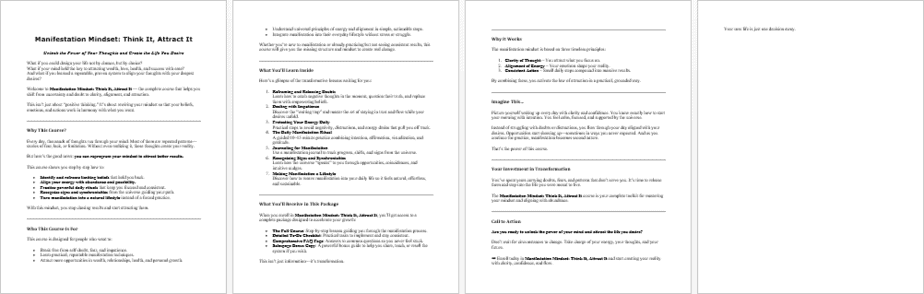
Package Details:
Word Count: 32 121 Words
Number of Pages: 137
Manifestation Mindset Think It, Attract It – Bonus Content
Checklist
Word Count: 519 words
FAQs
Word Count: 890 words
Salespage Content
Word Count: 804 words
Total Word Count: 34 334 Words
Your PLR License Terms
PERMISSIONS: What Can You Do With These Materials?
Sell the content basically as it is (with some minor tweaks to make it “yours”).
If you are going to claim copyright to anything created with this content, then you must substantially change at 75% of the content to distinguish yourself from other licensees.
Break up the content into small portions to sell as individual reports for $10-$20 each.
Bundle the content with other existing content to create larger products for $47-$97 each.
Setup your own membership site with the content and generate monthly residual payments!
Take the content and convert it into a multiple-week “eclass” that you charge $297-$497 to access!
Use the content to create a “physical” product that you sell for premium prices!
Convert it to audios, videos, membership site content and more.
Excerpt and / or edit portions of the content to give away for free as blog posts, reports, etc. to use as lead magnets, incentives and more!
Create your own original product from it, set it up at a site and “flip” the site for megabucks!
RESTRICTIONS: What Can’t You Do With These Materials?
To protect the value of these products, you may not pass on the rights to your customers. This means that your customers may not have PLR rights or reprint / resell rights passed on to them.
You may not pass on any kind of licensing (PLR, reprint / resell, etc.) to ANY offer created from ANY PORTION OF this content that would allow additional people to sell or give away any portion of the content contained in this package.
You may not offer 100% commission to affiliates selling your version / copy of this product. The maximum affiliate commission you may pay out for offers created that include parts of this content is 75%.
You are not permitted to give the complete materials away in their current state for free – they must be sold. They must be excerpted and / or edited to be given away, unless otherwise noted. Example: You ARE permitted to excerpt portions of content for blog posts, lead magnets, etc.
You may not add this content to any part of an existing customer order that would not require them to make an additional purchase. (IE You cannot add it to a package, membership site, etc. that customers have ALREADY paid for.)
Share Now!
Latest Products




Free Sales Funnel Builder

Related Products

Popular & Trending



Featured Products