
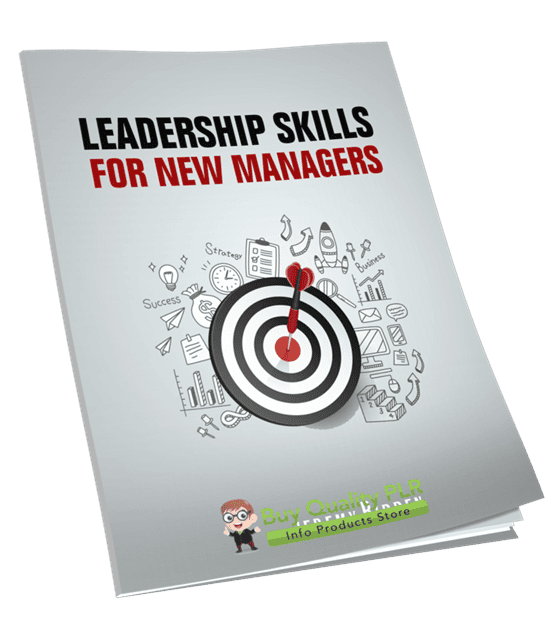
Leadership Skills for New Managers PLR Course 29k Words
in Business Coaching PLR , Business PLR , Leadership PLR , PLR eCourses , PLR List Building Reports , Premium PLR , Premium PLR Reports , Premium White Label Brandable PLR Coaching Courses , Private Label Rights ProductsChoose Your Desired Option(s)
has been added to your cart!
have been added to your cart!
#leadershipskills #newmanagers #plrcourse #businessleadership #managementskills #professionaldevelopment #plrcontent #careergrowth #leadershipdevelopment
Leadership Skills for New Managers PLR Course – 29,000 Words
Step Confidently into Leadership and Inspire Your Team to Success
Stepping into a management role for the first time can be exciting—but also overwhelming.
The Leadership Skills for New Managers PLR Course is designed to give your audience a complete roadmap to confidently transition into leadership, motivate their teams, and tackle challenges with ease.
With 29,000 words of ready-to-use content, this course is perfect for HR professionals, leadership coaches, corporate trainers, and PLR resellers looking to provide high-value, practical training in the leadership and management niche.
Whether your audience is newly promoted or about to lead their first team, this course equips them with the tools, strategies, and confidence to excel.
Introducing the…
Leadership Skills for New Managers
Why This Course is Essential for New Managers
New managers often struggle with:
- Transitioning from a peer to a leader
- Communicating effectively and giving feedback
- Motivating teams and maintaining performance
- Handling conflicts and difficult decisions
- Developing long-term leadership skills
This course solves all these challenges by providing step-by-step lessons, real-life examples, and actionable strategies that turn beginners into confident leaders.
What’s Inside the Course
The course is structured into five detailed modules, each containing four lessons, to gradually guide learners from understanding their role to mastering leadership.
Module 1: Understanding Your Role as a New Manager
Goal: Help new managers understand responsibilities, mindset, and expectations of leadership.
- Lesson 1: Transitioning from Peer to Manager
Navigate the shift from team member to team leader while maintaining trust and respect. - Lesson 2: Defining Your Leadership Style
Discover your natural leadership tendencies and adapt them to inspire and guide your team. - Lesson 3: Understanding Team Dynamics
Identify individual strengths, weaknesses, and working styles for better collaboration. - Lesson 4: Setting Clear Goals and Expectations
Learn how to define objectives and communicate expectations clearly to your team.
Module 2: Communication Skills for Effective Leadership
Goal: Teach managers how to communicate clearly, motivate their team, and resolve conflicts.
- Lesson 1: Active Listening and Empathy
Build trust by understanding team members’ needs and perspectives. - Lesson 2: Giving Constructive Feedback
Provide feedback that motivates improvement rather than creating tension. - Lesson 3: Leading Productive Meetings
Plan and run meetings that save time, drive results, and keep teams aligned. - Lesson 4: Mastering Difficult Conversations
Address sensitive topics, including conflicts or performance issues, with confidence.
Module 3: Team Motivation and Performance Management
Goal: Help managers drive productivity, engagement, and a positive team culture.
- Lesson 1: Understanding What Motivates Your Team
Learn strategies to inspire your team based on individual drivers. - Lesson 2: Recognizing and Rewarding Success
Boost morale and performance through meaningful recognition and rewards. - Lesson 3: Delegating Tasks Effectively
Assign tasks in ways that empower your team and save your time. - Lesson 4: Setting Performance Metrics
Measure success using clear, achievable metrics that everyone understands.
Module 4: Problem Solving and Decision Making
Goal: Equip managers with strategies to resolve challenges and make confident decisions.
- Lesson 1: Identifying Problems Quickly
Spot issues before they escalate into bigger challenges. - Lesson 2: Creative Problem-Solving Techniques
Use structured approaches to overcome obstacles and generate innovative solutions. - Lesson 3: Making Decisions with Confidence
Learn to weigh options strategically and make effective decisions. - Lesson 4: Learning from Mistakes
Turn setbacks into learning opportunities for yourself and your team.
Module 5: Growing as a Leader
Goal: Help managers build long-term leadership skills and maintain growth for themselves and their teams.
- Lesson 1: Continuous Self-Improvement
Develop your skills and stay updated with leadership trends. - Lesson 2: Mentoring and Coaching Your Team
Guide team members professionally while fostering loyalty and engagement. - Lesson 3: Building a Positive Work Culture
Create a collaborative, motivated, and high-performing team environment. - Lesson 4: Planning Your Leadership Journey
Set long-term goals for your personal growth and your team’s success.
Bonus Materials
This PLR course comes complete with ready-to-use bonuses to make it easier to sell or teach:
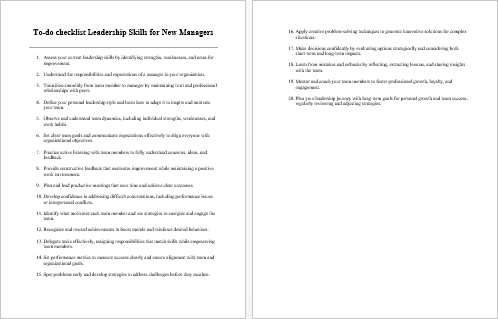
- Checklist – 294 Words: Step-by-step summary to reinforce learning.
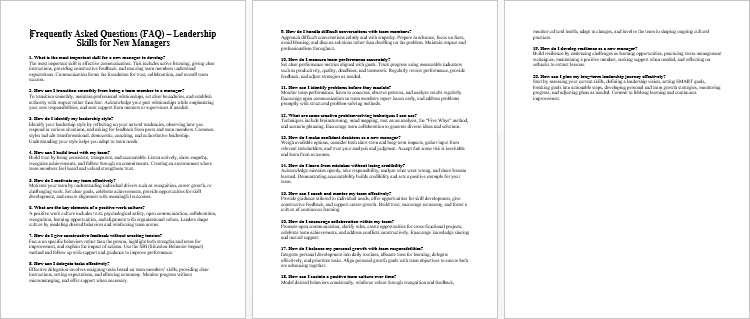
- FAQs – 812 Words: Answers to common questions about leadership and team management.
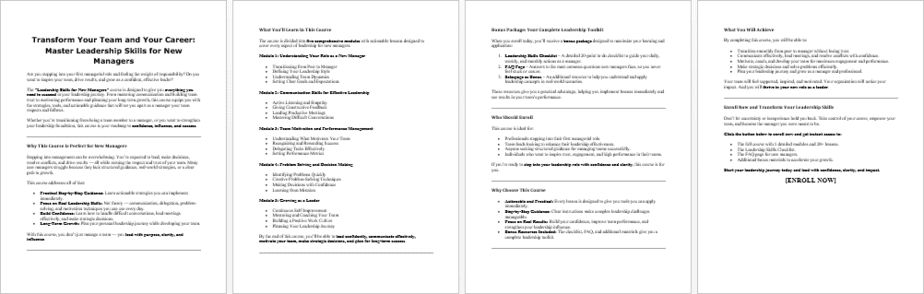
- Salespage – 850 Words: Ready-made, conversion-focused sales copy for marketing the course.
Who Can Benefit from This PLR Course
- HR Professionals & Trainers: Offer structured training for new managers in workshops or online programs.
- Leadership Coaches: Provide a ready-made product to guide clients to successful management.
- Corporate Organizations: Implement as part of onboarding or leadership development programs.
- PLR Resellers: Sell, rebrand, or bundle the course for immediate profit.
- New Managers Themselves: Learn practical, actionable leadership skills and techniques.
This course is highly flexible—perfect for creating mini-guides, e-courses, workshops, or membership content.
How to Use and Profit from This Course
- Sell the Full Course: Offer it as a digital course for $197–$497.
- Break Into Mini-Reports: Sell individual modules or lessons for $10–$20 each.
- Create Bundles: Combine with other leadership or business PLR products for $47–$97.
- Launch Multi-Week E-Classes: Use modules to build a 4–6 week leadership program for $297–$497.
- Membership Site Content: Offer recurring leadership lessons and coaching tips.
- Physical Products: Convert the content into workbooks, journals, or guides.
- Lead Magnets & Email Campaigns: Excerpts can be used as free resources to build an email list.
- Flip a Website: Create a leadership niche website using this course and sell it as a complete package.
Licensing Terms
Permissions – What You Can Do:
- Sell as-is or with minor edits.
- Claim copyright if 75%+ of the content is rewritten.
- Split the content into smaller guides, reports, or lessons.
- Bundle with other PLR products for greater value.
- Use excerpts for blogs, emails, or lead magnets.
Restrictions – What You Cannot Do:
- Pass PLR rights to your customers.
- Offer 100% affiliate commissions (maximum 75%).
- Give away the full course for free.
- Add it to existing customer orders without requiring an additional purchase.
Why Buy This PLR Course from Buy Quality PLR?
- Professionally written 29,000-word course ready for resale or teaching.
- Step-by-step modules for practical leadership development.
- Evergreen business and management niche with high demand.
- Includes checklist, FAQs, and sales page for fast marketing and sales.
- Save months of content creation and research.
- Monetize immediately via digital products, workshops, e-classes, membership sites, or physical products.
Bottom Line
The Leadership Skills for New Managers PLR Course is a turnkey solution for anyone in business, HR, coaching, or personal development:
- Teach new managers how to lead confidently and inspire teams.
- Provide actionable strategies to improve team performance and culture.
- Create recurring revenue with membership sites, workshops, or digital bundles.
- Profit from ready-to-use, high-value content without writing from scratch.
Give your audience the tools they need to succeed as new managers—and give yourself a ready-made product that sells in a high-demand niche.
has been added to your cart!
have been added to your cart!
Here A Sample of the Leadership Skills for New Managers PLR Course
Welcome to “Leadership Skills for New Managers”! This course is designed for anyone stepping into a management role for the first time. Through practical lessons, actionable insights, and real-life examples, you’ll learn how to lead with confidence, inspire your team, and handle challenges like a pro. By the end, you’ll feel empowered to guide your team toward success while growing as a leader yourself.
Module 1: Understanding Your Role as a New Manager
Goal: Help new managers understand the responsibilities, mindset, and expectations of leadership.
Lesson 1: Transitioning from Peer to Manager
Objective: Learn how to navigate the shift from team member to team leader without losing trust or respect.
Introduction
Becoming a manager for the first time is an exciting milestone in any professional career. At the same time, it can be challenging because the dynamics you once had as a peer will change. Suddenly, you are no longer just a teammate; you are the person responsible for guiding the team, making decisions, and ensuring that goals are met. The key to success in this transition is understanding the new role you are stepping into and managing relationships effectively without alienating the colleagues you once worked alongside as equals.
This lesson will help you recognize the challenges of this transition and provide you with practical strategies to build credibility, maintain trust, and establish your authority as a new manager. By the end of this lesson, you will have a clear roadmap for making this shift smoothly and confidently.
Step 1: Recognize the Change in Responsibility
The first step in transitioning from a peer to a manager is to acknowledge that your role has fundamentally changed. Previously, your focus may have been on completing your individual tasks, contributing to team projects, and collaborating with colleagues on equal terms. As a manager, your responsibilities now extend beyond your personal work. You are accountable for your team’s performance, growth, and overall morale.
Key points to understand in this step:
- Your success is now measured by your team’s outcomes, not just your own.
- Decisions you make will directly impact others, so you must think strategically and fairly.
- You must balance maintaining relationships with asserting authority when necessary.
It is normal to feel uncertain about this shift, especially if your team includes former peers. The important thing is to approach this change with self-awareness and a willingness to learn.
Step 2: Understand the Psychological Impact
Transitioning from peer to manager affects both you and your team psychologically. Team members may feel uncertain about how your relationship with them will change. Some may even feel threatened or resentful, fearing favoritism or judgment. As the new manager, you need to anticipate these reactions and address them proactively.
Consider the following strategies:
- Acknowledge the change openly with your team. Let them know you are aware of your new role and are committed to supporting them.
- Emphasize collaboration while setting boundaries. Make it clear that while you value your relationships, your primary responsibility is to lead effectively.
- Remain approachable and fair, so that team members feel comfortable sharing concerns and ideas.
Understanding the psychological dynamics at play allows you to manage the transition with empathy and tact. This awareness will help maintain team cohesion and prevent misunderstandings.
Step 3: Define Your Leadership Philosophy
One of the most important steps in transitioning successfully is to define your leadership philosophy. This is your personal approach to leading a team and the principles you will consistently follow. A clearly defined philosophy will guide your decisions, help you maintain consistency, and communicate your values to your team.
To create your leadership philosophy:
- Reflect on your experiences with past managers. Consider what worked and what didn’t.
- Identify your core values. What behaviors and principles are non-negotiable for you as a leader?
- Decide how you will balance authority with empathy. Will your approach be more coaching-focused, collaborative, or results-driven?
- Write down a brief statement that encapsulates your philosophy. This can be revisited and refined as you grow in your role.
Having a defined leadership philosophy ensures that your actions are deliberate and aligned with your values, which builds trust and respect among team members.
Step 4: Set Clear Expectations
New managers often make the mistake of assuming that their team knows what to expect from them. This assumption can lead to confusion, miscommunication, and frustration. Setting clear expectations from the beginning is critical to establishing credibility and authority.
Focus on these areas when setting expectations:
- Communication Style: How and when will you communicate with the team? Will you hold regular meetings, provide weekly updates, or prefer one-on-one check-ins?
- Decision-Making: Make it clear how decisions will be made, who will be involved, and how input from team members will be considered.
- Performance Standards: Clearly articulate what success looks like for each team member and for the team as a whole. Include specific, measurable goals.
- Feedback Process: Explain how feedback will be given, both positive and constructive, and encourage team members to provide feedback to you as well.
Setting these expectations early prevents misunderstandings and helps your team adjust to your leadership style.
Step 5: Build Credibility and Trust
As a new manager, your credibility is your most valuable asset. Without it, even the best strategies will fail. Credibility is earned through consistent actions, fairness, and competence. Trust is built by showing respect, empathy, and reliability.
Practical ways to build credibility and trust:
- Lead by Example: Demonstrate the behaviors and work ethic you expect from your team. Your actions speak louder than words.
- Deliver on Promises: Follow through on commitments. If you say you will address an issue or implement a change, make sure it happens.
- Be Transparent: Share information openly with your team whenever possible, including both successes and challenges.
- Admit Mistakes: Nobody is perfect. Acknowledging your errors and learning from them models accountability for your team.
When credibility and trust are established, team members are more likely to respect your decisions, collaborate willingly, and follow your guidance.
Step 6: Navigate Relationships with Former Peers
Managing people who were once your peers can be one of the trickiest aspects of this transition. You may worry about losing friendships or facing resistance. To handle this, it is essential to strike a balance between maintaining rapport and asserting authority.
Tips for managing these relationships:
- Maintain Professional Boundaries: Treat everyone equally, including friends, to avoid perceptions of favoritism.
- Communicate Openly: Be honest about your new responsibilities and how your role has changed.
- Be Fair and Consistent: Apply rules, policies, and expectations equally to all team members.
- Encourage Collaboration: Invite team members to contribute ideas and solutions, reinforcing a sense of shared purpose.
This approach ensures that former peers feel valued and respected while recognizing your leadership role.
Step 7: Develop Emotional Intelligence
Emotional intelligence (EI) is critical for managing yourself and your team effectively. It involves self-awareness, self-regulation, empathy, and social skills. High EI allows you to respond thoughtfully to challenges, maintain composure under pressure, and navigate interpersonal dynamics with skill.
To develop emotional intelligence as a new manager:
- Practice Self-Awareness: Reflect on your emotions, triggers, and reactions in different situations.
- Manage Stress: Develop techniques for staying calm and focused during high-pressure moments.
- Practice Empathy: Consider the perspectives of your team members before making decisions.
- Enhance Communication Skills: Adapt your communication style to fit the needs of different individuals and situations.
By strengthening your emotional intelligence, you become a more effective, approachable, and respected leader.
Step 8: Establish a Support System
Transitioning into management is a journey, and it is important not to go it alone. Surround yourself with mentors, peers in leadership roles, and professional networks that can provide guidance, feedback, and encouragement.
Suggestions for building your support system:
- Seek out a mentor who has successfully navigated the transition from peer to manager.
- Join professional groups or forums where new managers share experiences and best practices.
- Regularly meet with your manager or HR to discuss challenges and progress.
Having a support system ensures that you have resources to turn to when difficult situations arise, helping you grow more confidently in your role.
Step 9: Implement Continuous Reflection
Finally, continuous reflection is key to successfully transitioning from peer to manager. Regularly evaluate your leadership approach, assess what is working, and identify areas for improvement. This practice helps you stay aligned with your leadership philosophy and adapt to the evolving needs of your team.
Ways to practice reflection:
- Keep a leadership journal documenting decisions, challenges, and outcomes.
- Schedule regular self-check-ins to assess your effectiveness.
- Solicit feedback from your team on your leadership style and make adjustments as needed.
Reflection ensures that your growth as a manager is intentional, sustainable, and effective.
Conclusion
Transitioning from peer to manager is a complex but rewarding process. By recognizing the change in responsibilities, understanding team dynamics, defining your leadership philosophy, setting expectations, building credibility, navigating relationships, developing emotional intelligence, establishing a support system, and practicing continuous reflection, you can make this transition smoothly.
The most successful managers are those who approach their new role with self-awareness, empathy, and a commitment to continuous learning. Remember, leadership is not about exerting power—it is about guiding, inspiring, and enabling your team to succeed. By mastering this first step, you set the foundation for a successful and fulfilling managerial career.
Lesson 2: Defining Your Leadership Style
Objective: Discover your natural leadership tendencies and how to adapt them to inspire your team.
Introduction
Every manager brings their own unique strengths, preferences, and experiences to their leadership role. However, not every approach works in every situation. Understanding your natural leadership style is a critical step toward becoming an effective manager. Your leadership style affects how your team communicates, collaborates, and performs. By discovering your tendencies and learning how to adapt them to the needs of your team, you can lead with authenticity while maximizing engagement and productivity.
In this lesson, we will explore the process of identifying your leadership style, understanding its impact on your team, and refining your approach to inspire and motivate others. By the end of this lesson, you will have clarity on your leadership approach and practical strategies for applying it effectively in different situations.
Step 1: Understand the Concept of Leadership Style
Leadership style is the characteristic way you guide, motivate, and manage your team. It reflects your personality, values, and approach to decision-making. Recognizing your style does not mean you are limited to it; rather, it provides a foundation for self-awareness and growth.
Common leadership styles include:
- Autocratic: Makes decisions independently, expects compliance, often used in high-pressure situations.
- Democratic/Participative: Involves the team in decision-making, values collaboration and input.
- Coaching: Focuses on developing team members’ skills, providing guidance, and fostering long-term growth.
- Transformational: Inspires and motivates the team to achieve ambitious goals and embrace change.
- Transactional: Emphasizes structure, rules, and performance-based rewards.
Your natural tendencies may align with one or more of these styles. The goal is to understand which style comes most naturally to you and how it affects your team’s engagement and performance.
Step 2: Reflect on Your Past Experiences
Self-reflection is the first step in discovering your leadership style. Think back to your experiences as a team member, a peer, or even in informal leadership roles. Consider how you naturally respond to challenges, motivate others, and make decisions.
Ask yourself questions such as:
- How do I handle conflicts within a team?
- Do I prefer making decisions independently or collaboratively?
- What motivates me to perform my best, and how do I try to motivate others?
- How do I respond when team members struggle or make mistakes?
Document your observations in a journal or worksheet. By reflecting on real experiences, you can identify patterns that indicate your natural leadership tendencies.
Step 3: Take a Leadership Assessment
Leadership assessments provide structured insights into your style and preferences. Several widely recognized frameworks can help identify your natural tendencies. These tools are not definitive but offer valuable guidance for self-discovery.
Popular approaches include:
- The DISC Assessment: Measures behavior along four dimensions—Dominance, Influence, Steadiness, and Conscientiousness.
- The Myers-Briggs Type Indicator (MBTI): Highlights personality traits that influence leadership behavior, including decision-making and communication styles.
- The Leadership Practices Inventory (LPI): Evaluates behaviors across key leadership practices, including modeling, inspiring, and enabling others.
After completing an assessment, review the results critically. Compare the outcomes with your self-reflection notes. Consider areas of strength, potential blind spots, and opportunities for growth.
Step 4: Analyze the Impact on Your Team
Understanding your leadership style is not just about self-awareness; it is also about recognizing how your style affects your team. Different styles resonate differently with various individuals. For example, a highly independent manager may inspire self-starters but overwhelm team members who need guidance and support.
To analyze your impact:
- Observe team responses to your leadership in past projects or tasks. Did team members feel motivated, supported, or constrained?
- Solicit feedback from trusted colleagues or mentors about how your approach influences team dynamics.
- Identify situations where your style was effective and situations where it fell short.
This step allows you to make conscious adjustments to your approach and ensure your leadership style aligns with your team’s needs.
Step 5: Align Leadership Style with Organizational Goals
A strong leader aligns personal leadership style with the broader objectives and culture of the organization. While authenticity is essential, flexibility ensures that your leadership supports organizational priorities and enhances team performance.
Consider the following:
- Company Culture: Does the organization value collaboration, innovation, or strict adherence to process? Align your style to reinforce these values.
- Team Composition: Different teams have varying skill levels, experience, and motivation. Adapt your style to leverage strengths and address weaknesses.
- Business Objectives: Consider how your leadership style can help achieve strategic goals, whether it involves driving innovation, increasing efficiency, or improving customer satisfaction.
Balancing your natural tendencies with organizational needs ensures that your leadership is both authentic and effective.
Step 6: Develop Situational Flexibility
Effective leaders do not rely on a single style in every situation. Instead, they adapt their approach to meet the needs of the moment. Situational leadership involves adjusting your style based on team maturity, task complexity, and the urgency of the situation.
For example:
- New or inexperienced teams may benefit from a coaching or directive approach to provide structure and guidance.
- High-performing teams may respond better to a democratic or transformational style that encourages autonomy and innovation.
- Crisis situations may require a more decisive, autocratic approach to ensure quick action and clarity.
Practicing situational flexibility allows you to lead effectively in diverse circumstances while remaining true to your core values.
Step 7: Develop Your Leadership Presence
Leadership presence is the combination of confidence, communication, and authenticity that inspires trust and respect. It is how you carry yourself, engage with your team, and influence others. A strong presence amplifies the impact of your leadership style.
Key components of leadership presence include:
- Confidence: Demonstrate belief in your abilities and decisions without arrogance.
- Authenticity: Be genuine and consistent in words and actions.
- Communication: Speak clearly, listen actively, and convey vision and expectations effectively.
- Composure: Remain calm under pressure and model resilience for your team.
Your leadership presence reinforces your style and encourages your team to follow your example.
Step 8: Create an Action Plan for Growth
Once you have identified your leadership style, analyzed its impact, and developed situational flexibility, it is essential to create a plan for continuous improvement. Leadership is a lifelong learning process, and proactive development ensures ongoing effectiveness.
Steps to create an action plan:
- Identify Strengths: List the areas where your style naturally excels and where you consistently inspire and motivate your team.
- Recognize Weaknesses: Pinpoint aspects of your style that may limit your effectiveness in certain situations.
- Set Goals: Establish specific, measurable objectives for developing complementary leadership skills.
- Seek Resources: Attend workshops, read books, or engage in mentorship programs to strengthen areas that need improvement.
- Monitor Progress: Regularly review your development and adjust your approach based on feedback and outcomes.
A well-defined action plan helps ensure that your leadership style evolves in alignment with your career growth and organizational needs.
Step 9: Practice Reflective Leadership
To internalize your leadership style and refine it over time, adopt a practice of reflective leadership. Reflection allows you to evaluate your decisions, interactions, and outcomes objectively, helping you learn from experience and make informed adjustments.
Techniques for reflective leadership:
- Maintain a leadership journal documenting challenges, successes, and lessons learned.
- Conduct regular self-assessments to gauge progress against goals.
- Solicit feedback from team members, peers, and mentors to identify blind spots.
- Reflect on the impact of your style in different situations and consider adjustments for future interactions.
Reflection ensures that your leadership remains intentional, adaptive, and aligned with your evolving team and organizational needs.
Step 10: Inspire and Empower Your Team
Ultimately, defining your leadership style is about using it to inspire and empower your team. Your style shapes the culture, engagement, and performance of your team. A thoughtful, well-defined leadership approach creates an environment where team members feel supported, motivated, and capable of achieving their best work.
Practical ways to inspire your team:
- Recognize individual contributions and celebrate team achievements.
- Provide guidance and autonomy to foster growth and confidence.
- Encourage open communication and collaboration, creating a safe space for innovation.
- Model the behaviors and attitudes you wish to see in your team.
When your leadership style aligns with your values, team needs, and organizational objectives, you create a foundation for long-term success and influence.
Conclusion
Defining your leadership style is a critical step for any new manager. By understanding your natural tendencies, analyzing their impact on your team, adapting to different situations, and reflecting on your approach, you can lead with authenticity and effectiveness. Leadership is not a static skill—it evolves with experience, feedback, and self-awareness.
By investing the time to discover and refine your style, you will not only navigate the transition into management more smoothly but also inspire your team, foster trust, and achieve organizational goals. Remember, leadership is about influence, guidance, and empowerment. Defining your style is the first step in creating a positive, lasting impact on your team and your career.
Lesson 3: Understanding Team Dynamics
Objective: Learn to identify strengths, weaknesses, and working styles within your team for better collaboration.
Introduction
One of the most critical responsibilities for a new manager is understanding team dynamics. Teams are composed of individuals with different personalities, skills, motivations, and work habits. These differences can be a source of strength when harnessed effectively, but they can also lead to misunderstandings, conflict, and inefficiency if ignored.
Understanding team dynamics involves more than just knowing what each member does; it requires observing interactions, recognizing patterns, and adapting your leadership approach to foster collaboration, engagement, and productivity. By mastering this skill, you can align your team’s talents with organizational goals, create a positive work environment, and unlock the full potential of every team member.
In this lesson, we will explore practical steps to analyze team dynamics, identify strengths and weaknesses, understand working styles, and develop strategies to enhance collaboration and performance.
Step 1: Recognize the Importance of Team Dynamics
Before diving into assessments and observations, it is important to understand why team dynamics matter. Team dynamics influence every aspect of performance, from decision-making to problem-solving and innovation. Teams with strong, positive dynamics are more engaged, productive, and resilient. Conversely, teams with poor dynamics may experience conflict, low morale, and underperformance.
Key points to understand:
- Team dynamics affect communication, collaboration, and overall efficiency.
- Every team member contributes uniquely, and understanding these contributions is essential for maximizing results.
- As a manager, you play a central role in shaping, maintaining, and improving team dynamics.
Recognizing the significance of team dynamics helps you approach your role with intentionality and focus, knowing that the health of the team directly impacts outcomes.
Step 2: Observe Team Interactions
Observation is one of the most powerful tools for understanding team dynamics. By paying attention to how your team interacts in meetings, projects, and informal settings, you can identify patterns and behaviors that influence performance.
Focus on the following areas during observation:
- Communication Patterns: Who tends to speak up? Who remains quiet? Are ideas shared openly or dominated by a few voices?
- Decision-Making: How does the team reach consensus? Are decisions collaborative, or do conflicts stall progress?
- Conflict Resolution: How do team members handle disagreements? Is conflict addressed constructively or ignored?
- Collaboration and Support: Do team members help each other, or do they work in silos? Is knowledge shared freely?
Documenting these observations allows you to map the current state of your team dynamics and identify areas for improvement.
Step 3: Assess Individual Strengths and Weaknesses
Understanding team dynamics requires recognizing the unique strengths and weaknesses of each team member. This knowledge allows you to assign tasks strategically, support development, and balance workloads effectively.
To assess strengths and weaknesses:
- Review past performance records, feedback, and accomplishments.
- Observe skills in action during projects or collaborative efforts.
- Conduct one-on-one meetings to discuss self-perceived strengths, areas for growth, and career goals.
- Use structured assessment tools, such as competency matrices or skill inventories, to quantify capabilities.
By identifying each member’s talents and limitations, you can leverage strengths while providing support or training to address weaknesses. This approach ensures that tasks are matched to capability, maximizing efficiency and engagement.
Step 4: Identify Working Styles
Every individual has a preferred way of working, which can significantly affect team dynamics. Understanding working styles helps you tailor communication, assign tasks, and facilitate collaboration. Common working styles include:
- Analytical: Focused on data, accuracy, and logic; may take longer to make decisions but produce precise results.
- Expressive: Energetic and enthusiastic; excels in brainstorming and motivating others but may overlook details.
- Amiable: Cooperative and supportive; fosters harmony and teamwork but may avoid conflict or difficult decisions.
- Driver: Goal-oriented and decisive; pushes for results but may appear impatient or domineering.
To identify working styles:
- Observe how individuals approach tasks and problem-solving.
- Note how they respond to deadlines, collaboration, and feedback.
- Discuss preferences directly during one-on-one sessions to confirm observations.
Understanding working styles allows you to manage team dynamics proactively and reduce friction while maximizing the contribution of each member.
Step 5: Map Team Roles and Responsibilities
Once you understand individual strengths, weaknesses, and working styles, it is important to map out team roles and responsibilities clearly. Clarity in roles helps prevent overlap, confusion, and conflicts while ensuring that all critical functions are covered.
Consider the following approach:
- Define the primary responsibilities for each role within the team.
- Align tasks with individual strengths and working styles.
- Ensure accountability by clearly communicating expectations and outcomes.
- Encourage team members to take ownership of their responsibilities and collaborate effectively.
A well-structured team with clear roles fosters smoother workflows and creates an environment where members can excel.
Step 6: Recognize Group Dynamics and Influence Patterns
Beyond individual behaviors, team dynamics also involve how members interact collectively. Recognizing influence patterns, alliances, and informal leaders can help you navigate relationships and guide the team more effectively.
Pay attention to:
- Natural Leaders: Who do others look to for guidance and direction?
- Conflict Sources: Are there recurring disagreements between certain members?
- Support Networks: Who collaborates well and supports others in achieving goals?
- Motivational Drivers: What motivates the team collectively—recognition, challenge, stability, or learning?
Understanding these patterns allows you to intervene strategically, reinforce positive behaviors, and address issues before they escalate.
Step 7: Encourage Open Communication and Feedback
Open communication is essential for understanding team dynamics and fostering collaboration. By creating a safe environment where team members feel comfortable sharing ideas, concerns, and feedback, you can gain valuable insights into the team’s interactions and morale.
Strategies to promote communication:
- Hold regular team meetings with structured opportunities for input.
- Conduct anonymous surveys or feedback sessions to capture honest perspectives.
- Encourage one-on-one conversations to uncover individual concerns.
- Actively listen and respond to feedback without defensiveness.
Effective communication strengthens relationships, increases trust, and allows you to address issues proactively.
Step 8: Develop Team Collaboration Strategies
With a deep understanding of team dynamics, you can implement strategies to enhance collaboration and productivity. Consider the following approaches:
- Leverage Strengths: Assign tasks based on individual expertise to optimize results.
- Balance Weaknesses: Pair complementary skills to minimize gaps and encourage learning.
- Foster Cross-Functional Collaboration: Encourage team members to share knowledge and work together on projects.
- Create Clear Processes: Define workflows, decision-making protocols, and accountability measures to reduce confusion.
- Promote Team Bonding: Organize activities or discussions that build trust and mutual respect.
Strategic collaboration ensures that the team operates as a cohesive unit rather than a collection of individuals.
Step 9: Address Conflicts Constructively
Conflict is natural in any team, but unmanaged conflict can disrupt productivity and morale. By understanding team dynamics, you can identify potential sources of tension and address them constructively.
Steps to manage conflict:
- Identify Early Signs: Watch for repeated disagreements, miscommunication, or withdrawal.
- Address Issues Promptly: Intervene before conflicts escalate into major problems.
- Encourage Open Dialogue: Facilitate conversations between involved parties to understand perspectives.
- Seek Collaborative Solutions: Help team members reach agreements that respect all viewpoints and align with goals.
- Document Agreements: Ensure that resolutions are clear and communicated to all relevant parties.
Managing conflict proactively maintains harmony, trust, and productivity within the team.
Step 10: Continuously Monitor and Adapt
Team dynamics are not static; they evolve as the team grows, new members join, and challenges arise. Successful managers continuously monitor interactions, assess performance, and adapt their approach to maintain high-functioning teams.
Strategies for ongoing monitoring and adaptation:
- Conduct regular team performance reviews to evaluate outcomes and collaboration.
- Reassess roles and responsibilities periodically to ensure alignment with team goals.
- Gather ongoing feedback from team members about processes, communication, and morale.
- Adjust leadership style and interventions as the team matures and evolves.
By staying attentive and responsive, you ensure that your team remains effective, engaged, and motivated over time.
Conclusion
Understanding team dynamics is a cornerstone of effective management. By observing interactions, assessing individual strengths and weaknesses, identifying working styles, mapping roles, recognizing group dynamics, encouraging communication, fostering collaboration, managing conflict, and continuously monitoring progress, you can create a high-performing and cohesive team.
Mastering this skill allows you to not only lead your team more effectively but also cultivate a positive and productive work environment. A manager who understands team dynamics can leverage the unique strengths of each member, address challenges proactively, and inspire collaboration that drives organizational success.
Your ability to navigate and shape team dynamics will have a lasting impact on both your team’s performance and your growth as a manager. With these insights, you can build a team culture that supports innovation, engagement, and sustainable success.
We’re also giving these extra bonuses
Leadership Skills for New Managers – Checklist
Leadership Skills for New Managers – FAQs
Leadership Skills for New Managers – Salespage Content
Package Details:
Word Count: 27 811 Words
Number of Pages: 128
Leadership Skills for New Managers – Bonus Content
Checklist
Word Count: 294 words
FAQs
Word Count: 812 words
Salespage Content
Word Count: 850 words
Total Word Count: 29 767 Words
Your PLR License Terms
PERMISSIONS: What Can You Do With These Materials?
Sell the content basically as it is (with some minor tweaks to make it “yours”).
If you are going to claim copyright to anything created with this content, then you must substantially change at 75% of the content to distinguish yourself from other licensees.
Break up the content into small portions to sell as individual reports for $10-$20 each.
Bundle the content with other existing content to create larger products for $47-$97 each.
Setup your own membership site with the content and generate monthly residual payments!
Take the content and convert it into a multiple-week “eclass” that you charge $297-$497 to access!
Use the content to create a “physical” product that you sell for premium prices!
Convert it to audios, videos, membership site content and more.
Excerpt and / or edit portions of the content to give away for free as blog posts, reports, etc. to use as lead magnets, incentives and more!
Create your own original product from it, set it up at a site and “flip” the site for megabucks!
RESTRICTIONS: What Can’t You Do With These Materials?
To protect the value of these products, you may not pass on the rights to your customers. This means that your customers may not have PLR rights or reprint / resell rights passed on to them.
You may not pass on any kind of licensing (PLR, reprint / resell, etc.) to ANY offer created from ANY PORTION OF this content that would allow additional people to sell or give away any portion of the content contained in this package.
You may not offer 100% commission to affiliates selling your version / copy of this product. The maximum affiliate commission you may pay out for offers created that include parts of this content is 75%.
You are not permitted to give the complete materials away in their current state for free – they must be sold. They must be excerpted and / or edited to be given away, unless otherwise noted. Example: You ARE permitted to excerpt portions of content for blog posts, lead magnets, etc.
You may not add this content to any part of an existing customer order that would not require them to make an additional purchase. (IE You cannot add it to a package, membership site, etc. that customers have ALREADY paid for.)
Share Now!
Latest Products



Free Sales Funnel Builder

Related Products
Popular & Trending



Featured Products