
How to Relieve Financial Pressure PLR Course 33k Words
in Business Finance PLR , Finance PLR , PLR eCourses , PLR List Building Reports , Premium PLR , Premium PLR Reports , Premium White Label Brandable PLR Coaching Courses , Private Label Rights ProductsChoose Your Desired Option(s)
has been added to your cart!
have been added to your cart!
#relievefinancialpressure #plrcourse #financialwellness #moneymanagement #personalfinance #stressfreefinances #plrcontent #financialfreedom #wealthmindset
How to Relieve Financial Pressure PLR Course – 33,000 Words
Smart Strategies for Stress-Free Money Management
Financial pressure is one of the most common sources of stress in modern life. Whether it’s unpaid bills, debt, living paycheck to paycheck, or feeling overwhelmed by financial obligations, the constant worry can affect your mental health, relationships, and overall quality of life.
The How to Relieve Financial Pressure PLR Course is a 33,000-word comprehensive program that teaches smart, practical, and stress-free strategies to take control of your money, reduce anxiety, and create financial confidence.
With clear, actionable guidance, this course provides a step-by-step system to help learners understand their money stress, organize finances, manage debt, grow savings, and build habits for a financially secure life.
This ready-to-use PLR course is ideal for financial coaches, wellness educators, bloggers, or entrepreneurs looking to sell, teach, or repurpose a high-value product in the money management niche.
Introducing the…
How to Relieve Financial Pressure
Why Relieving Financial Pressure Matters
Financial stress isn’t just about money—it impacts your emotional wellbeing, decision-making, and day-to-day productivity. Chronic money stress can lead to anxiety, insomnia, poor health, and strained relationships.
This course equips learners to:
- Understand the root causes of financial stress
- Build a manageable, stress-free money system
- Organize income, expenses, and savings efficiently
- Make informed decisions about debt, budgeting, and spending
- Develop habits that reduce anxiety and build confidence in money management
By offering this course on your platform, you provide real value to an audience in urgent need, while monetizing a turnkey PLR product that is in high demand.
Course Overview: Step-by-Step Financial Relief
The course is divided into five comprehensive modules, each designed to guide learners from financial stress to clarity, control, and confidence.
Module 1: Understanding Financial Pressure
Objective: Identify the sources of financial stress and learn initial strategies for relief.
- Lesson 1: Spotting the Real Source of Stress
Discover whether your money worries come from overspending, lack of income, debt, or emotional triggers. - Lesson 2: How Money Stress Affects Your Life
Understand the connection between financial strain, mental health, and daily productivity to break the cycle of worry. - Lesson 3: The Mindset Shift You Need First
Replace limiting thoughts like “I’ll never have enough” with a proactive, growth-focused money mindset. - Lesson 4: Quick Relief Strategies You Can Use Right Now
Learn practical tools such as deep breathing, journaling, and micro-money wins to reduce stress immediately.
Module 2: Building a Stress-Free Money Foundation
Objective: Create a stable financial base and a clear system for managing money.
- Lesson 1: Setting Up Your Personal Money System
Organize income, expenses, and bills so nothing is missed or overlooked. - Lesson 2: Creating a Realistic Budget That Works
Build a flexible budget that supports your lifestyle while reducing guilt and anxiety. - Lesson 3: The 50/30/20 Rule Made Simple
Divide spending into needs, wants, and savings for clarity and reduced financial pressure. - Lesson 4: Building Your Emergency Cushion
Step-by-step guidance for creating a small emergency fund that provides peace of mind.
Module 3: Smart Debt & Expense Management
Objective: Manage debts and expenses in a structured, stress-free manner.
- Lesson 1: Understanding Good Debt vs. Bad Debt
Identify which debts are strategic to keep and which require priority repayment. - Lesson 2: Simple Steps to Cut Unnecessary Expenses
Locate hidden money leaks and reduce them without feeling deprived. - Lesson 3: Stress-Free Debt Payoff Methods
Explore the snowball and avalanche methods for paying off debt efficiently while staying motivated. - Lesson 4: Negotiating Bills & Lowering Costs
Use scripts and practical strategies to reduce interest rates, fees, and recurring expenses.
Module 4: Growing Your Money Without Stress
Objective: Increase savings, generate side income, and spend wisely.
- Lesson 1: The Power of Small, Automatic Savings
Set up automatic transfers to grow savings effortlessly over time. - Lesson 2: Side Income Without Burnout
Explore side hustles that align with your lifestyle and supplement your financial goals. - Lesson 3: Beginner-Friendly Investing
Learn simple, low-risk investment options to gradually grow your wealth. - Lesson 4: Smart Spending That Feels Good
Discover how to spend intentionally on things that bring value, satisfaction, and joy.
Module 5: Living a Financially Stress-Free Life
Objective: Build long-term money habits for peace, stability, and confidence.
- Lesson 1: Creating Your Personal Money Routine
Implement weekly and monthly check-ins that keep you in control without consuming hours. - Lesson 2: Building Long-Term Money Habits
Adopt habits like saving first, avoiding impulse spending, and planning for future expenses. - Lesson 3: Preparing for Life’s Unexpected Expenses
Manage emergencies like medical bills, car repairs, or unplanned costs without panic. - Lesson 4: Celebrating Progress & Staying Motivated
Track achievements, reward yourself, and maintain momentum toward a stress-free financial life.
✅ End Result
By the end of this course, learners will have:
- A clear, manageable budget tailored to their lifestyle
- Reduced financial stress through smart debt and expense management
- A growing savings cushion and emergency fund
- Additional income streams aligned with their goals
- Confidence and a stress-free approach to money management
Bonus Materials Included
The How to Relieve Financial Pressure PLR Course also comes with:
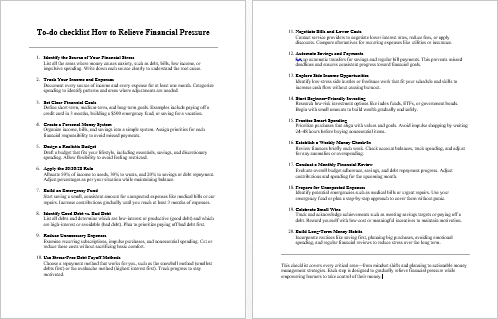
- Checklist – 596 Words: Step-by-step actions to implement financial relief immediately.
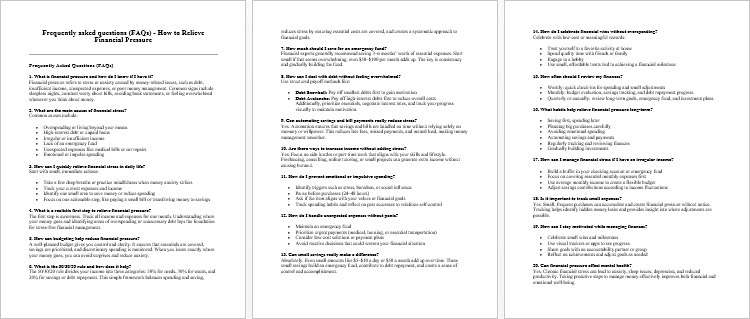
- FAQs – 922 Words: Answers common questions about budgeting, debt, and stress-free financial management.
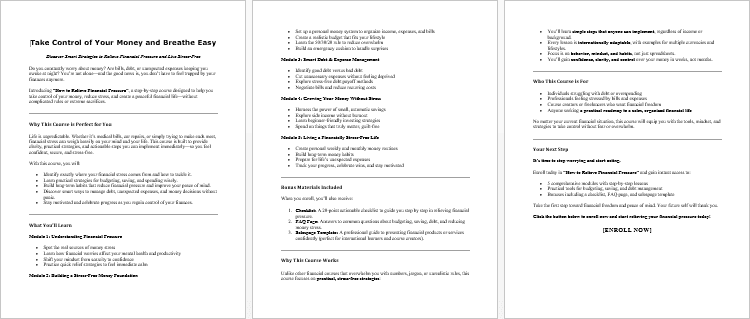
- Salespage – 688 Words: Professionally written copy you can use to promote the course right away.
Who Can Benefit From This PLR Course?
This course is perfect for:
- Financial coaches and money management educators
- Personal development bloggers and content creators
- Wellness and lifestyle instructors teaching stress reduction
- Entrepreneurs seeking a high-demand digital product to sell
With PLR rights, you can rebrand, sell, or repurpose this course in multiple formats to generate revenue.
Ways to Monetize and Profit From This Course
The How to Relieve Financial Pressure PLR Course is versatile and ready to generate income:
1. Sell the Full Course As-Is
Brand it slightly and offer it as a complete digital course.
2. Multi-Week eClass
Break the modules into a 4–6 week online program priced $297–$497.
3. Individual Guides or Reports
Sell individual lessons for $10–$20 each as actionable guides.
4. Bundle With Other PLR Products
Combine with financial literacy, budgeting, or wealth-building courses for $47–$97 bundles.
5. Membership Content
Provide weekly lessons in a membership model for recurring income.
6. Audio, Video, or Webinar Conversion
Turn content into audio lessons, webinars, or live teaching sessions.
7. Physical Products
Transform lessons into workbooks, planners, or journals for premium sales.
8. Lead Magnets
Use course excerpts as free resources to grow your audience or capture leads.
9. Build & Flip a Business
Create a financial wellness website or membership platform and sell it as a ready-made business.
Licensing Terms: What You Can and Cannot Do
You CAN:
- Sell the content with minor edits or rebranding
- Rewrite 75%+ and claim copyright
- Break it into smaller guides, modules, or reports
- Bundle with other PLR products
- Convert to audio, video, or membership content
- Use excerpts for blogs, lead magnets, or promotional purposes
You CANNOT:
- Pass PLR rights to customers
- Offer 100% affiliate commissions (max 75%)
- Give away the full course for free
- Include the course in packages without requiring an extra purchase
Why Buy Quality PLR?
When you purchase from Buy Quality PLR, you get:
- Professionally written, high-value content
- Turnkey PLR course ready to sell, teach, or repurpose
- Bonus resources for instant use
- Ethical, practical content in a high-demand niche
- Flexible formats for digital, audio, video, or physical products
The Bottom Line
Financial stress doesn’t have to control your life. The How to Relieve Financial Pressure PLR Course provides learners with:
- A stress-free money management system
- Smart budgeting, debt, and savings strategies
- Confidence in financial decision-making
- Practical steps to grow wealth and reduce anxiety
This complete PLR package is perfect for financial coaches, educators, and entrepreneurs looking to provide real value while generating income.
Take Action Today!
Offer your audience a proven system to relieve financial stress while monetizing a fully prepared, high-quality PLR course.
Available now at Buy Quality PLR – transform lives and build a profitable digital product instantly.
Relieve Financial Pressure. Gain Confidence. Live Stress-Free.
has been added to your cart!
have been added to your cart!
Here A Sample of the How to Relieve Financial Pressure PLR Course
Module 1: Understanding Financial Pressure
Goal: Get clarity on where money stress comes from and how it impacts you.
Lesson 1 – Spotting the Real Source of Stress
Goal: Get clarity on whether financial pressure comes from overspending, lack of income, debt, or emotional spending.
This lesson is designed for international course creators who need a clear, repeatable structure to help learners identify the root causes of their money stress. Below you’ll find a step-by-step instructor guide, learner activities, sample script language you can use verbatim, red flags to watch for (with international signs and currency examples), and facilitator notes to adapt for a global audience. Keep your tone calm, nonjudgmental, and curiosity-driven — the aim is clarity, not shame.
Learning outcomes (what learners will be able to do by the end of this lesson)
- Describe at least three distinct sources of financial stress (overspending, income shortfalls, debt, emotional spending).
- Use a simple mapping exercise to pinpoint which source(s) contribute most to their stress.
- Recognize practical signs and triggers of each source in their daily financial life.
- Begin a personal diagnostic checklist that informs smarter decisions going forward.
Quick overview for instructors
Teach this lesson as a guided discovery: start with defusing emotions, move into a structured mapping activity, introduce clear indicators for each stress source, and end with a reflective diagnostic checklist. Use international currency symbols and examples to make the lesson feel relevant to learners from different countries: $, €, £, ₹, ¥, AUD $, CAD $, etc.
Step-by-step instructor guide
Step 1 — Open with normalization and curiosity (script + activity)
Purpose: Reduce anxiety and open learners to honest examination.
Script (read aloud):
“Money stress is normal; it’s a signal, not a failure. Today we’ll treat it like any other signal — we’ll look for its source so we can respond effectively. Think of this as detective work, not blame.”
Activity: Pair share (or breakout rooms online)
- Prompt: “Describe one recent moment when money felt stressful. What happened right before and right after?”
- Time: Allow 5 minutes to share, 2 minutes each to listen.
Why this works: Starting with real stories anchors the lesson in lived experience and creates empathy among participants.
Step 2 — Define the four core sources (teach + examples)
Purpose: Give learners precise definitions so they can classify their stress correctly.
Teach these definitions clearly, with brief international examples:
- Overspending — expenses consistently exceed sensible limits. Example: Regular monthly discretionary spend of $350 on dining out that pushes you into overdraft each month; or spending €120 on fashion purchases while rent is due.
- Lack of income / insufficient cash flow — income is not enough to cover basic needs and planned expenses. Example: Contract work that pays ₹20,000 monthly but has irregular payments, causing 2–3 months with no inflow; or a reduction from £2,500 to £1,800 monthly.
- Debt pressure — servicing loans, credit cards, or informal debts creates unmanageable payments or fees. Example: A credit card balance accruing interest at 24% and monthly minimums of $100 that never reduce principal; or a microloan with weekly repayments of ¥8,000.
- Emotional spending — purchases driven by mood, stress, or social pressure rather than planning. Example: Buying expensive gadgets after a breakup or splurging during social media sales to feel connected.
After each definition, give a short real-world sign (see next section) so learners can begin to self-identify.
Step 3 — Guided mapping exercise (structured, step-by-step)
Purpose: Help each learner map their predominant stress source(s).
Materials: simple worksheet or slide with four quadrants labeled: Overspending, Income, Debt, Emotional Spending. For remote delivery, use a shared document or virtual whiteboard.
Instructions to learners (read exactly):
- List three recent money choices or events that caused you stress. Be specific: date, amount (use your own currency), and context.
- Place each item into one of the four quadrants. If it touches two, put it on the dividing line and note both.
- For each item, write one short sentence explaining why it felt stressful.
Facilitator note: Model the mapping live with a neutral example: “Example: I received a $150 phone bill I didn’t expect — I put that in Overspending because I didn’t track an extra subscription.”
Why this works: Mapping externalizes the problem. Seeing items grouped helps learners discover patterns they missed.
Step 4 — Teach the red flags and international signs to spot
Purpose: Give learners practical, observable indicators they can use after the session.
Present these signs as “what to look for,” using international currency signs and common banking signals:
Signs of overspending
- Regular withdrawals or card charges that exceed your planned budget: e.g., recurring Amazon charge of $29.99 or a monthly streaming total of €40.
- Frequent small purchases that add up (coffee, delivery fees). Example: 20 purchases of $5 = $100 in a month.
- Bank notifications: multiple overdraft warnings or low-balance alerts.
Signs of insufficient income
- Inability to cover essential bills (rent, utilities, basic food) without using savings or borrowing. Example: salary drop from £2,200 to £1,600.
- Unpredictable cash flow: large gaps between payments for freelancers or seasonal work.
- Routinely delaying bill payments because money hasn’t arrived.
Signs of debt pressure
- Minimum payments that don’t reduce principal (credit card minimums, payday loans). Example: minimum payment of $75 on a $1,200 balance but interest keeps balance steady.
- Increasing interest or penalty fees (late fees of €25, higher interest notices).
- Creditor calls or staggered repayment demands.
Signs of emotional spending
- Purchases made immediately after an emotional event (arguments, celebrations) or impulse buys after seeing targeted ads.
- Regret or hiding purchases from partners/friends.
- Buying to fill time: high cart abandonment, then later multiple purchases to “complete” the feeling.
Encourage learners to annotate their worksheets with the signs that match their items.
Step 5 — Case studies and group diagnosis
Purpose: Practice classification and diagnosis in a low-stakes setting.
Activity: Small groups analyze 2–3 short case studies you provide (create examples using different currencies: USD, EUR, INR, JPY). Each group must:
- Identify the primary source(s) of stress.
- Explain which red flags pointed them to that conclusion.
- Suggest one immediate action the person could take to reduce stress today.
Provide an example case you can read aloud:
“Maria in Madrid has €350 of monthly subscriptions she forgot to cancel and a €120 nonessential clothing purchase this month. She also missed a €200 utility bill last month and paid a €40 late fee.”
Ask groups to diagnose (this example points to overspending + bill management issues).
Why this works: Applying concepts to diverse examples helps learners see universal patterns, regardless of currency or country.
Step 6 — Personal diagnostic checklist (build as a concrete outcome)
Purpose: Leave learners with a usable diagnostic tool they can revisit.
Checklist prompts (have learners complete these on their worksheet):
- I have had to use savings to cover regular bills in the last 3 months. (Yes / No)
- I receive regular low-balance or overdraft alerts. (Yes / No)
- More than 30% of my monthly income goes to discretionary items. (Yes / No)
- I am making only minimum payments on one or more debts. (Yes / No)
- I make purchases when I feel stressed, lonely, or bored. (Yes / No)
Explain that any “Yes” is a clue. Two or more “Yes” answers suggest an area to prioritize. Crucially, this checklist is diagnostic — not punitive.
Facilitator note: Adjust the “30%” figure if needed for local standards; the point is to measure relative discretionary pressure, not to enforce a rigid rule.
Reflection prompts (for individual work)
Ask learners to write brief answers (3–4 sentences each):
- Which quadrant held most of your stressful items, and why do you think that is?
- What surprised you during the mapping exercise?
- Which single, small change could reduce your stress tied to one item on your map?
These reflection prompts help cement insight and are especially useful for international learners who may have different economic norms.
Inclusivity and international adaptation notes
- Use local currency symbols when learners share numbers; encourage people to name amounts both in local currency and in a rounded foreign currency only if it helps clarity.
- Be sensitive to regional financial products (informal loans, community savings, remittances). When discussing “debt,” include both formal and informal obligations.
- Avoid prescriptive income percentages across the board — economic realities vary by country. Frame figures as “benchmarks to consider” rather than rules.
Common facilitation challenges & how to handle them
- Learners feel ashamed: Reiterate that money behavior is often adaptive and shaped by context. Use nonjudgmental language and model vulnerability.
- Learners conflate causes: Use the mapping activity to separate events from causes; ask “what led to that purchase?” to move upstream.
- Discussion dominated by a few: Use breakout pairs or written responses to ensure everyone contributes.
Closing script (wrap up)
“Today we treated money stress like a signal. You now have a simple map and a checklist that point to the most probable causes — overspending, income shortfalls, debt, or emotional spending. With clarity comes choice: once you know the source, you can respond intentionally.”
Do not mention future lessons or next steps; focus on the insight gained in this session.
Materials to prepare (one-time instructor prep)
- Printable worksheet or slide with four-quadrant map and checklist (no external links).
- 3–5 short, internationalized case studies (use $, €, £, ₹, ¥ examples).
- Breakout room prompts or pair-share instructions.
This lesson is intentionally practical and reflective. For international groups, keep examples culturally neutral and offer localized language when you can. Your role as a course creator is to guide learners from feeling overwhelmed to being methodical — this lesson gives them the first clear, actionable view of where their financial pressure actually comes from.
Lesson 2 — How Money Stress Affects Your Life
Understand the connection between financial worries, mental health, and daily productivity
This lesson helps international course creators teach learners how financial pressure shows up beyond the bank balance — in sleep, moods, decision-making, and work performance. The aim is to make the connection concrete, observable, and teachable, so learners can notice the signs and take compassionate, practical steps. The language and examples use international currency symbols (e.g., $, €, £, ₹, ¥, AUD $) so participants from diverse regions can immediately relate.
Learning outcomes
By the end of this lesson learners will be able to:
- Describe at least four ways money stress can affect mental and physical health.
- Explain how financial worries reduce cognitive capacity and productivity.
- Identify personal and workplace signs that financial stress is impacting performance.
- Use a short self-assessment to measure the immediate effect of money worries on focus and mood.
Quick overview for instructors
Teach this lesson with a mix of brief science-backed explanations, low-stakes activities, and compassionate group discussion. Avoid pathologizing language; frame financial stress as a normal response to uncertainty. Use culturally relevant examples (pay cycles, remittances, informal credit) and encourage local adaptation for mental health resources.
Step-by-step instructor guide
Step 1 — Open with normalization and safety
Purpose: Reduce shame so learners can observe patterns honestly.
Script (read slowly, calmly):
“Money concerns are one of the most common stressors across the world. They affect how we sleep, how we think, and how we show up to work or family life. That doesn’t mean something is wrong with you — it means you’re human. Today we’ll look at concrete ways these pressures show up and how to notice them early.”
Safety note to present up front: let learners know there will be sensitive topics. Offer a private channel (chat, email) for anyone who needs extra support, and remind groups that if anyone expresses severe distress, they should be guided to local professional help immediately.
Step 2 — Teach the core connections (clear, nontechnical)
Purpose: Give learners a digestible model linking finances → mind → behavior → productivity.
Key points to present verbally and on a slide:
- Financial uncertainty increases baseline stress.
Examples: waiting for a €1,200 freelance payment, worrying about rent of £900, or anticipating an informal family loan repayment in ₹10,000. Uncertainty raises cortisol and keeps the nervous system alert. - Stress reduces cognitive bandwidth.
When part of the mind is occupied with money worries, there’s less capacity for attention, planning, and creativity. This is often called “cognitive load” or “scarcity mindset.” - Sleep and health effects impair functioning.
Trouble sleeping, headaches, muscle tension, and appetite changes result from ongoing worry, which in turn reduce concentration and energy. - Emotional and social spillover
Irritability, withdrawal, or conflict at home can follow financial stress. These relationship strains reduce emotional support that otherwise helps people cope. - Work performance declines
Missed deadlines, smaller output, errors, presenteeism (being at work but not fully productive), or absenteeism can follow. Even small financial distractions — a worrying notification about an unpaid bill — can measurably slow task completion.
After each point, give a 1–2 sentence internationalized example (e.g., “A designer in São Paulo who hasn’t been paid $400 for a contract might spend work time checking payment status instead of designing, which delays client deliverables.”).
Step 3 — Self-assessment activity: map worry to work
Purpose: Make the impact visible through personal data.
Instructions to learners (5–10 minutes quiet work):
- Write down one current financial worry (be specific — amount, due date, context). Example: “I’m waiting for my €1,000 invoice; rent of €800 due next week.”
- Immediately rate how much this worry occupies your mind on a 0–10 scale (0 = not at all, 10 = all-consuming).
- List three work- or daily-life tasks you need to do today. Beside each task, note whether you feel fully capable (Yes / No / Somewhat) and estimate how long you think it will take.
- Reflect for a minute: Did the time estimates change after writing the worry? Write one sentence about how the financial worry affected your ability to plan.
Facilitator tip: Model the activity with your own neutral example first. Emphasize privacy — people can keep entries private if they prefer.
Step 4 — Focus experiment (demonstration)
Purpose: Offer a quick experiential demonstration that worry affects concentration.
Materials: a short, neutral cognitive task (e.g., a 2–3 minute proofreading paragraph or simple math problems).
Procedure:
- Ask participants to do the task for 2 minutes and record how many items they completed.
- Then ask them to spend 3 minutes writing, as honestly as they’re comfortable, about their financial worry (same worry from the self-assessment).
- Immediately repeat a similar task for 2 minutes and record results.
Discuss: Compare outputs before and after the worry exercise. Most groups will see reduced speed or accuracy after thinking about money. Use this carefully and debrief: the point is awareness, not worry induction.
Ethics note: If expressive writing triggers strong emotions, offer a brief grounding exercise and the option to step out. Always have contact info for local support ready.
Step 5 — Small-group analysis of case studies
Purpose: Practice diagnosis across international contexts.
Provide 3 short anonymized case studies (use different currencies). Example set:
- Case A (USD): “Carlos is a 30-year-old contractor in Austin. He has $4,000 in savings but is owed $2,500 from a client. He’s been waking at 3 a.m. and misses morning meetings.”
- Case B (₹): “Priya is a teacher in Chennai who supports elderly parents and sends ₹8,000 monthly in remittances. She recently took a loan at 12% APR to cover a medical bill and is worried about monthly repayments.”
- Case C (€): “Anna runs a small café in Lisbon; business dropped 30% seasonally, and she’s delayed VAT payment of €1,200. She feels overwhelmed and snaps at staff.”
Group tasks:
- Identify mental health signs and productivity impacts in each case.
- Recommend one immediate supportive action (e.g., temporary workload adjustment, short-term task reallocation, a breathing/grounding break, or speaking with HR/manager).
- Identify one longer-term structural change the person could consider later (for the instructor’s own notes — do not present as a next-step to learners).
After groups report back, emphasize empathy and practical supports, not judgment.
Step 6 — Signs to watch for (concrete checklist)
Purpose: Give instructors and learners a practical watchlist.
Physical signs:
- Sleep disruption (difficulty falling asleep, waking early).
- Headaches, digestive upset, muscle tension.
Cognitive signs:
- Difficulty concentrating, forgetfulness, slowed decision-making.
- Shorter attention span; frequent task-switching.
Emotional/behavioral signs:
- Increased irritability, withdrawal from colleagues or family.
- Avoidance of financial tasks (ignoring bills) or hypervigilant checking of accounts.
Workplace signs:
- Missed deadlines, lower output, more errors, late arrivals or prolonged absences.
- Reduced collaboration or increased conflict.
Financially specific signs:
- Excessive checking of account balances or payment apps.
- Frequent use of credit to cover essentials, increasing reliance on minimum payments.
Encourage learners to annotate where they see these signs in their own life or team.
How to respond as an instructor (scripts and safe language)
If a learner shares stress:
- Immediate empathic line: “Thank you for sharing that. That sounds really hard, and it makes sense it’s affecting your sleep and work.”
- Offer accommodations: “If you need, we can pause or I can share the slides and notes so you can catch up later.”
- If someone indicates severe distress or suicidality, use direct, caring language: “I’m really sorry you’re feeling this way. I’m worried about your safety. If you’re in immediate danger, please contact local emergency services now. If you’re not in immediate danger, would you allow me to help you find a mental health professional or crisis helpline in your country?”
Note: As an instructor, have a prepared list (internally) of regional or national crisis resources to share privately. Do not try to provide clinical care yourself.
Inclusivity and international adaptation notes
- Cultural stigma around mental health varies. Offer anonymous ways to participate (polls, private journaling).
- Remember structural differences: gig work, remittances, informal credit, and seasonal income look different in different economies. Examples and language should reflect that.
- Be mindful of gendered expectations about financial responsibility in some cultures; avoid assumptions about who manages money in a household.
- Translate key terms where possible (mental health, anxiety, stress) so learners with limited English can grasp concepts.
Facilitation challenges & suggested responses
- Learners minimize problems: Use neutral curiosity: “Can you tell me what you mean by ‘fine’? What would make it feel better?”
- Conversations become overly personal: Re-anchor to learning outcomes and redirect personal disclosures to private channels.
- Emotional overwhelm: Offer a short grounding exercise (3 deep breaths, feet on floor) and a break. Have a co-facilitator check in with affected individuals privately.
Materials to prepare
- Short cognitive task sheets (two versions).
- Self-assessment worksheet (worry description, 0–10 scale, task list).
- Three short internationalized case studies.
- A private resource sheet template where instructors can paste local helplines and mental health services (for internal use only).
Closing script (wrap-up)
“Today we focused on how money worries show up in body, mind, and work. Recognizing those signs is the first step toward taking kind, practical action — for yourself and for people you work with. If any of this raised difficult feelings, please use the private check-in option and remember that local professional support is available in many places.”
This lesson balances evidence-based framing with practical activities and culturally inclusive examples. It equips course creators to help learners recognize the often-hidden ways financial stress reduces wellbeing and productivity, and to respond with empathy and practical support.
Lesson 3 — The Mindset Shift You Need First
Begin replacing “I’ll never have enough” thinking with a growth-focused money mindset
This lesson helps international course creators teach learners how to move from scarcity-driven thinking toward a practical, growth-oriented money mindset. The goal is not to promise instant wealth — it’s to change the mental habits that keep people stuck, so they can make clearer decisions, take consistent actions, and feel less reactive when money situations change. Use neutral, curiosity-driven language and international examples (USD $, EUR €, GBP £, INR ₹, JPY ¥, AUD $) so learners everywhere can relate.
Learning outcomes
By the end of this lesson learners will be able to:
- Recognize common scarcity thoughts (e.g., “I’ll never have enough,” “I can’t afford it”) and label them as mental patterns rather than facts.
- Apply three practical reframing techniques to shift thinking in the moment.
- Create a short, personalized affirmation and a daily micro-practice to strengthen a growth-focused money mindset.
- Use one evidence-based cognitive tool (thought record) to change persistent money beliefs.
Quick overview for instructors
Teach this lesson experientially: short teaching segments (what the scarcity mindset is and why it matters), followed by exercises (identification, reframing, journaling), group sharing, and an implementation plan. Keep the tone compassionate — many learners will have long histories with money shame. Reinforce that mindset work complements structural actions (budgeting, debt plans) rather than replaces them.
Step-by-step instructor guide
Step 1 — Open with normalization and the metaphor
Purpose: Reduce defensiveness and set a practical tone.
Script (read calmly):
“Most people’s money thinking is shaped by stories—family, culture, or tough times. Thoughts like ‘I’ll never have enough’ are normal reactions, not truths. Today we’ll practice spotting those thoughts and treating them like weather: something passing, not the whole climate.”
Use a quick metaphor: the mind is like a radio. Scarcity messages are old tracks; we’ll learn to change the station.
Step 2 — Define scarcity vs growth mindset (short teaching)
Purpose: Give clear distinctions using plain language and examples.
Scarcity mindset:
- Core belief: resources (money, security, opportunity) are limited and scarce.
- Typical thoughts: “I can’t afford that,” “If I spend, I’ll be broke,” “I’ll never catch up.”
- Behavior patterns: hoarding, avoidance of investment, panic decisions, paralysis.
Growth-focused money mindset:
- Core belief: resources can be expanded through planning, skill, and choices; setbacks are information, not destiny.
- Typical thoughts: “I can plan to cover this,” “Small changes add up,” “I can learn to earn more.”
- Behavior patterns: experiment, iterate, plan, ask for help, invest in capability.
Give international example comparisons:
- Scarcity: “After paying rent of £850, there’s no money left for savings.”
- Growth-focused reframe: “If I trim recurring costs by £50, I can start a small automatic saving of £20 a month and scale it.”
Step 3 — Identification exercise: catch the thought
Purpose: Make automatic scarcity thoughts conscious.
Instructions (5–8 minutes individual work):
- Ask learners to recall a recent money-trigger moment (an unexpected bill, a tempting purchase, missing a payment). Write one sentence describing what happened and name the thought that followed (exact words). Example: “I saw a sale for a new laptop — I thought, ‘I can’t afford to waste money; I should just buy it now before prices go up.’”
- Have them underline the automatic phrase (e.g., “I can’t afford”) — this is the thought to practice on.
Facilitator note: Encourage specificity (amounts and context). For global groups, allow writing amounts in local currency.
Step 4 — Reframing toolkit: three practical techniques
Purpose: Give concrete, repeatable tools to shift thoughts in the moment.
Technique A — The “Name-It” Pause (simple and fast)
- When a scarcity thought appears, pause and label it: “That’s my scarcity mind.”
- Script to use: “There’s the ‘not enough’ story again.”
- Why it works: Naming reduces fusion with the thought and creates distance.
Technique B — Evidence Check (short cognitive audit)
- Ask: “What evidence supports this thought? What evidence contradicts it?”
- Example: Thought — “I’ll never have enough to save.” Evidence for: currently saving 0. Evidence against: earned a €300 bonus last year, monthly income increased by €50 three months ago.
- Outcome: The mind sees nuance and reduces catastrophizing.
Technique C — Small-Step Reframe (action-oriented)
- Turn “I can’t” into an experiment: “I can try X for 30 days.”
- Example: Instead of “I can’t save,” reframe to “I will try automatically saving ₹500 this month and see how it fits.”
- Why it works: Shifts from defeat to a controllable experiment, lowers pressure, builds momentum.
Demonstrate each technique with one brief live example using different currencies.
Step 5 — Guided practice: rapid round-robin (pair or small groups)
Purpose: Practice applying techniques out loud.
Format:
- In pairs, each person reads their automatic thought (from Step 3) aloud.
- The partner asks which technique they want to try (Pause, Evidence Check, or Small-Step Reframe) and helps apply it for 2–3 minutes.
- Swap roles.
Facilitator tips:
- Model one round first.
- Encourage concise application — the goal is fluency not perfection.
- For online groups, use breakout rooms with a clear timer.
Step 6 — Longer exercise: structured thought record
Purpose: Give learners a durable template to rework persistent beliefs.
Provide a one-page template (can be on slide or worksheet). Ask learners to complete one full thought record for a belief they’ve had for years (takes 10–15 minutes):
Thought Record fields:
- Trigger (what happened?) — include date and amount if relevant (e.g., “Received a notice for overdue electricity bill of $120”).
- Automatic thought (exact words).
- Emotions (rate intensity 0–10).
- Evidence for the thought (facts).
- Evidence against the thought (facts).
- Alternative balanced thought (a realistic reframe).
- Small action to test the alternative thought within 7 days (a tiny experiment with currency example if applicable).
- Outcome (to fill later after they test).
Example (brief):
- Trigger: Missed client payment of €600.
- Automatic thought: “I’ll never be paid; I’m failing.”
- Evidence for: Invoice is late. Evidence against: client has paid in past, they sent a receipt last month.
- Alternative: “Client is late but has paid before; I will send a polite follow-up and make a temporary plan for bills.”
- Small action: Send a payment reminder and delay a nonurgent purchase of €40.
Explain this tool as an evidence-based cognitive-behavioral practice — useful for repeated negative beliefs.
Step 7 — Build a daily micro-practice (habit design)
Purpose: Strengthen the growth mindset with tiny, repeatable routines.
Suggest a micro-practice students can do in 3–7 minutes daily:
- Morning: read your short affirmation (create one line, e.g., “Small, steady actions grow my security.”) and review one small money win from yesterday (spent wisely, saved ₹50, negotiated a fee).
- Evening: 3-minute reflection — one thing that went well, one area to tweak.
Provide a template affirmation builder:
- Start with a value (safety, agency, learning).
- Add a small action word (plan, practice, save, learn).
- Combine: “I practise simple habits that build my financial safety.”
Encourage learners to anchor the micro-practice to an existing habit (after brushing teeth, with morning coffee, etc.) so it becomes automatic.
Step 8 — Group reflection and sharing
Purpose: Normalize the hard work and let learners learn from variation.
Prompts for sharing (short, 1–2 minutes each):
- Which technique felt easiest to use? Which felt hardest?
- What small action will you try in the next 7 days (name the action and amount if monetary)? Example: “I will pause before impulse purchases and wait 48 hours before buying an item over $50.”
Keep sharing limited and constructive. Emphasize confidentiality and nonjudgment.
Inclusivity and international adaptation notes
- Be mindful of real scarcity. Some learners face structural barriers; mindset work should not be framed as a cure-all. Pair mindset practices with practical supports (community resources, budgeting, debt advice).
- Translate key phrases or provide examples in local currencies. If giving percentage benchmarks, explain they are illustrative, not prescriptive.
- In cultures where affirmations feel awkward, frame micro-practices as data collection or experiments rather than positive-speech practices.
Facilitation challenges & suggested responses
- Learners feel invalidated by “mindset” framing: Acknowledge systemic reality. Say: “Mindset helps us respond better within constraints; structural change is also necessary.”
- Participants stuck in shame: Use compassionate language, invite one small, doable action, and reframe failure as data.
- Overemphasis on affirmations without action: Reinforce pairing mindset shifts with concrete experiments and systems (automated savings, expense reviews).
Materials to prepare
- One-page thought record template (printable or slide).
- Short worksheet for the micro-practice and affirmation builder.
- Two brief role-play prompts for pair practice.
- Timer for rapid rounds and breakout room instructions.
Closing script (wrap-up)
“Changing money thinking is practice work. Today you learned to catch the ‘never enough’ story, test it with evidence, and try small experiments that build proof over time. Mindset shifts won’t erase real constraints, but they help you make clearer choices and take calm, steady action. Pick one tiny experiment and try it for a week — that’s how change begins.”
This lesson gives course creators a practical, compassionate, step-by-step framework for helping learners move from scarcity thinking into small, sustainable growth habits. Keep examples grounded in real amounts and contexts, and always pair mindset work with structural strategies for the best outcomes.
We’re also giving these extra bonuses
How to Relieve Financial Pressure – Checklist
How to Relieve Financial Pressure – FAQs
How to Relieve Financial Pressure – Salespage Content
Package Details:
Word Count: 31 375 Words
Number of Pages: 135
How to Relieve Financial Pressure – Bonus Content
Checklist
Word Count: 596 words
FAQs
Word Count: 922 words
Salespage Content
Word Count: 688 words
Total Word Count: 33 581 Words
Your PLR License Terms
PERMISSIONS: What Can You Do With These Materials?
Sell the content basically as it is (with some minor tweaks to make it “yours”).
If you are going to claim copyright to anything created with this content, then you must substantially change at 75% of the content to distinguish yourself from other licensees.
Break up the content into small portions to sell as individual reports for $10-$20 each.
Bundle the content with other existing content to create larger products for $47-$97 each.
Setup your own membership site with the content and generate monthly residual payments!
Take the content and convert it into a multiple-week “eclass” that you charge $297-$497 to access!
Use the content to create a “physical” product that you sell for premium prices!
Convert it to audios, videos, membership site content and more.
Excerpt and / or edit portions of the content to give away for free as blog posts, reports, etc. to use as lead magnets, incentives and more!
Create your own original product from it, set it up at a site and “flip” the site for megabucks!
RESTRICTIONS: What Can’t You Do With These Materials?
To protect the value of these products, you may not pass on the rights to your customers. This means that your customers may not have PLR rights or reprint / resell rights passed on to them.
You may not pass on any kind of licensing (PLR, reprint / resell, etc.) to ANY offer created from ANY PORTION OF this content that would allow additional people to sell or give away any portion of the content contained in this package.
You may not offer 100% commission to affiliates selling your version / copy of this product. The maximum affiliate commission you may pay out for offers created that include parts of this content is 75%.
You are not permitted to give the complete materials away in their current state for free – they must be sold. They must be excerpted and / or edited to be given away, unless otherwise noted. Example: You ARE permitted to excerpt portions of content for blog posts, lead magnets, etc.
You may not add this content to any part of an existing customer order that would not require them to make an additional purchase. (IE You cannot add it to a package, membership site, etc. that customers have ALREADY paid for.)
Share Now!
Latest Products



Free Sales Funnel Builder

Related Products
Popular & Trending



Featured Products