Healthy Habits for Happy Kids PLR Course 34k Words
in Health PLR , Healthy Kids PLR , Kids PLR , Parenting , Parenting PLR , PLR eCourses , PLR List Building Reports , Premium PLR , Premium PLR Reports , Premium White Label Brandable PLR Coaching Courses , Private Label Rights Products , Wellness PLRChoose Your Desired Option(s)
has been added to your cart!
have been added to your cart!
#healthyhabits #happykids #plrcourse #parentingtips #childwellness #healthandwellness #plrcontent #familyhealth #wellnessmarketing
34,000+ Words of High-Quality, Family-Focused Content
A Step-By-Step Guide to Raising Happy, Healthy & Confident Children Through Simple Everyday Habits
If you’re looking for a timeless, high-demand niche that parents actively search for year-round, you’ve found it.
Every parent wants the same thing:
- Healthy kids
- Happy homes
- Confident children
- Less stress and more structure
The Healthy Habits for Happy Kids PLR Course delivers exactly that — in a warm, practical, step-by-step format that parents can immediately apply.
And for you?
It’s a fully editable, ready-to-sell, 34,000-word PLR course you can brand, package, and monetize in multiple powerful ways.
This is not a thin report.
It’s a complete transformation roadmap for families.
Introducing the…
Healthy Habits for Happy Kids PLR Course 34k Words
Why “Healthy Kids” Is a Profitable Evergreen Market
Parents never stop investing in their children.
Health, nutrition, confidence, emotional wellbeing, and family connection are topics that:
- Never go out of style
- Are constantly searched online
- Create strong emotional buying decisions
- Encourage repeat purchases
Today’s parents face unique challenges:
- Too much screen time
- Sugar-heavy diets
- Busy schedules
- Emotional stress
- Poor sleep routines
- Lack of structure
They are looking for simple, realistic solutions.
This course provides them.
And it positions you as a trusted resource in the parenting and wellness space.
What Makes This Course Different?
This isn’t about strict diets or rigid discipline.
It focuses on:
✔ Small daily habits
✔ Positive role modeling
✔ Fun routines
✔ Family bonding
✔ Encouragement over punishment
✔ Progress over perfection
It speaks to parents in a supportive tone — not judgmental or overwhelming.
And because it covers nutrition, movement, emotional wellness, and habit-building, it appeals to a wide audience:
- Moms and dads
- Homeschooling parents
- Family bloggers
- Parenting coaches
- Wellness brands
- Pediatric-focused businesses
Inside the Healthy Habits for Happy Kids Course
This comprehensive 5-module system walks families through building lifelong healthy habits — step by step.
Let’s explore what’s included.
Module 1: Building the Foundation for Healthy Kids
Before habits stick, families need the right mindset.
This module lays the groundwork.
Lesson 1 – Why Healthy Habits Matter
Parents learn how small daily actions shape:
- Long-term physical health
- Emotional stability
- Confidence
- Self-discipline
- Happiness
The course explains this in simple, kid-friendly language so parents can easily communicate these ideas to their children.
It emphasizes consistency over intensity.
Lesson 2 – Setting a Positive Example
Children copy what they see.
This lesson helps parents understand:
- The power of modeling behavior
- How their eating habits influence their children
- Why screen time limits must apply to adults too
- How emotional regulation starts with the caregiver
This section is both empowering and eye-opening.
Lesson 3 – Turning Routines into Fun
Routines don’t have to feel boring.
Parents discover how to turn:
- Brushing teeth into a game
- Bedtime into storytelling time
- Cleanup into a race
- Healthy eating into a colorful challenge
When routines are fun, resistance disappears.
Lesson 4 – Encouraging Small Wins
Confidence grows through small victories.
This lesson teaches families to celebrate:
- Trying a new vegetable
- Drinking more water
- Completing chores
- Staying screen-free for an hour
These “micro-successes” build long-term motivation.
Module 2: Smart Nutrition for Growing Bodies
Nutrition is one of the biggest concerns for parents today.
This module makes healthy eating simple and realistic.
Lesson 1 – Food as Fuel
Children learn (in age-appropriate language):
- How food gives energy
- Why protein helps muscles grow
- How fruits and vegetables support immunity
- Why water is essential
Parents receive scripts and examples to explain nutrition without fear-based messaging.
Lesson 2 – Making Healthy Eating Fun
This lesson offers creative strategies such as:
- Letting kids pick produce
- Creating rainbow plates
- Designing “build-your-own” healthy meals
- Involving children in cooking
When kids participate, they feel ownership.
Ownership reduces picky behavior.
Lesson 3 – Managing Sugar & Snacks
Rather than banning treats, this section teaches balance.
Parents learn:
- Smart snack swaps
- Portion control ideas
- How to reduce sugary drinks
- How to avoid power struggles over sweets
It promotes moderation instead of restriction.
Lesson 4 – Hydration Made Simple
This practical lesson shares:
- Fruit-infused water ideas
- Fun reusable bottles
- Hydration challenges
- Simple water goals
Many children are mildly dehydrated — this lesson addresses that in a positive way.
Module 3: Active Kids Are Happy Kids
Movement is essential for physical and emotional health.
This module encourages play-based activity.
Lesson 1 – The Joy of Movement
Children are reminded that exercise is not punishment.
Movement includes:
- Dancing
- Jumping
- Playground games
- Bike rides
- Obstacle courses
The focus is joy, not performance.
Lesson 2 – Screen-Free Fun
Parents receive ideas for:
- Outdoor adventures
- Indoor movement games
- Puzzle nights
- Creative arts
- Mini fitness challenges
This helps families reduce device dependency without constant arguments.
Lesson 3 – Building Daily Activity Routines
Small daily movement pockets include:
- Morning stretches
- After-school walks
- 10-minute dance breaks
- Bedtime yoga
Consistency builds habit strength.
Lesson 4 – Family Fitness Together
This section encourages:
- Weekend hikes
- Family sports days
- Evening walks
- Backyard challenges
Shared activity builds bonding and accountability.
Module 4: Healthy Mind, Happy Heart
Emotional wellness is just as important as physical health.
This module addresses sleep, feelings, gratitude, and self-care.
Lesson 1 – The Importance of Sleep
Parents learn how to:
- Create calming bedtime rituals
- Reduce nighttime screen exposure
- Establish consistent sleep schedules
- Use storytelling as a relaxation tool
Good sleep improves mood, behavior, and focus.
Lesson 2 – Managing Emotions
Children are taught:
- Simple breathing exercises
- Naming their feelings
- Journaling basics
- Calm-down techniques
This strengthens emotional intelligence at an early age.
Lesson 3 – Building Gratitude & Kindness
Families are introduced to:
- Gratitude jars
- Compliment circles
- Kindness charts
- Weekly appreciation rituals
These practices improve household harmony.
Lesson 4 – Self-Care for Kids
Self-care isn’t just for adults.
Children learn responsibility through:
- Hygiene routines
- Toy organization
- Personal quiet time
- Simple self-soothing habits
Independence builds confidence.
Module 5: Creating Lifelong Healthy Habits
This final module ensures long-term success.
Lesson 1 – Making Habits Stick
Parents are shown how to:
- Introduce habits gradually
- Avoid overwhelming changes
- Keep expectations realistic
- Stay consistent
Small steps create permanent results.
Lesson 2 – Overcoming Challenges
This practical lesson addresses:
- Picky eating
- Resistance to exercise
- Low motivation
- Sibling comparison
- Busy schedules
Solutions are positive, calm, and constructive.
Lesson 3 – Tracking Progress Together
Includes ideas like:
- Sticker charts
- Star trackers
- Printable progress sheets
- Family reward systems
Tracking makes habits visible and rewarding.
Lesson 4 – Celebrating Healthy Success
Families are encouraged to celebrate:
- Effort
- Growth
- Participation
- Teamwork
Rewards can include:
- Outdoor trips
- Family movie nights
- Special experiences
Celebration reinforces behavior.
What’s Included in This PLR Package
You receive:
✔ 34,000+ word complete course
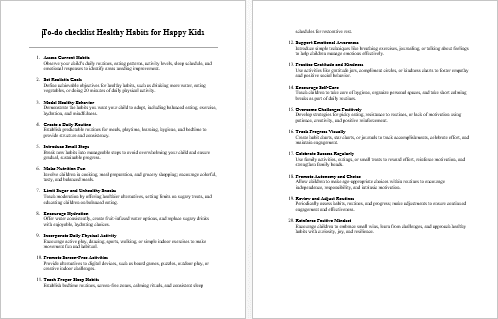
✔ Healthy Habits for Happy Kids Checklist (423 words)
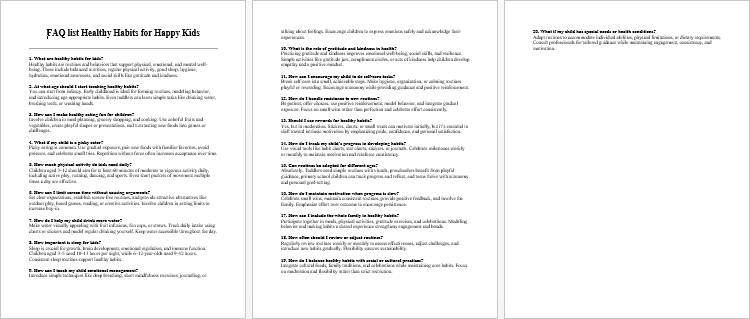
✔ Healthy Habits for Happy Kids FAQs (726 words)
✔ Ready-made Salespage (711 words)
Everything is structured, polished, and ready for customization.
Powerful Ways to Use & Profit From This Course
This PLR license opens multiple income streams.
1. Sell as a Digital Parenting Course
Offer it as:
- A downloadable PDF program
- A members-only parenting resource
- A guided email course
Suggested pricing: $27 – $97+
2. Create a Premium Multi-Week eClass
Turn it into a 6–8 week parenting program.
Add:
- Live coaching sessions
- Q&A calls
- Printable worksheets
- Private support group
Charge $297–$497.
3. Break Into Mini Products
Sell individual guides:
- Healthy Eating for Kids ($17)
- Screen-Free Activity Ideas ($19)
- Emotional Skills for Kids ($27)
Great for entry-level offers.
4. Launch a Family Wellness Membership
Release one module per month.
Add:
- Bonus printables
- Habit trackers
- Activity calendars
Generate recurring income.
5. Bundle With Other PLR Products
Combine with:
- Family budgeting content
- Homeschool resources
- Time management for moms
- Stress management guides
Create bundles priced $47–$97.
6. Create Physical Products
Convert it into:
- Printed workbooks
- Family planners
- Habit journals
- Laminated chore charts
Physical products increase perceived value.
7. Use Portions as Lead Magnets
Excerpt sections like:
- “5 Screen-Free Activity Ideas”
- “Simple Bedtime Routine Checklist”
- “Healthy Snack Swap Guide”
Grow your email list with high-value freebies.
8. Build a Parenting Authority Website
Use the content to:
- Publish blog articles
- Create email sequences
- Add affiliate recommendations
- Offer digital products
Monetize long-term or flip the site for profit.
License Terms Summary
You ARE Allowed To:
✔ Sell the content (with minor edits).
✔ Substantially modify (75%+) to claim copyright.
✔ Break it into smaller reports.
✔ Bundle with other products.
✔ Create memberships.
✔ Convert to video, audio, or print.
✔ Use excerpts for lead magnets.
✔ Build and flip a site.
You Are NOT Allowed To:
✘ Pass PLR rights to customers.
✘ Allow resell or redistribution rights.
✘ Offer 100% affiliate commissions (max 75%).
✘ Give away the complete product in its current form.
✘ Add it to existing paid products without requiring a new purchase.
These rules protect the long-term value of your investment.
Why Buy This PLR From Buy Quality PLR?
Because quality builds brand trust.
This course is:
- Warm and supportive
- Practical and actionable
- Structured and easy to follow
- Family-centered
- Non-preachy and realistic
It helps parents feel capable — not overwhelmed.
And when parents see positive changes in their children, they remember who helped them.
A High-Impact Opportunity in the Parenting Market
Healthy children.
Stronger families.
Simple habits that last a lifetime.
The Healthy Habits for Happy Kids PLR Course gives you a powerful, evergreen product in one of the most emotionally driven markets available.
Add it to your product line.
Brand it your way.
Launch with confidence.
And position yourself as a trusted voice in family health and happiness — while building a profitable, sustainable business.
has been added to your cart!
have been added to your cart!
Here A Sample of the Healthy Habits for Happy Kids PLR Course
A step-by-step guide to raising happy, healthy, and confident children through simple everyday habits.
Module 1: Building the Foundation for Healthy Kids
Lesson 1: Why Healthy Habits Matter
Introduce kids (and parents) to the idea that small daily habits shape health, mood, and happiness for life
Welcome! This lesson is the foundation stone of your course: it helps learners — both children and their caregivers — understand why tiny everyday choices matter. For international course creators, this lesson must be clear, adaptable, culturally sensitive, and practical. Below is a long, detailed, step-by-step instructor guide and lesson description you can use directly (or localize) in your course materials.
Overview and purpose
This lesson introduces the concept that consistent small habits accumulate into major effects on a child’s physical health, emotional wellbeing, learning ability, and social confidence. The goal is to make the idea simple, meaningful, and actionable for families from diverse cultural backgrounds.
Learning outcomes (what learners will be able to do by the end)
- Explain, in simple terms, how daily habits influence health, mood, energy, and learning.
- Identify three small habits that can be started today and describe why they matter.
- Demonstrate at least one fun way to teach or practice a healthy habit at home.
- Create a short, culturally-appropriate plan for introducing one habit to a child (for parents/caregivers).
Target audience
- Primary: Parents, caregivers, early childhood educators, and community health workers.
- Secondary: Older children (8+), who can participate directly in parts of the lesson.
- Age-appropriate adaptations are included below.
Duration
Total: 60–90 minutes (flexible).
Suggested breakdown:
- Warm-up & hook: 10 minutes
- Concept explanation (interactive): 15–20 minutes
- Activity: 20–30 minutes
- Reflection & planning: 10–20 minutes
- Q&A and closing: 5–10 minutes
Materials and preparation (international-friendly)
Use simple, low-cost materials so the lesson works anywhere:
- Large paper or whiteboard and markers (or chalk and chalkboard)
- Small cards or sticky notes
- A simple visual chart template (habit, why it matters, small step)
- Props for role-play (optional): toy fork, cup, toothbrush, ball, pillow
- Local food pictures or actual small food items (fruits, vegetables, whole grain examples) — adapt to local cuisine
- Timer or phone stopwatch
- Handout template for a one-week habit plan (printable or digital)
Note for course creators: provide both printable and editable digital versions; include translations if possible.
Step-by-step instructor script and actions
1. Hook: Open with a short story or question (10 minutes)
- Say: “I want to tell you about Mina (or choose a local name). Mina started brushing her teeth once a day — then twice a day — and after a few weeks she stopped getting sore gums, slept better, and smiled more at school. Small change, big difference.”
- Ask the group: “Can you think of a tiny thing you do every day that makes a big difference?” Invite 3–4 short responses. Use local examples (walking to school, drinking tea, helping in the kitchen).
- Purpose: The story creates emotional connection and primes the group to see the value of small, consistent actions.
2. Explain the core idea with an analogy (15 minutes)
- Present a simple analogy: “Habits are like drops of water filling a bucket. One drop alone does little, but many drops fill the bucket.”
- Show the visual: draw a bucket and add labeled drops: ‘sleep’, ‘water’, ‘play’, ‘handwashing’, ‘kind words’.
- Discuss physiological and psychological links in plain language:
- Body: “Eating well and sleeping well gives energy and keeps germs away.”
- Mind: “Good routines reduce worry and help children concentrate.”
- Social: “Healthy habits make children feel more confident and included.”
- Reinforce: Use local measurement signs if helpful — for example, “an extra 10 minutes of play a day is 70 minutes a week.” (Replace with metric-friendly examples like minutes and hours.)
3. Interactive mini-lecture: the science in simple terms (15 minutes)
- Keep it short and practical. Explain that habits affect:
- Immunity: better nutrition and hygiene reduce illness.
- Mood: sleep and movement regulate mood chemicals in the brain.
- Learning: routine and rest improve memory and attention.
- Use one brief, concrete example relevant to the audience: “A child who sleeps enough is more likely to remember letters they learned that day.”
- Invite quick checks: ask learners to nod or raise a hand if they have noticed these patterns in their children.
4. Activity — Identify and rank small habits (20–30 minutes)
Purpose: Make the idea practical and locally relevant.
Step A — Brainstorm (5–10 minutes)
- Give each pair or small group 6–8 sticky notes or index cards.
- Prompt: “Write one small habit per card that improves a child’s health, mood, or learning.” Examples to suggest: drink water in the morning, wash hands before meals, 10 minutes of reading, 15 minutes active play, eat a fruit, bedtime story.
- Encourage local habits and family customs; accept all culturally appropriate responses.
Step B — Group sorting (10 minutes)
- On the board, create three columns: Physical, Emotional, Learning.
- Ask groups to place their cards in the column they think fits best.
- Discuss differences and emphasize overlap — many habits support more than one area.
Step C — Rank by feasibility (5–10 minutes)
- Ask each group to choose one habit that’s small, doable, and impactful.
- Have them explain why to the full group. Encourage consideration of time, cost, and cultural fit.
5. Short role-play: practice how to introduce a habit (10–15 minutes)
- Give each group a scenario: a picky eater, a parent with little time, a family with many children, a family where school commute is long.
- Ask them to role-play a 2–3 minute introduction of a chosen habit to the child or caregiver.
- Debrief: highlight language and gestures that worked well and cultural adaptations used.
6. Create a one-week starter plan (10–15 minutes)
- Provide the handout template: Habit — Small Step — When — Who helps — How we celebrate.
- Ask participants to fill it out for one habit (parents do for their child; educators plan for classroom use).
- Encourage concrete timing: “After breakfast,” “before bedtime,” or “during the afternoon snack.”
7. Reflection, assessment, and closing (5–10 minutes)
- Quick reflection prompts:
- “What surprised you today?”
- “Which small habit will you try first?”
- Invite one or two participants to share their plan.
- Close with a positive reinforcement statement: “Tiny habits, repeated gently, become the strong habits that support a child’s life.”
Teaching tips for international contexts and cultural sensitivity
- Language: Use simple, clear language and avoid jargon. Offer translated handouts or key vocabulary if possible.
- Food examples: Always use local foods when discussing nutrition. For example, speak about locally common fruits and whole grains rather than unfamiliar items.
- Routines: Respect cultural routines (e.g., prayer times, siestas, communal meals) and show how habits can align with those practices.
- Gender and roles: Encourage inclusive language; show examples of mothers, fathers, grandparents, and siblings involved in habit-building.
- Resource variability: Offer low-cost and no-cost habit ideas for low-resource settings (e.g., water bottle refills, family songs for hygiene).
- Religious and cultural observances: Be sensitive to fasting or holiday schedules and show how habits can be adjusted rather than discarded.
Accessibility and inclusion
- Provide audio versions of materials for visually impaired learners.
- Use large print and high-contrast visuals.
- Include tactile or hands-on options for learners with different needs.
- Offer alternatives to physically active tasks for children with mobility limitations (e.g., seated stretches, breathing exercises).
Adapting for different age groups
- Toddlers (2–4 years): Use play-based demonstration and parent-focused instruction. Keep explanations very concrete: “We wash so germs go away.”
- Early primary (5–7 years): Use short stories, songs, and sticker charts. Include simple measurable goals (e.g., “Try one new fruit this week”).
- Older kids (8–12 years): Encourage goal-setting and simple self-monitoring. Invite them to help design the one-week plan.
- Teens: Emphasize autonomy and discuss habit benefits for mood, academic performance, and social life.
Assessment and follow-up ideas
- Formative: Observe participation in role-play and group discussions; check completed one-week plans.
- Short quiz: three simple questions to confirm understanding (e.g., “Name one way sleep helps your day.”).
- Homework: Families practice the chosen small habit for one week and report back with one success and one challenge.
- Optional follow-up session: After one week, run a 20–30 minute check-in workshop to share successes, troubleshoot obstacles, and scale to another habit.
Sample phrasing and script snippets for international instructors
- Opening line: “Today we are talking about how small things we do every day add up. These are simple, affordable, and child-friendly, and they work in cities and villages around the world.”
- When explaining benefits: “Think of habits as little tools we use every day. A tool like ‘drinking enough water’ helps the body and the brain — it is simple but powerful.”
- Troubleshooting resistance: “If a child resists, try doing the habit together for three days. Children copy adults. If you do it too, they often join in.”
Common instructor FAQs
Q: What if families are too busy?
A: Recommend micro-habits that take 2–5 minutes. Small wins build confidence and are easier to keep.
Q: How to handle skepticism from caregivers?
A: Use observable, local examples and invite them to try a 7-day experiment — short-term evidence is persuasive.
Q: What if a habit contradicts cultural norms?
A: Always adapt. Ask participants to suggest culturally-respectful alternatives. The core principle — small, consistent actions — remains the same.
Expected outcomes after this lesson
- Caregivers can name at least three small habits that positively affect their child’s health and mood.
- Participants leave with a concrete one-week plan that fits their local context.
- Families feel motivated to try one small habit experiment and to observe its effects.
Final instructor reminder
This lesson sets the tone for the whole course. Keep the atmosphere positive and empowering. Emphasize that change does not require perfect conditions — it requires consistency, kindness, and a willingness to try small steps. For international delivery, prioritize cultural respect, low-cost options, and clear, locally relevant examples. When learners see small actions produce visible improvements, they are far more likely to continue and to adopt additional healthy habits in the modules ahead.
This lesson is intentionally practical and adaptable so you can localize it quickly for classrooms, community centers, online courses, or parent workshops across different countries and cultures.
Lesson 2 — Setting a Positive Example
Teach parents and caregivers how children copy what they see — healthy role modeling is the key
This lesson trains course participants to become the kind of models children naturally imitate. Children learn faster by watching than by listening; a calm, consistent adult who “does what they say” teaches far more than words alone. This guide is written for international course creators: it is practical, adaptable to local cultures and resources, and ready to deliver in classrooms, community workshops, or online sessions.
Purpose and overview
Children copy the people around them. When caregivers show healthy behaviours — about food, sleep, movement, emotion management, and kindness — those behaviours become the child’s default. The aim of this lesson is to help parents and caregivers notice modeling opportunities, practice clear and realistic modelling techniques, and plan one small modelling experiment to try immediately.
Learning outcomes
By the end of this lesson participants will be able to:
✓ Explain why modelling is more powerful than instruction alone.
✓ Demonstrate three simple modelling techniques caregivers can use at home.
✓ Create and rehearse short, culturally-appropriate scripts for modelling healthy behaviour.
✓ Design a 7-day modelling experiment that fits their daily routine.
Target audience
Parents, caregivers, grandparents, early childhood educators, community health workers, and family volunteers. Adapt language and examples for toddlers, primary-age children and older children.
Duration
Total: 60–90 minutes.
Suggested timing: Hook (10 min) → Short theory (10–15 min) → Demonstrations (15 min) → Practice & role-play (25–30 min) → Plan & reflection (10–15 min).
Materials (international-friendly)
• Flipchart, whiteboard or large paper.
• Markers or chalk.
• Small props for demonstration (cup, plate, toothbrush, soft toy).
• Handout: “One-week Modelling Experiment” (simple table: Habit → Caregiver action → When → How child joins → How to celebrate).
• Timer or phone stopwatch.
Use local props and foods to make examples relatable.
Step-by-step instructor script and activities
1. Hook: Observe and reflect (10 minutes)
Start with a short, relatable prompt. Say: “Think of one small thing your child does that surprised you — maybe copying the way you laugh, the way you sit, or something they refuse to eat. Where did they pick that up?” Invite 3–4 brief answers. The goal is to get participants thinking about how quickly children imitate adults.
Facilitator note: encourage local examples (e.g., how children copy market greetings, household chores, or a parent’s morning stretching routine).
2. Short explanation: Why modelling works (10–15 minutes)
Explain the basic idea in simple terms:
• Children are wired to watch and repeat.
• Modelling links action to meaning — seeing an adult drink water after play teaches the child that water refreshes.
• Consistency matters: repeated small actions create habits.
Use an analogy: “Modelling is like planting seeds every day. One seed doesn’t change much; many seeds make a garden.” Draw the analogy on the board with simple symbols: seed → plant → garden.
Keep the science brief and practical — no jargon. Emphasize that modelling is not perfection; it’s consistent effort and honest acknowledgement of mistakes.
3. Demonstration: The “mirror moments” (15 minutes)
Show how imitation happens in real time.
Activity: Two-minute live demo.
• Facilitator models a short, positive behaviour (e.g., taking a big sip of water and saying, “That helped me feel ready to play”).
• Ask a participant to watch and then imitate the action as if they were the child.
• Debrief: Ask participants what they noticed about tone, gesture, and timing.
Repeat with three quick scenarios:
- Washing hands before eating — model song or simple step-by-step action.
- Managing frustration — model a calm breath and say, “I feel upset; I will take three slow breaths.”
- Trying a new food — take a small bite, make a positive comment and offer it to the child.
Key teaching points:
→ Non-verbal cues (smile, relaxed posture) matter as much as words.
→ Short, concrete actions are easiest for children to copy.
→ Actions that include the child — “watch me” — invite imitation.
4. Guided practice: Role-play realistic situations (25–30 minutes)
Divide participants into small groups. Give each group one real-life scenario to practice modelling behaviour. Scenarios should reflect local routines (mealtime with staple food, morning school run, communal bathing, cultural celebration meal).
Suggested scenarios:
• A picky eater refusing a familiar vegetable.
• A child refusing to turn off a screen at bedtime.
• A child who gets angry when a game doesn’t go their way.
• A family where adults smoke or consume alcohol (focus on positive substitutions and safety).
Each group creates a short script (1–2 minutes) showing: Caregiver action → Child reaction → Caregiver response. Encourage cultural sensitivity: adapt language and specifics to local norms.
After 5–10 minutes of rehearsal, each group performs for the class. After each skit, facilitate a quick feedback round:
• What modelling moves were clear?
• Which gestures or phrases would a child copy most easily?
• How did the caregiver acknowledge the child’s attempt?
Instructor tip: Praise the small wins — highlight realistic, low-cost actions such as drinking water visibly, sitting down to read, or taking a breath when upset.
5. Skill focus: The five modelling techniques (10 minutes)
Teach five practical modelling techniques participants can use immediately.
- Lead by doing — perform the behaviour first, then invite the child to try.
Example: “I’ll wash my hands now; would you wash with me?” - Narrate your action — say one simple sentence as you do it.
Example: “I am drinking water to feel strong.” - Make it visible and repeatable — keep actions short and consistent (same place/time).
Example: always have a water bottle by the door after outdoor play. - Use shared rituals — transform habits into rituals the child enjoys.
Example: a two-minute handwash song or rhyme adapted locally. - Acknowledge attempts — praise effort, not just outcome.
Example: “You tried a bite — that was brave.”
Use tic marks or simple icons on the board to represent each technique: → (lead by doing), ✍ (narrate), ⏱ (repeatable), ♫ (ritual), ✓ (acknowledge).
6. Create a short in-class “modelling experiment” (10–15 minutes)
Hand out the “One-week Modelling Experiment” sheet. Ask each participant to fill it in with:
• One habit to model (e.g., drinking water after play).
• The exact caregiver action (e.g., visibly drinking first).
• When it will happen (time or routine).
• How the child will be invited to join (words or gesture).
• A simple celebration or acknowledgement (sticker, praise phrase).
Encourage realistic choices: 2–5 minutes, low cost, compatible with household rhythms.
7. Reflection and common challenges (10 minutes)
Lead a group discussion:
• What might make modelling hard in your family or community? (time, multiple caregivers, cultural norms)
• How can you adjust? (rotate caregivers, set visible cues, adapt rituals)
Offer practical solutions:
• If time is limited, model during an existing routine (e.g., while making tea).
• If many caregivers are involved, create a shared phrase or signal everyone uses.
• If a habit conflicts with cultural practices, find an alternative that expresses the same value (e.g., if certain foods are unavailable, model balanced choices with local staples).
Language examples and short scripts (international-ready)
Keep phrases short, positive, and descriptive. Use local words for foods and routines.
• Mealtime: “I’ll try one small piece. It tastes crunchy!”
• Sleep: “I turn off my screen and read for 10 minutes before bed.”
• Movement: “I am stretching my arms — come stretch with me.”
• Emotions: “I am feeling angry. I will breathe slowly three times.”
Provide translations or allow participants to rewrite these lines in local languages during the session.
Cultural sensitivity and adaptation
• Respect family roles and religious practices — suggest modelling strategies that align with them.
• Use local foods, games and songs. Never suggest replacing cultural meals; instead show how to include healthy elements within them.
• Be mindful of gender expectations; show caregivers of all genders modelling domestic and health behaviours.
• Offer low-cost options for low-resource settings (e.g., using a bright cup as a visible water cue).
Accessibility and inclusion
• Demonstrate seated alternatives for physical activities.
• Use clear visual cues and large-print handouts.
• Invite caregivers of children with disabilities to share adaptations that work in their context.
Assessment ideas (within-class)
• Observe role-play: did the caregiver use at least two modelling techniques?
• Check experiment sheets for clarity and feasibility.
• Ask participants to state one modelling phrase they will use at home.
Expected outcomes from practicing modelling
• Caregivers will feel more confident demonstrating healthy behaviours.
• Children will begin to imitate visible, consistent actions and adopt small habits.
• Families will report more cooperative responses from children because modelling invites participation rather than orders.
Final instructor notes
• Model humility — show a short personal example where you modelled and it didn’t go perfectly, then explain how you tried again. That normalizes imperfection for participants.
• Keep activities culturally anchored and low-cost.
• Reinforce that modelling is a long game: small, repeated, and visible actions win.
This lesson makes modelling concrete and doable. When caregivers learn to “show” rather than only “tell,” children learn faster, more joyfully, and more sustainably.
Lesson 3 — Turning Routines into Fun
Show how to transform daily routines like brushing teeth or bedtime into games, stories, or challenges kids enjoy
This lesson shows course participants how to take ordinary, repeat activities and make them joyful, memorable, and child-led. The aim is practical: give parents, caregivers, and educators step-by-step methods they can adapt across cultures and resource levels so routines become moments of connection rather than resistance.
Purpose and learning outcomes
Purpose: Turn compliance into cooperation by making routines playful, predictable, and rewarding.
By the end of this lesson participants will be able to:
✓ Identify 5 ways to add play to a routine.
✓ Design a culturally relevant “fun routine” for at least one daily task.
✓ Run a short role-play demonstrating the routine with a child or peer.
✓ Create a simple one-week implementation plan and measure one small outcome.
Audience and timing
- Audience: Parents, caregivers, preschool teachers, community workers, course creators.
- Duration: 60–90 minutes (flexible for online or in-person).
- Suggested pacing: Hook (10 min) → Concept + examples (15 min) → Design workshop (25–30 min) → Role-play & feedback (15–20 min) → Reflection & planning (10 min).
Materials (international-friendly)
• Flipchart/whiteboard and markers.
• Blank routine chart templates (printable or digital).
• Small props: toothbrush, sheet, spoon, flashlight, toy. Use local items.
• Timer or phone stopwatch.
• Reward tokens (stickers, small stamps, paper stars) or a visible “celebration jar.”
• Optional: simple costume pieces (hat, cape), story cards, and music (local songs).
Use low-cost and no-cost options so activities work in low-resource settings.
Step-by-step instructor guide
1) Hook — fast illustration (10 minutes)
Start with a live demo. Do a two-minute “before and after” of a familiar routine:
• First, mime a boring bedtime routine: listless, hurried, and the child resisting.
• Then, perform the same routine with play: use a short rhyme, a flashlight “star hunt,” and a 2-minute calming story.
Ask: “Which one would your child prefer?” Collect quick answers. This demonstrates the difference and primes participants to think creatively.
2) Explain the why — simple psychology (10–15 minutes)
Deliver a brief, plain-language explanation:
→ Routines give children safety and predictability.
→ Play adds motivation and joy; it turns repetition into learning.
→ When children lead parts of routines, they feel agency and are more likely to cooperate.
Use the bucket-and-drops image from earlier lessons: small playful actions repeatedly produce the habit. Keep the explanation practical and avoid heavy theory.
3) Teach transformation techniques — the toolkit (20 minutes)
Present a set of proven techniques. For each, give a clear example and a low-cost variation.
- Mini-games (time-limited)
→ Example: “Beat the Timer” — set a 2-minute sand timer for toothbrushing. Make it a race to finish all brushing “zones” before the sand runs out.
→ Low-cost: Use a phone timer or clap rhythm. - Story frames
→ Example: Turn getting dressed into a story where the child dresses a puppet hero for a mission.
→ Low-cost: A scrap of fabric becomes a cape; tell the story in local language with local characters. - Choice and challenges
→ Example: Give two acceptable options: “Which two socks shall we pick?” or “Do you want to brush legs or arms first in our wipe-down game?”
→ Low-cost: Let the child choose the order or the song. - Counting, songs and chants
→ Example: A 10-count washing chant for handwashing.
→ Low-cost: Use a familiar nursery rhyme or a short invented chant; keep it culturally relevant. - Role reversal and pretend play
→ Example: Let the child pretend to be the caregiver and ‘check’ a doll’s teeth after demonstrating.
→ Low-cost: Use a cloth doll or stuffed toy. - Visual cues and charts
→ Example: A simple chart with pictures: toothbrush → wash hands → story → bed. Add magnets or stickers for completion.
→ Low-cost: Draw pictures on paper and let the child move a marker. - Sensorial add-ons
→ Example: Soft lights or a warm towel to make bedtime more soothing.
→ Low-cost: Use flashlights, soft fabric, or a quiet bell. - Micro rewards and celebrations
→ Example: A small star for each completed routine cycle, with five stars = a family picnic.
→ Low-cost: Paper tokens, a clap, or a single “special seat” at dinner. - Theme days
→ Example: “Pirate Toothbrush Day” where everyone wears a pretend patch while brushing.
→ Low-cost: Borrow a fabric scrap or paper hat. - Narration plus invitation
→ Example: Narrate your action (“I will drink my water now”) and invite the child (“Would you like your cup too?”). This models behavior and offers gentle invitation.
For each technique, invite short participant examples so ideas reflect local culture.
4) Design workshop — create three fun routines (25–30 minutes)
Divide participants into small groups. Ask each group to pick three everyday routines (e.g., toothbrushing, morning dressing, mealtime, packing school bag, bedtime). For each routine they must:
• Name the routine.
• Choose 1–2 transformation techniques from the toolkit.
• List required materials (local, low-cost options).
• Write a 30-60 second script or outline (caregiver action → child invitation → child action → celebration).
• Identify one measurable small outcome (e.g., “child brushes 2 minutes without protest,” “packs bag with 1 reminder”).
Provide a template to fill in. Circulate and give feedback emphasizing simplicity and cultural fit.
5) Role-play and feedback (15–20 minutes)
Each group performs one designed routine (2–4 minutes). After each role-play, lead quick constructive feedback focusing on:
• Clarity: Was the child’s invitation clear?
• Simplicity: Could the routine be repeated daily?
• Engagement: Did the routine use sensory or imaginative elements?
• Cultural fit: Is it appropriate and respectful to local norms?
Encourage peer praise and suggestions, then refine the scripts.
6) Implementation plan — one-week trial (10 minutes)
Hand out a one-week trial sheet:
• Routine to try → Technique(s) → When → Who leads → How we celebrate → Measure (simple: yes/no or star).
Ask participants to commit to trying one routine daily for 7 days and to note: What worked? What didn’t?
Age adaptations — examples by group
• Toddlers (1–3 years): Keep it sensory and very short. Use tactile props (washcloth, soft brush), simple songs, and immediate praise.
• Preschool (3–5 years): Add role-play and choice. Use puppet stories and simple charts.
• Early primary (6–8 years): Introduce challenges and simple scoring. Let children help design the routine.
• Older children (9–12 years): Offer autonomy and co-creation. Turn routines into short missions or “level-up” charts.
• Teens: Respect independence. Use negotiated routines with rewards linked to privileges rather than stickers.
Cultural sensitivity and inclusion
• Use local music, stories, and characters. Replace unfamiliar foods or toys with local equivalents.
• Keep gender-neutral language. Offer examples showing fathers, grandparents and siblings as routine partners.
• Adapt celebrations to fit local values — family praise, small acts of service, or a shared recipe instead of commercial prizes.
• During religious or fasting periods, adapt timing and sensory elements rather than abandoning routines.
Accessibility and special needs
• Visual schedules for children with autism, tactile cues for visually impaired children.
• Shorter, repeated steps for children with attention differences.
• Alternative sensory options for children with sensory sensitivities (e.g., soft cloths instead of tickly washcloths).
• Encourage caregivers to consult therapists where relevant and to focus on participation and connection rather than perfection.
Troubleshooting — common challenges and fixes
• Resistance persists: Reduce the routine into micro-steps and celebrate tiny progress.
• Many caregivers involved: Create a shared, simple phrase or visual cue everyone uses.
• Time pressure: Attach the fun routine to an existing event (e.g., the walking-to-school song).
• Over-stimulation: Use calm sensory elements and shorten play elements for evenings.
Assessment ideas (simple and practical)
• Direct observation: Does the child complete the routine with fewer prompts?
• Parent reflection: Journal one “win” and one “challenge” per day.
• Sticker count: Number of stickers earned across the week.
• Short parent survey: Did daily stress around the routine decrease? (Yes/No + one sentence)
Choose one simple assessment to keep follow-through realistic.
Sample short scripts (international-ready)
• Toothbrushing: “I’ll brush the top teeth now — two long swoops. Your turn to brush bottom teeth. Ready? 1, 2, 3 — go!”
• Bedtime: “Tonight our story is a quiet treasure hunt. Find the three soft stars on your pillow while I turn the page.”
• Mealtime: “This is the crunchy bowl. Let’s each try one crunchy bite. You choose first!”
• Dressing: “We’re getting superhero-ready. Put on your boots for the mission. I’ll zip the cape.”
Allow learners to translate or rewrite phrases in local languages.
Expected outcomes and closing notes
With consistent, culturally-attuned practice, routines become less contested and more cooperative. Children begin to expect and enjoy the ritual; caregivers experience less stress and more connection. The key is small, repeatable, joyful elements that fit household rhythms.
Final instructor reminders:
→ Keep it simple and repeatable.
→ Prioritize child choice and fun over perfection.
→ Encourage small trials and celebrate small wins.
This lesson equips international course creators to teach not just a trick for one child, but a repeatable design process that families everywhere can use to make daily life calmer, happier, and more playful.
We’re also giving these extra bonuses
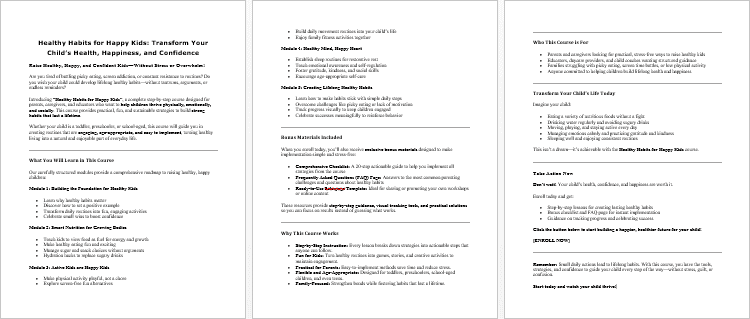
Healthy Habits for Happy Kids – Checklist
Healthy Habits for Happy Kids – FAQs
Healthy Habits for Happy Kids – Salespage Content
Package Details:
Word Count: 33 130 Words
Number of Pages: 103
Healthy Habits for Happy Kids – Bonus Content
Checklist
Word Count: 423 words
FAQs
Word Count: 726 words
Salespage Content
Word Count: 711 words
Total Word Count: 34 990 Words
Your PLR License Terms
PERMISSIONS: What Can You Do With These Materials?
Sell the content basically as it is (with some minor tweaks to make it “yours”).
If you are going to claim copyright to anything created with this content, then you must substantially change at 75% of the content to distinguish yourself from other licensees.
Break up the content into small portions to sell as individual reports for $10-$20 each.
Bundle the content with other existing content to create larger products for $47-$97 each.
Setup your own membership site with the content and generate monthly residual payments!
Take the content and convert it into a multiple-week “eclass” that you charge $297-$497 to access!
Use the content to create a “physical” product that you sell for premium prices!
Convert it to audios, videos, membership site content and more.
Excerpt and / or edit portions of the content to give away for free as blog posts, reports, etc. to use as lead magnets, incentives and more!
Create your own original product from it, set it up at a site and “flip” the site for megabucks!
RESTRICTIONS: What Can’t You Do With These Materials?
To protect the value of these products, you may not pass on the rights to your customers. This means that your customers may not have PLR rights or reprint / resell rights passed on to them.
You may not pass on any kind of licensing (PLR, reprint / resell, etc.) to ANY offer created from ANY PORTION OF this content that would allow additional people to sell or give away any portion of the content contained in this package.
You may not offer 100% commission to affiliates selling your version / copy of this product. The maximum affiliate commission you may pay out for offers created that include parts of this content is 75%.
You are not permitted to give the complete materials away in their current state for free – they must be sold. They must be excerpted and / or edited to be given away, unless otherwise noted. Example: You ARE permitted to excerpt portions of content for blog posts, lead magnets, etc.
You may not add this content to any part of an existing customer order that would not require them to make an additional purchase. (IE You cannot add it to a package, membership site, etc. that customers have ALREADY paid for.)
Share Now!
Latest Products
Free Sales Funnel Builder

Related Products
Popular & Trending

Featured Products