
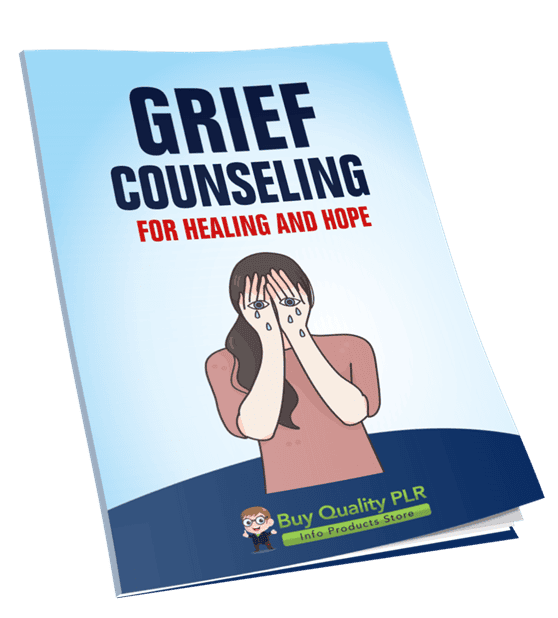
Grief Counseling for Healing and Hope PLR Course 34k Words
in Healing PLR , Mental Health PLR , PLR eCourses , PLR List Building Reports , Premium PLR , Premium PLR Reports , Premium White Label Brandable PLR Coaching Courses , Private Label Rights Products , Self Discipline PLR , Self Esteem PLR , Self Help PLR , Self Improvement PLR , Wellness PLRChoose Your Desired Option(s)
has been added to your cart!
have been added to your cart!
#griefcounseling #plrcourse #healingandhope #mentalwellness #lifecoaching #wellnessmarketing #plrcontent #emotionalhealing #supportandrecovery
34,000 Words of Compassionate, Practical Grief Support Content You Can Sell, Brand, and Profit From
If you’re looking for a high-quality PLR product in the personal development, mental wellness, or counseling niche—one that is deeply meaningful, evergreen, and highly in demand—this is it.
Grief Counseling for Healing and Hope PLR Course is a professionally structured, 34,000-word training program designed to teach practical grief counseling techniques that truly help.
This isn’t surface-level theory.
This is a complete, step-by-step course that walks learners through understanding grief, building healing connections, applying practical therapeutic tools, supporting special grief journeys, and guiding clients toward hope and resilience.
And the best part?
You can sell it.
Brand it.
Repackage it.
Build an entire business around it.
Welcome to one of the most powerful PLR opportunities you can add to your website, Buy Quality PLR.
Introducing the…
Grief Counseling for Healing and Hope PLR Course 34k Words
Why This PLR Course Is a Powerful Seller
Grief is universal.
Every single person will experience loss—of a loved one, a relationship, a dream, or a stage of life. And as awareness of mental health grows, more people are seeking guidance, tools, and compassionate support.
That means:
- Coaches need structured grief support materials.
- Counselors need practical frameworks.
- Churches and spiritual leaders need healing resources.
- Support group leaders need ready-to-use content.
- Bloggers need meaningful, helpful content.
- Course creators need complete training programs.
This course gives them exactly that.
Instead of spending months writing 30,000+ words from scratch, your customers can instantly access a complete, organized, ready-to-sell program.
And you get to profit from providing it.
What’s Included in This PLR Package
This isn’t just a course manuscript.
You receive:
- ✅ Grief Counseling for Healing and Hope Course (34,000 Words)
- ✅ Checklist (597 Words)
- ✅ FAQs (905 Words)
- ✅ Sales Page (919 Words)
Everything is professionally structured and organized into 5 complete modules.
A Closer Look at the Course Content
Module 1: Understanding Grief and Its Impact
This foundational module introduces learners to the emotional, physical, and spiritual dimensions of grief.
Lesson 1: What Is Grief Really About?
Learners explore how grief affects identity, relationships, routines, and personal meaning. It helps them move beyond the idea that grief is “just sadness” and recognize its full psychological depth.
Lesson 2: The Different Stages of Grief
A practical breakdown of denial, anger, bargaining, depression, and acceptance—how they appear in real people and how to support each stage without forcing progress.
Lesson 3: Common Misconceptions About Grief
This lesson dismantles harmful myths such as:
- “Time heals all wounds.”
- “You should be over it by now.”
- “Stay strong.”
Instead, it provides compassionate, realistic truths.
Lesson 4: The Counselor’s Role in Grief Support
Teaches boundaries, presence, and the importance of creating safe space without trying to “fix” the grieving person.
Module 2: Building a Healing Connection
Grief counseling begins with trust. This module builds that foundation.
Lesson 1: Active Listening Techniques
Practical exercises in:
- Reflective listening
- Emotional validation
- Non-verbal communication
Lesson 2: Using Empathy as a Healing Tool
Learners practice expressing empathy without overstepping or minimizing pain.
Lesson 3: Asking Gentle and Open-Ended Questions
Learn how to guide storytelling and emotional expression without interrogation.
Lesson 4: Creating Safe Counseling Environments
Covers both physical space and emotional safety, including tone, posture, and psychological boundaries.
Module 3: Practical Techniques for Processing Grief
This is where the course becomes hands-on and highly valuable.
Lesson 1: Journaling and Storytelling as Therapy
Clients learn to process grief through narrative expression and memory preservation.
Lesson 2: Guided Imagery and Relaxation Practices
Techniques to reduce anxiety and create moments of calm within overwhelming emotional storms.
Lesson 3: Cognitive-Behavioral Approaches
Simple CBT-inspired tools for reframing negative thinking patterns and reducing emotional spirals.
Lesson 4: Creative Expression in Healing
Art, music, movement, and other non-verbal outlets for clients who struggle to articulate grief in words.
Module 4: Supporting Special Grief Journeys
Grief is not one-size-fits-all.
This module teaches adaptive support strategies.
Lesson 1: Grief in Children and Adolescents
Age-appropriate communication methods and emotional validation techniques.
Lesson 2: Grief in Adults and Spouses
Addressing identity loss, loneliness, and relationship dynamics.
Lesson 3: Grief in Seniors
Handling multiple losses, isolation, and end-of-life reflection.
Lesson 4: Grief in Traumatic Loss Situations
Supporting those coping with sudden, violent, or unexpected loss.
Module 5: Guiding Toward Hope and Growth
Grief does not mean the end of joy.
This final module focuses on healing and rebuilding.
Lesson 1: Encouraging Meaning-Making After Loss
Helping clients find purpose, legacy, or lessons without minimizing their pain.
Lesson 2: Building Resilience and Coping Skills
Daily routines and emotional strength practices.
Lesson 3: Rebuilding Life and Finding Joy Again
Setting goals, rebuilding social connections, and welcoming happiness without guilt.
Lesson 4: When to Refer for Additional Support
Recognizing when specialized therapy or medical support is necessary.
Who This PLR Course Is Perfect For
This product appeals to multiple profitable markets:
- Life coaches
- Christian coaches
- Grief support group leaders
- Church ministries
- Mental wellness bloggers
- Course creators
- Therapists building online programs
- Self-help authors
- Wellness membership site owners
It’s evergreen.
Loss will always exist.
And healing resources will always be needed.
Ways You Can Use and Profit From This Course
This is where the opportunity multiplies.
Here are powerful ways you (and your customers) can monetize this content:
1. Sell It As-Is (With Minor Tweaks)
The simplest option:
- Add your branding
- Update formatting
- Create a simple cover
- Upload it as a digital course or ebook
Sell for $27–$67 easily depending on positioning.
2. Break It Into Mini Reports
Each module can become:
- A $10–$20 mini ebook
- A grief-specific guide (e.g., “Helping Grieving Children”)
- A niche-specific coaching toolkit
Five modules = five separate profit streams.
3. Create a Premium Online Course ($297–$497)
Turn each module into weekly training:
- Add worksheets
- Add Zoom calls
- Add guided audio exercises
- Offer certification of completion
This dramatically increases perceived value.
4. Build a Membership Site
Offer:
- Monthly grief support lessons
- Discussion forums
- Ongoing resilience training
- Bonus live Q&A sessions
Generate recurring monthly revenue.
5. Convert It Into Audio Programs
Grief content works extremely well in audio format.
Create:
- Guided relaxation recordings
- Audio journaling prompts
- Companion meditations
Sell as a premium bundle.
6. Use Portions as Lead Magnets
Excerpt:
- One lesson
- The checklist
- A guided journaling section
Offer it free in exchange for email addresses.
Build your list.
Sell high-ticket offers later.
7. Bundle With Other Wellness PLR Products
Combine this with:
- Mental health courses
- Self-care guides
- Mindfulness content
Create a $47–$97 premium bundle.
8. Create a Physical Product
Turn it into:
- A printed workbook
- A hardcover book
- A guided grief journal
Physical products command higher prices.
9. Build and Flip a Website
Use this course as the cornerstone of a grief-support brand.
Add:
- Blog posts
- Email funnels
- Digital offers
- Coaching services
Grow traffic and revenue—then sell the entire site for a significant multiple.
Clear Licensing – What You Can and Cannot Do
We protect the value of this product while giving you strong profit flexibility.
✅ You CAN:
- Sell the content with minor tweaks.
- Repackage into reports or bundles.
- Create courses, memberships, and physical products.
- Convert into video or audio.
- Use excerpts as lead magnets.
- Claim copyright only if you modify at least 75%.
❌ You CANNOT:
- Pass PLR rights to your customers.
- Allow others to resell the PLR rights.
- Offer more than 75% affiliate commission.
- Give the complete product away for free.
- Add it to existing purchases without requiring an additional payment.
This keeps the marketplace protected and your product valuable.
Why Buy From Buy Quality PLR?
Not all PLR is created equal.
With Buy Quality PLR, you get:
- Structured, logical course flow
- Professional formatting
- Real-world application
- Practical techniques (not fluff)
- Market-ready organization
- Immediate download access
This is content your customers can confidently build businesses on.
Imagine the Possibilities
Imagine selling a course that:
- Helps grieving individuals find hope.
- Supports counselors and coaches in doing meaningful work.
- Builds trust and authority in the wellness niche.
- Generates consistent, recurring revenue.
- Establishes your brand as a source of quality content.
This is not just another PLR file.
This is a foundation product.
A niche-defining asset.
A long-term revenue opportunity.
Ready to Add a High-Impact, High-Demand PLR Product to Your Store?
The Grief Counseling for Healing and Hope PLR Course (34,000 Words) gives you everything you need to enter or expand within the grief and wellness market.
Professional.
Compassionate.
Practical.
Profitable.
Add it to your website today at Buy Quality PLR and give your customers the tools to build meaningful businesses—while you build yours.
has been added to your cart!
have been added to your cart!
Here A Sample of the Grief Counseling for Healing and Hope PLR Course
Module 1: Understanding Grief and Its Impact
This first module gently introduces learners to the journey of grief, its stages, and the emotional, physical, and spiritual weight it carries.
Lesson 1: What is Grief Really About?
Long, step-by-step course instructions and descriptions for international course creators. Friendly, practical, and designed so you can deliver this lesson confidently in live or online classrooms with diverse learners.
Lesson Overview
Learning objective: By the end of this lesson, learners will be able to describe grief as a multi-dimensional human response, identify how grief shows up across emotional, physical, cognitive, behavioral, social and spiritual domains, and adapt their language and therapeutic stance so grieving people feel validated and understood.
Intended audience: Trainers and course creators delivering grief counseling to an international group of helpers — lay counselors, mental health practitioners, social workers, pastoral carers, and community leaders.
Suggested duration: 90–120 minutes (can be shortened to 60 minutes by tightening activities).
Materials needed: Slide deck, whiteboard or digital board, handouts (grief-domain map; case vignette), private journaling sheets, small group breakout instructions, translation/caption tools for multilingual groups.
Learning outcomes (concrete)
- Define grief beyond “sadness” using clear, multi-domain language.
- List at least five ways grief can affect a person (emotional, physical, cognitive, behavioral, social, spiritual).
- Demonstrate one culturally-sensitive way to invite a client to describe their grief.
- Identify one immediate safety or referral concern that may arise during grief work.
Trainer preparation (before the session)
- Review the slides and localize examples for cultural relevance. §
- Prepare one short, internationally diverse case vignette (see sample below).
- Set up a safe environment: decide a private signal participants can use if they feel overwhelmed; ensure referral contacts are visible.
- If the group includes multiple languages, enable captions or arrange an interpreter and prepare handouts in major languages when possible.
Step-by-step training plan
1. Opening and emotional safety (10–12 minutes)
- Greet participants warmly and state the lesson purpose in one sentence: “Today we’ll explore what grief really is — the whole human response, not just sadness — and how to notice it in ourselves and others.”
- Give a brief trigger warning: say that the topic can bring up strong emotions and name the supports available (breakout rooms, quiet space, contact info for local services).
- Lead a 60–90 second grounding: invite everyone to take three slow breaths and notice one sensation in their body. Keep it short and neutral — stillness is fine for some cultures.
- Trainer script sample: “I invite you to be present with whatever arises. You do not need to share until you’re ready.”
2. Short, clear definition and conceptual framing (12–15 minutes)
- Present a concise definition: “Grief is the natural response to loss that affects thoughts, feelings, body, behaviour, relationships and meaning.” Emphasize the universality and individuality of grief.
- Explain that grief is not a single emotion but a cluster of reactions that can arrive in waves and change over time. Use simple, non-technical language for international learners. Avoid idioms that may not translate well.
- Introduce the six core domains visually (slide or handout): Emotional, Physical, Cognitive, Behavioral, Social, Spiritual. Use one short descriptor for each:
• Emotional — e.g., sadness, anger, guilt, relief.
• Physical — e.g., fatigue, changes in appetite, sleep disruption, pain.
• Cognitive — e.g., confusion, memory issues, preoccupation.
• Behavioral — e.g., avoidance, searching, rituals, restlessness.
• Social — e.g., withdrawal or increased seeking of support, role changes.
• Spiritual — e.g., loss of meaning, questioning beliefs, heightened faith. - Trainer tip: Use familiar, local examples when naming behaviours or rituals so participants can map these domains to their cultural context.
3. Demonstration: How grief reaches every part of life (10 minutes)
- Tell a very short, anonymized story (one or two sentences) illustrating cross-domain effects: e.g., “After the sudden loss of her partner, Amina could not sleep (physical), struggled to concentrate at work (cognitive), felt numb and angry (emotional), stopped attending community gatherings (social), and questioned whether life had meaning (spiritual).”
- Ask learners to notice which domains are present in that story. Use a quick poll or show-of-hands depending on your delivery mode. For multilingual groups use simple numbered response options.
4. Active learning: Personal mapping activity (20–25 minutes)
- Instruction (2 minutes): Ask each learner to think of a fictional or composite person who has experienced a loss — it can be simple (loss of a pet, job, relationship, or person). Emphasize confidentiality and ask them not to disclose personal traumatic details.
- Mapping task (10–12 minutes): Give learners a one-page grief-domain map. Ask them to list specific signs of grief in each of the six domains for their chosen person. Encourage at least 1–2 items per domain.
- Pair-share (8–10 minutes): Put learners in pairs or small groups and invite them to compare maps, focusing especially on differences that may come from cultural expectations (e.g., a culture where public crying is common vs. one where silence is expected).
- Debrief (3–5 minutes): Bring the group back and solicit 2–3 observations: what surprised them, what patterns they noticed, how culture shaped the presentation.
5. Case vignette and group analysis (20–25 minutes)
- Present a short vignette that is culturally neutral or easily adaptable. Sample vignette:
“Raj lost his father six months ago. He returns to work but forgets small tasks, has frequent headaches, avoids family gatherings, reports an empty feeling, and sometimes experiences intense anger at times that seem unrelated.” - Facilitate the group to identify which domains are affected and to suggest initial empathetic responses (not clinical interventions). Use a guided worksheet with prompts:
• Which domains are most visible?
• What would you say first to Raj to validate his experience?
• What immediate safety or referral concerns might you check? - Invite one group to role-play a 2–3 minute opening response; others observe for language that validates feelings and normalizes the range of reactions.
6. Mini-lecture: Common misconceptions and cultural humility (10–12 minutes)
- Name common myths: “There is a right way to grieve,” “Time alone heals everything,” “If someone isn’t crying they aren’t grieving.” For each myth provide a short correction.
- Emphasize cultural humility: grief practices, mourning periods, and expressions vary widely. Encourage learners to ask respectful, curious questions rather than assuming. Provide sample questions trainers can pass to learners, e.g., “Can you tell me how grief is typically expressed in your community?”
- Trainer tip: remind learners that ‘silence’ or ‘stoicism’ can be culturally appropriate expressions, not necessarily signs of unresolved grief.
7. Reflection and short assignment (8–10 minutes)
- Guided journaling prompt (5–7 minutes): “Write one paragraph describing how grief can show up in a domain you might not have considered before. Name one neutral validating phrase you could use when you meet someone with this presentation.”
- Share-if-comfortable: invite 1–2 volunteers to read a short line. Encourage use of “I notice…” and “It makes sense that…” phrases.
8. Closing and signposting (5 minutes)
- Summarize three takeaways aloud: grief is multi-dimensional, cultural context shapes expression, and early validation matters.
- Remind learners of available supports and confidentiality. Provide a short reading list or downloadable handout with the domain map and the sample phrases.
Sample facilitator phrases (use and adapt)
• “There is no single ‘correct’ way to grieve. What you’re feeling makes sense given your loss.”
• “Sometimes grief shows as tiredness, sometimes as anger — both are part of the human response.”
• “Can you tell me what grief looks like where you come from?” — gentle invitation for cultural sharing.
Safety, ethics and referrals (brief notes for trainers)
- Watch for red flags: persistent suicidal ideation, severe substance misuse, psychosis, or inability to care for basic needs. Have local referral lists ready.
- Be mindful of mandatory reporting laws in different jurisdictions — do not give legal advice; suggest local consultation.
- Emphasize confidentiality but explain its limits clearly at the start (e.g., safety exceptions).
Adapting for international audiences
- Language: avoid idioms and culturally specific metaphors. Use plain language and offer translations of core terms.
- Examples: tailor vignettes to local contexts (urban/rural, family structures, religious practices).
- Timing: be mindful of group energy and fasting periods, holidays, and mourning customs when scheduling.
- Accessibility: provide captions, transcripts, and printed handouts; allow extra time for translation during discussions.
Assessment ideas (formative)
- Short reflective submission: learners submit one-page reflection mapping grief domains from a hypothetical client.
- Role-play evaluation: observe and score on three criteria — validation, curiosity about cultural context, safety check.
- Quick knowledge check: 6-question quiz matching symptoms to domains.
Final trainer tips
- Keep your tone calm, compassionate and neutral. Model validation rather than problem-solving.
- Use short, clear statements and allow silence—silence can be healing across many cultures.
- Prioritize participant safety: slow the pace if emotions rise and offer private follow-up.
This lesson is designed to equip international course creators with a clear, stepwise delivery plan and practical language you can adapt to many cultural settings. It prioritizes safety, cultural humility, and observable skills so learners leave with tools they can use immediately when meeting people who are grieving.
Lesson 2 — The Different Stages of Grief
Long, step-by-step course instructions and descriptions for international course creators. Friendly, practical, and designed so you can teach an international audience how to recognize denial, anger, bargaining, depression, and acceptance in clients.
Lesson overview
Learning objective: Learners will be able to identify practical, observable signs of each grief stage (denial, anger, bargaining, depression, acceptance), respond with culturally sensitive validating language, and use one immediate supportive technique for each stage.
Intended audience: Trainers, counsellors, community workers, pastoral carers, mental health professionals, and international course creators training helpers across cultures.
Suggested duration: 90–120 minutes.
Materials: Slide deck, handout “Stages quick-reference,” short vignettes from diverse cultural contexts, breakout instructions, whiteboard or digital board, journaling sheets.
Concrete learning outcomes
By the end of this lesson participants will be able to:
- Describe each of the five stages in simple, client-centered language.
- Name at least three observable signs for each stage across emotional, cognitive, physical, behavioural and social domains.
- Demonstrate one short validating response for each stage.
- Identify one red flag that requires immediate safety assessment or referral.
Trainer preparation (§)
• Localize examples to the learners’ cultural contexts.
• Prepare 3–4 short vignettes (one per breakout group) representing different ages, faiths, and family structures.
• Ensure referral lists and emergency contacts are accessible and visible to participants.
• Decide on a private signal participants can use if they become overwhelmed during the session.
Step-by-step training plan
1. Opening and framing (8–10 minutes)
- Start with a concise framing statement: “The five stages are a helpful map — not a strict route. People move in and out of these experiences; many stages may appear together.”
- Provide a brief trigger warning and normalise emotional reactions during the lesson.
- Share the five-stage list on screen: Denial → Anger → Bargaining → Depression → Acceptance. Use plain language and avoid jargon. Emphasize that the goal is recognition and sensitive response, not forced progression.
2. Quick orientation activity (5–7 minutes)
- Give participants a very short poll or show-of-hands question: “Which stage do you find most challenging to respond to?” Record results quickly.
- Use the poll as a bridge into detailed exploration — this helps tailor emphasis.
3. Teaching each stage — the pattern to follow (60–70 minutes)
For each stage use the same micro-structure so international learners can follow and apply consistently:
A. One-line definition.
B. Practical signs across domains (emotional, cognitive, physical, behavioural, social, spiritual).
C. Cultural variations to watch for.
D. Short facilitator script (what to say).
E. One immediate supportive technique.
F. Red-flag indicators for referral or urgent safety checks.
G. 3–5 minute micro-roleplay or reflection.
Below is a ready-to-teach script for each stage.
Denial
A. Definition: A protective response where the person cannot yet accept the reality of the loss.
B. Practical signs:
• Emotional: numbness, disbelief.
• Cognitive: statements like “This can’t be happening,” minimising the loss.
• Physical: seeming detached, slowed speech.
• Behavioural: returning to routine too quickly, avoidance of topics related to the loss.
• Social: keeping distance, preventing others from discussing the loss.
C. Cultural variations: In some cultures immediate public expressions are avoided; what looks like denial may be culturally sanctioned restraint. Ask with curiosity.
D. Script: “It makes sense that this feels unreal right now. When things are overwhelming, the mind sometimes protects us by saying ‘not yet.’”
E. Supportive technique: Gentle reality orientation — offer basic facts calmly and in small amounts, while validating that disbelief is normal. Example: “I can repeat the information whenever you want, and we can pause if it feels too much.”
F. Red flags: Persistent dissociation, inability to eat or care for basic needs for days, or signs of severe trauma reaction — consider immediate referral.
G. Activity: Pair role-play (one person expresses disbelief; the other practices the script and offers a single factual statement).
Anger
A. Definition: A natural reaction to pain, often directed at self, others, institutions, or the situation.
B. Practical signs:
• Emotional: irritation, rage, blame.
• Cognitive: rumination about injustice, “why” questions.
• Physical: restlessness, clenched jaw, increased heart rate.
• Behavioural: outbursts, aggression, withdrawing into hostility.
• Social: conflict with family, blaming cultural or religious leaders.
C. Cultural variations: Expressions of anger vary—some cultures accept raised voices; others use indirect expressions. Don’t mistake cultural norms for pathology.
D. Script: “Anger is a human response to loss. It often masks pain and helplessness. I can hold this with you.”
E. Supportive technique: Containment first — set clear boundaries for safety: “It’s okay to feel angry here, but I can’t allow harm. Let’s name the anger together.” Offer breath grounding and physical grounding options.
F. Red flags: Threats of violence, escalating aggression towards others, or self-directed anger with self-harm ideation — take safety protocols immediately.
G. Activity: Small group discussion — list safe, culturally appropriate ways clients can express anger (rituals, physical activity, writing).
Bargaining
A. Definition: Attempts to make deals or find ways to reverse or control the loss, often with “if only” statements.
B. Practical signs:
• Emotional: pleading, bargaining with grief or a higher power.
• Cognitive: preoccupation with “what if” scenarios.
• Physical: sleep disruption from repetitive thought.
• Behavioural: seeking multiple second opinions, trying alternative cures or rituals.
• Social: making repeated appeals to community or religious leaders.
C. Cultural variations: Bargaining may appear as intensified ritual-making or seeking many healers; respect those steps while gently assessing harm.
D. Script: “It’s natural to look for a way to make sense or undo what’s happened. I hear how much you want things to be different.”
E. Supportive technique: Reality-based reframing and empathy: acknowledge the desire to change the outcome, then gently redirect to what can be controlled now (self-care, meaning-making). Use brief CBT technique: label the thought, normalise it, and introduce a grounding action.
F. Red flags: When bargaining leads to dangerous medical decisions, extreme denial of prognosis, or severe life-disrupting behaviours — collaborate with medical teams and consider referral.
G. Activity: Journal prompt — write one “if only” thought, then write one small, concrete step that could help today.
Depression
A. Definition: Profound sadness and withdrawal that can include physical slowdown and loss of meaning.
B. Practical signs:
• Emotional: persistent sadness, emptiness, hopelessness.
• Cognitive: slowed thinking, concentration problems, hopeless statements.
• Physical: fatigue, changes in appetite or sleep, pain.
• Behavioural: social withdrawal, loss of interest in activities.
• Social: reduced contact, neglect of responsibilities.
C. Cultural variations: Depression may be expressed primarily as somatic complaints in some cultures (headaches, stomach pain). Be prepared to explore the emotional meaning behind somatic symptoms.
D. Script: “You are carrying a heavy sadness. I’m here with you. It makes sense to feel exhausted by this.”
E. Supportive technique: Low-intensity behavioural activation — encourage one small, achievable activity (a short walk, one phone call) and track it. Provide information about when sadness may need extra support.
F. Red flags: Suicidal ideation, inability to function, severe weight loss or gain, psychomotor retardation — conduct safety assessment and arrange urgent referral if needed.
G. Activity: In pairs, practice asking about suicide in a direct, non-judgemental way using a simple phrasing appropriate to local language.
Acceptance
A. Definition: Not “being happy” but reaching a level of accommodation where the person can remember without constant re-trauma and can plan again.
B. Practical signs:
• Emotional: moments of peace, fond memories without overwhelming pain.
• Cognitive: integration of the loss into life narrative.
• Physical: improved sleep or appetite, gradual return of energy.
• Behavioural: renewed engagement with life, establishing new routines or rituals.
• Social: reconnecting, forming new roles or relationships.
C. Cultural variations: Acceptance may be expressed through ritual completion, ongoing remembrance practices, or life changes that honour the lost person.
D. Script: “Acceptance does not mean you forget. It means you’re finding ways to live while still carrying your memories.”
E. Supportive technique: Meaning-making and legacy work — encourage activities that honour the deceased or lost element (letters, memorials, small rituals). Use goal-setting to support re-engagement.
F. Red flags: A sudden move to ‘acceptance’ that looks like emotional numbing may hide avoidance — check for unresolved numbness or avoidance patterns.
G. Activity: Have learners design a brief legacy exercise suitable for different cultures (example: a memory box, planting a tree).
4. Consolidation exercise (10–12 minutes)
- Give participants a one-page “stages cheat sheet” and a single vignette. Ask them to map which stages are present and list two immediate supportive responses.
- Debrief with 3 volunteer groups sharing their mappings and responses.
5. Complexities and cautions (8–10 minutes)
• Emphasize non-linearity: people may cycle, regress, or show multiple stages simultaneously.
• Address disenfranchised and ambiguous loss: when grief is not socially acknowledged (e.g., miscarriage, ex-relationship), outward signs may be muted; advocate for validation.
• Note cultural rituals that shape stages — some cultures have long public mourning; others have private mourning. Avoid pathologising differences.
6. Safety and referral guidance (5–7 minutes)
• Review red flags again and present a simple flowchart: observe → validate → assess safety → refer if necessary.
• Remind trainers to have local emergency and mental health referral resources ready.
7. Reflection and short assessment (5–8 minutes)
• Guided journal prompt: “Describe a time you observed one of these stages. What did you notice, and what would you do differently now?”
• Quick formative quiz: match 5 short client statements to the likely stage.
Quick reference cheat sheet (one-line for trainers)
• Denial — “This can’t be real.” Validate and orient. Watch for dissociation.
• Anger — Blame, irritability. Contain safely; offer expression alternatives.
• Bargaining — “If only…” Normalize and reorient to present choices.
• Depression — Persistent low mood, withdrawal. Monitor safety; use activation.
• Acceptance — Integration and meaning. Support legacy work and new goals.
Adapting for children, adolescents and older adults
• Children: Stages may appear as play reenactment, regressions, somatic complaints. Use play-based interventions and concrete language.
• Adolescents: May show anger or risk-taking; balance empathy with safety planning.
• Older adults: Multiple losses complicate stages; watch for compounded depression and social isolation.
Assessment ideas (formative)
• Role-play evaluation: participants demonstrate stage recognition and deliver a validating line.
• Case mapping submission: learners submit a short mapping of stages from a provided vignette.
• Short reflective essay: how cultural context changed their interpretation of a stage.
Trainer tips and closing notes
• Keep language simple and avoid idioms. Use local examples to ground abstract concepts.
• Model curiosity: teach participants to ask, “How is grief expressed in your community?” rather than assume.
• Emphasize compassion over correction: acknowledging is more helpful than immediately fixing.
• Stay mindful of your own reactions when teaching material that may be personal for participants; offer a brief pause if emotions rise.
This lesson gives international course creators a repeatable, culturally adaptable template to teach the stages of grief in a way that prioritises recognition, validation, safety, and practical response. Use the micro-structure for each stage to make your teaching predictable and transferable for learners working in diverse settings.
Lesson 3 — Common Misconceptions About Grief
Long, step-by-step course instructions and descriptions for international course creators. Friendly, practical, and written so you can teach diverse groups how to spot common myths, understand their harm, and offer supportive, evidence-informed alternatives.
Lesson overview
Learning objective: Learners will identify common myths about grief that hinder healing, explain why these beliefs are harmful, and practice replacing them with compassionate, culturally sensitive supportive truths.
Intended audience: Trainers, counsellors, community workers, pastoral carers, mental health professionals, and international course creators training helpers across cultures.
Suggested duration: 90–120 minutes.
Materials: Slide deck, handout “Myth → Truth” sheets, short vignettes from varied cultural settings, whiteboard or digital board, breakout instructions, journaling sheets, translation/caption tools.
Learning outcomes (concrete)
By the end of this lesson participants will be able to:
- Name at least eight common grief myths and describe why each is misleading.
- State a supportive truth that counters each myth in plain language.
- Demonstrate, through role-play, how to reframe a myth for a grieving person in a culturally respectful way.
- Recognize when a belief may conceal a safety concern and initiate appropriate referral steps.
§ Trainer preparation
• Localize the vignettes so examples reflect the cultures represented in your group.
• Prepare a “Myth → Truth” handout translated into major languages for participants who need it.
• Display local referral resources and emergency contacts.
• Decide a private signal participants can use if they become emotionally overwhelmed.
Step-by-step training plan
1. Opening and setting the stage (8–10 minutes)
- Welcome participants and explain the lesson purpose in one simple sentence: “We’ll examine common sayings about grief that can unintentionally harm people, and learn kinder, more helpful ways to respond.”
- Give a brief trigger warning and describe available supports (quiet space, private chat, referrals).
- Offer a short grounding invite (30–60 seconds): guide participants to notice one breath. Keep it neutral—some cultures prefer silence.
2. Quick orientation exercise (5 minutes)
- Ask participants to jot down the first grief phrase they remember hearing (e.g., “It was God’s will,” “You should move on”). Collect responses in a shared poll or chat.
- Note common entries and explain that many of these phrases come from cultural habits or attempts to comfort—but may not help the bereaved.
3. Teach the myths with the same micro-structure (70–75 minutes)
Use a repeatable pattern for each myth so learners can internalize and apply the material:
A. State the myth.
B. Explain why it can be harmful (brief, concrete examples).
C. Offer a supportive truth to replace it.
D. Provide a short facilitator script (what to say).
E. Suggest a quick practical activity or response.
F. Note cultural considerations and when to probe for safety concerns.
Below are ten widely encountered myths with ready-to-teach content.
Myth 1 — “Time heals all wounds.”
• Harm: Encourages passivity and invalidates ongoing pain; implies that lack of progress is a personal failure.
• Supportive truth: “Time can change how pain is carried, but healing often requires support, meaning-making, and small steps.”
• Script: “There’s no fixed timetable for grief. Some days improve, and some days feel harder — that’s normal. Let’s look at small ways to ease today.”
• Activity: Create a short plan with one achievable coping action for the coming week.
• Culture note: In some cultures formal mourning periods exist; combine respect for rituals with the truth that personal healing varies.
Myth 2 — “Be strong / Don’t cry.”
• Harm: Shames emotional expression and pushes people to hide feelings, raising risk for complicated grief or somatisation.
• Supportive truth: “Expressing sorrow is a healthy response and doesn’t make someone weak.”
• Script: “Crying and telling your story are natural. You are not weak — you’re human.”
• Activity: Role-play a validating response to someone trying to suppress tears.
• Culture note: If public crying is discouraged, ask how private expressions (journaling, prayer) are traditionally used.
Myth 3 — “If you loved them you’d be over it by now.”
• Harm: Blames the bereaved for ongoing attachment; increases shame and isolation.
• Supportive truth: “Ongoing love after loss is natural; it doesn’t mean someone hasn’t healed.”
• Script: “Love doesn’t disappear with absence. Carrying love is normal and part of remembering.”
• Activity: Invite participants to list culturally meaningful remembrance practices.
Myth 4 — “There is a ‘right’ way to grieve.”
• Harm: Invalidates culturally different or individual grieving styles and pressures conformity.
• Supportive truth: “Grief looks different for everyone and can be shaped by culture, personality, and relationship to the loss.”
• Script: “Tell me how your community honors loss — I’m curious to learn what’s meaningful for you.”
• Activity: Small groups compare grieving practices from two different cultures represented in the room.
Myth 5 — “Don’t talk about it — it will only make it worse.”
• Harm: Encourages avoidance and prevents narrative processing that aids integration.
• Supportive truth: “Talking when the person is ready can help them process memories and reduce intrusive distress.”
• Script: “If you want to tell me about them, I’ll listen. If not, that’s okay too.”
• Activity: Practice open-ended prompts that invite storytelling without pressure.
Myth 6 — “Grief follows neat stages in order.”
• Harm: Creates expectation of linear progress; when clients don’t follow it, they feel abnormal.
• Supportive truth: “Grief is non-linear; people may cycle through different feelings in various orders and intensities.”
• Script: “People move through experiences in their own ways — there is no single map everyone follows.”
• Activity: Use timelines to show non-linear grief trajectories.
Myth 7 — “It was for the best / It’s God’s plan” (overused religious platitudes)
• Harm: When used prematurely, this can dismiss the bereaved’s pain and provoke spiritual struggle.
• Supportive truth: “If faith helps, explore it gently; if it raises questions, hold space for doubt.”
• Script: “If your faith brings comfort, I can support that. If you’re struggling with beliefs, that’s okay to share too.”
• Activity: Discuss respectful ways to invite spiritual meaning or doubt depending on the client’s lead.
Myth 8 — “Children don’t understand death, so protect them.”
• Harm: Leads to secrecy that can increase fear, confusion, and misplaced guilt in children.
• Supportive truth: “Children understand loss in age-appropriate ways and benefit from honest, simple explanations and reassurance.”
• Script: “We can explain this in a way that fits their age and help them ask questions.”
• Activity: Practice a simple, age-appropriate script for explaining death to a child.
Myth 9 — “Complicated grief is rare or means you failed.”
• Harm: Minimizes severe, prolonged suffering and delays access to specialized care.
• Supportive truth: “Some losses lead to prolonged difficulty; professional help can be appropriate and healing.”
• Script: “I’m noticing intense, ongoing distress—let’s talk about options that could help more.”
• Activity: Review red flags for complicated grief and local referral pathways.
Myth 10 — “Grief and clinical depression are the same.”
• Harm: Can lead to over-pathologizing normal grief or under-recognizing treatable depression/suicidality.
• Supportive truth: “They can overlap but are different. We screen for safety and consider clinical assessment when needed.”
• Script: “I’m listening for how intense and persistent these feelings are, and if there are thoughts of harming yourself, we’ll address safety together.”
• Activity: Practice screening questions and safety dialogues sensitive to local language.
4. Active practice: small-group role-play (20 minutes)
- Form breakout groups and assign each group 1–2 myths plus a vignette.
- Task: One person plays a client who expresses the myth; another plays the helper who practices the supportive truth script and a short follow-up question.
- Observers note cultural sensitivity, tone, and safety checks. Rotate roles so everyone practices.
5. Group reflection and debrief (10–12 minutes)
- Invite groups to report back one effective phrase they used and one cultural adaptation they made.
- Highlight particularly helpful language and common challenges.
6. Safety, ethics and referral (5–8 minutes)
- Reiterate red flags tied to myths (e.g., “be strong” hiding suicidal ideation; “time heals” hiding unresolved trauma).
- Provide a simple flow: validate → assess safety → plan/support → refer if necessary.
- Remind trainers to know local reporting laws and referral resources.
Assessment ideas (formative)
• Role-play evaluation rubric: compassion, cultural curiosity, checking for safety.
• Short written reflection: identify a myth they have used or heard, why it was harmful, and how they would reframe it.
• Multiple-choice quiz matching myths to supporting truths.
Trainer tips and cultural humility reminders
• Model curiosity: use phrases like “Can you tell me how this is usually handled in your community?” rather than assuming.
• Avoid replacing one platitude with another; be concrete and behavior-oriented.
• Teach learners to listen more than speak — ask open questions and reflect.
• Prepare for strong reactions; pause the session if many participants feel overwhelmed and offer private follow-ups.
• Keep language simple and avoid idioms that don’t translate well.
Quick takeaway cheat sheet (for participants)
• Myth → Why harmful → Supportive truth (one sentence each).
• Example: “Time heals all wounds” → Minimizes ongoing pain → “Healing often needs connection and active support.”
• Encourage participants to keep this sheet and practice the scripts.
This lesson gives international course creators a precise, repeatable structure to identify and replace harmful grief myths with compassionate, culturally respectful truths. It prioritizes practical scripts, role-play practice, and safety checks so learners leave ready to support grieving people with empathy and clarity.
We’re also giving these extra bonuses
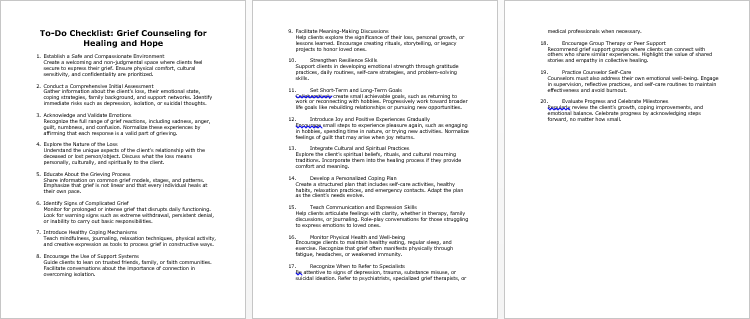
Grief Counseling for Healing and Hope – Checklist
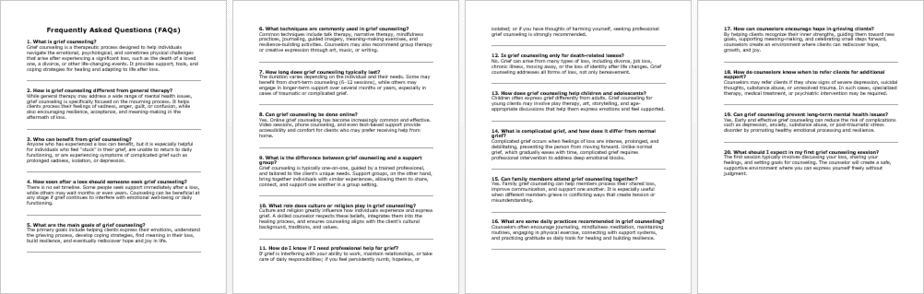
Grief Counseling for Healing and Hope – FAQs
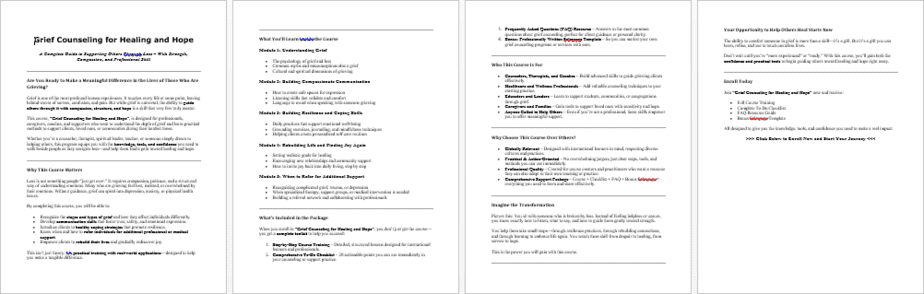
Grief Counseling for Healing and Hope – Salespage Content
Package Details:
Word Count: 31 682 Words
Number of Pages: 126
Grief Counseling for Healing and Hope – Bonus Content
Checklist
Word Count: 597 words
FAQs
Word Count: 905 words
Salespage Content
Word Count: 919 words
Total Word Count: 34 103 Words
Your PLR License Terms
PERMISSIONS: What Can You Do With These Materials?
Sell the content basically as it is (with some minor tweaks to make it “yours”).
If you are going to claim copyright to anything created with this content, then you must substantially change at 75% of the content to distinguish yourself from other licensees.
Break up the content into small portions to sell as individual reports for $10-$20 each.
Bundle the content with other existing content to create larger products for $47-$97 each.
Setup your own membership site with the content and generate monthly residual payments!
Take the content and convert it into a multiple-week “eclass” that you charge $297-$497 to access!
Use the content to create a “physical” product that you sell for premium prices!
Convert it to audios, videos, membership site content and more.
Excerpt and / or edit portions of the content to give away for free as blog posts, reports, etc. to use as lead magnets, incentives and more!
Create your own original product from it, set it up at a site and “flip” the site for megabucks!
RESTRICTIONS: What Can’t You Do With These Materials?
To protect the value of these products, you may not pass on the rights to your customers. This means that your customers may not have PLR rights or reprint / resell rights passed on to them.
You may not pass on any kind of licensing (PLR, reprint / resell, etc.) to ANY offer created from ANY PORTION OF this content that would allow additional people to sell or give away any portion of the content contained in this package.
You may not offer 100% commission to affiliates selling your version / copy of this product. The maximum affiliate commission you may pay out for offers created that include parts of this content is 75%.
You are not permitted to give the complete materials away in their current state for free – they must be sold. They must be excerpted and / or edited to be given away, unless otherwise noted. Example: You ARE permitted to excerpt portions of content for blog posts, lead magnets, etc.
You may not add this content to any part of an existing customer order that would not require them to make an additional purchase. (IE You cannot add it to a package, membership site, etc. that customers have ALREADY paid for.)
Share Now!
Latest Products




Free Sales Funnel Builder

Related Products
Popular & Trending



Featured Products