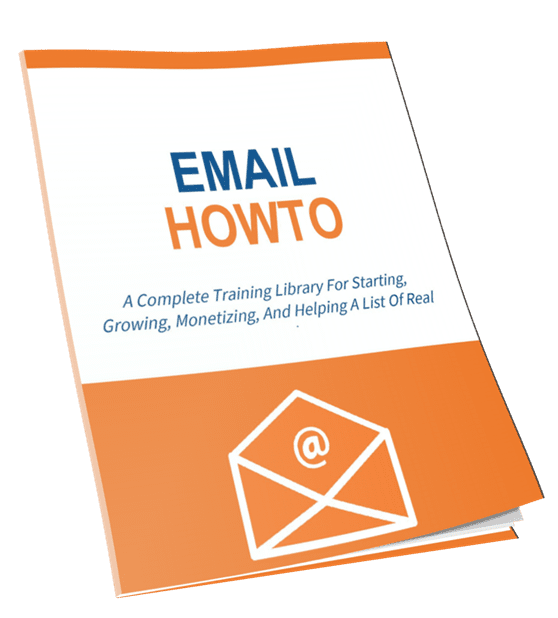

Future-Proof Careers PLR Course 34k Words
in Business PLR , PLR eCourses , PLR List Building Reports , Premium PLR , Premium PLR Reports , Premium White Label Brandable PLR Coaching Courses , Private Label Rights ProductsChoose Your Desired Option(s)
has been added to your cart!
have been added to your cart!
#futureproofcareers #plrcourse #careergrowth #professionaldevelopment #careercoaching #plrcontent #successmindset
34,000+ Words of Premium, Ready-to-Sell Content for the Fastest-Growing Career Niche
The world of work is changing faster than ever.
Automation is accelerating.
AI is transforming industries.
Remote work is redefining offices.
Entire job roles are disappearing — while new ones are being created overnight.
People are anxious.
They’re asking:
- “Will my job still exist in five years?”
- “What skills should I learn now?”
- “How do I stay relevant in this economy?”
- “How can I design a career that survives change?”
That fear creates opportunity.
And now you can step into one of the most profitable and evergreen markets online with a complete, high-value training program you can brand and sell as your own.
Introducing the…
Future-Proof Careers PLR Course 34k Words
A Step-by-Step Roadmap to Building Skills, Confidence, and Adaptability in the Changing World of Work
This is a comprehensive 34,000+ word PLR course designed to help learners understand the future of work, build in-demand skills, and create a personalized action plan to thrive in tomorrow’s economy.
This is not a basic ebook.
It’s a structured, professional training program built for real transformation — and real profit potential.
Why This Course Will Sell
Career anxiety is at an all-time high.
Students, graduates, mid-career professionals, corporate employees, freelancers, and even business owners are actively searching for answers.
They want:
- Career stability
- Future-ready skills
- Guidance on AI and automation
- Remote and freelance opportunities
- A clear roadmap for growth
Future-Proof Careers gives them exactly that.
It addresses uncertainty with clarity.
It replaces fear with strategy.
And it provides a structured path forward.
What You Get Inside This 34,000+ Word Course
The course is professionally organized into 5 detailed modules with 20 focused lessons. Each module builds on the previous one, guiding learners from awareness to action.
Module 1: Understanding the Future of Work
Foundation and Awareness
Before someone can future-proof their career, they need to understand what’s changing — and why.
Lesson 1: The Changing World of Careers
Learners discover how automation, AI, globalization, and digital transformation are reshaping industries. It clearly explains why traditional “one job for life” career paths are fading and what’s replacing them.
Lesson 2: Key Industries of the Future
This lesson highlights booming sectors such as:
- Technology
- Healthcare
- Green energy
- Digital services
- Remote-based industries
It shows where opportunity is expanding — not shrinking.
Lesson 3: The Importance of Adaptability
Adaptability is positioned as the #1 career survival skill. Learners discover practical ways to build flexibility and resilience starting immediately.
Lesson 4: The Mindset for Lifelong Growth
A growth mindset becomes the foundation for career security. This lesson reinforces curiosity, learning, and long-term relevance.
By the end of Module 1, learners understand that change is not the enemy — stagnation is.
Module 2: Building In-Demand Skills
The Skills Employers Will Value Most
Understanding change isn’t enough. Skills are the currency of the future.
Lesson 1: Power Skills vs. Hard Skills
This lesson breaks down:
- Technical skills (coding, analytics, systems knowledge)
- Human-centered skills (communication, leadership, adaptability)
It explains why both are critical — and why human skills are becoming more valuable in the age of AI.
Lesson 2: Digital Literacy & Tech Comfort
Not everyone is “tech-savvy,” and this lesson addresses that directly. It builds confidence around learning new tools, understanding basic digital platforms, and becoming comfortable in a tech-driven world.
Lesson 3: Creativity and Problem-Solving
Automation handles repetition. Humans handle creativity. Learners discover practical exercises to improve critical thinking and stand out in competitive industries.
Lesson 4: Communication & Collaboration
Modern work requires strong collaboration skills — especially in remote environments. This lesson teaches online communication, virtual teamwork, and professional presence.
By the end of Module 2, learners have a toolbox of high-value, transferable skills.
Module 3: Career Paths of Tomorrow
Real Opportunities in Growing Industries
Now the course gets practical.
Instead of abstract advice, learners explore actual career directions aligned with future demand.
Lesson 1: Careers in Technology
Explores roles such as:
- Data analyst
- AI specialist
- Cybersecurity expert
- Software developer
It explains how beginners can start small and gradually build expertise.
Lesson 2: Careers in Sustainability
Green energy and environmental careers are expanding rapidly. Learners explore renewable energy, sustainable business practices, and environmental science roles.
Lesson 3: Human-Centered Professions
Despite automation, certain fields will always need people at the center:
- Healthcare
- Coaching
- Education
- Counseling
This lesson highlights the long-term security of human-focused careers.
Lesson 4: The Rise of Freelance & Remote Work
The gig economy is reshaping employment. Learners discover how freelancing, remote work, and global contracts offer flexibility and income potential.
Module 3 turns uncertainty into tangible opportunity.
Module 4: Personal Branding & Career Resilience
Becoming Visible and Competitive
Skills alone are not enough. Visibility matters.
Lesson 1: Building a Personal Brand
Learners discover how to position themselves as valuable professionals. This includes showcasing strengths, values, and expertise in a way that attracts opportunities.
Lesson 2: Networking in the Digital Age
Practical strategies for building authentic professional relationships online — especially on LinkedIn — without being pushy or awkward.
Lesson 3: Continuous Learning Habits
Micro-learning, podcasts, online courses, and habit-building strategies that prevent overwhelm while ensuring steady growth.
Lesson 4: Handling Career Shifts with Confidence
Industries change. Roles evolve. This lesson teaches how to remain calm, adaptable, and proactive during career transitions.
This module significantly increases the perceived value of the course.
Module 5: Designing Your Future-Proof Career Plan
Turning Knowledge into Action
Awareness and skills mean little without execution.
Lesson 1: Mapping Your Career Vision
Learners clarify their long-term direction based on strengths, interests, and market trends.
Lesson 2: Setting Career Goals the Smart Way
Teaches practical goal-setting frameworks that create momentum without pressure.
Lesson 3: Building Your Action Plan
Step-by-step instructions for drafting a personal roadmap for skills, experience, networking, and growth.
Lesson 4: Staying Future-Ready
Encourages curiosity, flexibility, and continuous evaluation — ensuring long-term career security.
By the End of This Course, Learners Will Have:
- A clear understanding of how careers are evolving
- Knowledge of growing industries and opportunities
- A toolbox of in-demand future-ready skills
- Greater adaptability and resilience
- A personalized action plan for long-term success
This makes the product highly attractive to students, professionals, and career changers.
Bonus Materials Included
You also receive:
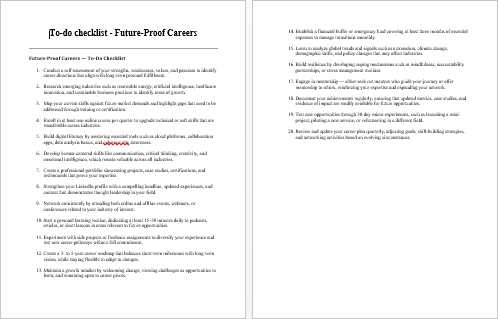
- Future-Proof Careers Checklist (417 Words)
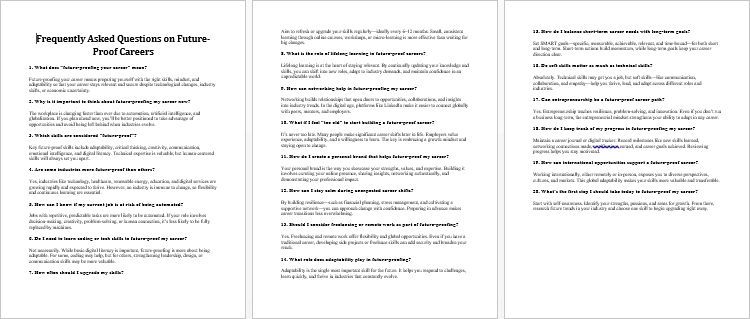
- Future-Proof Careers FAQs (801 Words)
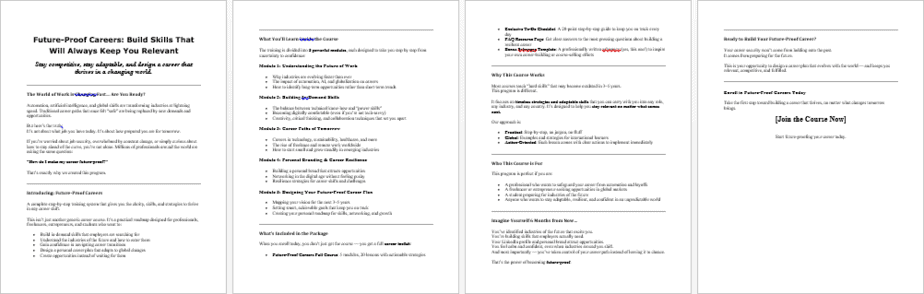
- Done-For-You Sales Page (781 Words)
These materials make launching fast and easy.
How You Can Use and Profit From This PLR Course
This product is extremely versatile.
Here are powerful monetization ideas:
1. Sell as a Complete Digital Course
Add branding and minor edits. Price it between $47 and $97 as a self-study program.
2. Break It Into Mini Reports
Turn each module into a standalone guide and sell them individually for $10–$20 each.
3. Create a Premium Bundle
Combine with productivity, AI, remote work, or business PLR and sell bundles for $47–$97.
4. Launch a Career Membership Site
Release modules monthly or weekly. Charge $19–$39 per month for recurring revenue.
5. Turn It Into a Multi-Week eClass
Add live sessions or coaching support and charge $297–$497 per student.
6. Convert to Audio or Video Training
Create a video course, workshop series, or audiobook for additional product formats.
7. Use as a Lead Generation Funnel
Offer a free excerpt like “Top 5 Future Skills” and upsell the full course.
8. Create a Physical Workbook
Transform into a printed planner or guided workbook and sell at premium pricing.
9. Build a Career-Focused Brand
Create a niche authority website around future careers, generate traffic, and flip the site for profit.
License Summary
You Can:
- Sell with minor tweaks
- Rebrand and modify
- Break into smaller products
- Bundle with other content
- Convert to audio, video, or physical formats
You Cannot:
- Pass PLR or resale rights to customers
- Offer more than 75% affiliate commissions
- Give away the complete product for free
- Add it to existing paid packages without requiring a new purchase
These terms protect the integrity and value of your investment.
Why Buy From Buy Quality PLR?
Buy Quality PLR specializes in:
- High-demand, evergreen niches
- Deep, structured content
- High word counts and real educational value
- Products designed for serious marketers
You are not buying thin content.
You are acquiring a complete career transformation framework that positions you in a booming industry.
The Opportunity Is Now
The future of work is uncertain — but the demand for guidance is certain.
Professionals want clarity.
Students want direction.
Employees want security.
Freelancers want adaptability.
Future-Proof Careers gives you a ready-made solution to meet that demand.
Launch faster.
Sell smarter.
Build authority in a growing niche.
Get the Future-Proof Careers PLR Course today and turn career anxiety into profitable opportunity.
has been added to your cart!
have been added to your cart!
Here A Sample of the Future-Proof Careers PLR Course
A step-by-step roadmap to building skills, confidence, and adaptability in the changing world of work.
Module 1: Understanding the Future of Work
This module sets the stage by helping learners understand how careers are evolving in today’s world.
Lesson 1: The Changing World of Careers
Welcome — this lesson lays the foundation for the whole course. We’ll explore how automation, artificial intelligence, globalization, demographic shifts, and social expectations are reshaping careers. The goal is to give learners both an intellectual map and practical first steps so they leave with clarity and confidence.
Learning objectives (what learners will be able to do)
✓ Explain three major forces changing work today (automation/AI, globalization, demographic & social change).
✓ Identify how those forces affect career paths and workplace expectations.
✓ Reflect on personal career assumptions and update one short-term career intention.
✓ Create a simple action checklist to begin adapting immediately.
Instructor preparation (before class)
• Read through the full lesson script and adapt language for your audience (beginner, mid-career, executive).
• Prepare slides or visual aids that show clear examples (no jargon). Use simple graphs or timelines.
• Print or prepare a one-page handout: “Three Forces Shaping Careers” and an activity worksheet titled “My Career Shift Map.”
• Arrange breakout groups (if online, pre-assign groups to avoid delays).
• Time estimate: plan for 90–120 minutes total; you can compress to 60 minutes by shortening activities.
Lesson timeline — step-by-step (90–120 minutes)
1) Warm-up & expectation check — 10 minutes
- Greet learners and state the lesson purpose in one sentence: “Today we’ll see why many career rules have changed and what that means for you.”
- Quick pulse: Ask learners to type one word in chat or on a sticky note: “What does ‘career’ mean to you today?” Display 6–8 responses.
- Use the responses to validate feelings (uncertainty, excitement) and to frame the lesson: careers are changing — and that creates both risk and opportunity.
2) Short lecture: The three big forces — 20 minutes
Structure the lecture as three short segments. For each, follow the mini-pattern: definition → clear example → one implication.
A. Automation & AI (7 minutes)
→ Define briefly: tools and systems performing tasks previously done by humans.
→ Example: routine data processing moved from manual spreadsheets to automated workflows and AI-assisted analysis.
→ Implication: Roles that rely on repetitive tasks shrink; roles that design, interpret, and humanize technology grow.
B. Globalization & Digital Connectivity (7 minutes)
→ Define: markets, teams, and clients connected across borders.
→ Example: a small design studio can now offer services globally; competition can come from anywhere.
→ Implication: Geographical advantage shifts; communication and cultural competence become critical.
C. Demographic & Social Shifts (6 minutes)
→ Define: aging populations, longer careers, changing values (purpose, flexibility).
→ Example: Multigenerational teams, later-career retraining, rising demand for healthcare and experience-driven services.
→ Implication: Career longevity requires continuous learning; job design must be more humane and flexible.
3) Guided discussion: Local effects, global patterns — 15 minutes
• Break students into small groups (3–5). Give each group one prompt (rotate prompts if many groups):
→ “How has technology changed hiring or work in your country or industry?”
→ “Name a job that existed 20 years ago but looks very different now.”
→ “What local cultural value affects how people approach career change?”
• Ask groups to prepare a 90-second summary.
• Reconvene and share 3–5 highlights. Emphasize similarities and differences across contexts. Use this to stress: global forces manifest differently locally.
4) Activity: Personal Career Shift Map — 25 minutes
This is the hands-on core of the lesson.
Step A — Individual reflection (7 minutes)
— On the worksheet, learners list their current role, three daily tasks, and one skill they enjoy.
— Then they mark which tasks are routine vs. creative/strategic.
Step B — Force-impact mapping (8 minutes)
— Learners draw three columns titled Automation, Globalization, Social/Demographic.
— For each task, they write a short note under the column where that force most likely affects it.
Step C — Pair share and peer feedback (10 minutes)
— In pairs, learners explain their map and receive one suggestion for retooling a skill or shifting a task toward higher-value work (roles machines don’t do well). Encourage culturally relevant suggestions — e.g., in some regions, interpersonal networks matter more than formal credentials.
5) Case study & role play — 15 minutes
Use a short, fictional case study (2–3 paragraphs) of a mid-career professional whose industry is being disrupted (e.g., a financial analyst seeing increased automation). Provide a decision set: retrain for data strategy, pivot to client-facing advisory, or learn product design.
• Assign roles: the professional, a mentor, an employer HR rep.
• Role play a 5–7 minute conversation where they negotiate a next move.
• Debrief: highlight adaptive behaviors shown (asking good questions, proposing a pilot project, seeking micro-credentials).
6) Synthesis & practical checklist — 10 minutes
Present a concise, practical checklist learners can use immediately. Read it aloud and explain briefly:
✓ Audit your task list weekly — note which tasks are repeatable.
✓ Identify one tech tool that can reduce manual work (learn the basics).
✓ Commit 30 minutes daily for learning (micro-learning).
✓ Build one evidence item (portfolio, case story) showing human judgment or creativity.
✓ Expand one network contact outside your current field.
7) Assessment & reflection — 5–10 minutes
• Quick written reflection: “One belief I had about my career that changed today” (1–2 sentences).
• Collect reflections (chat, sticky note, or form). Use these as formative assessment to see who needs extra support.
Instructor script tips (phrasing you can use)
• “Think of automation like an assistant that takes over tasks you do dozens of times a week — its arrival means you get to redesign the part of your job that only humans can do.”
• “When I say ‘globalization,’ I don’t mean only trade — I mean that your next collaborator or competitor could be in a different time zone.”
• “If a task is repeatable and rule-based, it’s probably at risk; if it requires judgment, empathy, or complex negotiation, it’s more future-proof.”
Assessment rubric (simple, practical)
Use a 3-point scale for the activity outputs:
3 — Clear, evidence-based map; actionable adaptation plan.
2 — Partial map; general adaptation ideas but lacking specifics.
1 — Incomplete map; needs guidance.
Assessment focuses on: clarity of task-audit, logical mapping of forces, and practicality of adaptation choices.
International course creator notes — adapt for different contexts
• Language: Offer the worksheet in learners’ main languages where feasible. Use plain English for international groups.
• Technology access: If learners have limited connectivity, convert breakout tasks into offline pair activities or homework.
• Cultural norms: In cultures where admitting uncertainty is sensitive, frame reflection as “curiosity exploration” to reduce defensiveness.
• Time zones & synchronous learning: For global cohorts, record the lecture portion and use live sessions for activities and discussion.
• Examples: Use local examples when possible — invite learners to submit one local disruption story ahead of class to personalize the case studies.
Accessibility & inclusion
• Provide slides and transcripts in advance.
• Use large fonts, high-contrast visuals, and readable charts.
• For neurodiverse learners, give clear step sequences and allow extra time for written reflection.
Materials & handouts (what to prepare)
• One-page handout: “Three Forces Shaping Careers” (definitions + quick examples).
• Worksheet: “My Career Shift Map” (task list, force columns, action box).
• Short case study printout for role play.
• Slide deck with visuals and simplified diagrams (no text-dense slides).
Closing summary (what learners should remember)
• Careers are being reshaped by automation/AI, globalization, and demographic/social changes — not just one factor.
• The key to resilience is not predicting exact jobs, but strengthening abilities machines can’t replace: judgment, creativity, relationship-building, and cultural fluency.
• Practical habits — auditing tasks, micro-learning, and building evidence of human judgment — are the most immediate levers learners can use.
Short homework assignment (practical and immediate)
Ask each learner to complete one tangible item within seven days:
• Produce a 1-page “Career Shift Map” showing three tasks to automate or delegate and three skills to develop, plus one small action they will take this week (e.g., enroll in a specific micro-course, interview someone in a growth industry, or try a productivity tool).
This lesson is intentionally practical: the emphasis is on recognition (see the forces), analysis (map the effects on your work), and action (create one small, achievable step). Use the activities and scripts as-is or adapt them for your learners’ language, culture, and access level.
Lesson 2 — Key Industries of the Future
Learn which industries are booming — technology, healthcare, green energy, and digital services — and what practical opportunities they create.
Welcome! This lesson is built for international course creators who will teach diverse audiences. The goal is to give you a ready-to-run, step-by-step classroom session that explains why these industries matter, what they look like in practice, and how learners can map opportunities into concrete career moves. Use plain language, regional examples, and the activities below to make the material local and actionable.
Learning objectives
By the end of this lesson learners will be able to:
- Name four high-growth industry clusters and describe the core drivers behind each.
- Identify 3–5 job roles or micro-roles emerging in each industry.
- Map one transferable skill to an industry opportunity.
- Draft a one-month experimental plan to test interest in a chosen industry.
Instructor preparation
- Print or prepare slides with one slide per industry: short definition, 3 drivers, 5 example roles.
- Prepare worksheets: “Industry Snapshot” and “Skill-to-Role Match.”
- Line up 2–3 short (2–3 minute) video clips or local news headlines showing innovation in each industry — or prepare short instructor-read case vignettes.
- Time: plan for 90–120 minutes (detailed timeline below).
- For global cohorts, collect 4–6 learner-submitted local examples in advance.
Lesson timeline — step-by-step (90–120 minutes)
1) Hook & framing — 10 minutes
- Start with a one-sentence framing: “Some industries are shrinking, others are expanding fast — today we focus on the ones creating the most new opportunities.”
- Quick poll (live or on paper): “Which industry do you think will hire the most in the next five years?” Show results and say: “We’ll check those assumptions against evidence and practical signals.”
2) Mini-lecture: Why these four clusters? — 20 minutes
Introduce the four clusters: Technology, Healthcare, Green Energy, and Digital Services. For each cluster give:
- A one-line definition.
- Two growth drivers (e.g., tech: AI & cloud adoption).
- Three real-world example roles (including micro-roles).
After each cluster, give a one-sentence implication for learners (what to focus on).
Technology (AI, cloud, cybersecurity, data)
Explain that businesses across sectors embed software, machine learning, and cloud platforms to improve productivity and create new products. This is not only for software firms — banks, hospitals, farms use these tools. Evidence shows rapid AI adoption across business functions globally. McKinsey & Company
Example roles: AI-assisted analyst, cloud engineer, MLOps technician, cybersecurity analyst, prompt engineer (micro-role).
Implication: Emphasize continuous learning in tooling, data literacy, and human-centred problem framing.
Healthcare (telehealth, biotech, eldercare, digital therapeutics)
Explain drivers: ageing populations, chronic disease burden, and tech-enabled care models (telemedicine, remote monitoring). Demand is growing for roles that blend clinical knowledge with technology and caregiving. The global population aged 60+ is rising rapidly, creating systemic demand in care and health services. World Health Organization
Example roles: telehealth coordinator, clinical data specialist, community health navigator, biotech lab technician, eldercare program manager.
Implication: Soft skills (empathy, communication) combine with digital skills (health IT literacy).
Green Energy (renewables, battery storage, EVs, grid modernization)
Explain drivers: cost declines in solar and wind technologies, policy targets for emission reductions, and investments in grid and storage. Global forecasts show major additions in renewable capacity—solar and wind are central to energy growth. IEA
Example roles: solar installation technician, battery systems engineer, EV service technician, energy auditor, project finance analyst.
Implication: Hands-on technical trades plus data and project financing skills are in demand.
Digital Services (e-commerce, digital marketing, cloud-based services, online education and platforms)
Explain drivers: digital consumption, platformization of services, and cross-border remote delivery. The ICT sector has outpaced broader economic growth, signaling sustained demand for digital skills and services. OECD
Example roles: e-commerce operations specialist, UX content designer, digital campaign manager, remote customer success associate, course curator.
Implication: Combine domain knowledge (e.g., retail) with platform competence (e.g., Shopify, analytics).
Conclude the mini-lecture with the broader labour market signal: large-scale job growth is expected in education, digital commerce and trade, and related clusters — which underscores transferable demand across regions. World Economic Forum
3) Deep-dive activity: Industry snapshot rotations — 30 minutes
Divide learners into four groups; assign one industry per group. Each group completes an “Industry Snapshot” worksheet with these steps:
Step A — Scan (5 minutes): Use instructor-provided short vignette or prepared local example.
Step B — Map (10 minutes): Identify 3 drivers, 5 emergent roles, and 2 transferable skills relevant locally.
Step C — Pitch (5 minutes): Prepare a 90-second pitch to the class: “Why this industry could hire in our city/region in the next 2 years.”
Instructor tip: encourage local examples — a small solar start-up, a telehealth clinic, a fintech firm, or a popular e-commerce seller.
4) Skill-to-role mapping — 15 minutes
After pitches, everyone does a quick individual worksheet: choose one role from any group and map:
- One existing skill you have that maps to the role.
- One short learning action (≤2 weeks) to close the gap (e.g., a micro-course, project, or volunteer gig).
Share examples aloud (30–60 seconds each).
5) Case study & micro-experiment design — 15 minutes
Present a 2-paragraph case (e.g., “Local NGO wants to launch telemedicine in semi-urban areas; budget €25,000; needs people to design service flow”). Learners sketch a micro-experiment (two-week pilot) to test whether a role is viable (define hypothesis, minimal deliverables, stakeholders to contact).
Debrief: highlight low-cost experiments learners can run to validate interest and fit.
6) Synthesis & practical checklist — 5 minutes
Read a short checklist aloud (and place on slide/handout):
- Monitor job listings & local projects weekly (set alerts in local currency signs: $, €, £, ₹, ¥).
- Build one evidence item (case write-up or micro-portfolio) within 30 days.
- Reach out to one practitioner for an informational conversation each week.
Classroom tools & materials
- Industry Snapshot worksheet (one page per industry).
- Skill-to-Role Match template (two columns: skills / actions).
- Case study printouts.
- Slide deck with concise data bullets and regional examples.
- Optional: short local video clips or guest speaker via call.
Assessment rubric (practical)
For the Industry Snapshot and Skill-to-Role tasks use a 3-point rubric:
3 — Insightful mapping; clear local relevance; concrete short learning action.
2 — Adequate mapping; general actions but lacking timeline or measurable deliverable.
1 — Vague mapping; needs instructor guidance.
Assess micro-experiment plans for clarity of hypothesis, feasibility within resources, and identification of at least one measurable outcome.
International adaptation notes
- Language & literacy: offer worksheet translations or simplified English. Use examples from participants’ regions (e.g., local renewable projects, local telehealth providers).
- Connectivity: if internet is limited, substitute live polls with paper sticky-notes and use pre-loaded vignettes.
- Currency & policy: when discussing jobs or project budgets, use international currency symbols to help learners think globally ($, €, £, ₹, ¥).
- Cultural norms: in some cultures a direct pitch may be unfamiliar—frame the “pitch” as a “community briefing” to reduce discomfort.
Accessibility & inclusion
- Provide slides and worksheets ahead of time.
- Use high contrast fonts and readable font sizes.
- Offer extra time for written reflections; allow audio responses for learners who prefer speaking.
Instructor script snippets (friendly, practical phrasing)
- “You don’t have to become a coder to participate in the tech economy — many roles focus on questions, not just code.”
- “In healthcare, technology expands reach but human care remains central — that’s where many new jobs live.”
- “Green energy growth creates both field jobs and finance jobs — so there are entry points for practical and office skills.”
- “Digital services scale fast — a small seller online can be global next month; the skills are practical and repeatable.”
Closing summary (what learners should remember)
- Four industry clusters — technology, healthcare, green energy, and digital services — are producing a wide variety of roles, from hands-on technicians to hybrid tech-human specialists.
- Look for roles that combine human strengths (judgment, empathy, cultural context) with digital or technical tools.
- Small experiments, local evidence, and targeted micro-learning are the fastest ways to move from curiosity to employability.
Homework assignment (practical, 7 days)
Ask each learner to complete one tangible item within seven days:
- Produce a one-page “Industry Interest Note”: pick one industry, name two local or online organizations working there, list three roles you could aim for, and write one 2-week experiment to test interest (contact a practitioner, complete a micro-task, or draft a mini-portfolio entry).
Use this lesson as a modular block: you can deliver it in a half-day workshop, two 60-minute sessions, or as a flipped classroom (record the lecture and use live time for activities). Adapt examples to the learners’ local economies and always close with a realistic, low-cost experiment learners can run immediately.
Lesson 3 — The Importance of Adaptability
Welcome. In this lesson we dive into why adaptability is the single most important career skill for the future — and how you, as an instructor, can help learners start building it today. This lesson is designed for international course creators teaching mixed cohorts, so every activity is easy to localize, low-cost, and focused on practical behaviour change rather than abstract theory.
Learning objectives
By the end of this lesson learners will be able to:
- Explain why adaptability matters more than any single technical skill in fast-changing labour markets.
- Identify three behaviours that show practical adaptability in the workplace.
- Complete a personal Adaptability Audit and pick one micro-habit to practise for 14 days.
- Design and run a two-week micro-experiment that demonstrates adaptive problem solving.
Instructor preparation
- Read the full lesson and adapt examples to your region. Prepare 1 slide per section.
- Print or create the following handouts: Adaptability Audit, Behavioural Checklist, Micro-Experiment Template.
- Prepare three short local case vignettes (1 paragraph each) showing adaptive moves: a hospitality worker who reskilled for logistics, a teacher who launched online classes, a shop owner who added delivery services.
- Arrange breakout rooms or pairings if teaching online.
- Time estimate: 90–120 minutes (you can compress to 60 minutes by shortening activities).
Include international signs in materials where relevant (e.g., budgets for micro-experiments shown as $ / € / £ / ₹ / ¥).
Lesson timeline — step-by-step (90–120 minutes)
1) Warm-up and orientation — 10 minutes
- Say a short framing sentence: “Adaptability is not a personality trait you either have or don’t — it’s a set of behaviours we can practise.”
- Quick poll: Ask learners to name one recent change in their job or city (e.g., new tech, different customer habits, local regulation). Capture 6–8 responses and use one or two as teaching hooks.
- Promise: “By the end of this session you will leave with a simple audit and one concrete micro-habit you can start today.”
2) Mini-lecture: What adaptability is — 15 minutes
Break the lecture into three clear parts: definition, why it outranks other skills, and the core behaviours.
A. Definition (3 minutes)
- Say: “Adaptability is the ability to notice change, make quick but thoughtful adjustments, and learn from outcomes.” Keep it behaviour-focused.
B. Why adaptability outranks single skills (6 minutes)
- Use plain examples: a printer operator who learned basic network troubleshooting, a marketing specialist who learned analytics to add value.
- Make the point: specific tools or platforms become obsolete; the capacity to learn, to reframe problems, and to collaborate across domains lasts.
- Mention tangible signals: if roles are reconfigured every few years, formal credentials alone won’t be enough. Employers hire people who can handle ambiguity.
C. Core adaptable behaviours (6 minutes) — introduce four behaviours and one quick example each:
- Learning Rapidly: deliberately learning the minimum that will move a decision forward (example: learning a dashboard to answer a client question within 48 hours).
- Experimenting Safely: running low-cost tests to validate ideas (example: offering a new service to one customer before scaling).
- Reframing Problems: shifting from “I can’t do X” to “What can I do next?” (example: turning a product shortage into a service opportunity).
- Seeking Diverse Feedback: asking for perspectives outside your immediate team (example: asking a colleague in operations how a delivery issue impacts customers).
3) Guided activity: Adaptability Audit — 20 minutes
This is the behavioural heart of the lesson.
Step A — Individual self-audit (10 minutes)
- Hand out the Adaptability Audit. Sections: Recent changes you’ve handled, Typical reactions (freeze/deny/try), Three times you learned something fast, One skill you avoided learning.
- Instruct learners to be honest and specific: name projects, dates, and actions.
Step B — Pair reflection (10 minutes)
- Pair learners (cross-cultural pairs if possible). Each person shares one audit item and the peer asks two structured questions: “What was helpful?” and “What would you try differently next time?”
- Encourage specific wording: avoid vague terms like “be proactive” — look for actions like “ask for daily 10-minute check-ins” or “try a one-week micro-course.”
4) Demonstration: Micro-Habit Design — 15 minutes
Show learners how to convert insight into a simple habit.
Step A — Instructor demo (5 minutes)
- On screen, show an example: someone who wants to be more comfortable with data commits to “15 minutes, three times a week, opening a dashboard and writing one sentence about what the numbers mean.” Include the international sign for time and budget if relevant (e.g., set aside ¥0, $0 — emphasize low-cost).
Step B — Learner drafting (10 minutes)
- Each learner chooses one micro-habit from a menu (15-minute learning slot, daily reflection, weekly outreach to someone outside their team, a 48-hour experiment window). They write it as a SMART-style sentence: Specific, Measurable, Achievable, Relevant, Time-bound.
5) Active practice: Rapid Problem-Solve Challenge — 20 minutes
This activity simulates adaptive behaviour under time pressure.
Step A — Present a short scenario (1–2 minutes)
- Example scenario: “A local retailer’s supply chain is disrupted for two weeks. The retailer must keep revenue flowing with reduced stock.” Keep the scenario regionally neutral and easy to modify for local contexts.
Step B — Small teams generate 3 adaptive responses (10 minutes)
- Each team lists three options under constraints (budget €500 / $500 / ₹5000; staff available: 2). Options must include at least one low-tech and one digital solution.
Step C — Rapid pitching and feedback (9 minutes)
- Each team makes a 60-second pitch. Peers give one concrete improvement suggestion each. Instructor highlights adaptive elements: reframing, quick learning, and pilot design.
6) Reflection & behavioural checklist — 10 minutes
- Present the Adaptability Behaviour Checklist: daily micro-learning (15 minutes), weekly feedback conversation (one person outside your function), monthly micro-experiment (1–2 weeks), and a public evidence item (a short case note or micro-portfolio entry). Include currency symbols when discussing small budgets for pilots: e.g., “Run a 2-week pilot with a budget of $50 / €50 / ₹2,000 / ¥5,000 / £40.”
- Ask learners to commit to one checklist item verbally or in chat.
7) Assessment activity — 10 minutes
- Quick written assessment: “Describe one situation where you will apply your micro-habit in the next 14 days. Include who you will involve and one metric you will use to judge success.” Collect responses via chat or a short form.
Instructor script tips (phrasing you can use)
- “Adaptability is a muscle — small repetitions build capacity.”
- “We don’t need perfection; we need iteration. A 2-week pilot that fails gives more learning than a 6-month plan that never starts.”
- “When learners feel stuck, ask them to identify the smallest useful next step — not the perfect solution.”
Assessment rubric (practical)
Use a 3-level rubric for the Adaptability Audit output and micro-experiment plan:
3 — Clear audit, a specific micro-habit with timeline, a feasible micro-experiment including one measurable outcome.
2 — Audit present, micro-habit general but plausible, experiment lacks a measurable outcome or timeline.
1 — Audit vague, no clear habit or experiment, needs guided support.
Assess active practice by observing teams: Did they reframe the problem? Did they propose a low-cost test? Did they identify a learning metric?
International adaptation notes
- Language and literacy: offer the Audit and Checklist in simplified English or local languages. Use clear verbs rather than abstract nouns.
- Connectivity and cost: design micro-experiments that require minimal internet or budget. Examples: phone surveys, classroom mock-ups, paper-based prototypes. Use international currency signs when giving sample budgets to help learners think in local terms ($ / € / £ / ₹ / ¥).
- Cultural expectations: in cultures where risk-taking is less common, frame experiments as “community learning pilots” and pair learners with a trusted peer or mentor.
- Timezones and scheduling: if your cohort is global, stagger practice groups so everyone has live peer feedback at reasonable local hours.
Accessibility & inclusion
- Provide written prompts and the Audit in advance.
- Allow audio or video responses for people who prefer speaking.
- Give extended time for reflective writing.
- Use large-font handouts and clear contrasts on slides.
Materials & handouts
- Adaptability Audit (one page).
- Behavioural Checklist (one page; printable).
- Micro-Experiment Template (hypothesis, minimal deliverable, timeline, measure, cost).
- Short case vignettes for role play.
Include a sample micro-experiment budget in multiple currencies to normalise low-cost testing: e.g., “Sample budget: $30 / €25 / £20 / ₹2,500 / ¥3,500 — for messaging, small materials, or transport.”
Closing summary
Adaptability is not a mystical trait — it is a practical cluster of behaviours you can teach, coach, and measure. As a course creator, your role is to make those behaviours visible, safe to practise, and quick to test. Focus on small habits, low-cost experiments, and regular feedback loops. Teach learners to reframe problems, learn the minimum needed fast, and document experiments as evidence of capability.
Deliver this lesson with local examples, pair learners across cultures when possible, and insist on one small, measurable action. That single action practiced for two weeks builds more adaptability than a vague aspiration.
We’re also giving these extra bonuses
Future-Proof Careers – Checklist
Future-Proof Careers – FAQs
Future-Proof Careers – Salespage Content
Package Details:
Word Count: 32 135 Words
Number of Pages: 145
Future-Proof Careers – Bonus Content
Checklist
Word Count: 417 words
FAQs
Word Count: 801 words
Salespage Content
Word Count: 781 words
Total Word Count: 34 134 Words
Your PLR License Terms
PERMISSIONS: What Can You Do With These Materials?
Sell the content basically as it is (with some minor tweaks to make it “yours”).
If you are going to claim copyright to anything created with this content, then you must substantially change at 75% of the content to distinguish yourself from other licensees.
Break up the content into small portions to sell as individual reports for $10-$20 each.
Bundle the content with other existing content to create larger products for $47-$97 each.
Setup your own membership site with the content and generate monthly residual payments!
Take the content and convert it into a multiple-week “eclass” that you charge $297-$497 to access!
Use the content to create a “physical” product that you sell for premium prices!
Convert it to audios, videos, membership site content and more.
Excerpt and / or edit portions of the content to give away for free as blog posts, reports, etc. to use as lead magnets, incentives and more!
Create your own original product from it, set it up at a site and “flip” the site for megabucks!
RESTRICTIONS: What Can’t You Do With These Materials?
To protect the value of these products, you may not pass on the rights to your customers. This means that your customers may not have PLR rights or reprint / resell rights passed on to them.
You may not pass on any kind of licensing (PLR, reprint / resell, etc.) to ANY offer created from ANY PORTION OF this content that would allow additional people to sell or give away any portion of the content contained in this package.
You may not offer 100% commission to affiliates selling your version / copy of this product. The maximum affiliate commission you may pay out for offers created that include parts of this content is 75%.
You are not permitted to give the complete materials away in their current state for free – they must be sold. They must be excerpted and / or edited to be given away, unless otherwise noted. Example: You ARE permitted to excerpt portions of content for blog posts, lead magnets, etc.
You may not add this content to any part of an existing customer order that would not require them to make an additional purchase. (IE You cannot add it to a package, membership site, etc. that customers have ALREADY paid for.)
Share Now!
Latest Products

Free Sales Funnel Builder

Related Products
Popular & Trending



Featured Products