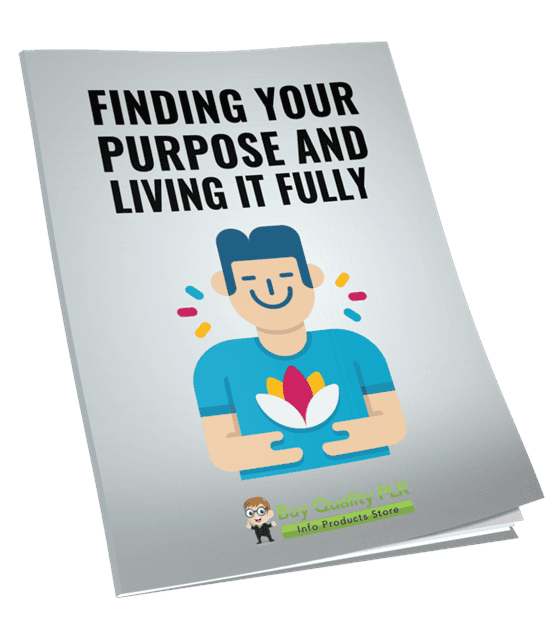
Finding Your Purpose and Living It Fully PLR Course 35k Words
in PLR Checklists , PLR eCourses , Premium PLR , Premium PLR Reports , Premium White Label Brandable PLR Coaching Courses , Private Label Rights Products , Self Discipline PLR , Self Doubt PLR , Self Esteem PLR , Self Help PLR , Self Improvement PLRChoose Your Desired Option(s)
has been added to your cart!
have been added to your cart!
#findingyourpurpose #plrcourse #lifepurpose #personalgrowth #mindsetcoaching #selfdevelopment #plrcontent #wellnessmarketing #purposedriven
A Complete Step-by-Step Personal Development Program You Can Rebrand, Sell, or Monetize Instantly
Millions of people are searching for meaning.
They feel busy but unfulfilled. Successful but disconnected. Motivated one day and lost the next. They ask questions like:
- What am I really meant to do?
- Why do I feel stuck?
- How do I find my purpose?
- How can I live a more meaningful life?
The Finding Your Purpose and Living It Fully PLR Course was created to guide them toward answers.
This powerful, structured personal development course helps learners move from confusion to clarity—step by step. It combines self-discovery, mindset work, actionable planning, and long-term purpose integration into a complete transformation roadmap.
For PLR buyers, this course represents a high-demand evergreen product in the personal growth niche that can be rebranded, sold, taught, or turned into coaching, memberships, workshops, or premium programs.
Introducing the…
Finding Your Purpose and Living It Fully PLR Course 35k Words
What This Course Is Designed to Do
The mission of this course is simple yet life-changing:
To help individuals discover their purpose, align their lives with it, and live it fully with clarity, confidence, and consistency.
Rather than offering vague inspiration, the course provides:
- Structured self-discovery exercises
- Clear reflection frameworks
- Mindset tools for overcoming doubt
- A step-by-step purpose blueprint
- Practical daily integration strategies
It guides learners from inner exploration to outer action.
Course Overview: Finding Your Purpose and Living It Fully
This course is structured across five progressive modules that build upon each other:
- Understanding purpose
- Discovering personal strengths and values
- Clarifying direction
- Living purpose daily
- Creating long-term impact
By the end of the course, learners will have:
- A clear understanding of what purpose means for them
- A personal vision statement
- A practical action blueprint
- Sustainable daily habits aligned with their purpose
- Confidence to live intentionally
Module Breakdown
Module 1: The Foundation – Understanding Purpose
This module establishes clarity and removes confusion.
Lesson 1: What Is Purpose, Really?
A relatable explanation of purpose and how it differs from passion, dreams, or short-term goals.
Lesson 2: Why Purpose Matters in Everyday Life
Explores the connection between purpose, motivation, fulfillment, and happiness.
Lesson 3: The Common Myths About Purpose
Breaks down misconceptions such as “purpose must be one big thing” or “only special people have purpose.”
Lesson 4: How to Start Your Journey With an Open Mind
Builds curiosity, patience, and self-compassion as learners begin the journey.
This module replaces confusion with clarity and calm confidence.
Module 2: Discovering Yourself – The Inner Roadmap
This module focuses on self-awareness.
Lesson 1: Identifying Your Strengths and Talents
Practical exercises to uncover natural gifts and learned abilities.
Lesson 2: Exploring Your Passions and Interests
Guided reflection to identify what energizes and excites.
Lesson 3: Understanding Your Core Values
Clarifies how values influence decisions and shape meaningful living.
Lesson 4: Spotting Patterns in Your Life Story
Helps learners connect past experiences to reveal purpose clues.
This module brings powerful self-insight.
Module 3: Shaping Your Purpose – Turning Insights Into Clarity
Here, insight turns into direction.
Lesson 1: Crafting Your Personal Vision Statement
Guidance for writing a clear and powerful purpose statement.
Lesson 2: Aligning Strengths, Passions, and Values
Combining skills, interests, and values into a cohesive direction.
Lesson 3: Overcoming Doubts and Fear of Failure
Practical mindset tools to move past self-doubt and hesitation.
Lesson 4: Designing Your Purpose Blueprint
Creating a realistic step-by-step action plan.
This module transforms reflection into a tangible roadmap.
Module 4: Living Your Purpose – Daily Actions and Habits
Purpose is not just a concept—it must be lived.
Lesson 1: Building Purposeful Daily Habits
Small consistent actions aligned with long-term meaning.
Lesson 2: Creating Balance Between Purpose and Responsibilities
Managing life commitments while staying true to personal direction.
Lesson 3: Navigating Setbacks With Purpose
Using challenges as stepping stones rather than roadblocks.
Lesson 4: Purpose in Work, Relationships, and Community
Practical strategies for integrating purpose into everyday life.
This module ensures purpose becomes sustainable, not temporary inspiration.
Module 5: Expanding Your Purpose – Inspiring and Impacting Others
The final module moves beyond personal growth.
Lesson 1: Sharing Your Purpose With Confidence
Communicating your mission clearly and authentically.
Lesson 2: Using Your Purpose to Inspire and Uplift
Understanding the ripple effect of intentional living.
Lesson 3: Leaving a Legacy That Matters
Thinking long-term impact and contribution.
Lesson 4: Living It Fully – The Lifelong Journey
Embracing purpose as an evolving journey of growth and fulfillment.
This module positions purpose as a lifelong commitment, not a one-time discovery.
What Makes This PLR Course Highly Valuable
Purpose is one of the most searched and discussed topics in the self-development space. This course taps into:
- Career dissatisfaction
- Midlife transitions
- Personal growth journeys
- Entrepreneurial exploration
- Spiritual and personal awakening
It is evergreen, emotionally resonant, and widely applicable.
Additional High-Value Content Included
This PLR package includes valuable supporting materials:
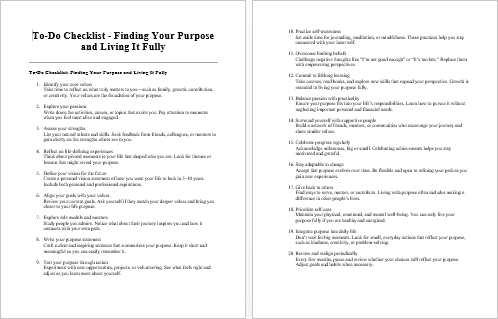
Finding Your Purpose and Living It Fully Checklist – 513 Words
A practical checklist to help learners apply each stage of the journey.
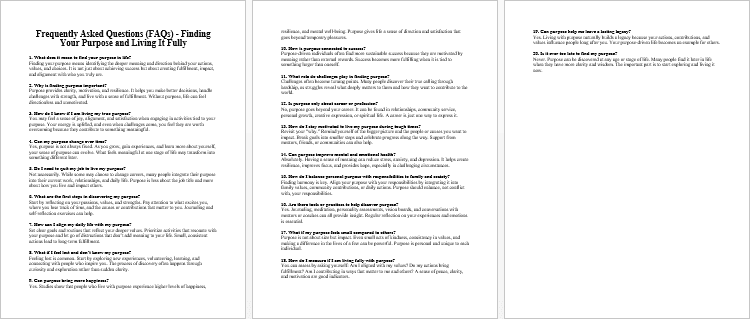
Purpose Course FAQs – 931 Words
A comprehensive FAQ section that addresses common concerns and builds trust.
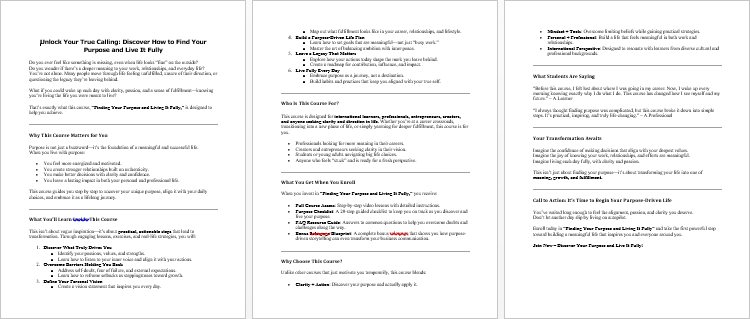
Finding Your Purpose and Living It Fully Sales Page – 822 Words
A professionally written sales page buyers can rebrand and customize.
Who This PLR Course Is Ideal For
This course is perfect for:
- Life coaches
- Personal development mentors
- Career transition coaches
- Spiritual growth educators
- Wellness bloggers
- Membership site owners
- Online course creators
It can be positioned as a self-discovery course, life redesign program, or transformational coaching framework.
How to Use and Profit from This PLR Course
This course offers exceptional monetization opportunities.
Sell It as a Standalone Online Course
Rebrand and sell it as a complete purpose discovery program.
Create a Premium Coaching Program
Use it as the foundation for 1-on-1 or group coaching packages.
Turn It Into a Multi-Week eClass
Deliver content weekly and charge $297–$497 for guided transformation.
Add It to a Membership Site
Use it as cornerstone content for recurring revenue.
Break It Into Smaller Products
Sell individual modules as mini-courses priced $10–$20.
Convert It Into Video or Audio Training
Increase perceived value with recorded lessons or guided journaling sessions.
Create Physical Products
Turn it into workbooks, guided journals, or printed planners.
Bundle It With Other Self-Development Products
Create packages priced $47–$97.
Build a Personal Growth Brand
Launch a niche site focused on purpose-driven living and scale it as a sellable digital asset.
License Terms – What Buyers Are Allowed to Do
Permissions
Buyers may:
- Sell the content with minor edits
- Claim copyright if 75% of the content is substantially modified
- Break content into smaller paid products
- Bundle with other content for higher-priced offers
- Create membership sites with recurring income
- Convert into multi-week eClasses priced $297–$497
- Turn it into audio, video, or physical products
- Use excerpts as blog posts or lead magnets
- Build a branded product or website and flip it
License Restrictions – What Buyers Cannot Do
To protect the product’s value:
- PLR or resale rights may not be passed on
- Licensing rights may not be transferred
- Affiliate commissions may not exceed 75%
- The full content may not be given away in its current form
- It may not be added to existing paid products without a new purchase
Why Buy This PLR Course from Buy Quality PLR
Buy Quality PLR provides high-quality, business-ready PLR products designed for real monetization.
This course offers:
- Evergreen demand in personal growth
- Emotional and transformational appeal
- Practical implementation tools
- Strong resale and repurposing potential
- Immediate usability
It eliminates months of content creation while opening the door to meaningful and profitable offers.
Get Instant Access Today
The Finding Your Purpose and Living It Fully PLR Course is available for instant download.
This is a complete, done-for-you personal transformation program that can be rebranded, sold, taught, or transformed into premium coaching and self-development products immediately.
Add this powerful PLR course to your Buy Quality PLR library today and start turning purpose-driven transformation into a profitable digital asset.
has been added to your cart!
have been added to your cart!
Here A Sample of the Finding Your Purpose and Living It Fully PLR Course
Module 1: The Foundation – Understanding Purpose
This module lays the groundwork. We’ll explore what “purpose” really means and why it matters in creating a fulfilling life.
Lesson 1: What Is Purpose, Really?
A simple, relatable explanation of purpose and how it differs from passion, goals, or dreams.
Lesson Intent (for international course creators)
By the end of this lesson, learners will be able to:
- Define “purpose” in clear, everyday language.
- Distinguish purpose from passion, goals, and dreams with confidence.
- Evaluate statements and classify them correctly (purpose vs passion vs goal vs dream).
- Draft a first, working-purpose sentence that feels personally true.
Use this as a facilitator script plus an activity plan you can run in classrooms, live online, or self-paced formats across regions and cultures.
Materials and Setup
- Whiteboard or digital board; markers or annotation tools.
- Slide deck with key definitions and examples (optional but recommended).
- Paper or digital notepad for participants.
- Timer (set visible countdown if teaching live).
- Translation or interpretation support if needed; keep sentences short and vocabulary simple.
Note on language: prefer plain English; avoid idioms that don’t translate well. Use neutral time formats (e.g., 15–20 min), neutral dates (YYYY-MM-DD), and SI units where relevant.
Step-by-Step Instruction Plan
Step 1 — Warm Welcome and Framing (5–7 min)
Script:
“Welcome to Module 1. Today we’ll build a solid foundation. We’re not chasing inspirational slogans—we’re defining purpose in a way that holds up in real life and across cultures. By the end, you’ll know exactly how purpose differs from passion, goals, and dreams, and you’ll write a first version of your own purpose statement.”
Invite one sentence from volunteers: “When you hear the word purpose, what comes to mind?” Capture answers without judging.
Facilitator note: Keep the energy inclusive. If participants share religious or philosophical views, thank them and keep the discussion centered on a practical, human-wide definition that works in diverse contexts.
Step 2 — The Working Definition of Purpose (10–12 min)
Write this on the board and read it slowly:
Purpose: An enduring direction for your life or work that expresses the contribution you want to make and the impact you aim to have on people, places, or problems.
Breakdown:
- Enduring direction: not a single project; it guides choices over years.
- Contribution: what you bring (skills, strengths, care).
- Impact: who or what benefits and how.
Offer 3 short, culture-neutral examples:
- “Improve access to practical education so people can create new opportunities.”
- “Design products that make daily life simpler for busy families.”
- “Build workplaces where people grow, not burn out.”
Emphasize: purpose is why you show up; it is identity-level and values-aligned. It is broad enough to last, specific enough to guide action.
Step 3 — The Quick Contrast Grid (12–15 min)
Draw a 2×2 table (or show a slide). Present each concept with a crisp test:
- Purpose (WHY; enduring)
Test: If you achieve one goal, does this still guide you tomorrow? If yes → likely purpose.
Example: “Advance human wellbeing through clear health communication.” - Passion (WHAT YOU LOVE; energizing)
Test: If you had no audience and no reward, would you still feel drawn to it?
Example: “I love teaching and simplifying complex ideas.” - Goals (WHAT + BY WHEN; measurable)
Test: Is it specific, time-bound, and trackable?
Example: “Publish a 20-lesson course by 2025-11-30.” - Dreams (VISION; aspirational images)
Test: Is it an inspiring picture of a future state without constraints?
Example: “One day I’ll lead a global learning studio that reaches millions.”
Key insight: Passions feed your energy; goals move you day to day; dreams stretch your imagination. Purpose is the stable why that holds them together.
Step 4 — “Name That Statement” Activity (15–20 min)
Instructions:
- Give participants a mixed list of statements (you can read them aloud or distribute a sheet).
- Ask them to label each: P (purpose), Pa (passion), G (goal), D (dream).
- Debrief quickly.
Sample set:
- “I feel alive when I solve messy problems with people.” → Pa
- “Launch a scholarship fund for 100 learners by 2026-12-31.” → G
- “Create systems that help small businesses thrive sustainably.” → P
- “Become a keynote speaker on three continents.” → D or G (if dated and measurable).
- “Design beautiful, accessible user experiences.” → Could be Pa or P depending on intent; discuss nuance.
Debrief prompts:
- Which items were tricky? Why?
- How does a time boundary shift a dream into a goal?
- When does a passion statement become purpose? (Usually when it names a beneficiary or impact.)
Facilitator hint: Normalize ambiguity. Some lines blur until we add clarity.
Step 5 — The Purpose Litmus Tests (10–12 min)
Give learners three short tests to refine their purpose sentence:
- Beneficiary Test: Who benefits (people, communities, fields, ecosystems)?
If no beneficiary is named, it’s likely passion or a value, not purpose. - Contribution Test: What distinct value do you bring (skills, style, advantage)?
If contribution is vague, the statement may be a dream or slogan. - Endurance Test: Would this still guide you after a big success or a big setback?
If it expires with a project, it’s a goal.
Invite learners to rewrite their statement to pass all three tests.
Step 6 — Global, Inclusive Examples (8–10 min)
Offer brief, diverse scenarios to show purpose in different contexts and economies:
- Education entrepreneur (Lagos): “Expand practical STEM learning so young people build employable skills.”
- Healthcare communicator (São Paulo): “Turn complex medical guidance into clear actions patients can trust.”
- Sustainability analyst (Berlin): “Help companies reduce emissions with data-driven strategies that last.”
- Community organizer (New Delhi): “Strengthen local networks so families access services with dignity.”
- Product designer (Dubai): “Create everyday tools that remove friction and respect user privacy.”
Discuss how the beneficiary and impact are explicit, while the methods can evolve.
Step 7 — Common Myths and Gentle Corrections (10–12 min)
Myth 1: “Purpose is one perfect calling.”
Correction: Purpose can be a stable direction expressed through many roles over time.
Myth 2: “Purpose must be world-changing.”
Correction: Scale is not the point. Purpose is about fit and service, whether to one client or a city.
Myth 3: “If I follow passion, purpose will appear.”
Correction: Passion is energy; purpose needs beneficiaries and impact named clearly.
Myth 4: “Purpose is fixed for life.”
Correction: The why can deepen as you learn; words may evolve while the core stays recognizable.
Myth 5: “Purpose equals job title.”
Correction: Titles are containers. Purpose is transferable across roles, sectors, and countries.
Step 8 — Write Your First Purpose Sentence (15–20 min)
Provide a simple template and then invite freeform writing.
Template 1 (Direct):
“I exist to contribute [your contribution] so that [beneficiary] can [impact/result].”
Example: “I exist to translate research into practical tools so that educators can improve learning outcomes.”
Template 2 (Problem–Impact):
“I aim to reduce/solve [problem] by [approach], enabling [beneficiary] to [impact].”
Example: “I aim to reduce small-business failure by teaching simple finance, enabling owners to make steady, confident decisions.”
Template 3 (Value–Field):
“I bring [value/strength] to [field/issue] to advance [impact].”
Example: “I bring systems thinking to local climate projects to advance resilience.”
Participant task:
- Draft one sentence using any template.
- Apply the Beneficiary, Contribution, and Endurance tests.
- Rewrite once to strengthen clarity.
Facilitator tip: Encourage verbs like improve, enable, clarify, connect, restore, design, empower. Avoid vague verbs like help unless followed by a precise impact.
Step 9 — Micro-Case Peer Review (10–12 min)
Format: Pairs or triads. Each person reads their statement. Peers respond with two prompts only:
- “I heard your contribution as …”
- “I understood the impact/beneficiary as …”
If either element is unclear, the author revises it in real time. Keep tone supportive, specific, and brief.
Step 10 — The Purpose Compass Visual (5–7 min)
Ask learners to sketch a simple compass with four labels:
- North (Why/Purpose)
- East (Passions/Energy)
- South (Goals/Projects)
- West (Dreams/Vision)
Explain: The compass keeps direction steady (North), while the other points supply motivation, plans, and stretch. When people feel lost, they often try to add more goals. The fix is usually to check North first.
Step 11 — Quick Diagnostic Quiz (6–8 min)
Read the items; learners choose P / Pa / G / D. Then reveal keys.
- “Open a studio that offers low-cost design services in three cities by 2027-06-30.” → G
- “I want to see a world where services are designed with dignity.” → D
- “I love mentoring new professionals.” → Pa
- “Guide early-career professionals to grow faster with evidence-based learning.” → P
- “Speak at 10 conferences next year.” → G
- “Build tools that make healthcare decisions clearer for families.” → P
Invite questions about edge cases. The aim is pattern recognition, not perfection.
Step 12 — Quality Checklist for Your Statement (5–7 min)
Ask learners to rate each item 0–2 (0 = not yet, 1 = partly, 2 = yes):
- Beneficiary is explicit.
- Contribution is concrete (what I bring).
- Impact is observable (what changes).
- Language is short (≤ 25 words if possible).
- Enduring beyond one project.
- Feels energizing and honest.
Score of 8–12 = solid draft; 5–7 = revise once; ≤ 4 = rework with a peer.
Instructor Notes and Cultural Sensitivity
- Neutral framing: Use examples from varied sectors (education, tech, public service, arts) and geographies without stereotypes.
- Accessibility: Offer printable worksheets; read prompts aloud; allow extra time where needed.
- Language: Encourage clear, simple sentences. For multilingual groups, let learners draft in their best language first, then translate.
- Psychological safety: Some participants link purpose to personal history. Affirm choice about how much to share.
- Professional relevance: Remind learners that an authentic purpose statement is a decision filter for future modules (e.g., choosing projects, partnerships, and platforms).
Troubleshooting Guide
- “My sentence sounds generic.”
Add a specific beneficiary (“early-stage founders,” “first-time managers,” “secondary school students”), a field (“financial literacy,” “mental health,” “clean energy”), and a verb showing contribution (“clarify,” “design,” “equip,” “organize”). - “I have many passions—how do I choose?”
Keep passions; link them under a broader purpose. Example: teaching + design + writing → “Make complex ideas usable for non-experts.” - “I worry I’ll change my mind.”
Good. Write a 6-month version. Purpose can be renewed as you gain data; the direction should remain recognizable. - “I can’t name a beneficiary.”
Try this prompt: Whose success lights you up? Whose problem do you notice first? If you still struggle, pick a provisional beneficiary and test it with small actions. - “Is this just branding?”
No. Branding follows purpose, not the other way around. Purpose should guide choices even when no one is watching.
Sample Purpose Statements (Refined)
- “Equip first-generation entrepreneurs with simple finance tools that reduce risk.”
- “Design accessible learning so busy professionals can upgrade skills without burnout.”
- “Translate data into decisions that protect community health.”
- “Cultivate teams where psychological safety drives innovation and delivery.”
- “Create practical climate solutions local businesses can implement now.”
Each one passes the three tests: beneficiary, contribution, endurance.
Reflection Prompts (Individual Writing)
- “When have I felt most useful to others? What was I doing, and who benefited?”
- “Which problems do I notice before others?”
- “What do people consistently ask me for?”
- “If I had to choose only one type of impact to keep making for the next 5 years, what would it be?”
Give 6–8 minutes of quiet writing. Encourage brevity and clarity over poetry.
Micro-Practice: Convert Across the Four Types
Take any one sentence you wrote today. Write three companion lines to express the same direction as:
- Passion: “I love …”
- Goal: “By [date], I will …”
- Dream: “One day, I imagine …”
This builds fluency and prevents future confusion.
Lesson Wrap (Concise Summary)
- Purpose is your enduring why—a direction for contribution and impact.
- Passion is energy; what you love doing.
- Goals are measurable steps; what + by when.
- Dreams are aspirational pictures; stretching your imagination.
A well-formed purpose statement names a beneficiary, a contribution, and an impact, and remains useful beyond a single project. Learners leave this lesson with a first, testable draft that will guide every decision in the course that follows.
Lesson 2: Why Purpose Matters in Everyday Life
Exploring the link between purpose, motivation, and happiness, with real-life examples.
Lesson Intent (for international course creators)
By the end of this lesson, learners will be able to:
- Explain how a clear purpose improves motivation and day-to-day decision-making.
- Distinguish short-term happiness (comfort/pleasure) from long-term fulfillment (meaning/growth) and describe how purpose supports both.
- Identify practical, low-effort ways to bring more purpose into ordinary routines at home and at work.
- Map a typical day, rate alignment with purpose, and plan small adjustments that improve energy and satisfaction.
Use this as a facilitator script with adaptable timing for live, hybrid, or self-paced delivery across regions and cultures.
Materials and Setup
- Whiteboard or digital board; markers or annotation tools.
- Timer visible to all participants.
- Handout or worksheet (digital or paper) with three parts: Daily Map, Motivation Ladder, and Happiness Map.
- Optional slides with key definitions and short examples.
- Language note: use clear, simple English. Avoid idioms and culture-specific references. Use SI units, ISO dates (YYYY-MM-DD), and currency codes (e.g., USD, EUR, INR).
Step-by-Step Instruction Plan
Step 1 — Opening Contrast: A Day With and Without Purpose (8–10 min)
Script:
“Think of two recent days. One day felt meaningful; the other felt like you were just getting through it. What made the difference? Today we’ll show why that difference is not luck; it is often purpose at work.”
Invite 2–3 volunteers to share brief observations. Capture phrases such as clear priorities, energy, less procrastination, satisfaction, contribution for the meaningful day, and confusion, delay, distractions, fatigue for the other.
Facilitator note: Keep sharing time short. The aim is to prime attention on the felt effect of purpose in ordinary life.
Step 2 — Quick Definitions: Purpose, Motivation, Happiness (10–12 min)
Write three concise definitions on the board:
- Purpose (WHY; enduring direction): The contribution you want to make and the impact you intend to have.
- Motivation (ENERGY to act): The drive to start and continue tasks. It can be intrinsic (interest, meaning) or extrinsic (rewards, pressure).
- Happiness:
- Short-term comfort/pleasure (hedonic): feeling good now.
- Long-term fulfillment (eudaimonic): growth, meaning, contribution.
Explain in plain language: purpose feeds intrinsic motivation and increases long-term fulfillment, while also making short-term pleasures more satisfying because they fit within a valued direction.
Step 3 — The Purpose → Motivation Chain (12–15 min)
Draw a simple chain on the board:
Purpose → Clarity → Priority → Action → Progress → Motivation loop
Explain each link:
- Purpose clarifies what matters.
- Clarity reduces choice overload and rework.
- Priority directs time, energy, and resources.
- Action becomes easier because options are fewer and better.
- Progress is visible and meaningful, which rewards the brain and increases motivation.
- The loop strengthens with repetition.
Micro-activity (3 min): Ask learners to name one task they have postponed. Have them connect it to their purpose (“How does this task contribute?”). Many will notice the task either gains meaning (easier to start) or is revealed as low-value (easier to decline).
Step 4 — Purpose as a Stress Buffer and Resilience Builder (10–12 min)
Explain: Purpose does not remove challenges; it gives them context and meaning.
Use three everyday examples:
- Caring responsibilities: A parent wakes at 05:30 for preparation. Tired, yes; but the act aligns with a purpose of “raising healthy, confident children.” The same effort without purpose feels heavier.
- Work deadline: A team member puts in 2 extra hours to ship a critical safety update. The overtime is tolerable because it protects users—an impact they value.
- Study schedule: A learner studies 30 min/day for 90 days (≈ 45 hours). A clear purpose (“qualify for new role improving public services”) keeps the routine consistent.
Emphasize: Purpose gives a narrative—“this difficulty serves something I care about”—which increases perseverance.
Step 5 — Purpose and Better Decisions (10–12 min)
Offer a simple filter: If it advances my purpose, it’s a candidate. If it distracts, it’s a polite no.
Teach the 3-question decision test:
- Is this aligned with my contribution and the people I serve?
- Will this create progress within the next 30–60 days?
- What will I stop or postpone to make space?
Demonstrate with a scenario:
Opportunity: speak at an event on 2025-09-15. Purpose: “Equip first-time managers with simple leadership tools.” If the audience is senior executives in a different field, the answer might be “no for now” unless there is a clear bridge to the stated beneficiary.
Facilitator note: Model neutral, culturally respectful language for declining: “Thank you. My current focus is X. This opportunity is valuable, but it is not aligned this quarter.”
Step 6 — Real-Life Vignettes (12–15 min)
Provide brief, international examples with neutral details:
- Retail operations lead (Nairobi, KES and USD context): Purpose: “Improve fairness and safety in hourly work.” Action: redesign shift schedules and rest periods based on data. Outcome: fewer late departures by 25 % over 60 days; staff turnover down; lead reports higher daily satisfaction.
- Language teacher (Hanoi): Purpose: “Make practical English accessible to service workers.” Action: 20-minute micro-lessons during lunch breaks; printable cards. Outcome: measurable gains in workplace communication; teacher reports less burnout because small wins match purpose.
- Software engineer (Toronto): Purpose: “Build tools that reduce household energy use.” Action: volunteer prototype on weekends; present at local meetups. Outcome: one feature adopted by employer; stronger engagement at work.
- Nurse coordinator (Lisbon): Purpose: “Create calm, respectful patient flow.” Action: new triage script; color-coded wayfinding. Outcome: average wait down by 10–15 min; staff morale up; coordinator feels daily pride.
- Small bakery owner (Pune): Purpose: “Offer nutritious, affordable snacks to schoolchildren.” Action: standardize recipes; clear labels; 100 g portions; INR pricing by cost. Outcome: stable margins; owner reports less decision fatigue because purpose sets product boundaries.
Use these to illustrate that purpose is practical, not abstract.
Step 7 — Daily Map Exercise: Where Purpose Lives in Your Day (15–20 min)
Distribute the Daily Map worksheet. It has three columns:
- Activity (from wake-up to bedtime, in 30–60 min blocks).
- Tag: P (Purpose-aligned), N (Neutral/necessary), D (Draining/misaligned).
- Why: one sentence (e.g., “P—serves my contribution to learner success”).
Instructions:
- Map yesterday or a typical weekday.
- Tag each block honestly.
- Tally total hours in P, N, D.
- Compute percentages:
- P% = (P hours ÷ total hours awake) × 100
- N% = (N hours ÷ total hours awake) × 100
- D% = (D hours ÷ total hours awake) × 100
Debrief prompts:
- What surprised you?
- Which D blocks can be removed, reduced, or reframed?
- Which N blocks can be connected to purpose (e.g., cooking as part of “family care” purpose; commuting as “learning time” with audio lessons)?
Facilitator tip: Avoid judgment. The goal is awareness and one small change, not perfection.
Step 8 — Motivation Ladder: Turning Low-Energy Tasks into Purpose-Fit (12–15 min)
Introduce the Motivation Ladder (four rungs):
- Avoidance — “I delay this task.”
- Compliance — “I do it because I must.”
- Contribution — “I see how it helps someone I serve.”
- Commitment — “I own it as part of my purpose.”
Exercise: Choose one low-energy task. For each rung, write a one-sentence reframe. Example for monthly reporting:
- Avoidance: “It’s boring.”
- Compliance: “It’s required.”
- Contribution: “These numbers help colleagues allocate resources fairly.”
- Commitment: “Clear reporting advances my purpose to make decisions transparent.”
Ask learners to identify one action that moves the task up one rung (e.g., redesign the template, add a short “insight” section, automate a step).
Step 9 — Happiness Map: Comfort vs Fulfillment (10–12 min)
Draw two overlapping circles: Comfort and Fulfillment.
- Comfort examples: music, good food, rest, light entertainment.
- Fulfillment examples: finishing a useful project, mentoring, community service, learning a skill.
Explain that both matter. Purpose increases the overlap: even rest can be more satisfying when it supports meaningful work and relationships.
Prompt: Write three activities that deliver mostly comfort, three that deliver mostly fulfillment, and two that deliver both. Invite 1–2 volunteers to share. Encourage culturally varied examples (family meals, outdoor walks ≥ 2 km, religious observance, creative crafts).
Step 10 — Micro-Experiments for a Purposeful Day (8–10 min)
Offer four low-cost experiments learners can run within 7 days:
- Purpose Minute (daily): At the start of the workday, write one sentence linking your top task to your purpose.
- Alignment Audit (weekly): List your top 5 commitments for the week. Mark each A (aligned) or Q (questionable). Replace one Q with an A.
- Energy Diary (3 days): Every 2 hours, rate energy 1–5. Note what you were doing and with whom. Look for patterns where purpose is present vs absent.
- 2×2 Impact Grid: Columns = High vs Low alignment to purpose; Rows = High vs Low effort. Prioritize High alignment + Low effort first for quick wins.
Encourage learners to choose one experiment and schedule it with a date format like 2025-08-30 to 2025-09-05.
Step 11 — Common Obstacles and Practical Fixes (12–15 min)
Obstacle 1: Purpose Pressure (“I must change everything today”).
- Fix: Reduce scope. Choose a single 30–60 min block per day to align with purpose for 7 days. Measure, then adjust.
Obstacle 2: Misalignment Fatigue (too many D blocks).
- Fix: Replace one D with an N (neutral but necessary) by simplifying standards or renegotiating scope. Example: move a meeting from 60 min to 30 min with a written agenda.
Obstacle 3: False Guilt (“Saying no is selfish”).
- Fix: Offer a values-aligned alternative. “I cannot join this quarter; I can share a resource or connect you to someone who fits better.”
Obstacle 4: Overidentification (“My job is my purpose”).
- Fix: Re-state purpose independently from a role: “Advance practical health literacy” rather than “Be a hospital educator.” This keeps identity stable across changes.
Obstacle 5: Unclear Metrics (“How do I know it’s working?”).
- Fix: Choose simple, observable indicators tied to beneficiaries: number of people served, errors reduced, minutes saved, satisfaction scores, repeat engagement. Track weekly.
Step 12 — Assessment: Quick Checks for Understanding (8–10 min)
A. Classification (P / M / H):
Label each statement as Purpose (P), Motivation booster (M), or Happiness source (H).
- “Run 2 km after work to recharge so I can focus on evening study.” → H (comfort/health) with M effect
- “Equip first-time managers with tools for confident conversations.” → P
- “Write a 10-line summary after each client call to capture insights.” → M (action that maintains motivation through progress)
B. Scenario Analysis:
A designer is offered a well-paid project in a sector that conflicts with their stated purpose of “privacy-first products for families.” Ask: accept, decline, or modify? Defend the choice using the 3-question decision test from Step 5.
C. Short Reflection:
“What is one routine activity you will reframe tomorrow to align with purpose? Write one sentence.”
Instructor Notes for Cross-Cultural Delivery
- Neutral examples: Mix sectors (education, health, public service, small business, technology) and regions. Avoid assumptions about resources or working conditions.
- Accessibility: Provide written instructions, speak at a moderate pace (≈ 120–140 words/min), allow writing time, and encourage drafting in a preferred language before translating.
- Time discipline: Keep exercises within announced ranges. Show the timer to build trust.
- Psychological safety: Emphasize that purpose is personal and may include family, community, or professional focus. No one must share beyond their comfort level.
- Data sensitivity: When discussing beneficiaries, avoid sharing personal data; use anonymized examples.
Practical Takeaways (Concise Summary for Learners)
- Purpose is your enduring why. It organizes attention, reduces decision fatigue, and sustains action.
- Motivation grows when progress serves something you care about. Purpose turns routine tasks into meaningful steps.
- Happiness includes comfort (short-term) and fulfillment (long-term). Purpose increases both and connects them.
- You can bring more purpose into daily life with small, repeatable moves: map your day, reframe one task, run a micro-experiment, and use a simple decision test.
Optional Worksheet Templates (text you can paste into a handout)
1) Daily Map (30–60 min blocks)
- Time Block: ________ Activity: __________________ Tag (P/N/D): __ Why: __________________
- Time Block: ________ Activity: __________________ Tag (P/N/D): __ Why: __________________
(Total awake hours: ____ ; P hours: ____ ; N hours: ____ ; D hours: ____)
2) Motivation Ladder (task name: ____________)
- Avoidance sentence: __________________________________________
- Compliance sentence: __________________________________________
- Contribution sentence: _________________________________________
- Commitment sentence: __________________________________________
- One action to move up one rung: _________________________________
3) Happiness Map
- Comfort-only activities (3): ____________________________________
- Fulfillment-only activities (3): _________________________________
- Both comfort and fulfillment (2): _______________________________
Closing Reflection Prompts
- “Where did I notice the purpose → clarity → priority → action → progress loop today?”
- “Which decision this week can I simplify with the 3-question test?”
- “What is one D block I can reduce by 30 min and reallocate to a P block within 7 days (YYYY-MM-DD to YYYY-MM-DD)?”
Learners leave this lesson understanding, in practical terms, how purpose strengthens motivation, improves daily choices, and deepens happiness—and with simple tools to experience these effects immediately in everyday life.
Lesson 2 — Aligning Strengths, Passions, and Values
Combining what you’re good at, what you love, and what matters most into a practical sense of direction.
Lesson intent (for international course creators)
By the end of this lesson learners will be able to:
- Produce three concise lists: evidence-backed strengths, tested passions, and ranked core values.
- Map those lists onto an alignment canvas and identify 1–2 high-fit direction statements.
- Score and prioritise opportunities using a simple Weighted Alignment Score.
- Design two small experiments that test a chosen direction in 7–21 days.
This facilitator script and activity plan is suitable for live workshops, hybrid sessions, or self-paced delivery. Use ISO dates (YYYY-MM-DD) and 24-hour times (09:00) when scheduling exercises.
Materials & setup
- Digital whiteboard or large paper with markers; sticky notes or virtual cards.
- Worksheets: Strengths Inventory, Passion Evidence Log, Values Ranked List, Alignment Canvas (Venn + Grid), Weighted Alignment Score sheet, Micro-Experiment Template.
- Timer visible to participants (24-hour clock recommended).
- Breakout rooms for pairs/triads.
- Accessibility: provide large-print worksheets and offer audio or text responses in participants’ preferred language.
High-level flow (suggested timing: 120 minutes)
- Quick recap & framing (8 minutes)
- Consolidate inputs: strengths, passions, values (20 minutes)
- Venn mapping & pattern spotting (25 minutes)
- Alignment canvas & priority scoring (20 minutes)
- Create direction statements (15 minutes)
- Weighted Alignment Score and decision protocol (12 minutes)
- Micro-experiments and accountability (15 minutes)
- Reflection, assessment, and close (5 minutes)
Adjust durations to fit your session length.
Step-by-step instruction plan
Step 1 — Warm framing and expectations (8 minutes)
Script: “This lesson is where self-knowledge becomes a practical compass. We are not hunting for a single mystical calling; we are combining what you reliably do well, what energises you, and what you will not trade away. The result is directions you can test, refine, and act on.”
Ask learners to spend 60 seconds writing one sentence: “If I had to pick one way to use my time this quarter that would feel meaningful, what would it be?” Collect a few volunteer answers to illustrate diversity.
Step 2 — Consolidate inputs: quick inventory (20 minutes)
Purpose: bring the three inputs into one place.
Deliverable: three concise lists (≤ 6 items each).
A. Strengths (evidence-backed) — 10 minutes
- Use the Strengths Inventory worksheet. For each candidate strength write: one concrete example (date YYYY-MM-DD), the observable result, and who noticed.
- Score each item 1–3 on evidence (1 = anecdote, 2 = repeated, 3 = documented metric or repeat requests).
- Reduce to top 6 by highest evidence score.
B. Passions (energy-tested) — 5 minutes
- Use the Passion Evidence Log. For each passion candidate note the last date tried (ISO), energy before, energy after (scale 1–5), and one beneficiary reaction.
- Keep items with positive average energy delta ≥ +1 and at least one external signal (request, repeat invite, thank-you).
C. Values (ranked) — 5 minutes
- Use the Values Ranked List. From your earlier values work, list your top 6 values in order, with a one-line example of how you lived each. Keep top 3 as anchors.
Facilitator tip: keep this fast. The aim is to consolidate previously done work into an actionable set.
Step 3 — Venn mapping: Where the three overlap (25 minutes)
Purpose: visualise the sweet spots.
Set up: draw a three-circle Venn diagram on the board (Strengths, Passions, Values). Provide sticky notes.
Instructions:
- Put each strength, passion, and value on its own colour sticky note.
- Invite participants to place their notes on the diagram where they think each belongs. Encourage overlaps—one item can appear in multiple circles. (12–15 minutes)
- Scan for the central overlap (items that appear in all three circles). These are high-promise signals.
Group debrief (8–10 minutes):
- Ask learners to share one item from the central overlap and one item on the edge (e.g., strong skill but low energy).
- Discuss why edge items might still be valuable (transferable skills, temporary low energy due to season).
Facilitator note: it’s normal for the centre to be small or empty. That signals the need for testing, not failure.
Step 4 — Alignment Canvas: turn overlaps into direction candidates (20 minutes)
Purpose: create 2–4 candidate directions that combine elements from the Venn mapping.
Canvas layout: table with columns — Candidate Direction, Components (strengths, passions, values), Beneficiary, Observable Outcome, First Test Idea.
Instructions:
- For each central or near-central overlap, craft a short candidate direction sentence: “I will [contribution] for [beneficiary] so that [observable outcome].” Keep ≤ 20 words.
- List the supporting strengths, which passions fuel it, and which values it honours.
- Add a one-line first test idea with date (YYYY-MM-DD) and time (24-hour) if possible.
Example:
- Candidate: “Design 20-minute micro-lessons for retail staff to reduce customer complaint rate.”
- Components: facilitation (strength), teaching micro-modules (passion), fairness & service (values).
- Beneficiary: retail teams in small shops.
- Outcome: 15% fewer complaints in 60 days.
- Test: run one 20-min session 2025-09-10 14:00 with local shop; ask for 3 feedback lines.
Pair-share (6–8 minutes): each pair reviews direction phrasing and suggests one tighter metric.
Step 5 — Weighted Alignment Score: prioritise (12 minutes)
Purpose: make choices when resources are limited.
Introduce the Weighted Alignment Score sheet with four criteria (each scored 0–5, multiply by weight):
- Strength Fit (weight 3) — how well your top strengths apply.
- Passion Energy (weight 2) — how energising is it for you.
- Values Alignment (weight 2) — how many top values it honours.
- Practical Feasibility (weight 1) — ability to test within 14 days with low cost.
Score 0–5 each, then compute total = 3×S + 2×P + 2×V + 1×F (max 30).
Activity:
- Score your 2–4 candidate directions.
- Rank them by total score. Threshold suggestion: ≥ 20 = high priority; 14–19 = experimental; <14 = put on hold.
Facilitator note: weights can be adjusted for local contexts (e.g., if immediate income is critical, increase Feasibility weight).
Step 6 — Convert top candidate into two direction statements (15 minutes)
Purpose: produce a short public pitch and a private working direction.
For the top-ranked candidate create:
- Public pitch (≤ 15 words): for quick introductions.
- Working direction (≤ 35 words): includes the method and decision rule.
Example:
- Public: “Design bite-sized training for shop teams that reduces customer complaints.”
- Working: “Create and test three 20-minute training modules for shop teams; continue if 2/3 managers report a visible 10% drop in complaints by 2025-10-01.”
Pair feedback: partners ask one clarifying question: “What counts as success?” Refine decision rule.
Step 7 — Micro-experiments: rapid validation (15 minutes)
Purpose: test with low cost, high clarity.
Micro-Experiment Template fields:
- Start / End date (YYYY-MM-DD)
- Hypothesis (If I X then Y)
- Action list (≤ 3 items with time estimates)
- Data to collect (energy score 1–5, beneficiary reaction, one metric)
- Decision rule (continue / adjust / stop)
Instruction: draft two micro-experiments:
- Experiment A (engagement): test whether beneficiaries show interest (e.g., run a 20-min demo 2025-09-10 14:00).
- Experiment B (sustainability): test whether you maintain energy over repeated sessions (e.g., deliver 3 sessions across 2 weeks, record energy after each).
Pair up for accountability and set a 24-hour time to check in (e.g., 2025-09-11 09:00).
Facilitator tip: insist on observable signals and leave prestige metrics aside in early tests.
Step 8 — Quick decision protocol and “no” scripting (8 minutes)
Purpose: help learners say yes selectively and decline gracefully.
Teach a short protocol:
- Check Weighted Alignment Score.
- Run the Values Decision Filter (Who benefits? Which top value? What trade-offs?).
- If score ≥ threshold and filter passes, accept or design experiment; otherwise decline or negotiate changes.
Provide one “no” script: “Thank you for the opportunity. My current focus is [public pitch]. I cannot accept new commitments that do not support it this quarter (until YYYY-MM-DD).” Encourage local tone adjustments.
Step 9 — Assessment & reflection (5 minutes)
Quick checks:
- State your top candidate direction in one sentence.
- Give your top micro-experiment start date (YYYY-MM-DD) and what observable will indicate success.
- List one “no” you will give this week to protect focus.
Assign brief homework: run Experiment A and collect two data points; bring results to the next session.
Instructor notes & cultural sensitivity
- Language options: allow drafts in a first language and offer time to translate into workshop language.
- Cultural norms: some participants prefer collective language (“we”) rather than individual “I.” Accept both forms.
- Resource sensitivity: when suggesting tests, propose low-resource options that fit participants’ contexts (phone calls, short in-person sessions, community boards). Use local currency codes if pricing is discussed (e.g., INR, EUR, USD).
- Feedback norms: ask groups whether they prefer direct critique or gentle suggestions; adapt facilitation accordingly.
- Power & hierarchy: when participants are from different seniority levels, use small-group peerings by role or experience to avoid discomfort.
Troubleshooting common issues
- “No overlap at all.”
Action: choose one high-evidence strength and one high-energy passion; design a 7-day mini-test linking them to one small beneficiary. Alignment often appears through testing. - “I score low on feasibility.”
Action: lower the scale—run a 30-minute test with a friend or volunteer beneficiary. Feasibility grows with iteration. - “I’m torn between two equal candidates.”
Action: run a 7-day split test or alternate focus per week; re-score after evidence. - “Context needs income now.”
Action: temporarily increase Feasibility / Income weight and prioritise directions that combine alignment with immediate earning potential.
Practical takeaways (concise)
- Alignment is practical, not mystical: it links what you can evidence, what energises you, and what you will not compromise.
- Use a three-circle Venn plus an Alignment Canvas to convert overlaps into candidate directions.
- Prioritise decisions using a Weighted Alignment Score and validate with short micro-experiments.
- Protect focus with a short “no” script and a decision protocol.
Ready-to-use templates (copy/paste)
Candidate direction sentence: “I will [contribution] for [beneficiary] so that [observable outcome].”
Weighted Alignment Score: Total = 3×Strength + 2×Passion + 2×Values + 1×Feasibility (each 0–5).
Micro-Experiment: Start YYYY-MM-DD | Hypothesis: If I X then Y | Actions: 1) __ (mins) | Data: energy 1–5, beneficiary reaction | Decision: continue if __
Reflection prompts (for learners)
- “Which two strengths will I rely on this month and why?”
- “What small ‘no’ will I say this week to protect alignment (date and script)?”
- “When will I check results from Experiment A (YYYY-MM-DD 24-hour time)?”
Use this lesson to move from insight to action: alignment becomes a repeatable practice of mapping, scoring, and testing so learners leave with clear, testable directions and a small plan they can run within days.
Lesson 4 — How to Start Your Journey With an Open Mind
Building the right mindset — curiosity, patience, and self-compassion — as you begin this roadmap
Lesson intent (for international course creators)
By the end of this lesson learners will be able to:
- Define and practise three companion mindsets — curiosity, patience, and self-compassion — that support sustainable exploration.
- Run three short, repeatable exercises to reduce fear of failure and increase willingness to experiment.
- Create a 4-week micro-experiment plan that balances learning with wellbeing.
- Facilitate psychologically safe exercises that work across cultures and time zones.
This lesson is written as a facilitator script plus activity plan for live workshops, virtual sessions, or self-paced layouts. Use ISO dates (YYYY-MM-DD) and 24-hour times (e.g., 09:30) in scheduling.
Materials and setup
- Digital whiteboard or flipchart and markers.
- Timer visible to everyone (24-hour clock recommended).
- Handouts or digital files: Curiosity Log, Patience Schedule, Self-Compassion Script, 4-Week Micro-Experiment Template.
- Quiet breakout rooms for pairs or triads.
- Optional: neutral background music for short reflective practices (very low volume).
- Accessibility: large-print handouts, audio recording option, and language support for drafting in first languages.
Facilitator note: keep sentences short and avoid idioms that don’t translate. Allow learners to draft in their native language first and then translate when ready.
High-level flow and suggested timings (total ~120 minutes)
- Opening and framing — 7 minutes
- Quick definitions and rationale — 10 minutes
- Micro mindfulness & curiosity prompt — 8 minutes
- Curiosity Lab activity — 20 minutes
- Patience plan + scheduling exercise — 20 minutes
- Self-compassion script + role play — 20 minutes
- Micro-experiment design (4 weeks) — 20 minutes
- Reflection, troubleshooting, closing checks — 15 minutes
Adjust timing to fit group size and session format.
Step-by-step instruction plan
1. Opening and framing (7 minutes)
Script:
“Starting a purposeful journey is not a sprint to a single answer. It is an iterative process that rewards curiosity, steady pacing, and kindness toward yourself when things don’t go to plan. Today we practise those three habits and leave with a 4-week experiment you can run immediately.”
Invite one-sentence volunteer: “Name one small thing you’ve been curious to try but hesitated to.” Capture 2–3 answers to set tone.
Facilitator note: normalize uneven progress. Emphasize learning, not immediate success.
2. Quick definitions and why they matter (10 minutes)
Write simple definitions on the board:
- Curiosity: a habit of asking concrete questions and testing them; it reduces certainty and creates options.
- Patience: organising experiments over time; it protects energy and reduces pressure to perform immediately.
- Self-Compassion: treating setbacks as data, not identity; it preserves wellbeing and speeds recovery.
Explain briefly how they interlock: curiosity generates small tests, patience schedules them into a sustainable rhythm, and self-compassion keeps learners from quitting after setbacks.
3. Micro mindfulness and the open-mind check (8 minutes)
Practice (3–4 minutes): A secular, optional exercise.
- Invite learners to sit comfortably and breathe 3 cycles (inhale 4s, exhale 6s).
- Ask silently: “What single ‘should’ thought appears right now?” Name it: “That’s a should thought.”
- Replace it with a curiosity prompt: “I wonder what would happen if I tried X for 7 days.”
Provide the script visually and allow participants to opt out or keep eyes open.
Debrief (3–4 minutes): Ask: “What did you notice about the ‘should’ thought?” Encourage one short share.
4. Curiosity Lab: transform judgments into testable questions (20 minutes)
Purpose: train learners to turn emotional conclusions into exploratory questions.
Explain: Judgmental questions stall action (“Why am I so bad at X?”). Curious questions create experiments (“What small change would move the needle in 7 days?”).
Activity (pair format):
- Give each pair 6 judgmental prompts (e.g., “I always fail at launching,” “I’m not creative”).
- Convert each into a curious, testable question using the formula: I notice X. I wonder whether Y might change that. Example: “I notice I procrastinate on launches. I wonder whether a 30-minute launch checklist would reduce procrastination this week?” (8 minutes)
- Each pair chooses one curious question and designs a 3-step micro-test (who, what, when) in 3 minutes.
- Pairs present one micro-test to the group in one sentence.
Facilitator tip: model one conversion live to show tone and specificity.
5. Patience Plan: schedule small, time-boxed experiments (20 minutes)
Purpose: transform good intentions into a sustainable cadence.
Explain: Patience is not inactivity. It is time-boxing experiments so progress compounds.
Template (4 weeks):
- Week 1 (Start, measure): 2–3 small actions, total ≤ 2 hours.
- Week 2 (Repeat + tweak): repeat most effective action, change one variable.
- Week 3 (Scale slightly): increase activity by ≤ 50% if energy allows.
- Week 4 (Reflect & decide): evaluate using data and self-compassion script.
Activity:
- Individually draft a 4-week plan for one curious question from the Curiosity Lab. Use ISO dates for start/end (e.g., 2025-09-01 → 2025-09-28) and estimate weekly time in hours/minutes. (12 minutes)
- Pair up for a quick review: partner checks for feasibility and suggests one simplification. (8 minutes)
Facilitator note: encourage low cost tests and reversible actions. If participants have constrained schedules, offer reduced plans (three 20-minute sessions per week).
6. Self-Compassion Script and role play (20 minutes)
Purpose: prepare learners to respond kindly and constructively after setbacks.
Teach a simple 3-line self-compassion script:
- Name the feeling: “I’m feeling disappointed/hurt/tired.”
- Common humanity line: “Many people would feel this after that outcome.”
- Kind correction + next step: “What I learned is X. Next, I will try Y or ask Z.”
Activity (triads):
- Person A describes a small setback (2 minutes).
- Person B reads the script aloud to A and offers one concrete suggestion (2 minutes).
- Person C records one practical action A could take (1 minute). Rotate until all have practiced.
Debrief: Ask volunteers to share how the script changed their immediate reaction.
Facilitator note: avoid probing for deeply personal trauma. Keep examples work-appropriate.
7. Design your 4-Week Micro-Experiment (20 minutes)
Purpose: produce a concrete, compassionate experiment plan that balances curiosity and patience.
Micro-Experiment Template fields:
- Clue / Question: ______
- Start date (YYYY-MM-DD) / End date: ______
- Hypothesis (If I X, then Y): ______
- Weekly actions with time estimates (minutes or hours)
- Data points to collect (energy 1–5, beneficiary reaction, observable metric)
- Reflection checkpoints (dates and 24-hour times)
- Decision rule: continue / adapt / stop (specify thresholds)
Activity: Each learner drafts one micro-experiment. Then, in pairs, they read each plan and apply the self-compassion script to a hypothetical failed outcome and suggest a kinder next move.
Facilitator tip: insist on at least one simple observable (e.g., one line of beneficiary feedback, a 1–5 energy rating).
8. Accountability, time zones and small rituals (10 minutes)
Purpose: create practical supports that respect international schedules.
Teach short accountability rituals:
- Two-minute mid-week check (text or email) with a partner. Use 24-hour time and include timezone (e.g., “Check-in 2025-09-08 09:30 IST / 04:00 UTC”).
- A weekly 10-minute reflection slot in calendar (use ISO date ranges).
- A one-sentence public declaration (optional): “This month I’m testing X; I’ll report one result on YYYY-MM-DD.”
Pair up to schedule a check-in with explicit date/time across time zones.
9. Troubleshooting common obstacles (10 minutes)
- “I don’t have time.” Break actions into 10–20 minute micro-tasks. Replace one D (draining) block with a P (purposeful) 20-minute slot for a week.
- “I’m afraid to fail publicly.” Use private pilots or anonymous data collection. Share only outcomes, not raw emotions.
- “I get impatient for results.” Use patience plan and track small leading indicators (e.g., number of attempts, constructive feedback).
- “Cultural norms discourage experimentation.” Frame experiments as learning projects for a team or community; use collective language if “I” feels uncomfortable.
10. Assessment, reflection and close (15 minutes)
Quick checks (written, 5 minutes):
- Write your curiosity question.
- State your Week-1 action and time estimate (minutes).
- Write your self-compassion sentence you will use if the experiment fails.
Group reflection (10 minutes): Invite 3 volunteers to share one thing they will try and one “no” they will say to protect time (use a polite script).
Closing script:
“Curiosity gets you asking better questions. Patience gives experiments time to reveal meaning. Self-compassion keeps you in the game. Run one small test and report back in a way that fits your context.”
Instructor notes and cultural sensitivity
- Allow drafting in first languages and offer translation time. Keep instructions visually available.
- Respect privacy: make all sharing optional and offer anonymous submission channels.
- Adapt examples to local realities (shift work, family duties, limited internet). Offer phone-based experiments where necessary.
- Feedback tone: ask groups whether they prefer direct or gentle feedback and adapt facilitation style.
- Time zones: always specify date and time with timezone (e.g., 09:30 IST / 04:00 UTC) to avoid confusion.
Practical takeaways (concise)
- Curiosity converts fear into testable questions.
- Patience organizes learning into time-boxed, low-cost experiments that compound.
- Self-compassion reframes failures into data and preserves wellbeing.
- A 4-week micro-experiment combining these three mindsets is the simplest way to begin — start small, measure kindly, iterate.
Reflection prompts to give learners
- “What one curious question will I test between YYYY-MM-DD and YYYY-MM-DD?”
- “What is my Week-1 action (minutes) and when will I do it (24-hour time)?”
- “Write the self-compassion sentence you will say after a setback.”
Use this lesson to create a learning culture: make small experiments safe, paced, and kind — and you will build momentum that lasts across countries, languages, and contexts.
We’re also giving these extra bonuses
Finding Your Purpose and Living It Fully – Checklist
Finding Your Purpose and Living It Fully – FAQs
Finding Your Purpose and Living It Fully – Salespage Content
Package Details:
Word Count: 33 687 Words
Number of Pages: 133
Finding Your Purpose and Living It Fully – Bonus Content
Checklist
Word Count: 513 words
FAQs
Word Count: 868 words
Salespage Content
Word Count: 822 words
Total Word Count: 35 890 Words
Your PLR License Terms
PERMISSIONS: What Can You Do With These Materials?
Sell the content basically as it is (with some minor tweaks to make it “yours”).
If you are going to claim copyright to anything created with this content, then you must substantially change at 75% of the content to distinguish yourself from other licensees.
Break up the content into small portions to sell as individual reports for $10-$20 each.
Bundle the content with other existing content to create larger products for $47-$97 each.
Setup your own membership site with the content and generate monthly residual payments!
Take the content and convert it into a multiple-week “eclass” that you charge $297-$497 to access!
Use the content to create a “physical” product that you sell for premium prices!
Convert it to audios, videos, membership site content and more.
Excerpt and / or edit portions of the content to give away for free as blog posts, reports, etc. to use as lead magnets, incentives and more!
Create your own original product from it, set it up at a site and “flip” the site for megabucks!
RESTRICTIONS: What Can’t You Do With These Materials?
To protect the value of these products, you may not pass on the rights to your customers. This means that your customers may not have PLR rights or reprint / resell rights passed on to them.
You may not pass on any kind of licensing (PLR, reprint / resell, etc.) to ANY offer created from ANY PORTION OF this content that would allow additional people to sell or give away any portion of the content contained in this package.
You may not offer 100% commission to affiliates selling your version / copy of this product. The maximum affiliate commission you may pay out for offers created that include parts of this content is 75%.
You are not permitted to give the complete materials away in their current state for free – they must be sold. They must be excerpted and / or edited to be given away, unless otherwise noted. Example: You ARE permitted to excerpt portions of content for blog posts, lead magnets, etc.
You may not add this content to any part of an existing customer order that would not require them to make an additional purchase. (IE You cannot add it to a package, membership site, etc. that customers have ALREADY paid for.)
Share Now!
Latest Products
Free Sales Funnel Builder

Related Products
Popular & Trending

Featured Products