

Eat Smart, Play Strong PLR Course 31k Words
in Fitness Mindset PLR , Fitness PLR , Fitness PLR Ebooks , Nutrition PLR , PLR Checklists , PLR eBooks , PLR eCourses , PLR List Building Reports , Premium PLR , Premium PLR eBooks , Premium PLR Reports , Premium White Label Brandable PLR Coaching Courses , Private Label Rights Products , Sports PLRChoose Your Desired Option(s)
has been added to your cart!
have been added to your cart!
#sportsnutrition #performancenutrition #fitnessnutrition #healthyeating #plrcourse #musclerecovery #strengthandconditioning
A Complete Sports Nutrition Program for Women You Can Rebrand, Sell, or Monetize Instantly
Nutrition plays a critical role in how sportswomen train, perform, recover, and feel—yet many female athletes struggle with confusing advice, restrictive food rules, or one-size-fits-all plans that don’t account for their unique needs.
The Eat Smart, Play Strong PLR Course was created to change that.
This professionally developed PLR course delivers a clear, supportive, and practical nutrition education system designed specifically for sportswomen. It teaches how to fuel the body properly, support performance, manage recovery, and build a healthy long-term relationship with food—without guilt, extremes, or complicated dieting.
For PLR buyers, this course is a ready-made, high-value digital product that can be branded, sold, taught, or transformed into premium coaching, memberships, or wellness programs.
Introducing the…
Eat Smart, Play Strong PLR Course 31k Words
What This Course Is Designed to Do
The purpose of Eat Smart, Play Strong is simple:
To help sportswomen understand what to eat, when to eat, and how to fuel their bodies for strength, endurance, and overall wellbeing—while maintaining a healthy relationship with food.
Instead of rigid meal plans or trendy diets, the course focuses on:
- Nutrition education made simple
- Performance-focused fueling strategies
- Sustainable daily eating habits
- Hormonal health and recovery support
- Confidence and consistency around food choices
This makes the course suitable for:
- Female athletes of all levels
- Sportswomen training for competition or fitness
- Coaches, trainers, and wellness educators
- Nutrition brands serving women
- Course creators in the health and fitness space
A Sportswoman-Focused Nutrition Course That Meets Real Needs
Many nutrition programs overlook the specific physiological and lifestyle needs of women in sport. This course takes a different approach.
It acknowledges:
- Different training demands (strength vs endurance)
- Hormonal fluctuations and energy needs
- Busy schedules and real-life eating situations
- The importance of mental wellbeing alongside performance
As a result, the course feels supportive, empowering, and practical, making it highly attractive for resale and repurposing.
Course Overview
Eat Smart, Play Strong PLR Course
A Sportswoman’s Guide to Healthy Eating
This is a complete, structured nutrition education program, designed to guide learners step by step from basic understanding to personalized implementation.
Module 1: Building the Foundation – Nutrition Basics Every Sportswoman Must Know
This module establishes the core principles of sports nutrition.
Lesson 1: Understanding Your Body’s Fuel Needs
Explains how carbohydrates, proteins, and fats fuel workouts, recovery, and overall performance.
Lesson 2: The Power of Hydration
Covers hydration strategies, electrolyte balance, and timing before, during, and after training.
Lesson 3: Macronutrients Made Simple
Breaks down how to balance carbs, protein, and fats for energy and endurance.
Lesson 4: Micronutrients That Matter
Highlights essential vitamins and minerals for women athletes, including iron, calcium, and vitamin D.
Module 2: Smart Fueling Strategies for Peak Performance
This module focuses on timing and performance-based nutrition.
Lesson 1: Pre-Workout Nutrition Secrets
What to eat before training or competition to boost energy without discomfort.
Lesson 2: During Training or Competition
Simple snack and hydration strategies to sustain performance.
Lesson 3: Post-Workout Recovery Meals
The ideal protein-carbohydrate balance for muscle repair and reduced soreness.
Lesson 4: Game Day Eating Plans
Clear examples of fueling before, during, and after important events.
Module 3: Everyday Healthy Eating Habits
This module helps learners apply nutrition principles in daily life.
Lesson 1: Building Balanced Meal Plates
Introduces the “sportswoman’s plate method” for everyday meals.
Lesson 2: Smart Snacking
Healthy, portable snack ideas to maintain steady energy.
Lesson 3: Eating Out Without Guilt
Strategies for making better food choices while dining out or traveling.
Lesson 4: Meal Prep Made Easy
Simple planning and preparation tips for busy schedules.
Module 4: Nutrition for Special Needs & Challenges
This module addresses common challenges female athletes face.
Lesson 1: Fueling for Strength vs Endurance
Adjusting nutrition based on training style and goals.
Lesson 2: Common Nutritional Pitfalls for Women Athletes
Identifying and avoiding under-fueling, over-reliance on supplements, and skipped meals.
Lesson 3: Managing Hormonal Health & Energy Levels
How nutrition supports hormone balance, mood, and consistent performance.
Lesson 4: Injury Recovery Nutrition
Using key nutrients to support healing and maintain strength during recovery periods.
Module 5: Creating Your Personalized Sports Nutrition Plan
This final module brings everything together.
Lesson 1: Assessing Your Goals & Lifestyle
Aligning nutrition with competition goals, fitness routines, or general health.
Lesson 2: Customizing Your Daily Meal Plan
Building a flexible, sustainable weekly eating plan.
Lesson 3: Tracking Progress Without Obsession
Monitoring energy and performance without unhealthy food tracking behaviors.
Lesson 4: Long-Term Healthy Relationship with Food
Creating a positive, lifelong approach to eating that supports both performance and wellbeing.
What Learners Will Gain from This Course
By the end of the course, learners will:
- Understand how to fuel their bodies for sport and recovery
- Know what to eat before, during, and after training
- Build balanced meals with confidence
- Support hormonal health and energy levels
- Develop a sustainable, healthy relationship with food
- Feel empowered rather than restricted around nutrition
Additional High-Value Content Included
This PLR package includes supportive materials that enhance value and usability.
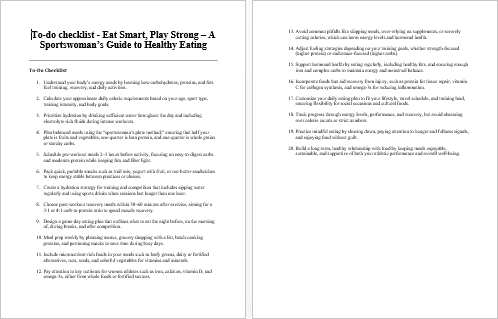
Eat Smart, Play Strong Checklist – 455 Words
A practical checklist that helps learners apply the course concepts consistently.
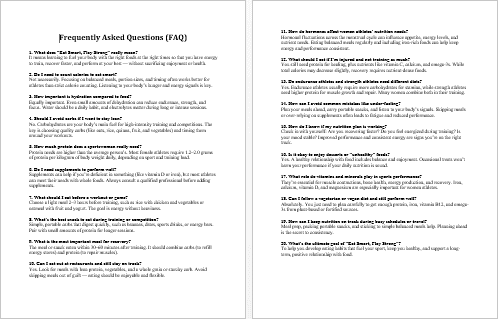
Eat Smart, Play Strong FAQs – 736 Words
A ready-made FAQ resource that answers common sports nutrition questions and builds trust.
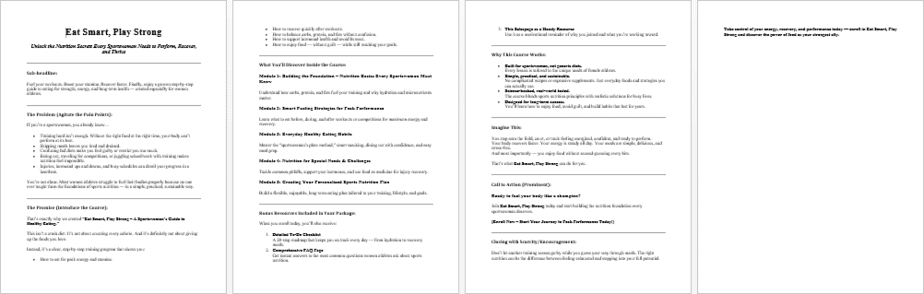
Eat Smart, Play Strong Sales Page – 676 Words
A professionally written sales page buyers can rebrand or customize for their own offers.
Total Content Value
This is a complete sports nutrition education system, suitable for premium positioning, coaching programs, or membership platforms.
Who This PLR Course Is Ideal For
This course is perfect for:
- Sports nutrition coaches
- Fitness and wellness professionals
- Women’s health brands
- Personal trainers
- Online course creators
- Membership site owners
- Wellness bloggers and influencers
It can be positioned as beginner-friendly, performance-focused, or holistic wellness—depending on branding.
How to Use and Profit from the Eat Smart, Play Strong PLR Course
This PLR course offers multiple profitable use cases.
Sell It as a Standalone Online Course
Rebrand and sell it as a sports nutrition program for women.
Create a Premium Coaching Program
Use the course as the foundation for 1-on-1 or group coaching.
Turn It into a Multi-Week eClass
Deliver content weekly and charge $297–$497 for guided access.
Add It to a Membership Site
Use it as cornerstone content for recurring monthly revenue.
Break It into Smaller Products
Sell individual modules or lessons as mini-courses or reports priced $10–$20.
Convert It into Video or Audio Training
Increase perceived value with recorded lessons or guided audio content.
Create Physical Products
Turn the course into printed workbooks, journals, or nutrition guides.
Build Lead Magnets and Funnels
Use excerpts as free content to grow email lists and upsell the full course.
Bundle with Other Health & Fitness Products
Create higher-value offers priced $47–$97.
License Terms – What Buyers Are Allowed to Do
Permissions
Buyers may:
- Sell the content with minor edits
- Claim copyright if 75% of the content is substantially modified
- Break content into smaller paid products
- Bundle with other content for higher-priced offers
- Create membership sites with recurring income
- Convert it into multi-week eClasses priced $297–$497
- Turn it into audio, video, or physical products
- Use excerpts as blog posts or lead magnets
- Build a branded product or website and flip it later
License Restrictions – What Buyers Cannot Do
To protect the value of this PLR product:
- PLR or resale rights may not be passed on to customers
- No licensing rights may be transferred
- Affiliate commissions may not exceed 75%
- The full content may not be given away for free in its current form
- The content may not be added to existing paid products without a new purchase
Why Buy This PLR Course from Buy Quality PLR
Buy Quality PLR is trusted for delivering high-quality, business-ready PLR products designed for real-world monetization.
This course offers:
- Evergreen demand in women’s health and sports nutrition
- Positive, balanced messaging
- Beginner-friendly education
- Strong emotional appeal
- Excellent resale and repurposing potential
It saves months of content creation while opening the door to profitable wellness offers.
Get Instant Access Today
The Eat Smart, Play Strong PLR Course is available for instant download.
This is a complete, done-for-you sports nutrition education system that can be rebranded, sold, taught, or transformed into premium coaching and wellness products immediately.
Add this powerful PLR course to your Buy Quality PLR library today and start turning sports nutrition education into a profitable digital asset.
has been added to your cart!
have been added to your cart!
Here A Sample of the Eat Smart, Play Strong PLR Course
Module 1: Building the Foundation – Nutrition Basics Every Sportswoman Must Know
Lesson 1: Understanding Your Body’s Fuel Needs
Introduction
Every athlete knows that training, discipline, and practice are critical to success. But there’s one equally important piece of the puzzle that often doesn’t get as much attention: nutrition. For a sportswoman, the way you fuel your body can make the difference between a sluggish performance and peak strength, endurance, and focus.
Think of your body as a finely tuned engine. The quality of fuel you put in determines how efficiently it runs. Just as a high-performance car cannot run smoothly on low-grade fuel, your body needs the right nutrients to meet the physical and mental demands of sports. To get there, you must understand the three primary macronutrients—carbohydrates, proteins, and fats—and how each one powers your workouts, supports recovery, and contributes to overall performance.
This lesson will guide you through these essential nutrients in a step-by-step, practical way so you know not only what they are, but exactly how they work for you as a sportswoman.
Step 1: Carbohydrates – Your Primary Energy Source
Carbohydrates often get mixed reviews in popular media, but for athletes, they are non-negotiable. They are the body’s preferred and most efficient source of energy, particularly for high-intensity exercise.
- How They Work
- When you eat carbohydrates, your body breaks them down into glucose (sugar).
- This glucose is stored in your muscles and liver as glycogen.
- During workouts, especially sprinting, weight training, or fast-paced games, glycogen is the first fuel your body taps into.
- Why Sportswomen Need Them
- Carbohydrates provide quick and accessible energy.
- They delay fatigue and help you maintain performance intensity.
- A lack of carbs often leads to early exhaustion, poor concentration, and slower recovery.
- Types of Carbohydrates
- Simple Carbohydrates: Found in fruit, honey, and milk. They provide quick bursts of energy.
- Complex Carbohydrates: Found in whole grains, legumes, and vegetables. They release energy more slowly, keeping you fueled longer.
- Practical Application
- Before training: Opt for easily digestible carbs like bananas, oats, or rice.
- During training: Small snacks like energy gels or a piece of fruit can top up glycogen.
- After training: Combine carbs with protein to replenish glycogen and repair muscles.
Think of carbohydrates as the premium petrol your athletic engine thrives on. Without them, your tank runs empty too quickly.
Step 2: Protein – The Builder and Repairer
If carbohydrates are the fuel, then protein is the repair crew. Every time you train, whether running, lifting, or playing, your muscles experience tiny tears. This is normal and part of building strength. Protein provides the amino acids necessary to repair these tears and make muscles stronger.
- How It Works
- Protein is broken down into amino acids.
- These amino acids rebuild and repair muscle fibers.
- Protein also supports immune function, hormone regulation, and tissue health.
- Why Sportswomen Need It
- Supports lean muscle development.
- Helps speed recovery after training or competition.
- Prevents muscle breakdown during periods of intense training.
- Sources of Protein
- Animal-Based: Chicken, fish, eggs, yogurt, lean beef.
- Plant-Based: Lentils, beans, tofu, quinoa, soy, nuts, and seeds.
- Practical Application
- Aim to include protein in every main meal.
- After workouts: A snack or shake with both protein and carbs helps jumpstart recovery.
- For vegetarian or vegan athletes: Mix different plant-based proteins (like rice and beans) to ensure you get all essential amino acids.
Protein is like the construction team that rebuilds your muscles stronger than before. Without it, your body struggles to recover and progress.
Step 3: Fats – The Long-Lasting Energy Reserve
Fats are often misunderstood. Many athletes fear them, thinking they’ll slow them down or add unnecessary weight. But fats are crucial, especially for sports that require endurance and for supporting overall health.
- How They Work
- Fats are a dense energy source, providing more than double the calories of carbs or proteins.
- During low- to moderate-intensity activities, like jogging or long training sessions, your body relies heavily on fat as a fuel source.
- Fats are also essential for absorbing fat-soluble vitamins (A, D, E, and K).
- Why Sportswomen Need Them
- Provide sustained energy during long events.
- Support hormonal health, which is especially important for women.
- Help regulate inflammation and joint health.
- Types of Fats
- Healthy Fats: Found in olive oil, avocados, nuts, seeds, fatty fish.
- Unhealthy Fats: Trans fats and excessive saturated fats (fried foods, processed snacks) should be limited.
- Practical Application
- Add a small portion of healthy fat to meals (e.g., drizzle olive oil over salad, add avocado to a sandwich).
- For long training sessions, snacks with nuts or seeds provide steady fuel.
- Avoid heavy, greasy foods before workouts as they slow digestion.
Think of fats as the reserve tank—not your immediate fuel, but the one that keeps you going when energy demands are stretched over time.
Step 4: Balancing the Three Macronutrients
Now that you understand how each nutrient works, the next step is to learn how to balance them in your diet. Sports nutrition is not about focusing on one macronutrient but finding the right proportions for your unique body, sport, and training schedule.
- General Ratios for Athletes
- Carbohydrates: 45–65% of daily calories.
- Protein: 15–25% of daily calories.
- Fats: 20–35% of daily calories.
- Training Load Adjustments
- On heavy training days: Increase carbohydrates to keep glycogen stores high.
- On rest days: Slightly reduce carbs and focus on protein and fats for recovery.
- Before competition: Carbohydrate loading may be recommended for endurance sports.
- Practical Plate Example
Imagine your plate divided into sections:- Half filled with complex carbs (rice, quinoa, pasta, or starchy vegetables).
- A quarter filled with lean protein (chicken, fish, tofu, or beans).
- A quarter filled with vegetables and healthy fats (avocado, olive oil, nuts).
Balancing these nutrients ensures you’re never running on empty, never under-repairing, and never neglecting your body’s long-term health.
Step 5: Timing Matters – When to Eat Your Fuel
Nutrition is not just about what you eat, but also when you eat. Strategic timing enhances performance, improves recovery, and helps regulate energy levels.
- Pre-Workout
- Eat a balanced meal 2–3 hours before training (carbs + protein + a little fat).
- If closer to workout time, stick to easily digestible carbs like a banana or toast.
- During Training
- For sessions under 60 minutes: Usually water is enough.
- For longer sessions: Small carb snacks or drinks help maintain energy.
- Post-Workout
- Within 30–60 minutes, eat carbs and protein to replenish glycogen and repair muscles.
- Examples: Smoothie with fruit and yogurt, or chicken with rice and vegetables.
Eating at the right times ensures your body always has the fuel it needs, right when it needs it most.
Step 6: Listening to Your Body
While science gives us guidelines, no two athletes are the same. Every sportswoman must learn to listen to her own body. Signs that your nutrition may need adjusting include:
- Constant fatigue, even with enough sleep.
- Difficulty building or maintaining muscle.
- Poor recovery or persistent soreness.
- Frequent injuries or illnesses.
- Mood swings or lack of concentration.
Use these signals as feedback to fine-tune your eating habits.
Step 7: Common Myths and Misconceptions
Many sportswomen fall into traps created by nutrition myths. Let’s clear up a few:
- Myth 1: Carbs make you fat.
Truth: Excess calories, not carbs alone, cause weight gain. Carbs are your main energy source. - Myth 2: High protein is all you need for muscle.
Truth: Without enough carbs, your body may burn protein for energy, limiting its muscle-building role. - Myth 3: Fats should be avoided.
Truth: Healthy fats are critical for energy and hormone balance. - Myth 4: Supplements replace real food.
Truth: Whole foods should always be the foundation. Supplements fill gaps, not replace meals.
By knowing the facts, you can avoid wasting time, energy, and money on misleading advice.
Step 8: Putting It All Together
At this point, you understand the core fuel system of your body:
- Carbohydrates are the quick-burning fuel that powers high-intensity activity.
- Protein is the repair system that rebuilds and strengthens muscles.
- Fats are the long-lasting reserve tank, supporting endurance and overall health.
When balanced thoughtfully and consumed at the right times, these three macronutrients give you the energy, strength, and resilience to perform at your best.
Conclusion
A sportswoman’s journey is not just about training harder; it’s about fueling smarter. By understanding how carbohydrates, proteins, and fats work together, you can give your body exactly what it needs to thrive—before, during, and after every performance.
This foundational knowledge will guide you through more advanced nutrition strategies as we continue in this course. But first, remember this: food is not just fuel—it’s your partner in every victory, every recovery, and every step of your athletic journey.
Lesson 2 — The Power of Hydration
Why water (and electrolytes) matter more than you think — and how to keep your body properly hydrated before, during, and after training
Learning objectives (for the instructor)
By the end of this lesson participants will be able to:
- Explain the physiological roles of water and electrolytes in athletic performance and recovery.
- Recognize signs of both dehydration and overhydration.
- Measure sweat loss and calculate a simple, personalised hydration plan.
- Apply practical hydration strategies for before, during and after training sessions in a variety of conditions.
Overview (one-sentence hook for learners)
Hydration is not just “drink more water”; it is a precision tool that preserves blood volume, regulates body temperature, supports muscle function and protects the brain — all essential for a sportswoman’s performance and recovery.
Step 1 — Why hydration actually matters (simple physiology)
Teach this section first so learners understand the “why”.
- Maintains blood volume and circulation. Adequate fluid keeps blood volume stable so oxygen and nutrients reach working muscles. When blood volume drops, the heart works harder and perceived effort rises.
- Regulates body temperature. Sweating cools the body. Without fluid replacement, core temperature climbs and performance decreases.
- Supports muscle function and recovery. Water is a medium for biochemical reactions. Proper hydration helps muscle contractions, reduces cramping risk and supports recovery.
- Protects cognitive performance. Even small fluid losses can impair concentration, decision-making and reaction time — critical for tactical sports.
- Transports electrolytes and nutrients. Electrolytes (sodium, potassium, magnesium, calcium, chloride) enable nerve impulses and fluid balance across cells.
Teaching tip: Use a short demonstration: ask learners to imagine performing a skill drill after 1 hour of sweating vs after rehydrating — prompt them to list what may feel different (focus, power, timing).
Step 2 — Electrolytes: the essential partners of water
Keep this concise and practical for course creators to teach.
- Sodium (Na⁺): Primary extracellular ion; crucial for fluid retention and nerve function. Lost in sweat; replacement helps retain ingested fluids.
- Potassium (K⁺): Important for muscle contractions; lost in smaller amounts in sweat but significant for cell function.
- Magnesium & Calcium: Support muscle function and recovery; low levels can affect cramps and fatigue.
- Chloride (Cl⁻): Works with sodium to maintain fluid balance.
Class activity idea: Provide everyday food examples that contain electrolytes (salted nuts, bananas, dairy, leafy greens) and ask learners to match them to electrolytes.
Step 3 — Recognize signs: dehydration vs overhydration
Make this practical — quick lists the instructor can present or put on a slide.
Mild-to-moderate dehydration (common):
- Thirst, dry mouth
- Decreased urine volume; darker yellow urine
- Slightly elevated heart rate during exercise
- Fatigue, decreased power output, slower recovery
Severe dehydration (teach as a warning sign):
- Dizziness, confusion, fainting
- Very low urine output or no urine
- Rapid breathing, rapid heartbeat
Overhydration / Hyponatraemia (important safety point):
- Nausea, headache, bloating
- Confusion, seizures (in extreme cases)
- Often occurs when large volumes of plain water are consumed during long endurance events without sodium replacement
Safety note to read aloud: Encourage learners to treat hyponatraemia seriously and seek medical attention if neurological signs appear.
Step 4 — Simple, practical tests to assess hydration (hands-on)
Teach these two classroom-friendly assessments.
- Urine colour check (easy, non-technical)
- Pale straw to light yellow → usually hydrated.
- Dark yellow → likely dehydrated.
- Use this as a quick screening tool, not a diagnosis. Note that some foods and supplements change urine colour.
- Sweat-rate / body-mass method (objective, for training labs)
- Ask the athlete to weigh themselves nude or in minimal dry clothing before exercise (kg).
- During exercise, record any fluid intake (L) and urine output (L).
- Weigh again immediately after exercise (same clothing).
- Sweat loss (L) = pre-exercise mass − post-exercise mass + fluid consumed − urine produced.
- Sweat rate (L·h⁻¹) = sweat loss ÷ exercise duration (hours).
Example to teach:
- Athlete A: pre 60.0 kg → post 59.0 kg after 1.0 h; drank 0.4 L; no urine.
- Sweat loss = 60.0 − 59.0 + 0.4 = 1.4 L.
- Sweat rate = 1.4 L ÷ 1.0 h = 1.4 L·h⁻¹.
- This tells the athlete roughly how much fluid to replace during long sessions.
Teaching tip: Make a worksheet so learners can practise with sample numbers and build confidence.
Step 5 — A step-by-step hydration strategy (before, during, after)
Use metric units for international audiences. Present as formulas + practical examples.
Daily baseline
- Approximate guideline: 30–40 mL per kg body mass per day as a starting point (adjust for climate and training load).
Example: 60 kg × 35 mL = 2.1 L per day.
Pre-training (practical formula)
- Aim to start sessions euhydrated (not thirsty).
- A useful rule: 5–7 mL·kg⁻¹ about 2–4 hours before training.
Example: 60 kg × 6 mL = 360 mL, 2–4 hours before. If urine is dark, add about 3–5 mL·kg⁻¹ around 2 hours prior.
During training
- Short sessions (<60 min): water is often sufficient; sip regularly.
- Long sessions (>60 min) or very hot/humid conditions: replace both fluids and electrolytes; match intake to sweat rate as far as practical.
- Practical sipping guide: ~150–300 mL every 15–20 minutes is a simple rule for many athletes; heavier sweaters will need more, lighter sweaters less.
- For endurance events, include carbohydrate-electrolyte drinks to supply energy and sodium.
Post-training (rehydration formula)
- For best recovery, replace about 1.2–1.5 L of fluid for each kg of body mass lost during exercise to account for ongoing urine and sweat losses.
Example: If an athlete lost 1.0 kg, target 1.2–1.5 L of fluid over the next 2–4 h, with some sodium and carbohydrate if the session was long.
Instructor note: Emphasise these are practical starting points — encourage personalisation via the sweat-rate method.
Step 6 — Choosing the right beverage (practical guidance)
Help learners understand when to use water, sports drinks, or other fluids.
- Water: Best for daily hydration and short low-intensity sessions.
- Carbohydrate–electrolyte sports drinks: Useful during prolonged exercise (>60–90 min) or when quick energy + sodium are needed. They aid fluid absorption and replace sodium lost in sweat.
- Oral rehydration solutions (ORS): For heavy fluid/electrolyte losses or in illness; have higher electrolyte levels than typical sports drinks.
- Milk or chocolate milk: Practical post-training option — contains fluid, carbohydrate, protein and electrolytes in a single drink.
- Caffeine & alcohol: Treat with caution — caffeine in moderate amounts is acceptable for many athletes, but alcohol is dehydrating and slows recovery.
Teaching tip: Have small sample bottles or mock labels for learners to evaluate sugar and sodium content.
Step 7 — Practical lesson activities & assignments for course creators
Give ready-to-run activities.
- Sweat-rate lab (practical session, 30–45 min)
- Learners pair up, perform a standard 45–60 min exercise (or simulated activity), and use pre/post mass and fluid logs to calculate sweat rate and plan intra-session fluid needs.
- Create a hydration plan (group work, 20–30 min)
- Assign different athlete profiles (e.g., 18-year-old endurance runner, 28-year-old soccer player in 30 °C heat) and ask groups to design pre/during/post hydration plans.
- Hydration log assignment (homework, 7 days)
- Learners keep a daily fluid and urine colour log; reflect on patterns and suggest practical adjustments.
- Case study discussion
- Present a case of an athlete with hyponatraemia symptoms after a marathon and lead a guided discussion on prevention and immediate response.
Step 8 — Teaching script, timing and cues (sample 60-minute lesson)
- 0–5 min: Welcome + objectives.
- 5–15 min: Short lecture on physiology and electrolytes.
- 15–25 min: Demonstration of urine-colour and sweat-rate method.
- 25–40 min: Practical sweat-rate activity or group plan exercise.
- 40–55 min: Case study + group presentations.
- 55–60 min: Quick summary, safety reminders, and assignment.
Instructor cue: Reiterate “hydration is personalised” several times — it reduces confusion and encourages the sweat-rate approach.
Step 9 — Safety considerations & referral
Always include this for a responsible course.
- Warn about hyponatraemia from excessive plain water intake in long events; teach athletes to include sodium if sweating heavily for many hours.
- Encourage participants with medical conditions (kidney disease, heart disease, pregnancy, medications that affect fluid balance) to consult a healthcare professional before making large changes.
- Refer complex cases or elite athletes with special needs to a registered sports dietitian or physician.
Conclusion (short instructor takeaway)
Hydration is a strategic, measurable and teachable element of sports performance. With a basic understanding of physiology, a simple sweat-rate test and sensible pre/during/post routines, any sportswoman can optimise fluid balance to protect performance, health and recovery. Teach these principles, practise them in the field, and encourage learners to personalise using the objective measures introduced in this lesson.
Lesson 3 — Macronutrients Made Simple
Break down how to balance carbohydrates, protein, and fats in daily meals to support both energy and endurance
Learning objectives (for the instructor)
By the end of this lesson participants will be able to:
- Explain the role of each macronutrient in performance and recovery.
- Calculate a practical macronutrient target (grams) from total daily energy needs.
- Build balanced daily and session-specific meal plans for different athlete profiles.
- Teach learners to adjust macronutrient proportions based on sport, training load and personal goals.
Lesson overview (one-line hook for learners)
Macronutrients are not a diet fad — they are the practical tools you use to control energy, recovery and body composition. When course participants learn to convert calories into grams of carbs, protein and fat, they gain a simple, repeatable method to plan every meal.
Step 1 — The simple facts (energy per gram)
Start by giving learners the basic, international facts they can rely on:
- Carbohydrate: 4 kcal per gram (≈ 16.736 kJ per gram)
- Protein: 4 kcal per gram (≈ 16.736 kJ per gram)
- Fat: 9 kcal per gram (≈ 37.656 kJ per gram)
Show both kilocalories (kcal) and kilojoules (kJ) because different countries use different energy units. (1 kcal = 4.184 kJ.)
Teaching tip: put these three values on a single slide and keep returning to them during calculations — they are the “conversion keys”.
Step 2 — Why each macronutrient matters for sportswomen
Teach the functional roles, not only the food examples.
- Carbohydrates — primary and rapid energy source for moderate-to-high-intensity work. They fill muscle and liver glycogen for repeated sprints, intervals and long sessions.
- Protein — the repair and adaptation nutrient. Essential for muscle recovery, immune function and keeping lean mass during heavy training or energy restriction.
- Fats — concentrated, long-lasting energy for lower-intensity and endurance activity; also critical for hormone production and fat-soluble vitamin absorption.
Practical framing: “Carbs get you through the session, protein helps you come back stronger, fats keep the system stable between sessions.”
Step 3 — Converting energy needs into macronutrient targets — a step-by-step method
Make this a live calculation in class using a simple athlete example so learners can follow the math.
Step A — Estimate total daily energy need (example method)
Use a practical rule-of-thumb for course work: multiply body mass (kg) by an activity multiplier. (Explain this is a starting estimate and should be refined.)
- Sedentary/light training: 25 kcal · kg⁻¹ · d⁻¹
- Moderate training: 35 kcal · kg⁻¹ · d⁻¹
- Heavy training / high-volume: 45 kcal · kg⁻¹ · d⁻¹
Example: sportswoman weighs 60 kg, moderate training level → 60 × 35 = 2 100 kcal · d⁻¹ (≈ 8 786 kJ).
Step B — Choose a macronutrient ratio appropriate to the sport
Give three practical templates to teach:
- Balanced (general training): Carbohydrates 55% / Protein 20% / Fat 25%
- Strength / power focus: Carbohydrates 45% / Protein 30% / Fat 25%
- Endurance focus: Carbohydrates 60% / Protein 15% / Fat 25%
Step C — Convert percentages to kcal and then to grams
Walk through the math live. Example using the balanced template and 2 100 kcal:
- Carbohydrate energy = 55% of 2 100 = 0.55 × 2 100 = 1 155 kcal.
Grams carb = 1 155 ÷ 4 = 288.75 g → round to 289 g. - Protein energy = 20% of 2 100 = 0.20 × 2 100 = 420 kcal.
Grams protein = 420 ÷ 4 = 105 g. - Fat energy = 25% of 2 100 = 0.25 × 2 100 = 525 kcal.
Grams fat = 525 ÷ 9 = 58.33 g → round to 58 g.
Present the three templates with computed grams for the 2 100 kcal example (balanced, strength, endurance) so learners see how targets change by sport focus.
Teaching tip: give printable worksheets with blank fields to practise these conversions with different calorie totals (e.g., 1 800 kcal, 2 500 kcal).
Step 4 — Daily distribution and meal timing (practical rules)
Teach participants to convert daily targets into meals and session plans.
- Protein distribution: aim for 20–40 g protein per main meal, and target 0.25–0.40 g · kg⁻¹ in a post-workout intake when recovery is the priority.
Example for 60 kg: 0.25 × 60 = 15 g and 0.40 × 60 = 24 g — so 15–24 g post-workout is a useful range. - Carbohydrate timing: prioritise carbs before and during sessions that are long or high-intensity. A typical guideline: pre-workout meal 2–3 hours before should contain mainly complex carbs; for sessions >60 minutes consider 30–60 g carbohydrate per hour during exercise depending on intensity.
- Fat intake: include moderate healthy fats at main meals but avoid large fat portions immediately pre-event because fat slows gastric emptying.
- Example day split (balanced 2 100 kcal):
- Breakfast: 25% energy → ~525 kcal (carbs + protein + small fat).
- Mid-morning snack: 10% → ~210 kcal.
- Lunch: 30% → ~630 kcal (larger carb/protein meal).
- Pre-training snack: 5–10% → ~100–200 kcal (fast carbs).
- Post-training meal: 15–20% → ~315–420 kcal (protein + carbs).
- Dinner: remaining energy, with vegetables and healthy fat.
Teaching tip: use a visual “meal pie” showing percentages so course participants can practice swapping items while keeping the macro targets.
Step 5 — Practical food swaps and portion guidance
Give concrete examples for each macronutrient rather than abstract rules.
- Carbohydrate sources: wholegrain bread/pasta, rice, oats, sweet potato, fruit, legumes. Use portion descriptors: 1 cup cooked rice ≈ 45–50 g carbs (varies by food).
- Protein sources: chicken breast, fish, eggs, Greek yogurt, tofu, lentils. Main-meal portion target: ~20–40 g protein (e.g., 120–140 g cooked chicken breast ≈ 30 g protein).
- Healthy fats: olive oil, avocado, nuts, seeds, fatty fish. A tablespoon of olive oil ≈ 13.5 g fat.
Include vegetarian and vegan swaps: combine legumes + grain (e.g., rice + beans), soy products, seitan, and consider fortified foods or a supplement for nutrients like B12 and iodine if relevant.
Step 6 — Designing sport-specific meal templates (teaching examples)
Provide ready-to-teach templates for common cases.
- Middle-distance runner (endurance focus) — higher carbs: breakfast with porridge and banana, lunch with rice + legumes + vegetables, pre-session toast with jam, post-session smoothie (yogurt + fruit + oats), dinner with pasta + lean protein + salad.
- Strength athlete (power focus) — higher protein: breakfast with eggs + wholegrain toast, snack of Greek yogurt and nuts, lunch with quinoa + chicken + vegetables, post-lift shake (20–30 g protein) + banana, dinner with salmon + sweet potato.
- Team-sport athlete (mixed demand) — balanced: meals with both carbs and protein spread evenly; small carbohydrate-based snacks during tournaments; attention to rapid recovery between matches (carb + protein within 30–60 minutes).
Encourage course participants to adapt foods to cultural preferences and budget — macronutrient goals can be met with local staples worldwide.
Step 7 — Classroom activities and assessment ideas
Practical exercises help course creators teach confidently.
- Activity 1 — Macro maths practice (20 min): in pairs, calculate grams for 3 athlete profiles (different kcal totals and ratios). Review answers as a group.
- Activity 2 — Meal build challenge (30 min): give a daily macro target and a local food pantry list; teams must design 3 meals + snacks to meet the targets. Judge on accuracy, cost and cultural relevance.
- Homework assignment: each learner prepares a 3-day meal plan for a chosen athlete profile, including calculations and shopping list.
Assessment rubric (suggested): accuracy of calculations (30%), practicality and variety (30%), cultural appropriateness and cost-awareness (20%), clarity of presentation (20%).
Step 8 — Common pitfalls, myths and safety notes
Teach course creators to address these confidently.
- Myth: “More protein always means more muscle.” Reality: protein helps, but total energy and training stimulus matter.
- Myth: “Carbs make you fat.” Reality: total energy surplus drives fat gain; carbs are essential for performance.
- Pitfall: Unbalanced restriction — female athletes are at risk of low energy availability; emphasise adequate total calories as the priority.
- Safety: Pregnant athletes, those with medical conditions, or suspected eating disorders should be referred to a registered dietitian or medical professional.
Step 9 — Sample 60-minute lesson plan (timing cues for instructors)
- 0–5 min: Introductions and objectives.
- 5–15 min: Quick lecture on macronutrient roles and energy-per-gram conversion.
- 15–30 min: Live calculation demo and worksheet practice.
- 30–45 min: Meal-build group activity.
- 45–55 min: Group presentations and feedback.
- 55–60 min: Summary, myths recap, and homework assignment.
Closing instructor note
Equip learners with the conversion keys (4 / 4 / 9), practise the math until it’s second nature, and always prioritise total energy and recovery needs ahead of chasing single macronutrients. When course participants can rapidly calculate grams from calories and convert those targets into culturally relevant meals, they have a robust, teachable skill that improves both performance and long-term health.
Lesson 4 — Micronutrients That Matter
Explore the role of vitamins and minerals (like iron, calcium, and vitamin D) for women athletes, and how to make sure you’re getting enough
Learning objectives (for the instructor)
By the end of this lesson participants will be able to:
- Explain why specific vitamins and minerals are crucial for a sportswoman’s performance, recovery and long-term health.
- Identify dietary sources, absorption enhancers and inhibitors for key micronutrients.
- Use simple screening tools and referral pathways to detect likely deficiencies.
- Design food-first strategies and safe supplementation plans tailored to different athlete profiles.
Lesson overview (one-line hook for learners)
Micronutrients do the “behind-the-scenes” work: they build bone, carry oxygen, repair tissue and regulate energy — small amounts, big consequences.
Step 1 — Why micronutrients matter for the sportswoman
Open the session by anchoring the physiology to performance.
- Micronutrients are cofactors and structural elements in processes that power training: oxygen transport, energy metabolism, muscle contraction, immune defence and bone remodelling.
- Women athletes have specific risks (menstrual blood loss, pregnancy, bone-health demands) that make attention to some vitamins and minerals especially important.
- A “food first” approach usually meets needs, but training load, restricted diets, travel and medical conditions raise the chance of gaps.
Teaching cue: Invite learners to name situations when small nutrient gaps could cause big problems (e.g., iron loss causing fatigue mid-season; low vitamin D contributing to stress fractures).
Step 2 — Key micronutrients to cover (practical teaching sequence)
Present each nutrient with the same template: role → at-risk groups → food sources → signs of deficiency → practical tips.
Iron — oxygen delivery and endurance
- Role: Central to haemoglobin and myoglobin; carries oxygen to working muscles and supports energy metabolism.
- At risk: Women of reproductive age, athletes with heavy menstrual losses, vegetarian/vegan athletes, distance runners (gut losses, foot strike haemolysis).
- Food sources: Heme iron from red meat, poultry and fish (better absorbed); non-heme iron from legumes, leafy greens, fortified cereals and nuts.
- Signs of low iron: Fatigue, reduced endurance, breathlessness, poor recovery; laboratory testing (haemoglobin and ferritin) confirms diagnosis.
- Teaching tips: Pair non-heme iron foods with vitamin C (fruit, bell pepper) to enhance absorption; avoid tea/coffee within one hour of iron-rich meals; consider iron screening mid-season. Encourage consultation before starting iron supplements.
Calcium & Vitamin D — bone strength and muscle function
- Role: Calcium is a structural component of bone; vitamin D enhances intestinal calcium absorption and supports immune and muscle function. Adequate stores protect against stress fractures.
- At risk: Female athletes with low energy availability, those in indoor sports or living at high latitudes, and athletes with darker skin or who use sun protection carefully.
- Food sources (calcium): Dairy products, fortified plant milks, canned fish with bones, leafy greens (note bioavailability varies).
- Food/source (vitamin D): Fatty fish, fortified foods; primary synthesis is cutaneous from sunlight — which varies by season, latitude, skin tone and sunscreen use.
- Signs of low status: Bone pain, recurrent stress injuries, slower recovery; vitamin D status is measured by serum 25(OH)D.
- Teaching tips: Promote weight-bearing exercise plus food sources; discuss sensible sun exposure and testing for at-risk athletes; advise professional guidance for supplementation.
Vitamin B12 & Folate — energy, red blood cell production and nervous system
- Role: B12 and folate are essential for red blood cell formation and DNA repair; B12 also supports nerve function.
- At risk: Strict vegans (B12 mainly in animal products), people with malabsorption conditions.
- Food sources: Animal products, fortified cereals and plant milks (B12); leafy greens, legumes and fortified grains (folate).
- Signs of deficiency: Anaemia, fatigue, neurological symptoms (B12).
- Teaching tips: Check B12 in plant-based athletes; consider fortified foods or a B12 supplement when necessary.
Magnesium, Zinc and Others — muscle, recovery and immunity
- Magnesium: Important for muscle function and sleep; low magnesium may relate to cramps and slower recovery. Sources: nuts, seeds, wholegrains, green leafy vegetables.
- Zinc: Supports immune health and wound repair; found in meat, seafood, legumes and seeds.
- Iodine & Selenium: Important for thyroid function and antioxidant defences; consider iodised salt and selenium-rich foods (brazil nuts, fish).
- Teaching tip: Frame these as supportive nutrients; encourage regular, varied whole-food intakes rather than single-nutrient focus.
Step 3 — Assessing micronutrient status: practical, safe steps
Teach course participants a simple assessment workflow they can use in practice.
- Dietary screening: 24-hour recall or 3-day food diary to identify likely gaps (e.g., no dairy, few animal products, frequent fasting).
- Symptom checklist: Fatigue, hair loss, recurrent injuries, heavy menstrual bleeding, tingling — use as flags, not diagnoses.
- Objective testing & referral: Encourage referral to a healthcare professional for blood tests when indicated: haemoglobin/ferritin (iron), serum 25(OH)D (vitamin D), B12, and thyroid panels as needed. Clarify local lab norms and referral pathways.
- Interpretation: Teach that lab values must be interpreted in clinical context; for example, ferritin under certain thresholds suggests depleted stores even if haemoglobin is normal.
Instructor caution: Avoid diagnosing or prescribing supplements unless qualified; position sport dietitians and physicians as the clinical resource.
Step 4 — Food-first strategies: practical meal and snack ideas
Give course creators ready-to-use examples that can be adapted culturally.
- Iron-smart breakfast: Fortified porridge with a handful of nuts and a serving of fruit (vitamin C).
- Calcium-rich lunch: Canned salmon salad (bones blended) or tofu stir-fry with sesame seeds and dark leafy greens.
- Vitamin D breakfast/lunch snack: Yogurt with chopped mackerel on toast (where culturally appropriate) or fortified plant milk smoothie.
- Vegan athlete strategy: Combine legumes with vitamin C sources at meals; use fortified cereals/plant milks; plan a B12 strategy.
Portion cues (international): suggest typical serving sizes (e.g., 100–150 g cooked fish, one cup/250 mL yogurt, one handful/30 g nuts) so course creators can translate into local foods and recipes.
Step 5 — Supplementation: principles and precautions
Equip learners to teach safe supplementation policies.
- Principle 1 — Test first: Recommend laboratory confirmation before routine supplementation for iron or vitamin D.
- Principle 2 — Dose prudently: Avoid mega-doses; more is not always better and can be harmful.
- Principle 3 — Check purity: For competitive athletes, stress the risk of contaminated supplements and recommend products with third-party testing (batch testing labels).
- Principle 4 — Monitor effects and side-effects: Follow up with repeat testing and watch for gastrointestinal or other adverse effects.
Include a strong caution: educating about supplement safety is essential to reduce inadvertent doping risks.
Step 6 — Classroom activities and assessment ideas
Provide ready-to-run tasks that bring theory into practice.
- Food analysis workshop (30–40 min): In small groups, give a sample 24-hour food diary and ask participants to flag micronutrient gaps and propose food-first solutions.
- Case studies (20–30 min): Present profiles (e.g., vegan marathoner with fatigue; teenage gymnast with stress fracture) and ask groups to recommend assessment and nutrition strategies, including referrals.
- Create a “micronutrient toolkit” handout: Each learner drafts a one-page cheat sheet for a chosen nutrient with top food sources, absorption tips and red flags. Assess for accuracy and cultural adaptability.
Assessment rubric: accuracy of recommendations (40%), safety/referral appropriateness (30%), cultural sensitivity and practicality (30%).
Step 7 — Common myths, pitfalls and teaching tips
Prepare instructors to correct common misunderstandings.
- Myth: “If I supplement, I do not need to eat well.” Reality: supplements are adjuncts, not replacements.
- Pitfall: Over-reliance on a single food or supplement can create imbalances. Encourage variety.
- Myth: “Fat-soluble vitamins are harmless in high doses.” Reality: vitamins A and D can accumulate; professional guidance is needed.
- Teaching tip: Use local food examples and budget-friendly swaps so learners see practical ways to improve micronutrient intakes.
Step 8 — Safety, ethics and referral
Close the lesson with a safety and ethics checklist.
- Screen for eating disorders; refer to specialist care if disordered eating is suspected.
- Encourage medical referral for persistent symptoms or abnormal labs.
- Emphasise supplement quality and anti-doping awareness.
- Document advice and follow-up plans when working with athletes.
Instructor takeaway (brief)
Micronutrients may be required in tiny amounts, but their impact on oxygen delivery, bone health, immunity and recovery is enormous. Teach a food-first, test-when-indicated approach; use culturally relevant foods; and always refer clinical cases to qualified professionals. With clear screening tools, simple meal solutions and prudent supplement guidance, course participants will be prepared to support sportswomen safely and effectively.
We’re also giving these extra bonuses
Eat Smart, Play Strong – Checklist
Eat Smart, Play Strong – FAQs
Eat Smart, Play Strong – Salespage Content
Package Details:
Word Count: 29 234 Words
Number of Pages: 108
Eat Smart, Play Strong – Bonus Content
Checklist
Word Count: 455 words
FAQs
Word Count: 736 words
Salespage Content
Word Count: 676 words
Total Word Count: 31 101 Words
Your PLR License Terms
PERMISSIONS: What Can You Do With These Materials?
Sell the content basically as it is (with some minor tweaks to make it “yours”).
If you are going to claim copyright to anything created with this content, then you must substantially change at 75% of the content to distinguish yourself from other licensees.
Break up the content into small portions to sell as individual reports for $10-$20 each.
Bundle the content with other existing content to create larger products for $47-$97 each.
Setup your own membership site with the content and generate monthly residual payments!
Take the content and convert it into a multiple-week “eclass” that you charge $297-$497 to access!
Use the content to create a “physical” product that you sell for premium prices!
Convert it to audios, videos, membership site content and more.
Excerpt and / or edit portions of the content to give away for free as blog posts, reports, etc. to use as lead magnets, incentives and more!
Create your own original product from it, set it up at a site and “flip” the site for megabucks!
RESTRICTIONS: What Can’t You Do With These Materials?
To protect the value of these products, you may not pass on the rights to your customers. This means that your customers may not have PLR rights or reprint / resell rights passed on to them.
You may not pass on any kind of licensing (PLR, reprint / resell, etc.) to ANY offer created from ANY PORTION OF this content that would allow additional people to sell or give away any portion of the content contained in this package.
You may not offer 100% commission to affiliates selling your version / copy of this product. The maximum affiliate commission you may pay out for offers created that include parts of this content is 75%.
You are not permitted to give the complete materials away in their current state for free – they must be sold. They must be excerpted and / or edited to be given away, unless otherwise noted. Example: You ARE permitted to excerpt portions of content for blog posts, lead magnets, etc.
You may not add this content to any part of an existing customer order that would not require them to make an additional purchase. (IE You cannot add it to a package, membership site, etc. that customers have ALREADY paid for.)
Share Now!
Latest Products



Free Sales Funnel Builder

Related Products
Popular & Trending

Featured Products