
Diabetes Reversal PLR Course 26k Words
in Diabetes PLR , Diabetes PLR Ebooks , Health PLR , Health PLR eBooks , Natural Health PLR , Natural Health PLR eBooks , PLR Checklists , PLR eBooks , PLR eCourses , PLR List Building Reports , Premium PLR , Premium PLR eBooks , Premium PLR Reports , Premium White Label Brandable PLR Coaching Courses , Private Label Rights Products , Wellness PLR , Wellness PLR eBooksChoose Your Desired Option(s)
has been added to your cart!
have been added to your cart!
diabetesreversal #bloodsugarcontrol #healthandwellness #wellness #plrcontent #healthylifestyle #plrcourse #naturalhealth
A Natural, Practical Guide to Regaining Control of Blood Sugar & Health
Create a High-Demand Wellness Product — Without Writing a Word
Diabetes, prediabetes, and insulin resistance affect millions of people worldwide. Many are overwhelmed, confused, and frustrated by conflicting advice, restrictive diets, and fear-based messaging.
What they’re truly looking for is:
• Clear understanding
• Practical daily guidance
• Sustainable lifestyle changes
• Confidence that improvement is possible
That’s exactly what the Diabetes Reversal PLR Course delivers.
This is not a fad-diet product.
It’s a well-structured, lifestyle-focused educational course that empowers people to support healthier blood sugar levels through nutrition, movement, mindset, and daily habits.
And now, you can brand, customize, and sell it as your own.
Why “Diabetes Reversal” Is an Extremely Powerful PLR Niche
This niche stands out because it is:
✅ Evergreen
✅ Emotionally driven
✅ Education-based (high trust)
✅ Solution-focused
✅ Perfect for coaching, wellness brands & memberships
People searching for diabetes reversal are not browsers — they are serious buyers looking for guidance and hope.
This course positions your brand as:
• Supportive
• Educational
• Empowering
• Responsible
• Long-term focused
Introducing the…
Diabetes Reversal PLR Course 26k Words
Course Overview
Diabetes Reversal is a step-by-step lifestyle education course designed to help learners:
• Understand diabetes at a root level
• Use food as a tool for balance
• Improve insulin sensitivity naturally
• Reduce blood sugar spikes through daily habits
• Build confidence in their body’s ability to improve
The tone throughout the course is clear, supportive, and practical — making complex health topics easy to understand without medical jargon.
What This Course Covers
Module 1: Understanding Diabetes at Its Root
This module gives learners clarity instead of fear.
They will:
• Understand Type 1, Type 2, and prediabetes clearly
• Learn how insulin and blood sugar actually work
• Identify common myths that keep people stuck
• Discover how lifestyle changes support the body’s natural balance
• Understand why type 2 diabetes is not automatically a life sentence
This foundation alone transforms how learners view their health.
Module 2: Food as Medicine – The Diabetes-Fighting Plate
Food is one of the most powerful tools for blood sugar balance.
Learners will:
• Identify foods that spike vs. stabilize blood sugar
• Use a simple “Reversal Plate” formula
• Clean out their pantry without overwhelm
• Learn how to grocery shop with confidence
• Create easy, blood-sugar-friendly meals
• Use meal prep to stay consistent, even on busy days
No calorie obsession. No extreme restrictions. Just structure and clarity.
Module 3: Move More, Heal Faster
Movement doesn’t have to be intense to be effective.
This module shows learners:
• How movement lowers blood sugar quickly
• Why short walks are powerful
• Which types of exercise support insulin sensitivity
• How to build consistency without burnout
• How to turn movement into a daily habit
Includes a simple, beginner-friendly movement challenge.
Module 4: Mindset, Stress & Sleep for Blood Sugar Control
Blood sugar is not just about food — emotions play a huge role.
Learners discover:
• How stress hormones affect blood sugar
• Why unmanaged stress blocks progress
• Simple breathing and calming techniques
• How sleep quality impacts insulin
• How mindset influences long-term success
• Journaling and habit tools to support healing
This module often creates major “aha” moments.
Module 5: Lifestyle Blueprint for Long-Term Reversal
This is where change becomes sustainable.
Learners will:
• Design a personal daily routine
• Track progress without obsession
• Avoid guilt and all-or-nothing thinking
• Bounce back quickly from setbacks
• Build motivation momentum
• Create a long-term vision for health
The result is confidence, structure, and empowerment.
What Learners Will Gain
✅ A clear understanding of diabetes
✅ Practical food strategies
✅ Improved daily energy
✅ Better blood sugar awareness
✅ Reduced stress around health decisions
✅ A sustainable lifestyle framework
✅ Confidence and motivation moving forward
What’s Included in This PLR Package
This is a complete, ready-to-use product, not fragments.
✅ Main Course
- Diabetes Reversal Course – 24,131 Words
✅ Bonus Materials (Word Counts Included)
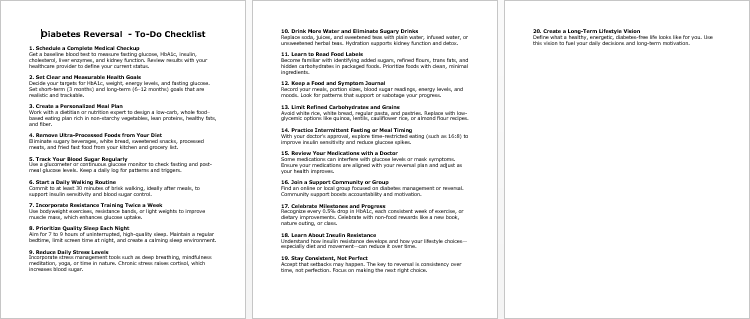
- Diabetes Reversal Checklist – 571 Words
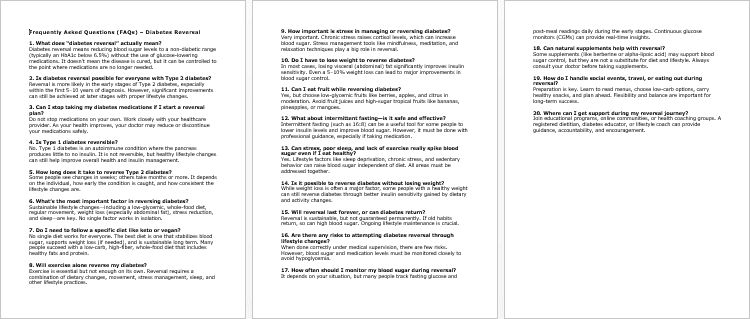
- Diabetes Reversal FAQs – 778 Words
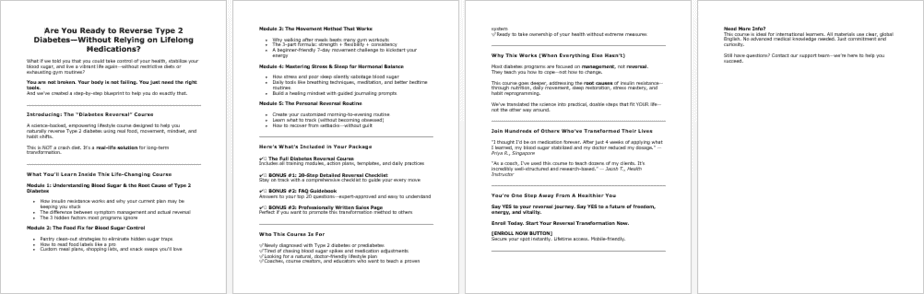
- Diabetes Reversal Ready-Made Sales Page – 636 Words
Every file is editable, brandable, and ready to deploy.
How You Can Use & Profit From This PLR Course
This course is extremely versatile and monetizes well.
💻 Sell as a Digital Course
Position as an educational lifestyle program
Suggested Price: $47 – $97
🧠 Coaching or Group Program
Use as a guided 6–8 week program
Suggested Price: $297 – $497
🔄 Membership Content
Add to a wellness or health membership
Monthly recurring revenue
📦 Mini Guideline Products
Split modules into focused guides
Sell at $10 – $20 each
📩 Lead Magnet Funnel
Give excerpts to build an email list
Upsell the full program later
🌐 Authority Health Brand
Build a diabetes education platform
Flip or scale long-term
PLR License Summary (Plain English)
✅ You MAY:
- Rebrand and sell the content
- Edit and customize freely
- Convert to video, audio, or print
- Bundle with other wellness products
- Use excerpts as lead magnets
- Offer via courses or membership sites
❌ You MAY NOT:
- Pass PLR or resale rights to customers
- Give away the complete product for free
- Offer 100% affiliate commissions
- Add to products already purchased without a new sale
Why This Diabetes PLR Course Is a Smart Investment
✔ High-demand, evergreen health niche
✔ Ethical, responsible education-based content
✔ Lifestyle-focused (not gimmicky)
✔ Perfect for wellness brands & coaches
✔ Saves months of writing and research
✔ Easy to customize
✔ Strong perceived value
Final Thoughts
The Diabetes Reversal PLR Course (24,131 words) gives you everything needed to launch a credible, high-value wellness product that genuinely helps people improve their health while building sustainable income for your business.
You bring:
• Your branding
• Your audience
• Your positioning
Buy Quality PLR provides the foundation.
has been added to your cart!
have been added to your cart!
Here A Sample of the Diabetes Reversal PLR Course
This course is designed to empower individuals with knowledge, daily action plans, and the confidence to take control of their health naturally and effectively. Let’s dive into the training modules!
Module 1: Understanding Diabetes at Its Root
Goal: Help learners truly understand what diabetes is, why it develops, and how it’s possible to reverse it.
Step 1: What Exactly is Diabetes?
Course Instruction & Description:
Welcome to Step 1 of our “Diabetes Reversal” course. In this foundational lesson, we’re going to unravel what diabetes truly is—clearly, simply, and in a way that makes complete sense, even if you have no medical background.
Many people hear the word “diabetes” and instantly feel overwhelmed. It sounds like a lifelong condition, surrounded by restrictions and medical jargon. But before we talk about reversing it, we need to deeply understand what’s happening inside the body when someone is diagnosed with diabetes.
This step is designed for international learners from all backgrounds. Whether you live in North America, Europe, Asia, Africa, or anywhere else in the world, this explanation applies to you—because diabetes affects the human body in the same basic way across all cultures and continents.
Learning Objective
By the end of this step, you will be able to:
- Differentiate between Type 1, Type 2, and Prediabetes
- Understand what insulin is and how it works in the body
- Grasp how diabetes develops and why it’s not always about sugar
- Recognize early warning signs that often go unnoticed
- Lay the groundwork for how diabetes can be reversed (particularly Type 2 and Prediabetes)
What is Diabetes, Simply Explained
Diabetes is a condition that affects how your body uses glucose, which is a type of sugar that gives your body energy. Normally, when you eat food, your body breaks it down into glucose and sends it into your bloodstream. At the same time, your pancreas releases a hormone called insulin to help move that glucose from your blood into your cells, where it can be used for energy.
But with diabetes, something goes wrong in that system.
Let’s look at what happens in the three common forms:
1. Type 1 Diabetes: The Autoimmune Attack
- What it is: Type 1 diabetes is an autoimmune condition. The body’s immune system mistakenly attacks the insulin-producing cells in the pancreas.
- Result: The body makes little to no insulin.
- Who it affects: Often diagnosed in children and young adults, but can occur at any age.
- Is it reversible?: No. Since the body cannot produce insulin on its own, lifelong insulin therapy is required. However, blood sugar can be managed effectively through diet, exercise, and insulin use.
2. Type 2 Diabetes: The Lifestyle-Driven Condition
- What it is: Type 2 diabetes is when the body either:
- Doesn’t produce enough insulin, or
- Doesn’t respond properly to the insulin it makes (insulin resistance).
- Result: Glucose builds up in the bloodstream instead of being used by the cells.
- Who it affects: Mostly adults, especially over 40, but it’s now increasingly common in younger people due to lifestyle factors.
- Key causes:
- Sedentary lifestyle
- High intake of processed foods
- Chronic stress
- Excess body weight (especially around the belly)
- Is it reversible?: Yes. In many cases, with dietary changes, physical activity, and stress management, blood sugar levels can return to normal without medication.
3. Prediabetes: The Warning Phase
- What it is: Prediabetes means your blood sugar levels are higher than normal but not high enough to be diagnosed as Type 2 diabetes.
- Result: It’s like your body is sending a warning sign. If ignored, it often turns into full-blown Type 2 diabetes.
- Who it affects: Globally, hundreds of millions of people are in this stage—many without knowing it.
- Symptoms: Usually none! That’s why regular health check-ups are critical.
- Is it reversible?: Absolutely. In fact, prediabetes is the most reversible phase if caught early.
Let’s Talk About Insulin in Plain Language
Think of insulin as a key. It unlocks the doors to your cells so glucose (sugar) from your food can go inside and be used for energy.
- In Type 1 diabetes, the body has no key.
- In Type 2 diabetes, the key doesn’t fit well anymore, or the locks are jammed (insulin resistance).
- In Prediabetes, the key is starting to struggle, but the locks still work if we act fast.
Why Understanding This Matters
Once you clearly see how your body processes glucose—and where the system breaks down—you’ll start to realize something powerful:
Diabetes doesn’t have to control your life. You can take control of it.
For those with Type 2 or Prediabetes, this course will help you fix the root causes. You don’t have to depend on medications for life. You just need to support your body in a way that helps it use insulin more effectively.
This doesn’t mean starving yourself. It means learning how to eat, move, rest, and think in a way that supports healing.
Common Signs and Symptoms of Diabetes (Often Overlooked):
Here’s a short list of symptoms that often appear during prediabetes or undiagnosed diabetes:
- Frequent urination
- Constant thirst
- Increased hunger (especially after eating)
- Fatigue or low energy
- Blurry vision
- Slow-healing wounds
- Tingling in hands and feet
- Unexplained weight loss (mainly in Type 1)
If you or your course participants are experiencing any of these symptoms, it’s essential to take them seriously and get tested.
Key Takeaway
Diabetes is not a disease of sugar. It’s a hormonal imbalance—centered around insulin—and how your body responds to it. Once you understand that, you’ll start to see that you have more control than you’ve been told.
Type 1 is a lifelong condition that requires insulin. But Type 2 and Prediabetes can often be reversed through changes in food, activity, stress, and sleep.
In the upcoming steps, you’ll learn exactly how to make that happen—step by step, with clarity, confidence, and support.
Step 2: The Blood Sugar Roller Coaster
Learn how blood sugar levels spike and crash, and why insulin plays the lead role in this ride.
Course Instruction & Description:
Welcome to Step 2 of our “Diabetes Reversal” course. Now that you understand what diabetes is and how insulin works, it’s time to dive deeper into the real-life experience many people go through every day without even realizing it — the blood sugar roller coaster.
This lesson will help you visualize and understand how daily habits — especially eating patterns — can create sudden blood sugar spikes, followed by sharp crashes, and how this unstable cycle can drain your energy, affect your mood, and eventually damage your health.
This step is designed in clear, international English, and uses globally recognized health concepts to ensure learners from all regions and backgrounds can apply what they learn.
Learning Objective
By the end of this step, you will:
- Understand how food affects blood sugar in real-time
- Learn what causes blood sugar to spike and crash
- Discover how insulin works to regulate those spikes
- Recognize symptoms of blood sugar imbalance
- Build awareness of how to smooth out the highs and lows
Let’s Start with a Simple Analogy
Imagine your body as a car on a racetrack. Your blood sugar is the fuel, and insulin is the traffic controller directing the fuel where it needs to go.
Now, picture what happens if you suddenly dump a huge amount of fuel into the tank — your car lurches forward uncontrollably, then sputters when it runs out. That’s exactly what’s happening during a blood sugar spike followed by a crash.
This is what we call the blood sugar roller coaster. And just like a real roller coaster, it might seem thrilling at first, but over time, it becomes exhausting — and dangerous.
Step-by-Step Breakdown of the Blood Sugar Roller Coaster
Step 1: You Eat a High-Carb or Sugary Meal
Let’s say you start your morning with:
- White toast
- Fruit juice
- A sweetened coffee
These foods are high in simple carbohydrates. They digest quickly and send a large wave of glucose into your bloodstream.
What happens next?
- Blood sugar spikes rapidly (think of a steep roller coaster climb).
- You feel a burst of energy, maybe even a bit jittery or hyper.
- Your pancreas senses the rise and releases a large amount of insulin to bring it down.
This is your body’s natural protective response. Too much glucose in your blood is toxic, so insulin comes to the rescue.
Step 2: Insulin Clears Out the Sugar – Fast
Now insulin is doing its job — removing glucose from the blood and storing it in your cells (mainly muscle, fat, and liver). If there’s too much sugar, and your cells don’t need that energy right now, insulin stores it as fat for later use.
Here’s the key part: when too much insulin is released quickly (after a sugar-heavy meal), your blood sugar may not just return to normal — it can drop below normal. This is the dreaded blood sugar crash.
What you feel:
- Fatigue
- Irritability
- Brain fog
- Intense cravings (especially for more sugar or carbs)
- Shakiness or anxiety in some cases
So, your body sends out a strong hunger signal. And what do you reach for? Often, another carb-heavy snack. The cycle repeats.
Step 3: The Crash Leads to Another Spike
When you eat again — maybe a muffin or a sweetened yogurt — your blood sugar shoots back up. The pancreas sends out more insulin. And the ride continues.
Over time, this repeated cycle creates:
- Insulin resistance: Your cells stop responding well to insulin.
- Chronic fatigue: Energy highs and lows become the norm.
- Weight gain: Especially around the abdomen.
- Hunger instability: You’re hungry even when you just ate.
- Mood swings: Irritability, depression, anxiety linked to sugar imbalances.
This is how the blood sugar roller coaster becomes part of everyday life — and how prediabetes or Type 2 diabetes can slowly develop.
Step 4: The Lead Role of Insulin
Think of insulin as the main character in this blood sugar drama.
Its job is to:
- Detect blood sugar increases
- Guide glucose into your cells
- Store excess glucose for future use (as glycogen or fat)
But when insulin is constantly pushed to work overtime — meal after meal, day after day — the body starts to resist it. This leads to chronically high insulin levels, even when you’re not eating.
High insulin can:
- Block fat burning (making weight loss harder)
- Cause constant hunger
- Lead to inflammation
- Drive your body toward insulin resistance and diabetes
Understanding insulin’s role is key to reversing this process. By learning to balance your blood sugar naturally, you give insulin a break — and your body a chance to heal.
Symptoms That You’re on the Blood Sugar Roller Coaster
You may not have diabetes yet, but if you’re experiencing these signs, you may already be on the ride:
- Mid-morning or mid-afternoon energy crashes
- Feeling “hangry” if you don’t eat every few hours
- Needing caffeine or sugar to get through the day
- Craving carbs, especially at night
- Trouble sleeping (especially waking up between 1–3 AM)
- Feeling tired after meals
If these sound familiar, your blood sugar balance is off — but the good news is, you can fix it.
Key Takeaway
The blood sugar roller coaster is not just about what you eat — it’s about how your body handles what you eat. Spikes and crashes are exhausting and harmful, but they are completely preventable and reversible with the right lifestyle strategies.
This is not about avoiding carbs entirely or obsessing over food. It’s about understanding how to work with your biology, not against it.
By stabilizing your blood sugar, you’ll gain:
- More consistent energy
- Fewer cravings
- Better mood and focus
- A healthier metabolism
- A real path to reversing Type 2 diabetes or prediabetes
This step lays the groundwork for real, sustainable change — because once you get off the roller coaster, everything in your health improves.
Step 3: Myths About Diabetes (And What’s Actually True)
Bust some common myths. Spoiler alert: Type 2 diabetes is NOT a life sentence.
Course Instruction & Description
Welcome to Step 3 of the Diabetes Reversal course. Now that you’ve learned how blood sugar behaves in your body and how insulin works, it’s time to clear the air and challenge some of the most widespread — and often harmful — myths about diabetes.
For decades, people around the world have accepted inaccurate or outdated beliefs about diabetes, particularly Type 2 diabetes. These myths have created confusion, fear, and in many cases, hopelessness.
This step is about empowering you with facts. We’ll separate truth from fiction using a simple, accessible approach — no heavy medical jargon, just clear and honest explanations that apply globally.
Whether you’re a patient, a caregiver, a coach, or a health educator, understanding what’s true (and what isn’t) about diabetes is essential to building the mindset and confidence required for change.
Learning Objective
By the end of this step, you will:
- Identify the most common myths surrounding Type 2 diabetes
- Understand the science-based truths behind each myth
- Learn how misinformation affects choices and mindset
- Build hope and motivation for natural blood sugar control
- Begin seeing diabetes as something you can influence, not fear
Step-by-Step Breakdown: Busting the Top Diabetes Myths
Step 1: Myth – “Once You Have Type 2 Diabetes, You’ll Always Have It”
Truth – Type 2 diabetes can be reversed or put into remission
This is one of the most damaging and limiting beliefs — and it’s simply not true. Type 2 diabetes is often presented as a progressive and permanent condition, where medications only delay the inevitable decline. But recent research and real-world examples tell a very different story.
The truth is, Type 2 diabetes is largely lifestyle-related, and in many cases, it can be reversed — meaning you can return your blood sugar levels to a normal range without medication, and stay there.
This doesn’t mean it’s “cured” in the traditional sense, but it can go into remission — just like other conditions that are triggered by chronic lifestyle imbalance.
Studies from the UK (like the DiRECT trial), the US, and other parts of the world have shown that with dietary changes, weight loss, stress management, and regular physical activity, many people can return to normal blood sugar levels.
So no — it’s not a life sentence. It’s a signal that your body needs help, and with the right support, it can absolutely heal.
Step 2: Myth – “Diabetes Is Caused by Eating Too Much Sugar”
Truth – Sugar plays a role, but it’s not the full story
You’ve probably heard someone say, “You gave yourself diabetes by eating too much sugar.” But this oversimplifies a very complex process.
The reality is, Type 2 diabetes is the result of long-term insulin resistance, which is influenced by:
- Poor metabolic health
- Sedentary lifestyle
- Excess visceral fat
- Chronic inflammation
- Poor sleep and high stress
- Genetic predisposition
Yes, consuming too much refined sugar and ultra-processed carbs over time can contribute to blood sugar spikes, weight gain, and insulin resistance — but it’s not sugar alone. Even high-carb “healthy” foods (like white rice, fruit juices, and processed breads) can have the same effect.
It’s not about cutting out all sugar forever. It’s about understanding the total dietary pattern and how your body responds to what you eat. Balanced nutrition, not strict sugar avoidance, is the key.
Step 3: Myth – “You’ll Need to Take Medication for Life”
Truth – Many people reduce or eliminate medications through lifestyle change
This is a myth that creates fear and passivity. While medications like metformin, insulin injections, or others are sometimes necessary — especially early on — they don’t fix the root cause. They help manage symptoms, but they don’t reverse the underlying insulin resistance.
Here’s the encouraging truth: when you take steps to reduce insulin resistance, improve cellular health, and balance your blood sugar naturally, your need for medication may decrease — and for many, it can be eliminated entirely.
With professional guidance and proper tracking, doctors often reduce medications as blood sugar normalizes. This is especially true for:
- People recently diagnosed with Type 2 diabetes
- Those with prediabetes
- Individuals with excess abdominal weight
- Those who commit to sustained lifestyle improvements
So instead of asking, “Which medication will I be on for the rest of my life?” a better question is: “What can I do to support my body so that it no longer needs medication?”
Step 4: Myth – “Diabetes Only Happens to Overweight People”
Truth – Thin people can also have insulin resistance and Type 2 diabetes
This myth is misleading and can be dangerous. While excess weight — especially abdominal fat — does increase the risk of developing Type 2 diabetes, it’s not the only factor.
Many people with a “normal” Body Mass Index (BMI) can have metabolic dysfunction. This is called TOFI — Thin Outside, Fat Inside. It means they may not appear overweight, but they have:
- High levels of visceral fat
- Poor liver function
- Elevated blood sugar and insulin levels
- Low muscle mass
- Sedentary habits
Diabetes is not just about body size. It’s about how well your body processes fuel — your metabolism.
That’s why it’s critical to look beyond weight and focus on overall metabolic health. That includes:
- Stable energy levels
- Normal fasting glucose and insulin
- Balanced lipid levels
- Healthy waist circumference
- Regular physical activity
If you’re thin and think you’re “safe” from diabetes, don’t ignore warning signs like fatigue, frequent urination, or sugar cravings. These could still indicate insulin resistance.
Summary: Shifting the Mindset from Fear to Empowerment
Myths can be comforting, but they often hold us back from real solutions. When we rely on outdated or incorrect beliefs, we become passive — waiting for doctors, drugs, or “bad luck” to decide our fate.
The truth is far more powerful.
You now know that:
- Type 2 diabetes is reversible or can go into remission
- Sugar is only part of the picture
- Medications can be reduced or stopped with lifestyle support
- Thin people are not immune to blood sugar issues
When you replace myths with facts, you don’t just improve your knowledge — you build hope, motivation, and a clear path forward. This isn’t about blame or guilt. It’s about understanding your body, taking back control, and learning how to thrive with the truth on your side.
Step 4: Is Reversal Really Possible?
Discover inspiring real-life success stories and the science behind diabetes reversal through lifestyle changes
Course Overview
This lesson is where knowledge meets transformation.
In the first three steps of the course, we explored what diabetes is, how blood sugar behaves, and which myths have been holding us back. Now, we ask one of the most important questions: Is it truly possible to reverse Type 2 diabetes through natural means—without depending on lifelong medications?
This module answers with a confident yes, grounded in clinical science, long-term data, and first-hand stories from individuals who have walked this path successfully.
As international course creators, you’ll be equipped with both the evidence and the human context to teach this topic with clarity and credibility to global learners. You’ll explore the science, learn what “reversal” really means, and understand how to communicate it responsibly across diverse cultures and educational backgrounds.
Learning Objectives
By the end of this lesson, learners will:
- Clearly understand what diabetes reversal means (and what it doesn’t mean)
- Know the medical criteria for reversal (based on international guidelines)
- Grasp the core mechanisms that make reversal possible
- Explore global, culturally relevant real-life case studies
- Learn the critical lifestyle elements that have driven successful remission
Step-by-Step Breakdown
Step 1: What Is “Reversal” and How Is It Defined Medically?
Let’s start by defining the term diabetes reversal—sometimes also called diabetes remission.
According to health bodies like the American Diabetes Association, Diabetes UK, and the World Health Organization, reversal is achieved when:
- HbA1c levels fall below 6.5% (48 mmol/mol)
- Without the use of diabetes medication
- And the normal blood sugar range is maintained for at least 3–12 months
This is not the same as a cure. Reversal means that blood glucose levels are stable and healthy without the need for external medication or insulin, but the underlying risk factors remain. If habits revert, diabetes can return.
By understanding this, we avoid overpromising or misleading learners. It empowers learners to see reversal not as a miracle, but as a manageable outcome through consistent lifestyle changes.
Teaching Tip: Always use the term reversal or remission—avoid using the word “cure” to maintain scientific credibility.
Step 2: The Science Behind How Reversal Happens
To truly teach diabetes reversal, we must explore the biology that makes it possible. The central idea is this:
Type 2 diabetes is primarily a condition of insulin resistance—not just high blood sugar.
When someone develops insulin resistance:
- Their cells stop responding to insulin effectively.
- The pancreas has to produce more insulin to compensate.
- Eventually, this leads to chronically high blood glucose.
What most people don’t know is that fat accumulation around the liver and pancreas plays a key role in insulin resistance. This is known as visceral fat, and it is metabolically active, meaning it directly interferes with insulin signaling.
Here’s how lifestyle changes reverse this:
- Sustained weight loss, especially 10–15% of body weight, reduces visceral fat.
- This restores the pancreas’s ability to regulate insulin naturally.
- Dietary interventions, like low-carb or Mediterranean diets, reduce the insulin load.
- Exercise, especially walking and resistance training, increases insulin sensitivity in muscles.
- Sleep, stress reduction, and intermittent fasting help stabilize blood glucose and reduce inflammation.
This biological pathway has been confirmed in studies such as the DiRECT trial in the UK, which showed that almost half of participants achieved remission within a year using a structured weight loss and maintenance program.
Step 3: Real-Life Stories of People Who Reversed Type 2 Diabetes
One of the most effective teaching strategies is storytelling. People relate more to stories than statistics. Here are three international case studies that bring the science to life:
Case Study 1 – United Kingdom (DiRECT Study Participant)
- Name: Robert, 59
- Condition: Type 2 diabetes for 4 years
- Approach: Participated in a structured very low-calorie diet plan followed by phased reintroduction of whole foods
- Outcome: Lost 14 kg (30 lbs), reduced HbA1c from 7.8% to 5.4%, no medications needed for over 2 years
Case Study 2 – India (Lifestyle Coaching + Yoga)
- Name: Kavita, 47
- Condition: Type 2 diabetes for 6 years
- Approach: Adopted a low-glycemic Indian diet, daily yoga, and intermittent fasting with medical supervision
- Outcome: Weaned off metformin, blood sugars stabilized at 5.6% HbA1c, regained energy and reduced belly fat significantly
Case Study 3 – Canada (Low-Carb and Intermittent Fasting)
- Name: Mark, 51
- Condition: Type 2 diabetes for 8 years, on two medications
- Approach: Transitioned to a ketogenic diet under the guidance of a medical professional and included 16:8 fasting schedule
- Outcome: Off all medications in 9 months, maintained remission for over 3 years
Each of these individuals took different paths to reversal, but the unifying thread was sustainable lifestyle change grounded in evidence-based strategies.
Teaching Tip: Encourage learners to reflect on which story they relate to most. It increases emotional connection and motivation.
Step 4: What Increases the Chances of Reversal Success?
Not everyone with Type 2 diabetes can reverse their condition — but many more can than currently believe. The success rate increases with:
- Early diagnosis: Reversal is more likely within 3–6 years of diagnosis
- Central obesity: If abdominal fat is present, targeted fat loss makes a major impact
- Strong support systems: Coaching, community groups, and structured programs lead to better adherence
- Cultural alignment: Dietary plans that respect local food traditions are more sustainable
- Mindset: Belief in the possibility of reversal is critical — hope fuels action
Some groups — such as older adults or those with long-standing diabetes — may not reach full reversal, but even partial reversal (lowering medication, stabilizing blood sugar) is a tremendous achievement and should be celebrated.
For international audiences, emphasize that this is not a one-size-fits-all journey. Tailoring strategies to local food availability, religious fasting practices, physical ability, and cultural norms makes the information more inclusive and practical.
Conclusion: The Door to Reversal Is Open
This module delivers a hopeful, science-based message: Reversal is not just a dream — it’s an achievable result for many people around the world.
As a course creator, your goal is to help learners:
- See the path ahead with clarity and confidence
- Understand the science in simple, accurate language
- Know that they are not alone — others have walked this path
- Recognize that lifestyle changes can transform health permanently
Whether you’re designing content for South Asia, Europe, the Americas, or Africa, this module provides a universal truth: Diabetes does not have to define the rest of your life.
We’re also giving these extra bonuses
Diabetes Reversal – Checklist
Diabetes Reversal – FAQs
Diabetes Reversal – Salespage Content
Package Details:
Word Count: 24 131 Words
Number of Pages: 100
Diabetes Reversal – Bonus Content
Checklist
Word Count: 571 words
FAQs
Word Count: 778 words
Salespage Content
Word Count: 636 words
Total Word Count: 26 116 Words
Your PLR License Terms
PERMISSIONS: What Can You Do With These Materials?
Sell the content basically as it is (with some minor tweaks to make it “yours”).
If you are going to claim copyright to anything created with this content, then you must substantially change at 75% of the content to distinguish yourself from other licensees.
Break up the content into small portions to sell as individual reports for $10-$20 each.
Bundle the content with other existing content to create larger products for $47-$97 each.
Setup your own membership site with the content and generate monthly residual payments!
Take the content and convert it into a multiple-week “eclass” that you charge $297-$497 to access!
Use the content to create a “physical” product that you sell for premium prices!
Convert it to audios, videos, membership site content and more.
Excerpt and / or edit portions of the content to give away for free as blog posts, reports, etc. to use as lead magnets, incentives and more!
Create your own original product from it, set it up at a site and “flip” the site for megabucks!
RESTRICTIONS: What Can’t You Do With These Materials?
To protect the value of these products, you may not pass on the rights to your customers. This means that your customers may not have PLR rights or reprint / resell rights passed on to them.
You may not pass on any kind of licensing (PLR, reprint / resell, etc.) to ANY offer created from ANY PORTION OF this content that would allow additional people to sell or give away any portion of the content contained in this package.
You may not offer 100% commission to affiliates selling your version / copy of this product. The maximum affiliate commission you may pay out for offers created that include parts of this content is 75%.
You are not permitted to give the complete materials away in their current state for free – they must be sold. They must be excerpted and / or edited to be given away, unless otherwise noted. Example: You ARE permitted to excerpt portions of content for blog posts, lead magnets, etc.
You may not add this content to any part of an existing customer order that would not require them to make an additional purchase. (IE You cannot add it to a package, membership site, etc. that customers have ALREADY paid for.)
Share Now!
Latest Products



Free Sales Funnel Builder

Related Products
Popular & Trending


Featured Products