

Chakra Balancing for Optimum Health PLR Course 21k Words
in Health PLR eBooks , PLR Checklists , PLR eBooks , PLR eCourses , PLR List Building Reports , Premium PLR , Premium PLR eBooks , Premium PLR Reports , Premium White Label Brandable PLR Coaching Courses , Private Label Rights Products , Self Help PLR , Self Help PLR eBooks , Self Improvement PLR , Self Improvement PLR EbooksChoose Your Desired Option(s)
has been added to your cart!
have been added to your cart!
#chakrabalancing #holistichealth #energyhealing #wellnessmarketing #mindbodyspirit #plrcontent #spiritualwellness #plrcourse
A Complete Holistic Guide to Energy Healing, Alignment & Whole-Body Wellness
Create a Powerful Energy Healing Program Without Writing a Single Word
Interest in chakra healing, energy balance, and holistic wellness has exploded worldwide. People are actively searching for natural ways to reduce stress, restore balance, improve emotional health, and reconnect with their inner wellbeing.
The problem?
Creating a high-quality chakra course from scratch takes weeks or months of research, organization, and writing.
That’s exactly why the Chakra Balancing for Optimum Health PLR Course exists.
This professionally written, beginner-friendly, and deeply practical course allows you to launch your own chakra healing product quickly, confidently, and legally—without starting from a blank page.
Simply brand it, customize it, and sell it as your own.
Introducing the…
Chakra Balancing for Optimum Health PLR Course 21k Words
Why Chakra Balancing Is a Highly Profitable PLR Niche
Chakra and energy healing content sits at the intersection of multiple evergreen markets:
✅ Spiritual growth
✅ Holistic health & wellness
✅ Personal development
✅ Stress relief & emotional healing
✅ Yoga, mindfulness & meditation
This means your finished product can appeal to:
- Wellness coaches
- Yoga instructors
- Energy healers
- Holistic practitioners
- Spiritual bloggers
- Self-help audiences
- Course creators & membership owners
It’s emotional, transformational, and high-value content people happily pay for.
Course Overview
Chakra Balancing for Optimum Health is a step-by-step training course designed to help learners:
✔ Understand the chakra system
✔ Identify energetic blockages
✔ Activate and balance all seven chakras
✔ Improve physical, emotional, and spiritual wellbeing
✔ Build a long-term chakra wellness lifestyle
This course is written in a friendly, approachable, and non-overwhelming style, making it perfect for beginners while still offering depth for wellness enthusiasts.
What the Course Covers
Module 1: Introduction to Chakras and Energy Healing
Learners are introduced to the body’s subtle energy system and how it directly influences overall health.
This module explains:
- What energy is and how it flows through the body
- What chakras are and their role in mind-body balance
- The seven main chakras and what each governs
- Signs of balanced vs. imbalanced chakras
- How chakra alignment supports immunity, stress relief, mood, and vitality
This foundation ensures clarity before moving into hands-on practices.
Module 2: Grounding with the Lower Chakras
This module focuses on stability, confidence, creativity, and emotional grounding.
Learners explore:
- Root chakra grounding techniques for safety and security
- Sacral chakra practices for creativity, pleasure, and emotional flow
- Solar plexus activation for confidence and personal power
- Simple daily grounding routines to stabilize energy
This section is deeply practical and ideal for daily use.
Module 3: Awakening the Upper Chakras
Here, the focus shifts to emotional openness, communication, intuition, and awareness.
This module teaches:
- Heart chakra meditations for compassion and emotional healing
- Throat chakra practices to improve self-expression
- Third eye exercises for intuition and clarity
- Harmonizing energy flow between emotional and intuitive centers
Learners experience deeper self-connection and inner balance.
Module 4: Crown Chakra and Full-Body Alignment
This module unifies the entire chakra system.
Topics include:
- Crown chakra awareness and spiritual connection
- Full chakra scan and alignment meditations
- Using crystals, essential oils, and sound healing
- Designing personal chakra healing rituals
This section adds depth and perceived premium value to the course.
Module 5: Living in Alignment – Chakra Lifestyle Practices
The final module teaches long-term chakra wellness through everyday habits.
Learners discover:
- Chakra-supportive nutrition and color-based eating
- Gentle yoga and movement for energy activation
- Emotional hygiene and energy protection techniques
- Creating a long-term chakra wellness plan
This module ensures transformation doesn’t end with the course.
What Learners Will Gain
✅ A complete understanding of all seven chakras
✅ Daily chakra balancing techniques
✅ Emotional resilience and mental clarity
✅ Improved energy, confidence, and calm
✅ A sustainable wellness routine they can maintain long-term
What’s Included in This PLR Package
You receive a complete, ready-to-sell product, not just raw lessons.
✅ Main Course
- Chakra Balancing for Optimum Health – 19,718 Words
✅ Bonus Materials (Word Counts Included)
- Chakra Balancing Checklist – 536 Words
- Chakra Balancing FAQs – 826 Words
- Chakra Balancing Ready-Made Sales Page – 696 Words
All materials are fully editable and professionally written.
How You Can Use & Profit from This PLR Course
This product gives you maximum flexibility for monetization:
🌿 Sell as a Digital Course
Perfect for wellness audiences
Suggested price: $47 – $97
🧘 Create a Chakra Coaching Program
Run it as a guided 5–7 week experience
Suggested price: $297 – $497
🔄 Membership Site Content
Add as a monthly chakra healing track
Generate recurring income
📦 Break into Mini Products
Sell each chakra as a mini guide
$10 – $20 per report
🎧 Convert to Audio or Meditation Series
Increase perceived value instantly
📩 Lead Magnet Funnel
Use excerpts to build your email list
Upsell the full course later
🌐 Build & Flip a Wellness Website
Position this as the flagship product
Sell the site for profit
PLR License Summary (Plain English)
✅ You ARE Allowed To:
- Rebrand and sell the content
- Edit, rewrite, or expand
- Bundle with other products
- Convert to audio, video, or print
- Sell via memberships or courses
- Use excerpts for lead magnets
❌ You Are NOT Allowed To:
- Pass PLR or resale rights to customers
- Give the full product away for free
- Offer 100% affiliate commissions
- Add it to an existing paid product with no new purchase
Why This PLR Course Is a Smart Buy
✔ High-demand evergreen niche
✔ Wide wellness & spiritual appeal
✔ Beginner-friendly yet comprehensive
✔ Strong perceived transformation value
✔ Time-saving done-for-you solution
✔ Perfect fit for Buy Quality PLR customers
Final Thoughts
The Chakra Balancing for Optimum Health PLR Course (19,718 words) gives you everything you need to launch a meaningful, profitable wellness product—fast.
No overwhelm.
No research.
No writing marathons.
Just brand it, customize it, and start selling.
Buy Quality PLR builds the foundation — you create the income.
has been added to your cart!
have been added to your cart!
Here A Sample of the Chakra Balancing for Optimum Health PLR Course
Course Goal: To help learners understand, activate, and balance their seven main chakras for improved physical, emotional, and spiritual health. This course is designed for beginners and wellness enthusiasts who want a practical and holistic approach to energy healing.
Module 1: Introduction to Chakras and Energy Healing
Step 1: Understanding Energy and the Human Body
Course Module: Introduction to Chakras and Energy Healing
Welcome to Step 1: Understanding Energy and the Human Body
Before we explore chakras in detail, it’s essential to understand the foundational concept of energy and how it operates within the human body. This understanding is the key to unlocking your body’s natural healing potential. Whether you’re new to this topic or have heard terms like “prana,” “qi,” or “life force energy,” this step will give you a clear, structured understanding from a global, inclusive perspective.
Section 1: What Is Energy in the Human Body?
In many traditional and contemporary healing systems, energy is described as the vital life force that animates all living beings. This concept may be known by different names around the world:
- Prana (India – Yoga, Ayurveda)
- Qi or Chi (China – Traditional Chinese Medicine)
- Ki (Japan – Reiki, martial arts)
- Ruach or Spiritus (Middle Eastern and Western traditions)
While modern medicine focuses on the physical, biochemical aspects of health (like blood pressure, hormones, etc.), these ancient systems speak to a subtle, non-physical energy field that is equally vital to our well-being.
Energy in the human body flows in patterns and networks, similar to how rivers run through a landscape. When energy flows freely, we feel healthy, vibrant, and emotionally balanced. When it’s blocked or stagnant, it may manifest as physical discomfort, mental fog, emotional distress, or spiritual disconnection.
Section 2: Understanding the Subtle Energy System
The subtle energy system refers to a network of energy centers (chakras), channels (called nadis or meridians), and fields (often referred to as the aura) that exist within and around the physical body.
This system is not visible to the naked eye or measured in traditional clinical settings, but it is sensed, felt, and experienced through various healing practices, including:
- Meditation
- Yoga and breathwork
- Energy healing modalities like Reiki, Qi Gong, and acupuncture
Here are key components of this system:
1. Chakras – Energy Centers
There are seven main chakras aligned along the spine, from the base to the top of the head. Each chakra governs different aspects of our physical, emotional, and spiritual health. We’ll explore them in detail in upcoming steps.
2. Nadis and Meridians – Energy Channels
In Yoga and Ayurveda, energy flows through 72,000 nadis, with three primary ones: Ida, Pingala, and Sushumna. In Traditional Chinese Medicine, meridians form a web of energy flow, and acupuncture is based on balancing this energy.
3. Aura – The Electromagnetic Field
The aura is the energetic field that surrounds the body. It reflects the state of your inner world — thoughts, emotions, and spiritual vibration — and interacts with the energy around you. Sensitive individuals can sometimes perceive auras as color shifts, feelings, or temperature changes.
Section 3: How Energy Influences Health, Mood, and Mindset
Let’s connect the dots between energy and your daily experience.
When your energy system is in harmony, you might notice:
- A strong immune system and quick recovery from illness
- Clear thinking and sharp mental focus
- A general sense of calm, balance, and joy
- The ability to handle stress without feeling overwhelmed
When energy is disrupted or blocked, symptoms may include:
- Chronic fatigue, tension, or frequent illness
- Unexplained emotional outbursts or numbness
- Anxiety, depression, or a sense of being “off”
- Difficulty concentrating or making decisions
Energy doesn’t just affect your body — it affects how you perceive life, how you interact with others, and how aligned you are with your purpose. It is the invisible thread linking your inner world with your outer reality.
Section 4: How to Begin Sensing and Becoming Aware of Your Energy
You don’t need any special tools or years of training to begin sensing your energy. Here are a few simple practices you can try today to develop awareness:
1. Body Scan Exercise (5 minutes)
Sit or lie down in a quiet space. Close your eyes. Slowly bring your attention from the top of your head to the soles of your feet. As you move your awareness, notice:
- Areas of warmth or coolness
- Tingling, pressure, or numbness
- Emotions or images that arise
- Places where energy feels “stuck” or heavy
This helps you connect to your inner energy flow and is a basic form of energy awareness.
2. Breath Observation
Focus on your breathing. Try to notice whether the breath is shallow, deep, fast, or uneven. The breath is directly linked to your energy. Slowing and deepening the breath naturally rebalances the system.
3. Hand Sensation Practice
Rub your hands together for 15–20 seconds. Then hold them a few inches apart and slowly move them closer and further away. Can you feel a magnetic-like field between them? This is a form of energy awareness — your body is emitting and sensing subtle energy.
Section 5: Recap and Key Takeaways
Let’s summarize what we’ve covered in this foundational step:
- Energy is the vital life force present in all living beings.
- The body has a subtle energy system, including chakras, channels, and the aura.
- Energy impacts physical health, emotional stability, and mental clarity.
- Practices like breathwork, mindfulness, and observation help you become more aware of your energy field.
- When your energy flows smoothly, you feel well, resilient, and aligned with life.
This understanding sets the stage for everything else in the course. As you move forward, remember that energy awareness is a practice. It grows with curiosity, patience, and intention.
If you’re teaching this content to an international audience, consider incorporating cross-cultural references and avoid culture-specific jargon. Use inclusive language, and explain unfamiliar terms when needed. The goal here is to build a shared vocabulary that respects and integrates multiple healing traditions around the world.
Step 2: What Are Chakras?
Course Module: Introduction to Chakras and Energy Healing
Welcome to Step 2: What Are Chakras?
Now that you’ve developed a basic understanding of the human energy system, it’s time to zoom in on one of its most essential elements: chakras.
Chakras are energy centers that play a vital role in our overall well-being — physically, emotionally, mentally, and spiritually. Whether you’re teaching this concept in a wellness program, yoga teacher training, energy healing course, or corporate mindfulness session, this step will give you a clear, internationally friendly and accessible explanation of what chakras are and why they matter.
Section 1: The Meaning and Origin of Chakras
The word chakra comes from the ancient Sanskrit language, meaning “wheel” or “disc.” Chakras are often visualized as spinning wheels or vortices of energy that correspond to different parts of the body and levels of consciousness.
This concept originates from the Vedic traditions of India, where chakras were described as part of the body’s pranic (life force) system. While this system is most famously discussed in yoga and Ayurveda, similar ideas of energy centers appear across many cultures:
- China: The system of meridians and dantians in Traditional Chinese Medicine
- Japan: Reiki healing uses energy centers aligned with chakra principles
- Christian mysticism: References to sacred centers of light or spirit
- Indigenous traditions: Body-soul connection and earth-based energy wisdom
Though the names and models differ, the underlying principle is the same: human beings have internal energy centers that regulate vital life processes.
Section 2: The Seven Main Chakras – An Overview
There are seven primary chakras, running along the spine from the base to the crown of the head. Each chakra governs a specific area of your body and consciousness. They are interconnected — when one is out of balance, it affects the others. Think of them like the gears in a machine: when they work in harmony, your energy flows with ease.
Let’s introduce each chakra briefly, from Root to Crown.
1. Root Chakra – “Muladhara”
- Location: Base of the spine (tailbone area)
- Color: Red
- Element: Earth
- Associated with: Safety, survival, physical needs, grounding
- Balanced state: You feel secure, grounded, and supported by life
- Imbalance signs: Fear, insecurity, financial stress, disconnection from the body
This is your foundation chakra. It’s connected to your primal instincts and your relationship with the physical world — food, shelter, security, and stability.
2. Sacral Chakra – “Svadhisthana”
- Location: Lower abdomen (just below the navel)
- Color: Orange
- Element: Water
- Associated with: Emotions, pleasure, sexuality, creativity
- Balanced state: You experience joy, emotional fluidity, and creative expression
- Imbalance signs: Guilt, emotional instability, sexual repression or excess
This chakra governs your emotional intelligence and your capacity to enjoy life. It also relates to your ability to form healthy relationships and process desire.
3. Solar Plexus Chakra – “Manipura”
- Location: Upper abdomen (stomach area)
- Color: Yellow
- Element: Fire
- Associated with: Personal power, confidence, motivation, willpower
- Balanced state: You feel self-assured, in control, and purpose-driven
- Imbalance signs: Low self-esteem, aggression, digestive issues
This is the chakra of personal identity. It fuels your confidence, leadership, and ability to take action.
4. Heart Chakra – “Anahata”
- Location: Center of the chest
- Color: Green (sometimes pink)
- Element: Air
- Associated with: Love, compassion, empathy, forgiveness
- Balanced state: You feel connected, loving, and at peace
- Imbalance signs: Isolation, jealousy, bitterness, grief
The heart chakra is the bridge between the lower (physical) and upper (spiritual) chakras. It connects your emotional world with your capacity for unconditional love.
5. Throat Chakra – “Vishuddha”
- Location: Throat
- Color: Blue
- Element: Ether (Space)
- Associated with: Communication, truth, self-expression
- Balanced state: You speak your truth with clarity and confidence
- Imbalance signs: Shyness, dishonesty, fear of speaking, sore throat issues
This chakra governs your ability to express yourself clearly and honestly. It also connects you to integrity in speech and active listening.
6. Third Eye Chakra – “Ajna”
- Location: Between the eyebrows (forehead area)
- Color: Indigo
- Element: Light
- Associated with: Intuition, insight, vision, perception
- Balanced state: You trust your inner guidance and think clearly
- Imbalance signs: Confusion, overthinking, lack of clarity or purpose
The third eye chakra is your inner compass. It governs your imagination, foresight, and ability to make intuitive decisions.
7. Crown Chakra – “Sahasrara”
- Location: Top of the head
- Color: Violet or White
- Element: Consciousness or Divine Energy
- Associated with: Spirituality, enlightenment, connection to the universe
- Balanced state: You feel connected to your higher self and universal wisdom
- Imbalance signs: Disconnection, spiritual confusion, cynicism
This chakra represents pure awareness and transcendence. It’s the seat of higher consciousness and unity with all life.
Section 3: How Do Chakras Work?
Chakras are like energy processing centers. Each one spins and vibrates at a unique frequency. These vibrations influence your organs, glands, emotions, and thoughts. When your chakras are open and balanced, energy flows easily between them. You feel whole — physically vital, emotionally steady, mentally sharp, and spiritually alive.
When a chakra is blocked, overactive, or underactive, it can disrupt the entire system. For example:
- A blocked throat chakra may cause you to avoid speaking up or feel misunderstood.
- An overactive solar plexus chakra may result in controlling or aggressive behavior.
- An underactive heart chakra can make it difficult to trust or connect with others.
Chakra balancing is about restoring the natural harmony and flow of energy through awareness, intention, and healing practices — which we will explore in detail throughout the course.
Section 4: The Chakras as a System – A Ladder of Growth
The chakra system is often visualized as a ladder of consciousness, where each level corresponds to a different layer of personal development. From survival at the root to self-realization at the crown, the journey through the chakras is both a healing path and a growth map.
You can think of them in three groups:
- Lower Chakras (Root, Sacral, Solar Plexus): Deal with physical needs, emotions, and personal power
- Middle Chakra (Heart): The balancing center — connects the earthly with the spiritual
- Upper Chakras (Throat, Third Eye, Crown): Deal with communication, intuition, and spiritual awareness
Balanced chakras support not just personal well-being but also our relationships, creativity, work, and overall quality of life.
Section 5: Key Takeaways and Integration
Let’s wrap up this step with a few core ideas:
- Chakras are spinning energy centers within the human body that influence your physical, emotional, and spiritual state.
- There are seven main chakras, each with a specific location, color, element, and life function.
- Chakras are interconnected, and imbalances in one can impact the whole system.
- Understanding the chakra system provides a framework for holistic healing and personal growth.
As you continue learning, keep in mind that chakra awareness is not about perfection, but about balance — learning to listen to the signals of your body and inner world with honesty and compassion.
This foundational knowledge prepares you for the deeper work of chakra assessment, clearing, and healing in later modules.
Step 3: Signs of Balanced vs. Imbalanced Chakras
Course Module: Chakra Assessment and Self-Diagnosis
Welcome to Step 3: Recognizing the Signs of Balanced and Imbalanced Chakras
Now that you understand what chakras are and where they are located, the next crucial step is learning how to recognize when they are in balance — and more importantly, when they are out of balance.
This knowledge empowers you and your learners to perform basic energy self-assessments and better support others in doing the same. As an international course creator, you’ll want to present this material in a structured, culturally neutral, and globally accessible way that supports both self-reflection and personal growth.
This step will walk you through the physical, emotional, and mental symptoms of chakra imbalances, as well as the positive indicators of a balanced energy system. You’ll learn how each chakra speaks to you — through your body, your mood, your behaviors, and your life circumstances.
Section 1: Why Recognizing Chakra Imbalances Matters
Before diving into the individual chakras, it’s important to understand the big picture: your chakras serve as energy processing centers. They absorb, transform, and distribute life force energy (also known as prana, chi, or qi) throughout your body and subtle systems.
When energy flows freely and appropriately through your chakras, you feel:
- Physically healthy
- Emotionally stable
- Mentally focused
- Spiritually connected
When energy is blocked, excessive, or deficient in any chakra, you may experience:
- Unexplained physical discomfort or chronic issues
- Emotional instability or reactive behavior
- Mental fog, anxiety, or confusion
- A feeling of being “stuck” in life
Imbalances don’t always mean illness, but they are often early warning signs that something needs attention. Recognizing them is the first step toward energy healing and personal alignment.
Section 2: Understanding Energy Patterns – Deficient, Balanced, Excessive
Every chakra can express itself in three primary energy states:
- Balanced – The chakra functions well; energy flows smoothly
- Deficient (Underactive) – The chakra is blocked or closed; energy is lacking
- Excessive (Overactive) – The chakra is overcompensating; energy is excessive, often uncontrolled
As you review each chakra, keep in mind that imbalances may show up in more than one form. Sometimes a chakra can even swing between excessive and deficient. Learning the signs helps your students tune into their internal state more precisely.
Section 3: Chakra-by-Chakra Signs of Balance vs. Imbalance
Let’s examine how each chakra expresses itself when it is in balance, underactive, or overactive.
1. Root Chakra (Muladhara)
- Balanced: Grounded, stable, secure. You trust in life and feel safe in your body.
- Deficient: Disconnected from the body, fearful, anxious, unstable. Financial or survival worries.
- Excessive: Material obsession, overeating, hoarding, rigidity, resistance to change.
- Physical signs: Lower back pain, leg/knee issues, fatigue, elimination problems.
2. Sacral Chakra (Svadhisthana)
- Balanced: Emotional flow, sensuality, creativity, joy, intimacy. Comfortable with pleasure.
- Deficient: Numbness, lack of desire, emotional suppression, fear of intimacy.
- Excessive: Overindulgence in food/sex, emotional dependency, drama addiction.
- Physical signs: Reproductive problems, hip pain, urinary issues, menstrual discomfort.
3. Solar Plexus Chakra (Manipura)
- Balanced: Confidence, motivation, personal power. Clear boundaries and direction.
- Deficient: Low self-esteem, indecisiveness, passivity, victim mindset.
- Excessive: Aggression, controlling behavior, arrogance, burnout.
- Physical signs: Digestive issues, ulcers, liver problems, chronic fatigue.
4. Heart Chakra (Anahata)
- Balanced: Love, compassion, empathy, forgiveness. Healthy relationships.
- Deficient: Isolation, fear of rejection, coldness, lack of empathy.
- Excessive: Codependency, jealousy, possessiveness, smothering others.
- Physical signs: Heart/lung problems, chest tightness, circulation issues.
5. Throat Chakra (Vishuddha)
- Balanced: Honest communication, authentic expression, clear voice.
- Deficient: Fear of speaking, introversion, dishonesty, difficulty expressing needs.
- Excessive: Gossip, talking over others, dominating conversation, harsh speech.
- Physical signs: Sore throat, thyroid imbalance, neck tension, jaw clenching.
6. Third Eye Chakra (Ajna)
- Balanced: Intuition, clarity, insight, imagination. Awareness beyond the senses.
- Deficient: Poor vision (literal or metaphorical), lack of focus, disbelief in intuition.
- Excessive: Overactive imagination, hallucinations, obsessive thinking, paranoia.
- Physical signs: Headaches, sinus issues, eye strain, insomnia.
7. Crown Chakra (Sahasrara)
- Balanced: Spiritual connection, purpose, peace, unity with life.
- Deficient: Cynicism, apathy, spiritual disconnection, rigid beliefs.
- Excessive: Spiritual bypassing, disassociation, neglect of the body, ego-driven “enlightenment.”
- Physical signs: Migraines, dizziness, neurological issues, sensitivity to light or sound.
Section 4: How to Use This Knowledge
As a course creator, guide your students to self-reflect regularly by asking questions such as:
- What physical symptoms am I experiencing regularly?
- What emotional patterns keep showing up?
- Do I feel energized or drained in a particular area of my life?
- How do I respond to stress, change, or intimacy?
You can encourage participants to journal their responses, complete chakra self-assessment worksheets, or use guided meditations to check in with each chakra’s energy. This awareness practice is not diagnostic in the medical sense, but it is a powerful complementary tool for self-care and healing.
Remind learners that chakra imbalances are common and natural — we all fluctuate. The goal is not perfection but awareness and balance.
Section 5: Key Takeaways
- Each chakra has distinct signs when in balance, underactive, or overactive.
- Imbalances can show up through physical symptoms, emotional states, and behavioral patterns.
- Understanding these signs allows for early correction and energy rebalancing.
- Regular self-check-ins and energy awareness build long-term emotional intelligence and resilience.
By understanding these patterns, your students gain a roadmap to their own energy system — one that can guide lifestyle changes, healing work, and spiritual development with clarity and purpose.
Let this step serve as the foundation for deeper work in chakra clearing, meditation, breathwork, and energy alignment.
Step 4: Why Chakra Balancing Matters for Optimum Health
Course Module: The Science and Energy Connection of Wellness
Welcome to Step 4: Understanding the Importance of Chakra Balancing for Your Health
In this step, we move from theory to meaningful connection. You and your learners already understand that chakras are part of the body’s subtle energy system, and how imbalance in these centers may show up in physical, mental, or emotional symptoms. Now we take this further — how exactly does the state of your chakras influence your overall health?
This is where energy work becomes directly relevant to everyday life: sleep quality, stress response, immune resilience, digestion, clarity of thought, emotional well-being, and even productivity. These are not just spiritual or abstract ideas — they are health fundamentals, especially for learners who want a holistic approach to wellness.
This section will equip you, as a course creator, with an easy-to-teach framework for explaining why balancing chakras is not just spiritual hygiene — it’s essential for optimal health.
Section 1: Energy Systems and the Mind-Body Connection
To begin, we must emphasize that energy is the foundation of the physical body. While chakras are not visible on an X-ray or scan, they interact continuously with your endocrine system, nervous system, and emotional processing centers.
Each chakra is associated with a specific endocrine gland and nerve plexus. For example:
- The Throat Chakra (Vishuddha) connects to the thyroid gland, which regulates metabolism.
- The Solar Plexus Chakra (Manipura) links to the adrenal glands, which manage stress hormones like cortisol.
- The Heart Chakra (Anahata) aligns with the thymus, important for immune defense.
When a chakra is blocked, deficient, or excessive, it disrupts the natural energy flow between mind and body, often leading to symptoms or imbalances in these systems.
Energy balancing helps restore this flow, supporting homeostasis — the body’s ability to self-regulate and heal.
Section 2: Chakra Imbalance and Modern Health Challenges
Most people today experience chronic stress, overstimulation, emotional suppression, and sensory overload — all of which affect chakra health. Let’s break this down across common health areas:
1. Stress and Anxiety
- The Solar Plexus Chakra, responsible for personal power and emotional control, becomes overwhelmed.
- You may feel tightness in the stomach, shallow breathing, racing thoughts, or burnout.
- Balancing this chakra helps shift from fight-or-flight mode into calm, focused presence.
2. Immunity and Energy
- The Root Chakra supports survival, grounding, and adrenal regulation. When weakened, the immune system becomes compromised, and fatigue sets in.
- The Heart Chakra, connected to the thymus gland, also plays a key role in immune support.
- Chakra alignment helps you build a stronger immune response by restoring energetic flow to these vital systems.
3. Sleep and Restoration
- The Third Eye and Crown Chakras influence melatonin production and circadian rhythms.
- An overactive or blocked mind may lead to insomnia or disrupted sleep cycles.
- Restoring balance to these higher chakras can support deep sleep and mental clarity.
4. Emotional Health and Resilience
- Blockages in the Sacral Chakra may lead to emotional numbness or volatility.
- Imbalance in the Heart Chakra can show up as grief, jealousy, or lack of compassion.
- Chakra balancing supports emotional intelligence, relationship health, and the ability to bounce back from challenges.
In short, the energy system is not separate from physical health — it is deeply interconnected. Regular chakra alignment work can act as preventive care, reducing symptoms and helping people avoid deeper imbalances or chronic conditions.
Section 3: How Chakra Balancing Affects Your Life on All Levels
When chakras are balanced, energy flows smoothly from the base of your spine (security) to the crown of your head (higher consciousness). This results in:
- Physical well-being – reduced tension, healthier sleep, more energy
- Mental focus – clearer thoughts, better decisions, enhanced creativity
- Emotional stability – increased calm, empathy, and resilience
- Spiritual alignment – a deeper sense of purpose and life connection
Let’s look at a practical example:
A student who constantly struggles with sore throats and communication anxiety may find that after working with the Throat Chakra through breathwork, journaling, and sound vibration techniques, their symptoms improve — not just physically, but in their confidence and relationships.
This is why chakra balancing matters. It’s not a one-time event. It’s a daily wellness practice that restores your body’s natural intelligence.
Section 4: Teaching Chakra Health in a Global Classroom
As an international course creator, your audience may come from diverse backgrounds — Western medicine, Eastern spirituality, psychology, coaching, or wellness therapy. Keep your explanations clear and inclusive.
Tips for global learners:
- Use neutral, universal language: Instead of “spiritual awakening,” use terms like “inner clarity” or “personal alignment.”
- Connect to science: Explain the nervous system, hormones, or brain waves as linked to chakra activity, without dogma.
- Offer analogies: Compare chakras to power circuits or musical notes — too much or too little current creates disharmony.
- Provide alternatives: Let learners choose tools that resonate — from yoga and Reiki to journaling and sound healing.
Your goal is to show that chakra balancing isn’t reserved for gurus or healers — it’s a tool that everyone can learn and benefit from.
Section 5: Key Takeaways
- Chakras are connected to vital systems like the endocrine glands and nervous system.
- Imbalanced chakras are linked to real-life health challenges like stress, poor immunity, fatigue, and emotional overwhelm.
- Balancing chakras promotes total health: physical, emotional, mental, and spiritual.
- This practice is not abstract or mystical — it is practical, preventive, and accessible to all.
- Course creators should use inclusive language and scientific touchpoints to make the content relevant for diverse learners.
By guiding your students to care for their chakra system as part of their overall wellness routine, you help them not only heal — but thrive.
This step lays the groundwork for applying chakra-balancing techniques in daily life with intention and integrity.
We’re also giving these extra bonuses
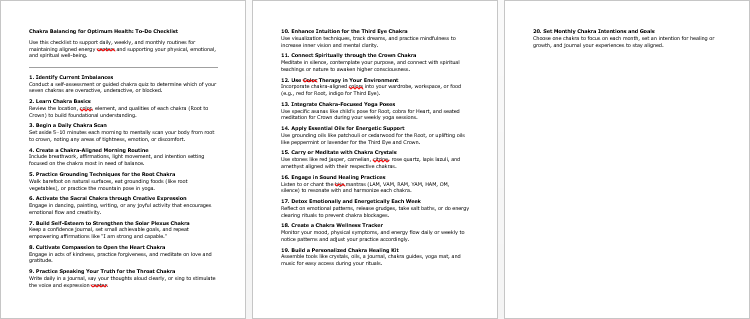
Chakra Balancing for Optimum Health – Checklist
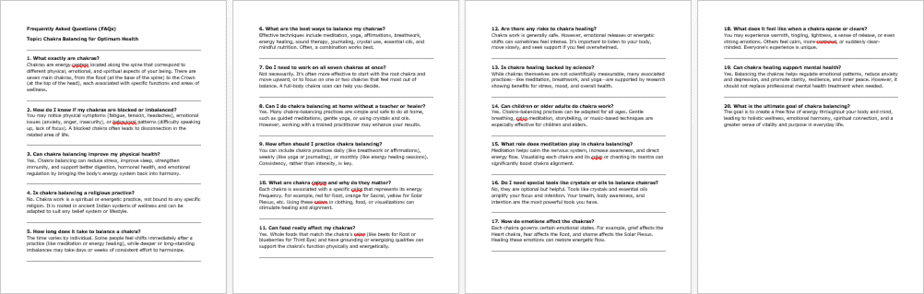
Chakra Balancing for Optimum Health – FAQs
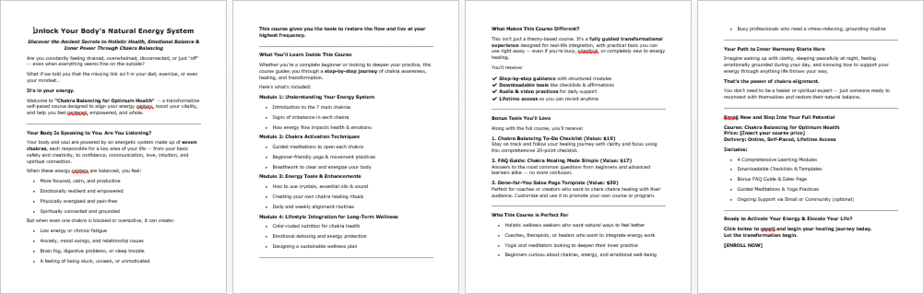
Chakra Balancing for Optimum Health – Salespage Content
Package Details:
Word Count: 19 718 Words
Number of Pages: 108
Chakra Balancing for Optimum Health – Bonus Content
Checklist
Word Count: 536 words
FAQs
Word Count: 826 words
Salespage Content
Word Count: 696 words
Total Word Count: 21 776 Words
Your PLR License Terms
PERMISSIONS: What Can You Do With These Materials?
Sell the content basically as it is (with some minor tweaks to make it “yours”).
If you are going to claim copyright to anything created with this content, then you must substantially change at 75% of the content to distinguish yourself from other licensees.
Break up the content into small portions to sell as individual reports for $10-$20 each.
Bundle the content with other existing content to create larger products for $47-$97 each.
Setup your own membership site with the content and generate monthly residual payments!
Take the content and convert it into a multiple-week “eclass” that you charge $297-$497 to access!
Use the content to create a “physical” product that you sell for premium prices!
Convert it to audios, videos, membership site content and more.
Excerpt and / or edit portions of the content to give away for free as blog posts, reports, etc. to use as lead magnets, incentives and more!
Create your own original product from it, set it up at a site and “flip” the site for megabucks!
RESTRICTIONS: What Can’t You Do With These Materials?
To protect the value of these products, you may not pass on the rights to your customers. This means that your customers may not have PLR rights or reprint / resell rights passed on to them.
You may not pass on any kind of licensing (PLR, reprint / resell, etc.) to ANY offer created from ANY PORTION OF this content that would allow additional people to sell or give away any portion of the content contained in this package.
You may not offer 100% commission to affiliates selling your version / copy of this product. The maximum affiliate commission you may pay out for offers created that include parts of this content is 75%.
You are not permitted to give the complete materials away in their current state for free – they must be sold. They must be excerpted and / or edited to be given away, unless otherwise noted. Example: You ARE permitted to excerpt portions of content for blog posts, lead magnets, etc.
You may not add this content to any part of an existing customer order that would not require them to make an additional purchase. (IE You cannot add it to a package, membership site, etc. that customers have ALREADY paid for.)
Share Now!
Latest Products




Free Sales Funnel Builder

Related Products

Popular & Trending



Featured Products