
Body Building for Strength and Size PLR Course 25k Words
in Fitness Mindset PLR , Fitness PLR , Fitness PLR Ebooks , Health PLR eBooks , PLR Checklists , PLR eBooks , PLR eCourses , PLR List Building Reports , Premium PLR , Premium PLR eBooks , Premium White Label Brandable PLR Coaching Courses , Private Label Rights Products , Workout PLR , Workout PLR EbooksChoose Your Desired Option(s)
has been added to your cart!
have been added to your cart!
#bodybuildingplr #fitnessplr #musclebuilding #strengthtraining #workoutguide #fitnesscontent #plrcourse #healthandfitness
Build Muscle, Burn Fat, and Transform Your Physique — Sell This Complete 23,000-Word Course as Your Own!
The fitness & bodybuilding niche is one of the largest, most evergreen, highest-paying markets online.
People are constantly searching for:
✔ How to build muscle
✔ How to burn belly fat
✔ How to get stronger
✔ How to train properly
✔ How to eat for growth
✔ How to build a better body
✔ How to stay motivated
And now you can offer them a complete, step-by-step bodybuilding transformation course—fully written, professionally structured, and ready to sell under your name.
Introducing…
🔥 Body Building for Strength and Size PLR Course
Your Complete “Body Building Blueprint” for Building Muscle, Strength, and Low Body Fat
This 23,420-word course gives your customers everything they need to achieve real physique results—using science-backed strategies, simple exercises, and diet methods that work for beginners and intermediates.
The content is structured, professional, and easy-to-teach.
But the best part?
YOU get 100% of the profit and full control.
🏆 Why This Course Will Sell Extremely Well
The bodybuilding niche is:
⭐ Evergreen
⭐ High-demand
⭐ High-ticket friendly
⭐ Beginner-friendly
⭐ Highly emotional (people want a better body FAST)
⭐ Filled with repeat buyers
People are tired of:
⛔ Complicated programs
⛔ Random workouts from YouTube
⛔ Confusing nutrition advice
⛔ Fitness myths
⛔ Years of trial and error
They want a clear blueprint.
And that’s exactly what this course delivers.
📘 What’s Inside the Body Building for Strength and Size Course
This program is built around 5 powerful modules, each containing 4 in-depth lessons that walk learners step-by-step through the entire transformation process.
MODULE 1: LAYING THE FOUNDATION – MINDSET, GOALS & BASICS
Build the mindset and clarity needed for real long-term results.
This module gives beginners clarity, motivation, and direction.
Your customers will learn:
✔ The difference between training for strength, size & fat loss
✔ How structure determines success
✔ How to set goals for their body type
✔ Ectomorph, mesomorph, endomorph strategies
✔ How to use the mind-muscle connection for better growth
✔ Why “training” beats “working out” every time
This sets the tone for a transformation that actually sticks.
MODULE 2: THE TRAINING BLUEPRINT – LIFTING FOR GROWTH AND STRENGTH
Build the perfect training split for maximum muscle and strength.
This module teaches the science and strategy behind effective workouts—not random routines.
Your customers will discover:
✔ How muscles grow & what stimulates growth
✔ Progressive overload & time under tension
✔ Push/Pull/Legs vs. Upper/Lower splits
✔ The power of compound lifts
✔ When to use isolation work
✔ Training volume & intensity secrets
✔ Exactly how many sets & reps they need
✔ How to build their own weekly workout plan
This module alone could be sold as a full ebook or course.
MODULE 3: NUTRITION FOR MUSCLE & FAT LOSS – EAT TO GROW
Unlock the secret to eating for both size and fat loss.
Training is only half the journey. Nutrition is the other half—and this module makes it simple.
Learners will understand:
✔ Daily calorie needs based on goals
✔ How to set macros for muscle gain or fat loss
✔ Protein requirements for muscle growth
✔ The truth about carbs and fats
✔ What to eat before and after workouts
✔ Supplements that actually work
✔ Supplements they should avoid
✔ How to create an easy weekly meal plan
This is practical, sustainable advice that anyone can follow.
MODULE 4: RECOVERY, PROGRESS & FAT-BURNING STRATEGIES
Maximize recovery, burn fat efficiently, and eliminate plateaus.
This module covers the often ignored—but essential—side of fitness success.
Your customers will learn:
✔ Why recovery is more important than the workout
✔ How to use sleep strategically
✔ Best forms of cardio for fat loss
✔ HIIT vs. steady-state cardio
✔ How to track progress accurately
✔ Why the scale is misleading
✔ How to break through plateaus
✔ Ways to adjust diet & training for continuous progress
This turns beginners into knowledgeable, self-adjusting trainees.
MODULE 5: STAYING CONSISTENT – LONG-TERM STRATEGIES & MOTIVATION
Stick to the plan, stay motivated, and sustain results for life.
Fitness is a lifestyle—this module teaches how to lock in habits and consistency.
Learners will discover:
✔ Habit-building psychology
✔ How to stay motivated during plateaus
✔ How to train when traveling or busy
✔ Healthy lifestyle routines
✔ How to build a sustainable long-term plan
✔ A complete 12-week bodybuilding transformation plan
This helps customers stay committed long after the course ends.
🎉 What Your Customers Will Achieve with This Course
By the end of this course, learners will be able to:
✔ Build muscle in a structured and predictable way
✔ Burn fat without extreme dieting
✔ Understand training, nutrition & recovery science
✔ Create their own bodybuilding routines
✔ Break plateaus and continue progressing
✔ Build sustainable fitness habits
✔ Transform their physique with a clear blueprint
This is EXACTLY what people want—and what they’ll gladly pay for.
📦 What’s Included in Your PLR Package
You get a complete, ready-to-sell digital product:
✔ Full Body Building for Strength and Size Course (23,420 Words)
Professionally written, detailed, and structured for learners to succeed.
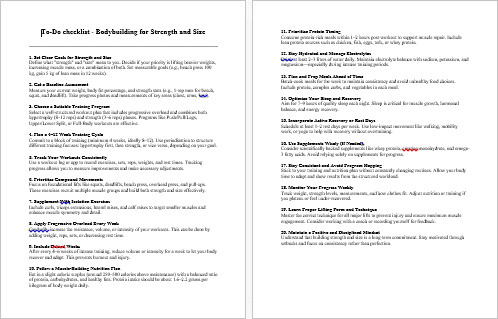
✔ Checklist (641 Words)
A simple action guide summarizing the entire course.
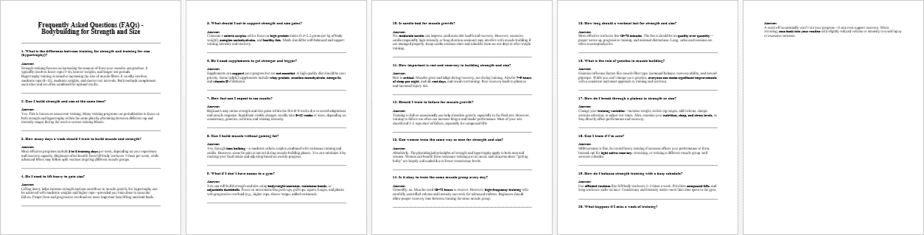
✔ FAQs (973 Words)
Answers to common questions, helping buyers get instant clarity.
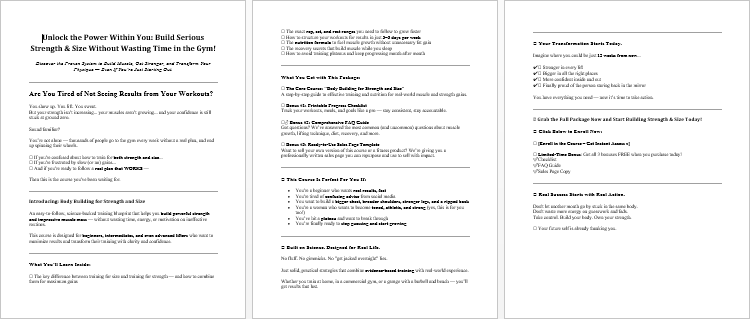
✔ Done-for-You Sales Page (671 Words)
Use it as-is or merge it with the long-form version you’re reading now.
Everything is fully editable—brand it, sell it, repurpose it, and profit from it.
💰 How You Can Profit From This PLR Course
Here’s how you can turn this into multiple streams of income:
✔ Sell the entire course as a digital product
Charge $27–$97 or more.
✔ Turn it into a video course
Use the scripts to create high-ticket content ($147–$497).
✔ Offer a fitness coaching upsell
Use the course as the foundation for a premium program.
✔ Break it into mini-ebooks
Sell each module for $10–$20.
✔ Bundle it with other health or fitness PLR products
Sell a “Transformation Mega Bundle.”
✔ Use it for a membership site
Add weekly lessons and charge monthly.
✔ Turn lessons into blog posts to grow your authority
Then funnel readers into your paid products.
✔ Use the content to build an email list
Offer excerpts as lead magnets or free guides.
✔ Sell a physical version
Print it as a “Bodybuilding Blueprint” manual.
✔ Run webinars or challenges
“12 Weeks to Strength & Size” challenge = HOT SELLER.
This is one of the most profitable niches in existence—and you now own a complete product within it.
📜 Your Private Label Rights (PLR) License
You CAN:
✔ Sell the course as your own
✔ Edit, rewrite, rebrand, or repurpose
✔ Turn into videos, audios, or physical books
✔ Use content for blogs, emails, or social media
✔ Add to memberships
✔ Bundle with other products
✔ Use for lead magnets (excerpted content)
✔ Build an entire fitness brand around it
You CANNOT:
✘ Give PLR rights to your customers
✘ Sell with resell or master resell rights
✘ Give away the full course for free
✘ Offer 100% affiliate commissions
✘ Add it to existing paid products without an extra charge
This protects the value of your investment.
🔥 Why You Need This PLR Product Today
✔ Fitness is a massive evergreen niche
✔ Muscle-building content sells year after year
✔ People are desperate for simple, effective instructions
✔ This course offers real transformation
✔ You get a full done-for-you product
✔ The value is extremely high
✔ The profit potential is unlimited
If you want to build a fitness brand, expand your offers, or add a high-demand product to your store, this is a perfect choice.
has been added to your cart!
have been added to your cart!
Here A Sample of Body Building for Strength and Size PLR Course
Welcome to the ultimate guide to building lean muscle, burning fat, and getting stronger – the smart way. This course is designed for beginners and intermediates who want clear, no-BS guidance on how to build a muscular physique, get stronger, and stay lean — without wasting years guessing what works.
MODULE 1: LAYING THE FOUNDATION – MINDSET, GOALS & BASICS
Before lifting a single dumbbell, it’s time to set the right mindset, structure your goals, and understand the core principles behind real body transformation.
Lesson 1: What Is Bodybuilding for Strength & Size?
Objective: Understand the distinctions between strength training, hypertrophy (muscle growth), and fat loss — and how this course blends all three for maximum results.
Introduction
Before you step foot in a gym or pick up a single dumbbell, it’s crucial to understand what you’re working toward and how you’re going to get there. This first lesson is about building clarity. Too often, beginners—and even some intermediates—enter bodybuilding with fragmented goals and a lack of understanding of the underlying principles that lead to visible transformation.
This course is called “Bodybuilding for Strength and Size”, but it’s also a blueprint to build muscle while managing body fat. It’s not just about lifting heavy weights or looking good in a mirror. It’s about combining three core components—strength training, hypertrophy, and fat loss—into one cohesive, science-based system.
Let’s break each component down and explain how they work together to transform your body in a healthy, sustainable, and performance-oriented way.
Part 1: Defining Bodybuilding in the Modern Era
Traditionally, bodybuilding refers to the process of developing the muscles of the body through diet and physical exercise, primarily with the intent of improving one’s physique. Classic bodybuilding focuses on muscle hypertrophy, which means increasing the size of muscle cells.
However, in recent years, the concept of bodybuilding has evolved. Today, modern bodybuilding includes elements of:
- Aesthetics – Achieving a well-balanced, muscular physique.
- Strength – Improving functional performance and power output.
- Fat Loss – Reducing body fat percentage to enhance definition and overall health.
In this course, we’re combining all three — not to prepare you for a bodybuilding stage, but to help you build lean muscle, burn stubborn fat, and get stronger over time — both physically and mentally.
Part 2: Understanding Strength Training
What is Strength Training?
Strength training is focused on increasing the maximum amount of force your muscles can exert. This is typically measured by how much weight you can lift for a single repetition of a compound exercise like the squat, bench press, or deadlift. These exercises recruit multiple muscle groups at once and are known as compound lifts.
Key Characteristics:
- Low to Moderate Reps: Typically in the range of 1–6 reps per set.
- Heavier Weights: Near-maximal loads, often expressed as a percentage of your 1-rep max (1RM).
- Longer Rest Periods: Usually between 2–5 minutes for full recovery.
- Goal: To improve neural efficiency, muscle fiber recruitment, and overall mechanical power.
Why It Matters in Bodybuilding:
While bodybuilding is often associated with volume training for muscle size, strength is the foundation of muscle-building. The stronger you become, the more weight you can lift during hypertrophy-focused workouts. This leads to greater mechanical tension — one of the most important drivers of muscle growth.
Think of strength training as building your base. A stronger base allows for better performance in higher-rep training, reduced injury risk, and long-term progression.
Part 3: Understanding Hypertrophy
What is Hypertrophy?
Hypertrophy is the enlargement of muscle fibers due to resistance training. It’s what most people think of when they envision “getting jacked” or building a muscular physique. There are two primary types of hypertrophy:
- Myofibrillar Hypertrophy – Growth of muscle contractile proteins (linked with strength).
- Sarcoplasmic Hypertrophy – Increase in muscle glycogen and fluid (linked with size and endurance).
Key Characteristics:
- Moderate Reps: Typically between 6–12 reps per set.
- Moderate to Heavy Weights: Enough resistance to challenge the muscle but not limit reps.
- Shorter Rest Periods: Usually between 30–90 seconds to maintain muscular stress.
- Goal: To induce muscle damage and metabolic stress, triggering muscle growth.
Training for Hypertrophy:
This type of training emphasizes volume, time under tension, and mind-muscle connection. It’s not just about moving weight from point A to B, but about controlling the movement, engaging the right muscles, and pushing close to muscular failure.
Hypertrophy training is where your muscles take shape, and when combined with a proper diet and recovery, you begin to see real, visible progress.
Part 4: Understanding Fat Loss
What is Fat Loss?
Fat loss refers to reducing the amount of stored body fat to improve definition and overall body composition. It’s not just about dropping numbers on a scale; it’s about maintaining muscle while reducing fat mass, also known as recomposition.
Key Factors in Fat Loss:
- Caloric Deficit: Consuming fewer calories than your body burns.
- Metabolic Conditioning (Cardio/HIIT): Supports fat loss while enhancing cardiovascular health.
- Muscle Preservation: Continuing resistance training during fat loss phases to avoid losing lean tissue.
- Nutritional Timing and Quality: Eating protein-rich, whole foods to support fat metabolism and satiety.
Why It’s Part of the Blueprint:
Many people gain size but also gain too much fat, while others lose weight but sacrifice muscle in the process. The goal here is to optimize both muscle gain and fat loss, creating a body that is lean, strong, and aesthetic.
By integrating strength training and hypertrophy with smart nutritional planning, this course ensures fat loss is managed in a healthy, strategic way — without crash dieting or excessive cardio.
Part 5: How These Three Pillars Work Together
Now that you understand the core components, let’s break down how this course blends them into a practical, results-driven system.
1. Progressive Strength Foundation
You’ll begin by learning how to perform compound lifts with proper form, focusing on linear progression over time. This builds functional strength, reinforces good posture, and gives you the foundation to train safely and effectively.
- Squats, deadlifts, bench press, overhead press, and rows will be emphasized.
- We’ll use low to moderate reps with progressive overload.
- As strength improves, your ability to lift heavier in hypertrophy ranges improves too.
2. Muscle-Focused Volume Training
Once your compound lifts are solid, we layer in isolation exercises and moderate-rep sets to target specific muscle groups for size.
- You’ll use structured training splits (e.g., push/pull/legs) designed for maximum volume and recovery.
- Emphasis is placed on technique, tempo, and time under tension.
- Supersets, drop sets, and slow eccentrics will help push muscles beyond their limits.
3. Strategic Fat Loss Integration
Throughout the course, we’ll apply nutritional strategies and light metabolic training that allow for simultaneous fat loss and muscle gain (especially for beginners and intermediates).
- You’ll learn how to adjust calories and macronutrients based on goals and progress.
- Cardio will be used strategically, not excessively.
- Meal timing and recovery will support your workouts, not hinder them.
Part 6: Common Misconceptions
Before moving on, let’s address a few widespread myths that may hinder your mindset:
Myth 1: You can only bulk or cut — not both.
→ Not true. Body recomposition is possible, especially with smart training and nutrition.
Myth 2: Lifting heavy makes you bulky.
→ Strength training enhances lean muscle density — not bulk — unless your nutrition supports mass gain.
Myth 3: Cardio kills gains.
→ When done moderately and strategically, cardio can enhance recovery and fat loss without compromising muscle.
Myth 4: Muscle turns to fat if you stop training.
→ Muscle and fat are different tissues. If you stop training and eat in surplus, fat may increase, but muscle doesn’t “turn into” fat.
Part 7: Building Your Mindset for Success
More important than physical strength is your mental foundation. To follow through with this course and see results, you need to adopt a growth mindset.
- Consistency beats perfection. You won’t hit every rep or meal perfectly. Show up anyway.
- Discipline over motivation. Don’t rely on feeling “motivated.” Build routines that carry you even on low-energy days.
- Patience is power. Results take time. Weeks of effort lead to months of change. Stay the course.
Conclusion
This lesson laid the groundwork for the entire course. You’ve learned that bodybuilding for strength and size isn’t about training one dimension of fitness. It’s about blending strength, hypertrophy, and fat loss in a smart, intentional, and sustainable way.
With this understanding, you’re now equipped to move forward with purpose. Everything from your workouts to your nutrition and recovery will now follow a clear system — not guesswork.
This isn’t about short-term results. It’s about building a body you’re proud of and a lifestyle that supports strength, confidence, and vitality for years to come.
Lesson 2: Setting Realistic Goals for Your Body Type
Objective: Learn how to set SMART goals tailored to your unique body type, current fitness level, metabolism, and genetic makeup, using a practical, individualized approach to long-term success in bodybuilding for strength and size.
Introduction
Goal-setting in bodybuilding is more than just saying “I want to get bigger” or “I want to lose weight.” Without clear direction and a plan rooted in your specific body type, your current starting point, and how your body responds to training and nutrition, you’re more likely to become frustrated, hit plateaus, or quit altogether.
This lesson will walk you through a step-by-step framework for creating SMART goals—goals that are Specific, Measurable, Achievable, Relevant, and Time-bound—and teach you how to adapt them based on your body type classification (ectomorph, mesomorph, endomorph), metabolism, and genetic traits.
Whether you’re just starting your transformation or coming back after a long break, this lesson will help you set realistic, sustainable, and motivating targets that drive progress and build momentum over time.
Step 1: Understand the Importance of Personalized Goal Setting
In the fitness world, generic goals are everywhere:
- “Lose weight”
- “Get shredded”
- “Build muscle fast”
- “Bulk up”
The problem is, what works for one person may not work for another. Two people can follow the exact same training plan and diet and experience completely different results based on their genetics, body type, and metabolic tendencies.
That’s why we take a personalized approach in this course.
Your journey will be based on:
- Your body composition and shape (somatotype)
- Your metabolic speed (fast vs. slow)
- Your current fitness level and training experience
- Your schedule, lifestyle, and recovery capacity
Before setting any goals, let’s identify your body type.
Step 2: Identify Your Body Type (Somatotype)
The somatotype system, developed by Dr. William Sheldon, categorizes body types into three primary groups: ectomorph, mesomorph, and endomorph. Most people fall somewhere in between two categories, but this model is still useful for setting realistic expectations.
1. Ectomorph
Traits:
- Naturally thin
- Small joints and narrow shoulders
- Fast metabolism
- Struggles to gain weight (muscle or fat)
Typical Challenges:
- Difficulty building muscle mass
- Requires higher calorie intake
- Needs more recovery due to limited energy reserves
Goal Approach:
- Focus on muscle gain first before any cutting phase
- Emphasize caloric surplus, compound lifts, and reduced cardio
- Set realistic timelines for gradual, lean mass growth
2. Mesomorph
Traits:
- Naturally muscular
- Broad shoulders, narrow waist
- Gains muscle easily
- Moderate metabolism
Typical Advantages:
- Responds well to both strength and hypertrophy training
- Gains size and strength quickly with proper training
- Can maintain a lean physique with balanced effort
Goal Approach:
- Versatile in setting both mass and cutting goals
- Focus on refining physique, optimizing performance, and progressive overload
- Embrace structured cycles (bulk, cut, maintenance)
3. Endomorph
Traits:
- Naturally broader and thicker build
- Tends to store more body fat
- Slower metabolism
- Gains strength easily but struggles with fat loss
Typical Challenges:
- Needs to monitor caloric intake carefully
- Struggles with cutting phases
- Often benefits from added cardio and dietary control
Goal Approach:
- Prioritize body recomposition (fat loss with muscle preservation)
- Incorporate strength and hypertrophy with metabolic training
- Use smaller calorie deficits to avoid muscle loss
Note: You are not locked into a body type. With smart training and nutrition, you can dramatically transform your physique. Body types are just a starting point.
Step 3: Assess Your Current Fitness Level and Metabolism
You can’t set realistic goals if you don’t know your baseline.
Evaluate the Following:
- Body Composition
- Are you currently lean, average, or overweight?
- Use tools like body fat calipers, bioelectrical impedance, or visual assessments (e.g., mirror progress photos).
- Training History
- Are you a beginner (0–6 months), intermediate (6 months–2 years), or advanced (2+ years)?
- Have you trained consistently, or are there long gaps in your history?
- Metabolic Speed
- Do you lose weight easily or gain fat quickly?
- Do you feel hungry often, or struggle to eat large portions?
Realistic goal setting must factor in these observations. Someone with 25%+ body fat should not aim to bulk immediately. Likewise, a 65kg male who struggles to eat 2,000 kcal per day should not expect 5kg of muscle gain in 2 months.
Step 4: Learn the SMART Goal Framework
Now that you’ve established your body type and current baseline, it’s time to set SMART goals. This is the gold standard in effective goal setting and applies perfectly to bodybuilding.
SMART stands for:
- Specific: Clearly define what you want to achieve.
Example: “I want to gain 3 kg of lean muscle.” - Measurable: Use numbers or data to track your progress.
Example: “I will measure my weight and chest/arm circumference every 2 weeks.” - Achievable: Ensure the goal is realistic based on your body type, metabolism, and time.
Example: “I aim to gain 3 kg of lean muscle in 4 months—not 8 kg in 2 months.” - Relevant: Align the goal with your long-term objective (strength, size, or fat loss).
Example: “This goal helps me build a foundation before cutting later.” - Time-bound: Attach a deadline to stay focused and avoid procrastination.
Example: “I will reach this goal by December 1st.”
Example SMART Goals by Body Type:
Ectomorph Beginner:
- Gain 2–3 kg of lean muscle in 12–16 weeks
- Increase calorie intake to 15% above maintenance
- Improve squat strength by 20% in 3 months
Mesomorph Intermediate:
- Cut 4% body fat in 8 weeks while maintaining lean mass
- Perform 3 full-body hypertrophy sessions per week
- Add 2 cm to arm circumference in 10 weeks
Endomorph Beginner:
- Lose 5 kg body fat in 10 weeks with strength retention
- Perform strength training 3x/week and HIIT 2x/week
- Improve resting heart rate and mobility
Step 5: Understand the Timeline of Physical Change
Too many trainees get discouraged when they don’t see “results” after 4–6 weeks. The reality is, muscle growth and fat loss occur gradually, and the visual changes often lag behind the physical improvements (like strength or endurance).
General Timeframes:
- Muscle Gain: Beginners can gain 1–1.5 kg of muscle per month under ideal conditions.
- Fat Loss: A safe and sustainable fat loss rate is 0.5–1 kg per week.
- Recomposition (muscle gain and fat loss simultaneously): Progress is slower but more efficient for beginners and those returning from a break.
Bodybuilding is not a short-term transformation. It’s a multi-phase journey that rewards consistency, not intensity alone.
Step 6: Align Goals with Phases of Training
Different goals require different phases of emphasis. You can’t chase maximum muscle gain and extreme fat loss simultaneously without compromising one.
Phases You’ll Work Through:
- Foundation Phase (4–8 weeks)
- Focus: Learning technique, establishing routine, conditioning the joints.
- Best for: All body types
- Growth Phase (Bulking/Strength Emphasis) (8–16 weeks)
- Focus: Progressive overload, hypertrophy, caloric surplus.
- Best for: Ectomorphs, mesomorphs
- Cutting Phase (Fat Loss Emphasis) (6–12 weeks)
- Focus: Fat loss, muscular definition, calorie control, metabolic work.
- Best for: Endomorphs, mesomorphs
- Recomposition Phase (12–20 weeks)
- Focus: Simultaneous fat loss and lean mass maintenance/gain.
- Best for: Beginners or returning trainees
Choosing your current phase goal helps you define the correct SMART goal.
Step 7: Document and Track Your Progress
Setting goals is only the beginning. Tracking and adjusting based on data is where real progress lives.
Track the following metrics:
- Weight (weekly average)
- Body fat percentage (monthly)
- Circumference measurements (arms, chest, waist, thighs)
- Progress photos (every 2–4 weeks)
- Workout logs (weights lifted, reps, performance)
Example Tracking Entry:
- Date: September 1
- Weight: 70.4 kg
- Body Fat % (est.): 16%
- Bench Press 5RM: 70 kg
- Goal: Increase lean body mass by 2 kg in 10 weeks
Tracking ensures accountability and provides objective feedback to adjust your training and nutrition.
Conclusion
Setting realistic goals for bodybuilding isn’t about ambition—it’s about strategy and self-awareness. By taking your body type, metabolism, and current fitness level into account, and combining them with the SMART goal framework, you’ll set yourself up for progress you can measure and sustain.
Instead of comparing your results to others, you’ll compare your progress to your past self, and that’s the true measure of transformation. With your goals clearly defined, the rest of this course will help you turn that vision into a reality.
Lesson 3: The Mind-Muscle Connection & Why It Matters
Objective: Discover how developing a strong mind-muscle connection improves training effectiveness, supports muscle growth, reduces the risk of injury, and refines lifting technique—regardless of experience level.
Introduction
When it comes to strength and size development, most beginners focus exclusively on external metrics: how much weight they’re lifting, how many reps they’re doing, or how often they train. While those variables are important, they miss a critical factor that often separates successful lifters from frustrated ones—the mind-muscle connection (MMC).
The mind-muscle connection refers to the neuromuscular focus and awareness you bring to each movement. It’s the ability to consciously engage the specific muscle you intend to train, and to keep it under tension throughout the lift. This practice not only enhances muscle activation, but also sharpens form, reduces injury risk, and accelerates growth over time.
This lesson offers a deep, practical, and scientific look into how the mind-muscle connection works, why it matters for strength and hypertrophy, and how to develop it intentionally through focused training techniques.
Step 1: Understanding the Mind-Muscle Connection
At its core, the mind-muscle connection is the ability to consciously feel and contract a muscle during an exercise, rather than just moving a weight from point A to point B.
Think of it this way: instead of passively performing a barbell curl by swinging the weight up and down, you intentionally squeeze the biceps through the entire range of motion, ensuring that the target muscle is doing most of the work—not momentum or surrounding muscle groups.
Scientific Explanation
The brain communicates with your muscles via the nervous system, sending electrical signals that tell specific muscle fibers to contract. This process is called neuromuscular activation. The more focused and intentional you are during the movement, the more muscle fibers are recruited, and the greater the muscle-building stimulus.
A study published in The European Journal of Applied Physiology (2012) found that participants who consciously focused on contracting their pecs during bench press exercises experienced higher muscle activation in the targeted muscle compared to those who did not focus.
This indicates that mental focus during exercise directly impacts how well the muscle is engaged, even if the external movement appears the same.
Step 2: Why the Mind-Muscle Connection Matters
Now that you understand the concept, let’s look at why the MMC is critical for both beginners and experienced lifters.
1. Enhanced Muscle Activation and Growth
If your goal is hypertrophy (muscle growth), your training needs to maximize tension in the target muscle. Poor form, rushed movements, or mindless lifting often shift tension away from the intended area—limiting growth.
- Focused activation leads to deeper muscle fatigue.
- Isolated tension prevents over-reliance on supporting muscles.
- Better contraction equals greater metabolic stress and fiber recruitment.
2. Improved Technique and Form
Developing a strong MMC forces you to slow down, focus on control, and improve your body mechanics. This leads to:
- Better posture and alignment
- Greater stability under load
- Improved balance and proprioception
With time, your form becomes automatic, and you move with purpose and precision. This is crucial when lifting heavier weights in compound movements like squats or bench presses.
3. Reduced Risk of Injury
When you train with awareness, you’re far less likely to:
- Use momentum instead of muscle
- Hyperextend joints or overcompensate with other areas
- Load the wrong muscles or overload weak links
This makes MMC especially important during isolation exercises, rehabilitation, and training with imbalances.
4. Consistency in Progress
When you learn to feel each rep, you can:
- Identify when a rep was effective (or not)
- Know when you’re fatiguing the right muscle
- Recognize plateaus not just by numbers, but by sensation
This develops a more intuitive connection to your body—a key asset for long-term transformation.
Step 3: Building the Mind-Muscle Connection – Practical Steps
This skill doesn’t happen overnight. It must be trained like any other aspect of fitness. The following techniques will help you develop it consciously.
1. Slow Down the Movement
Slower reps allow your nervous system to fully engage the target muscle. When rushing through a set, it’s easy for momentum or supporting muscles to take over.
Tip: Use a 2-1-2 tempo:
- 2 seconds to lift (concentric phase)
- 1 second to pause and squeeze at the top
- 2 seconds to lower (eccentric phase)
This increases time under tension and forces the muscle to stay active longer.
2. Use Light to Moderate Weight
Heavy weights can overwhelm your technique and cause compensation. Start with lighter weights and focus purely on contraction and control. As you improve, you can reintroduce heavier loads without losing focus.
Tip: On your first set of every exercise, treat it as a “feeler set”—a warm-up set where your only goal is to connect to the muscle.
3. Visualize the Muscle Working
Professional bodybuilders often speak about visualizing the muscle stretching and contracting during every repetition. Visualization enhances neuromuscular firing, particularly when you close your eyes or minimize distractions.
Tip: Picture the muscle shortening and expanding like an accordion. Focus on that image as you lift.
4. Touch the Muscle (When Safe)
If training with a partner or coach, gently placing a finger or hand on the working muscle can increase awareness and activation. This tactile cue sends additional feedback to your nervous system.
Tip: You can even tap or press the muscle before a set to “wake it up.”
5. Use Pre-Exhaust Techniques
Doing a light isolation movement before your main compound lift can “pre-exhaust” the target muscle, making it easier to feel and recruit in the heavier movement.
Example:
Before a chest press, perform 2 light sets of dumbbell flyes to engage the pecs and enhance activation in the compound lift.
6. Focus on the Squeeze
At the top of each repetition, intentionally squeeze the muscle as hard as possible for a brief pause. This is especially effective in exercises like:
- Biceps curls
- Cable rows
- Glute bridges
- Leg extensions
- Chest flyes
This conscious contraction reinforces control and builds lasting neural connections.
Step 4: Applying the Mind-Muscle Connection to Compound and Isolation Exercises
Compound Movements
Compound lifts involve multiple joints and muscle groups. It’s harder—but even more important—to apply the MMC during these exercises.
Example: Squat
- Instead of just standing up with the bar, think about pushing through your heels, engaging your glutes and quads, and keeping your core braced.
Example: Bench Press
- Instead of just pressing the bar, drive your pecs together, and imagine pushing your hands inward as you lift.
Isolation Movements
These are easier to control and are ideal for building MMC early in your training.
Examples:
- Biceps curls: Focus on curling with the forearm stable, and avoid swinging.
- Lateral raises: Move slowly, and lead with the elbows to engage the delts.
- Leg curls: Keep hips pressed down and feel the hamstrings contract fully.
Isolation exercises are your training ground for mastering the MMC. Once refined, you can carry it over into heavier, more complex movements.
Step 5: Troubleshooting – Common Mistakes
1. Lifting Too Heavy, Too Soon
Excessive weight limits control and forces other muscles to take over. It’s tempting to chase numbers, but control builds capacity. Choose weights you can control for 10–12 reps with solid form.
2. Moving Without Intention
Don’t let your body “go through the motions.” Every rep should be deliberate. If you can’t feel the target muscle working, adjust your grip, stance, or angle. Film yourself if necessary to assess your form.
3. Neglecting Warm-Up Sets
Rushing into heavy work sets without connecting to the movement can reduce performance. Use warm-up sets to dial in focus and technique.
Step 6: Long-Term Benefits of a Strong Mind-Muscle Connection
The mind-muscle connection isn’t just about “feeling the burn.” Over time, it leads to:
- Greater training efficiency: You’ll get more out of fewer reps and sets.
- Improved aesthetic results: Better muscle symmetry, shape, and definition.
- Quicker learning curve: Your form improves faster, and you become more coachable.
- Better injury prevention: Controlled movement patterns reduce wear and tear on joints and tendons.
- Sustainable progress: Training becomes more intuitive, and plateaus become easier to break through.
Conclusion
The mind-muscle connection is one of the most overlooked yet most powerful tools in the bodybuilding blueprint. It’s not about lifting more weight; it’s about lifting with awareness, control, and precision.
By learning to intentionally engage the muscles you’re training, you will not only increase your gains, but also develop better form, safer execution, and more consistent progress.
The most advanced lifters are not just strong—they are connected to every movement, every contraction, every rep. That is the mindset that transforms training from a chore into a craft. And it all starts with building your mind-muscle connection.
Lesson 4: Training vs. Working Out – Build with Purpose
(From Module 1: Laying the Foundation – Mindset, Goals & Basics)
In the world of fitness, the terms “training” and “working out” are often used interchangeably. But for anyone serious about bodybuilding—especially for building strength and size—understanding the difference between the two is critical. This lesson is designed to help you shift your mindset from simply “exercising” to purpose-driven “training” that delivers measurable, lasting results. This isn’t about going through the motions. It’s about developing a clear strategy to build your body intelligently and sustainably.
This lesson will walk you through the difference between the two approaches, why training with structure always wins in the long run, and how to start implementing structured training into your lifestyle starting today.
What Is the Difference Between “Working Out” and “Training”?
Let’s start by defining each term:
- Working Out: Typically refers to performing physical activity for the sake of movement, sweat, or general fitness. Workouts are often random, untracked, and vary widely day-to-day. Many people do cardio one day, try a HIIT class the next, or perform some weightlifting without a plan. While this does burn calories and improve overall health, it lacks direction.
- Training: Training involves following a structured plan with specific objectives, timelines, and progress markers. Whether your goal is to bench press 100 kilograms or gain 5 kilograms of lean muscle, training is systematic. It’s rooted in progressive overload, periodization, recovery planning, and nutrition alignment.
Key Distinction:
Working out is about the short-term effort, while training is about long-term progress.
Why Random Workouts Fail for Muscle & Strength Gains
Here’s why the “wing-it” workout approach tends to plateau, especially when building size and strength is the goal:
- Lack of Progression: If you’re lifting the same weights week after week, your body adapts and growth stalls. Without progression, there’s no incentive for your muscles to grow.
- No Measurement or Feedback: If you’re not tracking what you did last week, how will you know if you’re improving? Without structure, you lose the ability to adjust or push past plateaus.
- Imbalanced Development: Random workouts often lead to overtraining some areas (like chest or arms) and undertraining others (like legs or posterior chain), resulting in poor symmetry and increased injury risk.
- Motivation Drops: With no clear goal or timeline, it’s easy to lose motivation. You feel like you’re spinning your wheels.
- No Recovery Planning: Without a training structure, recovery is often overlooked or misunderstood. Over time, this increases the risk of burnout and injury.
The Core Elements of Intentional Training
To build strength and size, your program needs a solid framework. Let’s break down the essential components of intentional training.
1. Goal-Oriented Programming
Everything starts with a goal. Whether it’s to increase strength, add lean muscle, or burn fat while maintaining size—your training program should reflect that. For example:
- Hypertrophy-Focused Training: High volume (8–12 reps), moderate weights, shorter rest periods.
- Strength-Focused Training: Lower volume (3–6 reps), heavier loads, longer rest.
- Fat Loss + Muscle Retention: A mix of resistance training and energy-burning circuits with strict nutrition control.
You must define your training outcome before designing the plan.
2. Progressive Overload
This is the foundation of all successful bodybuilding routines. Progressive overload means gradually increasing the demand placed on your muscles. This can be achieved through:
- Increasing weight
- Increasing reps or sets
- Reducing rest time
- Improving tempo or range of motion
Your muscles adapt to what they’re exposed to. If the demand doesn’t grow, neither will your muscle fibers.
3. Tracking & Logging Workouts
One of the hallmarks of training is tracking your workouts. Whether you use a notebook, an app, or a spreadsheet, your training log helps you:
- Remember your previous lifts
- Spot trends and plateaus
- Make real-time adjustments
- Stay accountable
Over time, you’ll see how far you’ve come—and where you need to go.
4. Program Periodization
Periodization is the systematic planning of your training phases. A well-structured plan includes periods of:
- Volume increase (to build muscle mass)
- Intensity increase (to gain strength)
- Deload phases (to recover)
- Maintenance phases (to retain progress during travel or life events)
Structured periodization helps you avoid burnout, overtraining, and stagnation.
5. Balanced Muscle Group Focus
Intentional training ensures that every muscle group is trained systematically, often with specific splits like:
- Push/Pull/Legs
- Upper/Lower Body
- Full Body (for beginners)
- Body Part Splits (for intermediate to advanced)
This allows for appropriate muscle recovery while keeping training frequency optimal.
Real-World Analogy: Random Walk vs. Planned Journey
Imagine you’re trying to reach a mountain peak.
- Working Out is like hiking in any direction and hoping to find the summit. You might enjoy the scenery, but you could walk in circles for years.
- Training is like using a compass, map, and plan. You take calculated steps, monitor your location, and adjust your route as needed. You still enjoy the process, but you’re sure to reach your destination eventually.
How to Shift from Working Out to Training (Step-by-Step)
Step 1: Clarify Your Primary Goal
Are you training for:
- Pure muscle growth?
- Strength gains?
- Fat loss while preserving size?
Pick one clear focus. Avoid trying to “do it all” at once.
Step 2: Choose a Training Split That Matches Your Schedule
Ask yourself: How many days per week can I realistically train?
- 3 Days: Full-body or Upper/Lower splits
- 4 Days: Push/Pull/Legs with 1 rest day
- 5–6 Days: Body part splits or advanced hybrid programs
Your schedule must align with your goals and recovery needs.
Step 3: Build or Use a Structured Program
Use a scientifically backed program—or have one created for you—that includes:
- Weekly progression
- Periodization cycles
- Set and rep structure
- Planned rest days
- Optional cardio
Avoid random YouTube workouts or influencer routines with no progression system.
Step 4: Log Every Session
Track these core variables:
- Exercises performed
- Sets, reps, and weights used
- RPE (Rate of Perceived Exertion)
- Notes on technique, fatigue, or form
This data becomes invaluable as you adjust your routine over time.
Step 5: Review and Adjust Every 4–6 Weeks
Training isn’t static. Use your logs to:
- Increase weights if lifts feel easy
- Add volume if progress stalls
- Modify rest or rep ranges
- Include recovery if fatigue accumulates
A well-designed plan evolves as you do.
Mental Shift: Training Builds Discipline and Confidence
Training is not only a physical commitment—it’s a mental one. It cultivates:
- Discipline: Showing up consistently, following the plan even when it’s tough.
- Intentionality: Knowing why you’re doing each rep and what it contributes.
- Confidence: Seeing measurable progress builds belief in your process.
Once you shift to training, your entire relationship with fitness transforms. You’re not just exercising—you’re sculpting, building, and becoming stronger on purpose.
Summary – Train with Purpose, Build with Strategy
If you’ve been “working out” without direction, don’t feel bad—it’s where most people start. But real progress, especially in bodybuilding, requires more than effort. It demands structure, consistency, and clarity.
Training gives you:
- A defined path to follow
- Better results in less time
- Long-term motivation from visible progress
- Protection from injury and burnout
Start treating your training like a craft. Track it. Plan it. Refine it.
You’re not just moving weights—you’re moving toward the strongest, most muscular version of yourself. And that starts by training with intention every single session.
We’re also giving these extra bonuses
Body Building for Strength and Size – Checklist
Body Building for Strength and Size – FAQs
Body Building for Strength and Size – Salespage Content
Package Details:
Word Count: 23 420 Words
Number of Pages: 102
Body Building for Strength and Size – Bonus Content
Checklist
Word Count: 641 words
FAQs
Word Count: 973 words
Salespage Content
Word Count: 671 words
Total Word Count: 25 705 Words
Your PLR License Terms
PERMISSIONS: What Can You Do With These Materials?
Sell the content basically as it is (with some minor tweaks to make it “yours”).
If you are going to claim copyright to anything created with this content, then you must substantially change at 75% of the content to distinguish yourself from other licensees.
Break up the content into small portions to sell as individual reports for $10-$20 each.
Bundle the content with other existing content to create larger products for $47-$97 each.
Setup your own membership site with the content and generate monthly residual payments!
Take the content and convert it into a multiple-week “eclass” that you charge $297-$497 to access!
Use the content to create a “physical” product that you sell for premium prices!
Convert it to audios, videos, membership site content and more.
Excerpt and / or edit portions of the content to give away for free as blog posts, reports, etc. to use as lead magnets, incentives and more!
Create your own original product from it, set it up at a site and “flip” the site for megabucks!
RESTRICTIONS: What Can’t You Do With These Materials?
To protect the value of these products, you may not pass on the rights to your customers. This means that your customers may not have PLR rights or reprint / resell rights passed on to them.
You may not pass on any kind of licensing (PLR, reprint / resell, etc.) to ANY offer created from ANY PORTION OF this content that would allow additional people to sell or give away any portion of the content contained in this package.
You may not offer 100% commission to affiliates selling your version / copy of this product. The maximum affiliate commission you may pay out for offers created that include parts of this content is 75%.
You are not permitted to give the complete materials away in their current state for free – they must be sold. They must be excerpted and / or edited to be given away, unless otherwise noted. Example: You ARE permitted to excerpt portions of content for blog posts, lead magnets, etc.
You may not add this content to any part of an existing customer order that would not require them to make an additional purchase. (IE You cannot add it to a package, membership site, etc. that customers have ALREADY paid for.)
Share Now!
Latest Products




Free Sales Funnel Builder

Related Products
Popular & Trending


Featured Products