Make Money Online PLR Course 22k Words
in Make Money Online PLR Ebooks , Make Money PLR , PLR Checklists , PLR eBooks , PLR eCourses , PLR List Building Reports , Premium PLR , Premium PLR eBooks , Premium White Label Brandable PLR Coaching Courses , Private Label Rights ProductsChoose Your Desired Option(s)
has been added to your cart!
have been added to your cart!
#makemoneyonline #plrcourse #plrcontent #plrproducts #onlinebusiness #passiveincome #digitalmarketing #onlineincome #entrepreneurship #workfromhome #businessideas
Make Money Online PLR Course – Turn Your Laptop into a Money-Making Machine
Are you ready to take control of your income, work from anywhere, and build a sustainable online business?
The Make Money Online PLR Course is a 22,000-word, step-by-step training program designed to teach anyone—from beginners to intermediate entrepreneurs—how to start, grow, and scale an online business successfully.
Whether you’re a coach, blogger, entrepreneur, or PLR reseller, this course gives you everything you need to educate, sell, or repurpose a full online business course with actionable steps and clear strategies.
Presenting…
Make Money Online PLR Course 22k Words
Why Make Money Online Is the Ultimate Skill
In today’s digital world, your laptop can become your office, store, and income generator. But with so much information online, it’s easy to get lost, confused, or overwhelmed.
This course cuts through the noise by giving you:
- Step-by-Step Guidance: From choosing your online income path to scaling your business.
- Actionable Strategies: No fluff—real methods to start making money fast.
- Flexibility & Freedom: Work at your own pace, from anywhere, on your own terms.
- Multiple Income Options: Learn how to make money through services, digital products, content creation, affiliate marketing, and more.
By the end of this course, learners will have a complete roadmap to generate online income and grow a digital business.
What’s Inside the Make Money Online PLR Course
The course is divided into five comprehensive modules, each packed with practical lessons, worksheets, and action steps to help learners succeed online.
Module 1: Set the Foundation – Understand How People Make Money Online
Goal: Start with clarity and purpose before diving into execution.
- Step 1: Explore the Online Income World
Discover major income streams such as freelancing, affiliate marketing, digital products, dropshipping, and content creation. Learn how each method works and what suits your lifestyle. - Step 2: Identify Your Strengths & Interests
A fun self-assessment helps learners match their skills, passions, and personality to the best online money-making path. - Step 3: Set Your Money Goals
Define realistic short-term and long-term income targets. Whether it’s ₹5,000 a month or a full-time income, you’ll know what you’re working toward. - Step 4: Choose Your Path
Focus on one income stream first, ensuring momentum and eliminating overwhelm. Other methods can be explored later.
Outcome: Students gain clarity, direction, and confidence before building their online business.
Module 2: Pick Your Platform – Build Your Online Presence
Goal: Establish a professional and credible digital workspace.
- Step 1: Create Your Professional Identity
Learn to choose a name, niche, and online profile on platforms like Fiverr, Upwork, Instagram, YouTube, or your own website. - Step 2: Set Up Your Online Home
Step-by-step guidance to build a website, portfolio, blog, or profile, even if you have zero tech experience. - Step 3: Build Trust with Great Content
Learn to post samples, educational content, or testimonials that establish credibility and attract clients. - Step 4: Optimize for Visibility
Discover simple SEO, hashtags, and platform strategies so people can find your services or products easily.
Outcome: Students will have a professional online presence that builds trust and attracts their first customers.
Module 3: Learn to Sell – Offer Services or Products People Want
Goal: Turn skills, products, or services into income without feeling pushy or salesy.
- Step 1: Decide What You’ll Sell
Choose a digital product (eBook, course, template), service (writing, design, coaching), or physical product (dropshipping, print-on-demand). - Step 2: Create Your First Offer
Step-by-step instructions for building a product or service package, including pricing, presentation, and making it irresistible. - Step 3: Start Selling the Simple Way
Sell through marketplaces (Etsy, Amazon, freelancing platforms) or your own sales page with minimal technical hassle. - Step 4: Get Feedback & Improve
Learn how to collect customer feedback and make small adjustments to increase conversions and satisfaction.
Outcome: Students will have a real product or service ready to sell and start generating income.
Module 4: Drive Traffic – Get People to See What You Offer
Goal: Bring visitors to your offers and turn them into paying customers.
- Step 1: Pick 1–2 Traffic Strategies
Select from free methods (social media, blog posts, YouTube, SEO) or paid ads (Facebook, Google) based on comfort and budget. - Step 2: Create Simple Marketing Content
Learn to craft posts, short videos, and reels that educate, entertain, or solve problems while subtly promoting your products. - Step 3: Build an Email List (Optional but Powerful)
Use a freebie or lead magnet to collect emails and nurture potential buyers for repeated sales. - Step 4: Track What’s Working
Learn to use tools like Google Analytics or social insights to measure traffic sources, conversions, and ROI.
Outcome: Students will understand how to consistently attract and convert an audience online.
Module 5: Scale Up – Grow Your Income Consistently
Goal: Turn your initial earnings into a sustainable, growing online business.
- Step 1: Automate & Systemize
Save time and reduce stress with automation tools for emails, orders, and social posts. - Step 2: Offer More or Go Premium
Increase earnings by upselling, creating higher-value products, or bundling services. - Step 3: Diversify Your Income
Add another income stream: affiliate marketing, a second product, or a YouTube channel. - Step 4: Build a Long-Term Brand
Focus on becoming a trusted expert in your niche for consistent sales and opportunities.
Outcome: Students will scale their income and build a brand that lasts beyond the first sale.
Bonus Materials Included
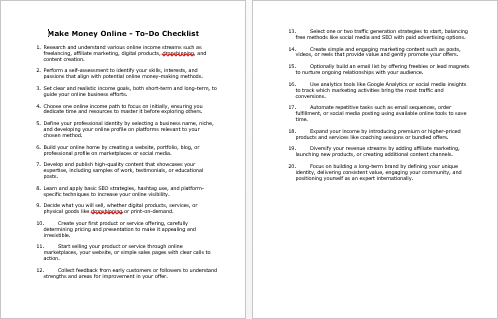
- Make Money Online – Checklist (399 Words)
A quick-action guide to ensure students implement key strategies immediately. - Make Money Online – FAQs (636 Words)
Answers to common questions about platforms, products, services, and marketing. - Make Money Online – Salespage (584 Words)
Ready-made sales copy you can use or repurpose to promote the course right away.
Who Can Benefit from This PLR Course
- Aspiring Entrepreneurs: Learn how to start and grow a business from scratch.
- Bloggers & Content Creators: Repurpose content to create e-courses or digital products.
- Coaches & Consultants: Provide structured guidance for clients wanting to earn online.
- PLR Resellers: Sell the course as-is, in bundles, or create multiple revenue streams.
- Beginners & Side Hustlers: Learn actionable steps to start earning online quickly.
Ways to Use and Profit from This PLR Course
- Sell as a Complete Online Course – Charge $297–$497 for full access.
- Break into Smaller Reports or Guides – Sell individual sections for $10–$20 each.
- Bundle with Other Digital Products – Offer premium packages for $47–$97.
- Create Multi-Week E-Classes – Turn content into a 4–12 week paid program.
- Membership Site Content – Generate recurring income with exclusive content.
- Convert to Physical Products – Workbooks, planners, or companion guides.
- Lead Magnets & Email Growth – Excerpts to build lists and attract new clients.
- Flip a Niche Site – Build a “make money online” website using the content for resale.
Licensing Terms
Permissions:
- Sell as-is or with minor edits.
- Claim copyright if 75%+ is rewritten.
- Break into smaller reports or lessons for sale.
- Bundle with other PLR content for upsells.
Restrictions:
- Cannot pass PLR rights to customers.
- Maximum affiliate commission: 75%.
- Cannot give full course away for free.
- Cannot include in existing orders without additional purchase.
Why Buy from Buy Quality PLR
- 22,000 Words of Ready-to-Use Content – Save time and create a full course immediately.
- Action-Oriented & Practical – Students can start earning online from day one.
- Comprehensive Modules – Covers income strategies, platforms, selling, traffic, and scaling.
- Bonus Checklist, FAQs, and Salespage – Everything needed to market and deliver the course.
- PLR Licensing – Brand, sell, or teach with confidence.
- Multiple Profit Opportunities – E-courses, guides, bundles, memberships, and more.
Bottom Line
The Make Money Online PLR Course is a complete, ready-to-use solution for anyone who wants to start, grow, and scale an online income stream.
Whether you’re selling, teaching, or repurposing content, this course gives you everything you need to deliver value, attract customers, and generate multiple streams of income online.
✅ Instant Access | Fully Editable | Practical & Profitable | Step-by-Step PLR
Start helping your audience turn their laptops into money-making machines today with Make Money Online.
has been added to your cart!
have been added to your cart!
Here A Sample of Make Money Online PLR Course
Module 1: Set the Foundation – Understand How People Make Money Online
Let’s start with the basics! This module is about getting clarity on what’s possible and what suits you best.
Step 1: Explore the Online Income World
Goal: To gain a clear understanding of the various legitimate online income streams available globally and identify which ones align with your skills, interests, and lifestyle goals.
This step is all about opening your eyes to the real possibilities the digital world offers. We’re not talking about get-rich-quick schemes or vague promises—this is about understanding proven, scalable, and sustainable online income models that thousands of people around the world are using to earn full-time or part-time income.
Why This Step Is Important
Before you dive into building a business or learning a specific skill, it’s crucial to understand the broader landscape. There are many ways to make money online—but each one requires a different mindset, skillset, and commitment level. By exploring the options in detail, you’ll be able to make informed decisions and avoid wasting time chasing methods that don’t suit you.
What You’ll Learn in This Step
- The 6 major online income categories recognized globally
- The pros and cons of each method
- Time and effort required for each
- Real-world examples of how people earn through each path
- A comparison table to help you make the right choice for your situation
Let’s Break It Down: The Six Major Online Income Streams
1. Freelancing
What it is:
Freelancing involves offering your services online to clients all over the world. This can range from writing and graphic design to programming, virtual assistance, voice-overs, translation, marketing, and more.
How it works:
You register on platforms like Upwork, Fiverr, Freelancer.com, Toptal, or PeoplePerHour, and create a service profile. Clients post jobs, and you either bid on them or get discovered through your gig listings.
Pros:
- Low startup cost
- Fastest path to income (often within weeks)
- Wide global demand
Cons:
- Time-based income (you trade hours for money)
- Can be competitive at the start
- Requires consistent client communication
Who it’s best for:
People with marketable skills (writing, design, editing, programming, etc.) who are ready to work on short-term projects and deliver results.
2. Affiliate Marketing
What it is:
Affiliate marketing involves promoting other people’s or company’s products and earning a commission for every sale made through your referral link.
How it works:
You join affiliate programs such as Amazon Associates, ClickBank, CJ Affiliate, or ShareASale, and get unique tracking links. You then promote those links through blogs, YouTube, email newsletters, or social media.
Pros:
- Passive income potential
- You don’t need to create your own product
- Scalable with audience growth
Cons:
- Requires traffic (visitors) to earn anything
- Results take time (often 3–6 months minimum)
- Commissions vary by product and platform
Who it’s best for:
Content creators, bloggers, email marketers, or anyone willing to build an online presence and recommend products authentically.
3. Selling Digital Products
What it is:
Digital products are downloadable or streamable content that you create once and sell repeatedly—like eBooks, templates, online courses, printables, music, photos, and more.
How it works:
You create the product and sell it on platforms like Gumroad, Etsy (for printables), Teachable, Podia, Udemy, or your own website using tools like Shopify or WooCommerce.
Pros:
- Passive income after initial creation
- High profit margins (you create once, sell unlimited times)
- Easy to automate
Cons:
- Requires content creation skills
- Needs marketing and traffic to succeed
- Can take time to build up authority and trust
Who it’s best for:
Educators, designers, coaches, and creatives with specialized knowledge or tools they can package into a product.
4. Dropshipping
What it is:
Dropshipping is an eCommerce business model where you sell physical products online without handling inventory. When someone places an order, your supplier ships it directly to the customer.
How it works:
You set up an online store using Shopify, WooCommerce, or BigCommerce, and connect it to dropshipping platforms like AliExpress, Spocket, or DSers. You market the products, take orders, and your supplier fulfills them.
Pros:
- Low inventory risk (no upfront stock needed)
- Global reach
- Scalable with paid ads and SEO
Cons:
- Thin profit margins
- Customer service challenges
- Highly competitive market
Who it’s best for:
Entrepreneurs who want to run an eCommerce store without managing products physically and are ready to learn digital marketing.
5. Content Creation & Monetization
What it is:
This includes blogging, YouTube channels, podcasting, TikTok, and Instagram content. You create value-packed content and earn through ads, sponsorships, donations, and affiliate links.
How it works:
You publish regular content and grow your audience. Platforms like YouTube, Medium, Substack, Anchor, and Instagram offer monetization options once you reach a certain threshold.
Pros:
- Long-term branding potential
- Multiple income streams (ads, affiliate, sponsored posts, merch)
- Builds authority and loyal audience
Cons:
- Takes time and consistency
- Revenue can be unpredictable at the start
- Requires creativity and niche focus
Who it’s best for:
Storytellers, educators, entertainers, or anyone comfortable creating consistent content and building a following.
6. Online Teaching & Coaching
What it is:
This involves teaching live or recorded classes online or offering one-on-one or group coaching in a specific area of expertise.
How it works:
You can host your own courses on platforms like Teachable, Thinkific, Kajabi, or list them on marketplaces like Udemy and Skillshare. For coaching, you can use Zoom, Calendly, and offer packages directly to clients via your website or social media.
Pros:
- High earning potential
- Great for authority building
- Deep impact through teaching
Cons:
- Requires subject-matter expertise
- Time-intensive unless automated
- Needs audience trust
Who it’s best for:
Trainers, educators, consultants, and professionals who can solve problems or teach skills.
Comparison Table of Online Income Streams
| Income Stream | Startup Cost | Time to Income | Passive Potential | Skill Needed | Platform Examples |
| Freelancing | Low | Fast (2–4 wks) | Low | Medium | Fiverr, Upwork, Freelancer |
| Affiliate Marketing | Low | Medium (2–4 mo) | Medium–High | Medium | Amazon, ClickBank, ShareASale |
| Digital Products | Low–Medium | Medium (1–3 mo) | High | Medium–High | Gumroad, Teachable, Etsy |
| Dropshipping | Medium | Medium (2–4 mo) | Medium | High | Shopify, AliExpress, Spocket |
| Content Creation | Low | Slow (3–6 mo) | High | Medium–High | YouTube, Medium, Instagram |
| Online Coaching | Low | Medium (1–2 mo) | Medium–High | High | Zoom, Teachable, Kajabi |
Action Steps for You
- Read through each income stream carefully again.
- Note which ones excite you the most. Which ones match your strengths?
- Highlight 1–2 methods you’d like to explore deeper.
- You don’t have to pick one yet—but start narrowing down.
- Write down your current skillsets.
- Are you a good writer, designer, speaker, or tech-savvy? This helps match income methods to your talents.
- Join 1 platform from each category (optional).
- Just to explore—create a free Fiverr account, browse Udemy’s instructor dashboard, or read through Shopify’s dropshipping guides.
End of Step 1
Once you’ve explored and understood the different ways to earn money online, you’ll be in a much stronger position to move forward with clarity and confidence.
Let’s take it one step at a time and remember: consistency > perfection.
Step 2: Identify Your Strengths & Interests
Do a fun self-assessment to discover which online paths fit your skills, passions, and personality.
Objective of This Step
This step is all about discovering you. Before diving deep into building an online income stream, you need to take time to understand your unique strengths, interests, and natural preferences. It’s like picking the right vehicle for a journey—you want something that suits your terrain, speed, and destination.
By the end of this step, you’ll walk away with a clear idea of which online income path feels right for you—not just what works for others. This isn’t guesswork; this is intentional alignment.
Why This Step Matters
Many people jump into online work based on trends or advice from friends, only to burn out quickly. Why? Because the model they chose didn’t match who they are.
When you align your work with your natural strengths, passions, and personality, everything becomes easier—learning is more enjoyable, growth is faster, and your success is more sustainable.
This is your chance to pause and reflect.
How We’ll Approach It
We’re going to use a mix of introspective exercises and practical checklists to help you uncover:
- What you’re naturally good at (skills)
- What you enjoy doing (interests)
- How you prefer to work (personality traits)
- Which values matter most to you in your professional life (lifestyle alignment)
Let’s go through this process step by step.
Step-by-Step Instructions
Step 2.1: Reflect on Your Skills (What You’re Good At)
Purpose: Understand the talents, abilities, and experiences you already possess that can translate into online work.
Instructions:
Take a piece of paper or open a blank document. Divide it into two columns:
- Column A: Hard Skills
- Column B: Soft Skills
Start listing everything you can think of.
Examples of Hard Skills:
- Writing
- Video editing
- Graphic design
- Data entry
- Social media management
- Excel/Spreadsheets
- Coding or tech skills
- Public speaking
- Teaching/training
- Marketing or SEO
Examples of Soft Skills:
- Time management
- Communication
- Problem-solving
- Creativity
- Adaptability
- Teamwork
- Listening
- Self-discipline
- Attention to detail
Now score each skill on a scale of 1 to 5, based on how confident you feel using it.
Ask yourself:
- Which of these do I love doing?
- Which have others complimented me on?
- Which skills do I want to develop further?
This helps you narrow down the list to your top 3–5 strongest and most enjoyable skills.
Step 2.2: Explore Your Interests and Passions
Purpose: Understand what subjects, industries, or activities you genuinely enjoy spending time on—even when you’re not getting paid.
Instructions:
Answer the following questions with as much honesty and detail as possible. There are no right or wrong answers.
Self-Discovery Questions:
- What are the top 3 topics you can talk about for hours?
- When browsing the internet or social media, what kind of content are you naturally drawn to?
- What YouTube videos, podcasts, or blogs do you regularly follow—and why?
- If money wasn’t an issue, what would you love to spend your time doing?
- What kind of problems do people come to you to solve?
Common Online Interest Areas:
- Fitness or wellness
- Beauty or fashion
- Technology or gadgets
- Education or languages
- Business or finance
- Food or cooking
- Gaming or entertainment
- Travel or culture
- Home decor or DIY
- Parenting or relationships
Now circle the ones you feel most excited about. These topics are your potential niches—your zone of genius.
Step 2.3: Understand Your Personality Style
Purpose: Discover how your personality influences the type of online work environment you’ll thrive in.
Instructions:
Choose the statement that best describes you in each pair:
- I prefer working alone with full control vs. I thrive in group projects with collaboration.
- I like following detailed instructions vs. I enjoy coming up with creative ideas and solutions.
- I like doing the same tasks every day vs. I need variety and flexibility.
- I enjoy speaking, teaching, or being on camera vs. I prefer writing or working behind the scenes.
- I want quick results, even if small vs. I can wait longer for a bigger outcome.
Now count how many times you chose the first option vs. the second option.
- Mostly first option: You likely prefer structured, independent, execution-focused roles like freelancing, virtual assistance, or data-driven affiliate marketing.
- Mostly second option: You may enjoy content creation, coaching, digital products, or creative business models like dropshipping design.
This isn’t a strict rule, but a guide to understanding your working personality.
You can also take a free personality test like the 16Personalities (MBTI) test or DISC personality profile to get deeper insights.
Step 2.4: Map Your Lifestyle Goals
Purpose: Choose online income models that match the lifestyle and freedom you want—not just the income.
Instructions:
Write short answers to these prompts:
- How many hours per week do you want to work?
- Do you prefer flexible hours or a fixed schedule?
- Are you looking for side income or full-time income?
- Do you want to travel while working, or work from home?
- Do you prefer active income (paid per task/hour) or passive income (get paid over time)?
Now match your answers to the model types:
- Freelancing = good for active income, fast results, structured work
- Affiliate Marketing = good for passive income, creative content, long-term
- Digital Products = good for flexibility, passive income, content creators
- Dropshipping = good for business builders with interest in eCommerce and ads
- Content Creation = good for creatives with time to build an audience
- Coaching/Teaching = good for communicators who enjoy helping others
Final Activity: Your Online Income Profile
Take 10 minutes to write a short summary of your findings:
- My top 3 skills are:
- My top 3 interests/niches are:
- My personality is more: [Structured / Creative / Independent / Collaborative]
- I want a lifestyle that includes:
- The online income paths that feel most aligned are:
Keep this summary. You’ll refer back to it often as you build your online journey.
Key Takeaways from Step 2
- Self-awareness is your foundation. The more you know about yourself, the better your business choices will be.
- Not every method is right for every person—and that’s perfectly okay.
- You don’t need to be an expert right now. You only need clarity about your direction.
- This is not just about skills. It’s about what brings you joy and energy.
Congratulations! You’ve completed a powerful inner exploration. You’re now equipped with the self-knowledge to choose the right path in the online income world.
Step 3: Set Your Money Goals
Define realistic short-term and long-term income goals (whether it’s $500 a month or a full-time income!).
Objective of This Step
In this step, you’ll learn how to define clear, achievable financial goals that guide your decisions, motivate your daily actions, and give you purpose as you build your online income stream.
Whether you’re aiming for an extra $500 per month, a full-time income of $5,000+ per month, or long-term passive income that supports your lifestyle, your goals must be intentional, measurable, and meaningful to you.
This is not about chasing unrealistic dreams—it’s about grounding your vision in strategy, self-awareness, and structured planning.
Why Money Goals Are So Important
Here’s the truth: vague goals create vague results. If you don’t define what success looks like for you, you won’t know when you’ve achieved it—or how to get there.
Money goals aren’t just about numbers. They shape:
- How much time you dedicate each day
- What business model you choose
- Which platforms or tools you invest in
- What skills you focus on developing
When you know your goals, you stop wasting time. You begin making intentional choices that align with your destination.
How We’ll Approach It
This step will guide you through a structured 4-part process:
- Understand your “why” behind the money
- Set specific short-term and long-term income targets
- Break your goals down into monthly and weekly benchmarks
- Align your goals with your lifestyle and available time
Let’s walk through each part together.
Step-by-Step Instructions
Step 3.1: Clarify Your Motivation (Your “Why”)
Purpose: Discover the emotional reason behind your income goals so you stay motivated when the work gets hard.
Instructions:
Ask yourself:
- Why do I want to make money online?
- What will this money allow me to do that I can’t do now?
- How would my life change if I achieved my income goal?
Write down at least 3 personal motivations. Be specific and honest.
Examples:
- “I want to earn $1,000/month to cover my child’s school tuition.”
- “I want to leave my job and become a full-time digital creator.”
- “I want to travel to 3 countries next year while earning online.”
- “I want to create a second income so I can save for retirement.”
These answers are your emotional drivers. When you hit challenges, come back to this list. It reminds you why you started.
Step 3.2: Set Your Short-Term and Long-Term Income Goals
Purpose: Define your income goals with clear numbers and realistic timeframes.
Instructions:
Start with 2 types of goals:
A) Short-Term Goal (3 to 6 months)
Ask yourself:
- What is a realistic amount of money I want to be earning monthly within the next 3–6 months?
- Consider your available time, skill level, and chosen income stream.
Examples:
- $300/month from freelancing
- $500/month from affiliate commissions
- $700/month from digital product sales
B) Long-Term Goal (12 months or more)
Ask yourself:
- If I stay consistent and grow my skills, what’s a realistic full-time or major income goal?
Examples:
- $2,000/month from content creation and brand sponsorships
- $5,000/month from a digital product store
- $3,000/month from multiple streams: freelancing + coaching + passive income
Now write both goals in this format:
My short-term income goal is to earn $___ per month by [date].
My long-term income goal is to earn $___ per month by [date].
Keep these goals visible—on your phone, in your planner, or at your desk.
Step 3.3: Reverse Engineer Your Goals Into Weekly & Monthly Targets
Purpose: Break your big goals into small, actionable steps you can actually work on daily.
Instructions:
Let’s say your short-term goal is to earn $500/month from freelancing.
Break it down:
- $500 per month = $125 per week
- If you charge $25 per project, you need 5 small projects per week
- That means you need to apply for at least 10–15 jobs per week to secure 5 gigs
This process is called reverse engineering. It works for all models.
Another example:
You want to earn $1,000/month from affiliate marketing.
- $1,000 per month = $33 per day
- If your affiliate product pays $30 commission, you need just over 1 sale per day
- That means you might need 100–200 clicks/day on your content or links
- You now know to focus on traffic, content creation, or email marketing daily
Use this technique to understand:
- How much you need to sell, post, apply, or publish
- What numbers you should track weekly
- Where your time should be spent each day
Set a simple Weekly Focus Plan:
I will do X activity [e.g., apply to 10 gigs, post 3 videos, write 2 blog posts] each week to move toward my $___ monthly goal.
Step 3.4: Align Your Goals With Your Time and Lifestyle
Purpose: Make sure your income goals are aligned with how much time and energy you can realistically commit.
Instructions:
Grab a calendar or weekly planner. Answer the following:
- How many hours can I realistically dedicate to building my online income each week?
- What times of day do I feel most focused and productive?
- Do I have any non-negotiable life commitments I must work around?
Now do the math:
- If you have 10 hours per week and your goal is $500/month, that means you need to earn $50/hour of effort
- This tells you that lower-paying gigs or time-wasting activities won’t help you reach your goal
- If you only have 5 hours/week, you may need to focus on more passive models or high-value offers
This step helps you balance ambition with realism. It’s better to aim for $300/month and hit it, than aim for $3,000 and burn out.
You can always scale up once your system is working.
Final Activity: Your Personal Income Blueprint
Use everything you’ve learned to create your own simple Money Goal Blueprint. Fill in the blanks below:
My ‘Why’:
My Income Goals:
Short-Term Goal: $________ per month by __________ (date)
Long-Term Goal: $________ per month by __________ (date)
Weekly Focus Plan:
I will _____________________________ every week to reach my goal.
I have _______ hours/week available to build my online income.
Keep this page in your workspace. Revisit it monthly to check progress and adjust goals as needed.
Key Takeaways from Step 3
- Clear goals give your journey structure, direction, and motivation
- Short-term and long-term goals keep you grounded and inspired
- Breaking goals down into weekly targets makes them feel achievable
- Your available time and energy must match your expectations
- Writing your goals down makes them 10X more likely to be achieved
We’re also giving these extra bonuses
Make Money Online – Checklist
Make Money Online – FAQs
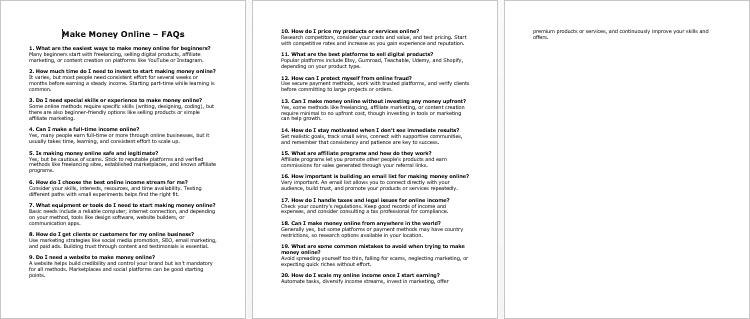
Make Money Online – Salespage Content
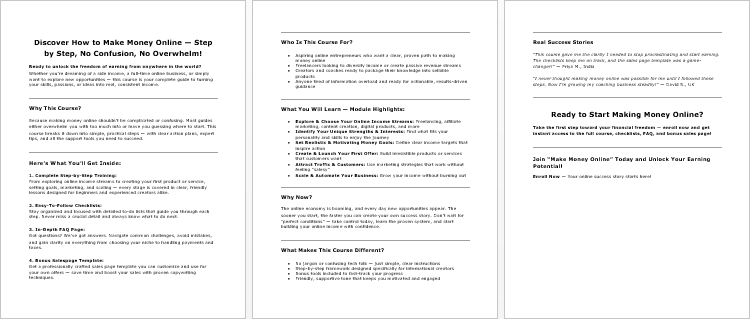
Package Details:
Word Count: 20 886 Words
Number of Pages: 99
Make Money Online – Bonus Content
Checklist
Word Count: 399 words
FAQs
Word Count: 636 words
Salespage Content
Word Count: 584 words
Total Word Count: 22 505 Words
Your PLR License Terms
PERMISSIONS: What Can You Do With These Materials?
Sell the content basically as it is (with some minor tweaks to make it “yours”).
If you are going to claim copyright to anything created with this content, then you must substantially change at 75% of the content to distinguish yourself from other licensees.
Break up the content into small portions to sell as individual reports for $10-$20 each.
Bundle the content with other existing content to create larger products for $47-$97 each.
Setup your own membership site with the content and generate monthly residual payments!
Take the content and convert it into a multiple-week “eclass” that you charge $297-$497 to access!
Use the content to create a “physical” product that you sell for premium prices!
Convert it to audios, videos, membership site content and more.
Excerpt and / or edit portions of the content to give away for free as blog posts, reports, etc. to use as lead magnets, incentives and more!
Create your own original product from it, set it up at a site and “flip” the site for megabucks!
RESTRICTIONS: What Can’t You Do With These Materials?
To protect the value of these products, you may not pass on the rights to your customers. This means that your customers may not have PLR rights or reprint / resell rights passed on to them.
You may not pass on any kind of licensing (PLR, reprint / resell, etc.) to ANY offer created from ANY PORTION OF this content that would allow additional people to sell or give away any portion of the content contained in this package.
You may not offer 100% commission to affiliates selling your version / copy of this product. The maximum affiliate commission you may pay out for offers created that include parts of this content is 75%.
You are not permitted to give the complete materials away in their current state for free – they must be sold. They must be excerpted and / or edited to be given away, unless otherwise noted. Example: You ARE permitted to excerpt portions of content for blog posts, lead magnets, etc.
You may not add this content to any part of an existing customer order that would not require them to make an additional purchase. (IE You cannot add it to a package, membership site, etc. that customers have ALREADY paid for.)
Share Now!
Latest Products

Free Sales Funnel Builder

Related Products

Popular & Trending

Featured Products