
Healthy Back Fitness PLR Course 26k Words
in Fitness Mindset PLR , Fitness PLR , Health PLR , PLR eCourses , PLR List Building Reports , Premium PLR , Premium PLR Reports , Premium White Label Brandable PLR Coaching Courses , Private Label Rights ProductsChoose Your Desired Option(s)
has been added to your cart!
have been added to your cart!
#healthybackfitness #plrcourse #backpainrelief #fitnesscoaching #wellnessmarketing #healthandwellness #plrcontent #injuryprevention #strengthtraining
The Complete Healthy Back Fitness Plan
26,000+ Words of Done-For-You Content to Help Your Audience Build Strength, Relieve Pain, Improve Posture & Stay Active — Pain-Free
Are you looking for a high-demand health topic that never goes out of style?
Back pain affects millions of people worldwide. From desk workers and entrepreneurs to parents, caregivers, and fitness enthusiasts — nearly everyone struggles with stiffness, poor posture, or recurring back discomfort at some point.
That’s why the Healthy Back Fitness PLR Course is a powerful, evergreen product you can confidently add to your catalog at Buy Quality PLR.
This professionally structured, 26,000-word course gives you everything you need to offer a complete, practical, step-by-step back care program your audience will truly value.
It’s designed to help people:
- Build core strength safely
- Improve posture naturally
- Reduce everyday back pain
- Prevent future injuries
- Stay active without fear
And best of all?
It’s fully editable, flexible, and ready for you to package, brand, and profit from.
Introducing the…
Healthy Back Fitness PLR Course 26k Words
Why Back Health Is a Profitable Evergreen Niche
Back pain is not a trend. It’s a global, ongoing issue.
Modern life encourages:
- Long hours sitting
- Poor posture
- Screen overuse
- Weak core muscles
- Stress-related tension
People are actively searching for solutions every single day.
This course gives you a comprehensive, structured solution you can sell as:
- A digital course
- A premium program
- A membership product
- A coaching framework
- A physical workbook
- Or a multi-week online class
It solves a real problem in a practical, approachable way.
Inside the Healthy Back Fitness PLR Course
This is not a thin report. It’s a complete back care system broken into 5 structured modules that walk learners step-by-step from understanding their back to building lifelong habits.
Let’s take a deeper look.
Module 1: Know Your Back to Protect It
Before someone can fix back pain, they must understand their back.
This foundational module builds confidence and clarity.
Step 1: Discover How Your Back Works
Learners are introduced to:
- The spine and its natural curves
- Intervertebral discs
- Core and stabilizing muscles
- The relationship between posture and spinal health
This section explains back anatomy in simple, non-intimidating language. It removes confusion and helps people understand what’s actually happening when they feel discomfort.
When customers understand their “engine,” they feel empowered — not afraid.
Step 2: Understand What Causes Back Pain
Back pain isn’t always caused by a major injury.
This lesson breaks down:
- Sedentary habits
- Poor lifting mechanics
- Weak core muscles
- Stress-related muscle tension
- Overtraining
- Improper sleep positioning
Your customers learn how everyday habits quietly strain their backs.
This awareness alone can dramatically change behavior.
Step 3: Spot the Warning Signs Early
Not every ache is serious — but some signals should never be ignored.
This step teaches:
- The difference between muscle soreness and structural pain
- When stretching helps
- When rest is better
- Red flags that require medical attention
This builds trust and positions your product as responsible and balanced.
Step 4: Bust the Myths
Many people make their back pain worse because they believe outdated advice like:
- “No pain, no gain”
- “Bed rest is always best”
- “Crunches fix everything”
This section separates fact from fiction, helping learners avoid costly mistakes.
Module 2: Fix Your Posture & Your Setup
Posture is one of the biggest silent contributors to back pain.
This module delivers practical, daily solutions.
Step 1: Master the Basics of Good Posture
Learners discover:
- What a neutral spine really means
- How to align ears, shoulders, and hips
- Why small posture shifts make a big difference
Clear, actionable explanations make it easy to apply immediately.
Step 2: Correct Sitting, Standing & Sleeping Habits
This lesson is extremely practical.
It covers:
- Desk sitting alignment
- Standing weight distribution
- Mattress and pillow positioning
- Safe side and back sleeping techniques
These small changes create noticeable improvements fast.
Step 3: Set Up an Ergonomic Workspace
Your audience doesn’t need expensive equipment.
This step teaches how to:
- Adjust chair height
- Position monitors correctly
- Use household items to improve setup
- Reduce neck and lower back strain
This is ideal for remote workers and office employees.
Step 4: Do a Daily Posture Reset
A simple 3-minute reset routine helps learners:
- Release tension
- Realign posture
- Reset after long periods of sitting
Short routines increase compliance and success.
Module 3: Stretch, Move & Feel Free Again
Movement is medicine — when done correctly.
This module introduces safe, beginner-friendly mobility.
Step 1: Gentle Morning Mobility Routine
A quick 5-minute wake-up sequence helps:
- Increase circulation
- Reduce morning stiffness
- Prepare the spine for the day
Perfect for busy people who claim they “don’t have time.”
Step 2: Daily Decompression Stretches
These stretches:
- Gently unload the spine
- Reduce compression
- Ease tension after work
Especially helpful for desk workers.
Step 3: Build a Custom Flexibility Routine
Instead of a one-size-fits-all plan, learners choose stretches based on:
- Tight hips
- Lower back stiffness
- Hamstring tightness
- Upper back tension
This personalization increases engagement.
Step 4: Track How Your Body Responds
This teaches self-awareness.
Learners discover:
- How to adjust intensity
- When to rest
- How to measure progress
This prevents overdoing it — a common mistake.
Module 4: Strengthen Your Core to Support Your Spine
Strong backs begin with strong core stability.
But this is NOT a crunch-heavy program.
Step 1: Understand Core vs. Abs
This crucial distinction explains:
- Deep stabilizing muscles
- Transverse abdominis
- Multifidus
- Pelvic floor support
It shifts focus from aesthetics to function.
Step 2: Core Stability Workouts
Safe bodyweight exercises include:
- Bird dogs
- Dead bugs
- Modified planks
- Glute bridges
These exercises protect rather than strain the spine.
Step 3: Add Light Resistance (Optional)
For progression, resistance bands can be introduced carefully.
This increases strength without compressing the spine.
Step 4: The 3-Workout Weekly Plan
A done-for-you 20–30 minute routine.
Clear. Simple. Sustainable.
Consistency beats intensity — and this module reinforces that.
Module 5: Build Lifelong Back-Friendly Habits
This is where transformation happens.
Step 1: Create Your Healthy Back Routine
Learners combine:
- Stretching
- Strength
- Posture checks
- Mobility resets
Into a custom weekly plan.
Step 2: Use the Daily Back Care Checklist
A ready-made checklist keeps habits top-of-mind.
Small daily actions = long-term results.
Step 3: Recovery & Pain Relief Tools
Covers practical tools such as:
- Foam rollers
- Warm compresses
- Cold packs
- Gentle self-massage techniques
Easy, affordable recovery options increase satisfaction.
Step 4: Celebrate Progress & Stay Consistent
Motivation strategies include:
- Tracking improvements
- Recognizing reduced stiffness
- Building sustainable habits
This encourages long-term engagement.
What’s Included in This PLR Package
✔ 26,000+ word complete course
✔ Healthy Back Fitness Checklist (579 words)
✔ Healthy Back Fitness FAQs (551 words)
✔ Ready-made Salespage (643 words)
Everything is professionally structured and ready to edit, brand, and deploy.
Ways You Can Use & Profit From This Course
This license gives you incredible flexibility.
Here are powerful monetization strategies:
1. Sell It As a Standalone Digital Course
Package it as:
- A downloadable PDF course
- A members-only portal product
- A structured email course
Price range: $27 – $97+
2. Break It Into Mini Reports
Divide the modules into separate products:
- Posture Guide ($17)
- Core Stability Blueprint ($27)
- Stretching for Back Pain Report ($19)
Sell individually or bundle later.
3. Create a Premium Coaching Program
Turn it into a 4–6 week eClass.
Add:
- Weekly live sessions
- Accountability check-ins
- Private group support
Charge $297–$497.
4. Launch a Membership Site
Upload one module per month.
Add:
- Bonus videos
- Printable worksheets
- Q&A sessions
Generate recurring income.
5. Bundle With Other Health PLR
Combine with:
- Weight loss content
- Mobility programs
- Stress management courses
Create a $47–$97 bundle.
6. Convert to Physical Products
Create:
- Printed workbooks
- Spiral-bound back care planners
- Guided journals
Physical products command premium prices.
7. Use Portions as Lead Magnets
Excerpt sections like:
- “3-Minute Posture Reset”
- “Morning Back Mobility Routine”
Offer them as free downloads to grow your email list.
8. Flip the Site
Build a niche back pain authority website using this content.
Monetize with:
- Affiliate offers
- Course sales
- Coaching
Then sell the site for a lump sum.
License Summary (Important)
You CAN:
✔ Sell the content (with minor edits).
✔ Break it into smaller products.
✔ Bundle it.
✔ Create memberships.
✔ Convert it into audio/video.
✔ Use excerpts as lead magnets.
✔ Build and flip a website.
You CANNOT:
✘ Pass PLR rights to your customers.
✘ Allow others to resell or redistribute the content.
✘ Offer 100% affiliate commissions (maximum 75%).
✘ Give away the full product for free.
✘ Add it to existing paid packages without an additional purchase.
These rules protect the long-term value of your investment.
Why Buy This PLR From Buy Quality PLR?
Because your reputation matters.
This isn’t spun fluff or keyword-stuffed filler.
It’s:
- Logically structured
- Practical
- Beginner-friendly
- Action-oriented
- Designed for real-world results
Your customers will feel supported, not overwhelmed.
And when they get results — they trust your brand more.
The Opportunity Is Here
Back pain is not going away.
But poor-quality products won’t survive.
If you want a high-value, evergreen health course that:
- Solves a real problem
- Builds trust
- Creates multiple income streams
- Positions you as a wellness authority
Then the Healthy Back Fitness PLR Course is your next smart investment.
Add it to your store.
Brand it your way.
Launch it confidently.
And start building a profitable health product line that truly helps people live pain-free.
has been added to your cart!
have been added to your cart!
Here A Sample of the Healthy Back Fitness PLR Course
Module 1: Know Your Back to Protect It
Let’s start with understanding your back, so we can take care of it properly.
Step 1: Discover How Your Back Works
Get to know your spine, muscles, discs, and what they all do. It’s like getting to know the engine before driving the car.
Introduction
Before we can dive into strengthening, stretching, or protecting our back, we need to understand how it works. Just like you wouldn’t start repairing a machine without knowing how it functions, it’s essential to explore the basic structure and mechanics of the human back.
This step is all about building awareness. A strong foundation of knowledge helps you make smart, informed decisions. It empowers you to listen to your body, respond to signals, avoid harmful movements, and apply the exercises you’ll learn in this course with confidence and purpose.
Whether you’re a course creator designing fitness programs, a health enthusiast eager to prevent pain, or someone dealing with ongoing back issues, this step is your entry point into a deeper understanding of the most central support structure in your body — your back.
Section 1: The Spine – Your Body’s Central Support Beam
Let’s start with the backbone — literally. The spine is the main structural support of the body. It connects the upper body to the lower body, supports your weight, allows for movement, and protects the spinal cord, which is part of the central nervous system.
The Spine’s Five Regions
Your spine is made up of 33 vertebrae (small bones) and is typically divided into five regions:
- Cervical Spine (Neck) – 7 vertebrae
This supports the head and allows for neck motion. It’s very flexible but also vulnerable to injury, especially from poor posture or long hours at a computer. - Thoracic Spine (Upper Back) – 12 vertebrae
This part connects to your ribs and is relatively stable. It’s designed more for protection than for movement. - Lumbar Spine (Lower Back) – 5 vertebrae
This bears the most weight and is the most common site of back pain. It allows for bending, twisting, and heavy lifting. - Sacrum – 5 fused vertebrae
These are fused together and form the back of your pelvis. - Coccyx (Tailbone) – 4 fused vertebrae
A small, triangular bone at the base of your spine that helps with balance when sitting.
Natural Curves of the Spine
Your spine isn’t a straight rod. It has natural curves that help absorb shock and allow for balanced movement:
- Cervical Curve – curves slightly inward
- Thoracic Curve – curves outward
- Lumbar Curve – curves inward again
These S-shaped curves help you stay upright and absorb the impact of walking, running, and jumping. But poor posture, muscle imbalances, or injuries can exaggerate these curves, leading to pain or mobility issues.
Section 2: The Intervertebral Discs – Shock Absorbers of the Spine
Between most vertebrae sit small, cushion-like pads called intervertebral discs. Each disc acts like a shock absorber to prevent bone-on-bone contact when you move.
Structure of a Disc
- Annulus fibrosus – The tough outer layer made of strong fibers.
- Nucleus pulposus – The gel-like center that helps distribute pressure evenly.
When you move, jump, or lift something, these discs compress and decompress, helping your spine remain flexible yet protected.
Disc Issues You May Have Heard Of
- Herniated disc (slipped disc) – When the inner gel pushes through the outer layer. This can press on a nerve and cause pain or numbness.
- Degenerative disc disease – When discs wear down over time, losing flexibility and cushioning ability.
These conditions aren’t always painful, but when they are, understanding how they happen is the first step toward managing them.
Section 3: Muscles that Support the Spine
The spine doesn’t work alone. It’s supported by an intricate network of muscles, ligaments, and tendons that stabilize, move, and protect it. Weakness or imbalance in these areas can lead to pain, especially in the lower back.
Key Muscle Groups to Know
- Erector Spinae
These are long muscles running along either side of your spine. They help with posture, extension (bending backward), and stabilization. - Multifidus
Small but powerful muscles deep in the spine that assist in stabilization. Weak multifidus muscles are linked to chronic lower back pain. - Quadratus Lumborum (QL)
This muscle connects your spine to your pelvis. It helps you bend sideways and stabilize your pelvis when walking. - Psoas Major
A deep muscle that connects your spine to your legs. It’s a hip flexor, but if it’s tight, it can pull on the lumbar spine and cause pain. - Abdominals and Obliques
Often thought of as “core muscles,” these support the front and sides of the spine. They work with the back muscles to create balance and protect the lower back. - Gluteal Muscles (Glutes)
Your buttocks muscles are crucial in stabilizing the pelvis and lower spine during movement. Weak glutes can result in overcompensation by the lower back muscles, leading to strain.
Section 4: The Spinal Cord and Nerves
The spinal cord is a bundle of nerves running down the center of the spine, protected by the vertebrae. It acts like a major communication highway, sending messages between your brain and the rest of your body.
From the spinal cord, spinal nerves branch out through small spaces between the vertebrae, sending signals to your muscles and skin. If a disc or bone impinges (presses on) one of these nerves, you can experience:
- Pain
- Numbness
- Tingling
- Muscle weakness
Understanding this connection helps explain why back problems can sometimes cause symptoms in your arms, legs, or even fingers and toes — especially in conditions like sciatica, where the sciatic nerve is affected.
Section 5: Movement & Function of the Back
The spine is designed for mobility, stability, and protection. These three roles are constantly balanced.
Spinal Movements Include:
- Flexion – Bending forward
- Extension – Bending backward
- Lateral Flexion – Side bending
- Rotation – Twisting from side to side
When the spine moves, the surrounding muscles and discs help stabilize and absorb pressure. But when movement is done with poor form, excessive weight, or lack of muscle support, these actions can lead to injury.
Learning to move intentionally, with body awareness and muscular support, is one of the best ways to protect your back long-term.
Section 6: Why Understanding the Back Matters for Fitness
Many people jump straight into workouts without considering whether their spine and supporting muscles are ready. Here’s why that’s a mistake:
- Lack of awareness leads to poor form and increased risk of injury
- Overtraining the wrong muscles (like only doing crunches for abs) can cause imbalances that lead to back pain
- Neglecting postural and stabilizing muscles can result in long-term joint stress
By understanding how the spine works, you can:
- Choose exercises that protect your back
- Spot movements that may put you at risk
- Modify routines to suit your personal body mechanics
- Educate others (if you’re a coach or course creator) with greater authority
Conclusion
Your back is a beautifully designed, complex, and essential structure — and now, you have a clearer understanding of how it works.
From the vertebrae and discs to the muscles and nerves, each part plays a critical role in supporting movement, bearing weight, and protecting the nervous system. When everything is working well together, the result is smooth, pain-free motion. But even small misalignments or weaknesses can lead to big discomforts over time.
This foundational knowledge empowers you to move forward in the course with confidence. You now know why we focus on posture, mobility, flexibility, and strength. Every technique and tool we’ll share next is grounded in this deep respect for the anatomy and function of your back.
You’ve just taken a powerful first step toward lifelong back health — and it starts with understanding, awareness, and intelligent action.
Step 2: Understand What Causes Back Pain
We’ll break down everyday habits, injuries, and stress factors that strain your back without you even realizing it.
Introduction
Understanding the root causes of back pain is the key to preventing it. Back pain doesn’t always begin with a sudden injury—it often builds up silently, through daily habits, poor movement patterns, lack of activity, or unnoticed stress. This step of the course will help you identify what could be harming your back in your daily life, even when nothing feels wrong.
This section is especially useful for fitness professionals, course creators, therapists, and wellness educators who want to teach others with confidence. When you know the causes, you can help your audience develop strategies that prevent injury, improve posture, and support long-term spinal health.
Let’s explore the many ways back pain develops and why it often comes as a surprise.
Section 1: Mechanical and Lifestyle-Related Causes of Back Pain
1. Poor Posture Over Time
One of the most overlooked causes of back pain is postural strain. It happens slowly but surely.
Common culprits:
- Slouching at a desk or in front of a screen
- Looking down at a phone (tech neck)
- Standing with locked knees or uneven weight distribution
- Driving for long hours with poor lumbar support
When your spine is misaligned—whether sitting or standing—certain muscles have to work overtime to support you. This leads to:
- Muscle fatigue
- Compressed spinal discs
- Reduced circulation in soft tissues
- Joint stiffness
Over time, your body adapts to poor posture by tightening some muscles (like the hip flexors) and weakening others (like the glutes or deep abdominal stabilizers), creating a muscular imbalance that stresses the spine.
2. Inactivity and Prolonged Sitting
A sedentary lifestyle is one of the most damaging things you can do to your back. The spine was made to move. When you don’t move enough:
- The discs lose hydration
- Muscles weaken and atrophy
- Ligaments and fascia tighten
- Your joints become less mobile
Prolonged sitting, especially in a slouched position, increases pressure on the lumbar spine by 30%–40% compared to standing. Without movement, your muscles lose strength and the stabilizing structures of your back weaken.
3. Repetitive Movements or Poor Lifting Technique
Even if you’re active, repetitive stress can be just as harmful.
Examples include:
- Lifting heavy objects with your back instead of your legs
- Twisting while carrying weight
- Repeating a motion over and over (e.g., in manual labor or sports)
These activities cause:
- Muscle strain
- Joint stress
- Disc compression
- Inflammation of soft tissues
Improper form—especially in exercise routines—can silently create wear and tear that manifests as pain weeks or months later.
Section 2: Common Medical Causes and Structural Issues
While lifestyle is the leading cause of back pain, it’s also important to be aware of medical and structural contributors.
1. Herniated or Bulging Discs
Spinal discs act as shock absorbers. When too much pressure is placed on them—either suddenly (e.g., a heavy lift) or gradually (e.g., poor posture)—the inner gel of the disc can bulge out or rupture.
This can press on surrounding nerves, causing:
- Radiating pain
- Numbness or tingling
- Muscle weakness (especially in the legs if it’s in the lower back)
Not all disc issues cause symptoms, but when they do, they can seriously interfere with daily activities.
2. Degenerative Disc Disease (DDD)
As we age, our discs naturally lose moisture and elasticity. This degeneration can cause the spine to become less flexible, increasing friction between vertebrae.
This leads to:
- Stiffness
- Chronic low back pain
- Difficulty bending or twisting
Although this is a natural process, lifestyle and movement can slow or accelerate it.
3. Spinal Stenosis
This condition occurs when the spaces within the spine narrow, putting pressure on the nerves. It’s most common in older adults and may cause:
- Pain while walking or standing
- Numbness in legs
- Balance issues
Again, not all people with spinal stenosis have symptoms, but when symptoms are present, back-friendly movement routines can help manage them.
Section 3: Muscle-Related Back Pain
Often, back pain isn’t caused by structural damage—it’s muscular. This is good news because muscular pain is typically easier to resolve.
1. Muscle Strains and Microtears
These happen when a muscle is stretched beyond its capacity, often from sudden movements, overuse, or poor form.
Symptoms:
- Sharp pain during or after movement
- Muscle stiffness
- Pain that worsens with specific positions
Strains usually improve with rest, ice, and gradual return to movement.
2. Myofascial Pain Syndrome
This is a chronic condition involving sensitive trigger points in your muscles. The pain may not always be located where the problem originates.
Example: Tight glutes may cause lower back pain. Tight upper trapezius muscles may contribute to headaches or upper back discomfort.
These are often due to:
- Poor posture
- Stress-related muscle tension
- Repetitive motion
Releasing trigger points with massage, stretching, and movement can be very effective.
Section 4: Psychological and Emotional Triggers
Here’s something often overlooked: back pain can have emotional roots.
1. Stress and Muscle Tension
When you’re anxious or stressed, your body goes into “fight-or-flight” mode. Your muscles tighten as a protective reflex, especially in the neck, shoulders, and lower back.
Over time, this chronic tension leads to:
- Muscle fatigue
- Stiffness
- Reduced blood flow to the tissues
Many people carry emotional stress in their body without realizing it. The physical pain is real—but the source is emotional.
2. Depression and Physical Pain
Studies show that people with depression are more likely to experience chronic back pain. This connection is thought to be both chemical and behavioral:
- Depression can change brain chemistry in a way that increases pain sensitivity
- It can also reduce motivation to move, which worsens stiffness and pain
In short, addressing mental health is a vital part of long-term back care.
Section 5: Hidden Daily Habits That Strain the Back
Let’s look at a few everyday activities that can sneakily strain your spine:
1. Carrying a Heavy Bag on One Shoulder
Whether it’s a purse, a laptop bag, or a backpack slung over one side, this unbalanced load pulls on your spine and overworks one side of your back and shoulder muscles.
Solution: Use a backpack with even weight distribution or alternate shoulders frequently.
2. Wearing Poorly Designed Shoes
High heels, flip-flops, and unsupportive sneakers can all change your posture and throw off your natural gait, forcing your spine to compensate.
Solution: Choose footwear with proper arch support and cushioning.
3. Sleeping on a Mattress That’s Too Soft or Too Firm
Your spine should maintain a neutral curve while you sleep. If your mattress doesn’t support this, your back muscles may stay slightly tensed all night.
Solution: Use a medium-firm mattress and sleep on your side with a pillow between your knees to maintain spinal alignment.
4. Using Smartphones and Devices
Constantly looking down strains your neck and upper back—a condition now commonly referred to as “tech neck.”
Solution: Hold devices at eye level and take posture breaks every 20–30 minutes.
Section 6: Why Identifying the Cause Matters
When back pain occurs, most people reach for painkillers, massage, or a chiropractor. While those may help relieve symptoms, they rarely address the source of the problem.
By identifying what’s causing the pain, you can:
- Choose the right exercises
- Avoid harmful movements
- Create an environment that supports healing
- Make sustainable lifestyle changes
Think of this like solving a mystery. Pain is just the clue—now you know how to look for the cause.
Summary and Reflection
Back pain is not a random or inevitable part of life. It almost always has a cause—and more importantly, it has a solution. Whether it stems from posture, poor movement habits, injury, stress, or underlying medical issues, understanding the why behind your pain empowers you to take meaningful action.
You now understand:
- The impact of daily posture and lifestyle choices
- The structural and muscular causes of back pain
- The influence of stress and emotion on physical tension
- How even small changes in your environment can reduce strain
This knowledge is not only valuable for your own health, but also for anyone you’re teaching or supporting. When you can confidently explain what causes back pain, you become a resource for others seeking relief and resilience.
Understanding is the first step to healing.
Step 3: Spot the Warning Signs Early
Not every ache is the same. Learn which pains you can stretch out—and which ones mean “see a doctor.”
Introduction
Back pain is one of the most common physical complaints worldwide. It affects people across all professions, age groups, and fitness levels. But while many types of back discomfort are harmless and resolve with time, stretching, or strengthening, others are signals of deeper issues that shouldn’t be ignored.
This lesson teaches you how to distinguish between “normal” discomfort and warning signs that may indicate injury, nerve involvement, or underlying medical conditions. Knowing what your body is telling you is a skill—one that can help you act early, avoid complications, and refer yourself (or others) to appropriate medical professionals when needed.
For course creators and wellness professionals, this knowledge is not only critical for your own back health, but also crucial in keeping your clients safe. Let’s explore how to listen to your back with more intelligence and intuition.
Section 1: Understanding “Good” Pain vs. “Bad” Pain
The first step in spotting warning signs is knowing how to differentiate helpful pain from harmful pain. Not all pain is a problem—in fact, some discomfort is a natural and even necessary part of movement and growth. But certain types of pain can signal injury or dysfunction.
A. What Is “Good” Pain?
This type of pain is generally mild, temporary, and associated with:
- Muscle soreness after activity (especially when starting a new routine)
- Stretching discomfort during mobility exercises
- Fatigue-based sensations after strength work
Characteristics of good pain:
- Dull, aching, or mildly sore
- Localized to muscles, not joints or bones
- Improves within 24–72 hours
- Feels better with gentle movement or light massage
“Good” pain is a sign your muscles are adapting or waking up. It should not interfere with your daily function or worsen with rest.
B. What Is “Bad” Pain?
This type of pain suggests inflammation, nerve impingement, or structural damage. It typically:
- Persists longer than 72 hours
- Worsens with specific movements
- Radiates beyond the original area
- Limits motion or function
- Interrupts sleep
“Bad” pain may feel:
- Sharp or stabbing
- Burning or tingling
- Deep and unrelenting
- Accompanied by numbness or weakness
These symptoms require further investigation. When in doubt, err on the side of caution.
Section 2: Localized vs. Radiating Pain
One of the most helpful ways to assess back pain is to notice where it is and how it travels.
A. Localized Pain
This is pain you feel in one specific spot—such as the lower back or shoulder blade area.
Causes of localized pain may include:
- Muscle strain
- Ligament sprain
- Poor posture
- Repetitive motion
Localized pain is usually musculoskeletal and may improve with:
- Stretching
- Heat therapy
- Gentle strengthening
However, if localized pain becomes intense or chronic, especially in the lower back, it may point to deeper disc or joint issues.
B. Radiating Pain
Radiating pain moves from the spine into other parts of the body. This often means that a nerve is being compressed or irritated.
Examples include:
- Pain that travels down one leg (sciatica)
- Tingling in fingers or hands (cervical nerve compression)
- Numbness or burning in the foot or calf
Radiating symptoms indicate that something more than just muscle strain is involved. These require medical evaluation, especially if accompanied by:
- Loss of sensation
- Muscle weakness
- Changes in reflexes
Section 3: Red Flag Symptoms You Should Never Ignore
There are certain symptoms that act as “red flags”. These are signs of potentially serious issues and require immediate medical attention. If you or someone you’re coaching experiences any of the following, do not delay referral to a physician.
A. Loss of Bladder or Bowel Control
This could indicate cauda equina syndrome, a rare but serious condition involving severe compression of the spinal nerves. It’s a medical emergency.
B. Sudden, Unexplained Weight Loss Accompanied by Back Pain
Could signal infection, cancer, or systemic disease. Particularly concerning if the pain is:
- Unrelenting
- Worse at night
- Not relieved by rest or position
C. Persistent Night Pain
Pain that wakes you up from sleep or increases at night, especially if not tied to physical activity, can be a warning of:
- Infection
- Inflammatory disease (e.g., ankylosing spondylitis)
- Tumors
D. Severe, Sudden Onset of Pain After Minor Injury (Especially in Older Adults)
May indicate vertebral compression fractures, particularly in individuals with osteoporosis.
E. Progressive Neurological Symptoms
- Numbness or tingling that worsens over time
- Foot drop or hand weakness
- Difficulty walking or maintaining balance
These point to nerve or spinal cord compression, which needs timely diagnosis and treatment.
Section 4: When Pain Is Positional vs. Constant
Understanding the behavior of pain—when and how it changes—is critical.
A. Positional Pain
Pain that:
- Increases in certain positions
- Improves with movement or stretching
- Appears only during or after specific activities
Likely causes:
- Muscular tightness
- Postural strain
- Joint stiffness
This pain often responds well to:
- Mobility work
- Strengthening
- Ergonomic adjustments
B. Constant, Unchanging Pain
Pain that:
- Doesn’t improve with rest or activity
- Remains the same throughout the day
- Doesn’t respond to self-care
This may indicate a non-muscular issue, such as inflammation, nerve compression, or deeper tissue damage.
Section 5: Self-Assessment Strategies
While diagnosing conditions should always be left to medical professionals, there are safe and simple tests you can do to gather more information about your symptoms.
1. Movement Testing
Try the following and observe:
- Does bending forward make the pain worse?
This may indicate a disc issue (especially if there’s radiating pain). - Does arching backward relieve discomfort?
Suggests disc involvement or postural relief. - Does pain worsen after sitting for long periods?
Common in those with lumbar disc compression or poor core support.
2. Nerve Tension Checks (gentle and optional)
- Straight Leg Raise Test (for sciatica)
Lie on your back and raise one leg with a straight knee. Pain radiating down the leg may signal sciatic nerve irritation. - Neck Flexion Test
Tuck your chin to your chest. If this increases arm pain, it may indicate nerve root irritation in the neck.
Note: These are not diagnostic tools but can offer useful clues. If discomfort increases with these tests, it’s best to seek professional advice.
Section 6: Pain Duration and Frequency
Tracking how long the pain lasts and how often it comes back is another vital part of spotting early warning signs.
A. Acute Pain
- Lasts a few days to a few weeks
- Often the result of injury or muscle strain
- Typically improves with basic care
B. Subacute Pain
- Lasts 4–12 weeks
- May suggest slower healing or a need for focused rehab
C. Chronic Pain
- Lasts more than 12 weeks
- May involve structural issues, stress, or compensation patterns
- Needs a holistic approach including movement, posture, and lifestyle adjustment
Patterns of recurrence are also important. If pain keeps coming back every few weeks or after the same movements, that’s a sign of an underlying issue that hasn’t been fully addressed.
Section 7: Creating a Back Pain Monitoring System
To spot issues early, it helps to track symptoms consistently. Here’s a basic framework:
Daily Symptom Journal
- Rate your pain (0–10 scale)
- Where is it located?
- What movements increase/decrease it?
- Did you sleep well?
- Any changes in stress or emotional state?
Weekly Patterns to Watch
- Is pain improving, staying the same, or worsening?
- Does it shift locations?
- Is it interfering with work, exercise, or sleep?
This type of tracking can be extremely helpful when consulting a medical professional or deciding whether to modify your fitness routine.
Conclusion
Pain is not the enemy—it’s a messenger. But it’s a message we need to learn to read accurately. When you listen to the quality, location, timing, and behavior of your pain, you gain powerful insight into what your body needs.
You now know how to:
- Distinguish between good and bad pain
- Spot red flags and refer when needed
- Observe how movement and position affect pain
- Track symptoms intelligently for better decisions
These insights allow you to protect your back, prevent injury, and teach others with confidence. When we stop ignoring early warning signs, we interrupt the pain cycle before it becomes chronic or disabling.
Back pain may be common, but it doesn’t have to be your story. Recognizing the signs early is the first step toward resilience and recovery.
Step 4: Bust the Myths
Overview:
This step is all about clearing the confusion. When it comes to back health, misinformation can do more harm than good. Many people still cling to outdated or oversimplified advice—like “rest is best” or “no pain, no gain.” These myths not only hinder healing but often aggravate existing issues. In this step, we will dig deep into the most common back-related misconceptions, explain why they’re wrong (or misunderstood), and offer science-backed truths that will help you support your spine safely and confidently.
Whether you’re recovering from discomfort or proactively trying to avoid injury, knowing what to believe is critical. Let’s clear the fog and empower your decision-making with real knowledge.
Myth #1: “No Pain, No Gain”
The Misconception:
Pain is often seen as a sign of progress in fitness—proof that you’re pushing your limits. While this saying might apply to muscle soreness in strength training, it is absolutely not true when it comes to back health.
The Truth:
Back pain is your body’s way of signaling something is wrong—often a misalignment, overuse, or inflammation. Ignoring this signal and continuing to “push through” can lead to long-term damage. Unlike biceps or hamstrings, your spine houses your central nervous system and is structurally delicate. Pushing through pain may aggravate a herniated disc, inflame spinal joints, or cause nerve irritation.
What To Do Instead:
If an exercise causes sharp, shooting, or persistent back pain, stop immediately. Replace high-impact or high-torque exercises (like heavy deadlifts or deep twisting yoga poses) with controlled, spine-safe movements like bird-dogs, pelvic tilts, or walking. Pain-free motion is your goal—not pain as proof of effort.
Myth #2: “Rest Is Best for a Sore Back”
The Misconception:
You hurt your back—so you should lie down and stay there, right?
The Truth:
While short-term rest may ease pain during an acute flare-up (like a muscle spasm), prolonged rest often delays healing. Your spine thrives on gentle movement. Resting for more than a couple of days can weaken your back-supporting muscles, reduce flexibility, and increase stiffness. Inactivity can also cause psychological effects like fear of movement (kinesiophobia), which further traps you in a cycle of pain and immobility.
What To Do Instead:
After 24–48 hours of rest during an acute episode, gently return to low-impact movement. Start with short walks or gentle stretching. Exercises that keep your spine aligned and muscles engaged (like glute bridges or wall sits) help restore blood flow, lubricate joints, and promote healing.
Myth #3: “Sit Up Straight at All Times”
The Misconception:
“Sit up straight!” We’ve all heard it from teachers and parents. While posture matters, the idea that you should hold a rigid, upright position all day is not only unrealistic—it’s actually counterproductive.
The Truth:
There’s no such thing as a “perfect” posture. In fact, staying in any position for too long (even a supposedly good one) leads to muscle fatigue and imbalance. A spine that moves regularly is a healthier spine. Good back care isn’t about sitting in the same position all day—it’s about changing positions frequently and using ergonomic support when needed.
What To Do Instead:
Adjust your posture every 30–45 minutes. Use a lumbar pillow or small rolled-up towel to support the natural curve of your lower back. Stand up, stretch, or walk around regularly. When sitting, make sure your knees are at hip level and your feet flat on the floor. Movement > stiffness.
Myth #4: “Lifting Is Bad for Your Back”
The Misconception:
Many people with back issues fear lifting objects—even light ones—thinking it’s inherently harmful.
The Truth:
Lifting isn’t the problem—how you lift is. When done with poor form (like bending at the waist instead of the hips and knees), lifting places excess stress on the lower back. But avoiding lifting altogether can lead to deconditioning, which actually increases your risk of future injury.
What To Do Instead:
Learn and practice proper lifting technique:
- Stand close to the object.
- Bend your knees and hips, not your waist.
- Keep your back straight and chest forward.
- Hold the object close to your body.
- Lift with your legs, not your back.
Strength training that targets your core, glutes, and legs can make lifting safer and easier.
Myth #5: “Back Pain Always Means Something Is Seriously Wrong”
The Misconception:
Any back pain must mean there’s something structurally damaged—like a disc rupture or bone issue.
The Truth:
Most back pain is mechanical in nature—caused by poor posture, muscle imbalance, overuse, or stress. In fact, studies show that 80–90% of people will experience low back pain at some point in their lives, and in the majority of cases, it’s not due to a serious medical condition.
What To Do Instead:
Use the “pain filter”:
- Is it localized or does it radiate (e.g., down the leg)?
- Does it improve with movement or worsen?
- Is it sharp and sudden or dull and aching?
If the pain is chronic, severe, radiating, or accompanied by numbness, weakness, or bladder/bowel dysfunction, seek medical evaluation. But for typical soreness or tightness, active management through movement, stretching, and lifestyle adjustments is usually effective.
Myth #6: “Back Braces Fix Everything”
The Misconception:
Wearing a back brace all day provides support and protection—so it must be good, right?
The Truth:
While back braces can be helpful temporarily (especially during acute flare-ups or after surgery), relying on them long-term weakens your core and reduces your body’s natural ability to stabilize the spine. It’s like using crutches when you don’t need them—eventually, the muscles forget how to walk on their own.
What To Do Instead:
Use a brace only under professional guidance and for short durations. Focus on strengthening your deep core muscles (like the transverse abdominis) to create your own “internal back brace.” This provides far better protection in the long run.
Myth #7: “Crunches and Sit-Ups Strengthen Your Back”
The Misconception:
Strong abs equal a strong back—so let’s do hundreds of crunches.
The Truth:
Traditional sit-ups and crunches tend to overwork the superficial abdominal muscles while placing excess strain on the lumbar spine, especially when done with poor form. They often worsen back issues rather than strengthen spinal support.
What To Do Instead:
Focus on functional core exercises that target the deep stabilizers of your trunk. Some excellent choices include:
- Bird-dogs
- Dead bugs
- Planks
- Modified side bridges
These moves build balanced, coordinated core strength that supports the spine from all directions.
Myth #8: “You’re Too Young (or Too Old) for Back Pain”
The Misconception:
Back pain is only for the elderly—or it shouldn’t happen to someone young and active.
The Truth:
Back pain doesn’t discriminate. It affects teenagers, office workers, pregnant women, elite athletes, and retirees. It’s not always about age—it’s about habits, posture, stress, genetics, and how you treat your body daily.
What To Do Instead:
Listen to your body, regardless of age. Don’t ignore early signs of discomfort just because you think you’re too young to have problems. The earlier you start taking care of your back—through awareness, movement, and posture—the better your lifelong spinal health will be.
Conclusion: Knowledge Is Prevention
Busting these myths is a powerful step in your journey toward a healthy, pain-free back. When you separate fact from fiction, you’re not just preventing injury—you’re reclaiming your freedom to move, work, play, and live without fear. A well-informed approach to back fitness is sustainable, empowering, and rooted in your body’s real needs—not cultural clichés or outdated advice.
Take what you’ve learned here and let it reshape how you train, sit, lift, and care for your spine. Your back will thank you.
We’re also giving these extra bonuses
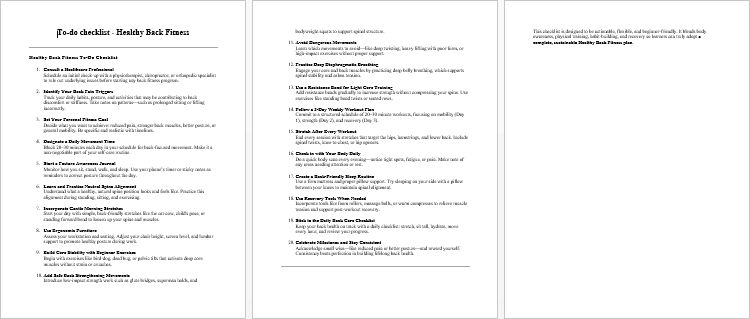
Healthy Back Fitness – Checklist
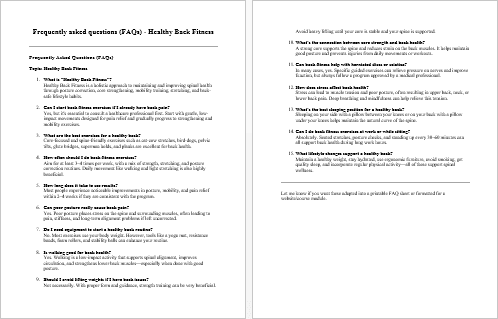
Healthy Back Fitness – FAQs
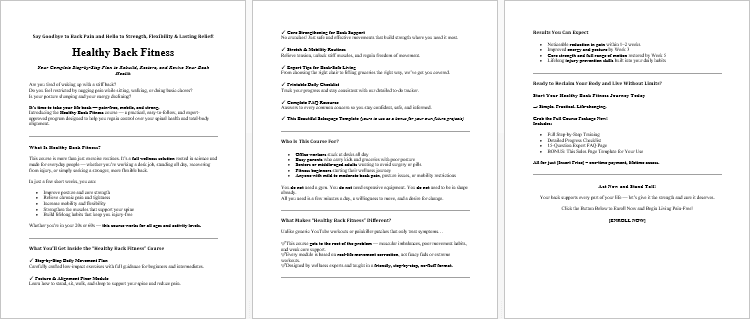
Healthy Back Fitness – Salespage Content
Package Details:
Word Count: 24 881 Words
Number of Pages: 103
Healthy Back Fitness – Bonus Content
Checklist
Word Count: 579 words
FAQs
Word Count: 551 words
Salespage Content
Word Count: 643 words
Total Word Count: 26 654 Words
Your PLR License Terms
PERMISSIONS: What Can You Do With These Materials?
Sell the content basically as it is (with some minor tweaks to make it “yours”).
If you are going to claim copyright to anything created with this content, then you must substantially change at 75% of the content to distinguish yourself from other licensees.
Break up the content into small portions to sell as individual reports for $10-$20 each.
Bundle the content with other existing content to create larger products for $47-$97 each.
Setup your own membership site with the content and generate monthly residual payments!
Take the content and convert it into a multiple-week “eclass” that you charge $297-$497 to access!
Use the content to create a “physical” product that you sell for premium prices!
Convert it to audios, videos, membership site content and more.
Excerpt and / or edit portions of the content to give away for free as blog posts, reports, etc. to use as lead magnets, incentives and more!
Create your own original product from it, set it up at a site and “flip” the site for megabucks!
RESTRICTIONS: What Can’t You Do With These Materials?
To protect the value of these products, you may not pass on the rights to your customers. This means that your customers may not have PLR rights or reprint / resell rights passed on to them.
You may not pass on any kind of licensing (PLR, reprint / resell, etc.) to ANY offer created from ANY PORTION OF this content that would allow additional people to sell or give away any portion of the content contained in this package.
You may not offer 100% commission to affiliates selling your version / copy of this product. The maximum affiliate commission you may pay out for offers created that include parts of this content is 75%.
You are not permitted to give the complete materials away in their current state for free – they must be sold. They must be excerpted and / or edited to be given away, unless otherwise noted. Example: You ARE permitted to excerpt portions of content for blog posts, lead magnets, etc.
You may not add this content to any part of an existing customer order that would not require them to make an additional purchase. (IE You cannot add it to a package, membership site, etc. that customers have ALREADY paid for.)
Share Now!
Latest Products





Free Sales Funnel Builder

Related Products

Popular & Trending



Featured Products