

Headache & Migraine Relief Masterclass PLR Course 32k Words
in Headache PLR , Pain PLR , PLR eCourses , PLR List Building Reports , Premium PLR , Premium PLR Reports , Premium White Label Brandable PLR Coaching Courses , Private Label Rights ProductsChoose Your Desired Option(s)
has been added to your cart!
have been added to your cart!
#migrainerelief #headacherelief #plrcourse #naturalhealth #wellnessmarketing #healthandwellness #plrcontent #painmanagement
32,000 Words of High-Demand Health Content You Can Brand, Sell, and Turn Into a Profitable Wellness Asset
If you’re looking for a strong, evergreen PLR product in the health and wellness niche—one that addresses a daily struggle faced by millions—this is a powerful addition to your catalog.
Headache & Migraine Relief Masterclass PLR Course is a comprehensive 32,000-word, step-by-step training program designed to help learners understand, manage, and naturally reduce headaches and migraines for a healthier, more pain-controlled life.
This is not a thin ebook.
This is a fully structured masterclass with modules, lessons, practical strategies, prevention tools, natural remedies, medical insights, and long-term management frameworks.
And as a PLR buyer, you gain the flexibility to:
- Sell it under your brand
- Repackage it into multiple products
- Build a membership around it
- Create high-ticket coaching programs
- Turn it into video, audio, or print
- Bundle it with other health products
- Generate long-term recurring revenue
Welcome to one of the most practical and profitable health PLR opportunities available at Buy Quality PLR.
Introducing the…
Headache & Migraine Relief Masterclass PLR Course 32k Words
Why Headache & Migraine Content Sells Consistently
Headaches and migraines are among the most common health complaints worldwide.
People are searching every day for:
- Natural headache relief
- Migraine prevention tips
- Tension headache solutions
- Stress-related pain management
- Alternatives to medication
- Ways to reduce frequency and severity
This is not a trend-based topic.
It’s evergreen.
That means:
- Health bloggers need premium content.
- Wellness coaches want structured programs.
- Holistic practitioners need ready-made materials.
- Membership sites need high-value courses.
- Supplement brands need educational funnels.
- YouTube creators need structured teaching outlines.
This course gives you a fully developed framework that your customers can instantly put to work.
What’s Included in This PLR Package
You’re not just getting a manuscript. You’re getting a complete, organized training system.
Inside this package:
- ✅ Headache & Migraine Relief Masterclass (32,000 Words)
- ✅ Checklist (412 Words)
- ✅ FAQs (766 Words)
- ✅ Salespage (660 Words)
The course is professionally structured into five comprehensive modules that move logically from understanding the problem to building long-term solutions.
Inside the Headache & Migraine Relief Masterclass
Let’s take a closer look at the value packed inside.
Module 1: Understanding Headaches & Migraines
Laying the foundation before diving into relief methods
Before someone can reduce headaches, they must understand them.
Lesson 1: Different Types of Headaches
This lesson clearly explains:
- Tension headaches
- Cluster headaches
- Migraines
It breaks down symptoms, patterns, and differences in simple language so learners can identify what they’re experiencing.
Understanding the type is the first step toward effective relief.
Lesson 2: Common Causes & Triggers
Learners explore everyday triggers such as:
- Stress
- Dehydration
- Lack of sleep
- Poor posture
- Screen overuse
- Dietary triggers
- Hormonal changes
This section alone can create strong engagement because readers begin recognizing their own patterns.
Lesson 3: Symptoms & Warning Signs
Many migraines come with early warning signals.
This lesson teaches learners how to spot:
- Aura symptoms
- Sensory changes
- Fatigue signals
- Mood shifts
- Tension buildup
Early awareness means earlier intervention.
Lesson 4: When to Seek Medical Help
This important lesson ensures responsible education.
It covers:
- Red flag symptoms
- Sudden severe headaches
- Neurological warning signs
- When professional diagnosis is necessary
This makes the course both helpful and balanced.
Module 2: Lifestyle & Daily Habits for Prevention
Simple changes that make a big difference
Prevention is powerful.
This module focuses on daily habits that reduce frequency and severity.
Lesson 1: Nutrition & Hydration
Learners discover:
- How dehydration contributes to headaches
- The role of caffeine
- Trigger foods to monitor
- Balanced eating for stability
This lesson is ideal for repurposing into mini-guides or printable trackers.
Lesson 2: Sleep & Rest Patterns
Poor sleep is one of the most overlooked triggers.
This lesson teaches:
- Creating a consistent sleep schedule
- Reducing screen exposure at night
- Supporting restorative sleep cycles
Lesson 3: Stress & Emotional Health
Stress is one of the biggest contributors to headaches.
This section includes:
- Journaling techniques
- Mindfulness practices
- Gentle daily decompression routines
- Emotional awareness strategies
Lesson 4: Daily Routine Adjustments
Small changes can produce significant results.
This lesson covers:
- Improving posture
- Taking screen breaks
- Breathing habits
- Ergonomic adjustments
Highly practical. Immediately usable.
Module 3: Natural Relief Methods
Gentle, effective techniques without medication
This module is extremely marketable because natural solutions are in high demand.
Lesson 1: Relaxation & Breathing Techniques
Step-by-step breathing exercises and progressive muscle relaxation routines that calm the nervous system.
Lesson 2: Stretching & Movement
Gentle neck, shoulder, and upper-back stretches designed specifically for tension relief.
These can easily be turned into:
- Video demonstrations
- Printable guides
- Social media content
Lesson 3: Cold & Warm Therapy
Teaches when to use:
- Ice packs
- Warm compresses
- Alternating temperature techniques
Simple tools. Fast results.
Lesson 4: Essential Oils & Herbal Remedies
Covers natural options such as:
- Peppermint
- Lavender
- Ginger
This lesson appeals strongly to holistic audiences.
Module 4: Medical & Advanced Approaches
Understanding modern treatment options
Balanced health education builds trust.
Lesson 1: Over-the-Counter Options
Covers:
- Safe use of pain relievers
- Avoiding rebound headaches
- Understanding dosage guidelines
Lesson 2: Prescription Treatments
Explains:
- Preventive medications
- Acute migraine treatments
- Doctor-guided care plans
Lesson 3: Alternative Therapies
Introduces:
- Acupuncture
- Biofeedback
- Chiropractic adjustments
This section adds depth and credibility.
Lesson 4: Building a Care Plan with Your Doctor
Teaches learners how to:
- Track symptoms
- Prepare questions
- Communicate effectively
This is practical and empowering.
Module 5: Long-Term Headache & Migraine Management
Creating a lifestyle that keeps pain under control
The final module focuses on sustainability.
Lesson 1: Identifying & Tracking Your Triggers
Encourages keeping a headache diary to spot patterns and prevent attacks.
Lesson 2: Creating a Personal Relief Toolbox
Learners build a go-to kit that may include:
- Cold packs
- Oils
- Relaxation routines
- Emergency action steps
Lesson 3: Balancing Work, Family & Self-Care
Practical strategies for busy lifestyles.
Lesson 4: Staying Consistent for Lasting Relief
Habit-building strategies for long-term improvement.
What Learners Achieve by the End
By completing this course, learners will:
- Understand their headache type and patterns
- Identify triggers
- Build prevention habits
- Apply natural relief techniques
- Understand medical options
- Develop a long-term management plan
This outcome-driven structure makes it easier to sell.
Who This PLR Product Is Perfect For
This course is ideal for:
- Health coaches
- Wellness bloggers
- Holistic practitioners
- Fitness trainers
- Stress-management coaches
- Natural health influencers
- Membership site owners
- Supplement marketers
It fits perfectly into:
- Chronic pain niches
- Women’s health
- Stress management
- Workplace wellness
- Holistic living
Ways You Can Use and Profit From This Course
Here’s where the opportunity multiplies.
1. Sell It as a Branded Digital Course
Add:
- Your logo
- Custom cover
- Branded formatting
Sell it for $27–$97 depending on positioning.
2. Break It Into Mini Products
Turn modules into:
- “Natural Migraine Relief Guide” ($17)
- “Headache Prevention Blueprint” ($19)
- “Stress & Tension Headache Toolkit” ($15)
Multiple products. Multiple income streams.
3. Create a High-Ticket Eclass ($297–$497)
Convert it into:
- A 5-week guided program
- Weekly lessons
- Live coaching calls
- Downloadable workbooks
Chronic pain relief programs command premium pricing.
4. Build a Membership Site
Offer:
- Monthly headache prevention tips
- Stress-reduction challenges
- New natural remedy research
- Community support forums
Generate recurring revenue.
5. Bundle With Other Health PLR
Combine with:
- Stress management courses
- Sleep improvement guides
- Nutrition programs
Sell bundles for $47–$97.
6. Convert Into Video or Audio
Turn lessons into:
- YouTube videos
- Podcast episodes
- Guided relaxation recordings
- Online video courses
Expand across platforms.
7. Use Portions as Lead Magnets
Offer:
- A headache trigger checklist
- A migraine diary template
- A natural relief mini-guide
Grow your email list.
8. Create Physical Products
Turn it into:
- A printed headache journal
- A pain-management planner
- A workbook
Physical products increase perceived value.
9. Build and Flip a Niche Website
Use this masterclass as your core product.
Add:
- SEO blog content
- Affiliate product recommendations
- Email funnels
- Coaching upsells
Scale traffic and sell the website later.
Licensing – Clear and Protected
✅ You CAN:
- Sell it with minor tweaks
- Repackage into smaller products
- Bundle into larger offers
- Convert to audio, video, or physical products
- Use excerpts as lead magnets
- Claim copyright if you modify at least 75%
❌ You CANNOT:
- Pass PLR rights to customers
- Allow resale or reprint rights
- Offer more than 75% affiliate commission
- Give away the full product as-is
- Add it to existing purchases without requiring new payment
These restrictions protect the product’s value and your investment.
Why Buy From Buy Quality PLR?
When you purchase from Buy Quality PLR, you get:
- Structured, organized courses
- Practical, actionable lessons
- Evergreen niche topics
- Professional formatting
- Immediate monetization potential
This isn’t filler content.
It’s designed to be sold.
Imagine Offering Real Relief Under Your Brand
Imagine launching a product that:
- Helps people reduce daily pain
- Provides natural and medical balance
- Offers practical prevention tools
- Builds authority in the wellness niche
- Generates consistent revenue
This is more than a PLR file.
It’s a scalable health asset.
Ready to Add a High-Demand Wellness Course to Your Store?
The Headache & Migraine Relief Masterclass PLR Course (32,000 Words) gives you everything you need to enter or expand in the chronic pain and wellness market.
Structured.
Evergreen.
Practical.
Profitable.
Add it to your website at Buy Quality PLR today and turn one course into multiple streams of income.
has been added to your cart!
have been added to your cart!
Here A Sample of the Headache & Migraine Relief Masterclass PLR Course
A step-by-step course to understand, manage, and naturally reduce headaches & migraines for a healthier, pain-free life.
Module 1: Understanding Headaches & Migraines
(Laying the foundation before diving into relief methods)
Lesson 1 — Different Types of Headaches
Purpose: Lay the foundational knowledge learners need to recognize common headache types (tension, migraine, cluster), understand why classification matters, and practice distinguishing between them in real-world scenarios.
Learning objectives (what learners will be able to do by the end of this lesson)
✓ Identify and describe the core features of tension headaches, migraines, and cluster headaches.
✓ Differentiate common triggers and typical symptom patterns for each type.
✓ Recognize “red flag” signs that indicate urgent medical attention may be needed.
✓ Apply classification skills to short case studies and begin keeping a simple headache record.
Recommended timing and materials
• Duration: 60–75 minutes (adjust for group size and depth).
• Materials: slide deck, printable symptom comparison chart, sample case studies, headache diary template, whiteboard or shared document, short video (optional).
• Visual aids: diagrams of head pain distributions, timeline graphics for duration/onset, icon-based symptom cards (use neutral, internationally recognizable icons).
Step-by-step teaching flow (instructor script + actions)
1) Establish context and open (5–8 minutes)
→ Begin with a warm, empathic introduction: acknowledge that headaches are common worldwide and that people experience them differently. Set a non-judgmental tone.
→ Quick poll (live or show of hands): “Who has experienced a headache in the last month?” Use results to normalize the topic and emphasize clinical variety.
→ State the lesson’s purpose: “Today we’ll learn to tell three common types apart — tension, migraine, and cluster — so learners can better understand symptoms and make informed choices about self-care and when to see a professional.”
2) Short primer: why classification matters (5 minutes)
→ Explain simply: correct identification helps with choosing appropriate self-care strategies, knowing when medication overuse may be a risk, and understanding when to refer to medical professionals.
→ Emphasize limitations: this is educational, not a clinical diagnosis — always encourage learners to consult healthcare providers for medical decisions.
3) Tension-type headaches — teach and illustrate (10–12 minutes)
• Definition (concise): usually mild-to-moderate, pressure-like pain, often described as a tight band around the head.
• Typical features: bilateral location, steady (non-pulsing) quality, not strongly worsened by routine physical activity. Duration ranges from 30 minutes to several days.
• Common triggers: stress, poor posture, eye strain, dehydration, irregular sleep.
• Teaching tips: show a head map highlighting bilateral band-like distribution; play a 90-second guided posture check so learners feel neck/shoulder tension.
• Instructor script sample: “Say you wake up with a dull pressure across your forehead after a long day at the computer — that’s a classic pattern for a tension-type headache.”
• Activity idea: Ask learners to pair up and list 3 lifestyle factors most relevant to tension headaches in their country — compare lists to highlight cultural/work differences.
4) Migraines — teach and illustrate (15–18 minutes)
• Definition (concise): a neurological disorder marked by recurrent attacks of moderate-to-severe head pain, often throbbing, usually unilateral but can be bilateral. Frequently accompanied by nausea, light/sound sensitivity, and sometimes sensory warning signs (aura).
• Key features: pulsating quality, moderate-to-severe intensity, aggravated by physical activity, duration typically 4–72 hours (untreated). Aura (visual disturbances, tingling) may precede the pain in some people.
• Common triggers: hormonal changes, certain foods, sleep changes, stress, sensory overload, weather changes. Note: triggers vary widely across individuals.
• Teaching tips: use chronology visuals — prodrome → aura (if present) → headache → postdrome. Play a short narrated scenario describing an aura and ask learners to identify the stage.
• Sensitivity note: discuss the impact of migraine on daily function — it’s often disabling. Use case vignettes that show work, family, and cultural contexts.
• Instructor script sample: “Migraines often make normal activities intolerable: bright lights or loud sounds that used to be background can feel unbearable.”
• Activity idea: Provide 4 short patient vignettes and ask learners to mark which sound like migraines. Debrief with consensus and reasoning.
5) Cluster headaches — teach and illustrate (8–10 minutes)
• Definition (concise): intense, short-lived attacks of severe, usually unilateral pain around the eye or temple, occurring in clusters over weeks or months.
• Key features: extremely severe, sharp or burning pain; typically unilateral and focused around the eye; often accompanied by eye redness, tearing, nasal congestion, or eyelid droop on the affected side. Attacks are brief (15–180 minutes) but can happen multiple times per day, often predictably at night.
• Typical demographic and pattern: more common in men historically and strongly linked to circadian patterns; smoking and alcohol may be associated triggers for some.
• Teaching tips: show a time-of-day chart to represent nocturnal recurrence; use a silhouette to mark unilateral orbital pain. Stress the dramatic intensity and distinct autonomic signs (tearing, redness).
• Instructor script sample: “A cluster attack is a medical emergency in the sense that it’s extremely painful and disruptive — it is not the same as migraine or tension headaches.”
• Activity idea: Role-play a clinical history: one learner describes a night-waking, severe unilateral eye pain with tearing; others identify features pointing to cluster headache.
6) Short comparison and classification practice (8–10 minutes)
→ Present a clean comparison table that contrasts: location (bilateral vs unilateral), quality (pressure vs pulsating vs sharp), duration, associated symptoms, and typical triggers. Use simple icons next to each row for international clarity.
→ Interactive task: distribute three anonymized case cards (one per headache type). In small groups, learners classify each case and justify their choice based on the table. Rotate answers and provide instructor feedback.
7) Red flags: when to encourage urgent medical evaluation (5 minutes)
• List concise warning signs learners should recognize and teach others to look for: sudden severe “worst-ever” headache, neurological deficits (weakness, slurred speech, loss of consciousness), fever with stiff neck, head trauma, new severe headache in someone with cancer or on anticoagulants, progressive worsening over weeks.
— Emphasize: these are signs that require urgent professional evaluation; this lesson is educational, not a diagnostic tool.
8) Assessment, reflection, and homework (5–8 minutes)
• Quick formative quiz: 5 short multiple-choice or matching questions to check understanding.
• Homework assignment: ask learners to start a simple 2-week headache diary (time of onset, duration, quality, 1 suspected trigger) and bring one anonymized case to the next session. This starts the habit of observation and grounds future lessons in real data.
• Reflection prompt (oral or written): “Which headache type surprised you, and why?” Use answers to guide later modules.
International and accessibility considerations (important for global classrooms)
• Language: avoid idioms and local medical slang. Provide translated key terms if teaching multilingual groups. Use plain English and a glossary for medical terms (aura, unilateral, throbbing).
• Cultural sensitivity: expressions of pain and help-seeking behavior vary. Encourage learners to consider cultural norms when discussing triggers and behaviours.
• Healthcare access: recognize that diagnostic tests and specialists may be unavailable in some regions; focus on practical, low-resource education about symptom recognition and safe referral.
• Visuals and icons: use universally recognized icons (ear, eye, clock, water droplet) rather than culturally specific imagery.
• Accessibility: ensure materials are screen-reader friendly, provide captions for any videos, and offer printable large-font handouts.
Instructor tips and tone
• Keep language empathetic and validating; many learners may have personal or family experience with headache disorders.
• Avoid making clinical recommendations. When discussing treatments or self-care, frame them as “common approaches” and always recommend professional consultation for persistent or severe symptoms.
• Use real-world examples and local context to make the lesson relatable, but keep clinical descriptions consistent and evidence-based in tone.
• Encourage questions and normalize uncertainty: it’s okay to say “refer to medical professionals” when in doubt.
Sample formative quiz items (use in-class or online)
- Which feature is most typical of a tension-type headache?
A) Severe unilateral pain with tearing. B) Bilateral pressure-like pain not worsened by activity. C) Aura followed by throbbing pain. (Answer: B) - Migraines commonly include which of the following? (Choose one)
— Sensitivity to light and sound — Nausea — Aura (sometimes) — All of the above. (Answer: All of the above) - A headache that wakes a person from sleep, is extremely sharp around one eye, and includes tearing is most suggestive of: (Answer: Cluster headache)
- True or False: A sudden “worst-ever” headache should be treated at home first. (Answer: False — seek urgent medical care)
Closing note (brief)
Wrap the lesson by restating the value of accurate recognition: correct identification helps people get the right support, reduces unnecessary worry, and lays the groundwork for effective self-care and collaboration with healthcare providers. Invite learners to bring their headache diary notes to the next session so the course can move from theory to personalized, practical management.
Lesson 2 — Common Causes & Triggers
Purpose: Help learners recognise everyday causes and triggers of headache and migraine so they can make practical, culturally sensitive changes, reduce frequency, and know when to seek professional care.
Learning objectives
✓ Explain the difference between a cause and a trigger.
✓ Describe common everyday triggers (stress, dehydration, sleep disruption, diet, environment, medication overuse, posture, hormones, and sensory overload).
✓ Lead learners through simple, low-resource detection activities that help identify personal triggers.
✓ Create a practical, international-friendly trigger-tracking template learners can use in any setting.
Recommended timing and materials
• Duration: 75–90 minutes.
• Materials: slide deck, printable trigger-tracking sheet (table), sample case vignettes, whiteboard or shared document, simple icons to represent triggers (water droplet, bed, plate, sun, ear), stopwatch or timer for short activities.
• Visual aids: symptom–trigger flowcharts, timelines showing how a trigger may build to an attack, and a one-page “Trigger Response” checklist.
Teaching flow — step by step (instructor script + actions)
1) Warm opening and context (5 minutes)
→ Start by normalising the topic: “Headaches are common worldwide, but the patterns that lead to them vary greatly between people.”
→ Quick class poll: ask learners to call out common triggers they’ve noticed in their community — capture answers on the board. This immediately grounds the session in learners’ lived experiences.
2) Primer: cause vs trigger (5–7 minutes)
→ Explain clearly: a cause is something that creates a physiological vulnerability (for example, a chronic neck problem or a diagnosed medical condition). A trigger is an event or exposure that precipitates an attack in someone who is vulnerable (for example, skipping a meal or a strong smell).
→ Teaching tip: use a simple metaphor — “Think of vulnerability as dry tinder and triggers as sparks.” This clarifies why the same trigger won’t cause a headache in everyone.
3) Stress and emotional triggers (12–15 minutes)
• What to teach: Stress is one of the most common and variable triggers. Both acute stress (an argument, a tight deadline) and chronic stress (long-term worry or caregiving load) can precipitate tension-type headaches and migraines.
• Mechanism (brief): stress activates muscle tension and the body’s stress hormones, which can change vascular and neural sensitivity.
• Classroom activity: Guided 3-minute breathing and body-scan demonstration to show immediate relaxation effects. Then ask learners to map three stressors in their week and estimate how often stress links to headaches.
• Cultural note: stressors vary by culture and job type — include local examples (e.g., shift work, exam seasons, family obligations) to make it relevant.
4) Dehydration and simple physiological triggers (8–10 minutes)
• What to teach: Inadequate fluid intake is a common, often under-recognised trigger. Symptoms may include dull, bilateral pain and general malaise.
• Low-resource check: teach learners to notice thirst, dark urine, dry mouth, and reduced urine frequency as practical signs.
• Activity: Ask learners to record fluid intake for one day and notice any association with headache onset. Encourage discussion about barriers to drinking (long shifts, limited access to safe water) and culturally appropriate solutions (water bottles, scheduled short breaks).
5) Sleep: quantity and timing (10 minutes)
• What to teach: Both too little and too much sleep, and irregular sleep timing, can trigger headaches. Circadian disruption (night shifts, jet lag) is also a strong trigger for many people.
• Teaching activity: Distribute a simple sleep hygiene checklist (regular schedule, wind-down routine, light control, reducing screens) and have learners rate which items they break most often.
• Practical tip: Encourage learners to keep a short sleep log for the diary assignment (bedtime, wake time, perceived sleep quality).
6) Diet, fasting and blood sugar (10 minutes)
• What to teach: Skipping meals, long fasting, low blood sugar and certain foods or additives can act as triggers for some people. Known culprits vary individually — processed meats, some cheeses, or foods high in certain compounds can trigger attacks in susceptible individuals.
• Teaching activity: Use an anonymised case study: someone who gets headaches after skipped lunches. Ask groups to propose behavioural fixes and why they would work (regular small meals, portable snacks).
• Cultural note: make dietary discussions nonjudgmental and local — recognise fasting practices in religious contexts and adapt guidance to respect them while offering mitigation strategies (timing, hydration, planning).
7) Caffeine and alcohol (8 minutes)
• What to teach: Caffeine can relieve an attack in the short term but can also lead to withdrawal headaches when intake is reduced suddenly. Alcohol commonly triggers headaches for many people, especially in social settings.
• Classroom activity: Prompt learners to track typical caffeine sources in their culture (tea, coffee, energy drinks) and sketch a personal caffeine diary for three days.
• Safety caution: Don’t prescribe tapering schedules; instead, recommend discussing significant changes with a healthcare provider for those with frequent headaches.
8) Medication overuse and rebound headaches (8 minutes)
• What to teach: Frequent use of simple pain relievers can cause a rebound pattern — more frequent headaches that are hard to control. Emphasise the pattern (frequent short-lived relief followed by recurrence).
• Teaching tip: Ask learners to maintain a basic medication log (type, dose, frequency) as part of the diary. If someone’s using analgesics many days a week, encourage them to seek professional advice rather than self-manage.
9) Environmental and sensory triggers (8–10 minutes)
• What to teach: Bright or flickering lights, loud noise, strong smells, smoke, high altitudes, and rapid weather changes can trigger attacks in susceptible people. Some triggers are sensory overloads.
• Low-cost demo: dim the lights slightly and have learners note comfort level; play a short audio clip at two volumes to discuss sensitivity to sound. This helps learners understand sensory thresholds.
• Cultural note: consider occupational exposures (factory noise, urban pollution) and household factors (incense, cooking smoke).
10) Posture, visual strain and physical exertion (8 minutes)
• What to teach: Poor ergonomics, prolonged screen time, neck tension, and sudden vigorous exercise can trigger headaches. For some people, heavy lifting or intense exertion produces short-lived exertional headaches.
• Activity: Lead a short posture-check: chair height, screen level, keyboard position. Provide a one-page ergonomic checklist for classroom or workplace use.
11) Hormonal and life-stage triggers (6 minutes)
• What to teach: Hormonal fluctuations, particularly in women around menstruation, pregnancy, and menopause, can affect migraine patterns. Teach sensitivity and confidentiality when discussing these triggers.
• Classroom approach: Use anonymised examples and encourage learners to include menstrual cycle notes in diaries if they choose, stressing privacy.
12) Putting it all together — a practical framework (8 minutes)
→ Introduce a simple four-part framework to teach learners how to respond to triggers: Track → Understand → Modify → Evaluate. Explain each step briefly and use icons for clarity.
• Track: use the diary to collect data.
• Understand: identify patterns (time of day, activity, food).
• Modify: test one change at a time (e.g., add water, adjust sleep).
• Evaluate: after 2–4 weeks, review the diary and judge the impact.
13) Assessment and homework (5 minutes)
• In-class quiz: 6 short multiple-choice items that check understanding of major trigger categories.
• Homework assignment: Give the international-friendly trigger-tracking template (see below) and ask learners to use it for 14 days. Explain that the aim is pattern recognition, not perfection.
Trigger-tracking template (suggested columns)
Date | Time of onset | Pain quality (pressure/throbbing/sharp) | Duration | Possible triggers (sleep, food, hydration, stress, environment) | Caffeine/alcohol (yes/no & approx) | Medication taken | Action tried | Outcome/notes
(Use simple icons for each column heading for low-literacy contexts — e.g., bed for sleep, water droplet for hydration, fork for food.)
International & accessibility considerations
• Language: avoid idioms. Provide translated glossary of key terms if feasible.
• Cultural practices: respect fasting, communal meals, and traditional remedies — frame trigger identification as observational, not prescriptive.
• Resource variation: offer low-cost alternatives for tracking (paper notebook, simple calendar) and low-tech interventions (hydration reminders, scheduled breaks).
• Accessibility: ensure written materials are screen-reader friendly and provide large-print versions.
Instructor tone and facilitation tips
• Keep it empathetic and evidence-minded. Many learners have personal experience; listen to their stories and validate them.
• Avoid prescriptive medical instructions. Use phrases like “commonly reported” and “many people notice” and always advise consultation with a healthcare professional when patterns are severe or changing.
• Emphasise small tests: change one thing at a time so learners can see cause-and-effect.
• Encourage confidentiality and respect when learners share personal health information.
Sample formative quiz items
- True or False: Skipping meals can trigger headaches in some people. (Answer: True)
- Which of the following is a sign of dehydration? A) Very pale urine B) Dark urine C) Warm hands (Answer: B)
- Caffeine withdrawal headaches are most likely when a person: A) suddenly stops usual caffeine intake B) increases caffeine intake C) drinks coffee with food (Answer: A)
- Name one low-cost method to test if bright light is a trigger. (Answer: Gradually dim lights before a task and note change in symptoms.)
Closing reminder: teach learners that triggers often interact — it’s usually not one single factor. The goal of this lesson is to equip people to observe patterns, make small, culturally appropriate changes, and bring clear information to health professionals when needed. Keep the conversation practical, respectful, and rooted in learners’ everyday realities.
Lesson 3 — Symptoms & Warning Signs
Purpose: Equip learners to spot early warning signs and subtle symptoms that often precede or signal the start of a headache or migraine, so they can respond appropriately, record useful information, and seek help when needed.
Learning objectives
By the end of this lesson, learners will be able to:
- Describe common early (prodromal) symptoms and aura phenomena.
- Recognise associated symptoms that commonly accompany different headache types.
- Identify clear warning signs that require urgent medical attention.
- Teach others how to observe and record early signs effectively, using a simple international-friendly format.
Recommended timing and materials
- Duration: 75–90 minutes.
- Materials: slide deck, printable symptom checklist, symptom-mapping head diagram, headache diary template, simple icons to label symptom categories ([Eye], [Ear], [Bed], [Water], [Clock], [Head], [Alert]).
- Accessibility: captions for any audio/video; large-print handouts; low-contrast and high-contrast visual versions.
Teaching script and step-by-step activities
1) Warm opening (5 minutes)
Start with a brief, empathetic framing: “Many people notice small changes before a headache begins — slight yawning, trouble concentrating, or a short visual change. Learning to spot those early signals helps people act faster and with more confidence.” Invite one or two volunteers to share, briefly, a symptom they’ve noticed before a headache — emphasise confidentiality and no requirement to share medical details.
2) Primer: phases of a migraine/headache attack (7 minutes)
Introduce the common phases — prodrome (early warning), aura (in some people), headache (pain phase), and postdrome (recovery). Use a simple timeline graphic ([Clock]) to show typical timing: prodrome hours to a day before; aura usually 5–60 minutes before/with onset; headache can last minutes to days; postdrome may last hours to a day. Stress that not everyone experiences all phases and that patterns vary by person.
3) Prodromal (early warning) symptoms — what to look for (15 minutes)
Explain that prodrome symptoms are subtle, often non-painful, and can provide a useful heads-up. Present a categorized list with examples and teaching cues:
- Behavioural and mood changes [Head]: increased irritability, low mood, or unusual euphoria. Teaching cue: ask learners to note sudden mood shifts that are out of character.
- Sleep and energy changes [Bed]: excessive yawning, tiredness, or feeling unusually energetic. Teaching cue: log sleep quantity and perceived sleep quality.
- Appetite and digestion [Fork]: specific food cravings (sweet or salty), nausea, or constipation. Teaching cue: ask learners to observe and record any unusual appetite patterns in their diary.
- Cognitive changes [Head]: difficulty concentrating, slowed thinking, or confusion. Teaching cue: short cognitive check — ability to list three recent tasks.
- Neck and muscle sensations [Shield/Neck]: stiffness, tightness or soreness in the neck or shoulders. Teaching cue: simple posture check and palpation demonstration (hands-on if appropriate).
- Autonomic or physiological signs [Water/Eye]: increased thirst, frequent yawning, nasal congestion. Teaching cue: ask learners to compare baseline thirst/urination frequency to the day of a headache.
For each symptom, provide short sample phrasing that learners can teach others to use when describing their experience, e.g., “I felt unusually tired and yawny two hours before my headache.”
4) Aura — sensory and neurological warning signs (15 minutes)
Define aura as transient focal neurological symptoms experienced by some people before or at the onset of headache pain. Use the [Eye] and [Head] icons to categorise common aura types while emphasising safety:
- Visual aura [Eye]: shimmering lights, zigzag lines, blind spots (scotomas), or transient tunnel vision. Teaching note: avoid flashing or high-contrast visual demonstrations without explicit warnings — visual stimuli can trigger symptoms or be distressing for some learners. If demonstrating visual examples, provide a clear opt-out and restrict to low-risk, static images.
- Sensory aura [Hand/Head]: pins-and-needles or numbness that typically starts in the hand or face and may spread. Practical cue: invite learners to describe whether sensations are spreading or fixed.
- Language/communication aura [Mouth/Head]: transient difficulty finding words, slurred speech, or short-term confusion in language. Teaching cue: simple naming task can demonstrate transient difficulty (but do not overburden or embarrass learners).
- Motor aura (rare) [Leg/Arm]: temporary weakness on one side of the body. Stress: if a motor aura is suspected, it is a reason to seek immediate medical assessment.
Explain that aura symptoms are usually reversible and develop over minutes, but they can sometimes mimic stroke symptoms; teaching must emphasise caution and appropriate referral.
5) Early associated symptoms at onset (8 minutes)
Discuss symptoms that commonly appear as a headache begins and that can serve as early signals to take action:
- Sensitivity to light and sound [Eye/Ear]
- Nausea or vomiting [Fork]
- Mild visual blurring or discomfort with bright light
- Increased pacing or restlessness (common in cluster headache onset)
Ask learners to role-play short patient histories focusing on timing and sequence of these symptoms: “I felt a visual sparkle, then my head began to throb and lights made me squint.”
6) Recognising patterns and individual baselines (8 minutes)
Teach learners how valuable personal baselines are. Encourage them to help participants build a short personal checklist: typical prodrome signs, usual aura type (if any), common associated symptoms, and usual time course. Provide a template: “Baseline sheet: Prodrome signs — __________________; Aura — yes/no & type; Pain onset timing — __ hours/minutes.”
7) Red flags and urgent warning signs (10 minutes)
This is a critical safety segment. Emphasise that this lesson is educational and not diagnostic, and give clear, plain-language guidance on red flags that require urgent medical attention:
- Sudden, severe ‘worst-ever’ headache that reaches maximal intensity within seconds–minutes ([Alert]).
- New, severe headache in someone over 50 years old.
- Focal neurological signs that do not resolve (severe weakness, slurred speech, vision loss).
- Fever with stiff neck or confusion (possible infection).
- Headache following head trauma.
- Worsening pattern over days or weeks, or headaches that change in character.
- New headache in someone with cancer, bleeding disorder, or on blood thinners.
For each red flag, give an instructor script to read aloud in simple words and a sample action: “If someone has a sudden, very severe headache and then slurred speech or weakness, advise urgent medical evaluation immediately.”
8) Safe demonstration activities and precautions (5 minutes)
If you plan sensory demonstrations (brightness, sound), explicitly warn participants ahead of time and allow those who are sensitive to opt out. Provide alternatives: verbal description, written scenarios, or low-intensity examples. Never use rapid flashing lights or high-volume sounds in a mixed group.
9) Practice: symptom recognition exercise (8 minutes)
Distribute three short case vignettes showing different early symptom patterns (one prodrome-heavy migraine, one visual aura example, one cluster-like early signs). In small groups, learners identify the early signs, suggest what to document, and note which would prompt an urgent referral. Circulate and provide feedback.
10) Assessment and recording tools (6 minutes)
Share a simple symptoms checklist and a 14-day diary format that focuses on early signs: time of prodrome, nature of symptom, aura presence and type, time to headache onset, actions taken, outcome. Encourage wording that is non-technical and translatable.
International & accessibility considerations
- Language: use plain English and prepare translated glossaries for key terms (prodrome, aura, focal deficit).
- Cultural differences: some cultures express or prioritise bodily complaints differently; encourage respectful listening and avoid assumptions.
- Low-resource settings: use paper diaries and pictograms rather than digital apps when technology is limited. Use icons like [Eye], [Bed], [Water], [Clock] for low-literacy contexts.
- Accessibility: offer large-print materials, screen-reader-friendly documents, and captioned videos. When asking learners to role-play, provide private options for those who prefer not to perform publicly.
Instructor tone and facilitation tips
- Be calm, validating, and nonjudgmental; many learners or their family members may live with disabling headaches.
- Make frequent, clear safety disclaimers when discussing neurological signs; avoid making direct medical diagnoses. Use wording like “This can be a sign that needs urgent review” rather than “this is a stroke.”
- Encourage single-variable testing in personal diaries: change one thing at a time so patterns are easier to see.
- Model how to respond compassionately if a participant discloses ongoing severe symptoms — have a list of local resources or recommend they seek local professional care.
Sample formative quiz items
- Name two common prodromal signs that may appear before a migraine. (Sample answer: yawning, mood changes.)
- True or False: A visual aura that develops over 15 minutes and then resolves is usually reversible. (Answer: True)
- Which of the following warrants urgent medical attention? A) Mild light sensitivity B) Sudden, severe ‘worst-ever’ headache C) Regular headaches once a month. (Answer: B)
- List three items you would include on a short pre-headache checklist for a participant. (Sample answer: prodrome signs, aura presence/type, time from prodrome to pain.)
Closing note
Finish by reminding learners that early signs are often personal and subtle. The goal of this lesson is practical: teach people to observe, record, and act safely. Reliable symptom records improve self-management and enable clearer communication with healthcare providers when care is needed.
We’re also giving these extra bonuses
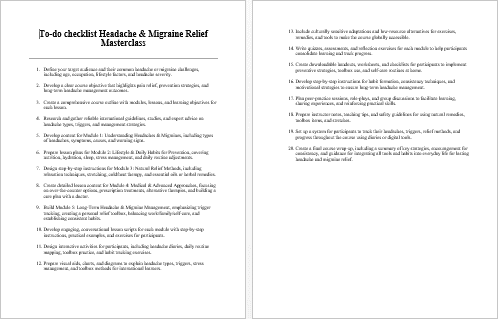
Headache & Migraine Relief Masterclass – Checklist
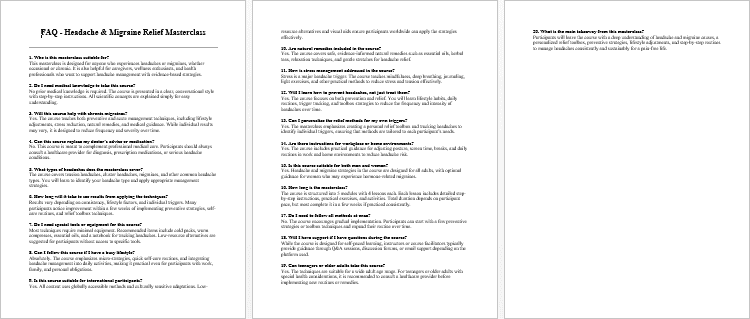
Headache & Migraine Relief Masterclass – FAQs
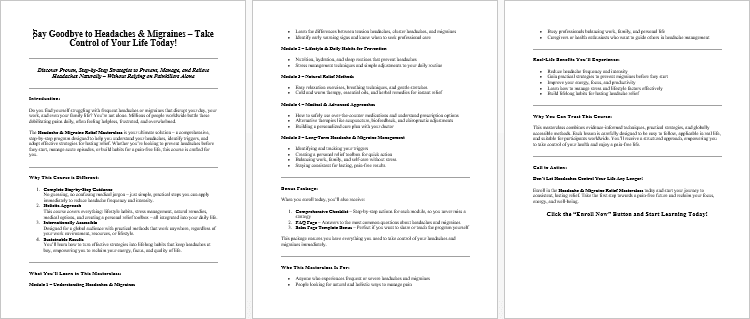
Headache & Migraine Relief Masterclass – Salespage Content
Package Details:
Word Count: 30 233 Words
Number of Pages: 137
Headache & Migraine Relief Masterclass – Bonus Content
Checklist
Word Count: 412 words
FAQs
Word Count: 766 words
Salespage Content
Word Count: 660 words
Total Word Count: 32 071 Words
Your PLR License Terms
PERMISSIONS: What Can You Do With These Materials?
Sell the content basically as it is (with some minor tweaks to make it “yours”).
If you are going to claim copyright to anything created with this content, then you must substantially change at 75% of the content to distinguish yourself from other licensees.
Break up the content into small portions to sell as individual reports for $10-$20 each.
Bundle the content with other existing content to create larger products for $47-$97 each.
Setup your own membership site with the content and generate monthly residual payments!
Take the content and convert it into a multiple-week “eclass” that you charge $297-$497 to access!
Use the content to create a “physical” product that you sell for premium prices!
Convert it to audios, videos, membership site content and more.
Excerpt and / or edit portions of the content to give away for free as blog posts, reports, etc. to use as lead magnets, incentives and more!
Create your own original product from it, set it up at a site and “flip” the site for megabucks!
RESTRICTIONS: What Can’t You Do With These Materials?
To protect the value of these products, you may not pass on the rights to your customers. This means that your customers may not have PLR rights or reprint / resell rights passed on to them.
You may not pass on any kind of licensing (PLR, reprint / resell, etc.) to ANY offer created from ANY PORTION OF this content that would allow additional people to sell or give away any portion of the content contained in this package.
You may not offer 100% commission to affiliates selling your version / copy of this product. The maximum affiliate commission you may pay out for offers created that include parts of this content is 75%.
You are not permitted to give the complete materials away in their current state for free – they must be sold. They must be excerpted and / or edited to be given away, unless otherwise noted. Example: You ARE permitted to excerpt portions of content for blog posts, lead magnets, etc.
You may not add this content to any part of an existing customer order that would not require them to make an additional purchase. (IE You cannot add it to a package, membership site, etc. that customers have ALREADY paid for.)
Share Now!
Latest Products





Free Sales Funnel Builder

Related Products
Popular & Trending



Featured Products