
Golf Made Simple PLR Course 33k Words
in Golf PLR , PLR eCourses , PLR List Building Reports , Premium PLR , Premium PLR Reports , Premium White Label Brandable PLR Coaching Courses , Private Label Rights ProductsChoose Your Desired Option(s)
has been added to your cart!
have been added to your cart!
#golfmadesimple #plrcourse #golftraining #sportscoaching #golftips #plrcontent #sportsmarketing #athletedevelopment #golflife
33,000+ Words of Premium Golf Training Content You Can Brand, Sell, and Profit From
Golf is one of the most popular sports in the world.
Millions of beginners step onto the course every year — excited, curious… and completely overwhelmed.
They don’t understand the rules.
They don’t know which clubs to buy.
They struggle with their swing.
They feel embarrassed about etiquette.
And most beginner golfers quit too early because the learning curve feels intimidating.
That’s where opportunity lives.
Now you can tap into the evergreen golf and sports training niche with a complete, professionally structured course designed specifically for beginners.
Introducing the…
Golf Made Simple PLR Course 33k Words
A Beginner’s Guide to Mastering the Game
This is a comprehensive 33,000+ word PLR training course that takes absolute beginners from confusion to confidence — step-by-step.
It’s structured like a real coaching program.
It’s practical and easy to follow.
And it’s ready for you to customize and sell.
Why This Course Is a Strong Seller
Golf is not just a sport.
It’s a lifestyle.
It’s social.
It’s professional.
It’s competitive.
It’s relaxing.
New golfers are constantly searching for:
- “How to play golf for beginners”
- “How to improve my golf swing”
- “Golf basics explained simply”
- “Golf etiquette for new players”
This course answers those questions in a structured, beginner-friendly way.
It removes intimidation.
It builds skill gradually.
It creates confidence fast.
That makes it highly marketable in the sports, hobby, and recreation niche.
What’s Inside the 33,000+ Word Course
The course is divided into 5 complete modules, each containing 4 focused lessons that build logically from basics to improvement strategy.
This is not random content.
It’s a guided progression.
Module 1: Getting Started with Golf
Build a Solid Foundation Before You Step Onto the Course
Many beginners fail because they skip the fundamentals. This module prevents that.
Lesson 1: Understanding the Game of Golf
Beginners learn what golf is really about — scoring basics, core rules, and how a round flows from start to finish. No confusion. No overwhelm.
Lesson 2: Choosing the Right Equipment
This lesson removes the biggest beginner fear: buying the wrong gear. It explains essential clubs, balls, and accessories — without overspending.
Lesson 3: Golf Course Layout and Etiquette
Learners become familiar with key course areas like tee box, fairway, greens, and bunkers. They also learn simple etiquette rules that earn respect from other players.
Lesson 4: Setting Your Golfing Goals
Why are they playing? For fitness? Fun? Networking? Competition? This lesson helps define clear, realistic goals to keep motivation strong.
By the end of Module 1, beginners feel prepared — not intimidated.
Module 2: Mastering the Fundamentals
Learn the Core Techniques That Make Golf Easier
This module focuses on technique — simplified.
Lesson 1: The Proper Golf Grip
Step-by-step guidance on how to hold the club for control and accuracy. Small adjustments here make massive improvements.
Lesson 2: Stance and Posture
Learners discover how foot placement, knee bend, and body alignment affect consistency.
Lesson 3: The Golf Swing Basics
The swing is broken down into manageable parts:
- Backswing
- Downswing
- Impact
- Follow-through
No jargon. Just clear explanations.
Lesson 4: The Short Game Essentials
Chipping and putting are where most strokes are gained or lost. This lesson introduces the fundamentals early so beginners improve faster.
This module gives learners immediate skill-building confidence.
Module 3: Building Skills and Confidence
Turn Theory Into Real Ability
Now it’s time to refine performance.
Lesson 1: Driving the Ball Off the Tee
Beginners learn how to tee up correctly and develop consistent drives that land in the fairway.
Lesson 2: Iron Shots and Fairway Play
This lesson explains distance control and accuracy when not using a driver.
Lesson 3: Mastering the Short Game (Chipping & Pitching)
Improving touch around the greens dramatically lowers scores. This lesson focuses on control and feel.
Lesson 4: Putting with Confidence
A step-by-step putting practice strategy helps avoid 3-putts and build consistency.
This module transitions learners from “beginner” to “confident player.”
Module 4: Playing the Game
Smart Strategy Beats Raw Power
Skill is important — but strategy wins rounds.
Lesson 1: Course Management Basics
Learners discover how to make smart decisions instead of always swinging for maximum distance.
Lesson 2: Playing Different Lies
How to handle rough, bunkers, and uneven ground with practical techniques.
Lesson 3: Rules and Scoring in Action
A simple walkthrough of keeping score and understanding basic rules during real play.
Lesson 4: Playing Your First Round of Golf
Tips for staying relaxed, enjoying the game, and learning from the experience.
This module prepares beginners for real-world play.
Module 5: Becoming a Better Golfer Every Day
Focus on Long-Term Improvement
This final module ensures consistent growth.
Lesson 1: Smart Practice Strategies
Effective drills and routines that deliver results instead of wasting time.
Lesson 2: Common Beginner Mistakes (and How to Avoid Them)
Spotting errors early prevents bad habits from forming.
Lesson 3: Building Confidence and Mental Strength
Golf is as much mental as physical. Learners develop focus and emotional control.
Lesson 4: Creating Your Personal Golf Improvement Plan
A personalized improvement roadmap ensures steady progress long after the course ends.
By the End of This Course, Beginners Will:
- Understand the rules and flow of golf
- Feel confident stepping onto a course
- Master grip, stance, and swing fundamentals
- Improve short game and putting
- Avoid common beginner mistakes
- Develop a long-term improvement strategy
That makes this product highly attractive to new golfers and hobbyists.
Bonus Materials Included
You also receive:
- Golf Made Simple Checklist (621 Words)
- Golf Made Simple FAQs (912 Words)
- Done-For-You Sales Page (854 Words)
These extras increase perceived value and make launching faster.
How You Can Use and Profit From This PLR Course
This product offers multiple income opportunities.
1. Sell as a Complete Beginner Golf Course
Add branding and minor edits. Sell between $37–$97 as a self-study program.
2. Break It Into Mini Guides
Sell individual modules as focused guides for $10–$20 each.
3. Bundle with Fitness or Sports PLR
Create a sports improvement package priced at $47–$97.
4. Launch a Golf Membership Site
Release lessons weekly and charge $19–$39 per month.
5. Turn It Into a Premium eClass
Add video demonstrations or coaching elements and charge $297–$497.
6. Convert Into Video or Audio Training
Create swing breakdown videos or guided audio lessons for additional product formats.
7. Use as Lead Magnets
Offer “Beginner Golf Mistakes to Avoid” as a free report and upsell the full course.
8. Create a Physical Workbook
Turn it into a printed golf training manual or improvement journal.
9. Build a Niche Golf Authority Site
Create a beginner golf brand, monetize with ads and products, then flip the site.
License Summary
You Can:
- Sell the content with minor tweaks
- Rebrand and customize
- Break into smaller products
- Bundle with other offers
- Convert into audio, video, or physical products
You Cannot:
- Pass PLR or resale rights to customers
- Offer more than 75% affiliate commission
- Give away the complete product for free
- Add it to existing purchases without requiring a new transaction
These restrictions protect the value of your investment.
Why Buy From Buy Quality PLR?
Buy Quality PLR focuses on:
- High-demand hobby and skill niches
- Deep, structured content
- Clear lesson progression
- Real educational value
This isn’t shallow content.
It’s a complete beginner training system that can be positioned as a professional golf learning program.
Turn Passion Into Profit
Golf is growing.
Beginners need guidance.
You can provide the roadmap.
Launch your own golf training brand.
Sell with confidence.
Tap into a global sports niche.
Get the Golf Made Simple PLR Course today and start turning a timeless sport into a powerful income stream.
has been added to your cart!
have been added to your cart!
Here A Sample of the Golf Made Simple PLR Course
Module 1: Getting Started with Golf
Build a solid foundation before even stepping onto the course.
Lesson 1: Understanding the Game of Golf
Learn what golf is really about, from rules to scoring basics, so you never feel lost on the course.
Introduction
Golf is one of the world’s most respected sports, often seen as both a game of leisure and a test of precision, patience, and personal skill. For a beginner, the world of golf can seem confusing at first glance: new terms, unfamiliar scoring systems, and a course layout that feels like a puzzle. But once you understand the essentials, the sport becomes simple, enjoyable, and rewarding.
This lesson will walk you through the core purpose of the game, the basic rules, how scoring works, and the important concepts you need to know before ever swinging a club. By the end, you will feel confident in understanding how golf is played worldwide.
Step 1: What Golf Really Is
At its heart, golf is a sport where the goal is to hit a small ball into a series of holes in as few strokes as possible. Unlike many other sports, golf is played against the course, not directly against an opponent.
- A standard golf course has 18 holes, though some smaller courses offer 9 holes.
- Each hole has a teeing area, where you begin, and a green, where the hole (also called the cup) is located.
- Between the tee and the green lies the fairway, which is the ideal stretch of short grass for hitting shots. There are also rough areas, sand bunkers, and sometimes water hazards that make the game more challenging.
The key challenge of golf is combining physical skill with mental strategy. You must decide how to approach each hole, what club to use, and how much power and accuracy to apply with every swing.
Step 2: The Objective of Golf
The central objective is simple:
- Get the ball from the tee into the hole in as few strokes as possible.
Each swing you take counts as one stroke, whether the ball travels a long distance or barely moves. At the end of a round, you add up your total number of strokes. The player with the fewest strokes wins.
This makes golf unique: success is not measured by who is fastest or strongest but by precision, consistency, and smart decision-making.
Step 3: Basic Structure of a Golf Course
To understand the rules, you need to know the layout:
- Tee Box (Starting Point)
- This is where every hole begins. The ball is placed on a small wooden or plastic peg called a tee. Players hit their first shot here.
- Fairway (The Target Zone)
- This is the stretch of neatly mowed grass leading toward the green. Players aim to keep the ball here for easier shots.
- Rough (The Outer Areas)
- Longer grass surrounding the fairway. Shots from here are harder.
- Hazards (Sand & Water)
- Bunkers (sand traps) and ponds or lakes add challenge. If your ball lands here, you must know special rules for how to continue.
- The Green (Final Target)
- A smooth, short grass area with the hole (marked by a flagstick). This is where putting happens, the final strokes to finish each hole.
Step 4: How Scoring Works in Golf
Scoring is one of the trickiest things for beginners. Let’s simplify:
- Each hole has a par, which is the expected number of strokes it should take to complete that hole.
- For example:
- A par 3 means it should take 3 strokes (one to reach the green, two putts).
- A par 4 means 4 strokes.
- A par 5 means 5 strokes.
Your performance is compared to par:
- Birdie (−1): You complete the hole in one stroke less than par.
- Par (0): You complete the hole in the expected number of strokes.
- Bogey (+1): You take one stroke more than par.
- Double Bogey (+2): Two strokes over par.
- Eagle (−2): Two strokes less than par (rare for beginners).
- Hole-in-One: You hit the ball directly from the tee into the hole in one shot.
When you finish the full round (18 holes), you total up all your strokes. The player with the lowest score is the winner.
Step 5: Understanding Turn-Taking and Play
Golf is typically played in groups of 2 to 4 players. Here’s how play flows:
- Teeing Off: Everyone hits their first shot from the tee box.
- Order of Play: After the tee shot, the person farthest from the hole always plays first.
- Continuing Shots: Each player takes turns until everyone gets their ball into the hole.
- Moving to the Next Hole: Once all players finish, the group moves to the next tee.
Step 6: Rules Every Beginner Should Know
Golf has a long list of official rules, but here are the essentials to get started:
- Play the Ball as It Lies
- You must hit the ball from where it rests, without moving it, unless specific rules allow (such as water hazards or unplayable lies).
- Stay Within Bounds
- If your ball goes out of bounds (marked by white stakes or lines), you must replay the shot with a penalty stroke.
- Hazard Rules
- If the ball lands in water or a bunker, there are special relief options, usually costing penalty strokes.
- Tee Box Rules
- You must tee off from between the designated markers, not in front of them.
- Counting Every Stroke
- Every swing counts, whether or not the ball moves. Even if you barely touch the ball, it’s a stroke.
Step 7: Golf Etiquette – The Unwritten Rules
Golf is as much about respect and tradition as it is about competition. Knowing etiquette helps you fit in anywhere:
- Silence While Others Play: Don’t talk or move when another player is swinging.
- Pace of Play: Move at a steady speed; don’t hold up others behind you.
- Repairing the Course: Fix any damage you make, such as filling divots or smoothing bunkers.
- Respect for Others: Shake hands at the end of a round, congratulate good shots, and keep a positive spirit.
These courtesies are recognized worldwide and make you a welcome player at any course.
Step 8: How to Keep Score
Keeping score is simple once you get the hang of it:
- Each hole has a box on the scorecard.
- Write down the number of strokes it took you to complete that hole.
- At the end of the round, total your strokes for all holes.
- Compare to par:
- If the course is a par 72 and you shot 90 strokes, you are 18 over par.
- If you shot 70, you are 2 under par.
This allows you to track progress over time, even when you are playing casually.
Step 9: Match Play vs. Stroke Play
There are two main ways golf is scored in competition:
- Stroke Play (Most Common):
- Every stroke counts. The lowest total after 18 holes wins.
- Match Play (Head-to-Head):
- Each hole is a separate contest. Whoever takes fewer strokes wins that hole. The match is decided by who wins the most holes.
For beginners, casual rounds are almost always stroke play.
Step 10: Why Golf Is Unique
Golf is unlike many sports because:
- You don’t need equal opponents. Beginners can enjoy playing with experts because everyone focuses on their own score.
- Age and physical fitness are less limiting compared to other sports. Many people play golf well into their senior years.
- It’s both a social game and a solitary challenge—you can play with others or practice alone.
- The variety of courses worldwide means every game is a fresh experience.
Step 11: Key Terms Every Beginner Should Know
To feel comfortable, here are some common terms:
- Tee Shot: First shot on a hole.
- Fairway: Short grass between tee and green.
- Green: Area around the hole with short grass for putting.
- Putt: Gentle stroke on the green.
- Chip: Short shot close to the green.
- Drive: Long shot from the tee, usually with a driver club.
- Handicap: A scoring system that evens competition between players of different skill levels.
Step 12: Building Confidence Before Playing
The goal of this lesson is not to overwhelm you but to give you confidence. When you understand the structure, rules, and scoring, the game feels far less intimidating. Even without perfect swings yet, you’ll feel prepared to step onto a course and follow along naturally.
Remember: golf is about progress, not perfection. Even the best players in the world once started by learning the basics of the game.
Conclusion
Golf, at its core, is a simple yet endlessly fascinating game: get the ball into the hole in as few strokes as possible. By understanding the layout of the course, the purpose of par, the basics of scoring, the key rules, and the importance of etiquette, you now have the foundation to step into the golfing world with confidence.
This knowledge is the first step toward mastering not just the techniques of golf but also its culture, tradition, and universal appeal.
Lesson 2 — Choosing the Right Equipment
Discover the essential clubs, balls, and gear you actually need as a beginner (no need to overspend!).
Introduction
Choosing golf equipment as a beginner can feel overwhelming: dozens of club models, confusing technical terms, and salespeople who push premium gear. The good news is that beginners rarely need the full premium setup to improve. This lesson gives international course creators a clear, step-by-step guide to help students choose practical, cost-effective gear that accelerates learning and enjoyment. Wherever your students are in the world, these principles apply.
Step 1 — Know the basic rules about club possession and categories
- The 14-club rule: A player may carry no more than 14 clubs during a round. This is global and essential to planning a beginner’s kit.
- Categories of clubs: Understand the role of each group so you can explain them simply:
- Driver and fairway woods — for maximum distance off the tee and occasional long shots from the fairway.
- Hybrids — versatile replacements for long irons; easier to hit for most beginners.
- Irons (numbered 3–9) — used for a variety of approach shots; higher number = higher loft = shorter distance.
- Wedges (PW, SW, GW/LW) — specialized short game clubs for chips, pitches and bunker shots.
- Putter — for strokes on the green; arguably the most important club for scoring.
Use this framework to design a simplified starter set.
Step 2 — Choose a simple, effective starter set (recommended minimum)
Beginners benefit from a compact, forgiving set that encourages practice of fundamentals. A recommended starter lineup that fits within the 14-club limit:
- Driver (optional for absolute beginners — some start with a 3-wood or hybrid) — long distance off the tee.
- 3-wood or 5-wood or 3-hybrid — long fairway shots and off-the-tee backup.
- 4-hybrid — bridges the gap between woods and mid-irons.
- 5-iron or 6-iron — easier to hit if using hybrids above; choose the iron that fits the player’s comfort.
- 7-iron — a go-to mid iron for learning control.
- 9-iron — short iron for approach shots.
- Pitching wedge (PW) — standard wedge for approach and short play.
- Sand wedge (SW) — essential for bunker play and short recovery shots.
- Putter — choose a model that feels comfortable on the green.
That’s 8–9 clubs — plenty for learning. Keep slot space for an extra wedge or an additional hybrid if desired. Emphasize that a smaller number of forgiving clubs helps beginners focus on fundamentals rather than complicated club selection.
Step 3 — Understand club features that matter most for beginners
When comparing models, guide students to focus on these features rather than marketing buzzwords:
- Forgiveness: Look for cavity-back irons and hybrids with larger sweet spots to reduce the penalty for off-center strikes.
- Loft and gap consistency: Clubs should have predictable loft progression so students can learn distance control.
- Shaft flex: Choose a flex that suits swing speed. Common designations are L (Ladies), A (Senior/Soft), R (Regular), S (Stiff), X (Extra Stiff). If uncertain, default to Regular for most adult beginners.
- Club length and lie angle: Proper length and lie help with consistent contact and direction. Beginners often play standard lengths but benefit from a basic fitting check.
- Grip size and condition: Comfortable grip thickness aids control. Old or slippery grips should be replaced.
Course creators should encourage students to test feel more than brand prestige.
Step 4 — The importance of trying before buying (demo and rental options)
- Demo clubs: Most pro shops and retailers allow testing of driver and irons. Advise students to hit a few shots with different shafts and head sizes to feel the difference.
- Rental sets and course hire: For a first few lessons or a first round, rental clubs are perfect. They remove expense and let students try different styles.
- Buy used or “demo” sets: High quality used clubs or demo models are excellent cost-savers. Ensure shafts and grips are in good condition.
For international courses, include a note: if students are traveling, rental clubs at the course avoid airline hassles.
Step 5 — Fundamentals of the golf ball: what beginners need to know
- Two-piece vs multi-layer: Two-piece balls are durable and designed for distance—ideal for beginners. Multi-layer “tour” balls favor spin and control but are more expensive. Beginners should start with two-piece distance balls.
- Compression and feel: Higher compression suits faster swing speeds; beginners with moderate swing speeds benefit from lower to medium compression. Don’t over-complicate—select a ball labeled for distance and durability.
- Visibility: Brightly colored balls (yellow, orange) or ones with high-contrast markings help locate shots and speed up play.
- Cost consideration: Lost ball frequency is common when learning. Recommend affordable balls to reduce stress about losing them.
Step 6 — Essential accessories every beginner needs
Keep the accessory list short and practical:
- Tees: Bring a mix of heights to suit driver vs irons.
- Golf glove: Improves grip and prevents blisters—one for the dominant hand (left hand for right-handed players, and vice versa).
- Golf shoes: Choose comfortable spiked or spikeless shoes with good traction. Spikeless are more universal and double as casual wear.
- Golf bag: Cart bag for players using a buggy; stand bag for walking. Lightweight carry bags are ideal for beginners who want to walk.
- Towel, divot tool, ball marker: Basic course maintenance items and etiquette.
- Umbrella and rain gear: Essential in many climates—teach preparedness.
- Rangefinder or GPS (optional): Helpful for distance, but not required initially.
Course creators should emphasize functional gear over aesthetic or brand choices.
Step 7 — Practice aids that help beginners improve fast
Introduce low-cost, high-impact aids:
- Alignment sticks: Teach aim and swing path.
- Putting mat or mirror: Improves stroke mechanics at home.
- Chipping net or target: Builds short-game confidence.
- Swing trainer (basic): For tempo and wrist hinge practice.
Recommend only one or two aids at first so students don’t get distracted from core practice.
Step 8 — Fitting — how much is necessary early on?
- Basic fitting: Even a short static fitting—checking height, wrist-to-floor measurement and dominant hand—helps select correct club length and grip size.
- Full dynamic fitting: Best reserved until the student plays regularly (3–6 months). It measures swing speed, launch angle, and optimal shaft flex/length.
- Practical approach: Encourage a short fitting session for the driver or a driver demo day, and a basic check for irons. Investing in one good fitting can prevent frustration and wasted expense.
Step 9 — Buying tips and budget strategy
- Prioritize spending: Spend more on the putter and a forgiving driver; save on irons by buying quality used sets.
- Avoid cheapest complete sets: Ultra-cheap sets often have poor loft spacing and low durability. Instead, build a minimal set with targeted purchases.
- Second-hand market: Local pro shops, reputable online marketplaces and demo sales are great sources—inspect shafts, heads and grips.
- Seasonal sales and trade-in programs: Encourage students to trade up when their swing improves rather than buying everything at once.
Step 10 — Maintenance and longevity
Teach simple care routines:
- Clean club heads after each round to prevent build-up.
- Wipe grips dry and replace when worn.
- Check ferrules and shafts for cracks after travel.
- Store clubs indoors in a dry place to protect grips and shafts.
- Regrip frequency: Typically every 12–24 months depending on play — inexpensive and transformational.
Good maintenance preserves performance and resale value.
Step 11 — Special considerations for diverse students
- Left-hand and junior players: Many equipment lines support left-hand setups and junior lengths—ensure your course materials mention these options.
- Smaller or larger body types: Shorter players may benefit from shorter shafts and differently lofted clubs; seniors may prefer lighter shafts.
- Adaptive and accessible equipment: There are options for players with mobility differences—be familiar with alternatives and local suppliers.
As an international course creator, include these options in student onboarding.
Summary checklist for beginners (quick reference)
- Start with a compact set: driver (or 3-wood), a couple of hybrids, 5–9 irons, PW, SW, putter.
- Keep total clubs ≤ 14; 8–10 for beginners is ideal.
- Choose forgiving, cavity-back irons and hybrids.
- Pick affordable two-piece balls to start.
- Buy one comfortable putter and test it on a green.
- Use demo/rental clubs before committing.
- Invest in a basic fitting for length and shaft flex if possible.
- Carry essential accessories: tees, glove, towel, divot tool, and a spare ball.
- Start with simple practice aids: alignment stick and putting mat.
- Maintain clubs and replace grips when worn.
Closing thought
For beginners, the smartest strategy is to keep equipment simple, comfortable and forgiving. Teach students to prioritize learning the swing and short game rather than chasing equipment “fixes.” A small, well-chosen set, sensible ball choice, and a couple of practical accessories will take a new player a long way — and save money and frustration along the learning curve.
This lesson equips you, as an international course creator, to advise students confidently and consistently regardless of their local market or budget.
Lesson 3: Golf Course Layout and Etiquette
Get comfortable with golf course terms (tee box, fairway, green, bunkers) and learn simple etiquette that earns respect from other players.
Introduction
Every golfer, whether beginner or advanced, plays the game in the same arena: the golf course. Unlike many sports where the playing field is identical, golf courses are all unique. No two courses are the same in design, shape, or challenge. This makes learning the layout essential for beginners.
Equally important is golf etiquette—the unwritten rules and traditions that make the game enjoyable for everyone. Golf is a sport rooted in respect: respect for the course, respect for fellow players, and respect for the game itself.
In this lesson, we will break down both the physical layout of a golf course and the etiquette practices that help you fit right in, even as a beginner.
Step 1: Understanding the Basic Layout of a Golf Course
A standard golf course is made up of 18 holes (though some beginner-friendly courses may have 9). Each hole is a mini challenge, and understanding its key parts is the first step toward feeling confident on the course.
1. The Tee Box
- This is the starting point for each hole.
- Marked by two tee markers, you must place your ball between them and no more than two club lengths behind.
- Tee boxes can come in multiple sets: championship, men’s, women’s, or junior tees. As a beginner, always start from the forward tees to make the game easier and more fun.
2. The Fairway
- The short-mown grass strip that leads from the tee box to the green.
- The goal after your tee shot is to land the ball here, as it provides the cleanest surface to hit your next shot.
- Some fairways are straight, others curve left (called a dogleg left) or right (dogleg right).
3. The Rough
- Areas with longer grass bordering the fairway.
- Shots from the rough are harder to control, so accuracy is rewarded in golf.
4. Hazards
- Golf courses are designed with obstacles. These include:
- Bunkers (sand traps): sandy areas often near greens or fairways.
- Water hazards: lakes, ponds, or streams.
- Natural features: trees, bushes, or rocky areas.
- Hazards challenge golfers to think strategically instead of always swinging for power.
5. The Green
- A smooth, closely mowed area at the end of each hole where the flagstick (pin) and hole are located.
- Putting takes place here. Greens vary in size, slope, and speed, which makes them both exciting and challenging.
6. The Hole and Flagstick
- The actual cup is 10.8 cm (4.25 inches) in diameter.
- A flagstick marks its location, helping golfers aim from far away.
7. Par and Scoring Basics
- Each hole is assigned a par, the number of strokes a skilled golfer is expected to need.
- Par 3: Short hole, usually one shot to the green and two putts.
- Par 4: Medium length, usually two shots to reach the green.
- Par 5: Long hole, usually three shots to reach the green.
- Your score is based on how many strokes you take relative to par. For example:
- Par = expected strokes.
- Birdie = one under par.
- Bogey = one over par.
- Double Bogey = two over par.
Step 2: Learning Course Flow
A round of golf moves in a structured way:
- Start at Hole 1 Tee Box: Begin play from the designated tee.
- Play through the Fairway: Progress toward the green, stroke by stroke.
- Reach the Green: Switch from full swings to putting.
- Complete the Hole: Sink the ball into the cup.
- Move to Next Hole: Follow the signage and course path.
This flow repeats until you finish all 18 holes.
Step 3: Core Principles of Golf Etiquette
Golf is unique because there are no referees on the course. Players are expected to self-regulate by following etiquette. Mastering this will instantly make you a respected golfer.
1. Respect for Other Players
- Silence during shots: Never talk, move, or make distracting noises when someone is swinging or putting.
- Play in turn: Traditionally, the player farthest from the hole hits first. In casual play, you can use “ready golf”—hit when you are ready and it is safe.
- Be mindful of pace: Play at a steady rhythm to avoid slowing down others behind you.
2. Respect for the Course
- Replace divots: When your swing takes out a chunk of turf, put it back and press it down.
- Rake bunkers: After playing from the sand, smooth it with the rake provided.
- Repair ball marks: Use a repair tool to fix indentations on the green where your ball landed.
- Avoid damaging greens: Never drag clubs or stand too close to the hole.
3. Safety Etiquette
- Shout “Fore!”: If your ball is heading toward another player, call out this warning.
- Stay aware: Never hit when someone is in front of you within range.
- Check surroundings: Ensure your swing will not accidentally hit someone.
4. General Courtesies
- Dress appropriately: Many courses have dress codes (collared shirts, proper shoes).
- Keep carts on paths: Follow cart rules to avoid damaging turf.
- Leave the course better than you found it: Always clean up after yourself.
Step 4: Step-by-Step Guide to Practicing Etiquette
Here’s a simple framework to internalize etiquette from day one:
- On the Tee Box
- Stand behind or beside the player hitting, never in their line of vision.
- Wait for your turn and avoid practice swings that distract others.
- Be ready when it’s your shot to keep pace.
- On the Fairway
- Walk briskly to your ball.
- Plan your shot while others are hitting so you’re ready.
- If searching for a lost ball, allow faster groups to play through.
- In Bunkers
- Enter from the low side to avoid damaging the edges.
- Play your shot, then rake smooth the sand as you exit.
- On the Green
- Place your bag or cart on the side nearest the next tee.
- Do not step on another player’s putting line.
- Mark your ball with a coin-sized marker if it interferes with another’s putt.
- Stand quietly and out of sight lines when others putt.
- Once everyone finishes, move promptly to the next hole.
Step 5: Common Beginner Mistakes to Avoid
- Talking during shots: Even a whisper can throw off concentration.
- Standing too close: Always stay behind or off to the side.
- Taking too long: Overthinking slows the game; trust your swing.
- Forgetting to repair damage: Leaving divots or ball marks creates frustration for others.
- Ignoring cart rules: Driving too close to greens or bunkers damages sensitive areas.
Step 6: Building Confidence on the Course
At first, remembering all these details may feel overwhelming. The key is to internalize small habits:
- Always watch where your ball goes.
- Stay aware of your surroundings.
- Respect the quiet and pace of others.
- Make it a routine to fix the course after your shot.
By repeating these practices, you’ll naturally fit into the rhythm of the game.
Conclusion
Understanding golf course layout and etiquette is like learning the language of the game. Once you know the terms—tee box, fairway, rough, green, bunker—you can navigate any course with confidence. And by practicing etiquette—respect for players, respect for the course, and respect for the game—you immediately stand out as someone who belongs.
This lesson lays the groundwork for enjoyable, respectful, and stress-free play. With these basics in place, every round you play will feel more natural, and you’ll quickly gain the confidence to focus on developing your skills.
Lesson 4 — Setting Your Golfing Goals
Define why you’re learning golf (fun, fitness, socializing, competition) and set realistic, beginner-friendly goals.
Introduction
Goals give learning direction. Without clear goals, practice becomes unfocused and progress slows. For new golfers, goal-setting is especially powerful because small, measurable wins build confidence and keep students engaged. This lesson teaches international course creators how to lead learners through a simple, practical goal-setting process that matches motivation (fun, fitness, social, competition) to realistic, beginner-friendly targets. The approach is universal, adaptable to different cultures and facilities, and keeps the emphasis on steady progress rather than instant results.
Step 1 — Start with “Why?”: discovering each student’s motivation
Begin every session by helping students articulate why they want to play golf. Use short prompts to guide the conversation and make this a standard onboarding exercise.
Common motivations and teaching focus:
- Fun & Leisure
- Wants relaxed rounds, enjoyment, and social time.
- Emphasize ease, pace of play, and basic course comfort.
- Fitness & Wellbeing
- Wants walking rounds, core strength, and low-impact exercise.
- Emphasize walking, conditioning, simple drills that increase mobility.
- Social & Networking
- Wants to meet people, join groups, or play casual business rounds.
- Emphasize etiquette, basic consistent play, and confidence on the first tee.
- Competition & Improvement
- Wants to lower scores, enter club events or earn a handicap.
- Emphasize measurable performance metrics and structured practice.
Ask each student to choose one primary reason and one secondary reason. Record these reasons — they will shape the goals you create together.
Step 2 — Explain goal types: outcome, performance, and process
Teach students the three goal categories and why process and performance goals matter more for beginners.
- Outcome goals: End results (e.g., shoot under 90). Outcome is important but can be discouraging early on because it depends on many variables.
- Performance goals: Personal measures not dependent on others (e.g., hit fairway on 50% of tee shots). These are motivating and measurable.
- Process goals: Daily or weekly actions (e.g., practice putting 20 minutes three times a week). These drive improvement and are under the player’s control.
As an instructor, prioritize process + performance goals for beginners and treat outcome goals as longer-term targets.
Step 3 — Use SMART to make goals realistic and clear
Introduce the SMART framework (Specific, Measurable, Achievable, Relevant, Time-bound) and model examples for each motivation.
Examples:
- Fun: “Play a 9-hole round from the forward tees without feeling rushed within 6 weeks.”
- Fitness: “Walk and carry a 9-hole round twice a week for one month to build endurance.”
- Social: “Attend one club social round within 8 weeks and introduce myself to three other players.”
- Competition: “Reduce average putts per hole from 2.8 to 2.2 in 12 weeks and enter one club novice competition.”
Work with each student to rewrite raw wishes into SMART goals. Insist on measurable terms and a clear timeline.
Step 4 — Break big goals into bite-sized milestones
Large goals feel daunting; breaking them down makes progress visible.
Example: Competitive aim — “Shoot a consistent 90 by 12 weeks.”
Micro-goals:
- Week 1–2: Master a 60-second pre-shot routine and practice 50 controlled wedge swings.
- Week 3–4: Achieve 8/10 up-and-downs from 15 m range on the practice area.
- Week 5–8: Reduce three-putts per round to zero in practice rounds.
- Week 9–12: Play two 9-hole rounds under timed conditions aiming for par + 6 on each hole.
For leisure or social players, milestones focus on comfort: first comfortable tee shot, completing nine holes, regular club attendance.
Step 5 — Build a practical practice plan tied to goals
Create a weekly template that links directly to the process goals. Make it compact so students can follow it consistently.
Sample 6-week plan (three sessions per week):
- Session A — Full swing & driving (45 minutes)
- Warm-up (5 minutes), 30 minutes of targeted driving/long-iron work, 10 minutes cool-down and reflection.
- Session B — Short game focus (45 minutes)
- 10 minutes putting drill, 20 minutes chipping/pitching practice, 10 minutes bunker practice, 5 minutes review.
- Session C — Play/practice hybrid (60 minutes)
- Play 3–6 holes focusing on course management; keep score and note three things to improve.
Include a short daily 10-minute habit (putting or alignment) that keeps momentum even on busy days.
Step 6 — Track progress with simple metrics
For beginners, keep metrics uncomplicated and visual. Provide a one-page tracking sheet or template.
Useful beginner metrics:
- Balls struck cleanly: e.g., 20/30 strike quality.
- Putting from 3 m: success rate per session.
- Up-and-down percentage from around the green.
- Fairways hit (for driver users).
- Putts per hole in practice rounds.
- Rounds completed and emotional rating (enjoyment 1–10).
Encourage students to maintain a short practice log: date, time, focus, one success, one improvement area.
Step 7 — Build mental and routine goals
Golf is mental. Include goals that strengthen habits and confidence.
Examples:
- Establish a pre-shot routine: the same 45–60 seconds to prepare for each shot.
- Practice controlled breathing: three slow breaths before addressing the ball.
- Set resilience goals: after a bad shot, practice a “bounce-back” routine—take one deep breath, select a short process goal, and execute.
These process goals improve decision-making and reduce negative emotions during play.
Step 8 — Customize goals by player profile
Provide tailored examples for each motivation category.
- Fun-seekers: Goal — “Play one casual 9-hole round per week and reduce anxiety by practicing one relaxation technique.”
- Fitness-focused: Goal — “Walk 9 holes carrying a bag 3 times per week for 8 weeks; track heart-rate or perceived exertion.”
- Social players: Goal — “Attend three group sessions and exchange contact details with at least two new players.”
- Competitive beginners: Goal — “Complete 3 structured practice sessions weekly and enter a novice competition within 12 weeks.”
Emphasize that small, consistent steps are better than occasional marathon sessions.
Step 9 — Accountability and review
Accountability increases follow-through. Offer options:
- Buddy system: pair students so they check in weekly.
- Group milestones: celebrate collective achievements in class to boost morale.
- Video review: have students record a practice session monthly to visually track improvement.
- Instructor checkpoints: schedule brief 15-minute check-ins at weeks 4 and 8 to adjust goals.
Teach students to reflect: What worked? What felt hard? How will the next week change?
Step 10 — Assessment rubric for course creators
Use this simple three-level rubric to assess beginner progress:
- Foundational (week 0–4)
- Can explain main goal(s), follow a basic practice plan, and demonstrate one reliable routine (e.g., putting warm-up).
- Developing (week 5–8)
- Shows measurable improvement in 1–2 metrics, completes practice sessions reliably, and plays a short practice round confidently.
- Competent (week 9–12)
- Consistently meets process goals, shows performance gains on tracked metrics, and participates in a social or competitive round.
Provide written feedback and one actionable next-step after each assessment.
Closing guidance for instructors
- Keep goals student-centered: they must be meaningful to the learner.
- Emphasize process over perfection. Early wins are about forming useful habits.
- Be flexible: revisit and adjust goals frequently, especially after two to four weeks.
- Celebrate progress publicly—small achievements build confidence and community.
Use this lesson as a structured, repeatable module for new groups. With clear motivation, SMART goals, weekly practice templates, and simple tracking, students will feel purposeful, see measurable gains, and most importantly, enjoy the game.
We’re also giving these extra bonuses
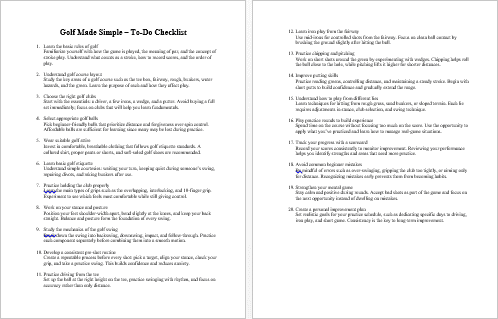
Golf Made Simple – Checklist
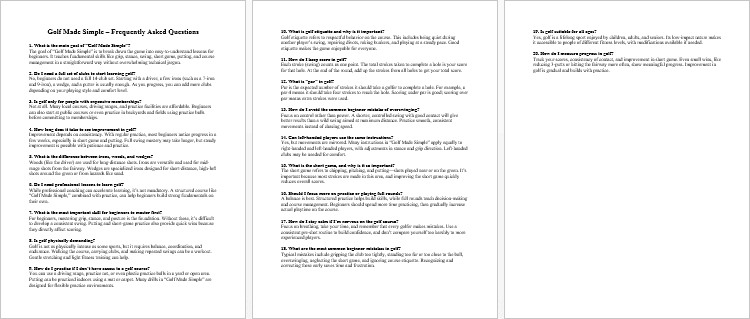
Golf Made Simple – FAQs
Golf Made Simple – Salespage Content
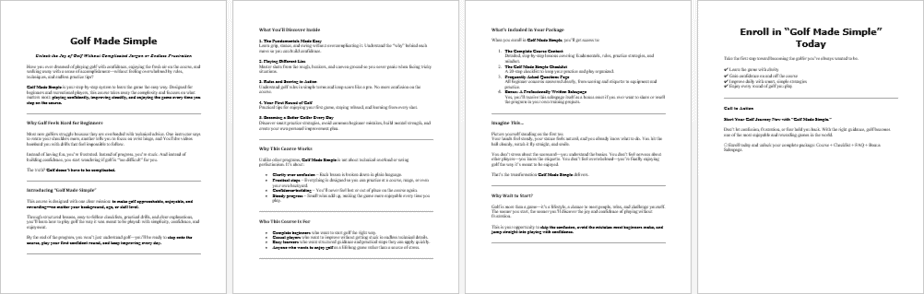
Package Details:
Word Count: 31 423 Words
Number of Pages: 124
Golf Made Simple – Bonus Content
Checklist
Word Count: 621 words
FAQs
Word Count: 912 words
Salespage Content
Word Count: 854 words
Total Word Count: 33 810 Words
Your PLR License Terms
PERMISSIONS: What Can You Do With These Materials?
Sell the content basically as it is (with some minor tweaks to make it “yours”).
If you are going to claim copyright to anything created with this content, then you must substantially change at 75% of the content to distinguish yourself from other licensees.
Break up the content into small portions to sell as individual reports for $10-$20 each.
Bundle the content with other existing content to create larger products for $47-$97 each.
Setup your own membership site with the content and generate monthly residual payments!
Take the content and convert it into a multiple-week “eclass” that you charge $297-$497 to access!
Use the content to create a “physical” product that you sell for premium prices!
Convert it to audios, videos, membership site content and more.
Excerpt and / or edit portions of the content to give away for free as blog posts, reports, etc. to use as lead magnets, incentives and more!
Create your own original product from it, set it up at a site and “flip” the site for megabucks!
RESTRICTIONS: What Can’t You Do With These Materials?
To protect the value of these products, you may not pass on the rights to your customers. This means that your customers may not have PLR rights or reprint / resell rights passed on to them.
You may not pass on any kind of licensing (PLR, reprint / resell, etc.) to ANY offer created from ANY PORTION OF this content that would allow additional people to sell or give away any portion of the content contained in this package.
You may not offer 100% commission to affiliates selling your version / copy of this product. The maximum affiliate commission you may pay out for offers created that include parts of this content is 75%.
You are not permitted to give the complete materials away in their current state for free – they must be sold. They must be excerpted and / or edited to be given away, unless otherwise noted. Example: You ARE permitted to excerpt portions of content for blog posts, lead magnets, etc.
You may not add this content to any part of an existing customer order that would not require them to make an additional purchase. (IE You cannot add it to a package, membership site, etc. that customers have ALREADY paid for.)
Share Now!
Latest Products
Free Sales Funnel Builder

Related Products

Popular & Trending


Featured Products