
Get Promoted at Work PLR Course 34k Words
in Business PLR , PLR eCourses , PLR List Building Reports , Premium PLR , Premium PLR Reports , Premium White Label Brandable PLR Coaching Courses , Private Label Rights ProductsChoose Your Desired Option(s)
has been added to your cart!
have been added to your cart!
#getpromotedatwork #plrcourse #careersuccess #professionalgrowth #workplaceskills #careercoaching #plrcontent #leadershipskills #successmindset
34,000+ Words of Premium Career Advancement Content You Can Brand, Sell, and Profit From
Everyone wants to move up.
Higher salary.
More responsibility.
Greater recognition.
Stronger job security.
But most employees don’t know how to position themselves for promotion.
They work hard… yet stay invisible.
They deliver results… yet get overlooked.
They wait for recognition… that never comes.
This creates frustration — and massive demand for guidance.
Now you can step into this evergreen, high-demand niche with a complete, professionally structured PLR course designed to help professionals advance their careers with confidence.
Introducing the…
Get Promoted at Work PLR Course 34k Words
Proven Steps to Advance Your Career
This is a comprehensive 34,000+ word PLR course that provides a clear, actionable roadmap for earning promotions and building long-term career success.
It’s structured like a real training program.
It’s designed for real results.
And it’s ready for you to customize and sell.
Why This Course Is a Powerful Seller
Career advancement is a universal desire.
Your potential customers include:
- Corporate employees
- Mid-level managers
- Ambitious graduates
- Professionals stuck in the same role
- Career changers seeking upward movement
They’re actively searching for:
- “How to get promoted faster”
- “How to stand out at work”
- “How to ask for a promotion”
- “How to build leadership skills”
This course answers those questions step-by-step.
It moves learners from mindset to strategy to execution — covering everything needed to earn a promotion successfully.
What’s Inside the 34,000+ Word Course
The course is divided into 5 comprehensive modules, each containing 4 focused lessons. The progression is logical and practical — starting with mindset and ending with long-term leadership growth.
Module 1: Mindset for Promotion
Think Like a High-Performer
Before someone gets promoted, they must think like someone who deserves it.
Lesson 1: Understanding Your Career Goals
Learners clarify what “promotion” truly means to them. Is it more money? Leadership? Influence? Responsibility? They define both short-term and long-term career objectives.
Lesson 2: Cultivating a Growth Mindset
Promotion-ready professionals embrace feedback, challenges, and continuous learning. This lesson helps learners shift from fixed thinking to growth-oriented habits.
Lesson 3: Overcoming Limiting Beliefs
Self-doubt quietly sabotages career growth. This lesson teaches how to replace negative internal dialogue with confidence-building habits.
Lesson 4: Visualizing Success
Visualization techniques help maintain focus, motivation, and long-term clarity. Learners mentally rehearse success to build real-world confidence.
By the end of Module 1, learners are mentally prepared to pursue advancement.
Module 2: Building Exceptional Skills
Become Indispensable at Work
Hard work alone doesn’t earn promotions — value does.
Lesson 1: Identifying High-Impact Skills
Learners discover which skills their managers value most. They align development efforts with organizational needs.
Lesson 2: Mastering Core Competencies
This lesson teaches practical methods to improve performance quickly in their current role. Excellence becomes visible.
Lesson 3: Soft Skills That Matter
Communication, collaboration, problem-solving, and emotional intelligence separate average employees from top performers.
Lesson 4: Continuous Learning Plan
Learners build a personalized development roadmap that keeps them promotion-ready long term.
This module positions learners as reliable, high-impact professionals.
Module 3: Visibility and Influence
Get Noticed for the Right Reasons
Skill without visibility equals stagnation.
This module teaches how to stand out professionally — without arrogance.
Lesson 1: Building Your Personal Brand
Learners position themselves as competent, dependable, and forward-thinking team members.
Lesson 2: Networking Internally
Strong internal relationships matter. This lesson shows how to build authentic connections with decision-makers and influencers.
Lesson 3: Showcasing Your Achievements
Many professionals fail to communicate their accomplishments effectively. This lesson teaches how to highlight results confidently and professionally.
Lesson 4: Mentoring and Supporting Others
Leadership potential becomes visible when employees mentor peers and support team growth.
This module dramatically increases the perceived value of the course because it addresses one of the biggest promotion barriers: invisibility.
Module 4: Strategic Career Moves
Position Yourself Intentionally
Promotions rarely happen by accident.
Lesson 1: Understanding Organizational Priorities
Learners discover how to align their efforts with company goals and strategic initiatives.
Lesson 2: Taking Initiative
Going beyond job descriptions creates visibility and trust. This lesson helps learners identify high-impact opportunities.
Lesson 3: Requesting Feedback Effectively
Instead of fearing feedback, learners use it strategically to demonstrate growth and professionalism.
Lesson 4: Timing Your Promotion Ask
Perhaps the most valuable lesson — how and when to discuss promotion confidently with a manager.
This module alone makes the course highly attractive because it directly addresses the moment employees fear most: asking for advancement.
Module 5: Leadership and Long-Term Career Growth
Prepare for the Next Level
Promotion is not the end — it’s the beginning.
Lesson 1: Developing Leadership Qualities
Decision-making, accountability, mentoring, and strategic thinking are explored in depth.
Lesson 2: Managing Up and Across
Learners discover how to build strong relationships with managers and peers to increase influence.
Lesson 3: Planning for Career Transitions
Strategic positioning for lateral moves, bigger promotions, or new departments.
Lesson 4: Sustaining Growth Over Time
A long-term career roadmap ensures continuous advancement and professional fulfillment.
This final module positions learners not just for one promotion — but for ongoing career growth.
By the End of This Course, Learners Will Have:
- Clear career goals
- Stronger professional confidence
- High-impact, promotion-ready skills
- Improved workplace visibility
- Strategic action steps to earn advancement
- Leadership habits for long-term growth
This makes the product appealing to a wide professional audience.
Bonus Materials Included
You also receive:
- Get Promoted at Work Checklist (487 Words)
- Get Promoted at Work FAQs (734 Words)
- Done-For-You Sales Page (807 Words)
These assets allow you to launch faster and enhance perceived value.
Multiple Ways to Use and Profit From This Course
This PLR package offers enormous flexibility.
1. Sell It as a Complete Digital Course
Add branding and minor edits. Price it between $47–$97 as a self-study promotion program.
2. Break It Into Mini Reports
Turn each module into individual guides and sell for $10–$20 each.
3. Create a Career Advancement Bundle
Combine with productivity or leadership PLR and sell for $47–$97.
4. Launch a Career Membership Site
Release modules monthly and charge $19–$39 per month for recurring income.
5. Create a Multi-Week Coaching eClass
Add live sessions or accountability components and charge $297–$497.
6. Convert to Video or Audio
Turn lessons into professional video training or audiobook products.
7. Use as a Lead Magnet Funnel
Offer a free report like “5 Mistakes That Block Promotions” and upsell the full course.
8. Create a Physical Workbook
Develop a printed planner or career success workbook for premium pricing.
9. Build a Career Brand and Flip It
Create an authority site focused on career advancement and sell it as a profitable asset.
License Overview
You Can:
- Sell the content with minor tweaks
- Rebrand and customize
- Break into smaller products
- Bundle with other offers
- Convert to audio, video, or physical formats
You Cannot:
- Pass PLR or resale rights to customers
- Offer more than 75% affiliate commission
- Give away the complete product for free
- Add it to existing purchases without requiring an additional transaction
These restrictions protect the value of your investment.
Why Buy From Buy Quality PLR?
Buy Quality PLR focuses on:
- High-demand professional niches
- Deep, structured, actionable content
- High word counts with real substance
- Products designed for serious marketers
This is not surface-level advice.
It’s a complete career advancement framework your audience can implement immediately.
Turn Ambition Into Income
Employees want promotions.
Professionals want growth.
Managers want advancement.
You can provide the roadmap.
Launch faster.
Sell smarter.
Build authority in the career development niche.
Get the Get Promoted at Work PLR Course today and turn professional ambition into predictable profits.
has been added to your cart!
have been added to your cart!
Here A Sample of the Get Promoted at Work PLR Course
Module 1: Mindset for Promotion
Learn how to think like a high-performer and position yourself for career growth.
Lesson 1: Understanding Your Career Goals
Promotion and career advancement do not happen by accident. They require intention, clarity, and strategic planning. The first and most crucial step in positioning yourself for promotion is understanding your career goals. Without knowing exactly where you want to go, you risk wandering aimlessly in your career, waiting for opportunities that may never align with your aspirations. This lesson is about helping you define what promotion truly means for you, understand your career objectives, and create a clear, actionable roadmap that sets the foundation for long-term success.
Why Understanding Your Career Goals Matters
Career goals act as a compass. They give direction, help prioritize tasks, and provide clarity on which opportunities to pursue and which to avoid. Many professionals struggle to get promoted not because of a lack of skill or effort but because they haven’t clearly defined what they want. Promotion means different things to different people. For some, it’s a higher title; for others, it’s increased responsibility, a larger salary, or the ability to make a meaningful impact. Understanding what promotion means to you personally is essential because it determines the actions you take, the skills you develop, and the relationships you cultivate.
Furthermore, having clearly defined goals allows you to communicate your ambitions effectively to your manager and mentors. When leadership understands your objectives, they can provide guidance, opportunities, and support that align with your career trajectory. Clear goals also increase your confidence and help you stay motivated during challenging periods, as you know that your efforts are contributing to a larger, meaningful purpose.
Step 1: Reflect on Your Current Position
Before defining your future goals, it is important to have a deep understanding of where you currently stand in your career. Take some time to reflect on your current role, responsibilities, and achievements. Ask yourself questions such as:
- What are the aspects of my current role that I enjoy the most?
- Which tasks or responsibilities do I excel at consistently?
- What feedback have I received from my manager or colleagues that highlight my strengths?
- Are there areas where I feel I could improve or grow?
- How satisfied am I with my current work-life balance, compensation, and level of influence?
This reflection exercise is crucial because it helps you identify your strengths, areas for improvement, and your unique value within the organization. Understanding these elements gives you a solid foundation to define realistic and meaningful career goals.
Step 2: Define What Promotion Means to You
The term “promotion” can be interpreted in many ways. For some, it’s purely about climbing the corporate ladder and obtaining a higher title. For others, it may mean taking on projects that have a bigger impact, leading teams, or being recognized as a subject matter expert. To define what promotion means for you, consider the following dimensions:
- Title and Role: Do you want to move into a higher-level position with more authority and decision-making power? Are you seeking leadership responsibilities, or would you prefer to become a senior specialist in your current field?
- Compensation and Benefits: Are you aiming for a significant increase in salary or other perks such as flexible working hours, bonuses, or professional development opportunities?
- Skill Development and Learning: Is your primary goal to gain new skills, broaden your expertise, or work on more complex projects that challenge you intellectually?
- Influence and Impact: Do you want to influence company strategy, mentor others, or lead initiatives that create tangible results for the organization?
- Work-Life Balance and Job Satisfaction: Consider whether your ideal promotion aligns with personal values, lifestyle preferences, and long-term career satisfaction.
Write down your personal definition of promotion. Be as specific as possible. For example: “For me, a promotion means leading a team of at least five people, managing key projects that impact revenue, and receiving recognition for my contributions through a salary increase of 20% within the next 12 months.”
The clarity gained from this step ensures that every action you take aligns with your personal definition of success.
Step 3: Identify Short-Term and Long-Term Career Objectives
Once you understand what promotion means to you, the next step is to break your ultimate career goal into manageable short-term and long-term objectives. Short-term goals are actionable steps that can be achieved within 6 to 12 months. Long-term goals are broader milestones that may take several years to accomplish.
Short-Term Career Objectives:
These are smaller, achievable steps that build momentum toward your ultimate goal. Examples may include:
- Gaining proficiency in a key skill or software required for the next role.
- Successfully leading a small project or initiative to demonstrate leadership ability.
- Receiving positive feedback from your manager during performance reviews.
- Expanding your professional network within the organization.
Long-Term Career Objectives:
These represent your broader aspirations and the endpoint you aim to reach over the next 3–5 years or more. Examples may include:
- Becoming a team leader, department manager, or senior executive.
- Leading cross-functional projects that significantly impact company performance.
- Achieving recognition as an industry expert or thought leader.
- Securing a role that offers autonomy, strategic influence, and financial stability.
The combination of short-term and long-term objectives provides a clear roadmap for your career. Short-term goals act as stepping stones, while long-term objectives ensure you remain focused on the bigger picture.
Step 4: Conduct a Gap Analysis
With your goals clearly defined, it is essential to assess the gap between your current skills, experiences, and achievements and the requirements of your desired promotion. This step helps you identify the areas that need attention so you can create a targeted plan for growth.
Ask yourself questions such as:
- What skills or competencies are required for the next level that I currently lack?
- Are there certifications, trainings, or courses that would strengthen my qualifications?
- What experiences or projects could demonstrate my readiness for promotion?
- Which relationships or networks within the company could help support my career advancement?
Documenting these gaps allows you to focus your energy on high-impact actions that bring you closer to your promotion goal. For example, if your goal is to become a team leader but you have little experience managing people, your short-term objective may be to lead a small project team or mentor junior colleagues.
Step 5: Set SMART Goals
Once you have clarity about your career aspirations and gaps, it is time to formalize your goals using the SMART framework. SMART stands for Specific, Measurable, Achievable, Relevant, and Time-bound.
- Specific: Your goal should be clear and unambiguous. Instead of “I want a promotion,” write “I want to be promoted to Senior Marketing Specialist within 12 months by leading two high-impact campaigns.”
- Measurable: Ensure your goal can be quantified or evaluated. This allows you to track progress and celebrate achievements.
- Achievable: Set a goal that is challenging yet realistic based on your skills, experience, and opportunities.
- Relevant: Your goal must align with your career vision and organizational needs.
- Time-bound: Include a deadline or timeframe to create urgency and motivation.
By setting SMART goals, you convert vague aspirations into actionable plans that guide your day-to-day decisions and long-term strategy.
Step 6: Create a Career Action Plan
With your goals defined and gaps identified, develop a career action plan. This is a detailed blueprint outlining the steps you will take to achieve your promotion. Your action plan should include:
- Skill Development Activities: Identify trainings, courses, or self-learning projects that enhance your capabilities.
- Experience Opportunities: Seek projects or responsibilities that demonstrate your readiness for higher roles.
- Networking Initiatives: Connect with colleagues, mentors, and leaders who can provide guidance and sponsorship.
- Feedback Mechanisms: Establish regular check-ins with your manager to discuss progress and areas for improvement.
- Milestones and Deadlines: Set monthly or quarterly milestones to ensure consistent progress.
A career action plan turns abstract goals into tangible steps and provides a roadmap to keep you accountable.
Step 7: Monitor Progress and Adjust
Career development is not static. Regularly review your goals, action plan, and progress. Ask yourself:
- Am I making measurable progress toward my short-term objectives?
- Have new opportunities or challenges emerged that require adjusting my goals?
- Am I consistently building skills, experiences, and relationships that position me for promotion?
Be flexible and willing to adapt. Sometimes organizational changes, industry shifts, or personal circumstances require recalibrating your strategy. Monitoring progress ensures that you remain focused, motivated, and prepared to seize promotion opportunities as they arise.
Step 8: Internalize Your Career Goals
Finally, take time to internalize your career goals. Understand that promotion is a journey, not just an event. Developing clarity and commitment to your objectives fosters the mindset of a high-performer. Internalization means:
- Visualizing yourself achieving your goals regularly.
- Speaking confidently about your career aspirations when appropriate.
- Making daily choices that align with your long-term objectives.
- Maintaining resilience in the face of challenges or setbacks.
By internalizing your career goals, you cultivate a sense of purpose and direction that distinguishes top performers in any organization.
Summary of Key Takeaways
- Career goals act as a compass, guiding your actions and decisions toward promotion.
- Understand your current position, strengths, and areas for improvement before defining your goals.
- Clarify what promotion truly means for you, considering title, compensation, skills, influence, and satisfaction.
- Define short-term and long-term career objectives to create a roadmap for success.
- Conduct a gap analysis to identify the skills, experiences, and relationships needed for advancement.
- Use the SMART framework to create clear, actionable goals.
- Develop a detailed career action plan outlining skill-building, experience opportunities, networking, and milestones.
- Monitor progress regularly, adjust goals as necessary, and stay committed to your long-term vision.
- Internalize your goals to develop the mindset of a high-performer ready for promotion.
Understanding your career goals is the foundation upon which all subsequent steps for promotion are built. This lesson equips you with the tools and strategies to clarify your aspirations, define your path, and begin the journey with confidence and purpose. The next steps in this module will build on this foundation by developing the mindset, habits, and skills necessary to position yourself as a strong candidate for promotion.
Lesson 2: Cultivating a Growth Mindset
The foundation for professional advancement goes far beyond technical skills or formal qualifications. One of the most critical factors in earning a promotion and sustaining career growth is the mindset you adopt. This lesson focuses on cultivating a growth mindset—a perspective that embraces challenges, values learning, and views feedback as an opportunity for improvement. A growth mindset is the defining characteristic of high-performers in organizations worldwide. It allows professionals not only to excel in their current roles but also to prepare themselves for the responsibilities and challenges that come with higher positions.
Understanding the Growth Mindset
Before we explore actionable steps, it is important to understand what a growth mindset actually is. The term was popularized by psychologist Carol Dweck and refers to the belief that abilities, intelligence, and skills can be developed through dedication, effort, and learning. People with a growth mindset see challenges as opportunities rather than threats. They embrace failure as part of the learning process and are resilient in the face of setbacks.
In contrast, a fixed mindset is the belief that skills and intelligence are innate and largely unchangeable. Professionals with a fixed mindset may avoid challenges, fear failure, and resist feedback, which can stagnate career growth. Cultivating a growth mindset involves shifting your perspective, changing the way you respond to challenges, and actively seeking opportunities to learn and improve.
Step 1: Recognize Your Current Mindset
The first step in cultivating a growth mindset is self-awareness. You must understand your current approach to challenges, learning, and feedback. Reflect on the following questions:
- How do I respond when I face a difficult task at work? Do I embrace it or avoid it?
- How do I handle mistakes or failures? Do I see them as setbacks or opportunities to learn?
- Do I actively seek feedback from colleagues, mentors, and managers?
- Do I believe my abilities can be improved through effort and learning?
Take time to honestly assess your answers. This will provide insight into whether you currently lean toward a fixed or growth mindset. It is natural for individuals to have a mix of both mindsets depending on the situation. Awareness is the first step toward transformation.
Step 2: Reframe Challenges as Opportunities
A hallmark of a growth mindset is the ability to embrace challenges rather than fear them. Challenges in the workplace—whether they involve complex projects, tight deadlines, or high-stakes responsibilities—can be intimidating. However, they are also the most significant opportunities for growth.
Here is how you can start reframing challenges:
- Shift Your Language: Replace limiting phrases like “I can’t do this” or “This is too difficult” with empowering statements such as “This is an opportunity to learn and grow” or “I will find a way to overcome this challenge.”
- Focus on Learning, Not Perfection: Understand that challenges are not tests of your inherent ability but opportunities to develop new skills. Concentrate on the process of learning rather than immediate results.
- Break Tasks into Manageable Steps: Large or complex tasks can feel overwhelming. Divide them into smaller, achievable steps and tackle them one by one, celebrating progress along the way.
By approaching challenges with curiosity and determination, you demonstrate resilience and adaptability—qualities that managers and leaders highly value.
Step 3: Embrace Continuous Learning
A growth mindset thrives on continuous learning. Advancement in any organization requires staying current with industry trends, expanding skills, and acquiring new knowledge. Committing to lifelong learning ensures you remain competitive and promotion-ready.
Consider the following strategies:
- Identify Learning Opportunities: Assess areas where you can grow professionally. This may include technical skills, leadership capabilities, project management, communication, or problem-solving.
- Formal Education and Certifications: Enroll in courses, certifications, or workshops that enhance your skill set. Many organizations offer training programs; taking advantage of these resources demonstrates initiative.
- Self-Directed Learning: Read books, listen to podcasts, or engage with online resources relevant to your field. Allocate dedicated time each week to learn something new.
- Learning from Others: Observe high-performers in your organization, seek mentorship, and ask questions. Learning from the experience of others accelerates growth and provides practical insights.
The more you invest in continuous learning, the more versatile and indispensable you become within your organization.
Step 4: View Feedback as a Gift
Feedback is one of the most powerful tools for career advancement. However, many professionals perceive feedback as criticism, which can trigger defensiveness or anxiety. Cultivating a growth mindset involves reframing feedback as a gift—a roadmap for improvement and professional development.
Here is how to approach feedback constructively:
- Listen Actively: Pay full attention to what is being said without interrupting. Ask clarifying questions if necessary to ensure you fully understand the points being made.
- Separate Feedback from Self-Worth: Feedback is about your performance, not your value as a person. Maintain a neutral, open mindset when receiving input.
- Identify Actionable Insights: Extract practical steps from feedback that you can apply to improve your performance. Write down key takeaways and create an action plan.
- Express Gratitude: Thank the person providing feedback. This demonstrates professionalism and shows that you are committed to growth.
By embracing feedback, you signal to managers and peers that you are coachable, adaptable, and dedicated to improvement—all key traits of future leaders.
Step 5: Cultivate Resilience and Adaptability
A growth mindset is not just about learning; it is also about resilience and adaptability in the face of setbacks. Career advancement inevitably comes with challenges, including project failures, missed deadlines, or difficult workplace dynamics. Developing resilience ensures you can bounce back stronger and maintain momentum toward your goals.
Key strategies to build resilience include:
- Reframe Setbacks: View failures as experiments or learning opportunities rather than personal deficiencies. Ask yourself, “What can I learn from this experience?”
- Maintain Perspective: Understand that career growth is a journey with ups and downs. Avoid getting discouraged by temporary obstacles.
- Develop Problem-Solving Skills: Focus on solutions rather than dwelling on problems. Brainstorm multiple approaches and implement the most effective one.
- Practice Emotional Regulation: Maintain composure under pressure. Techniques such as mindful breathing, journaling, or reflection can help manage stress and enhance clarity.
Resilient professionals are perceived as reliable, capable, and ready for higher responsibility—a critical factor in earning promotion.
Step 6: Adopt a “Learning by Doing” Approach
Theory and knowledge are important, but practical experience is what ultimately accelerates growth. Cultivating a growth mindset requires you to take action and learn through experience.
Consider these approaches:
- Volunteer for Challenging Projects: Seek assignments that stretch your abilities. Even if success is not guaranteed, the experience builds confidence, skill, and visibility.
- Experiment with New Methods: Introduce new approaches or innovative solutions in your work. Learning from experimentation encourages adaptability and problem-solving skills.
- Reflect on Experience: After completing a challenging task, evaluate what went well, what could be improved, and what lessons you learned. Document these insights for future application.
By learning through doing, you transform challenges into stepping stones for promotion and professional development.
Step 7: Surround Yourself with a Growth-Oriented Network
Mindset is contagious. The people you interact with regularly influence your perspective, motivation, and behaviors. Surrounding yourself with individuals who embrace growth, continuous learning, and resilience accelerates your own development.
- Seek Mentors and Coaches: Engage with professionals who have successfully navigated career advancement. Learn from their experiences and strategies.
- Collaborate with High-Performers: Work closely with colleagues who demonstrate a growth mindset. Observe their approach to challenges and adopt similar behaviors.
- Participate in Learning Communities: Join professional associations, online forums, or study groups that encourage learning and exchange of ideas.
A supportive, growth-oriented network provides guidance, accountability, and inspiration as you work toward promotion.
Step 8: Practice Self-Reflection Regularly
Cultivating a growth mindset requires ongoing self-reflection. Regular reflection allows you to evaluate progress, recognize achievements, and adjust strategies as needed.
Consider implementing a weekly or monthly reflection routine:
- Review your goals and assess progress.
- Identify successes and areas for improvement.
- Reflect on how you responded to challenges and feedback.
- Adjust your strategies to ensure continuous improvement.
Reflection strengthens self-awareness, reinforces learning, and keeps you aligned with your promotion objectives.
Step 9: Develop a Personal Growth Statement
A personal growth statement is a concise declaration of your commitment to professional development and embracing a growth mindset. It serves as a daily reminder of your attitude toward learning and advancement.
Example statement:
“I embrace challenges, seek feedback, and continuously develop my skills. I view every obstacle as an opportunity to grow, improve, and prepare myself for greater responsibility in my career.”
Write your own statement and revisit it regularly to reinforce your mindset and motivation.
Summary of Key Takeaways
- A growth mindset is the belief that skills and intelligence can be developed through effort, learning, and resilience.
- Self-awareness is the first step—recognize your current mindset and identify areas for growth.
- Reframe challenges as opportunities to learn and demonstrate your capabilities.
- Commit to continuous learning through formal education, self-directed study, and observation of high-performers.
- View feedback as a gift, extract actionable insights, and implement improvements.
- Cultivate resilience to bounce back from setbacks and maintain momentum toward your goals.
- Apply a “learning by doing” approach—seek challenging projects, experiment, and reflect on experiences.
- Surround yourself with a network of mentors, peers, and learning communities that encourage growth.
- Practice regular self-reflection to evaluate progress and refine strategies.
- Develop a personal growth statement to reinforce mindset, commitment, and daily action.
Cultivating a growth mindset is not a one-time effort; it is a continuous journey. Professionals who consistently adopt this mindset differentiate themselves in the workplace, embrace opportunities for advancement, and become prime candidates for promotion. By internalizing the principles in this lesson, you are laying the groundwork for long-term career success and positioning yourself as a high-performer who is ready for the next level of responsibility and recognition.
Lesson 3: Overcoming Limiting Beliefs
Limiting beliefs are one of the most significant barriers to career advancement. They are the internal narratives and assumptions that hold you back from realizing your full potential. If you want to get promoted and advance your career, you must first recognize these self-imposed barriers and replace them with confidence-boosting habits that empower you to perform at your best. In this lesson, we will explore the nature of limiting beliefs, their impact on professional growth, and step-by-step strategies to overcome them.
Understanding Limiting Beliefs
Limiting beliefs are deeply ingrained thoughts that often originate from past experiences, cultural conditioning, education, or feedback from others. These beliefs create a mental ceiling, convincing you that certain achievements are beyond your capability. Common examples include:
- “I am not ready for a leadership role.”
- “I don’t have enough experience to be promoted.”
- “I am not good at networking or self-promotion.”
- “I will fail if I take on more responsibility.”
Although limiting beliefs may feel like reality, they are often inaccurate perceptions that prevent you from seizing opportunities. Overcoming them is not about ignoring challenges or overestimating your abilities; it is about developing a mindset that aligns confidence with competence and encourages calculated risk-taking.
Step 1: Identify Your Limiting Beliefs
The first step in overcoming limiting beliefs is self-awareness. You must identify the specific thoughts and assumptions that are holding you back. Start by reflecting on your experiences and reactions in professional settings.
Ask yourself questions such as:
- When I think about promotion, what fears or doubts come to mind?
- What tasks or opportunities do I avoid because I feel I am not capable?
- Which negative statements do I repeat to myself about my skills or potential?
- How often do I downplay my accomplishments or contributions at work?
Write down your limiting beliefs. Seeing them on paper transforms abstract thoughts into concrete statements that you can actively challenge and change.
Step 2: Understand the Impact of Limiting Beliefs
Limiting beliefs affect your performance, decision-making, and career trajectory in subtle but profound ways:
- Reduced Initiative: You may avoid volunteering for challenging projects or leadership roles because you believe you are not capable.
- Self-Sabotage: You might unconsciously make choices that reinforce your doubts, such as procrastinating or under-preparing.
- Impaired Confidence: Constant self-doubt reduces your ability to communicate effectively, negotiate, and take risks.
- Stagnant Growth: By avoiding opportunities, you limit exposure to experiences that are critical for promotion.
Recognizing the impact of these beliefs helps you understand that they are not neutral—they actively hold you back. Awareness creates the motivation needed to challenge and replace them.
Step 3: Challenge Limiting Beliefs with Evidence
Once you have identified your limiting beliefs, the next step is to examine them critically. Ask yourself:
- Is this belief based on fact or assumption?
- Have I successfully accomplished similar tasks before?
- What feedback or evidence contradicts this belief?
- How would a mentor, colleague, or leader view my capabilities?
For example, if your belief is “I am not ready to lead a team,” reflect on instances where you have successfully guided projects, mentored colleagues, or made decisions that positively influenced outcomes. Documenting these examples provides concrete evidence that challenges the limiting belief.
Step 4: Reframe Limiting Beliefs into Empowering Statements
Reframing is the process of turning negative or restrictive thoughts into positive, action-oriented statements. This does not mean blind optimism; it means adopting a perspective that encourages growth and action.
Here is how to reframe effectively:
- Original Belief: “I don’t have enough experience to get promoted.”
Reframe: “I have relevant experience and the ability to learn quickly. Taking on new responsibilities will accelerate my growth.” - Original Belief: “I am not good at networking.”
Reframe: “I can develop strong professional relationships by taking small, consistent steps and learning from each interaction.” - Original Belief: “I will fail if I take on more responsibility.”
Reframe: “Challenges are opportunities to demonstrate my capabilities and learn new skills. Failure is a chance to improve, not a reflection of my worth.”
Write these empowering statements and repeat them daily. Over time, they shift your mental patterns and build confidence.
Step 5: Develop Confidence-Boosting Habits
Replacing limiting beliefs requires more than positive thinking; it requires consistent action. Confidence-boosting habits reinforce your belief in your abilities and prepare you for promotion opportunities.
- Celebrate Small Wins: Recognize and document daily or weekly achievements, no matter how minor. Over time, this builds a track record of success that strengthens confidence.
- Set Achievable Goals: Break larger tasks into smaller, manageable objectives. Achieving these step by step reinforces competence and reduces self-doubt.
- Prepare Thoroughly: Invest time in developing expertise in your role, learning new skills, and understanding organizational priorities. Confidence often stems from preparedness.
- Seek Feedback and Act on It: Constructive feedback highlights areas for improvement and validates progress. Use it as a tool for growth rather than criticism.
- Visualize Success: Mentally rehearsing successful performance—whether presenting, leading a meeting, or completing a project—helps reduce anxiety and builds self-assurance.
Step 6: Surround Yourself with Positive Influences
The people you interact with regularly can either reinforce limiting beliefs or support your growth. Surround yourself with mentors, peers, and leaders who encourage and challenge you.
- Engage with colleagues who demonstrate confidence, resilience, and a growth-oriented mindset.
- Seek mentors who have successfully navigated career advancement and can provide practical guidance.
- Limit time with individuals who perpetuate negativity or doubt your abilities.
Positive influences create an environment where your empowering beliefs and confidence-boosting habits can flourish.
Step 7: Practice Resilience in the Face of Setbacks
Overcoming limiting beliefs is not a linear process. Self-doubt may resurface, and setbacks are inevitable. Cultivating resilience ensures that these moments do not derail your progress.
- Acknowledge Setbacks Without Judgment: Treat failures as information rather than a reflection of your worth.
- Analyze and Learn: After a setback, identify what went wrong and what could be done differently next time.
- Take Action Quickly: Implement lessons learned and continue moving forward rather than dwelling on mistakes.
- Maintain Perspective: Understand that promotion and career growth are long-term endeavors. Temporary obstacles do not define your potential.
Resilience transforms challenges into opportunities to reinforce your growth mindset and demonstrate your readiness for higher responsibility.
Step 8: Build a Personal Empowerment Plan
A personal empowerment plan formalizes your commitment to overcoming limiting beliefs and developing confidence. It should include:
- Identified Limiting Beliefs: List all beliefs that hold you back.
- Reframed Empowering Statements: Transform each limiting belief into a positive, action-oriented statement.
- Action Steps: Define specific actions to reinforce confidence, such as skill development, taking on new projects, or networking initiatives.
- Support System: Identify mentors, colleagues, or peers who can provide encouragement and guidance.
- Review Schedule: Set weekly or monthly checkpoints to review progress, celebrate wins, and adjust strategies as needed.
A structured plan ensures that the process of overcoming limiting beliefs is intentional, consistent, and measurable.
Step 9: Apply Your Confidence Daily
Habits are formed through repeated action. To internalize empowering beliefs, you must practice confidence daily:
- Volunteer for responsibilities that stretch your abilities.
- Speak up in meetings with ideas and insights.
- Take initiative on projects and offer solutions rather than waiting for instructions.
- Reflect at the end of each day on moments when you acted with confidence, no matter how small.
Daily practice reinforces new beliefs and gradually replaces self-doubt with a strong sense of competence and readiness for promotion.
Step 10: Monitor Progress and Adjust
Overcoming limiting beliefs is an ongoing journey. Regularly monitor your progress by asking:
- Have I successfully challenged negative self-talk?
- Am I consistently applying confidence-boosting habits?
- Do I notice a change in how I approach challenges or new responsibilities?
- Are opportunities for advancement becoming more attainable?
Adjust your strategies as needed, revisit empowering statements, and continue building habits that strengthen your professional confidence.
Summary of Key Takeaways
- Limiting beliefs are self-imposed barriers that prevent you from realizing your full potential.
- Identify specific limiting beliefs through self-reflection and awareness.
- Understand the impact of these beliefs on performance, decision-making, and career growth.
- Challenge limiting beliefs using evidence from past achievements, feedback, and observation.
- Reframe negative beliefs into empowering statements that promote confidence and action.
- Develop habits that reinforce competence, such as celebrating wins, goal-setting, preparation, feedback utilization, and visualization.
- Surround yourself with positive influences who encourage growth and challenge self-doubt.
- Cultivate resilience to navigate setbacks and maintain momentum toward promotion.
- Create a personal empowerment plan to formalize your commitment and track progress.
- Apply confidence daily and monitor progress to reinforce empowering beliefs.
Overcoming limiting beliefs is a transformative process. By identifying and challenging self-doubt, reframing negative thoughts, and building confidence-boosting habits, you equip yourself to stand out in your workplace. Professionals who master this skill demonstrate the mindset, resilience, and initiative that organizations seek in their future leaders. This lesson lays the foundation for higher-level mindset development, preparing you to embrace challenges, continuous learning, and opportunities for promotion with confidence and clarity.
We’re also giving these extra bonuses
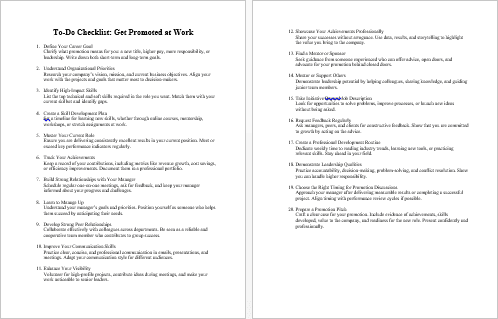
Get Promoted at Work – Checklist
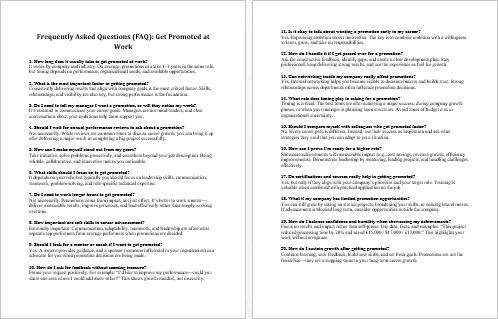
Get Promoted at Work – FAQs
Get Promoted at Work – Salespage Content
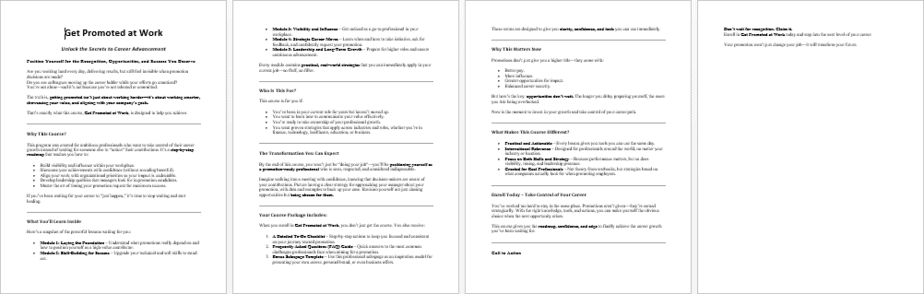
Package Details:
Word Count: 32 326 Words
Number of Pages: 145
Get Promoted at Work – Bonus Content
Checklist
Word Count: 487 words
FAQs
Word Count: 734 words
Salespage Content
Word Count: 807 words
Total Word Count: 34 354 Words
Your PLR License Terms
PERMISSIONS: What Can You Do With These Materials?
Sell the content basically as it is (with some minor tweaks to make it “yours”).
If you are going to claim copyright to anything created with this content, then you must substantially change at 75% of the content to distinguish yourself from other licensees.
Break up the content into small portions to sell as individual reports for $10-$20 each.
Bundle the content with other existing content to create larger products for $47-$97 each.
Setup your own membership site with the content and generate monthly residual payments!
Take the content and convert it into a multiple-week “eclass” that you charge $297-$497 to access!
Use the content to create a “physical” product that you sell for premium prices!
Convert it to audios, videos, membership site content and more.
Excerpt and / or edit portions of the content to give away for free as blog posts, reports, etc. to use as lead magnets, incentives and more!
Create your own original product from it, set it up at a site and “flip” the site for megabucks!
RESTRICTIONS: What Can’t You Do With These Materials?
To protect the value of these products, you may not pass on the rights to your customers. This means that your customers may not have PLR rights or reprint / resell rights passed on to them.
You may not pass on any kind of licensing (PLR, reprint / resell, etc.) to ANY offer created from ANY PORTION OF this content that would allow additional people to sell or give away any portion of the content contained in this package.
You may not offer 100% commission to affiliates selling your version / copy of this product. The maximum affiliate commission you may pay out for offers created that include parts of this content is 75%.
You are not permitted to give the complete materials away in their current state for free – they must be sold. They must be excerpted and / or edited to be given away, unless otherwise noted. Example: You ARE permitted to excerpt portions of content for blog posts, lead magnets, etc.
You may not add this content to any part of an existing customer order that would not require them to make an additional purchase. (IE You cannot add it to a package, membership site, etc. that customers have ALREADY paid for.)
Share Now!
Latest Products



Free Sales Funnel Builder

Related Products
Popular & Trending



Featured Products