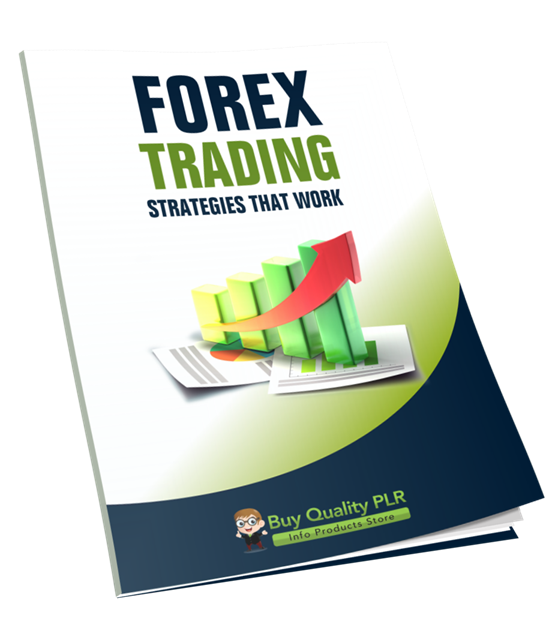
Forex Trading Strategies That Work PLR Course 33k Words
in Finance PLR , Forex PLR , PLR eCourses , PLR List Building Reports , Premium PLR , Premium PLR Reports , Premium White Label Brandable PLR Coaching Courses , Private Label Rights ProductsChoose Your Desired Option(s)
has been added to your cart!
have been added to your cart!
#forextrading #tradingstrategies #plrcourse #forexeducation #onlinetrading #financialmarkets #plrcontent #tradingsuccess #makemoneyonline
Master Forex Trading Strategies for Profits
The forex market is the largest financial market in the world, with trillions of dollars traded daily. It attracts beginners seeking opportunity and experienced traders aiming to refine their edge.
Yet most aspiring traders struggle for one simple reason:
They lack structure.
They jump into strategies without understanding the foundation.
They trade based on emotion instead of logic.
They risk too much and manage too little.
The Forex Trading Strategies That Work PLR Course was created to solve that problem.
This complete, step-by-step training program teaches learners how to understand the forex market, apply proven trading strategies, manage risk professionally, and develop the discipline required for long-term consistency.
For PLR buyers, this course offers a high-demand financial education product that can be rebranded, sold, taught, or transformed into premium trading mentorship programs.
Introducing the…
Forex Trading Strategies That Work PLR Course 33k Words
What This Course Is Designed to Do
The goal of this course is clear:
To help learners move from confusion to confidence by mastering forex trading strategies that are practical, structured, and risk-aware.
Rather than promising unrealistic shortcuts, the course focuses on:
- Strong trading foundations
- Clear market analysis skills
- Proven strategy frameworks
- Risk management discipline
- Professional trading mindset
It emphasizes structured learning over speculation.
Course Overview
Forex Trading Strategies That Work
Master Forex Trading Strategies for Profits
This course is organized into five progressive modules, each building upon the previous one.
By the end of the course, learners will:
- Understand how the forex market operates
- Use trading platforms confidently
- Apply technical and fundamental analysis
- Execute multiple core trading strategies
- Manage risk professionally
- Develop a disciplined trader’s mindset
Module Breakdown
Module 1: Laying the Foundation of Forex Trading
Before applying strategies, learners must understand the basics.
Lesson 1: What Is Forex Trading?
Explains how currency pairs work, why traders speculate on price movements, and how profits are generated.
Lesson 2: The Trading Platforms & Tools You’ll Need
Walks through MetaTrader (MT4/MT5) and similar platforms to place and manage trades effectively.
Lesson 3: Key Forex Terminology Made Simple
Breaks down pips, lots, leverage, spreads, margin, and other essential terms.
Lesson 4: Types of Traders & Styles
Helps learners identify whether scalping, day trading, swing trading, or position trading suits their personality and schedule.
This module builds clarity and confidence.
Module 2: Understanding the Market
Here, learners develop analytical skills.
Lesson 1: Technical Analysis Basics
Teaches how to read candlestick charts, identify trends, and mark support and resistance levels.
Lesson 2: Introduction to Indicators
Introduces RSI, MACD, Moving Averages, and how to use them for decision-making.
Lesson 3: Fundamental Analysis
Explains how economic news, interest rates, and global events impact currency pairs.
Lesson 4: Sentiment & Market Psychology
Explores fear, greed, and crowd behavior in price movements.
This module equips learners with tools for informed trading decisions.
Module 3: Core Forex Trading Strategies
This module delivers actionable trading strategies.
Lesson 1: Trend Following Strategy
How to trade with the market direction using moving averages and breakout confirmations.
Lesson 2: Range Trading Strategy
How to profit when markets move sideways between support and resistance.
Lesson 3: Breakout Trading Strategy
How to identify explosive price moves when key levels break.
Lesson 4: Scalping for Quick Profits
Step-by-step guidance for capturing small gains in short timeframes.
This module transforms theory into execution.
Module 4: Advanced Strategy Building
Now strategies are refined and combined.
Lesson 1: Fibonacci Retracement Strategy
Using Fibonacci tools for precise entry and exit points.
Lesson 2: Moving Average Crossovers
Catching potential trend reversals early.
Lesson 3: Combining Indicators for Confirmation
Blending RSI, MACD, and Moving Averages to reduce false signals.
Lesson 4: Risk-Reward Strategy
Structuring trades with favorable risk-to-reward ratios.
This module increases probability and consistency.
Module 5: Risk Management & Trading Mindset
Even the best strategy fails without discipline.
Lesson 1: Money Management Basics
How much to risk per trade to protect capital.
Lesson 2: Stop Loss & Take Profit Mastery
Setting smart exit points to minimize losses and lock in gains.
Lesson 3: Building a Trading Plan
Creating structured daily routines and rule-based trading systems.
Lesson 4: Mastering the Trader’s Mindset
Developing patience, discipline, and emotional control.
This module ensures long-term sustainability.
What Makes This PLR Course Valuable
Forex trading remains one of the most searched financial topics globally. Demand continues to grow due to:
- Increased access to online trading platforms
- Rising interest in financial independence
- Growth of retail trading communities
- Global economic uncertainty
This course meets that demand with a structured, responsible approach focused on education rather than hype.
Additional High-Value Content Included
This PLR package includes:
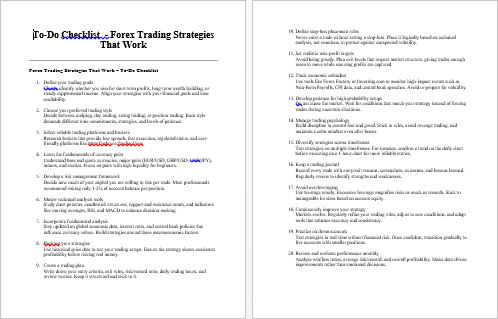
Forex Trading Strategies That Work Checklist – 530 Words
A practical trading checklist to help learners implement strategies consistently.
Forex Trading Strategies That Work FAQs – 1,010 Words
A detailed FAQ section that builds credibility and answers common concerns.
Forex Trading Strategies That Work Sales Page – 792 Words
A professionally written sales page buyers can customize and rebrand.
Who This Course Is Ideal For
This course is perfect for:
- Trading educators
- Financial bloggers
- Investment mentors
- Online course creators
- Membership site owners
- Forex affiliates
- Financial coaching brands
It can be positioned as:
- A beginner forex trading course
- A structured trading strategy program
- A risk management masterclass
- A disciplined trading blueprint
How to Use and Profit from This PLR Course
This course offers strong monetization opportunities.
Sell It as a Standalone Trading Course
Rebrand and launch as a complete forex strategy program.
Create a Premium Mentorship Program
Use it as a framework for group coaching or 1-on-1 mentorship.
Turn It Into a Multi-Week eClass
Deliver modules weekly and charge $297–$497.
Add It to a Trading Membership
Use it as foundational education for recurring revenue.
Break It Into Smaller Reports
Sell individual strategies for $10–$20 each.
Convert Into Video Training
Record lessons and increase perceived value significantly.
Bundle With Other Financial Courses
Create packages priced $47–$97.
Build a Forex Education Brand
Launch a niche trading website and grow it into a sellable digital asset.
License Terms – What Buyers Are Allowed to Do
Permissions
Buyers may:
- Sell the content with minor edits
- Claim copyright if 75% is substantially modified
- Break content into smaller paid products
- Bundle with other offers
- Create membership sites with recurring income
- Convert into multi-week eClasses priced $297–$497
- Turn into audio, video, or physical products
- Use excerpts as lead magnets
- Build and flip a branded site
License Restrictions – What Buyers Cannot Do
To protect value:
- PLR or resale rights may not be passed on
- Licensing rights may not be transferred
- Affiliate commissions may not exceed 75%
- The full product may not be given away in its current form
- It may not be added to existing paid products without a new purchase
Why Buy This PLR Course from Buy Quality PLR
Buy Quality PLR delivers business-ready digital products designed for real monetization opportunities.
This forex trading course offers:
- High-demand financial niche appeal
- Structured, responsible trading education
- Practical strategies
- Strong resale and repurposing flexibility
- Immediate usability
It eliminates months of content creation while giving buyers a complete trading education framework ready to brand and profit from.
Get Instant Access Today
The Forex Trading Strategies That Work PLR Course is available for instant download.
This is a complete, structured forex trading education system that can be rebranded, sold, taught, or transformed into premium financial coaching and trading programs immediately.
Add this powerful PLR course to your Buy Quality PLR library today and start turning trading education into a profitable digital asset.
has been added to your cart!
have been added to your cart!
Here A Sample of the Forex Trading Strategies That Work PLR Course
Module 1: Laying the Foundation of Forex Trading
Before jumping into strategies, you need to understand the basics. This module sets you up for success.
Lesson 1: What is Forex Trading?
Introduction
Before diving into strategies, technical tools, and advanced market concepts, it’s vital to first understand what forex trading really is. The term “forex” stands for foreign exchange, and it refers to the marketplace where currencies are bought and sold. At its core, forex trading is about exchanging one currency for another, with the goal of making a profit when the value of one currency changes against another.
To give you a sense of its scale, the forex market is the largest and most liquid financial market in the world, with daily trading volumes exceeding USD 6 trillion (according to the Bank for International Settlements). Unlike stock exchanges that operate during business hours, the forex market runs 24 hours a day, 5 days a week, making it accessible to traders across every time zone.
In this lesson, we will explore the fundamental building blocks of forex trading:
- What the forex market is and how it works.
- The role of currency pairs and how they are quoted.
- Who the main participants are in the forex market.
- Why people trade forex and what makes it attractive.
By the end of this lesson, you will have a solid foundation to confidently move forward into more technical lessons.
1. Understanding the Global Forex Market
The forex market is a decentralized global marketplace. Unlike stock exchanges such as the New York Stock Exchange (NYSE) or London Stock Exchange (LSE), forex does not have a single central location. Instead, trading happens electronically over-the-counter (OTC) through a global network of banks, brokers, financial institutions, and individual traders.
How the Forex Market Works
- Currencies are traded in pairs. For example, if you are trading EUR/USD, you are essentially buying the euro (EUR) while selling the U.S. dollar (USD).
- Price movements are determined by supply and demand. If demand for euros increases relative to the U.S. dollar, the EUR/USD exchange rate rises.
- Market participants range from central banks to retail traders. Each has a different motivation: governments may stabilize their currency, corporations may hedge against currency risk, while traders seek profit.
Because the forex market spans across Asia, Europe, and North America, it is open continuously from Monday 00:00 GMT to Friday 23:59 GMT. The market transitions seamlessly from one financial hub to another—Tokyo, London, New York—creating overlapping trading sessions where liquidity is highest.
2. What Are Currency Pairs?
Forex trading always involves two currencies. This is because one currency’s value is always measured relative to another. These two currencies form what we call a currency pair.
Structure of a Currency Pair
Every currency pair has two components:
- Base Currency (the first currency in the pair).
- Quote Currency (the second currency in the pair).
For example, in EUR/USD:
- EUR is the base currency.
- USD is the quote currency.
If EUR/USD = 1.1500, it means 1 euro (EUR) equals 1.15 U.S. dollars (USD). When you trade, you are either buying the base currency and selling the quote currency, or vice versa.
Types of Currency Pairs
- Major Pairs
- These include the most traded currencies in the world, always paired with the U.S. dollar.
- Examples: EUR/USD, GBP/USD, USD/JPY, USD/CHF.
- They are highly liquid and have the tightest spreads.
- Minor Pairs (Crosses)
- These pairs exclude the U.S. dollar but include other major currencies.
- Examples: EUR/GBP, AUD/JPY, NZD/CAD.
- They may have slightly wider spreads but still offer good liquidity.
- Exotic Pairs
- These pair a major currency with a currency from a smaller or emerging economy.
- Examples: USD/TRY (U.S. dollar/Turkish lira), EUR/THB (euro/Thai baht).
- They can be volatile, with higher risk but also higher potential reward.
Understanding how these pairs are structured is essential because your profit or loss is determined by how the base currency moves against the quote currency.
3. How Are Currency Prices Quoted?
When you look at a trading platform, you’ll see that every currency pair has two prices: the bid price and the ask price.
- Bid Price: The price at which the market (or your broker) will buy the base currency from you. Essentially, this is the price you can sell at.
- Ask Price: The price at which the market (or your broker) will sell the base currency to you. This is the price you can buy at.
The difference between the bid and the ask price is called the spread. For example:
- EUR/USD: 1.1500 (bid) / 1.1502 (ask).
- The spread here is 2 pips (a pip is the smallest unit of price movement, usually 0.0001 for most pairs).
Spreads matter because they represent the cost of entering a trade. In highly liquid pairs like EUR/USD, spreads are very small, making them attractive for traders.
4. Who Trades in the Forex Market?
The forex market is made up of different participants with unique roles and motivations. Let’s break them down:
- Central Banks and Governments
- Influence currency value through monetary policies, interest rates, and interventions.
- Example: The U.S. Federal Reserve (Fed) or the European Central Bank (ECB).
- Commercial and Investment Banks
- Facilitate forex transactions for clients and also trade for profit.
- They provide much of the liquidity in the market.
- Corporations
- Engage in forex to hedge currency risk from international business operations.
- Example: An American company that imports goods from Europe may buy euros to pay its suppliers.
- Hedge Funds and Investment Managers
- Trade forex in large volumes, often speculating to maximize returns.
- Retail Traders
- Individuals like you and me trading through brokers.
- Although they represent a smaller portion of total volume, retail traders have grown significantly thanks to online trading platforms.
5. Why Do People Trade Forex?
Forex trading is popular worldwide for several reasons:
- Liquidity: The forex market is extremely liquid, meaning it’s easy to enter and exit trades quickly.
- Accessibility: With as little as a few hundred dollars, anyone can open a forex trading account.
- Leverage: Brokers often provide leverage (e.g., 1:100), allowing traders to control large positions with smaller capital. However, leverage increases both potential profits and risks.
- Opportunities in Both Directions: Unlike some markets, you can profit whether currencies rise or fall. If you believe the euro will rise against the dollar, you buy EUR/USD. If you think it will fall, you sell EUR/USD.
- Global Nature: Forex reflects global economic events, politics, and trade. This makes it fascinating for those who enjoy analyzing world events.
6. The Importance of Understanding Forex Basics
Many beginners make the mistake of rushing into advanced strategies without truly grasping the fundamentals. Knowing how currency pairs work, why prices move, and who the key players are will help you:
- Read charts more effectively.
- Choose the right pairs to trade.
- Understand the risks involved.
- Build a stronger foundation for applying strategies later.
Forex is not a “get rich quick” scheme; it’s a structured market where informed decisions lead to long-term profitability.
7. Practical Example of a Forex Trade
Let’s walk through a simple example so you can visualize how forex trading works in real life.
Imagine you believe the euro will strengthen against the U.S. dollar. You decide to buy EUR/USD at 1.1500.
- You buy 10,000 units (a mini lot).
- Each pip movement (0.0001) in EUR/USD is worth USD 1 for a mini lot.
If the price rises to 1.1600, that’s a 100-pip move in your favor.
- Profit = 100 pips × USD 1 = USD 100.
On the other hand, if the price falls to 1.1400, you lose USD 100.
This example shows how profit and loss are calculated and why risk management is essential.
Conclusion
In this lesson, we uncovered the foundation of forex trading. You learned that:
- Forex is the global marketplace for trading currencies, operating 24 hours a day, 5 days a week.
- Currencies are traded in pairs, with the first being the base and the second the quote currency.
- Prices are quoted with a bid and ask, and the spread is the difference between the two.
- Market participants include central banks, corporations, hedge funds, and retail traders.
- People trade forex because of its liquidity, accessibility, leverage, and opportunities in both directions.
Having this understanding equips you with the confidence to navigate the world of forex. As we progress further, these concepts will serve as the stepping stones for learning strategies and techniques to trade profitably.
Lesson 2: The Trading Platforms & Tools You’ll Need
Introduction
Once you understand what forex trading is and how currency pairs work, the next crucial step is knowing where and how to actually place your trades. For most traders, the journey begins with a trading platform. Think of it as your “workstation” — it’s where you’ll analyze charts, monitor price movements, and execute trades.
In this lesson, we’ll focus on the most widely used trading platforms in the forex industry: MetaTrader 4 (MT4) and MetaTrader 5 (MT5). These platforms are trusted worldwide by brokers, traders, and professionals because of their stability, reliability, and rich features. We’ll cover how to set them up, the tools you’ll need to use inside them, and how to confidently execute trades like a professional.
By the end of this lesson, you’ll have a clear understanding of:
- What MT4 and MT5 are, and their differences.
- How to download and install these platforms.
- How to navigate the platform interface step by step.
- Essential tools for charting and analysis.
- How to place, manage, and close trades.
- Extra tools and add-ons that enhance your trading experience.
1. What Are MT4 and MT5?
MetaTrader 4 (MT4) and MetaTrader 5 (MT5) are trading platforms developed by a company called MetaQuotes.
- MT4 was released in 2005 and became the global standard for forex trading. It is known for simplicity, speed, and a strong community of users.
- MT5, released in 2010, is the updated version. It supports more asset classes (such as stocks, futures, and commodities), additional technical tools, and faster trade execution.
Key Differences Between MT4 and MT5
- Markets Supported: MT4 is mostly forex-focused. MT5 supports forex, stocks, indices, commodities, and futures.
- Programming Language: MT4 uses MQL4; MT5 uses MQL5. This matters if you want to code custom indicators or automated strategies.
- Technical Indicators: MT5 offers more built-in indicators and timeframes.
- Interface: Both are similar, but MT5 provides slightly more advanced features for professional traders.
For most beginners, MT4 is sufficient to start trading forex. Many brokers still support MT4, although MT5 is slowly becoming the new standard.
2. How to Download and Install MT4/MT5
Here’s a step-by-step guide to getting started:
Step 1: Choose a Broker
- First, select a reputable forex broker that offers MT4 or MT5. Most international brokers will provide free downloads of these platforms.
- Make sure the broker is regulated by a recognized authority (e.g., FCA in the UK, ASIC in Australia, NFA in the US, CySEC in Europe).
Step 2: Download the Platform
- Visit your broker’s website and find the download link for MT4 or MT5.
- Versions are available for Windows, macOS, Android, and iOS.
Step 3: Install the Platform
- Open the downloaded file and follow installation prompts.
- Once installed, launch the application.
Step 4: Open a Demo Account
- Most brokers offer free demo accounts with virtual money.
- A demo account lets you practice trading without risking real capital.
- Login credentials (account number, password, and server) will be provided by your broker.
3. Navigating the Platform Interface
When you open MT4/MT5 for the first time, the platform may look overwhelming. Let’s break it down into simple sections:
1. Menu Bar (Top of the Screen)
- Contains options for file management, charts, tools, and help.
- Example: Open a new chart, load templates, or set alerts.
2. Toolbar (Below Menu Bar)
- Provides quick shortcuts for functions like creating orders, zooming charts, or adding indicators.
3. Market Watch Window (Usually Left Side)
- Displays a list of currency pairs and their real-time bid/ask prices.
- Right-click to add or remove pairs, or view their charts.
4. Navigator Window
- Contains your accounts, indicators, expert advisors (EAs), and scripts.
- Use this to switch accounts or drag-and-drop indicators onto charts.
5. Chart Window (Main Area)
- This is the core of the platform. It shows price movement in candlestick, line, or bar chart format.
- You can open multiple charts for different pairs and timeframes.
6. Terminal Window (Bottom Section)
- Displays open trades, account balance, trade history, alerts, and news.
- Essential for monitoring your trading activity.
By familiarizing yourself with these areas, you’ll quickly feel comfortable navigating the platform.
4. Essential Charting Tools
Charts are the heart of forex trading. MT4 and MT5 offer robust charting capabilities. Here’s how to use them step by step:
Step 1: Choose a Chart Type
- Candlestick charts are most popular, as they show price action clearly.
- You can switch between candlestick, bar, and line charts via the toolbar.
Step 2: Change Timeframes
- Select different timeframes (M1, M5, H1, D1, etc.) to analyze price movements over minutes, hours, or days.
- Example: A scalper may focus on M1 or M5, while a swing trader may prefer H4 or D1.
Step 3: Add Indicators
- Common indicators include Moving Averages, RSI, MACD, Bollinger Bands.
- Drag and drop indicators from the Navigator Window onto your chart.
Step 4: Draw Tools
- Use tools like trendlines, Fibonacci retracements, or horizontal lines to mark support and resistance levels.
- These are accessible from the toolbar.
Step 5: Save Templates
- Once you customize a chart with your favorite indicators, save it as a template for reuse.
5. How to Place Trades
This is where you put your knowledge into practice. Here’s the process step by step:
Step 1: Open a New Order Window
- Right-click on the chart or use the toolbar button “New Order.”
Step 2: Select Your Trade Settings
- Symbol: Choose the currency pair (e.g., EUR/USD).
- Volume (Lot Size): Decide how many units to trade. For beginners, start with micro (0.01 lot).
- Stop Loss: Set a level where the trade will close if it goes against you.
- Take Profit: Set a target where the trade will automatically close in profit.
- Order Type: Choose between:
- Market Order: Executes immediately at the current price.
- Pending Order: Executes when price reaches a specified level (Buy Limit, Sell Limit, Buy Stop, Sell Stop).
Step 3: Execute the Trade
- Click “Buy” or “Sell” depending on your analysis.
- Your order will now appear in the Terminal window under “Trade.”
Step 4: Monitor and Manage Trades
- Watch your open position in real time.
- Modify stop loss and take profit levels by right-clicking the trade.
Step 5: Closing the Trade
- To exit manually, right-click the trade in the Terminal and select “Close Order.”
- Alternatively, if stop loss or take profit levels are hit, the platform will close it automatically.
6. Additional Tools and Features
To trade like a professional, you’ll want to explore the platform’s extra features:
- Economic Calendar (MT5 only): Shows important global financial events.
- Expert Advisors (EAs): Automated trading systems you can install or code.
- Alerts: Set price alerts so the platform notifies you when a pair hits a certain level.
- Backtesting (MT4/MT5): Test strategies on historical data before using real money.
- One-Click Trading: Allows faster trade execution directly from the chart.
7. Practical Tips for Using MT4/MT5 Effectively
- Keep Your Charts Clean: Too many indicators can clutter your screen and confuse decisions. Focus on a few reliable tools.
- Use Demo Accounts First: Practice trade execution and analysis before going live.
- Learn Hotkeys: Keyboard shortcuts save time when you need to act quickly.
- Stay Updated: Brokers often release updates or add-ons. Keep your platform current.
- Organize Workspaces: Save chart setups and templates for consistency in your trading.
8. Example Walkthrough: Placing Your First Trade
Let’s say you believe the British pound (GBP) will rise against the U.S. dollar (USD). Here’s how you’d place a trade in MT4:
- Open the GBP/USD chart.
- Click “New Order.”
- Select Volume = 0.10 (a mini lot).
- Set Stop Loss = 1.2600 and Take Profit = 1.2800.
- Click “Buy.”
- Monitor your trade in the Terminal window. If GBP/USD climbs to 1.2800, your trade closes with profit.
This hands-on example mirrors how you’ll trade in real conditions.
Conclusion
Trading platforms like MT4 and MT5 are your gateways to the forex market. They may look complex at first, but with practice, they become second nature.
In this lesson, you learned:
- What MT4 and MT5 are, and why they are the global standards.
- How to download, install, and set up these platforms through a broker.
- The main interface components: Market Watch, Navigator, Charts, Terminal.
- How to analyze charts with indicators and drawing tools.
- How to place, manage, and close trades step by step.
- Additional features such as expert advisors, alerts, and backtesting.
Mastering your trading platform is just as important as learning strategies, because it’s the tool that connects your ideas to the real market. With confidence in using MT4 or MT5, you’re prepared to apply strategies and begin trading like a professional.
Lesson 3 — Key Forex Terminology Made Simple
Pips, lots, leverage, spreads — get comfortable with the language of forex
Introduction
If you want learners to trade confidently, they must speak the language of the market. In this lesson we’ll demystify the core building blocks you’ll hear and teach every day: pips, pipettes, lots, leverage, margin, spreads, pip value, and a few related terms. Each concept will include clear definitions, practical examples with worked arithmetic, and short teaching tips you can reuse in an international classroom (using common currency signs: €, $, £, ¥, etc.).
Read through the step-by-step examples carefully — the arithmetic is shown explicitly so you can demonstrate the same calculations in a live class or workbook.
1. Pips and Pipettes — the smallest meaningful move
Definition:
A pip (percentage in point) is the standard smallest price move for most currency pairs. For most EUR/USD-style pairs a pip = 0.0001. For yen pairs (USD/JPY, EUR/JPY) a pip = 0.01 because those rates are quoted to two decimal places. A pipette is a fractional pip (one-tenth of a pip), shown as an extra decimal.
Why it matters:
Traders measure profit and loss by pips. Understanding pip size is the foundation for calculating value and risk.
Examples with step-by-step arithmetic
- EUR/USD moves from 1.1500 to 1.1505 → change = 0.0005 → this equals 5 pips.
Calculation:
1.1505 − 1.1500 = 0.0005 → 0.0005 ÷ 0.0001 = 5 pips. - USD/JPY moves from 110.00 to 110.25 → change = 0.25 → since 1 pip = 0.01:
0.25 ÷ 0.01 = 25 pips.
Teaching tip: always show learners how to convert price moves into pips — it’s the universal metric.
2. Lots — the contract sizes you actually trade
Definition:
A lot is the standard contract size in forex. Common sizes:
- Standard lot = 100,000 units of the base currency.
- Mini lot = 10,000 units.
- Micro lot = 1,000 units.
- Nano lot (rare) = 100 units.
When someone says “I bought 0.10 lots,” they mean 0.10 × 100,000 = 10,000 units (a mini lot).
Why it matters:
Lot size determines how much a pip is worth and therefore how much you gain or lose per pip.
Example (linking pips to lots):
If you buy 1 standard lot of EUR/USD (100,000 EUR) and the pair moves 10 pips in your favor, how much did you make (in USD)?
Step-by-step:
- Standard lot = 100,000 units.
- Pip size for EUR/USD = 0.0001 USD per EUR.
- Pip value per standard lot = 100,000 × 0.0001 = 10 USD per pip.
Calculation shown: 100,000 × 0.0001 = 100,000 ÷ 10,000 = 10. - Profit for 10 pips = 10 pips × 10 USD/pip = 100 USD.
Teaching tip: use a simple table (micro/mini/standard) and ask learners to calculate pip value for different lot sizes.
3. Pip value — how much a pip is worth
Definition:
Pip value = the monetary value of one pip for a specific lot size and currency pair. It’s expressed in the quote currency (the second currency in the pair) by default.
General formula (when quote currency = account currency):Pip value = Lot size × Pip size
Worked examples
A. EUR/USD, standard lot (100,000), pip = 0.0001
- Lot size × pip size = 100,000 × 0.0001.
- 100,000 × 0.0001 = 100,000 ÷ 10,000 = 10 (USD).
So 1 pip = $10 for one standard lot.
B. EUR/USD, mini lot (10,000)
- 10,000 × 0.0001 = 10,000 ÷ 10,000 = 1 (USD).
So 1 pip = $1 for a mini lot.
C. USD/JPY, standard lot (100,000)
- Pip size = 0.01 (JPY per USD).
- Pip value in JPY = 100,000 × 0.01 = 1,000 JPY.
Calculation: 100,000 × 0.01 = 100,000 ÷ 100 = 1,000. - To express pip value in USD (if account is USD), convert:
If USD/JPY = 110.00, then pip_value_USD = 1,000 ÷ 110.00 = 9.0909… USD.
Calculation: 1,000 ÷ 110 = 1000/110 = 100/11 ≈ 9.0909.
Teaching tip: always check whether the quote currency equals the trader’s account currency — if not, a conversion is required.
4. Spreads — the broker’s visible cost
Definition:
The spread is the difference between the broker’s ask (buy) price and bid (sell) price. It’s often measured in pips.
Example and arithmetic:
EUR/USD quoted as 1.1500 / 1.1502 → Ask = 1.1502, Bid = 1.1500.
- Spread = 1.1502 − 1.1500 = 0.0002 → 0.0002 ÷ 0.0001 = 2 pips.
- Cost in USD (standard lot): 2 pips × $10/pip = $20.
Calculation: 2 × 10 = 20.
Why it matters:
Spreads are an immediate cost you pay on entry. Tight spreads are desirable for active traders; wider spreads increase trading costs.
Other costs: Some brokers also charge commissions per trade or per lot, which must be added to spread costs.
Teaching tip: show live quotes in class and ask learners to compute spread cost for different lot sizes.
5. Leverage and Margin — controlling big positions with smaller capital
Definition:
- Leverage lets traders control a large position with a smaller amount of capital. It’s quoted as a ratio (e.g., 1:100, 1:50).
- Margin is the portion of your account balance that is set aside as collateral to keep a position open.
Key formula:Required margin = (Position size × Price) ÷ Leverage
Worked example 1 — Standard lot, EUR/USD, price 1.1500, leverage 1:100
- Position size (base currency value expressed in account currency) = 100,000 × 1.1500 = 115,000 USD.
Calculation: 100,000 × 1 = 100,000; 100,000 × 0.1500 = 15,000; sum = 115,000. - Required margin = 115,000 ÷ 100 = 1,150 USD.
Calculation: 115,000 ÷ 100 = 1,150.
Worked example 2 — Mini lot (0.1 lot = 10,000), price 1.1500, leverage 1:50
- Position value = 10,000 × 1.1500 = 11,500 USD.
- Required margin = 11,500 ÷ 50 = 230 USD.
Why it matters:
Leverage magnifies both profits and losses. With the 1:100 example, controlling $115,000 of currency required only $1,150 of margin. A 100-pip move (100 × $10/pip = $1,000) would be nearly a 87% change relative to the required margin.
Teaching tip: emphasize risk — show win and loss scenarios using the same leverage to illustrate how quickly account equity can change.
6. Position sizing with pip value and risk
A practical rule: decide the dollar amount you are willing to risk per trade (often expressed as a percentage of account equity), then calculate the position size using the stop-loss distance in pips.
Worked example — risk-based sizing
Assumptions:
- Account balance = $10,000.
- Risk per trade = 1% → Risk amount = $10,000 × 0.01 = $100.
- Stop loss = 50 pips on EUR/USD.
- Pip value per mini lot (10,000) = $1/pip (from earlier).
Step-by-step:
- Risk amount = $10,000 × 0.01 = $100.
- Loss per mini lot if stop = 50 pips × $1/pip = $50.
Calculation: 50 × 1 = 50. - Number of mini lots that match risk = 100 ÷ 50 = 2 mini lots = 0.20 standard lots.
Calculation: 100 ÷ 50 = 2; 2 mini lots = 2 × 10,000 = 20,000 units = 0.2 standard.
Why it matters:
This method ties risk to account size and makes trading consistent and scalable across learners from different countries and currencies.
7. Other useful terms (brief)
- Swap / Rollover: interest credited or charged for holding a position overnight.
- Slippage: difference between expected execution price and actual execution price, common in fast markets.
- Tick: the smallest possible price movement offered by a broker (close to pip/pipette).
- Base currency / Quote currency: base is the first currency in the pair (e.g., EUR in EUR/USD); quote is second (USD).
- Account currency: the currency in which your broker reports your balance (e.g., USD, EUR, GBP). Conversions may be needed for pip/margin calculations.
8. Classroom exercises you can use immediately
- Quick quiz: Give three quote examples (EUR/USD, USD/JPY, GBP/USD). Ask students to calculate pip movement and pip value for a micro, mini, and standard lot.
- Position-size drill: Account $5,000, risk 2%, stop 30 pips on GBP/USD. Ask learners to compute the maximum lot size.
- Spread cost comparison: Provide live bid/ask samples from three brokers and ask learners to compute cost for a 0.5 lot trade. Discuss how spreads affect scalpers vs swing traders.
Closing notes (for course creators)
- Use many short, worked examples — learners from different currency zones need to see conversions and the logic behind each step.
- Keep a clean template for calculations: define
account currency,pair,price,lot size,pip size, then computepip value,margin,position size. - Emphasize that the numbers (pip size, lot sizes, formulae) are universal; only prices and account currencies change.
This lesson arms your learners with the precise vocabulary and arithmetic needed to measure risk and profit. Mastering these terms is the bridge from theory to real-world trading decisions.
Lesson 4 — Types of Traders & Styles
Discover whether you’re more suited for scalping, day trading, swing trading, or position trading
Introduction
Not all traders are cut from the same cloth. Choosing a trading style that matches your personality, capital, time availability, and risk tolerance is one of the single most important decisions a new trader will make. This lesson walks international course creators through the four main retail forex styles — scalping, day trading, swing trading, and position trading — and gives step-by-step instructions, clear examples (with arithmetic shown), classroom activities, and checklists so students can identify the best fit for them.
Throughout, I use common currency symbols (€ $ £ ¥ ₹) as examples so your global learners can relate. Keep this as a structured script you can present live or convert to worksheets.
Overview: How to read the style matrix
Each style will be described under the same headings so learners can compare easily:
- Timeframe — how long trades are typically held.
- Typical targets & stop sizes — pips or percent expected.
- Lot sizes & capital examples — how much capital is commonly needed.
- Required skills & personality fit — temperament and strengths.
- Tools & routines — platform settings and daily workflow.
- Pros & cons — quick summary.
- Mini example trade with arithmetic — step-by-step profit/loss calculation.
Scalping
Timeframe: Seconds to minutes. Trades often last 5–30 seconds up to a few minutes.
Targets & stops: 1–10 pips per trade, tight stop losses (1–10 pips).
Capital example: Often uses micro (0.01) to mini (0.1) lots with higher leverage. A small account (e.g., $500–$2,000) is typical for learners practicing scalps on demo.
Personality fit: Fast decision-maker, calm under pressure, able to react quickly, enjoys high-frequency repetitive work.
Tools & routines: One-click trading, 1-minute and 5-minute charts, Level II (if available), economic news filtered off, low-spread pairs (EUR/USD, GBP/USD). Use demo to start.
Pros: Many opportunities per day; small per-trade risk.
Cons: Transaction costs (spreads/commissions) add up; high stress; requires constant attention.
Example trade (step-by-step arithmetic):
- Pair: EUR/USD.
- Lot size: 0.10 mini lot (10,000 units).
- Pip value for EUR/USD at mini lot = 10,000 × 0.0001 = 1.0000 USD per pip.
Calculation shown: 10,000 × 0.0001 = 10,000 ÷ 10,000 = 1. - Target: 5 pips. Stop loss: 2 pips.
- Profit if target hits: 5 pips × $1/pip = $5.
Calculation: 5 × 1 = 5. - Loss if stop hits: 2 pips × $1/pip = $2.
Calculation: 2 × 1 = 2. - Risk–reward ratio = 5 ÷ 2 = 2.5 : 1.
Calculation: 5 ÷ 2 = 2.5.
Day Trading
Timeframe: Minutes to hours; all positions closed by session end (no overnight holds).
Targets & stops: 10–50 pips typical, depending on pair and volatility.
Capital example: Comfortable accounts are often $1,000–$10,000; lot sizes from micro to standard depending on risk rules.
Personality fit: Focused for several hours, good at intraday pattern recognition, disciplined with routine, prefers daily engagement.
Tools & routines: 5-minute, 15-minute, 1-hour charts; news awareness; more technical setups (breakouts, pullbacks). Pre-session analysis and post-session review are essential.
Pros: Active but less frenetic than scalping; opportunities daily.
Cons: Can be affected by intraday news; requires daily time commitment.
Example trade (step-by-step arithmetic):
- Pair: GBP/USD.
- Lot size: 0.05 standard lot (0.05 × 100,000 = 5,000 units).
- Pip value (GBP/USD, mini equivalence): 5,000 × 0.0001 = 0.50 USD per pip.
Calculation: 5,000 × 0.0001 = 5,000 ÷ 10,000 = 0.5. - Target: 30 pips. Stop: 15 pips.
- Potential profit: 30 × $0.50 = $15.
Calculation: 30 × 0.5 = 15. - Potential loss: 15 × $0.50 = $7.50.
Calculation: 15 × 0.5 = 7.5. - Risk–reward = 30 ÷ 15 = 2 : 1.
Swing Trading
Timeframe: Hours to days, usually held for 2–7 days, sometimes weeks.
Targets & stops: 50–300 pips or moves of several percent.
Capital example: Often $2,000–$20,000 accounts; lot sizes commonly mini to standard depending on risk appetite. Lower monitoring frequency suits those with jobs.
Personality fit: Patient, analytical, comfortable with overnight gaps, prefers trade setups that don’t need constant screen time.
Tools & routines: Daily and 4-hour charts, weekly trend context, fundamental filters (earnings, central bank events), swing entry techniques (pullback to moving averages, breakout retest).
Pros: Lower screen time, fewer trades with larger moves.
Cons: Overnight risk, gaps, requires strong risk management.
Example trade (step-by-step arithmetic):
- Pair: USD/JPY.
- Lot size: 0.10 mini lot (10,000 units).
- Pip value (USD/JPY pip = 0.01): pip value in JPY = 10,000 × 0.01 = 100 JPY.
Calculation: 10,000 × 0.01 = 10,000 ÷ 100 = 100. - Convert pip value to USD assuming USD/JPY = 110.00: 100 JPY ÷ 110.00 = 0.9091 USD per pip (rounded).
Calculation: 100 ÷ 110 = 10,000/11,000 ≈ 0.9090909. - Target: 150 pips. Stop: 75 pips.
- Potential profit in USD: 150 × $0.9091 ≈ $136.36.
Calculation: 150 × 0.9091 = 136.365 ≈ 136.36. - Potential loss: 75 × $0.9091 ≈ $68.18.
Calculation: 75 × 0.9091 = 68.1825 ≈ 68.18. - Risk–reward ≈ 150 ÷ 75 = 2 : 1.
Position Trading
Timeframe: Weeks to months, sometimes years. Trades are placed on macro themes or long-term trends.
Targets & stops: Hundreds to thousands of pips; percentage moves of several to double-digit percent.
Capital example: Requires larger capital (e.g., $10,000+) for meaningful position sizes with reasonable risk. Many position traders use standard lots but at conservative sizing.
Personality fit: Strategic, patient, comfortable with large swings and drawdowns; focuses on macro fundamentals.
Tools & routines: Weekly and monthly charts, economic cycles, fundamental research, less frequent but deeper analysis. Use limit orders and wide stops tied to structural levels.
Pros: Low time commitment per day; captures major market moves.
Cons: Large drawdowns possible; long waits between profitable exits.
Example trade (step-by-step arithmetic):
- Pair: EUR/USD.
- Account: $20,000. Risk per trade 1% = $200.
Calculation: 20,000 × 0.01 = 200. - Stop: 200 pips. Lot size to align with risk: pip value × pip distance = risk. Solve for pip value: pip value × 200 pips = $200 → pip value = $200 ÷ 200 = $1.00 per pip.
Calculation: 200 ÷ 200 = 1. - $1/pip corresponds to a mini lot (10,000) for EUR/USD. (As learned earlier: 10,000 × 0.0001 = $1).
- If the trade runs to 1,000 pips, profit = 1,000 × $1 = $1,000.
Calculation: 1000 × 1 = 1000. - Return on account if trade wins = $1,000 ÷ $20,000 = 5%.
Calculation: 1,000 ÷ 20,000 = 0.05 = 5%.
How to choose your trading style — step by step
- Assess time availability
- Can you watch the screen all day? Scalping/day trading.
- Can you check daily and set alerts? Swing trading.
- Busy with a full-time job and prefer long-term planning? Position trading.
- Assess temperament
- Do you enjoy fast, frequent decisions? Scalping.
- Do you prefer measured decisions with some intraday action? Day trading.
- Comfortable with patience and holding through swings? Swing or position.
- Assess capital & risk tolerance
- Small capital may be better suited to scalping/day with micro lots and higher leverage (but be careful).
- Larger capital enables swing/position with conservative leverage and lower stress.
- Run a 30-day demo test
- Choose a style, use a demo account, and follow strict rules and a journal. If you can maintain a positive edge and emotional control, that style likely fits you.
Risk management per style — key rules
- Scalpers: Tight stop, small risk per trade (<0.5% account), high win rate required.
- Day traders: Risk per trade usually 0.5–1.0% of account balance. Daily loss limit (e.g., stop trading if down 3% on the day).
- Swing traders: Risk per trade 1–2% with wider stops. Use overnight gap protection and set realistic position sizes.
- Position traders: Risk per trade 1% or lower; focus on correlation and portfolio-level risk management.
Classroom activities & assignments
- Personality questionnaire: 20 questions mapping to the four styles; provide automated scoring.
- Demo challenge: Students pick a style and run a 30-day demo with a fixed rule set. Submit a trade journal.
- Backtest assignment: Backtest a simple setup appropriate for the chosen style (e.g., moving average crossover for swing). Report win rate, average return, max drawdown.
- Routine design: Students write a daily/weekly routine plan tailored to their style (include pre-market checklist, trade journal template, risk limits).
Closing summary
Choosing the right trading style is both personal and practical. Give your learners clear, repeatable steps: evaluate time, temperament, capital; test on demo; journal results; and iterate. Use the trade examples and arithmetic in class to show how position sizing and risk change with style — the numbers make the differences tangible. With these step-by-step explanations and exercises, your students will be able to discover the trading style that suits them best and act on that choice with discipline.
We’re also giving these extra bonuses
Forex Trading Strategies That Work – Checklist
Forex Trading Strategies That Work – FAQs
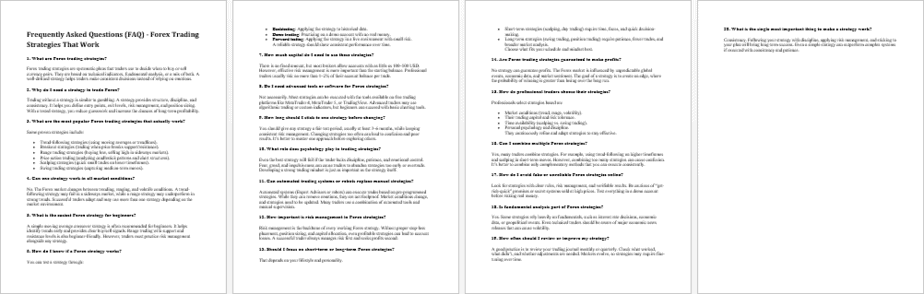
Forex Trading Strategies That Work – Salespage Content
Package Details:
Word Count: 33 734 Words
Number of Pages: 136
Forex Trading Strategies That Work – Bonus Content
Checklist
Word Count: 455 words
FAQs
Word Count: 736 words
Salespage Content
Word Count: 676 words
Total Word Count: 36 066 Words
Your PLR License Terms
PERMISSIONS: What Can You Do With These Materials?
Sell the content basically as it is (with some minor tweaks to make it “yours”).
If you are going to claim copyright to anything created with this content, then you must substantially change at 75% of the content to distinguish yourself from other licensees.
Break up the content into small portions to sell as individual reports for $10-$20 each.
Bundle the content with other existing content to create larger products for $47-$97 each.
Setup your own membership site with the content and generate monthly residual payments!
Take the content and convert it into a multiple-week “eclass” that you charge $297-$497 to access!
Use the content to create a “physical” product that you sell for premium prices!
Convert it to audios, videos, membership site content and more.
Excerpt and / or edit portions of the content to give away for free as blog posts, reports, etc. to use as lead magnets, incentives and more!
Create your own original product from it, set it up at a site and “flip” the site for megabucks!
RESTRICTIONS: What Can’t You Do With These Materials?
To protect the value of these products, you may not pass on the rights to your customers. This means that your customers may not have PLR rights or reprint / resell rights passed on to them.
You may not pass on any kind of licensing (PLR, reprint / resell, etc.) to ANY offer created from ANY PORTION OF this content that would allow additional people to sell or give away any portion of the content contained in this package.
You may not offer 100% commission to affiliates selling your version / copy of this product. The maximum affiliate commission you may pay out for offers created that include parts of this content is 75%.
You are not permitted to give the complete materials away in their current state for free – they must be sold. They must be excerpted and / or edited to be given away, unless otherwise noted. Example: You ARE permitted to excerpt portions of content for blog posts, lead magnets, etc.
You may not add this content to any part of an existing customer order that would not require them to make an additional purchase. (IE You cannot add it to a package, membership site, etc. that customers have ALREADY paid for.)
Share Now!
Latest Products




Free Sales Funnel Builder

Related Products

Popular & Trending

Featured Products