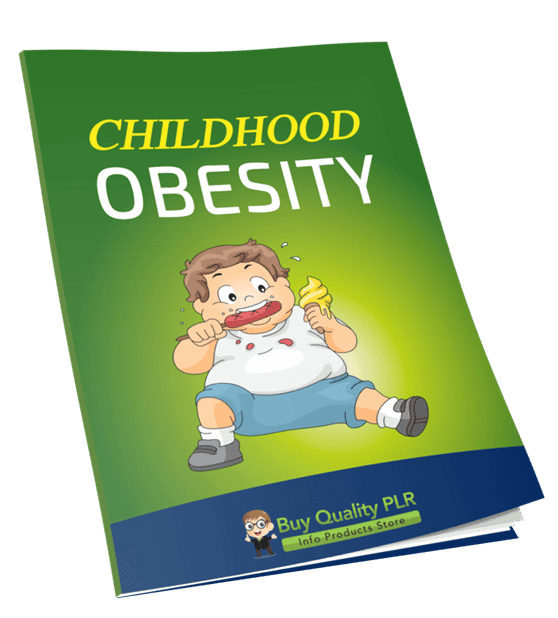
Childhood Obesity PLR Course 22k Words
in Health Ebooks MRR , Health PLR , Health PLR eBooks , Healthy Kids PLR , Kids PLR , Kids PLR Ebooks , Parenting , Parenting PLR , Parenting PLR Ebooks , PLR Checklists , PLR eBooks , PLR eCourses , PLR List Building Reports , Premium PLR , Premium PLR eBooks , Premium PLR Reports , Premium White Label Brandable PLR Coaching Courses , Private Label Rights ProductsChoose Your Desired Option(s)
has been added to your cart!
have been added to your cart!
#childhoodobesity #childhealth #parentingtips #healtheducation #plrcourse #healthykids
Understanding, Preventing & Supporting Healthy Kids with Confidence and Care
Create a Meaningful, In-Demand Health Course Without Starting From Scratch
Childhood obesity is one of the most important and emotionally sensitive health topics today. Parents, caregivers, educators, and professionals are actively searching for guidance that is:
• Practical
• Compassionate
• Non-judgmental
• Evidence-based
• Easy to understand and apply
The challenge?
Creating trusted, helpful content on this topic takes weeks of research, careful wording, and expert structuring.
That work has already been done for you.
The Childhood Obesity PLR Course gives you a professionally written, supportive, action-oriented program that you can legally brand, customize, and sell as your own—while making a real difference in families’ lives.
Introducing the…
Childhood Obesity PLR Course 22k Words
Why Childhood Obesity Is a Powerful PLR Authority Niche
This is not a trend topic—it’s evergreen, high-impact, and deeply needed.
This niche connects to:
✅ Parenting & family health
✅ Child development & education
✅ Public health & prevention
✅ Nutrition & lifestyle coaching
✅ Mental and emotional wellbeing
Your buyers could include:
- Parents and caregivers
- Teachers and school administrators
- Health coaches and nutritionists
- Pediatric wellness brands
- Community organizations
- Online educators and course creators
When handled properly (as this course does), it becomes high-trust, high-value content people are willing to pay for.
Course Overview
Childhood Obesity: Understanding, Preventing & Supporting Healthy Kids is a carefully written, supportive training designed to help adults guide children toward healthier lifestyles—without shame, fear, or pressure.
The course focuses on:
✔ Knowledge and awareness
✔ Prevention strategies
✔ Emotional wellbeing and confidence
✔ Family-based healthy habits
✔ Long-term, sustainable lifestyle changes
It is written in a friendly, practical, plain-English style, making it accessible to non-medical audiences while remaining informative and responsible.
What the Course Covers
Module 1: Understanding Childhood Obesity
This foundational module explains what childhood obesity is and why early awareness matters.
Learners are guided through:
- How childhood obesity is defined
- BMI-for-age explained clearly and gently
- Physical and emotional health impacts
- Common contributing factors
- Myths that often prevent early action
This module replaces confusion and guilt with understanding and clarity.
Module 2: Early Prevention at Home
This module focuses on realistic lifestyle changes families can implement immediately.
Topics include:
- Building healthy eating habits without “dieting”
- Reducing sugar and processed snacks gently
- Encouraging natural movement and play
- Modeling healthy behaviors as adults
- Creating a home environment that supports success
All strategies are family-centered and pressure-free.
Module 3: Working with Schools and Communities
Because children don’t live in isolation, this module expands support beyond the home.
Learners explore:
- Communicating effectively with teachers and schools
- Navigating school lunches and snack policies
- Encouraging physical activity during school hours
- Leveraging community programs and resources
This module empowers parents and caregivers to advocate calmly and effectively.
Module 4: Emotional Support & Positive Body Image
One of the most critical parts of long-term success.
This module teaches:
- How to talk about weight with compassion
- Building confidence and self-esteem in children
- Identifying and addressing bullying and body shaming
- Celebrating progress beyond the scale
This section alone dramatically increases the course’s perceived value and trust.
Module 5: Creating Long-Term Healthy Habits
The final module ensures changes actually stick.
Topics include:
- Setting realistic, achievable family goals
- Turning health into something fun—not stressful
- Monitoring progress without obsession
- Staying encouraged during setbacks
- Building habits that last into adulthood
This module turns short-term effort into lifelong results.
What Learners Will Walk Away With
✅ A clear understanding of childhood obesity
✅ Practical prevention tools
✅ Confidence in supporting children positively
✅ Strategies that don’t harm self-esteem
✅ A sustainable, family-first approach to health
What’s Included in This PLR Package
This is a complete, ready-to-sell product, not unfinished content.
✅ Main Course
- Childhood Obesity Course – 21,065 Words
✅ Bonus Materials (Word Counts Included)
- Childhood Obesity Checklist – 566 Words
- Childhood Obesity FAQs – 701 Words
- Childhood Obesity Ready-Made Sales Page – 636 Words
All files are fully editable and brandable.
How You Can Use & Profit from This PLR Course
This PLR license allows you to create multiple income streams from one product.
👨👩👧 Sell as a Digital Parent Course
Position as a supportive family guide
Suggested price: $47 – $97
🏫 Offer to Schools or Communities
License as a wellness resource
Higher perceived authority
🧠 Coaching or Support Program
Run it as a guided program for parents
Suggested price: $297 – $497
📦 Mini Guides & Reports
Break modules into standalone PDFs
$10 – $20 each
🔄 Membership Site Content
Offer monthly parenting or wellness support
Create recurring income
📩 Email Funnel or Lead Magnet
Use selected excerpts to build trust
Upsell the full course later
🌐 Build a Parenting Health Website
Position the course as your flagship product
Flip the site for profit
PLR License Summary (Plain English)
✅ You MAY:
- Rebrand and sell the content
- Edit, rewrite, or expand
- Bundle with other products
- Convert to print, audio, or video
- Use excerpts as lead magnets
- Offer through memberships or courses
❌ You MAY NOT:
- Pass PLR or resale rights to customers
- Give the full product away free
- Offer 100% affiliate commissions
- Add to existing paid products without a new purchase
Why This PLR Course Is a Smart Investment
✔ Sensitive topic handled professionally
✔ Evergreen, high-demand niche
✔ Trust-based, family-friendly approach
✔ Strong emotional and educational value
✔ Ideal for authority building
✔ Saves months of development time
Final Thoughts
The Childhood Obesity PLR Course (21,065 words) allows you to create a valuable, respectful, and profitable health product—while genuinely helping families build healthier futures.
No researching.
No writing stress.
No guesswork.
Just brand it, customize it, and launch with confidence.
Buy Quality PLR gives you the content. You give it purpose—and profit.
has been added to your cart!
have been added to your cart!
Here A Sample of the Childhood Obesity PLR Course
This course is designed in a friendly, practical, and easy-to-follow format, ideal for parents, caregivers, educators, and healthcare professionals. It contains 5 core modules, each with 4 simple steps that build on each other and provide clear action points.
Module 1: Understanding Childhood Obesity
Let’s begin with the basics—what exactly is childhood obesity, and why does it matter?
Step 1: What is Childhood Obesity?
Course Objective for This Step:
By the end of this step, learners will be able to clearly define childhood obesity, understand how BMI-for-age is used internationally to measure weight status in children, and recognize when a child is considered overweight or obese using standard indicators and charts.
1. Introduction to Childhood Obesity
Childhood obesity is a serious public health concern that affects millions of children and adolescents worldwide. It is more than just a cosmetic issue — it has significant health implications that can carry into adulthood if not addressed early.
Definition:
Childhood obesity is typically defined as a condition where excess body fat negatively impacts a child’s health or well-being. Unlike adults, the diagnosis of obesity in children is not based on fixed BMI values but rather on a comparison to standardized growth charts based on age and sex.
Globally, organizations such as the World Health Organization (WHO), Centers for Disease Control and Prevention (CDC), and International Obesity Task Force (IOTF) have developed criteria and tools to assess obesity in children using age-specific growth standards.
2. Understanding BMI-for-Age
What is BMI?
Body Mass Index (BMI) is a simple calculation based on a person’s weight in kilograms divided by the square of height in meters (kg/m²). For adults, BMI cutoffs are straightforward. However, in children and teens (ages 2–19), BMI must be interpreted differently because:
- Children grow at different rates
- Boys and girls develop differently
- Body fat changes with age
That’s why we use BMI-for-age percentiles or z-scores based on reference growth charts.
International Standards Used:
A. WHO Growth Standards (Age 0–5 and 5–19 years):
- Overweight: > +1 SD (Standard Deviation), which roughly equates to the 85th percentile
- Obesity: > +2 SD, roughly equating to the 97th percentile
B. CDC Growth Charts (Primarily used in the U.S.):
- Overweight: BMI-for-age between the 85th and 94th percentile
- Obese: BMI-for-age at or above the 95th percentile
C. IOTF Classification:
- Uses cutoff points linked to adult BMI (i.e., extrapolated backwards to match BMI 25 and 30 at age 18 for overweight and obesity respectively)
Each of these systems is valid and used in different countries. Course creators should specify which standard they are aligning with, depending on their location or audience.
3. How to Calculate and Interpret BMI-for-Age
To assess whether a child is overweight or obese using BMI-for-age, follow these steps:
Step 1: Measure Height and Weight Accurately
- Height: Use a stadiometer or non-stretchable tape on a wall; make sure the child stands upright without shoes.
- Weight: Use a calibrated digital scale; the child should wear light clothing and no shoes.
Step 2: Calculate BMI
Formula:
BMI = weight (kg) / [height (m)]²
Example:
A child weighing 40 kg and measuring 1.4 m tall:
BMI = 40 / (1.4 × 1.4) = 40 / 1.96 = 20.4
Step 3: Determine the BMI Percentile or Z-score
Once you have the BMI, plot the value on a BMI-for-age chart or use a digital BMI calculator for children, such as those provided by:
- WHO: https://www.who.int/tools/growth-reference-data-for-5to19-years
- CDC: https://www.cdc.gov/healthyweight/bmi/calculator.html
Match the child’s age and sex with the BMI value to find their percentile or z-score.
Step 4: Interpret the Result
Based on the percentile:
| Percentile Range | Weight Status |
| < 5th percentile | Underweight |
| 5th to < 85th percentile | Healthy weight |
| 85th to < 95th percentile | Overweight |
| ≥ 95th percentile | Obese |
Note: Z-scores work similarly but are more often used in clinical or research settings.
4. Why This Matters: Health Implications
Identifying obesity early allows for timely intervention. Childhood obesity is linked to:
- Type 2 diabetes
- High blood pressure
- Joint problems
- Sleep apnea
- Low self-esteem and depression
- Greater risk of adult obesity
Recognizing the signs early through BMI-for-age is not about labeling, but about supporting children’s health and empowering families to make healthy choices.
5. Key Reminders for Course Participants
- Always use age- and sex-specific BMI charts when evaluating children.
- Consider ethnic, cultural, and developmental differences when interpreting data.
- BMI is a screening tool, not a diagnostic instrument. A full evaluation should involve a healthcare provider.
- Respect confidentiality and approach the topic with sensitivity and compassion.
Resources for Course Creators (International Use)
- WHO Child Growth Standards (0–5 years): https://www.who.int/childgrowth/standards/en/
- WHO Reference 5–19 years: https://www.who.int/tools/growth-reference-data-for-5to19-years
- CDC Growth Charts (U.S.): https://www.cdc.gov/growthcharts/clinical_charts.htm
- IOTF BMI Cut-offs: https://www.worldobesity.org/resources/resource-library/international-obesity-taskforce-iotf
This step lays the foundation for understanding childhood obesity. By mastering these definitions and tools, learners will be better prepared to identify concerns early and guide effective responses in both home and professional settings.
Step 2: The Health Impacts
Course Objective for This Step:
By the end of this module, learners will be able to clearly describe the short-term and long-term health impacts of childhood obesity on both physical and emotional well-being. They will be equipped with real-world examples, scientific evidence, and age-appropriate explanations to use in educational or counseling settings.
1. Understanding Why the Health Impacts Matter
Childhood obesity is not just about body size. It significantly increases the risk of serious health conditions, both during childhood and into adulthood. These health effects span physical health, mental and emotional well-being, and social functioning.
As an international course creator, it’s essential to emphasize that the effects of obesity are universal, but their severity, visibility, and stigma may vary by region, culture, and healthcare infrastructure.
2. Physical Health Impacts of Childhood Obesity
2.1 Type 2 Diabetes (Non-Insulin Dependent Diabetes Mellitus)
What happens:
In overweight children, the body becomes less responsive to insulin, a condition called insulin resistance. As a result, blood glucose levels rise, leading to type 2 diabetes, a disease that used to be rare in children but is now increasingly common due to rising obesity rates.
Signs and symptoms to watch for:
- Frequent urination
- Increased thirst
- Fatigue
- Darkened skin patches (acanthosis nigricans)
Global relevance:
Type 2 diabetes in children is rising globally, especially in countries undergoing rapid urbanization and dietary shifts.
2.2 Cardiovascular Health Risks
What happens:
Obesity increases the strain on a child’s heart and blood vessels, even at a young age.
Key concerns include:
- High blood pressure (hypertension): Often asymptomatic but damages arteries over time.
- High cholesterol and triglyceride levels: Lead to the buildup of plaques in arteries.
- Early signs of atherosclerosis: Hardening of arteries can begin in obese children, increasing future risk of stroke or heart attack.
Case Study Tip:
Use real-world case studies comparing cholesterol levels in obese vs. non-obese school-age children to make this section engaging.
2.3 Breathing and Sleep Disorders
Obstructive Sleep Apnea (OSA):
Excess fat around the neck and airways can block breathing during sleep, leading to interrupted sleep cycles, fatigue, poor attention, and behavioral issues.
Asthma:
Obese children have higher rates of asthma, and obesity can worsen its symptoms due to inflammation and mechanical stress on the lungs.
Educational Note:
Explain to parents or caregivers that a child who snores loudly or seems sleepy during the day might not just be “tired” but could have underlying obesity-related sleep apnea.
2.4 Joint and Musculoskeletal Problems
Carrying extra weight puts additional stress on the joints, bones, and growth plates. This can lead to:
- Knee pain or hip misalignment
- Flat feet or walking difficulty
- Early signs of osteoarthritis
These issues can make physical activity painful, which then contributes to a negative cycle of reduced movement and increased weight gain.
2.5 Early Puberty and Hormonal Changes
Obesity can influence hormonal pathways and cause early onset of puberty, especially in girls. This not only has physical implications but can also affect mental and emotional development.
Hormonal issues can include:
- Irregular menstrual cycles
- Polycystic ovary syndrome (PCOS)
- Fertility concerns later in life
3. Emotional and Mental Health Impacts of Childhood Obesity
3.1 Low Self-Esteem and Body Image Issues
What happens:
Obese children are often conscious of their appearance, especially when teased or excluded. This can lead to:
- Shame and embarrassment
- Social withdrawal
- Fear of participating in school activities (e.g., sports, drama, group work)
What to teach caregivers or educators:
How to recognize subtle signs of low self-esteem—e.g., a child not wanting to attend school events or cover their body excessively.
3.2 Anxiety and Depression
Obese children are more likely to report feelings of sadness, anxiety, or hopelessness. They may internalize negative comments, struggle with comparison, and isolate themselves from peers.
Relevant statistics:
Studies show that children with obesity are up to three times more likely to develop depression than their healthy-weight peers.
Teaching Tip:
Encourage educators and health professionals to screen for emotional distress, not just physical symptoms.
3.3 Bullying and Social Stigma
Weight-based teasing is one of the most common forms of bullying in schools. This can have devastating effects on a child’s:
- Academic performance
- Friendships and social confidence
- Willingness to participate in school or community events
Important for international educators:
This stigma is cross-cultural, but reactions can differ. In some cultures, larger body size may be normalized or even idealized, which can lead to delayed intervention or denial of the problem.
3.4 Impact on Academic and Social Performance
Obese children may struggle more in school—not because they are less capable, but due to:
- Fatigue from sleep issues
- Low energy levels
- Difficulty concentrating
- Emotional stress or embarrassment
This can lead to reduced classroom participation, lower grades, and limited social development.
4. Long-Term Impacts into Adulthood
If left unaddressed, childhood obesity often tracks into adulthood, resulting in chronic conditions such as:
- Heart disease
- Type 2 diabetes
- Stroke
- Certain types of cancer
- Infertility and reproductive disorders
- Reduced life expectancy
Early intervention is not just about preventing childhood illness — it’s about investing in long-term health and helping future adults thrive.
5. Summary and Teaching Tips
- Childhood obesity impacts nearly every system in the body, including the brain and emotional well-being.
- Health risks begin in childhood but worsen over time without early support.
- Teach students, caregivers, and communities that childhood obesity is a medical and emotional issue, not a personal failing.
- Focus on empathy, education, and early action in all messaging.
- Use language that avoids blame and encourages hope, emphasizing that positive change is possible with the right support.
Suggested Visual Aids and Teaching Tools:
- Growth chart overlays showing risk zones
- Diagrams of internal organs affected by obesity
- Role-play scenarios of bullying or peer exclusion
- Videos or testimonials from youth about their journey with obesity
- Checklists for early signs of emotional distress
Step 3: Causes & Contributing Factors
Course Objective for This Step:
By the end of this lesson, learners will be able to identify and explain the key causes of childhood obesity. They’ll also understand how a combination of biological, behavioral, environmental, and socio-economic factors influence weight gain in children. The goal is to give course participants a clear, well-rounded picture so they can educate families and communities effectively.
1. Understanding Obesity as a Multifactorial Condition
Childhood obesity is not caused by a single factor. Instead, it results from a complex interaction of various elements — some within our control (like diet and physical activity) and some beyond it (like genetics or environmental influences). This lesson encourages international course creators to avoid overly simplistic messages and instead foster a balanced, science-based understanding.
Key principle to teach: “It’s not just about willpower — it’s about understanding the full picture.”
2. Biological and Genetic Factors
2.1 Genetics and Family History
What happens:
Children with one or both obese parents are significantly more likely to become obese themselves. This may be due to shared genes that affect:
- Appetite regulation
- Metabolism (how the body uses energy)
- Fat storage and distribution
Instructional Example:
Use family-tree visual aids to illustrate how obesity can run in families. Reinforce that genetics may increase risk, but do not determine destiny — lifestyle still plays a major role.
2.2 Hormonal or Medical Conditions
While rare, certain hormonal disorders can lead to childhood weight gain, such as:
- Hypothyroidism: Low thyroid hormone slows metabolism.
- Cushing’s Syndrome: Excess cortisol leads to fat accumulation.
- Growth hormone deficiency: Slows growth while allowing fat gain.
Tip for educators:
It’s important to train caregivers and health workers to rule out medical causes before assuming poor habits are to blame.
3. Dietary and Behavioral Contributors
3.1 Poor Nutrition Habits
In many parts of the world, the rise in processed and calorie-dense foods has transformed children’s diets.
Contributing dietary behaviors include:
- Frequent consumption of fast food and fried snacks
- Large portions, often encouraged culturally or commercially
- High intake of sugary beverages (sodas, flavored drinks, packaged juices)
- Skipping breakfast, leading to overeating later
- Low intake of fruits, vegetables, whole grains, and fiber
International note:
In both high-income and low-to-middle-income countries, unhealthy food marketing to children is widespread. Show learners how ultra-processed food is marketed using toys, celebrities, and cartoon characters — making it highly appealing to kids.
3.2 Sedentary Lifestyle and Screen Time
Modern-day reality:
Children are increasingly spending time in front of screens (TV, smartphones, tablets, video games), which limits physical movement and often pairs with snacking.
Health guidelines suggest:
- No more than 1–2 hours of recreational screen time daily
- At least 60 minutes of physical activity each day
Consequences of high screen time:
- Disrupted sleep cycles (blue light exposure)
- Increased exposure to junk food advertising
- Reduced time outdoors and less peer interaction
Teaching tool:
Ask learners to track screen time in a daily log and compare it with physical activity to highlight the imbalance.
4. Environmental and Social Influences
4.1 Urbanization and Unsafe Play Spaces
In urban areas worldwide, children may have limited access to parks or safe play areas. This discourages outdoor activity and fosters indoor entertainment (TV, games, internet). Additionally, busy roads, crime, or pollution may prevent walking to school or engaging in sports.
Case insight:
In high-density areas, even apartment living can reduce children’s opportunity to move. Discuss examples from various countries (e.g., high-rise living in East Asia or slum settlements in Latin America).
4.2 School and Community Food Environments
Many schools offer or allow:
- Sugar-sweetened drinks
- Packaged snacks
- Energy-dense school lunches
- Vending machines with chips, sodas, and candy
Children also tend to copy what peers are eating. When healthy options are not normalized, children may feel left out or reluctant to choose them.
Interactive suggestion:
Use a “school food audit” worksheet where learners assess what’s being served in local schools and how it contributes to obesity.
4.3 Advertising and Digital Influence
Children are especially vulnerable to advertising that targets their emotional response. Fast food brands, sweetened cereal companies, and soda manufacturers spend billions globally to reach young audiences.
Forms of influence include:
- YouTube influencer promotions
- Online games that offer rewards from food brands
- Sponsored cartoons or animations with product placements
Teach learners to help families recognize media manipulation and encourage children to become “advertising smart.”
4.4 Socioeconomic Status and Food Access
Paradox:
Low-income families may face higher obesity risks, not due to overabundance, but due to:
- Limited access to healthy foods
- Reliance on cheap, high-calorie products
- Lack of time or resources to cook meals
- Food deserts — areas without nearby grocery stores offering fresh produce
This contributes to what’s called “hidden hunger” — children may get enough calories but lack essential nutrients.
Real-world insight:
In developing countries, undernutrition and obesity can coexist in the same community or even the same family — highlighting the complexity of food inequality.
5. Psychological and Family Dynamics
5.1 Emotional Eating and Coping Mechanisms
Children may turn to food for comfort due to stress, trauma, or family conflict. This emotional eating pattern often includes:
- Eating when not hungry
- Choosing high-sugar or high-fat “comfort” foods
- Feeling guilt or shame after eating
Important angle for international educators:
Some cultures discourage emotional expression, making emotional eating harder to recognize. Train course participants to look for subtle patterns of comfort-seeking through food.
5.2 Parenting Style and Role Modeling
Children are heavily influenced by adult behavior. Parents and caregivers who:
- Consume junk food regularly
- Use food as a reward or punishment
- Lead inactive lifestyles
…are more likely to raise children with similar habits.
Promote positive modeling strategies, such as:
- Eating meals together at a table
- Encouraging discussion around food choices
- Involving children in shopping or cooking
6. Summary and Teaching Tools
- Childhood obesity is caused by a range of factors, not just diet or inactivity.
- Effective education must address biological, social, emotional, and environmental dimensions.
- Avoid shame or blame; instead, promote understanding and solutions.
- Train learners to assess the child’s whole ecosystem, not just their weight.
Suggested Tools and Visuals:
- Flowcharts showing how different causes interact (e.g., stress → emotional eating → weight gain)
- Food diary templates
- Community resource mapping (to identify play areas, fresh food sources, etc.)
- “Spot the Marketing Trick” worksheet for evaluating children’s ads
- Role-play scenarios of family mealtime interactions
Final Note to Course Creators:
Always encourage culturally sensitive education. A solution that works in one region may not apply to another. Encourage participants to adapt content for their local context while maintaining scientific accuracy and compassionate messaging.
We’re also giving these extra bonuses
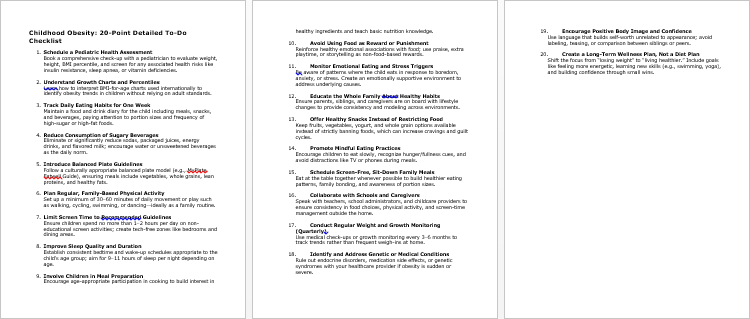
Childhood Obesity – Checklist
Childhood Obesity – FAQs
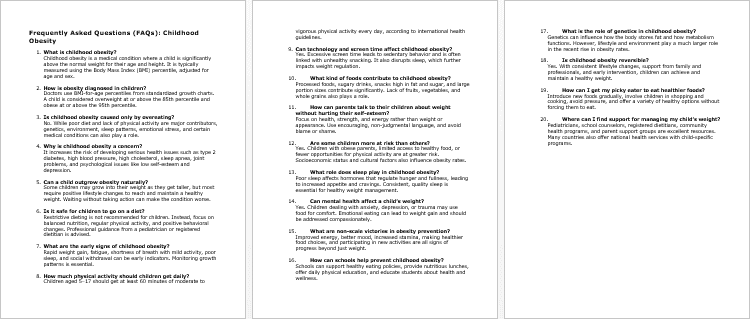
Childhood Obesity – Salespage Content
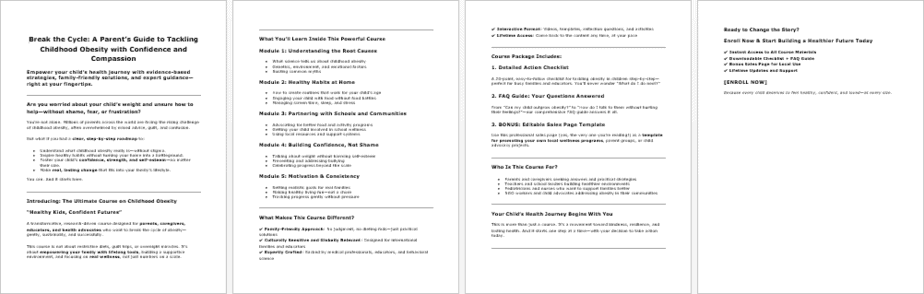
Package Details:
Word Count: 21 065 Words
Number of Pages: 117
Childhood Obesity – Bonus Content
Checklist
Word Count: 566 words
FAQs
Word Count: 701 words
Salespage Content
Word Count: 636 words
Total Word Count: 22 968 Words
Your PLR License Terms
PERMISSIONS: What Can You Do With These Materials?
Sell the content basically as it is (with some minor tweaks to make it “yours”).
If you are going to claim copyright to anything created with this content, then you must substantially change at 75% of the content to distinguish yourself from other licensees.
Break up the content into small portions to sell as individual reports for $10-$20 each.
Bundle the content with other existing content to create larger products for $47-$97 each.
Setup your own membership site with the content and generate monthly residual payments!
Take the content and convert it into a multiple-week “eclass” that you charge $297-$497 to access!
Use the content to create a “physical” product that you sell for premium prices!
Convert it to audios, videos, membership site content and more.
Excerpt and / or edit portions of the content to give away for free as blog posts, reports, etc. to use as lead magnets, incentives and more!
Create your own original product from it, set it up at a site and “flip” the site for megabucks!
RESTRICTIONS: What Can’t You Do With These Materials?
To protect the value of these products, you may not pass on the rights to your customers. This means that your customers may not have PLR rights or reprint / resell rights passed on to them.
You may not pass on any kind of licensing (PLR, reprint / resell, etc.) to ANY offer created from ANY PORTION OF this content that would allow additional people to sell or give away any portion of the content contained in this package.
You may not offer 100% commission to affiliates selling your version / copy of this product. The maximum affiliate commission you may pay out for offers created that include parts of this content is 75%.
You are not permitted to give the complete materials away in their current state for free – they must be sold. They must be excerpted and / or edited to be given away, unless otherwise noted. Example: You ARE permitted to excerpt portions of content for blog posts, lead magnets, etc.
You may not add this content to any part of an existing customer order that would not require them to make an additional purchase. (IE You cannot add it to a package, membership site, etc. that customers have ALREADY paid for.)
Share Now!
Latest Products




Free Sales Funnel Builder

Related Products

Popular & Trending

Featured Products