
Breathe Better PLR Course 33k Words
in Health PLR , Health PLR eBooks , PLR Checklists , PLR eBooks , PLR eCourses , PLR List Building Reports , Premium PLR , Premium PLR Emails , Premium PLR Reports , Premium White Label Brandable PLR Coaching Courses , Private Label Rights Products , Wellness PLR , Wellness PLR eBooksChoose Your Desired Option(s)
has been added to your cart!
have been added to your cart!
#breathebetter #lunghealth #wellness #healthandwellness #plrcourse #breathingtechniques #plrcontent #naturalhealth
Turn the World’s Most Underrated Wellness Skill into a Premium Offer—Under Your Brand
Breathwork has surged from niche interest to mainstream must-have because it’s simple, science-supported, and life-changing. Yet most people still breathe shallowly, live in a constant stress response, and don’t know how to fix it. Breathe Better solves that with a clear, practical curriculum that teaches any beginner how to breathe correctly for energy, calm, focus, and sleep.
With full Private Label Rights, this isn’t just a high-value wellness course—it’s a complete rebrandable asset you can launch as your own program, bundle into memberships, turn into a video course, or use as the backbone of a coaching offer.
Introducing the…
Breathe Better PLR Course 33k Words
Who This Is Perfect For
- Wellness coaches, yoga and Pilates instructors, fitness trainers, and meditation teachers who want a structured breathwork curriculum.
- Health bloggers, creators, and PLR store owners seeking a premium, evergreen product.
- Therapists, counselors, and corporate well-being providers who need a practical stress-reduction program.
- Local studios and gyms wanting a turnkey “Breath Basics” workshop series or 5-week class.
Clear, Compelling Transformation
By the end of the course, learners will:
- Understand how breathing mechanics affect energy, mood, digestion, sleep, and recovery.
- Identify and correct unhelpful patterns like shallow, chest-driven breathing.
- Master core and advanced techniques (diaphragmatic, box, 4-7-8, alternate nostril, targeted holds, energizing patterns).
- Integrate breathwork into work, study, workouts, and nightly wind-down routines.
- Build a personalized daily breathing practice that actually sticks.
What’s Inside the Breathe Better Course
The program includes five progressive modules with four lessons each, written in a friendly, accessible voice. It’s plug-and-play for you and crystal-clear for your audience.
Module 1: Understanding Your Breath
Foundation, clarity, and science in simple terms.
- Lesson 1: The Science of Breathing
A plain-language explanation of oxygen exchange, CO₂ tolerance, and why efficient breathing supports the brain, heart, and muscles. - Lesson 2: Common Breathing Mistakes
The pitfalls of mouth breathing, over-breathing, and chest dominance—and how they spike stress and drain energy. - Lesson 3: Benefits of Deep Breathing
The measurable upsides: improved mental clarity, lower anxiety, steadier energy, and better cardiovascular efficiency. - Lesson 4: Breathing and Your Nervous System
How breath toggles the sympathetic/parasympathetic response and how to consciously “downshift” out of stress.
Outcome: Learners see why breath is the master skill for calm, focus, and resilience.
Module 2: Assessing Your Current Breathing
Awareness first; change second.
- Lesson 1: Breathing Self-Check
A simple at-home assessment to map current patterns without judgment. - Lesson 2: Recognizing Stress Breathing
Real-life cues that signal shallow or hurried breath—and how to interrupt them quickly. - Lesson 3: Posture and Breathing Connection
How head, neck, and rib positioning limit expansion; practical cues to restore space. - Lesson 4: Breathing Diary
A short daily tracking framework to reinforce progress and reveal triggers.
Outcome: Learners uncover when, where, and why their breathing goes off track.
Module 3: Core Breathing Techniques
Foundational practices anyone can master.
- Lesson 1: Diaphragmatic Breathing
Step-by-step coaching for deep, efficient, belly-led breaths that calm and oxygenate. - Lesson 2: Box Breathing
Even-count inhale, hold, exhale, hold—for balance, poise, and focus. - Lesson 3: 4-7-8 Breathing
A proven, soothing pattern to release tension and prepare the body for sleep. - Lesson 4: Alternate Nostril Breathing
A traditional technique to steady the mind and smooth nervous system arousal.
Outcome: Learners gain a toolkit of dependable, go-to techniques.
Module 4: Advanced Breathing Practices
For energy, emotional regulation, and deeper awareness.
- Lesson 1: Breath Holds and Controlled Exhalations
Safely expand CO₂ tolerance and sharpen mental clarity with progressive protocols. - Lesson 2: Energizing Breathwork
Uplifting patterns to increase alertness and motivation without caffeine. - Lesson 3: Stress-Release Breath Patterns
On-the-spot resets for meetings, conflict, or performance nerves. - Lesson 4: Mindful Breath Awareness
Weaving attention and breath into a daily awareness practice.
Outcome: Learners tailor breath to the moment—up or down, focus or flow.
Module 5: Breathing for Everyday Life
Integration for lasting results.
- Lesson 1: Breathing at Work and Study
Micro-breaks, posture resets, and 60-second calmers for cognitive endurance. - Lesson 2: Breathing for Exercise and Fitness
Bracing, pacing, and recovery breath for strength, cardio, and mobility sessions. - Lesson 3: Breathing for Sleep
An evening downshift routine that trains the body to settle and stay asleep. - Lesson 4: Creating a Personal Breathing Routine
A choose-your-own daily plan with morning, midday, and evening options.
Outcome: Breath becomes a lifestyle habit, not a one-off exercise.
Assets You Receive (Ready to Rebrand and Sell)
- The complete 31,655-word course (modular and well-structured).
- Breathe Better Checklist to keep learners on track.
- Breathe Better FAQs addressing common objections, safety, and technique tips.
- Done-For-You Sales Page you can publish with your brand, visuals, and buy buttons.
- Full PLR licensing so you can edit, repackage, and profit.
Why This Sells (and Sticks)
- Breathwork provides instant wins people can feel today—in stress levels, clarity, and sleep—making it easy to recommend and share.
- The topic is evergreen and cross-niche: stress management, productivity, fitness, sleep, mental health, corporate wellness.
- The course blends science and practice without jargon, making it accessible to complete beginners while still useful for pros.
12 Proven Ways to Use and Profit from the Breathe Better PLR
- Sell as a flagship course on your site or storefront (great price bands: $47–$197).
- Record it as a video program (screen + voice or live demonstrations) and sell at a premium ($197–$397).
- Run it as a 5-week live cohort—teach one module per week with Q&A and charge $197–$497.
- Bundle with yoga, meditation, or sleep content to create a high-value wellness pack.
- License to workplaces as a corporate well-being workshop series.
- Convert to a mini-book series—sell each module as a short guide for $9–$19 or bundle as a $49 compendium.
- Use Module 1 as a free lead magnet and upsell the full course via email.
- Create a podcast or YouTube series from each lesson and drive viewers to the full program.
- Offer it as a members-only course inside your wellness membership for recurring revenue.
- Turn lessons into an email course (20-day breath challenge) that sells coaching on the backend.
- Deliver in-studio or in-gym workshops and sell the digital program as the take-home version.
- Flip it: rebrand, package with a sales page and checkout, and sell the completed funnel as a done-for-you asset.
Your PLR Rights (Simple Summary)
You CAN:
- Edit, rebrand, and sell the content as your own.
- Convert it to audio, video, workshops, or print.
- Add it to a paid membership site or bundle.
- Excerpt and/or edit portions for blog posts, lead magnets, email sequences, or social content.
- Break it into smaller products or sell as reports.
You CANNOT:
- Pass PLR or resale rights to your customers.
- Give away the complete materials in their current state for free.
- Offer 100% commission to affiliates for offers containing this content (max 75%).
- Add to an existing order a customer has already paid for without an additional purchase.
These terms protect your investment and maintain the value of the product across the market.
What Makes Breathe Better Different
- Clarity without fluff: Every lesson is practical, coach-ready, and outcome-driven.
- Modular structure: Deliver as a course, workshop, challenge, or serialized content.
- Universal relevance: Breath affects everything—from stress and sleep to performance and relationships.
- Fast to launch: You get curriculum, checklist, FAQs, and a sales page. Add your branding and you’re live.
What You’ll Receive Today
- Complete 31,655-word Breathe Better course content
- Checklist for quick reference and habit formation
- FAQs to overcome buyer objections and guide safe use
- Done-For-You Sales Page to speed up launch
- PLR License granting rebrand and resale rights under your brand
Help Your Audience Feel the Difference in a Single Session—Then Build a Lasting Habit
Breath is the gateway to a calmer mind, better sleep, sharper focus, and steadier energy. With Breathe Better PLR, you can put a proven, step-by-step breathwork system into the hands of your audience—while building a new revenue stream for your brand.
Add Breathe Better PLR Course to your catalog now and launch a wellness offer that genuinely changes lives—starting with the very next breath.
has been added to your cart!
have been added to your cart!
Here A Sample of the Breathe Better PLR Course
Discover the secrets to healthier, deeper, and more effective breathing for energy, calm, and overall wellbeing.
Module 1: Understanding Your Breath
Overview:
In this module, we’ll explore the fundamentals of breathing—how it works, why it matters, and how it affects your body and mind.
Lesson 1: The Science of Breathing
Objective: By the end of this lesson, you will understand the physiological process of breathing, how oxygen impacts every system in your body, and why proper breathing is essential for health, energy, and wellbeing.
Step 1: Recognizing the Role of Breathing
Breathing is one of the most fundamental processes in the human body, yet it is often taken for granted. Unlike many body functions, breathing can be both involuntary and voluntary. In other words, your body continues to breathe automatically without your conscious effort, but you can also control your breath whenever you want. This dual nature makes breathing uniquely powerful.
The primary role of breathing is to supply oxygen to the body and remove carbon dioxide, a waste product. Every cell in your body relies on oxygen to produce energy, maintain function, and support life. Oxygen fuels the production of adenosine triphosphate (ATP), which is the energy currency your body uses to perform physical and mental tasks. Without oxygen, cells begin to malfunction, and eventually, the body cannot survive.
In this step, you will reflect on your current awareness of breathing. Close your eyes for a moment and notice your breath. Where do you feel it most prominently—your chest, your stomach, or your throat? Most people are unaware that many of their breaths are shallow and limited to the upper chest. This is an important observation because the depth and quality of your breath influence the oxygen supply to your body and the state of your nervous system.
Step 2: Understanding the Mechanics of Breathing
Breathing involves a complex interaction of muscles, nerves, and organs. The primary muscles of breathing include the diaphragm, intercostal muscles (between the ribs), and accessory muscles in the neck and shoulders.
- Inhalation (Breathing In)
When you inhale, the diaphragm contracts and moves downward, creating more space in the chest cavity. This negative pressure allows the lungs to expand and fill with air. The intercostal muscles also help lift the rib cage, further increasing lung capacity. Oxygen-rich air enters the lungs, reaching tiny air sacs called alveoli, where oxygen diffuses into the blood. - Exhalation (Breathing Out)
Exhalation is typically a passive process. The diaphragm relaxes and moves upward, and the lungs contract, expelling carbon dioxide from the body. However, with controlled breathing practices, exhalation can become an active process, which is crucial for releasing tension, calming the nervous system, and regulating oxygen levels.
Understanding these mechanics is critical for appreciating why proper breathing matters. Many people rely on shallow chest breathing, which only partially inflates the lungs, limiting oxygen intake and increasing stress. Learning to engage the diaphragm and expand the lungs fully ensures more efficient oxygen delivery and better overall health.
Step 3: Oxygen and the Body Systems
Once oxygen enters the blood, it travels through the circulatory system to every cell in your body. Oxygen is not only necessary for energy production but also plays a key role in maintaining proper organ function, cellular repair, and brain activity.
- Brain Function: The brain consumes approximately 20% of the body’s oxygen supply. Proper breathing ensures that neurons receive sufficient oxygen, supporting cognitive function, memory, concentration, and decision-making. Shallow or irregular breathing can cause brain fog, fatigue, and reduced mental clarity.
- Cardiovascular System: Oxygen-rich blood supports the heart and circulatory system. Deep, controlled breathing can improve circulation, reduce blood pressure, and enhance overall cardiovascular health.
- Muscular System: Oxygen fuels muscle contraction and endurance. Athletes often focus on breathing techniques to maximize performance and recovery. Even daily activities like walking, climbing stairs, or lifting objects rely on efficient oxygen supply to muscles.
- Immune System: Proper oxygenation helps immune cells function effectively. Cells require oxygen to fight infections and repair damage. Poor breathing can compromise immunity over time.
- Digestive System: Oxygen supports the metabolism of nutrients in the digestive tract. Controlled breathing can also influence the nervous system to improve digestion and reduce stress-related digestive issues.
Step 4: Carbon Dioxide and Its Role
While oxygen is crucial, carbon dioxide (CO₂) is equally important. CO₂ is not just a waste product; it plays a vital role in maintaining the body’s pH balance and regulating the release of oxygen to tissues. A delicate balance of oxygen and carbon dioxide ensures optimal cell function.
Many people over-breathe, consciously or unconsciously, by taking rapid shallow breaths. This reduces carbon dioxide levels in the blood, which can cause dizziness, lightheadedness, and tension. Learning to regulate both inhalation and exhalation helps maintain the proper oxygen-CO₂ balance, enhancing overall health and mental stability.
Step 5: Breathing and the Nervous System
Your breathing patterns have a direct impact on your nervous system. The autonomic nervous system has two primary branches:
- Sympathetic Nervous System: Activates the “fight or flight” response, increasing heart rate and energy in stressful situations.
- Parasympathetic Nervous System: Activates the “rest and digest” response, promoting relaxation, repair, and calmness.
Shallow, rapid breathing tends to stimulate the sympathetic nervous system, keeping the body in a state of alertness and stress. In contrast, slow, deep breathing activates the parasympathetic system, reducing stress, lowering blood pressure, and promoting relaxation. Understanding this connection is essential for using breath as a tool for mental and emotional control.
Step 6: Common Breathing Patterns and Their Effects
People typically exhibit one of three breathing patterns:
- Chest Breathing: Shallow and quick, mainly in the upper chest. Often linked to stress, anxiety, and limited oxygen supply.
- Diaphragmatic Breathing: Deep breathing that engages the diaphragm. Promotes relaxation, better oxygenation, and improved energy.
- Combination Breathing: Uses both chest and diaphragm. Can be effective if balanced, but often people favor the chest, reducing efficiency.
Awareness of your natural breathing pattern is the first step toward improving it. Most international health studies indicate that retraining your breath toward diaphragmatic patterns can improve mental clarity, emotional balance, and physical performance.
Step 7: Breath and Emotional Health
Breathing is tightly linked to emotion. Anxiety, stress, and excitement often cause shallow, rapid breathing. Conversely, intentional deep breathing can calm the mind, reduce cortisol levels, and stabilize mood.
In this lesson, consider the following reflective exercise: recall a recent stressful event and notice how your breathing changed. Did it become rapid, shallow, or uneven? Understanding this natural connection allows you to use your breath intentionally to regulate emotions and maintain calm under pressure.
Step 8: Daily Impacts of Proper Breathing
Proper breathing doesn’t just influence physical and emotional health; it affects your daily life in practical ways:
- Energy Levels: Efficient oxygen delivery helps prevent fatigue and supports sustained focus throughout the day.
- Stress Management: Conscious breathing techniques can quickly lower stress and restore balance.
- Sleep Quality: Better oxygenation and parasympathetic activation improve relaxation and sleep patterns.
- Performance: Athletes, performers, and even office workers benefit from improved stamina, clarity, and resilience through proper breathing.
By recognizing these benefits, you can start appreciating breathing not just as a basic function, but as a powerful tool for personal improvement and wellbeing.
Step 9: Practical Observation Exercise
To internalize the science of breathing, try this simple exercise:
- Sit comfortably and close your eyes.
- Take three natural breaths and notice where you feel the air the most. Is it shallow or deep? Chest or abdomen?
- Observe your heart rate, posture, and mental state before and after three deep breaths.
- Reflect on the difference between your automatic breath and intentional breath.
This exercise highlights the immediate effects of breath awareness and sets the stage for the techniques we will explore in later modules.
Step 10: Key Takeaways from Lesson 1
- Breathing is essential for delivering oxygen and removing carbon dioxide, supporting all body systems.
- Shallow chest breathing limits oxygen supply and can contribute to stress, fatigue, and poor health.
- Deep, diaphragmatic breathing enhances energy, mental clarity, and emotional balance.
- Breathing patterns influence the nervous system and can be consciously controlled to promote relaxation or alertness.
- Awareness of your natural breathing is the first step toward improved health, performance, and overall wellbeing.
This foundational understanding provides a scientific basis for all breathing exercises, techniques, and routines you will learn in subsequent lessons. It demonstrates that proper breathing is not only about relaxation but is a critical tool for enhancing physical, mental, and emotional health.
By integrating this knowledge into your daily life and teaching it to others, you can help learners worldwide understand that proper breathing is an accessible, transformative practice with profound implications for health, energy, and performance.
This completes Module 1, Lesson 1: The Science of Breathing, providing an in-depth, step-by-step explanation of why breathing matters and how it impacts the body, mind, and emotions.
Lesson 2: Common Breathing Mistakes
Overview:
In the first lesson, we explored the science of breathing and the vital role it plays in your body, mind, and overall wellbeing. In this lesson, we will dive deeper into common breathing mistakes. Understanding these patterns is crucial because improper breathing can undermine energy, productivity, and emotional balance, even if you are otherwise healthy. Recognizing these mistakes allows you to correct them and make breathing a powerful tool for wellness.
Step 1: Identifying Shallow Breathing
Shallow breathing is perhaps the most widespread and often unnoticed breathing mistake. This pattern is usually characterized by small, rapid breaths confined to the upper chest. Instead of fully engaging the diaphragm and expanding the lungs, shallow breathing relies heavily on accessory muscles in the neck and shoulders.
- Why it happens: Stress, tension, poor posture, and lifestyle habits often encourage shallow breathing. Many people carry their stress in their upper body without even realizing it, which naturally restricts lung expansion.
- Effects: Shallow breathing decreases oxygen intake, which can result in fatigue, headaches, dizziness, and reduced mental clarity. It also triggers the sympathetic nervous system, keeping your body in a state of alertness or stress.
To observe shallow breathing, place one hand on your chest and one hand on your abdomen. Breathe naturally for a few moments. Notice which hand rises more prominently. If your chest rises more than your abdomen, you are likely using shallow breathing most of the time.
Step 2: Chest-Focused Breathing
Chest-focused breathing is a subset of shallow breathing. While shallow breathing may involve quick, uneven breaths, chest-focused breathing often involves more controlled but still limited chest movements. Many people mistakenly think that filling the chest with air is sufficient for oxygen supply, but this style does not fully utilize the lungs’ capacity.
- Physiological impact: Chest-focused breathing restricts diaphragm movement, limiting oxygen exchange. As a result, your body receives less oxygen with every breath, causing cells to work harder and increasing metabolic stress.
- Psychological impact: Chest breathing often corresponds with tension, anxiety, and a sense of urgency. When under pressure, your breathing naturally shifts to the chest, reinforcing the body’s stress response.
International research emphasizes that habitual chest-focused breathing contributes to chronic stress, elevated cortisol levels, and a weakened immune response over time.
Step 3: Breath Holding and Irregular Patterns
Another common mistake is unintentional breath holding or irregular breathing patterns. Many people unconsciously hold their breath during moments of concentration, stress, or physical exertion. For example, you might notice yourself holding your breath while typing, lifting objects, or listening intently during a conversation.
- Consequences: Breath holding can elevate blood pressure, increase tension in the neck and shoulders, and reduce oxygen availability to the brain. This pattern also disrupts the rhythm of the nervous system, leading to fatigue, irritability, and reduced cognitive performance.
- Observation exercise: Sit quietly and pay attention to your natural breathing for a few minutes. Notice any pauses or irregularities in your inhalation or exhalation. Recognizing these tendencies is the first step in correcting them.
Over time, irregular breathing patterns can become deeply ingrained, making conscious practice essential for improvement.
Step 4: Rapid, Shallow Breaths and Hyperventilation
Rapid, shallow breathing, also known as hyperventilation, is another common mistake, especially during stress, anxiety, or physical activity. This pattern causes a disproportionate loss of carbon dioxide from the body. Many people assume that breathing faster automatically provides more oxygen, but the reality is more complex.
- Physiological impact: Carbon dioxide is necessary for maintaining blood pH and facilitating the release of oxygen to tissues. Hyperventilation reduces carbon dioxide levels, impairing oxygen delivery and causing dizziness, tingling in the hands and feet, and a sense of panic.
- Psychological impact: Rapid breathing reinforces anxiety and nervous tension. It creates a feedback loop where stress causes hyperventilation, which in turn increases stress and anxiety.
To identify this pattern, observe your breathing when you are stressed or excited. Count the number of breaths in one minute without trying to change your pattern. If the count is unusually high, your body may be relying on rapid shallow breathing, which can be corrected with mindful exercises.
Step 5: Mouth Breathing versus Nasal Breathing
Mouth breathing is a widespread habit, often overlooked as a breathing mistake. Many people breathe through their mouths, particularly during sleep, exercise, or stress. While mouth breathing can feel easier in the short term, it bypasses the benefits of nasal filtration and humidification.
- Health consequences: Mouth breathing can dry the oral cavity, increase susceptibility to infections, and reduce nitric oxide production—a molecule that improves oxygen uptake in the lungs. Chronic mouth breathing is associated with sleep disturbances, snoring, and even altered facial structure over time.
- Breathing efficiency: Nasal breathing slows the breath, encourages diaphragmatic engagement, and ensures a more efficient exchange of oxygen and carbon dioxide. It also activates the parasympathetic nervous system, promoting calmness and relaxation.
Exercise to observe: Close your mouth and breathe exclusively through your nose for two minutes. Notice the difference in how your body feels and how your breath naturally deepens.
Step 6: Upper Body Tension and Posture-Related Breathing Mistakes
Posture plays a crucial role in breathing efficiency. Many breathing mistakes originate from poor posture, such as slouching, rounded shoulders, or forward head positions. These postural habits compress the chest cavity, limit lung expansion, and force reliance on chest and accessory muscles.
- Effects on breathing: Slouched posture can reduce lung capacity by up to 30%, forcing shallow, inefficient breaths. Over time, this contributes to chronic fatigue, poor oxygenation, and muscular tension.
- Effects on energy and stress: Restricted breathing amplifies the body’s stress response, increasing cortisol and adrenaline. This can create a cycle of tension and fatigue.
Observation tip: Stand tall with shoulders relaxed and spine aligned. Take a deep breath. Notice how much easier it is to fill the lungs compared to a slouched position. This demonstrates the direct link between posture and breathing quality.
Step 7: Habitual Breathing Mistakes and Lifestyle Factors
Modern lifestyles contribute significantly to common breathing mistakes. Long hours sitting at a desk, staring at screens, chronic stress, and lack of physical activity encourage shallow, chest-dominant breathing.
- Sedentary habits: Sitting compresses the diaphragm and limits natural lung expansion. Over time, this leads to habitual shallow breathing.
- Stressful environments: Workplace pressure, urban noise, and multitasking can trigger chest-focused, rapid breaths.
- Lack of awareness: Many people have never learned to breathe consciously, and their habits persist without conscious recognition.
By becoming aware of these influences, learners can begin to identify situations in daily life that trigger poor breathing patterns and take steps to counteract them.
Step 8: How Breathing Mistakes Affect Energy Levels
Breathing mistakes directly impact energy levels. Shallow, rapid, or irregular breaths reduce oxygen supply to the cells, forcing the body to work harder to meet energy demands. Common effects include:
- Fatigue and lethargy
- Brain fog and difficulty concentrating
- Increased tension and irritability
- Reduced endurance during physical activity
Proper awareness and correction of these mistakes allow the body to utilize oxygen more efficiently, improving stamina, alertness, and overall vitality.
Step 9: How Breathing Mistakes Affect Stress Levels
Breathing is closely linked to emotional regulation. Chest-focused, shallow, or rapid breathing activates the sympathetic nervous system, creating a heightened stress response. Over time, habitual breathing mistakes can contribute to chronic stress, anxiety, and mood imbalances.
- Sympathetic activation: Shallow and rapid breaths signal the body that it is under threat, increasing heart rate and tension.
- Parasympathetic suppression: Inefficient breathing reduces activation of the rest-and-digest system, making it harder to relax, sleep, and recover from stress.
By correcting these mistakes, learners can use breathing as a deliberate tool to reduce stress and enhance mental clarity.
Step 10: Reflection and Awareness Exercise
To help learners recognize their own breathing mistakes, include the following exercise:
- Sit comfortably with a straight spine.
- Observe your natural breath for five minutes without altering it.
- Identify whether your breath is shallow, chest-focused, rapid, or irregular.
- Note any tension in the shoulders, neck, or chest.
- Reflect on how your breathing pattern might influence your energy, mood, and focus throughout the day.
This exercise builds awareness, which is essential for correcting habits and improving breath quality.
Step 11: Key Takeaways from Lesson 2
- Shallow breathing limits oxygen intake, reduces energy, and increases stress.
- Chest-focused breathing restricts diaphragm movement and triggers the sympathetic nervous system.
- Irregular or rapid breathing disrupts oxygen and carbon dioxide balance, creating fatigue and anxiety.
- Mouth breathing bypasses nasal benefits and reduces breathing efficiency.
- Posture and lifestyle significantly influence breathing quality.
- Awareness of these common mistakes is the first step toward improving breath control, energy, and mental clarity.
By understanding these patterns, learners are equipped to identify and correct their own breathing habits. Recognizing mistakes is a critical step in building healthier, more efficient breathing practices, laying the foundation for the techniques and exercises that follow in subsequent lessons.
Lesson Summary:
Breathing is much more than a simple automatic process. Common mistakes such as shallow, chest-focused, rapid, irregular, or mouth-based breathing can significantly impact your energy, stress levels, and overall health. By increasing awareness and understanding the physiological and psychological consequences of these habits, learners are empowered to take control of their breath and unlock the full benefits of proper breathing.
This completes Module 1, Lesson 2: Common Breathing Mistakes, providing an in-depth exploration of why most people breathe inefficiently, how these mistakes affect their body and mind, and how to recognize patterns that need correction.
Lesson 3: Benefits of Deep Breathing
Overview:
In the previous lessons, we explored the science of breathing and common breathing mistakes that reduce oxygen efficiency and increase stress. In this lesson, we focus on the transformative potential of deep breathing. Deep breathing is more than a relaxation technique; it is a powerful tool for enhancing mental clarity, reducing anxiety, and improving physical health. By practicing deep, diaphragmatic breathing, learners can significantly improve the quality of their life, both mentally and physically.
Step 1: Understanding Deep Breathing
Deep breathing, also known as diaphragmatic or abdominal breathing, involves fully engaging the diaphragm while inhaling, allowing the lungs to expand fully and maximize oxygen intake. Unlike shallow chest breathing, deep breathing uses the lower part of the lungs, improves oxygen exchange, and facilitates relaxation.
- Mechanics of deep breathing: When you inhale deeply, the diaphragm contracts and moves downward, pushing the abdominal contents outward. This expands the lower lungs and allows air to fill alveoli that often remain underutilized during shallow breathing. On exhalation, the diaphragm relaxes, aiding in the removal of carbon dioxide and toxins.
- Difference from shallow breathing: Deep breathing increases lung capacity and oxygen delivery while reducing tension in the shoulders, neck, and upper chest. Shallow breathing limits oxygen supply and often leaves the body in a heightened state of stress.
Deep breathing is a natural state that most people experience as infants but gradually lose with age, stress, and lifestyle habits. Relearning and practicing this type of breathing can restore balance and health.
Step 2: Mental Clarity and Focus
One of the most immediate and noticeable benefits of deep breathing is enhanced mental clarity. The brain is highly sensitive to oxygen levels, consuming approximately 20% of the body’s oxygen. By increasing oxygen delivery through deep breathing, the brain functions more efficiently.
- Improved cognitive function: Deep breathing ensures that neurons receive sufficient oxygen to maintain optimal electrical activity. This supports memory, focus, and problem-solving abilities.
- Reduced mental fatigue: Many people experience brain fog due to shallow breathing and low oxygen levels. Deep breathing increases alertness and reduces fatigue, allowing learners to stay productive for longer periods.
- Step-by-step exercise for mental clarity:
- Sit or lie down in a comfortable position.
- Place one hand on your abdomen and the other on your chest.
- Inhale deeply through your nose for four counts, allowing your abdomen to expand.
- Hold the breath for two counts.
- Exhale slowly through your mouth for six counts, feeling the abdomen contract.
- Repeat for five minutes, focusing on the flow of air and the sensations in your body.
This practice enhances oxygenation to the brain and improves your ability to focus and think clearly.
Step 3: Stress Reduction and Anxiety Relief
Deep breathing is one of the most effective techniques for reducing stress and managing anxiety. The mechanism lies in the connection between breathing and the autonomic nervous system.
- Parasympathetic activation: Deep, slow breaths stimulate the parasympathetic nervous system, promoting the rest-and-digest response. This counters the effects of chronic stress by lowering heart rate, reducing blood pressure, and calming the mind.
- Reduction of cortisol levels: Chronic stress increases cortisol production, which negatively affects mood, metabolism, and immune function. Deep breathing reduces cortisol, allowing the body to return to a state of balance.
- Step-by-step relaxation exercise:
- Find a quiet place and sit comfortably.
- Close your eyes and inhale deeply through the nose for a count of five.
- Visualize tension leaving your body with each exhale.
- Exhale slowly for a count of eight, letting go of mental clutter.
- Continue this pattern for 10 minutes while focusing on the sensations in your body.
Regular practice of deep breathing provides tools to manage anxiety and stress in real-time, improving emotional resilience.
Step 4: Physical Health Benefits
Deep breathing positively affects almost every system in the body. The physical benefits extend beyond relaxation, contributing to long-term health improvements.
- Enhanced oxygenation: Deep breathing maximizes oxygen intake, improving cellular function and energy production.
- Cardiovascular health: It reduces heart rate and blood pressure, supporting heart health and circulation.
- Lung capacity and respiratory efficiency: Regular practice strengthens the diaphragm and intercostal muscles, enhancing overall lung function.
- Detoxification: Controlled exhalation helps remove carbon dioxide and other metabolic waste products more efficiently.
- Digestive support: Deep breathing stimulates the vagus nerve, improving digestive processes and nutrient absorption.
These physiological benefits demonstrate that deep breathing is not just a relaxation technique but a foundational practice for long-term physical wellness.
Step 5: Emotional Balance and Mood Enhancement
Emotional health is closely tied to breathing patterns. Deep breathing helps regulate emotions by influencing the nervous system and brain chemistry.
- Reduction of negative emotions: Slow, deep breaths reduce the activation of the sympathetic nervous system, which is often associated with fear, anxiety, and irritability.
- Increased feelings of calm: Parasympathetic activation promotes feelings of safety, calm, and emotional stability.
- Improved mood through oxygen supply: Adequate oxygen to the brain supports neurotransmitter production, including serotonin and dopamine, which regulate mood and motivation.
Deep breathing thus becomes a natural tool for emotional self-regulation, helping learners navigate challenges with greater calm and resilience.
Step 6: Enhanced Energy and Vitality
Contrary to the misconception that deep breathing is only relaxing, it also boosts energy levels. By fully oxygenating the blood and removing carbon dioxide efficiently, deep breathing revitalizes the body.
- Energy renewal: Increased oxygen availability improves ATP production in cells, providing more energy for physical and mental activities.
- Reduced fatigue: Deep breathing prevents the sluggishness caused by oxygen deprivation and shallow breathing.
- Step-by-step energizing exercise:
- Stand or sit upright with shoulders relaxed.
- Inhale deeply through your nose for four counts, expanding the abdomen.
- Exhale forcefully through the mouth for four counts, engaging the diaphragm.
- Repeat for one minute while maintaining a rhythm.
- Observe the immediate sensation of alertness and vitality.
This practice is particularly useful in the morning or before tasks requiring focus and energy.
Step 7: Impact on Sleep Quality
Deep breathing supports restorative sleep by promoting relaxation and reducing nighttime stress.
- Parasympathetic activation before sleep: Deep breathing slows the heart rate and calms the nervous system, preparing the body for restful sleep.
- Reduced insomnia symptoms: People who practice deep breathing before bed often report faster sleep onset, fewer nighttime awakenings, and improved sleep quality.
- Step-by-step bedtime exercise:
- Lie comfortably on your back with hands on your abdomen.
- Inhale slowly through the nose for four counts.
- Hold the breath gently for two counts.
- Exhale through the mouth for six counts.
- Continue for five to ten minutes while focusing on relaxation.
Integrating this routine into daily life can significantly improve overall sleep health and support daily functioning.
Step 8: Deep Breathing and Mindfulness
Deep breathing is a cornerstone of mindfulness practices. By focusing on the breath, learners can anchor their attention in the present moment, reducing rumination and mental distractions.
- Mind-body connection: Conscious breathing enhances body awareness, helping individuals notice tension and stress before it escalates.
- Emotional regulation: Mindful breathing supports calm responses to triggers, reducing reactive behaviors.
- Step-by-step mindfulness exercise:
- Sit comfortably with eyes closed.
- Observe your natural breathing for one minute.
- Begin to lengthen inhales and exhales gradually, focusing on the rise and fall of your abdomen.
- Each time your mind wanders, gently return attention to the breath.
- Practice for ten minutes daily to enhance focus and mindfulness.
Through regular practice, learners can integrate mindfulness into daily activities, improving overall wellbeing.
Step 9: How Deep Breathing Supports Long-Term Health
Consistent deep breathing practice can lead to lasting improvements in both mental and physical health.
- Cardiovascular longevity: Lower heart rate and improved circulation support heart health.
- Immune function: Enhanced oxygenation and reduced stress strengthen immune defenses.
- Stress resilience: Regular practice decreases baseline stress and increases coping capacity.
- Cognitive enhancement: Improved oxygen delivery and focus support mental clarity and memory retention.
By viewing deep breathing as a long-term habit rather than a one-time exercise, learners can achieve sustainable benefits.
Step 10: Daily Integration of Deep Breathing
To make deep breathing an integral part of daily life, learners can implement simple routines:
- Morning energizing breaths: Begin the day with three to five minutes of deep, rhythmic breathing to activate the body and mind.
- Midday reset: Use short breathing sessions to manage stress, boost focus, and maintain energy.
- Evening relaxation: Incorporate deep breathing before bedtime to prepare the body for restorative sleep.
- During challenges: Whenever feeling anxious, frustrated, or overwhelmed, take intentional deep breaths to regain composure.
Consistency and awareness are key to unlocking the full benefits of deep breathing.
Step 11: Key Takeaways from Lesson 3
- Deep breathing engages the diaphragm, expanding lung capacity and maximizing oxygen intake.
- It enhances mental clarity, focus, and cognitive performance.
- Deep breathing reduces stress, anxiety, and cortisol levels by activating the parasympathetic nervous system.
- It improves physical health, including cardiovascular function, lung efficiency, and energy levels.
- Regular practice supports emotional balance, mood regulation, and mindfulness.
- Integrating deep breathing into daily routines creates long-term benefits for mental, physical, and emotional wellbeing.
Lesson Summary:
Deep breathing is a powerful, scientifically proven practice that impacts nearly every aspect of human health. By learning to breathe deeply, learners gain the tools to enhance mental clarity, reduce stress, boost energy, and support physical health. Recognizing the benefits and implementing daily practice creates a foundation for improved wellbeing, resilience, and quality of life. Deep breathing is not just a technique; it is a transformative habit that can change the way you live, think, and perform in daily life.
This completes Module 1, Lesson 3: Benefits of Deep Breathing, providing a comprehensive understanding of why deep breathing matters and how it enhances mental, emotional, and physical health.
Lesson 4: Breathing and Your Nervous System
Overview:
In the previous lessons, we explored the science of breathing, common mistakes, and the benefits of deep breathing. In this lesson, we will examine the profound connection between breath and the nervous system. Breathing is not merely a mechanical process; it directly influences the state of your nervous system, helping you manage stress, enhance focus, and achieve relaxation. Understanding this connection allows learners to consciously use their breath as a tool for regulating mental, emotional, and physical states.
Step 1: Introduction to the Nervous System
The nervous system is the body’s communication network. It regulates every function, from heartbeat and digestion to thought processes and emotional responses. It consists of two primary branches:
- Sympathetic Nervous System (SNS): Often referred to as the “fight or flight” system, it prepares the body for action during stress or danger. It increases heart rate, blood pressure, and respiratory rate while redirecting blood flow to muscles.
- Parasympathetic Nervous System (PNS): Known as the “rest and digest” system, it promotes relaxation, recovery, and restorative processes. It slows the heart rate, reduces blood pressure, and encourages digestion and repair.
Both systems work together to maintain homeostasis, but the balance can be disrupted by lifestyle, stress, and improper breathing patterns. Understanding how breath interacts with these systems is essential for using breathing as a tool for nervous system regulation.
Step 2: How Breathing Influences the Nervous System
Breathing is unique in that it can be both involuntary and voluntary. This duality provides a direct pathway to influence the autonomic nervous system. By adjusting the depth, rate, and rhythm of your breath, you can intentionally shift your nervous system from a state of stress (sympathetic dominance) to a state of relaxation (parasympathetic dominance).
- Shallow, rapid breaths: Activate the sympathetic nervous system, increasing alertness but also stress and tension.
- Deep, slow breaths: Stimulate the parasympathetic nervous system, promoting calmness, relaxation, and restoration.
This relationship forms the basis for many breathwork techniques used in stress management, meditation, yoga, and cognitive performance enhancement.
Step 3: Understanding the Vagus Nerve
A critical element in the breath-nervous system connection is the vagus nerve. The vagus nerve is the longest cranial nerve in the body and a key component of the parasympathetic nervous system. It connects the brain to multiple organs, including the heart, lungs, and digestive tract, and plays a major role in regulating internal body functions.
- Role in breathing: Deep, slow exhalations stimulate the vagus nerve, sending signals to the brain to reduce heart rate and promote relaxation.
- Health benefits: Regular vagal stimulation through conscious breathing has been associated with reduced anxiety, improved digestion, better sleep, and enhanced emotional resilience.
Step-by-step observation: Place a hand on your abdomen, inhale slowly for four counts, and exhale gently for six counts. Notice the calming effect on your body as the breath stimulates the parasympathetic system via the vagus nerve.
Step 4: Breathing Patterns and Nervous System States
Different breathing patterns have distinct effects on the nervous system. Understanding these patterns allows learners to select techniques tailored to their needs.
- Rapid, shallow breathing: Triggers sympathetic activation, increasing alertness and preparing the body for action. Useful briefly in emergencies but detrimental when chronic.
- Slow, controlled breathing: Enhances parasympathetic activity, promoting relaxation, reducing stress hormones, and improving digestion.
- Balanced rhythmic breathing: Supports homeostasis, allowing the nervous system to operate efficiently in both calm and active states.
Step-by-step practice: Sit comfortably and place one hand on your chest and one on your abdomen. Inhale deeply through your nose for four counts, pause for two counts, and exhale slowly for six counts. Repeat for five minutes, noticing how your body transitions from tension to relaxation.
Step 5: The Breath-Stress Connection
Chronic stress often leads to habitual shallow or chest-focused breathing, which in turn reinforces sympathetic dominance. This creates a feedback loop: stress causes rapid breathing, which increases cortisol and adrenaline, intensifying the feeling of stress.
- Physical symptoms: Elevated heart rate, tense muscles, headaches, and digestive disturbances.
- Emotional symptoms: Anxiety, irritability, and difficulty focusing.
- Mental symptoms: Racing thoughts, reduced clarity, and difficulty making decisions.
By recognizing and correcting these breathing patterns, learners can interrupt this feedback loop, reducing stress and restoring parasympathetic balance.
Step 6: Breathwork Techniques for Nervous System Regulation
Intentional breathwork provides practical tools for managing the nervous system. Below are some step-by-step techniques that target sympathetic and parasympathetic states:
- Calming Breath for Relaxation
- Sit comfortably with a straight spine.
- Inhale deeply through the nose for four counts, expanding the abdomen.
- Pause for two counts.
- Exhale slowly through the mouth for six counts, feeling tension release.
- Repeat for five to ten minutes to activate the parasympathetic system.
- Box Breathing for Stress Management
- Inhale for four counts.
- Hold the breath for four counts.
- Exhale for four counts.
- Hold again for four counts.
- Repeat for several cycles to achieve a balanced nervous system state.
- Stimulating Breath for Alertness
- Inhale quickly through the nose for one count.
- Exhale forcefully through the mouth for one count.
- Repeat 20-30 times to activate the sympathetic nervous system temporarily, useful for increasing focus and energy.
Step 7: Conscious Breath and Emotional Regulation
Emotions and breath are interconnected. Breath acts as a bridge between mind and body, allowing conscious influence over emotional states.
- Anxiety management: Slow, deep breaths can reduce the intensity of anxious feelings by calming the nervous system.
- Anger regulation: Controlled exhalations help release tension and prevent reactive behavior.
- Mood stabilization: Consistent practice of deep, rhythmic breathing supports emotional resilience, reducing susceptibility to mood swings.
Step-by-step emotional regulation exercise:
- Identify the emotion you are feeling, such as stress or frustration.
- Sit comfortably and inhale deeply for four counts.
- Hold briefly for two counts.
- Exhale slowly for six counts, visualizing the emotion leaving your body.
- Repeat for five minutes, noticing a shift toward calmness.
Step 8: Integrating Breath Awareness into Daily Life
The most effective way to influence the nervous system through breathing is consistent practice. Learners should integrate breath awareness into daily routines:
- Morning routine: Begin the day with five minutes of deep breathing to set a calm, alert tone.
- During work or study: Pause for two to three minutes of conscious breathing to maintain focus and reduce stress.
- Evening wind-down: Use slow, deep breaths to prepare the body and mind for restful sleep.
- During stressful moments: Recognize tension and use targeted breathing exercises to regain control over the nervous system.
Regular practice transforms breathing from a passive function into an active tool for self-regulation and wellbeing.
Step 9: Breathing and Physical Performance
Breath control not only impacts mental and emotional states but also affects physical performance. Athletes, performers, and individuals engaging in physical activities benefit from understanding and regulating their nervous system through breathing.
- Energy management: Slow, controlled breathing improves oxygen delivery to muscles, enhancing stamina and reducing fatigue.
- Focus under pressure: Conscious breathing helps maintain calmness and clarity during high-stress situations, such as competitions or presentations.
- Recovery: Post-activity deep breathing promotes parasympathetic activation, aiding recovery and reducing muscle tension.
Step-by-step performance breath exercise:
- Inhale deeply through the nose for four counts, focusing on oxygen reaching the abdomen and lungs.
- Exhale slowly through the mouth for six counts, releasing tension from muscles.
- Repeat for five minutes before or after physical activity to optimize nervous system balance and recovery.
Step 10: Observation and Self-Awareness Practice
To strengthen the connection between breath and the nervous system, learners can conduct a self-observation exercise:
- Sit quietly and observe your natural breath for five minutes.
- Note areas of tension in your body, such as shoulders, chest, or jaw.
- Try a few cycles of deep diaphragmatic breathing, focusing on slow, controlled exhalations.
- Observe changes in heart rate, muscle tension, and mental clarity.
- Reflect on how breathing affects your emotional and physical state throughout the day.
This exercise reinforces awareness, a critical first step for consciously using breath to regulate the nervous system.
Step 11: Key Takeaways from Lesson 4
- Breathing is a direct pathway to influence the autonomic nervous system.
- The sympathetic nervous system governs the fight-or-flight response, while the parasympathetic system promotes rest and relaxation.
- Deep, slow breaths activate the parasympathetic system, reducing stress, lowering heart rate, and promoting calm.
- The vagus nerve plays a critical role in transmitting signals from the breath to the brain and organs, enhancing relaxation and resilience.
- Different breathing patterns can stimulate or calm the nervous system, allowing conscious regulation of emotional and physical states.
- Integrating breath awareness into daily routines supports mental clarity, emotional stability, stress management, and overall wellbeing.
- Conscious breath control also enhances physical performance and recovery by balancing energy and nervous system activity.
Lesson Summary:
Breathing is more than a physiological process—it is a powerful tool to regulate the nervous system. By understanding the relationship between breath and the sympathetic and parasympathetic systems, learners gain practical strategies to manage stress, enhance mental clarity, improve emotional resilience, and optimize physical performance. Consistent awareness and practice of intentional breathing can transform daily life, providing balance, energy, and calm in a world filled with constant demands.
This completes Module 1, Lesson 4: Breathing and Your Nervous System, offering a comprehensive understanding of how breath influences the nervous system and providing actionable techniques for conscious regulation of stress and relaxation.
We’re also giving these extra bonuses
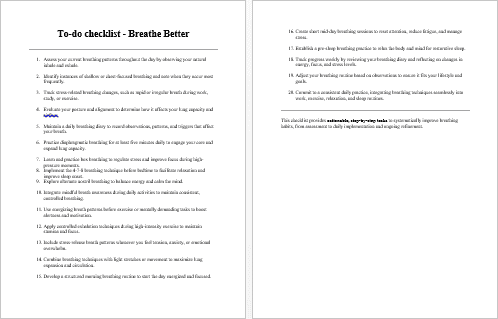
Breathe Better – Checklist
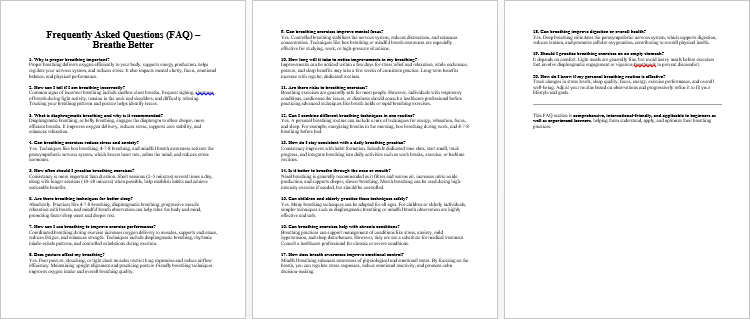
Breathe Better – FAQs
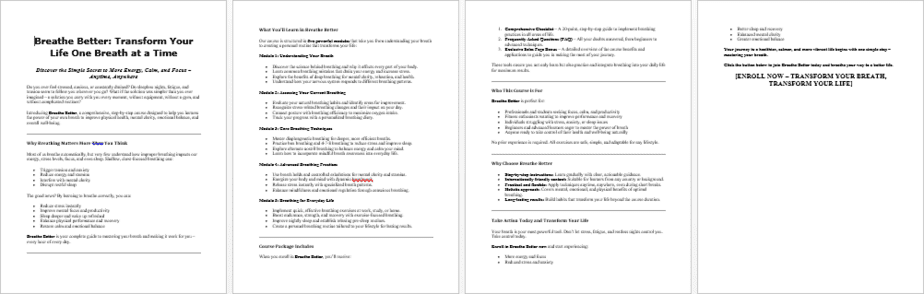
Breathe Better – Salespage Content
Package Details:
Word Count: 31 655 Words
Number of Pages: 138
Breathe Better – Bonus Content
Checklist
Word Count: 329 words
FAQs
Word Count: 802 words
Salespage Content
Word Count: 808 words
Total Word Count: 33 594 Words
Your PLR License Terms
PERMISSIONS: What Can You Do With These Materials?
Sell the content basically as it is (with some minor tweaks to make it “yours”).
If you are going to claim copyright to anything created with this content, then you must substantially change at 75% of the content to distinguish yourself from other licensees.
Break up the content into small portions to sell as individual reports for $10-$20 each.
Bundle the content with other existing content to create larger products for $47-$97 each.
Setup your own membership site with the content and generate monthly residual payments!
Take the content and convert it into a multiple-week “eclass” that you charge $297-$497 to access!
Use the content to create a “physical” product that you sell for premium prices!
Convert it to audios, videos, membership site content and more.
Excerpt and / or edit portions of the content to give away for free as blog posts, reports, etc. to use as lead magnets, incentives and more!
Create your own original product from it, set it up at a site and “flip” the site for megabucks!
RESTRICTIONS: What Can’t You Do With These Materials?
To protect the value of these products, you may not pass on the rights to your customers. This means that your customers may not have PLR rights or reprint / resell rights passed on to them.
You may not pass on any kind of licensing (PLR, reprint / resell, etc.) to ANY offer created from ANY PORTION OF this content that would allow additional people to sell or give away any portion of the content contained in this package.
You may not offer 100% commission to affiliates selling your version / copy of this product. The maximum affiliate commission you may pay out for offers created that include parts of this content is 75%.
You are not permitted to give the complete materials away in their current state for free – they must be sold. They must be excerpted and / or edited to be given away, unless otherwise noted. Example: You ARE permitted to excerpt portions of content for blog posts, lead magnets, etc.
You may not add this content to any part of an existing customer order that would not require them to make an additional purchase. (IE You cannot add it to a package, membership site, etc. that customers have ALREADY paid for.)
Share Now!
Latest Products




Free Sales Funnel Builder

Related Products

Popular & Trending


Featured Products