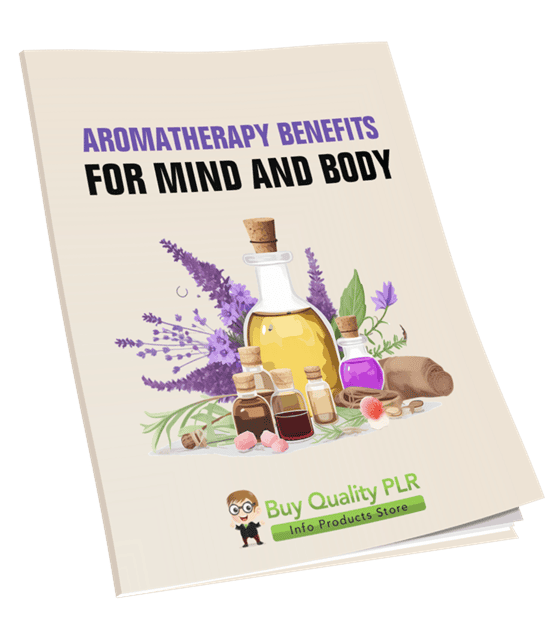
Aromatherapy Benefits for Mind and Body PLR Course 32k Words
in Essential Oils PLR , Health PLR eBooks , Heart Health PLR , Holistic Healing and Alternative Medicine PLR , PLR Checklists , PLR eBooks , PLR eCourses , PLR List Building Reports , Premium PLR , Premium PLR eBooks , Premium PLR Reports , Premium White Label Brandable PLR Coaching Courses , Private Label Rights Products , Self Care PLR , Wellness PLR , Wellness PLR eBooksChoose Your Desired Option(s)
has been added to your cart!
have been added to your cart!
#aromatherapy #essentialoils #wellnessplr #healthandwellness #holistichealing #mindandbody #naturaltherapy #plrcourse #selfcaretips #wellbeingjourney
A Complete Done-for-You Course You Can Sell, Rebrand, and Profit From Starting Today!
Over 31,000 Words of High-Quality, Editable Training Content
Are you looking for high-quality, in-demand wellness content you can sell immediately? Want to tap into the booming aromatherapy and holistic wellness markets with zero writing, zero research, and zero stress?
You’re in the perfect place.
Introducing the Aromatherapy Benefits for Mind and Body PLR Course — a done-for-you program that teaches the foundations, applications, and lifestyle practices of aromatherapy in a simple, friendly, step-by-step way. This comprehensive course is designed for beginners and wellness seekers, and now you can sell it, rebrand it, repurpose it, and turn it into a profitable digital asset.
If you’re a coach, course creator, wellness blogger, aromatherapy seller, or digital marketer…
This is exactly what you’ve been looking for.
Introducing the…
Aromatherapy Benefits for Mind and Body PLR Course 32k Words
Why the Aromatherapy Market Is Exploding Right Now
Aromatherapy is one of the fastest-growing niches in natural wellness today. From essential oils to stress relief to natural beauty routines, people all over the world are actively searching for guidance on:
✔ Reducing stress naturally
✔ Improving sleep
✔ Boosting immunity
✔ Cleaning their homes with natural scents
✔ Using oils safely
✔ Creating daily self-care rituals
✔ Supporting mental health without medication
This course gives you a complete, ready-to-sell solution for one of the most evergreen wellness topics in digital publishing.
What You Get Inside the Aromatherapy Benefits for Mind and Body PLR Course
This massive 30,000+ word course is structured to take your customers on a beginner-friendly journey from understanding aromatherapy to applying it confidently in their daily lives.
This is a professional-grade program you would normally spend weeks creating — now instantly available for you to brand as your own.
📘 Module 1: Introduction to Aromatherapy
Build a strong foundation and understand the science behind scent.
Lesson 1 – What is Aromatherapy?
A friendly, easy-to-understand guide to what aromatherapy really is and its long historical use for healing, relaxation, and emotional well-being.
Lesson 2 – How Aromatherapy Works on Mind & Body
Shows the science behind how scents influence the brain, mood, nervous system, and physical wellness.
Lesson 3 – Understanding Essential Oils
Covers what essential oils are, how they’re extracted, and why they are the foundation of aromatherapy.
Lesson 4 – Safety First
Teaches crucial safety guidelines—dilutions, dosages, carrier oils, precautions for children, pregnancy, pets, and more.
📘 Module 2: Aromatherapy for Mental Well-Being
Emotional wellness is one of the hottest sub-niches in aromatherapy.
Lesson 1 – Stress & Anxiety Relief
Step-by-step use of calming oils like lavender, chamomile, bergamot, and cedarwood.
Lesson 2 – Boosting Focus & Concentration
Natural mental performance enhancers such as rosemary, orange, peppermint, and lemon.
Lesson 3 – Emotional Balance & Mood Lifting
Covers mood-boosting blends and oils that support positivity and emotional regulation.
Lesson 4 – Sleep & Relaxation
Bedtime rituals using ylang-ylang, clary sage, sandalwood, and lavender to support restful sleep.
📘 Module 3: Aromatherapy for Physical Wellness
Natural support for the body using plant-based solutions.
Lesson 1 – Natural Pain Relief
Gentle, effective oil blends for headaches, menstrual discomfort, sore muscles, and tension.
Lesson 2 – Respiratory Support
How to use eucalyptus, peppermint, tea tree, and thyme to open airways and support easier breathing.
Lesson 3 – Immune System Boost
Immune-supportive oils, detox blends, and antimicrobial plant oils for holistic wellness.
Lesson 4 – Skin & Hair Care
Shows how oils like lavender, tea tree, frankincense, and geranium support natural beauty routines.
📘 Module 4: Practical Applications of Aromatherapy
Help learners bring aromatherapy into everyday life easily and joyfully.
Lesson 1 – Diffusion Methods
Covers diffusers, sprays, steam inhalation, and room cleansing.
Lesson 2 – Topical Applications
Massage oils, roll-ons, salves, balms, and proper dilution charts.
Lesson 3 – Aromatherapy in Self-Care
Daily rituals, bath soaks, skincare routines, meditation blends, and grounding practices.
Lesson 4 – Blending Basics
Beginner-friendly blending rules, scent families, and simple formulas.
📘 Module 5: Creating Your Personal Aromatherapy Journey
Make aromatherapy a lifelong wellness practice.
Lesson 1 – Building Your Starter Kit
Must-have oils, tools, and accessories for beginners.
Lesson 2 – Designing Daily Rituals
Morning, workday, and evening routines that support well-being.
Lesson 3 – Aromatherapy for Special Occasions
Yoga, meditation, celebrations, travel, intention-setting, and emotional support.
Lesson 4 – Staying Inspired and Consistent
How to deepen your aromatherapy practice over time.
📎 Additional Included Materials
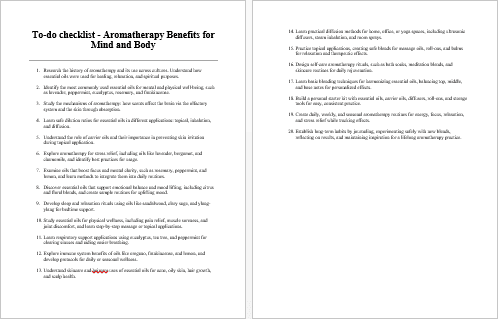
✔ Aromatherapy Benefits for Mind and Body – Checklist (398 Words)
A summary checklist ideal for quick reference, printable downloads, or bonus content.
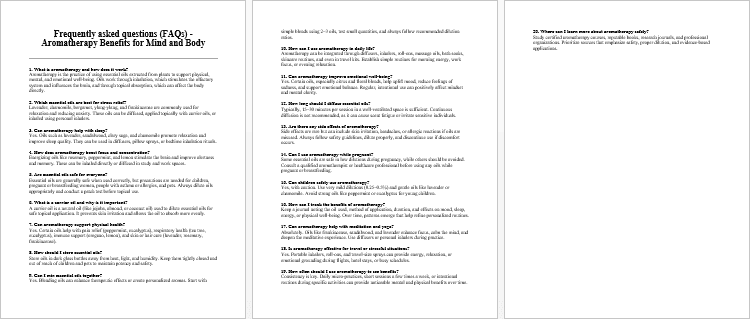
✔ Aromatherapy Benefits for Mind and Body – FAQs (742 Words)
Answers to common questions your customers will have about aromatherapy.
✔ Aromatherapy Benefits for Mind and Body – Sales Page (713 Words)
A ready-made sales page you can publish immediately—or customize to your voice.
Total Content Included: Over 31,000 Words!
All fully editable, brandable, and ready to sell.
Who Is This Course Perfect For?
✔ Wellness bloggers
✔ Aromatherapy brands & essential oil sellers
✔ Coaches & holistic practitioners
✔ Spa owners & yoga instructors
✔ Lifestyle influencers
✔ Health markets on Etsy, Gumroad, Payhip, and Shopify
✔ Anyone looking to sell high-quality digital content
The possibilities are endless.
How You Can Profit from This PLR Course
Here are powerful ideas to turn this done-for-you content into long-lasting income:
1. Sell it as a complete course
Turn it into a video course, digital download, or full online program.
2. Break it into mini-courses
Each module can be sold separately for $17–$47 each.
3. Create an aromatherapy membership program
Give one lesson, recipe, or blend formula per week.
4. Turn it into a workbook, journal, or printable kit
Perfect for Etsy, KDP, or your Shopify wellness store.
5. Add it as a bonus to essential oil products
Increase product value without additional work.
6. Use the course as lead magnet content
Pull from the lessons to grow your email list fast.
7. Offer it as a coaching program foundation
Teach aromatherapy as part of a lifestyle or holistic health coaching package.
8. Create YouTube scripts & social media posts
Repurpose content into dozens of videos and posts.
9. Sell physical books through Amazon KDP
Turn the course into a paperback or workbook.
10. Flip the course as a full website
Build a specialty aromatherapy niche site and sell it for a premium.
This PLR course gives you endless ways to profit—again and again.
PLR Rights Included (What You CAN Do)
✔ Sell the content as-is or lightly customized
✔ Rewrite and claim authorship (must change 75% to claim copyright)
✔ Break into standalone mini-guides or reports
✔ Bundle with other wellness or lifestyle content
✔ Use in memberships or coaching programs
✔ Convert into audio, video, and multimedia products
✔ Turn it into lead magnets, blog posts, or social content
✔ Create physical products
✔ Build an entire business with it
❌ PLR Restrictions (What You CANNOT Do)
✘ Cannot pass PLR or resell rights to customers
✘ Cannot offer 100% affiliate commissions
✘ Cannot give the course away fully unedited
✘ Cannot add it to existing memberships without a new purchase
✘ Cannot allow others to pass rights to third parties
This keeps the value high for all license holders.
Ready to Own a Premium Aromatherapy Course You Can Sell Today?
This is one of the most profitable, evergreen wellness niches—and now you can enter it instantly with a professional, beautifully structured, done-for-you course worth hundreds of dollars in creation time.
You get over 31,000 words of expertly written, fully editable PLR content you can rebrand and sell immediately.
No writing.
No research.
No stress.
Just publish → promote → profit.
has been added to your cart!
have been added to your cart!
Here A Sample of Aromatherapy Benefits for Mind and Body PLR Course
Module 1: Introduction to Aromatherapy
Goal: Help learners build a strong foundation about what aromatherapy is and why it matters.
Lesson 1 – What is Aromatherapy?
Goal: Discover the basics of aromatherapy, where it comes from, and how it has been used for centuries to heal, relax, and energize.
1. Setting the Stage: Why Learn About Aromatherapy?
Imagine walking into a room filled with the delicate fragrance of fresh lavender or breathing in the crisp scent of peppermint on a warm day. Instantly, your mind feels lighter, your body begins to relax, and your mood shifts. That is the essence of aromatherapy—it is the practice of using natural plant extracts and aromatic compounds to support physical, mental, and emotional well-being.
Aromatherapy is much more than “just enjoying nice smells.” It is an ancient practice rooted in holistic healing traditions that date back thousands of years. Today, it is recognized globally as a supportive wellness practice that can enhance modern lifestyles in a safe and natural way.
This first lesson lays the foundation for everything you will explore in this course. By the end of this session, you will not only understand what aromatherapy truly is, but also appreciate its deep history, its cultural significance across the world, and its growing role in supporting wellness in today’s fast-paced environment.
2. Defining Aromatherapy
Let’s begin with a clear definition.
Aromatherapy is the therapeutic use of essential oils—highly concentrated extracts from plants, flowers, herbs, and trees—used to promote balance in the mind, body, and spirit. These oils can be inhaled, diffused into the air, applied topically (with proper dilution), or incorporated into daily rituals like bathing, massage, or meditation.
Key elements of aromatherapy include:
- Natural origin: Essential oils are derived from plant parts such as flowers, leaves, bark, roots, and seeds.
- Holistic focus: Aromatherapy is not just about treating symptoms; it supports overall wellness by working on both the mind and body simultaneously.
- Sensory pathway: The primary way aromatherapy works is through the sense of smell, which is directly connected to the brain’s limbic system—the part that controls emotions, memory, and mood.
- Multiple applications: It can be used for relaxation, energy boosting, emotional balance, physical support (like easing headaches or sore muscles), and even skincare.
In short, aromatherapy is the art and science of harnessing nature’s fragrances to promote health and well-being.
3. The Historical Roots of Aromatherapy
To truly appreciate aromatherapy, it is helpful to explore its historical journey. Aromatherapy is not a modern trend—it is a continuation of traditions that have existed for thousands of years. Let’s look at how different cultures around the world embraced this healing art.
Ancient Egypt
One of the earliest records of aromatherapy practices comes from ancient Egypt. Egyptians used aromatic resins, oils, and herbs for spiritual ceremonies, embalming, and daily hygiene. Oils like frankincense and myrrh were considered sacred and were offered to the gods. Cleopatra herself was said to have used rose and jasmine oils for beauty and seduction.
Ancient China
In traditional Chinese medicine, herbs and aromatic plants were used as part of a holistic system to balance the body’s energy, or “Qi.” Texts from as early as 2700 BCE mention the use of aromatic plants in healing and meditation.
Ancient India
In Ayurveda, India’s traditional healing system, essential oils and herbal infusions were used to balance the mind, body, and spirit. Oils like sandalwood, tulsi (holy basil), and neem were highly valued for both medicinal and spiritual purposes.
Ancient Greece and Rome
Greek physicians like Hippocrates, known as the “father of medicine,” recommended aromatic baths and massages using essential oils to promote health. Later, the Romans adopted these practices, making aromatic baths, perfumes, and massages a part of daily life.
The Middle Ages in Europe
During this period, essential oils were used for their protective qualities. For example, during outbreaks of the plague, herbal mixtures containing oils like clove and rosemary were used to ward off disease.
The Modern Era
The term “aromatherapy” was coined in the early 20th century by René-Maurice Gattefossé, a French chemist who discovered the healing potential of lavender oil after accidentally burning his hand in his laboratory. His research laid the foundation for aromatherapy as a recognized practice in modern complementary medicine.
This historical journey shows that aromatherapy is deeply woven into human history. It has evolved across cultures, but its purpose has remained the same: to use the power of scent and natural plant compounds to restore balance and well-being.
4. The Science Behind Aromatherapy
Aromatherapy is both an art and a science. To understand how it works, we need to explore two key pathways:
The Olfactory System (Sense of Smell)
When you inhale an essential oil, tiny scent molecules travel through your nose and stimulate the olfactory nerve. This nerve sends signals directly to the limbic system in the brain, which controls emotions, mood, memory, and even certain physiological responses like heart rate and stress levels.
This is why:
- Lavender can calm the nervous system.
- Peppermint can awaken and energize.
- Citrus oils can uplift mood almost instantly.
Absorption Through the Skin
Essential oils can also be absorbed through the skin, especially when blended with carrier oils and applied during massage or skincare. Once absorbed, they interact with the bloodstream and tissues, offering localized benefits (such as soothing sore muscles) or systemic effects (like boosting circulation).
Together, these pathways explain why aromatherapy is effective not just emotionally, but also physically.
5. Benefits of Aromatherapy
Aromatherapy is not a cure-all, but it can be a powerful complementary practice. Here are some of its widely recognized benefits:
- Emotional well-being: Reduces stress, calms anxiety, uplifts mood.
- Physical relief: Helps with headaches, muscle tension, respiratory discomfort, and sleep issues.
- Mental clarity: Improves focus, alertness, and memory.
- Holistic health: Supports relaxation, balance, and harmony in daily life.
- Beauty and skincare: Promotes healthy skin, reduces blemishes, and enhances natural glow.
Its versatility makes it suitable for many situations—whether you want to wind down after a long day, boost productivity, or simply create a peaceful atmosphere in your home.
6. Aromatherapy in Today’s World
In the modern era, aromatherapy has become part of wellness practices worldwide. You’ll find it integrated into:
- Spa treatments: Aromatherapy massages, facials, and baths.
- Yoga and meditation practices: Using calming scents to deepen mindfulness.
- Healthcare settings: Some hospitals use lavender or chamomile oils to help patients relax before procedures.
- Daily self-care routines: Diffusing oils at home, adding them to bathwater, or creating personalized blends.
Its popularity continues to grow because people are seeking natural, holistic, and safe ways to support their health and reduce stress in a fast-paced world.
7. Addressing Misconceptions
As with any wellness practice, there are misconceptions about aromatherapy. Let’s clear a few of them up:
- “Aromatherapy is just about pleasant smells.”
No—it is rooted in the therapeutic effects of plant compounds, not just fragrance. - “It’s an alternative to medical treatment.”
Aromatherapy should be seen as complementary, not a replacement for medical advice or treatment. - “Essential oils can be used without caution.”
Essential oils are powerful; they must be diluted and used with proper knowledge to avoid skin irritation or misuse.
By understanding these points, learners can approach aromatherapy with respect and awareness.
8. The Cultural and Global Relevance of Aromatherapy
Aromatherapy is practiced around the world today, but it has different expressions in different cultures:
- In France, aromatherapy is often practiced clinically, with essential oils prescribed by healthcare professionals.
- In the United States and Europe, it is more often part of wellness and self-care routines.
- In Asia, aromatherapy is integrated with ancient systems like Ayurveda and traditional Chinese medicine.
This international relevance shows that aromatherapy is adaptable—it can be part of both ancient traditions and modern science.
9. Why Aromatherapy Matters
So, why does aromatherapy matter in the big picture of wellness?
- It connects us back to nature. In an age of synthetic chemicals, aromatherapy reminds us of the healing power of plants.
- It empowers self-care. Aromatherapy gives people practical, affordable tools to manage stress and improve daily well-being.
- It bridges ancient wisdom and modern science. Aromatherapy honors cultural traditions while also benefiting from research into essential oils’ properties.
- It promotes holistic health. It addresses the whole person—mind, body, and emotions—rather than just symptoms.
10. Summary of Lesson 1
In this first lesson, you learned that:
- Aromatherapy is the therapeutic use of essential oils to support mind and body balance.
- It has deep roots across ancient cultures—from Egypt and India to Greece and Rome.
- The science behind aromatherapy lies in its effects on the brain through scent and its ability to be absorbed through the skin.
- It provides benefits for emotional, mental, and physical well-being.
- Today, aromatherapy is practiced globally, both as part of healthcare systems and in personal wellness routines.
Aromatherapy is not just about fragrance—it is about unlocking the natural healing potential of plants and making it part of your everyday life.
Lesson 2 — How Aromatherapy Works on Mind & Body
Learn how scents interact with the brain, emotions, and physical well-being through the olfactory system and skin absorption.
Overview (short): This lesson explains the two core biological routes that make aromatherapy effective: (A) the olfactory pathway (smell → brain → emotion/behavior) and (B) dermal/transdermal absorption (skin → local/systemic action). You will receive step-by-step trainer notes, simple demos, learner activities, and practical teaching tips for international classrooms.
Important disclaimer (present to learners at the start): This lesson is educational. Aromatherapy can support well-being but is not a replacement for medical diagnosis or treatment. Encourage learners to consult qualified healthcare providers when addressing medical conditions, pregnancy, or complex health issues.
Learning objectives (what learners will be able to do)
- Describe the olfactory pathway and how scent influences emotion and physiology.
- Explain how essential oil molecules interact with skin and enter the body.
- Identify the main chemical constituents of essential oils and their typical aromatic profiles.
- Demonstrate two simple, safe aromatherapy techniques (inhalation and topical application) and explain appropriate dilutions and precautions.
Time estimate for live training: 75–90 minutes (adjustable).
Materials you’ll need: small scent vials or cotton pads, a diffuser, carrier oils (e.g., jojoba, sweet almond), measuring spoons or syringes (mL), sample essential oils, tissues, whiteboard or slides, assessment handouts.
Step-by-step lesson plan
Step 1 — Warm up: a brief sensory primer (5–8 minutes)
- Invite learners to close their eyes and smell a neutral cotton pad, then a single essential oil (e.g., a drop of lavender on a pad).
- Ask: “What memories, images, or feelings came up?” Note answers on a shared board.
- Trainer note: This quick exercise demonstrates that scent triggers emotion and memory before you explain the neuroscience.
Trainer script suggestion: “Notice how scent can create an immediate emotional response — that’s because smell connects directly to brain regions that manage emotion.”
Step 2 — The olfactory pathway: anatomy in plain language (20–25 minutes)
- Present a simple diagram: nose → olfactory epithelium → olfactory bulb → limbic system (amygdala, hippocampus) → hypothalamus. Use the diagram to walk learners through the route.
- Explain key points:
- Olfactory receptor neurons in the nose detect volatile molecules.
- Signals travel to the olfactory bulb, which relays information to the limbic system (emotion and memory centers).
- The hypothalamus connects scent to autonomic responses (heart rate, breathing, endocrine changes).
- Give practical examples: smell of citrus often feels “uplifting”; a spice may feel “energizing”; floral notes may feel “calming.” These associations are partly cultural and partly neurobiological.
- Trainer tip: Use a physical or slide diagram and label the amygdala and hippocampus to show why scent evokes memory and feeling.
Teaching point: Emphasize that the brain’s direct olfactory links explain the speed and intensity of scent responses.
Step 3 — Inhalation: volatility, onset, and methods (10–15 minutes)
- Explain volatility: essential oils are composed of small, volatile molecules (monoterpenes, sesquiterpenes, alcohols, esters). Volatile = they vaporize at room temperature, so they easily reach olfactory receptors.
- Methods & practical effects:
- Direct inhalation (in a cupped hand or tissue): rapid onset, useful for quick mood shifts.
- Diffusion: slower, sustained exposure suitable for environment/ambience.
- Steam inhalation: short, intense exposure for respiratory comfort (use caution with heat).
- Demonstration: diffuse a calming oil for 3–5 minutes; measure subjective ratings (scale 1–10) for calm before and after. Collect learner reflections.
Safety reminder: Keep inhalation concentrations moderate. Avoid intense exposure for people with respiratory conditions; always ask about asthma/allergies.
Step 4 — Skin absorption: how topical application works (20–25 minutes)
- Simple anatomy: skin layers = stratum corneum → epidermis → dermis → subcutaneous tissue. Most essential oil molecules are small (molecular mass generally < 300 g·mol⁻¹) and can penetrate the skin when properly formulated.
- Carrier oils: explain purpose — dilution, improved spreadability, reduced skin irritation. Examples: jojoba, sweet almond, fractionated coconut. Typical carrier volumes measured in mL.
- Dilution guidelines (international, conservative):
- Adults: 1–3% dilution for daily use (≈ 1–3 mL essential oil per 100 mL carrier).
- Children, elderly, pregnant people: keep to lower end, e.g., 0.5–1%.
- Short-term, localized needs (adult): up to 5% used by some practitioners for short periods.
Use “%” and mL on your demonstration cards so learners can practice calculations.
- Demonstration: make a 2% roller blend in front of the class (example: 10 mL carrier + 6 drops essential oil ≈ 1%–2% depending on drop size). Show precise measuring tools, then test on a patch of skin (optional and only with informed consent).
Trainer caution: Never apply essential oils undiluted to skin. Avoid eyes and mucous membranes.
Step 5 — From skin to system: distribution and metabolism (8–10 minutes)
- Explain how, after penetrating skin, molecules can enter local tissues and sometimes systemic circulation via capillaries. The liver metabolizes many compounds; the body then excretes metabolites via urine, breath, and sweat.
- Use the metaphor: “Topical application is like sending a message through the skin — some words stay local, some travel.”
- Teaching note: Keep explanations conceptual. Avoid clinical dosing claims. Reiterate professional boundaries: internal ingestion of essential oils is a specialty practice and should only be taught by qualified clinicians where it is legal and safe.
Step 6 — Key chemical constituents and what they ‘do’ (qualitative) (10–12 minutes)
- Teach a short list of common constituents (name + smell + typical use in aromatherapy language):
- Linalool (C₁₀H₁₈O): floral, calming — commonly found in lavender.
- Linalyl acetate: sweet-floral, often associated with relaxation.
- Limonene: citrusy, often described as uplifting/cleansing.
- Menthol: cooling, minty — associated with a menthol sensation.
- 1,8-Cineole (eucalyptol): camphoraceous, used in respiratory blends.
- Explain: constituents, not “the oil itself,” interact with receptors and tissues, which helps explain different functional effects across oils.
Trainer tip: Use molecular names sparingly; focus on scent profiles and safe language like “associated with” rather than definitive clinical claims.
Step 7 — Practical classroom activities and experiments (10–15 minutes)
- Blind smell test: present three unlabeled vials and have learners match scent to descriptors; discuss cultural differences in scent perception.
- Pre/post measurement: before a short 5-minute inhalation exercise, have learners rate stress or focus on a 1–10 scale; repeat after and discuss perceived changes. This teaches them to collect subjective data in low-tech studies.
- Topical patch test demo: show how to do a patch test: dilute to chosen % and apply a small amount on forearm; observe after 24 hours. Stress informed consent and documentation.
Step 8 — Safety, contraindications, and special populations (8–10 minutes)
- Reinforce: essential oils are concentrated plant extracts and require respect. Key safety points to teach:
- Always dilute for topical use.
- Avoid use near eyes, ears, and mucous membranes.
- Ask learners to record allergies, pregnancy status, age, and respiratory conditions before hands-on work.
- Use lower dilutions for children, elderly, and sensitive skin.
- Provide an international-friendly safety checklist card (simple symbols + short phrases) for quick field use: e.g., “Pregnancy? ✔ consult practitioner” / “Asthma? ✔ avoid strong diffusion” / “Pets? ✔ check species sensitivity.”
- Trainer note: Encourage learners to adopt a conservative approach and to consult local regulations and clinical aromatherapy guidelines when working clinically.
Step 9 — Teaching tips for international classrooms (5–8 minutes)
- Acknowledge cultural differences: certain scents carry different meanings across cultures; use local examples when possible.
- Units and signs: present dilutions in both % and mL; when discussing temperature for steam work, use °C and °F (e.g., 40–50 °C ≈ 104–122 °F) if demonstrating steam inhalation.
- Language & translation: provide both botanical and common names to avoid confusion (e.g., Lavandula angustifolia — lavender).
Step 10 — Assessment and wrap (5–10 minutes)
- Quick formative assessment: ask learners to write a 2–3 sentence explanation of “how inhalation and topical application differ in onset and duration.”
- Assign a short take-home task: design a 10-minute aromatherapy routine for either sleep or focus, list chosen oils, dilution, method, and safety checks. Provide a simple rubric: clarity (30%), safety (30%), rationale based on lesson points (40%).
- End with a summary: repeat the two core mechanisms — olfactory (fast, emotional) and dermal (local/systemic, slower) — and why both matter for practice.
Closing summary (one paragraph)
This lesson equips course creators with a clear, practical understanding of how aromatherapy works: volatile molecules engage the olfactory system to influence emotion and behavior quickly, while topical applications allow molecules to interact with local tissues and, at times, enter systemic circulation. Both routes are powerful when used safely and intentionally. With the demos, activities, and safety checklist provided, you can teach this science in an accessible, internationally relevant way that empowers learners to apply aromatherapy responsibly.
Lesson 3 — Understanding Essential Oils
A simple overview of essential oils — what they are, how they’re extracted, and why they’re the “heart” of aromatherapy.
Lesson goal: Equip international course creators with clear, evidence-informed teaching content so learners can confidently explain what essential oils are, how different extraction methods shape quality and aroma, and why careful sourcing, testing, storage, and safety matter.
Estimated time for delivery: 75–90 minutes (lecture + demos + activities).
Materials: small amber or cobalt glass sample bottles, vial of distilled water (hydrosol example), cotton pads, simple steam-distillation diagram or model, carrier oils (jojoba, sweet almond), measuring tools (mL syringe), sample GC/MS report (mock), dilution calculator sheet, safety checklist handout.
1. Warm-up: Why call them “essential”? (5–7 minutes)
Begin with a quick sensory moment. Ask learners: “What does ‘essential’ mean to you?” Then introduce the term: historically “essential” referred to the essence of a plant — its volatile aromatic compounds that give the plant its characteristic scent and, in aromatherapy, its primary functional properties. This sets a conceptual baseline: essential oils are concentrated, volatile plant extracts — small amounts carry powerful aroma and bioactivity.
Trainer note: Keep this short and conversational to orient learners before deep technical detail.
2. What are essential oils? A clear definition (8–10 minutes)
Present a concise definition:
Essential oils are volatile, hydrophobic liquid concentrates containing the aromatic compounds produced by plants. They capture the plant’s fragrance “signature” and a complex mix of chemical constituents (for example, monoterpenes, sesquiterpenes, alcohols, esters, ketones, aldehydes, and oxides). These molecules are small enough to vaporize at room temperature and interact with olfactory receptors and, when applied correctly, with skin and tissues.
Emphasize three key points:
- Concentration: They are highly concentrated — a few drops can have strong effects.
- Complexity: One oil contains dozens to hundreds of chemical constituents.
- Variability: Same species from different regions or harvests can smell and act differently (chemotypes, terroir, and harvest timing).
3. How essential oils are extracted — step-by-step methods (30–35 minutes)
Explain extraction methods in plain language, with a short practical description of how each works, typical uses, and pros/cons.
A. Steam distillation (most common)
How it works: Steam passes through plant material; steam carries volatile compounds; vapour is condensed; oil separates from the hydrosol (floral water).
Commonly used for: Herbs, woods, many flowers (where appropriate).
Pros/cons: Efficient, preserves many constituents; not ideal for extremely delicate flowers.
B. Hydro-distillation
How it works: Plant material is submerged in boiling water; volatiles vaporize with steam, then condense. Historically common and still used for some materials.
Commonly used for: Certain woody and herbaceous aromatics.
C. Cold pressing / expression
How it works: Mechanical pressing of peels or rinds to release essential oil + juice (commonly used for citrus). No heat.
Commonly used for: Citrus oils (lemon, sweet orange, bergamot, lime).
Pros/cons: Preserves fresh citrus aroma; cold-pressed citrus oils are often phototoxic unless processed to remove bergapten.
D. Solvent extraction → absolutes
How it works: A solvent extracts aromatic compounds from fragile flowers; solvent removed to create a concrete; further processing yields an absolute.
Commonly used for: Jasmine, tuberose, some florals where distillation would destroy delicate compounds.
Pros/cons: Produces fragrant absolutes but may contain trace solvent residues; absolutes are richer and used in perfumery and some aromatherapy contexts; not all absolutes are suitable for topical use without professional guidance.
E. CO₂ (supercritical) extraction
How it works: Supercritical CO₂ is used as a solvent at high pressure; it extracts aromatic compounds without high heat; when pressure is reduced CO₂ evaporates, leaving a cleaner extract.
Commonly used for: Resins, herbs, flowers; yields aromatic extracts sometimes called “CO₂ extracts.”
Pros/cons: Produces a fuller spectrum extract often more similar to fresh plant aroma; considered high-quality but requires specialized equipment.
F. Enfleurage and maceration (traditional/slow methods)
How it works: Enfleurage uses fat or oil to absorb fragrance from flowers (historical, rare today). Maceration infuses plant material into a carrier oil to create an infused oil (not an essential oil, but useful in herbal preparations).
Use: Historical perfumery, crafts, teaching labs.
Trainer tip: Use a slide or simple animation to show each method. If possible, demonstrate a small, safe steam-distillation model or show images so learners can visualize the process.
4. Why extraction method matters (5–8 minutes)
Explain that the extraction method influences: aroma profile, chemical composition, yield, price, and suitability for topical or inhalation use. For example: a cold-pressed citrus oil has a fresh, zesty aroma and contains phototoxic compounds that require special handling; a CO₂ extract may retain heavier, less volatile constituents that change its aroma and actions.
5. Chemical constituents — categories and teaching language (10–12 minutes)
Introduce common constituent families and how to explain them to learners without excessive chemistry:
- Monoterpenes (e.g., limonene) — often uplifting, volatile, found in citrus and conifers.
- Sesquiterpenes (e.g., patchoulol) — less volatile, grounding, often present in woody oils.
- Alcohols (e.g., linalool) — often calming and less irritating.
- Esters (e.g., linalyl acetate) — frequently soothing, gentle on skin.
- Phenols and ketones — can be powerful but sometimes irritant or contraindicated in specific populations.
- Oxides (e.g., 1,8-cineole/eucalyptol) — associated with respiratory effects.
Trainer note: Use safe language like “associated with” rather than clinical claims. Provide examples: Lavandula angustifolia is rich in linalool and linalyl acetate (calming); Citrus sinensis (sweet orange) is high in limonene (uplifting).
6. Quality, testing, and how to read a label (12–15 minutes)
Teach learners what to look for and how to explain it:
- Botanical name (Latin) — prevents confusion (e.g., Lavandula angustifolia vs. Lavandula × intermedia).
- Chemotype (ct.) — useful when species have different dominant constituents (e.g., thyme ct. linalool vs. ct. thymol).
- Country of origin — indicates terroir differences.
- Extraction method — steam-distilled, cold-pressed, CO₂, etc.
- Batch number and harvest date — helpful for traceability.
- GC/MS report — gas chromatography–mass spectrometry shows chemical profile; teach learners to read a simplified mock report highlighting major constituents.
- Adulteration signs: unusually low price, inconsistent scent, lack of GC/MS, filminess in the bottle, or vague labeling such as “fragrance oil.” Discuss common adulterations: diluting with carrier oils, synthetic compounds, or blending with cheaper oils.
Trainer activity: Provide a few mock labels and one mock GC/MS summary. Ask groups to identify red flags.
7. Yield, sustainability, and ethical sourcing (8–10 minutes)
Explain that essential oil yields vary hugely. Some flowers produce tiny amounts of oil and require huge quantities of plant material; others (citrus peels) are higher-yield and less costly. Discuss sustainability concerns: overharvesting, impact on ecosystems, and fair labor practices. Encourage sourcing from suppliers who provide transparency, ethical harvesting statements, or certifications when available.
Trainer note: Encourage course creators to include sourcing conversations in their curriculum to promote responsible practice.
8. Storage, shelf life, and practical handling (8–10 minutes)
Teach practical rules for longevity and safety:
- Storage: amber, cobalt or dark glass bottles with tight caps; keep upright.
- Environment: cool, dark place away from heat and sunlight — ideal 15–25 °C (59–77 °F). Some people refrigerate citrus oils to extend shelf life.
- Shelf life (approximate): citrus oils 6–12 months; light herbal oils 1–3 years; woody/resinous oils 3–7+ years. Note: these are general guidelines — always use smell and GC/MS if in doubt.
- Labeling: add an opened-on date and batch number sticker for inventory control.
Trainer tip: Demonstrate labeling an empty sample bottle with “opened on” date and storage location.
9. Safety highlights (brief, practical) (10–12 minutes)
Essential oils are powerful — include core safety teaching points:
- Dilute for topical use; never apply undiluted to skin.
- Perform a patch test for skin sensitivity (24-hour observation).
- Be aware of photosensitivity with certain cold-pressed citrus oils (avoid sunlight exposure after topical application or use bergapten-free options).
- Adapt dilutions for children, pregnant people, elderly, and those with medical conditions.
- Learn species-specific cautions (some oils are neurotoxic or hepatotoxic in high doses) — teach students to consult professional reference texts for clinical situations.
- Consider pets: teach that many essential oils can be harmful to cats and some other animals; consult veterinary guidance before using oils around pets.
Trainer note: Provide a one-page safety checklist that course creators can hand out.
10. Practical classroom activities and dilution math (10–15 minutes)
Offer hands-on learning that reinforces the theory:
Activity A — Smell & identify
Present 6–8 unlabeled single-note oils and ask learners to describe, categorize (citrus, floral, herbal, woody), and guess the botanical name.
Activity B — Dilution calculation practice (showing conversions)
Explain widely used approximation: 1 drop ≈ 0.05 mL (therefore 20 drops ≈ 1 mL). Then show examples:
- For a 10 mL roller bottle:
• 1% dilution = 0.1 mL = 2 drops.
• 2% dilution = 0.2 mL = 4 drops.
• 3% dilution = 0.3 mL = 6 drops. - For a 30 mL bottle:
• 1% = 0.3 mL ≈ 6 drops.
• 2% = 0.6 mL ≈ 12 drops.
• 3% = 0.9 mL ≈ 18 drops. - For a 100 mL bottle:
• 1% = 1.0 mL ≈ 20 drops.
• 2% = 2.0 mL ≈ 40 drops.
Have learners calculate a blend for a chosen scenario (sleep roller or focus diffuser blend) and prepare the mixture under supervision.
Trainer caution: Remind learners that drop size varies by bottle and viscosity; these numbers are practical approximations.
11. Assessment and summary (5–7 minutes)
Conclude with a short written assessment: ask learners to write one paragraph explaining why extraction method, chemical profile, and storage together determine an oil’s suitability for a given use. Provide feedback emphasizing safe, traceable, and ethical practice.
Closing summary: Essential oils are complex, concentrated plant extracts that power aromatherapy. Understanding how they are produced, what’s inside them, and how to source, store, and use them safely gives learners the practical foundation they need. For course creators, the teaching aim is to balance enthusiasm for aromatherapy’s benefits with responsible, evidence-informed practice.
Lesson 4 — Safety First
Step-by-step guide on safe usage: dilutions, carrier oils, and precautions for kids, pregnancy, and sensitive skin.
Lesson goal: Equip international course creators with a full, practical safety toolbox so learners understand how to prepare safe blends, perform patch tests, manage contraindications, and respond to adverse reactions. This lesson focuses on conservative, usable rules rather than exhaustive clinical protocols. Always encourage learners to consult qualified healthcare professionals for medical questions.
Estimated delivery time: 75–90 minutes (lecture + demonstrations + hands-on practice).
Materials: carrier oils (jojoba, sweet almond, fractionated coconut), sample essential oils, amber sample bottles, syringes or graduated droppers (mL), small roller bottles (5 mL, 10 mL), dilution calculator sheet, patch-test labels, printed client intake & consent form, first-aid reference card.
Learning objectives
By the end of this lesson, learners will be able to:
- Calculate safe dilutions in % and drops for common bottle sizes (5 mL, 10 mL, 30 mL, 100 mL).
- Choose appropriate carrier oils and understand basic properties (viscosity, comedogenicity, shelf life).
- Perform and supervise a proper patch test and interpret results.
- Apply conservative precautions for children, pregnant people, elderly and sensitive skin, and outline emergency responses to adverse reactions.
- Implement classroom/client intake, consent, and documentation practices.
Step 1 — Introduce the safety-first mindset (5 minutes)
Begin with a concise principle: essential oils are powerful, concentrated plant extracts. Safety is not a hindrance; it protects clients and builds professional credibility. Emphasize “start low, go slow” as the core mantra — begin with low concentrations, observe effects, then adjust only if needed.
Step 2 — Dilutions: clear rules and step-by-step math (20 minutes)
A. Key dilution concepts
- Percent (%) = volume of essential oil divided by total volume of final blend × 100.
- Rule-of-thumb: 20 drops ≈ 1 mL. This is practical for classroom work; remind learners drop size varies by bottle.
B. Recommended conservative dilutions (international, general)
- Adults (general daily use): 1.0% – 3.0%.
- Elderly / very sensitive adults: 0.5% – 1.0%.
- Children (age-based conservative guide):
• Infants under 3 months: avoid essential oils.
• 3 months – 2 years: 0.25% – 0.5%.
• 2 – 6 years: 0.5% – 1.0%.
• 6 – 12 years: 1.0% or lower.
• Over 12: approach adult dilutions with care. - Pregnancy: use a conservative approach — lower dilutions (≤ 0.5–1.0%) and avoid routine use in the first trimester; always consult healthcare provider.
- Short-term, localized adult use: some practitioners use up to 3–5% for limited periods, but teach caution and professional judgement.
C. Practical dilution calculations (step-by-step)
Use the 20 drops = 1 mL approximation.
Example 1 — 10 mL roller bottle
- 1% of 10 mL = 0.10 mL. Convert to drops: 0.10 mL × 20 drops/mL = 2 drops.
- 2% of 10 mL = 0.20 mL → 4 drops.
- 3% of 10 mL = 0.30 mL → 6 drops.
Example 2 — 5 mL roller
- 1% of 5 mL = 0.05 mL → 1 drop.
- 2% of 5 mL = 0.10 mL → 2 drops.
Example 3 — 30 mL massage blend
- 1% of 30 mL = 0.30 mL → 6 drops.
- 2% of 30 mL = 0.60 mL → 12 drops.
- 3% of 30 mL = 0.90 mL → 18 drops.
Example 4 — 100 mL batch (useful for very low % for children)
- 0.25% of 100 mL = 0.25 mL → 5 drops.
- 0.5% of 100 mL = 0.50 mL → 10 drops.
Using larger batches (e.g., 100 mL) makes precise small-percentage blends easier to create and portion.
Trainer tip: always show these calculations on the board and have learners practice converting % → mL → drops.
Step 3 — Carrier oils: selection and practical use (10 minutes)
A. Why carrier oils matter
Carrier oils dilute essential oils for topical use, aid absorption, and reduce irritation. They are not neutral: they have their own aromas, textures, and potential allergies.
B. Common carrier oils and teaching notes
- Jojoba oil: stable, long shelf life, non-greasy, good for sensitive skin. (Technically a liquid wax.)
- Fractionated coconut (MCT): light, non-greasy, odorless, excellent for roll-ons.
- Sweet almond oil: nourishing, slightly heavier; avoid for nut-allergic clients.
- Grapeseed oil: light, good for massage; check cold-press processing if teaching allergens.
- Olive oil: very common, heavier texture, longer chain fatty acids; not ideal for cosmetically light blends.
C. Practical selection guide
Match carrier properties to the application: light carriers for roll-ons and blends used under clothing; heavier carriers for massage or dry skin. Always check for nut allergies and label accordingly.
Step 4 — Patch test protocol (10 minutes)
A. Why a patch test?
A patch test checks for delayed contact dermatitis and sensitivity before broader application.
B. Step-by-step patch test
- Prepare a 1% dilution: e.g., 1 drop essential oil in 5 mL carrier (1 drop ≈ 0.05 mL; 0.05/5 = 0.01 = 1%).
- Clean a small area on the inner forearm.
- Apply a pea-sized amount and label the site with the date/time.
- Observe for 24 hours; if no redness, itching, blistering, or significant irritation occurs, the dilution is likely safe for that person at that concentration. If mild irritation appears, wash immediately with carrier oil, then gentle soap and water; discontinue use. If severe reaction (swelling, breathing difficulties), seek emergency care.
Trainer note: Teach learners to document the test and client consent before performing hands-on patch tests.
Step 5 — Specific precautions for special populations (15 minutes)
A. Children
- Use conservative dilutions as above; infants under 3 months should avoid essential oils.
- Avoid tight clothing over applied oils; use low concentrations and small surface area.
- Always check with a pediatrician before topical or inhalation use for infants and young children.
B. Pregnancy
- Advocate conservative practice: many teachers recommend avoiding routine topical/inhalation use in the first trimester.
- If using later in pregnancy, select oils with a benign safety profile and keep dilutions low (≤ 0.5–1.0%), with explicit consent and healthcare clearance.
- Never claim essential oils prevent or treat obstetric conditions; always refer to qualified medical care for pregnancy-related issues.
C. Elderly and medically compromised
- Start at lower dilutions (0.5–1.0%); consider thinner skin and polypharmacy.
- Ask about medication interactions (some oils may interfere with anticoagulants, sedatives, etc.). Encourage consultation with the person’s physician.
D. Sensitive skin & allergies
- Use hypoallergenic carriers (jojoba, fractionated coconut) and perform patch tests.
- Avoid high-phenol or high-ketone oils for sensitive skin unless supervised by a trained clinician.
Trainer reminder: When in doubt, consult a qualified clinical aromatherapist, pharmacist or medical professional.
Step 6 — Classroom/client safety systems and documentation (10 minutes)
A. Intake and consent form (brief items to include)
- Full name, age, phone/emergency contact.
- Pregnancy status (current or planning).
- Known allergies, skin conditions, asthma, epilepsy, cardiac conditions, medications.
- Pet ownership (important for diffusion recommendations).
- Signature confirming informed consent and that they will alert the trainer of any adverse reaction.
B. Labeling & record-keeping
Always label blends with: date prepared, dilution %, batch number, carrier oil, intended use, and “For external use only.” Keep a log of who received which blend and any observations.
Step 7 — Responding to adverse reactions (8–10 minutes)
A. Skin irritation (mild)
- Stop use immediately.
- Remove contaminated clothing.
- Wipe area with a carrier oil (e.g., olive or jojoba) to dilute/remove the essential oil.
- Wash with mild soap and water.
- Apply a cool compress if needed.
- If symptoms persist or worsen, seek medical advice.
B. Severe allergic reaction (anaphylaxis)
- Signs: throat tightness, difficulty breathing, facial swelling, dizziness.
- Action: call emergency services immediately. Administer epinephrine if available and trained to do so. Stay with the person and monitor breathing.
C. Inhalation causing respiratory distress
- Move the person to fresh air, loosen tight clothing, call emergency services if breathing difficulty continues.
D. Ingestion
- Treat ingestion as a medical emergency. Do not induce vomiting. Call local poison control or emergency services immediately and bring the oil container for identification.
Trainer caution: Have local emergency numbers handy in your classroom and a basic first-aid kit available.
Step 8 — Pet safety (brief guidance) (5 minutes)
Many essential oils can be harmful to pets, especially cats and some small mammals. Avoid diffusing strong oils in enclosed spaces with pets present. Teach learners to ask clients about pets and to advise veterinary consultation before routine diffusion or topical application in homes with animals.
Step 9 — Practical teaching activities (10–12 minutes)
- Dilution workshop: learners calculate and prepare 5 different blends (5 mL and 10 mL) using the dilution math learned. Instructor checks math and labels.
- Patch-test role-play: learners perform patch tests on each other (with consent), record observations, and complete intake forms.
- Case study: present a client profile (e.g., 28-year-old pregnant person in 2nd trimester who has asthma) and have learners design a conservative aromatherapy plan and safety checklist.
Step 10 — Assessment and wrap-up (5 minutes)
Assign a short take-home: design a written safety protocol for a one-hour community aromatherapy workshop that includes intake form, emergency contacts, dilution table, and three classroom rules. Evaluate on completeness (40%), safety accuracy (40%), and clarity (20%).
One-sentence summary: Prioritizing safety — through conservative dilutions, correct carrier selection, rigorous patch testing, thorough intake/consent procedures, and clear emergency plans — allows aromatherapy to be practiced responsibly and confidently across international settings.
We’re also giving these extra bonuses
Aromatherapy Benefits for Mind and Body – Checklist
Aromatherapy Benefits for Mind and Body – FAQs
Aromatherapy Benefits for Mind and Body – Salespage Content
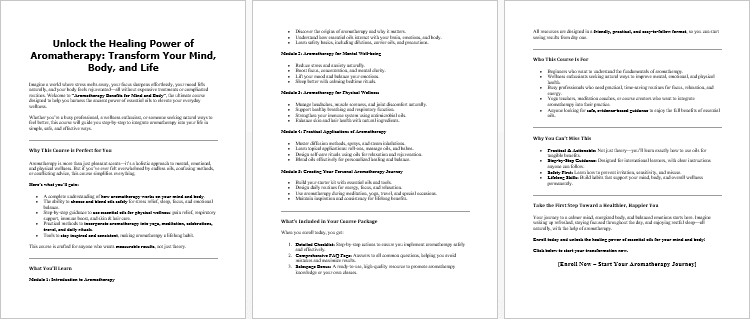
Package Details:
Word Count: 31 030 Words
Number of Pages: 132
Aromatherapy Benefits for Mind and Body – Bonus Content
Checklist
Word Count: 398 words
FAQs
Word Count: 742 words
Salespage Content
Word Count: 713 words
Total Word Count: 32 883 Words
Your PLR License Terms
PERMISSIONS: What Can You Do With These Materials?
Sell the content basically as it is (with some minor tweaks to make it “yours”).
If you are going to claim copyright to anything created with this content, then you must substantially change at 75% of the content to distinguish yourself from other licensees.
Break up the content into small portions to sell as individual reports for $10-$20 each.
Bundle the content with other existing content to create larger products for $47-$97 each.
Setup your own membership site with the content and generate monthly residual payments!
Take the content and convert it into a multiple-week “eclass” that you charge $297-$497 to access!
Use the content to create a “physical” product that you sell for premium prices!
Convert it to audios, videos, membership site content and more.
Excerpt and / or edit portions of the content to give away for free as blog posts, reports, etc. to use as lead magnets, incentives and more!
Create your own original product from it, set it up at a site and “flip” the site for megabucks!
RESTRICTIONS: What Can’t You Do With These Materials?
To protect the value of these products, you may not pass on the rights to your customers. This means that your customers may not have PLR rights or reprint / resell rights passed on to them.
You may not pass on any kind of licensing (PLR, reprint / resell, etc.) to ANY offer created from ANY PORTION OF this content that would allow additional people to sell or give away any portion of the content contained in this package.
You may not offer 100% commission to affiliates selling your version / copy of this product. The maximum affiliate commission you may pay out for offers created that include parts of this content is 75%.
You are not permitted to give the complete materials away in their current state for free – they must be sold. They must be excerpted and / or edited to be given away, unless otherwise noted. Example: You ARE permitted to excerpt portions of content for blog posts, lead magnets, etc.
You may not add this content to any part of an existing customer order that would not require them to make an additional purchase. (IE You cannot add it to a package, membership site, etc. that customers have ALREADY paid for.)
Share Now!
Latest Products



Free Sales Funnel Builder

Related Products

Popular & Trending

Featured Products